

Copper mining · Mine comparison
Copper Ore Grades by Mine: 10 Major Mines Compared
Large copper mines reported ore grades from 0.30% (Cerro Verde mill) to 3.14% (Kamoa-Kakula) in 2025. This page compares ten mines on one table, charts how grades moved from 2024, and adds a calculator for yield and break-even grade.
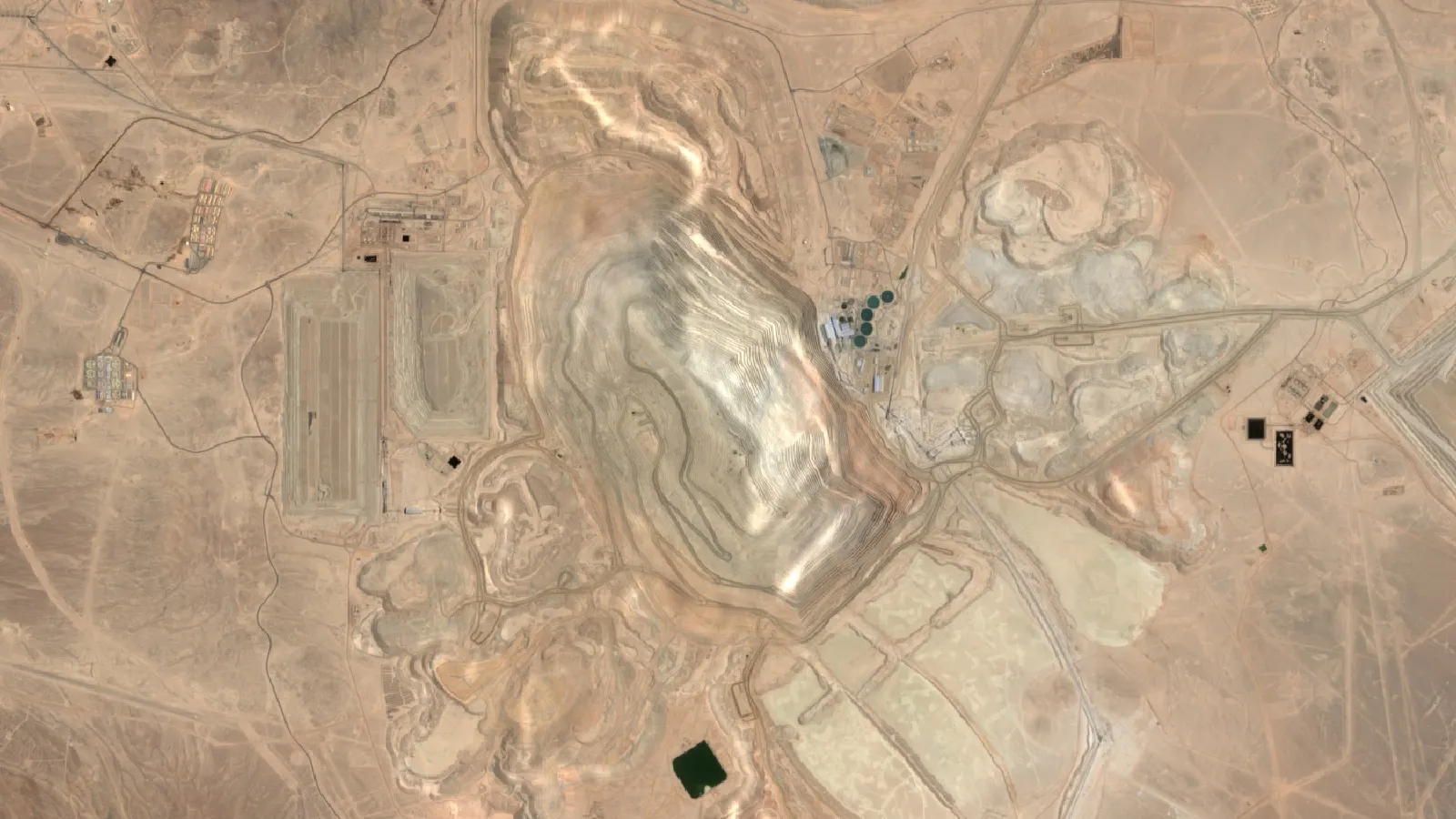
Key takeaways
- Kamoa-Kakula in the DRC fed its mills at 3.14% copper in 2025, the highest of the ten large mines compared, though its grade fell from 4.10% in the first quarter to 2.35% in the fourth (Ivanhoe Mines, 2026).
- Open pits run at a fraction of a percent: Bingham Canyon 0.40% and Pinto Valley 0.31% in 2025 (Rio Tinto and Capstone Copper reports).
- Oyu Tolgoi shows both worlds: 0.50% open pit and 2.14% underground ore, a blended 0.97% in 2025 (Rio Tinto, 2026).
- Grades swing with the mine plan: of nine mines with two comparable years, five fell and four rose between 2024 and 2025.
- Codelco’s reserves average 0.62% copper across 6,809 million tonnes at 31 December 2025 (Codelco).
In this article
- Copper ore grades by mine: ten large operations compared
- How to read a copper ore grade
- Open pit versus underground: why one mine shows two grades
- Are copper ore grades falling? What recent company reports show
- Reserve grades: what Codelco reports by division
- Largest copper producers by country and by company
- Check your own numbers: yield, value and break-even grade
- What grade means for a mine's cost and footprint
- What satellites can and cannot say about grade
- Frequently asked questions
Large copper mines run on ore that holds between about 0.3% and 3.1% copper. In 2025 the Kamoa-Kakula mills in the Democratic Republic of the Congo (DRC) were fed ore averaging 3.14% copper. At the other end, the Bingham Canyon pit in Utah averaged 0.40% and Pinto Valley in Arizona 0.31% (company reports, 2025). The table below puts ten mines side by side with the grade each company reported, the period it covers and the copper it produced.
A grade is the share of the rock that is copper. At 0.5% copper, one tonne of ore holds 5 kilograms of metal. Every figure here comes from a company filing or from the US Geological Survey (USGS) Mineral Commodity Summaries 2026, and each row says which year it covers. Bases differ between mines, so read the notes before comparing two rows.
Copper ore grades by mine: ten large operations compared
| Mine (country) | Operator or main owner | Reported grade | Period and basis | Copper output |
|---|---|---|---|---|
| Kamoa-Kakula (DRC) | Ivanhoe Mines and Zijin Mining, 39.6% each | 3.14% | 2025, mill feed, all concentrators | 388,841 t |
| Grasberg district (Indonesia) | Freeport-McMoRan, 48.76% (PT Freeport Indonesia) | 1.10% (plus 0.77 g/t gold) | 2025, ore milled | 1,015 million lb (about 460,000 t) recoverable, 100% basis |
| Oyu Tolgoi (Mongolia) | Rio Tinto, 66% | 0.97% (open pit 0.50%, underground 2.14%) | 2025, mill head grade | 345,200 t in concentrate |
| Escondida (Chile) | BHP, 57.5% | 1.02% | Year to 30 June 2025, concentrator feed | 1,304.9 kt, 100% basis, all products |
| Antamina (Peru) | BHP 33.75% and partners | 0.82% | Year to 30 June 2025, head grade | 119 kt, BHP share |
| Spence (Chile) | BHP | 0.64% | Year to 30 June 2025, concentrator | 267.6 kt, concentrate and cathode |
| Bingham Canyon (Utah, USA) | Rio Tinto (Kennecott) | 0.40% | 2025, ore treated | 125,100 t in concentrate |
| Cerro Verde (Peru) | Freeport-McMoRan and partners | 0.30% mill | 2025, South America operations | 801 million lb (about 363,000 t) from the mill |
| Pinto Valley (Arizona, USA) | Capstone Copper, 100% | 0.31% | 2025, mill feed | 42,382 t, including cathode |
| Mantos Blancos (Chile) | Capstone Copper, 100% | 0.93% sulphide feed | 2025 | 61,919 t, concentrate and cathode |
Chart
Reported copper grade of ore milled, 2025
% Cu; eight of the ten mines in the table; mill feed or head grade as each company reports it (BHP mines: year to June 2025)
Sources for the table: Ivanhoe Mines 2025 results (Kamoa-Kakula), Freeport-McMoRan fourth-quarter 2025 release (Grasberg and Cerro Verde), Rio Tinto fourth-quarter 2025 production release (Oyu Tolgoi and Bingham Canyon), BHP operational review for the year to 30 June 2025 (Escondida, Antamina, Spence) and Capstone Copper fourth-quarter 2025 results (Pinto Valley and Mantos Blancos).
Four notes on the table. First, Freeport reports Grasberg together with the Deep Mill Level Zone and Big Gossan underground mines. The Grasberg Block Cave stopped after a mud rush in September 2025, and Freeport said in January 2026 that a phased restart was expected from the second quarter of 2026. Second, Kamoa-Kakula’s grade fell through 2025, from 4.10% in the first quarter to 2.35% in the fourth, and Ivanhoe’s own table rounds the full-year figure to 3.15%. Third, Escondida and Antamina are BHP joint ventures, so BHP quotes the full mine for Escondida and BHP’s share for Antamina. Fourth, Cerro Verde is shown by its mill grade. Freeport reports a leach grade only for its South America group, which includes El Abra in Chile.
How to read a copper ore grade
The word “grade” hides several different numbers, and a mine can show three or four of them in the same year.
- Head grade or mill feed grade: the average copper content of the ore that actually enters the mill in a period. This is the figure used in the table.
- Leach grade: oxide ore is often stacked on pads and dissolved with acid. It is reported separately and is usually lower. Freeport’s US leach ore averaged 0.21% in 2025, against 0.31% for its US mill ore.
- Reserve grade: the average grade of the ore that a company has shown can be mined at a profit under stated prices and costs. It is a forecast, not a measurement.
- Resource grade: the average grade of mineralised rock with reasonable prospects of being mined someday. It is usually lower than the reserve grade because it includes marginal rock.
- Cut-off grade: the lowest grade a mine treats as ore. Rock below it goes to the waste dump. The cut-off moves with the copper price, the cost of mining and processing, and the expected recovery.
Recovery matters as much as grade. Pinto Valley recovered 86.2% of the copper in its 2025 mill feed (Capstone Copper, 2026). At a 0.31% grade, that means the plant needs about 374 tonnes of ore to produce one tonne of copper. Kamoa-Kakula, at 3.14%, needs roughly 32 tonnes of ore for the same tonne before recovery losses. That tenfold gap in rock handled is why grade shows up in almost every cost and energy comparison between mines.
Open pit versus underground: why one mine shows two grades
Oyu Tolgoi shows the effect clearly. In 2025 its open pit fed the mill at 0.50% copper, while the underground block-cave ore averaged 2.14%. As the underground mine ramped up, the blended mill grade rose from 0.64% in 2024 to 0.97% in 2025, and copper in concentrate rose from 215,000 to 345,200 tonnes (Rio Tinto, 2026).
Underground mines can only pay for shafts, tunnels and conveyors if the rock is richer, so they tend to run at higher grades. Open pits can move huge tonnages cheaply, so they can work ore at a fraction of a percent. The two are not rivals. Many large districts, including Oyu Tolgoi and the Grasberg district, use both. For the geology behind these deposit types, see our guides to copper deposit types and where they occur and to porphyry copper deposits, the style that supplies most of the open-pit tonnage in the table.
Are copper ore grades falling? What recent company reports show
Over decades, mined grades have trended down as the richest ground is used first. A peer-reviewed model by Northey and co-authors (Resources, Conservation and Recycling, 2014) estimated future grade decline from a global resource database. They suggested the future rate of decline may be lower than in the past, because mined grades are approaching the average grade of the remaining resource.
Chart
Mill grade, 2024 versus 2025
% Cu; nine mines with two comparable years; BHP years run July to June
Year to year, the picture is mixed, because grade follows the mine plan, not a straight line. Among the nine mines with two comparable years of data, five fell and four rose:
- Escondida’s concentrator grade rose from 0.88% to 1.02% in the year to June 2025, then BHP reported 0.94% for the July to September 2025 quarter. It guided to about 0.85% for the year to June 2026 (BHP, 2025).
- Grasberg fell from 1.27% to 1.10%. Block Cave ore stopped after the September 2025 mud rush, and the fourth-quarter grade was 0.68%.
- Cerro Verde’s mill grade slipped from 0.33% to 0.30%, and Pinto Valley’s from 0.34% to 0.31%, which Capstone tied to the mine sequence.
- Mantos Blancos rose from 0.81% to 0.93%, Bingham Canyon from 0.37% to 0.40%, and Oyu Tolgoi from 0.64% to 0.97% as underground ore ramped up.
Companies also point to grade when they miss targets. Glencore said its 2025 own-sourced copper output of 851,600 tonnes was 11% below 2024, mainly because of lower head grades and recoveries from mine sequencing (Glencore full-year 2025 production report). In January 2026 Chile’s copper commission, Cochilco, put its forecast peak for Chilean output at 6.06 million tonnes in 2033, later than the 2027 peak in its earlier outlook. Reuters linked the revision to falling ore grades and changes to mining plans.
Reserve grades: what Codelco reports by division
Codelco, the Chilean state producer, publishes reserve and resource grades for each division. As of 31 December 2025 it reported 6,809 million tonnes of reserves at 0.62% copper, excluding its stakes in El Abra, Anglo American Sur and Quebrada Blanca, holding 41.9 million tonnes of contained copper. Its wider resource base was 24,396 million tonnes at 0.59% (Codelco at a glance, December 2025). The chart shows reserve grades by division in kilograms of copper per tonne of ore, which is the percentage multiplied by ten.
Chart
Codelco reserve grade by division
kg of copper per tonne of ore (the % grade times ten); reserves at 31 December 2025
Andina and El Teniente carry the richest reserves, at 0.84% and 0.77%. Radomiro Tomic, a large oxide and sulphide pit, sits at 0.48%, and Gabriela Mistral at 0.36%. Reserve grades are estimates, not measurements, and the sheet does not state the price assumptions, so they should not be mixed with the mill grades in the first table.
Largest copper producers by country and by company
Mine output is concentrated. The USGS estimates world mine production at 23 million tonnes in 2025, led by Chile with 5.3 million tonnes, the DRC with 3.2 million, Peru with 2.7 million, China with 1.8 million and Russia with 1.3 million. The United States produced about 1.0 million tonnes. USGS lists world reserves at 980 million tonnes (USGS, 2026). Dividing reserves by 2025 output gives roughly 43 years, a simple ratio and not a forecast, because reserves and prices keep changing.
By company, the latest full-year figures are below. They do not measure the same thing, so do not rank them to the last digit.
| Company | Copper output | Period and basis |
|---|---|---|
| BHP | 2,017 kt | Year to 30 June 2025, operated and non-operated assets |
| Freeport-McMoRan | 3.4 billion lb (about 1.54 million t) | 2025, consolidated production |
| Codelco | 1,440 kt | 2025, includes its stakes in El Abra, Anglo American Sur and Quebrada Blanca |
| Rio Tinto | 883 kt | 2025, Escondida at equity share, others consolidated |
| Glencore | 851.6 kt | 2025, own-sourced |
| Ivanhoe Mines (Kamoa-Kakula) | 388,841 t | 2025, 100% of the complex |
| Capstone Copper | 224,764 t | 2025, consolidated |
Freeport’s tonnage conversion uses 1 pound = 0.45359 kg. Sources: BHP, Freeport-McMoRan, Codelco, Rio Tinto, Glencore, Ivanhoe and Capstone releases linked above.
Check your own numbers: yield, value and break-even grade
The calculator below turns a grade into tonnes of copper and a rough value, then shows the lowest grade at which the metal pays for moving and treating the rock. It is a screening tool. It leaves out smelter charges, freight, royalties, sustaining capital and tax, so a real project needs a full model.
Calculator
How much copper does your ore yield, and what is the break-even grade?
Enter your own ore tonnage, grade, recovery, price and cost.
- Gross metal value (US$): $37,478,540
- Mining and processing cost (US$): $15,000,000
- Value less that cost (US$): $22,478,540
- Break-even grade at these inputs: 0.20 % Cu
Example values only, not benchmarks. Copper price is an input in US$ per pound (example, use today’s price). Cost is an example in US$ per tonne of ore for mining and processing. Uses 2,204.62 pounds per tonne. Smelter charges, freight, royalties, capital and tax are not included.
What grade means for a mine’s cost and footprint
Lower grade means more rock for every tonne of copper. A mine that processes about 37 million tonnes of 0.40% ore, as Bingham Canyon did in 2025, handles about 250 tonnes of ore per tonne of metal before recovery losses. That rock must be drilled, blasted, hauled, crushed and ground, and the waste left behind must be stored. Companies respond with bigger equipment, ore sorting, leaching of old stockpiles and mill upgrades. Capstone, for example, completed new haul trucks at Pinto Valley in 2025. Pinto Valley is a 100%-owned Capstone Copper mine, and our write-up of the Pinto Valley mine covers the operation in more detail. Older versions of this page named a different company as its operator. We found no filing supporting that and removed it, along with unsourced company grade and output ranges.
High grade helps, but it does not remove risk. Ivanhoe reported that Kamoa-Kakula’s fourth-quarter 2025 costs rose partly because the plants processed low-grade surface stockpiles and lower-grade run-of-mine ore while Stage Two dewatering of the Kakula underground mine was completed (Ivanhoe Mines, 2026). Grade, water, ground conditions and permits all decide the cash flow.
▶ Explains the seven environmental impacts of mining, which scale with the ground a mine must move for a given grade. · 2:31
What satellites can and cannot say about grade
Satellite images cannot measure the copper percentage under the ground. Grade comes from drill core, assays and a formal resource estimate prepared by a qualified person. What satellite and airborne data can do is map surface clues: alteration minerals such as iron oxides and clays, faults and rock types. That helps explorers rank where to send geologists, as explained in our guide to remote sensing in copper prospecting. Farmonaut provides satellite mineral screening, and its results are exploration targets that sit ahead of a resource estimate, not a replacement for one.
▶ Explains the six families of remote sensing instruments and why agreement between them matters. · 2:01
Related reading on this site: Gold and Copper Concentrate: Grades, Payables, Charges.
We cover a connected topic in Copper Mining Case Studies: 5 Major Mines Compared.
Frequently asked questions
What is a good copper ore grade?
There is no single answer, because the size of the mine and the processing route matter. Large open pits such as Bingham Canyon (0.40%) and Pinto Valley (0.31%) were profitable at scale in 2025. Underground mines need more, and Kamoa-Kakula averaged 3.14% (company reports, 2025).
What is the average copper ore grade in the world?
No official global average is published in the sources we checked. The ten mines above range from 0.30% to 3.14%, and Codelco’s total reserves average 0.62% (Codelco, December 2025). Any single world figure depends heavily on which mines and which year are included.
What is considered high-grade copper ore?
Among large producers, ore above about 2% is high-grade. Kamoa-Kakula’s mill feed (3.14%) and Oyu Tolgoi’s underground ore (2.14%) are examples from 2025 reports. Small vein deposits can be far richer, but they produce much less metal.
What is low-grade copper ore?
Ore below about 0.5% is usually called low-grade. It supports the biggest open pits in the Americas, including Pinto Valley (0.31%), Cerro Verde (0.30% mill) and Bingham Canyon (0.40%). It only pays when the pit is large, the equipment is efficient and recovery is high.
Which large copper mine has the highest ore grade?
Of the ten mines compared above, Kamoa-Kakula in the DRC had the highest reported grade in 2025, at 3.14%. Other mines not covered here may report higher or lower figures.
What is cut-off grade?
The cut-off grade is the lowest copper content at which a mine treats rock as ore instead of waste. It rises when costs rise and falls when the copper price rises. Ivanhoe, for instance, states its Western Forelands discovery cost at a 1% cut-off grade (Ivanhoe Mines, 2026).
How many tonnes of ore does it take to make one tonne of copper?
Divide 100 by the grade in percent, then adjust for recovery. At 0.5% grade and 85% recovery, about 235 tonnes of ore are needed. At 3% grade and the same recovery, about 39 tonnes. Use the calculator above for your own values.
Are copper ore grades falling?
Over the long term, researchers expect mined grades to decline, though possibly more slowly than in the past (Northey and others, 2014). In 2025 reports, five of nine mines with comparable data showed lower grade than in 2024, and four showed higher.
Who are the largest copper mining companies?
By reported 2025 output, Freeport-McMoRan (about 1.54 million tonnes), BHP (2.0 million tonnes in the year to June 2025) and Codelco (1.44 million tonnes including stakes) are among the largest. Reporting bases differ, so check each company’s definition.
Which countries mine the most copper?
According to USGS, Chile mined 5.3 million tonnes in 2025 (estimate), the DRC 3.2 million, Peru 2.7 million, China 1.8 million and Russia 1.3 million, out of about 23 million tonnes worldwide.
Can satellite data show the copper grade of a deposit?
No. Satellite data can map surface alteration and structure to help rank exploration targets. Grade must be confirmed by drilling, sampling and laboratory assays.
This page is for information only. It is not investment advice.
Farmonaut mining
Map your client's licence area from space
Farmonaut screens large licence areas with satellite data to rank exploration targets before field work. Results are targets, not a resource estimate.
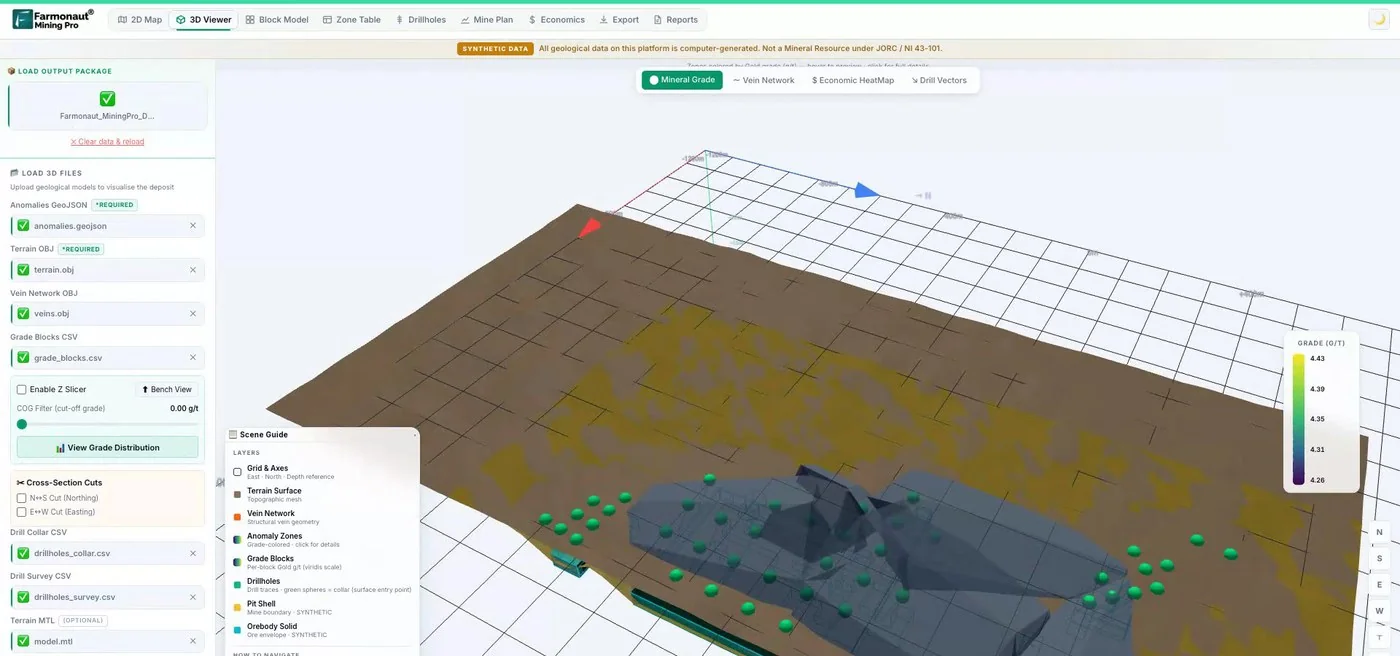
Mining Pro sample view, synthetic data
Keep reading
Sources
- USGS, Mineral Commodity Summaries 2026: Copper (February 2026): pubs.usgs.gov
- BHP, Operational review for the year ended 30 June 2025 (Form 6-K): sec.gov
- BHP, Operational review for the quarter ended 30 September 2025 (Form 6-K): sec.gov
- Rio Tinto, Fourth quarter 2025 operations review (Form 6-K): sec.gov
- Freeport-McMoRan, Fourth-quarter and year 2025 results (Form 8-K exhibit 99.1): sec.gov
- Ivanhoe Mines, Fourth-quarter and annual 2025 financial results: ivanhoemines.com
- Codelco, Codelco at a glance, 31 December 2025: codelco.com
- Capstone Copper, Fourth quarter 2025 results (ASX release, 3 March 2026): announcements.asx.com.au
- Glencore, Full year 2025 production report: glencore.com
- Northey and others, Modelling future copper ore grade decline (Resources, Conservation and Recycling, 2014): ideas.repec.org
- Reuters via Kitco, Chile delays copper output peak, cuts short-term forecasts (19 January 2026): kitco.com
Discussion
Questions, corrections or field experience? Share them below. First-time comments are reviewed before they appear, and your email is never published.
No comments yet. Be the first to add a question or your experience.

 Riverside Resources Limited
 Congo Mining Solutions
 Mining SARL
 SenGold Invest SAS
 Sania Corporation
 Sean Mining Limited
 NTS Group (Pty) Ltd
 Mine4Africa
 Lithspo Minerals Limited
 Tintina Mining Group
 Dalgety Minerals Pty Ltd
 Vortex Minerals Pty Ltd
 Faith At Work (Pty) Ltd
 Geotech Mining Solutions plc
 Vulcan International Limited
 Kidepo Associates
 GKY Mining
 Alkimy SARL
 Double A Trading
 Licence holder · Nigeria · Gold + lithium










