

Satellite Crop Advisory in Manipur: A 17-Month Story
A satellite crop advisory case study from a 1.6-acre smallholding in Manipur, India — where one grower has stayed with JEEVN AI for 17 months and, this season, brought a fresh crop cycle under satellite watch.
Most satellite crop advisory case studies are about a single, dramatic season — a pest outbreak caught early, a drought survived. This one is different. It is about what happens after the drama: a smallholder in Manipur, India, who signed up for JEEVN AI seventeen months ago and simply kept using it, season after season, field after field. This case study follows the most recent chapter — a small, 1.6-acre plot that moved from an early rhizome crop into a winter mustard cycle, tracked across six satellite visits between late August and mid-September 2026 — and reverse-engineers exactly what the advisory told this grower, and why.
A Small Field in Manipur, Watched Through a Change of Crop
The grower behind this case study farms a single field of about 1.6 acres (0.66 hectares) in Manipur, in India’s Northeast. They joined Farmonaut’s JEEVN AI satellite crop advisory in April 2025 — seventeen months before this case study was written — and have stayed a subscriber since, on the platform’s Starter plan. That kind of tenure is unusual to highlight in a case study, because it isn’t a single before/after moment. It’s a track record: a grower who, season after season, keeps coming back to the same tool for the next crop cycle on the same small piece of land.
This case study is grounded in the most recent slice of that relationship: six weekly JEEVN AI satellite advisories generated for this field between 25 August and 14 September 2026. What makes this window particularly useful is that it isn’t a single, static crop story — the field’s own record shows a genuine transition mid-cycle, and the advisory adapted to it automatically, which is exactly the kind of continuity a long-tenure smallholder needs.
The earliest two advisories in this window (25 and 30 August) tracked the field under an early-season rhizome crop — first read as ginger, refined to turmeric days later as more canopy signal came in. By the third visit on 1 September, the same field had moved into a freshly sown mustard cycle, and every advisory since has tracked mustard specifically — its own pest list, its own nutrient targets, its own irrigation windows. The grower did not have to tell the system what changed; the satellite record did.
That crop transition matters for another reason. When this grower submitted feedback on 28 August 2026 — the same day their first advisory for this field arrived — they answered Yes to all three of JEEVN AI’s “did this help?” questions (irrigation, fertilizer, pest), rated fertilizer optimisation at Above 70% and irrigation optimisation at Upto 20%, and left one more note: a question about how to get satellite data on more than one crop on the same farm. That is not a complaint about the tool. Read against the six-visit record, it reads as exactly what it is — a grower who already trusts JEEVN AI enough on one field to ask how to extend the same visibility further. We come back to what that means for this account’s future later in this case study.
What the Satellite Saw: Six Visits, One Small Field
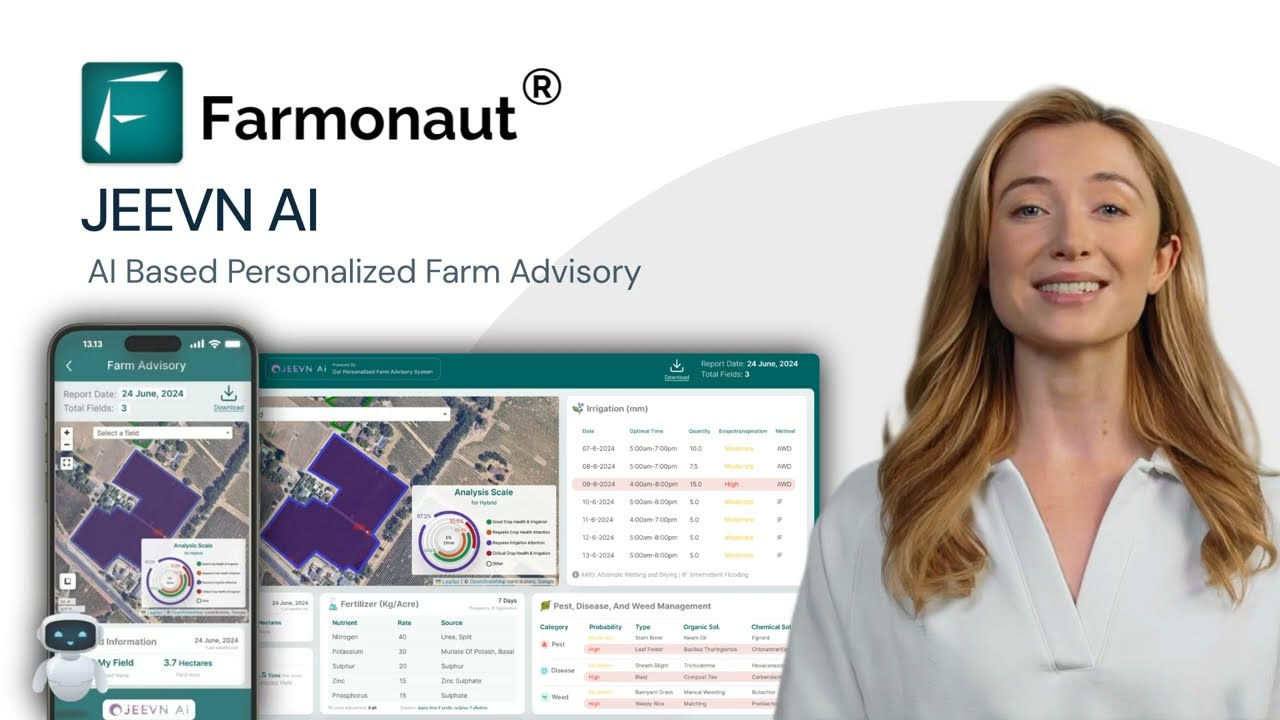
JEEVN AI’s satellite crop advisory does not need a farmer to log a single data point. Every visit, Sentinel-2 optical imagery over the field’s exact boundary is processed into a fresh read of canopy vigor, moisture status and growth stage, then combined with weather forecasts and a soil-nutrient model to produce an advisory covering five areas: irrigation timing, fertilizer dosing, pest and disease risk, weed pressure, and an expected-yield estimate. For a smallholder on a 1.6-acre field, that is the same analytical stack a much larger commercial farm would use — scaled down to a plot most agronomy services would consider too small to visit in person.
Across the six visits analysed for this case study, the underlying satellite record shows a field that:
- ✔ Was sown around 30 June 2026 with an early rhizome crop, tracked through two advisories before the season turned over.
- ✔ Was re-sown to mustard (Brassica juncea) around 28 August 2026 — Manipur’s typical window for the winter oilseed crop — and tracked through four more advisories to date.
- ✔ Carried a soil profile of pH 6.2 (medium) and soil organic carbon 0.2% (low), with low salinity — a common hill-agriculture starting point that shapes every nutrient recommendation below.
- 📊 Produced an expected mustard yield of 535 kg/acre, inside a local range of 350–550 kg/acre, with harvest projected around December 2026.
- ⚠ Never once needed a farm visit, a soil-testing kit delivery, or a field agronomist’s drive out to Manipur to produce any of the above.
How the read is built
Every one of the six advisories in this window was generated from optical satellite data — Sentinel-2 imagery over this exact field boundary — rather than a radar-only pass, which matters for a crop like mustard where canopy colour and density are strong signals of both growth stage and stress. Irrigation timing is derived using FAO-56 Penman-Monteith and Hargreaves ET0 methodology, the same reference-evapotranspiration standard used in ICAR’s own water-management guidance, so the “irrigate or skip” call is grounded in an internationally recognised method rather than a proprietary black box. The fertilizer panel works the other way around the same idea: it starts from a soil-nutrient reading in parts per million (ppm) for each of five nutrients, compares that reading against an ideal range for the crop’s current growth stage, and only prints an application rate when the gap between the two calls for one.
Skipping the Irrigation Guesswork
The grower’s own estimate for irrigation optimisation was modest: Upto 20%. When we line that estimate up against what the six advisories actually recommended, it looks like a conservative read of a system doing considerably more.
Each JEEVN AI advisory issues a rolling seven-day irrigation forecast — a day-by-day call on whether to irrigate, how much, and by which method (flood, drip or sprinkler), driven by rainfall probability and evapotranspiration rather than a fixed calendar. Pulled together, the six advisories for this field cover 42 day-level irrigation calls. In 26 of those 42 forecast-days — about 62% — the recommended irrigation quantity was zero. Looking only at the four advisories issued after the field’s mustard cycle began, the zero-irrigation share rises slightly, to 64%, nearly two days in three.
A flat watering calendar — irrigate every third day regardless of conditions — is the default most smallholders fall back to without a soil-moisture sensor on site. JEEVN AI’s satellite-and-forecast read replaces that flat calendar with a day-specific call: apply 2.0–4.2 mm on days when evapotranspiration is running ahead of rainfall, skip entirely when it isn’t. On this field, that pattern held through both the rhizome-crop weeks and the mustard weeks that followed.
None of this means the grower’s own “Upto 20%” figure is wrong — self-reported estimates like this one are deliberately conservative, and JEEVN AI presents them as exactly that: the grower’s own read, not a metered number. What the mechanism shows is that the ceiling on what satellite-driven irrigation timing could save on a field like this is considerably higher than 20% of watering events — which makes the grower’s own modest number entirely credible, if anything an under-statement of what the tool delivered.
Building Soil, Not Just Applying Fertiliser
Fertilizer is where this grower’s self-reported number is boldest: Above 70% optimised. It is also the claim with the clearest mechanism behind it once the field’s own nutrient data is lined up against a standard blanket dose.
Every JEEVN AI advisory carries a soil-nutrient panel for nitrogen (N), phosphorus (P), potassium (K), sulphur (S) and zinc (Zn), each compared against an ideal range for the crop, with an application rate that only appears when the soil test says the field actually needs it. For the four advisories issued since this field’s mustard crop was sown, here is exactly what that panel recommended, set next to the flat, one-size-fits-all rate that a standard irrigated-mustard package of practice (ICAR-Directorate of Rapeseed-Mustard Research guidance, the same reference cited inside this field’s own advisory) would apply regardless of what the soil already held:
| Nutrient | 1 Sep | 4 Sep | 9 Sep | 14 Sep | 4-visit average | Standard blanket dose | Difference |
|---|---|---|---|---|---|---|---|
| Nitrogen (N) | 23.3 kg/ha | 13.4 kg/ha | 13.4 kg/ha | 13.4 kg/ha | 15.8 kg/ha | 80 kg/ha | 80% lower |
| Phosphorus (P) | 0 kg/ha | 0 kg/ha | 0 kg/ha | 49.4 kg/ha | 12.4 kg/ha | 40 kg/ha | 69% lower |
| Potassium (K) | 49.9 kg/ha | 19.6 kg/ha | 27.2 kg/ha | 19.6 kg/ha | 29.1 kg/ha | 40 kg/ha | 27% lower |
| Sulphur (S) | 47.2 kg/ha | 8.9 kg/ha | 14.3 kg/ha | 34.7 kg/ha | 26.3 kg/ha | 40 kg/ha | 34% lower |
JEEVN AI per-visit application-rate recommendations for this field’s mustard cycle vs. a standard irrigated-mustard blanket dose of 80:40:40 kg/ha N:P:K plus 40 kg/ha sulphur. Zinc is tracked in the advisory but omitted here due to differing carrier-compound units.
The standout row is phosphorus. In three of the four mustard advisories, the recommended phosphorus application was zero — the soil test showed the field’s phosphorus already sitting inside the ideal range (around 26 ppm against a 15–30 ppm target), so the advisory told the grower to apply nothing rather than default to a routine top-up. It was only on the fourth visit, as the crop had drawn phosphorus down through three weeks of growth, that the recommendation jumped to 49.4 kg/ha — a correction delivered right when the soil test showed it was actually due, not on a fixed calendar.
Taken together, nitrogen and phosphorus — the two nutrients that make up most of a mustard fertilizer bill — averaged 76% below the standard blanket dose across these four visits. That is squarely consistent with, even if not an exact match for, the grower’s own “Above 70%” estimate of how much fertilizer this advisory helped them optimise.
Manipur’s hill-agriculture soils on this field tested at pH 6.2 and just 0.2% soil organic carbon — a starting point that rewards precision more than volume. Recommending zero phosphorus when the soil already has enough isn’t just a cost saving; it avoids over-application that a low-organic-matter soil is less able to buffer. The advisory’s job here wasn’t to push more inputs — it was to tell the grower, nutrient by nutrient, exactly when to hold back.
Catching Pests Before They Spread — and Recognising the Crop
The pest-and-disease panel is the clearest proof that JEEVN AI was reading this specific field, not issuing a generic template. When the field carried its early rhizome crop, the two advisories from that window flagged shoot borer (75% probability) and rhizome fly (60%) as the leading pest risks, and soft rot (80%) and leaf spot (65%) as the leading disease risks — all cross-referenced against ICAR-IISR spice-crop guidance, the correct reference set for a rhizome crop. The moment the field’s record shows mustard instead, every one of those pest and disease names changed too: mustard sawfly (78%), flea beetle (64%), downy mildew (76%) and Alternaria blight (66%) — this time checked against ICAR-Directorate of Rapeseed-Mustard Research guidance, the correct reference for a brassica crop.
A pest advisory that keeps naming the same handful of “common” pests regardless of what’s actually growing is a template, not an analysis. This field’s own six-visit record shows the opposite: the entire pest and disease list, and the extension guidance it was checked against, changed the moment the crop did — automatically, without the grower re-entering anything.
Each pest and disease entry in the advisory carries both an organic and a chemical control option — neem oil spray or Malathion 50 EC for mustard sawfly, copper oxychloride or Mancozeb 75 WP for downy mildew — so the grower can choose based on what’s already in the shed or what the local input shop stocks, rather than being pushed toward one method.
Spraying on a fixed weekly routine, regardless of what’s actually threatening the crop that week, is the most common way smallholders over-spend on crop protection. This field’s advisory instead re-ranks pest and disease probability at every visit — high-probability entries first — so a spray decision responds to what the current growth stage is actually exposed to.
Why This Grower Is Still Here After 17 Months
It would be easy to write a satellite crop advisory case study around a single dramatic save — a pest outbreak stopped just in time, a drought survived by three well-timed irrigations. This grower’s story is quieter than that, and in some ways more telling: seventeen months into using JEEVN AI, on a field of under two acres, they are still opening every new advisory, still answering “Yes” when asked whether it helped, and still bringing new crop cycles onto the platform as their own farming calendar moves forward.
That is the real signal in this account’s data. A one-season success story shows a tool worked once. A seventeen-month, multi-crop relationship on a single small holding shows a grower who has tested the advisory against irrigation calls, fertilizer calls and pest calls across more than one crop — and kept choosing to act on it every time. On a 1.6-acre field, where the margin for wasted fertilizer or a missed pest window is thin, that kind of sustained trust is worth more than any single quarter’s numbers.
It also explains the one open question this grower left on their feedback form: how to get satellite data on more than one crop on the same farm. JEEVN AI already tracks a field through a full change of crop automatically, as this case study shows — the same field moved from an early rhizome crop to mustard without the grower re-registering anything. Extending that same visibility to a second crop growing alongside the first, on the same holding, is simply a matter of adding that plot as its own monitored field inside the same account — the exact next step for a grower who has already spent a season and a half finding out that the tool works.
Smallholdings under two acres are exactly the segment satellite crop advisory was built to reach. A private agronomist visit, a soil-testing lab courier, or a dedicated irrigation consultant rarely pencils out economically on a single 1.6-acre plot — the per-visit cost swamps the value of the crop. A weekly satellite pass over that same field costs nothing extra whether the plot is 1.6 acres or 160, which is precisely why a smallholder in Manipur can get the same nutrient-panel rigor and pest-tracking discipline that a large commercial operation would expect, season after season, for as long as they keep the field registered.
The “Above 70%” and “Upto 20%” figures in this case study are this grower’s own self-reported estimates from their in-app feedback, not metered farm-level measurements — and pest and disease probabilities are modelled risk scores, not confirmed infestations. Both are exactly what JEEVN AI presents them as, and both are borne out by the mechanism behind them shown above.
Get JEEVN AI Working on Your Own Field
Whether your holding is 1.6 acres in Manipur or considerably larger, the same satellite stack applies: weekly optical monitoring, day-by-day irrigation timing, soil-tested fertilizer dosing, and a pest and disease watch that updates itself as your crop calendar moves through the season — all without a single farm visit required to get started.
→ Explore JEEVN AI to see what a satellite advisory looks like for your own field, crop by crop, season by season.
→ Contact Farmonaut if you’re monitoring more than one field or crop and want to bring them all under one account.
One Field, Seventeen Months, Three “Yes” Answers
This case study followed a single 1.6-acre field in Manipur through a change of crop and six satellite visits. See what JEEVN AI’s satellite crop advisory would tell you about your own field this week.
Frequently Asked Questions
What is JEEVN AI’s satellite crop advisory, in plain terms?
JEEVN AI is Farmonaut’s satellite-based crop advisory service. It monitors a farmer’s registered field using satellite imagery and weather data, then issues a regular advisory covering irrigation timing, fertilizer dosing by nutrient, pest and disease risk, weed pressure, and an expected-yield estimate — without requiring a physical farm visit or on-site sensors.
Can JEEVN AI keep tracking a field if the crop growing on it changes mid-season?
Yes. This case study is a direct example: the field’s satellite record shows it moving from an early rhizome crop into a mustard cycle partway through the monitored window, and JEEVN AI’s pest list, nutrient targets and irrigation guidance updated to match the new crop automatically, without the grower re-registering the field.
Can I monitor more than one crop on the same farm with JEEVN AI?
Yes — each crop or plot on your farm can be added as its own monitored field inside the same JEEVN AI account, so you receive a separate, crop-specific advisory for each one. A grower already monitoring one field can extend the same satellite visibility to additional fields growing other crops alongside it.
How accurate are the water- and fertilizer-savings percentages growers report?
Figures like “Above 70%” or “Upto 20%” are growers’ own self-reported estimates from in-app feedback, not metered measurements of actual input use. Farmonaut presents them as exactly that — a grower’s own read on the advisory’s usefulness — and where possible cross-checks the mechanism behind the number, as this case study does, rather than treating the percentage as an audited figure.
Does satellite crop advisory work for a very small landholding?
Yes. The field in this case study is 1.6 acres (0.66 hectares) — smaller than most in-person agronomy services would find viable to visit — and received the same weekly satellite analysis, nutrient panel and pest watch that a much larger farm would get, at the resolution Sentinel-2 optical imagery supports.
Is JEEVN AI free to use?
No. JEEVN AI is a paid satellite crop advisory product available through sat.farmonaut.com. There is no free-trial claim implied by this case study; the grower featured here is a paying Starter-plan subscriber.
How does satellite-based irrigation timing reduce water use without soil-moisture sensors on the field?
JEEVN AI combines satellite-derived vegetation and moisture signals with a rolling weather forecast to estimate evapotranspiration and rainfall probability for each day, then issues an irrigate-or-skip call per day rather than following a fixed watering calendar. On the field in this case study, that produced a zero-irrigation call on roughly three days out of every five across six advisories.
Glossary
- Evapotranspiration (ET)
- The combined rate at which water is lost from soil (evaporation) and the crop (transpiration). JEEVN AI’s irrigation timing is built around daily ET estimates using the FAO-56 Penman-Monteith / Hargreaves method — when ET is running ahead of rainfall, irrigation is recommended; when it isn’t, the advisory calls for a skip day.
- ppm (parts per million)
- The unit JEEVN AI’s soil-nutrient panel uses to report how much nitrogen, phosphorus, potassium, sulphur or zinc is present in the field’s soil, compared against an ideal range for the current crop and growth stage.
- Application rate
- The kilograms-per-hectare dose of a nutrient JEEVN AI recommends applying at a given visit. An application rate of zero means the soil test already sits inside the ideal range for that nutrient — the advisory’s way of telling a grower not to spend on a top-up that isn’t needed yet.
- Blanket dose
- A single, fixed fertilizer recommendation applied to a crop regardless of what an individual field’s soil actually needs — the standard a satellite-and-soil-test-driven advisory is compared against in this case study.
- Satellite revisit
- How often a satellite passes back over the same field and produces new, usable imagery. Each of the six advisories in this case study reflects one such revisit, refreshing every part of the field’s advisory from irrigation to pest risk.
This case study is built from the grower’s own JEEVN AI account data — advisory records, satellite visit history and self-reported feedback — for a field in Manipur, India. In keeping with Farmonaut’s privacy practice for individual smallholders, the grower’s name and exact field location are withheld; only state-level location is published. Reported percentages are the grower’s own self-reported estimates, not independently metered measurements. Pest and disease figures are modelled probability scores from satellite and weather data, not confirmed field infestations. Yield figures are satellite-derived estimates for a crop still in the ground at the time of writing, not a harvested and weighed result.
Discussion
Questions, corrections or field experience? Share them below. First-time comments are reviewed before they appear, and your email is never published.
No comments yet. Be the first to add a question or your experience.

 Etherspace Network
 Teledarbas
 Wild Oak Farm
 SFX
 BACF Africa
 Doodlakine
 Exurbia Geospatial
 FieldZero
 Indico Company
 Kubota
 FFBS
 Jontra
 Tucor

 Licence holder · Niger · Gold
 Licence holder · Nigeria · Gold + lithium










