

Diamond mining · Location, history and closure guide
Argyle Diamond Mine: Location, History and Closure
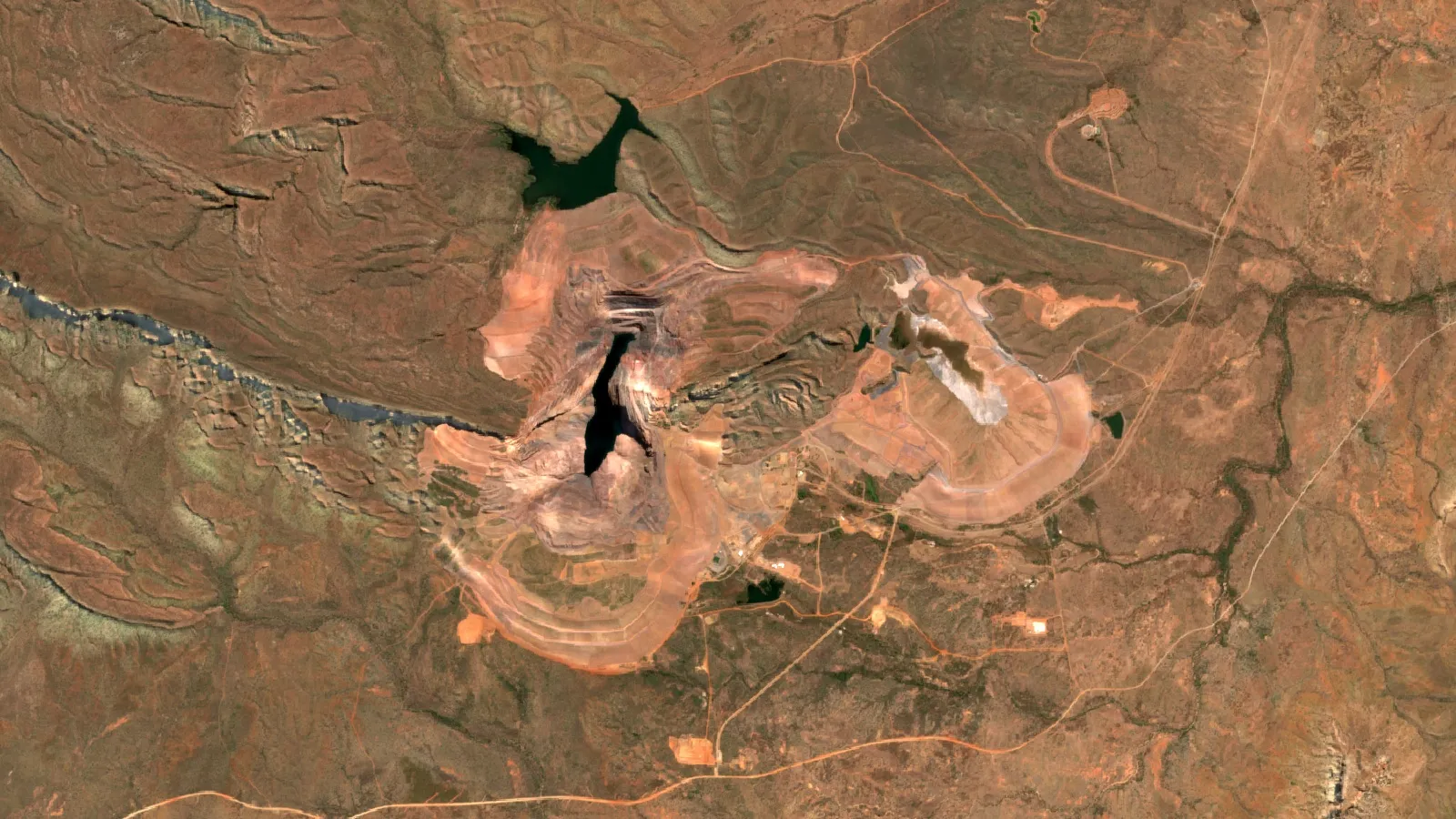
The Argyle mine in Western Australia produced more than 865 million carats before mining ended on 3 November 2020. This guide covers its location, history, closure, rehabilitation, the pink diamond brand sale, and a value-per-tonne calculator.
Key takeaways
- Argyle mined more than 865 million carats of rough diamonds in 37 years; the last day of mining was 3 November 2020 (International Mining, 2020; Rio Tinto, accessed 16 October 2026).
- Pink diamonds were under 0.1% of output, yet Argyle supplied over 90% of the world’s pinks; about 1 carat in every half million carats of rough went to the tender (GIA, 2014).
- Rio Tinto plans 2,000 hectares of rehabilitation and says it is on track to finish infrastructure removal and revegetation in 2026, followed by 10 years of monitoring (Rio Tinto; IBR, 17 February 2026).
- Traditional Owners questioned in February 2026 whether the agreed rehabilitation criteria would be met before handback (Indigenous Business Review).
- On 1 October 2026 the Argyle Pink Diamonds brand and the last pink inventory passed to Boodles (Rio Tinto).
In this article
- Argyle diamond mine at a glance
- Where is the Argyle diamond mine?
- Argyle diamond mine history: from discovery to the last day
- The underground years and the cost of going deeper
- How many carats did Argyle produce?
- How the Argyle pipe formed
- Why Argyle pink diamonds are so rare
- Why did Argyle close?
- What happens to the Argyle site now: rehabilitation and handback
- Argyle closure timeline
- What happened to the Argyle pink diamond brand
- Argyle and Diavik compared
- Where Argyle sits among diamond mines today
- Why grade alone did not decide Argyle's value
The Argyle diamond mine was in the East Kimberley region of Western Australia, about 500 km south-west of Darwin. Rio Tinto ran it until the last day of mining on 3 November 2020, after 37 years and more than 865 million carats of rough diamonds (International Mining, 4 November 2020). A carat is 0.2 gram. Argyle was one of the world’s largest diamond producers by volume and the main source of pink and red diamonds. It is now being cleaned up and reshaped, and the land is due to go back to its Traditional Owners.
This page covers where the mine was, how its history ran, why it closed, what has happened to the land since, and what became of the pink diamond brand. It also puts Argyle next to today’s diamond producers, and shows why a mine with poor-value stones still made money. Every figure carries its source and date.
Argyle diamond mine at a glance
| Item | Fact | Source |
|---|---|---|
| Place | East Kimberley, Western Australia, on the country of the Miriwoong, Gija, Malgnin and Wularr people | Rio Tinto, Argyle page |
| Rock type | AK1 pipe, an olivine lamproite about 1.2 billion years old | Rayner and others, ANU |
| Discovered | October 1979 | International Mining, 2020 |
| Mining phases | Alluvial from 1983, open pit from 1985, underground from 2013 | International Mining, 2020 |
| Last day of mining | 3 November 2020 | Rio Tinto, Argyle page |
| Total output | More than 865 million carats of rough diamonds | International Mining, 2020 |
| Closure plan | Infrastructure removal, landform shaping and revegetation due to finish in 2026, then monitoring | Rio Tinto, Argyle page (accessed 16 October 2026) |
Where is the Argyle diamond mine?
Argyle sits in the far north-east of Western Australia. The Gemological Institute of America (GIA) places it 500 km south-west of Darwin and more than 2,200 km north-east of Perth (GIA Gems & Gemology, Winter 2014).
The ground is not just a mining lease. Rio Tinto describes the former mine as sitting at Barramundi Gap, a cultural landscape linked to the Ngarranggarni Dreaming, a creation story about how the local geography formed. It calls Barramundi Gap one of the most significant sites for the Miriwoong and Gija people (Rio Tinto, accessed 16 October 2026). The Argyle Participation Agreement, registered as an Indigenous Land Use Agreement in 2005, is the formal deal between Rio Tinto and seven Traditional Owner family groups. It replaced a 20-year-old Good Neighbour Agreement.
If you came here for other diamond sites, the closest US comparison is covered in our guide on how many diamond mines are in the United States. For a Canadian view, see diamond mines in Canada.
Argyle diamond mine history: from discovery to the last day
Systematic exploration began in 1969 after a few alluvial diamonds (diamonds washed out of their source rock into river gravels) turned up in the region. Another decade of fieldwork passed before geologists recognised the host rock as a diamond-bearing lamproite pipe (GIA, 2014). The pipe was found in October 1979. Alluvial mining began in 1983, open-pit mining in 1985, and the mine became fully underground in 2013 (International Mining, 2020). GIA dates the start of underground mining to April 2013 and notes that plans had existed since 2006.
Infographic
Argyle in 5 steps
- 1ExploreFrom 1969, geologists follow alluvial diamonds to the source.
- 2Find the pipeThe AK1 lamproite pipe is recognised in October 1979.
- 3MineAlluvial mining starts in 1983 and the open pit in 1985.
- 4Go undergroundUnderground mining starts in 2013.
- 5CloseMining ends on 3 November 2020 and rehabilitation begins.
- 1969 to 1979. Exploration follows alluvial diamonds to the Argyle pipe.
- 1983. Alluvial mining starts.
- 1985. The open pit begins and the mine becomes fully operational in late 1985. In 1986, one year later, Australia was the world’s largest source of diamonds by weight (GIA, 2014).
- 2013. Underground mining starts below the pit. GIA reported about 40 km of tunnels built to reach the ore.
- 3 November 2020. The last day of mining. Rio Tinto said the mine had used up its economic reserves.
The underground years and the cost of going deeper
By the mid-2000s the open pit was nearing its limit, so Rio Tinto planned to mine the pipe from below. In 2006 an underground mine was announced to extend the life of the operation to 2018, and GIA says the life was later extended to at least 2020, with expected production of up to 20 million carats a year (GIA, 2014). In 2009 Geoscience Australia reported that Rio Tinto slowed the $1.86 billion transition because of weak markets, cut staff from 360 to 140 and suspended production for three months from March (Geoscience Australia, 2010). It also noted that the underground mine was expected to make 20 to 25 Mc a year for seven years, which would have taken the mine to 2018. Real output after the move underground was lower than that plan, with Australia producing 14.01 Mc in 2018 and 12.99 Mc in 2019.
The pattern is common in mining. Going deeper removes the waste rock of an open pit but adds tunnelling, ventilation and a fixed cost base, so the mine needs a steady grade and value to keep paying for it. At Argyle both the resource and the grade were falling by 2019.
How many carats did Argyle produce?
Output was very large but fell sharply at the end. Geoscience Australia put Argyle’s historical annual average at about 34 million carats (Mc) when it wrote in 2010, and the Northern Miner reported 35 Mc in 1991. In 2009 Argyle made 10.6 Mc after the company cut output in the financial crisis, against 15 Mc in 2008 (Geoscience Australia, Australia’s Identified Mineral Resources 2010). Australian production was 14.01 Mc in 2018 and 12.99 Mc in 2019, and Geoscience Australia states that Argyle was responsible for all of Australia’s diamond production (Geoscience Australia, 2020 edition). The chart below plots these years.
Chart
Argyle output in selected years
Million carats of rough diamond; 2018 and 2019 are Australian totals, which Geoscience Australia attributes entirely to Argyle
Most of what came out was not gem quality. A 1993 AusIMM cost handbook put the share of gem stones at about 5 per cent (AusIMM, Cost Estimation Handbook, 1993). GIA says the output was dominated by near-colourless to brown diamonds.
How the Argyle pipe formed
Many diamond mines work a kimberlite pipe, a vertical column of volcanic rock that carried diamonds up from deep in the Earth. Argyle was different. Its AK1 pipe is a lamproite, a volcanic rock related to kimberlite. Researchers describe it as about 1.2 billion years old, made of four joined steep-sided vents (diatremes) that taper to narrow feeders at depth, in the Halls Creek orogen on the south-eastern edge of the Kimberley craton (Rayner and others, Society of Economic Geologists / ANU). The same chapter notes it was emplaced during a period of stretching along a major fault. For explorers, the lesson is that diamond targets are not limited to kimberlites, and that a fault-controlled setting can matter.
Why Argyle pink diamonds are so rare
Natural coloured diamonds make up an estimated 0.01 per cent of world production (GIA, 2014). Argyle changed that picture. Pinks were always a tiny share of the mine’s own output, less than 0.1 per cent according to GIA, yet the mine supplied more than 90 per cent of the pink diamonds in the market. Rio Tinto lists the colours Argyle produced as white, yellow, brown, blue, violet, pink and red.
Chart
Carats of pink diamond offered at the Argyle tender
Total carats polished, selected tender years
GIA reports that for every half million carats of rough diamond mined, only about one carat was suitable for the annual Argyle pink tender, an invitation-only sale. The first tender, in Antwerp in 1985, offered 33 diamonds weighing 18.03 carats. The tender grew through the 1980s and 2000s, with the largest on GIA’s list at 64.38 carats in 1989 and 62.46 carats in 2008, then fell to 34.74 carats in 2009; the chart shows selected years. Argyle named few winning bidders, though GIA reports prices for some years, such as more than US$4.5 million for the 1995 tender.
Why did Argyle close?
Rio Tinto said the mine ended because it had exhausted its economic reserves (International Mining, 2020). The public figures fit that. Geoscience Australia reports that Australia’s economic demonstrated resources of diamond fell 57 per cent between 2018 and 2019, from 25.48 Mc to 10.97 Mc, largely because the Argyle resource was being depleted and grades were lower. It calculated a reserve life of only one year (Geoscience Australia, 2020). Because the stones were low in value, there was little room for higher costs as grades and tonnage fell, as the section on grade and value below explains.
What happens to the Argyle site now: rehabilitation and handback
Rehabilitation means removing infrastructure, reshaping the ground and replanting so that the area can recover as a self-sustaining ecosystem. Rio Tinto says the last day of mining began a closure process that started with a six-month “make safe” period, and that it expected about five years to dismantle infrastructure, shape the land and begin revegetation. Its figures for the work (Rio Tinto, accessed 16 October 2026):
- 2,000 hectares of land to be rehabilitated.
- 34,000 tonnes of steel from the processing plant sent off site for recycling.
- 11,000 kilograms of seed to be collected for revegetation.
- More than 35 per cent of the site works and services scope delivered by Traditional Owner businesses.
Rio Tinto says it is on track to complete infrastructure removal, landform profiling and revegetation in 2026, after which it will keep monitoring the environment. In 2022, Stage One of a Mine Closure Agreement was signed with the Traditional Owners, with a financial contribution to offset the impact of closure.
The handback is not settled. In February 2026, the Indigenous Business Review reported Traditional Owners were concerned that the land could be returned without the agreed rehabilitation criteria being met. Gelganyem Limited, the body that manages relations between Rio Tinto and the Traditional Owners, said they would not accept the land if it stayed permanently contaminated. Rio Tinto said it would carry out a 10-year monitoring and maintenance program after handback, with surface and groundwater monitoring for at least 10 years and annual fish sampling at Gap Dam, Limestone Creek and Flying Fox Creek (Indigenous Business Review, 17 February 2026). The Western Australian government requires documented Traditional Owner engagement in a mine closure plan, according to the same report.
▶ A plain-language claymation on the seven environmental impacts of mining. · 2:31
Argyle closure timeline
- 2005. The Argyle Participation Agreement is registered as an Indigenous Land Use Agreement.
- 3 November 2020. Last day of mining; a six-month make-safe period follows.
- 2022. Stage One of the Mine Closure Agreement is signed with the Traditional Owners.
- 19 September 2025. Rio Tinto launches its final Beyond Rare Tender.
- February 2026. Traditional Owners publicly question whether rehabilitation will meet the agreed criteria.
- 2026. Rio Tinto says infrastructure removal, landforming and revegetation are on track to finish, followed by a 10-year monitoring and maintenance program.
- 1 October 2026. The Argyle Pink Diamonds brand passes to Boodles.
What happened to the Argyle pink diamond brand
On 1 October 2026 Rio Tinto announced that ownership of the Argyle Pink Diamonds brand had passed to the jeweller Boodles. Boodles acquired the last remaining Argyle pink diamond inventory, a set of trademarks, and the brand’s website and digital marketing assets (Rio Tinto, Argyle page, release of 1 October 2026). No price was given on that page. Before that, Rio Tinto launched its final Beyond Rare Tender on 19 September 2025, with 52 lots from its Australian and Canadian mines. No new Argyle rough is being produced, so stones already sold can be resold, but the supply of new ones has ended.
Argyle and Diavik compared
Argyle and Diavik were both Rio Tinto diamond mines, and both have now stopped producing. Their products were very different: Argyle’s output was dominated by near-colourless to brown stones with a small supply of pinks, while Diavik produced mainly white gem-quality stones and a small share of yellows.
| Item | Argyle (Western Australia) | Diavik (Northwest Territories, Canada) |
|---|---|---|
| Discovered | 1979 | 1991 |
| Mining began | 1983 (alluvial), 1985 (open pit) | 2003 |
| Last day of production | 3 November 2020 | March 2026 |
| Years of operation | 37 | 23 |
| Rough diamonds produced | More than 865 million carats | More than 150 million carats |
| Main output | Brown, near-colourless, rare pinks | Mainly white gem-quality, some yellow |
Sources: International Mining, 2020 and Rio Tinto, 26 March 2026. The two mines show how different diamond economics can be: Argyle moved huge volumes of low-value stones, while Diavik made fewer carats of higher value.
Where Argyle sits among diamond mines today
Argyle no longer appears in the world production table. The US Geological Survey (USGS) lists 2025 estimated gem-quality natural diamond output of about 69 million carats worldwide, led by Russia at 21 million. Australia is not listed. Rio Tinto’s other big mine, Diavik in Canada, also finished: after 23 years and more than 150 million carats, its final day of production was in March 2026 (Rio Tinto, 26 March 2026). USGS also notes that the global natural diamond market has been in a downturn since early 2023, with weaker demand and competition from less expensive synthetic diamonds (USGS, Mineral Commodity Summaries 2026, gemstones). For stories on other diamond regions see Cullinan and Venetia in South Africa.
Chart
Gem-quality natural diamond mine output, 2025 estimate
Thousand carats; leading producers listed by USGS (Australia is not listed)
Why grade alone did not decide Argyle’s value
Argyle shows why a high grade does not guarantee a good mine. The 1993 AusIMM handbook says the average grade of an orebody matters less than the dollar value per tonne. It compares the Argyle pipe, with a grade of about 6 carats per tonne but an average value of about $10 per carat, with an alluvial deposit in West Africa at 0.1 carat per tonne and about $300 per carat (figures as printed in 1993, in dollars as stated there). Revenue per tonne of ore is grade times value per carat, and that is the number to compare with mining and processing cost per tonne. Use your own figures below.
Calculator
What is a tonne of diamond ore worth?
Enter your own grade, stone value and cost per tonne.
- Carats recovered per year: 2,000,000
- Gross revenue per year (US$): $40,000,000
- Margin per tonne before capital (US$): 10.00
- Break-even value per carat (US$): 15.00
Example values only, not a benchmark for Argyle or any mine. The method follows the AusIMM Cost Estimation Handbook (1993): value per tonne is grade times value per carat. Prices are inputs: example, use today’s price (US$ per carat). Costs are an input; capital, royalties and taxes are left out.
Checking a closed mine from space
A closed lease like Argyle leaves a simple question: is the vegetation coming back? Public Sentinel-2 satellite images let anyone compare plant cover across the roughly 2,000 hectares from one year to the next, using the same season each time. That shows cover, not soil or water chemistry, so it cannot show whether land is contaminated. Farmonaut applies the same kind of image analysis to mineral exploration, and consultants can use it to map a site boundary and look at change over time. Our overview is on satellite-based mineral detection, and you can send a site for a quote.
▶ Explains what remote sensing measures for mining and why agreement between instruments matters. · 2:01
What mine planners can take from Argyle
- Value per tonne beats grade. A mine of low-value stones needs a high grade and large tonnage, and has little margin when either falls.
- Plan closure early. Rio Tinto began with a six-month make-safe phase and a multi-year rehabilitation plan; the handback is still contested six years after the last day of mining.
- Agree the closure criteria with landholders in writing. The 2026 dispute is about whether the agreed criteria are met.
- Track land condition over time. Repeat monitoring of water, fish and vegetation is part of Rio Tinto’s plan for at least 10 years.
For a closer look at a related question, see our guide: Denver Rock Drill: History and 5 Bit Makers Today.
Frequently asked questions
Where was the Argyle mine?
It was in the East Kimberley region of Western Australia, about 500 km south-west of Darwin and more than 2,200 km north-east of Perth (GIA, 2014). The site is at about 16.7 degrees south, 128.4 degrees east.
Is Argyle still operating?
No. Mining stopped on 3 November 2020. Rio Tinto is now rehabilitating the site and says it is on track to finish infrastructure removal, landform profiling and revegetation in 2026.
How many diamonds did Argyle produce?
More than 865 million carats of rough diamonds over 37 years, according to Rio Tinto as reported by International Mining in November 2020. An earlier ANU chapter gave more than 835 million carats, written before the mine finished.
Why are Argyle pink diamonds so valuable?
Because they are rare. Pinks were less than 0.1 per cent of Argyle’s output, only about one carat in every half million carats of rough was good enough for the tender (GIA, 2014), and the mine has now closed.
Who owns the Argyle Pink Diamonds brand now?
Boodles, a jewellery group, took over the brand, the trademarks and the last remaining pink diamond inventory from Rio Tinto on 1 October 2026.
Who are the Traditional Owners of the Argyle site?
Rio Tinto says the mine is on the traditional country of the Miriwoong, Gija, Malgnin and Wularr people, and that seven Traditional Owner family groups are signatories to the Argyle Participation Agreement.
What is a lamproite?
A volcanic rock related to kimberlite. Geoscience Australia notes that diamonds are carried to the surface in both kimberlites and lamproites; Argyle worked a lamproite, and its AK1 pipe is about 1.2 billion years old (ANU).
Does Australia still produce diamonds?
Geoscience Australia stated that Argyle accounted for all Australian diamond production, and the USGS gem-diamond table for 2025 does not list Australia, so no commercial output appears in those sources.
Are there diamond mines in the United States?
The USGS production table shows no natural diamond output from the United States. See our guide on diamond mines in the United States.
How much were Argyle diamonds worth per carat?
Low compared with other mines. A 1993 handbook put the average at about $10 per carat, while only about 5 per cent of stones were gem quality. Prices have changed since, so treat this as history, not today’s value.
What does “make safe” mean at a closed mine?
Rio Tinto used the term for the first six months after mining ended, before the main closure work began. Rio Tinto publishes closure update newsletters on its Argyle page.
How long will Argyle be monitored after handback?
Rio Tinto said in February 2026, as reported by the Indigenous Business Review, that a 10-year monitoring and maintenance program starts after the land is handed back, and that surface and groundwater monitoring will run for at least 10 years, with annual fish sampling at Gap Dam, Limestone Creek and Flying Fox Creek (a dam and two creeks).
Why did Argyle produce so many low-value diamonds?
The pipe was rich in diamonds but most were brown or industrial. The AusIMM handbook put gem stones at about 5 per cent. The mine relied on volume, which worked while grades and tonnage were high.
This page is for information only. It is not investment advice.
Farmonaut mining
Map your mining site from space
Consultants can send a lease or closed-mine boundary and see satellite imagery of the area over time.

Mining Pro sample view, synthetic data
Keep reading
Sources
- Rio Tinto, Argyle operations page (accessed 16 October 2026): riotinto.com
- International Mining, Argyle closes after 37 years (4 November 2020): im-mining.com
- Indigenous Business Review, Traditional Owner concerns over Argyle rehabilitation (17 February 2026): theibr.com.au
- GIA Gems & Gemology, 30th Argyle Diamond Tender (Winter 2014): gia.edu
- Rayner and others, The Geology of the Argyle (AK1) Diamond Deposit, ANU / SEG: researchportalplus.anu.edu.au
- Geoscience Australia, Australia’s Identified Mineral Resources 2010: ga.gov.au
- Geoscience Australia, Australia’s Identified Mineral Resources 2020, commodity summaries: ga.gov.au
- AusIMM, Cost Estimation Handbook, Monograph 20 (1993), revenue and marketing: ausimm.com
- USGS, Mineral Commodity Summaries 2026, gemstones: pubs.usgs.gov
- Rio Tinto, Diavik final production (26 March 2026): riotinto.com
- The Northern Miner, Argyle largest diamond producer (1992): northernminer.com
Discussion
Questions, corrections or field experience? Share them below. First-time comments are reviewed before they appear, and your email is never published.
No comments yet. Be the first to add a question or your experience.

 Almosi SARL
 SRK Consulting
 Berks Gold Limited
 Mwerezi Minerals Company Limited
 Mining SARL
 SenGold Invest SAS
 Sean Mining Limited
 NTS Group (Pty) Ltd
 Mine4Africa
 Lithspo Minerals Limited
 Tintina Mining Group
 Dalgety Minerals Pty Ltd
 Vortex Minerals Pty Ltd
 Faith At Work (Pty) Ltd
 Geotech Mining Solutions plc
