

Reviewed August 2026 against USDA Economic Research Service farm technology data, Research and Markets’ drone GIS mapping forecast, and SkyeBrowse’s 2026 drone services pricing guide.
Try it: Run your own numbers →
Table of Contents
- What Drone GIS Mapping Is, and Why This Page Exists
- The Drone GIS Mapping Market: Size and Growth
- How GIS Drone Mapping Actually Works
- Best Drones for GIS Mapping: RTK Models Compared
- Comparison Table: RTK Mapping Drones
- RTK Accuracy: What “Centimeter-Level” Actually Means
- Getting Drone Data Into GIS Software
- Drone Mapping Cost: Per-Acre, Hourly, and Daily Rates
- Calculator: Estimate Your Drone Mapping Project Cost
- US Farm Adoption: Who Is Actually Flying Drones
- Drone Pricing for International Buyers
- Where Drones Hit a Ceiling — and Where Satellites Pick Up
- Farmonaut’s Platform for Data-Driven Agriculture
- Durable Checklist: Choosing and Budgeting a GIS Drone Program
- FAQ
- Try it: Run your own numbers
What Drone GIS Mapping Is, and Why This Page Exists
Drone GIS mapping is the process of flying a drone over land to capture overlapping aerial photos, then processing those photos with photogrammetry software into a georeferenced orthomosaic, elevation model, or 3D map that a GIS platform like QGIS or ArcGIS can layer against soil, boundary, and yield data. The output is not a picture — it is a coordinate-accurate dataset you can measure, overlay, and analyze.
This page exists to answer the practical questions that come before a purchase or a contract: which drones are actually built for GIS-grade output, what RTK accuracy is worth paying for, what a mapping project costs per acre versus per day, and how the market is sized so you know whether this is a fringe technology or a mainstream one. It covers drone GIS mapping, GIS drones, and RTK drones for mapping specifically — not general crop-scouting drones or consumer photography quadcopters.
The Drone GIS Mapping Market: Size and Growth
The global drone GIS mapping market was valued at $1.17 billion in 2025, according to Research and Markets’ forecast report. That figure sits inside a broader commercial drone surveying market, sized separately at $1.97 billion in 2025 by industry analysis cited in Barchart’s coverage of the sector — the difference reflects how the two reports scope “GIS mapping” against the wider surveying category that includes construction and inspection work.
The growth rate matters more than the snapshot: Barchart’s cited analysis puts commercial drone surveying at a 19.3% compound annual growth rate from 2025 through 2035. At that rate, a market sized near $2 billion in 2025 would need to roughly double every four years — useful context if you’re deciding whether to build in-house drone capability or keep contracting it out, since a fast-growing service market usually means more competing contractors and falling day rates over time.
Neither report breaks out what share of that spending is agricultural versus construction, utility, or mining survey work — that split is not published in the sources available for this review. If you need a sector-specific breakout, the Research and Markets report page linked above is the primary place to check for an updated or purchased full report.
How GIS Drone Mapping Actually Works
Every GIS-grade drone mapping project follows the same five stages, regardless of drone brand:
- Flight planning: Mission-planning software defines the boundary polygon, altitude, and image overlap (typically 70–85% front and side overlap for photogrammetry to stitch cleanly). Altitude and overlap together set your ground sample distance — the cm/pixel resolution of the final map.
- Image capture: The drone flies an automated grid pattern, firing its camera on a timer or distance trigger. RGB sensors handle standard orthomosaics; multispectral sensors add near-infrared bands for vegetation indices; thermal sensors reveal irrigation leaks or moisture stress invisible to the naked eye.
- Georeferencing via RTK correction: Real-Time Kinematic GPS tags each photo with a corrected position as it’s captured, removing the need for as many ground control points and cutting post-processing time substantially.
- Photogrammetric processing: Software (Pix4D, DroneDeploy, Agisoft Metashape, or similar) stitches hundreds to thousands of overlapping images into a single orthomosaic and, where LIDAR or sufficient overlap exists, a 3D point cloud or digital elevation model.
- GIS analysis: The finished orthomosaic and elevation data import into QGIS, ArcGIS, or a farm management platform as georeferenced layers, ready to overlay against soil maps, parcel boundaries, or prior-season imagery.

Best Drones for GIS Mapping: RTK Models Compared
The single feature that separates a GIS-grade drone from a consumer drone is onboard RTK (or PPK) positioning. Without it, a drone’s raw GPS is accurate to a few meters — fine for a photo, useless for a boundary survey or a cut-fill calculation. The two current models with published, verifiable pricing are:
- DJI Matrice 4E RTK: Listed at $5,189 as of 2026 per Global Drone HQ’s construction and survey buying guide. Built specifically for survey-grade mapping with an integrated RTK module, multispectral option, and mechanical shutter to avoid motion blur during grid flights.
- Autel EVO II Pro RTK V3: Listed at $2,999 (promotional pricing) per Autel-focused industry buying guides covering low-budget RTK/PPK options for 2025–2026. It’s positioned as the lower-cost entry into survey-grade RTK mapping without stepping down to a non-RTK consumer drone.
Both figures are manufacturer or retailer list prices at the time the sources were published, not a guaranteed current price — drone pricing moves with promotions, trade-in programs, and new model releases. Before budgeting, check DJI.com or Autel’s site directly, since a listed price a few months old can already be superseded by a new model generation.
Comparison Table: RTK Mapping Drones
| Drone Model | List Price (USD) | Positioning | RTK Accuracy Spec | Sensor Options | Best Fit |
|---|---|---|---|---|---|
| DJI Matrice 4E RTK | $5,189 | Integrated RTK module | 1 cm ± 1 ppm horizontal / 1.5 cm ± 1 ppm vertical (RTK-class spec) | RGB, multispectral option | Professional survey, construction staking, large-field agronomy |
| Autel EVO II Pro RTK V3 | $2,999 (promotional) | Budget RTK/PPK entry | 1 cm ± 1 ppm horizontal / 1.5 cm ± 1 ppm vertical (RTK-class spec) | RGB; PPK fallback without base station | Smaller operations, first RTK purchase, budget-constrained surveys |
* Prices as sourced above; verify current pricing directly with the manufacturer before purchase, since list prices and promotions change without a fixed schedule.



RTK Accuracy: What “Centimeter-Level” Actually Means
Survey-grade RTK drones publish a two-part accuracy spec: 1 cm ± 1 ppm horizontal and 1.5 cm ± 1 ppm vertical, per manufacturer specifications compiled by drone surveying industry sources. Read that correctly: it is not “accurate to 1 cm anywhere.” The “± 1 ppm” (parts per million) term adds error proportional to distance from your RTK base station or network correction source — at 10 km from your base, that adds roughly 1 cm of extra uncertainty on top of the fixed 1 cm figure.
This is why RTK accuracy claims are meaningless without knowing the baseline distance and correction source. A drone flown within 1–2 km of its own base station will perform close to its rated spec. The same drone flown 20 km from a network RTK correction service will carry meaningfully more drift. For a full breakdown of RTK GPS accuracy and how to verify it in the field, check ground control points against known survey markers before trusting a new setup on a paying job.
Getting Drone Data Into GIS Software
A finished orthomosaic is only useful once it’s inside a GIS environment where it can be measured and layered. The two dominant platforms are ArcGIS (commercial, Esri) and QGIS (free, open-source) — both accept standard GeoTIFF orthomosaic exports from Pix4D, DroneDeploy, and Agisoft Metashape without conversion. Inside either platform, a typical agricultural workflow overlays the drone orthomosaic against:
- Parcel and boundary layers, to confirm mapped acreage matches deed or lease records
- Prior-season imagery, to track changes in vegetation vigor or soil exposure over time
- Soil sample points, to correlate visible stress zones with lab-tested nutrient or pH data
- Elevation/contour layers derived from the drone’s own photogrammetric point cloud, for drainage and erosion planning
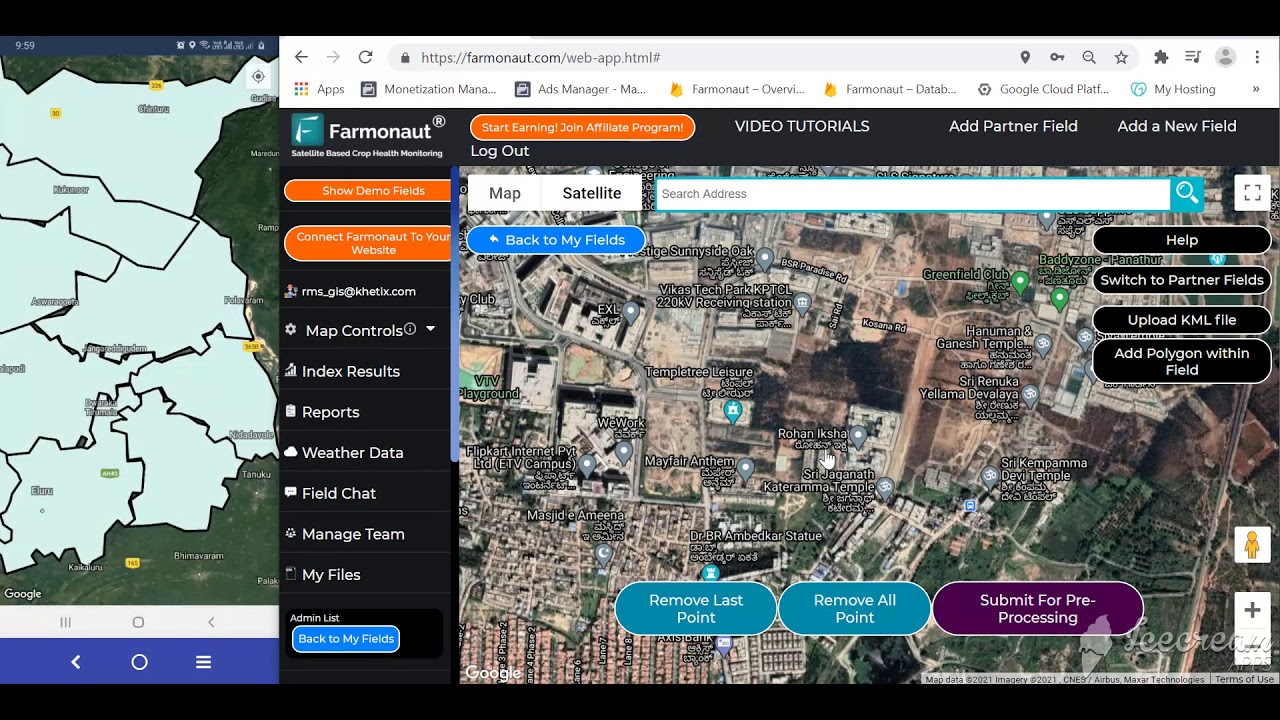
For teams building custom pipelines rather than using off-the-shelf GIS desktop software, Farmonaut’s API and its developer documentation provide satellite-based layers that can sit alongside drone-captured data in the same GIS project — useful when a field needs both the resolution of a drone pass and the wider-area, repeat-visit coverage a satellite feed provides between drone flights.

Drone Mapping Cost: Per-Acre, Hourly, and Daily Rates
Drone mapping cost breaks down into three usable benchmarks, all from SkyeBrowse’s 2026 drone services pricing guide:
- Per-acre, large projects: $15–$50 per acre for photogrammetry-based drone surveying. Larger contiguous acreage pushes toward the bottom of that range because setup and mobilization costs spread across more mapped area.
- Hourly rate: $300–$600 per hour for professional drone mapping services, typically billed when a job is too small or irregular to price cleanly per acre.
- Daily rate: $500–$1,500 per day for professional drone surveying, the usual billing unit for multi-field or multi-site contracts.
On top of contracted service rates, ownership costs for the hardware itself run from the Autel EVO II Pro RTK V3’s $2,999 promotional price to the DJI Matrice 4E RTK’s $5,189 list price, plus GIS software (QGIS is free; ArcGIS and photogrammetry suites like Pix4D or Agisoft typically run into annual license fees not itemized in the sources reviewed here — check each vendor’s current pricing page directly, since license tiers change often), batteries, insurance, and any FAA Part 107 certification costs for commercial operators. None of the sources reviewed publish a bundled “total cost of drone ownership” figure — that number depends too much on flight frequency and acreage to generalize, which is exactly what the calculator below is for.
Calculator: Estimate Your Drone Mapping Project Cost
Enter your acreage and preferred billing method to see an estimated cost range, based on the per-acre and per-day rates published above.
Run your own numbers
Assumptions: uses SkyeBrowse's published 2026 per-acre ($15–$50) and per-day ($500–$1,500) service rates; excludes drone hardware purchase, GIS software licensing, mobilization travel, and any site-specific complexity (obstacles, restricted airspace, required re-flights). Treat the output as a planning range, not a quote.

US Farm Adoption: Who Is Actually Flying Drones
Adoption data specific to GIS-grade drone use on farms is not published anywhere in the sources reviewed for this article — that is a genuine gap, not an oversight. What the USDA Economic Research Service does publish is broader: aerial imagery adoption, a category that bundles drones together with manned aircraft and satellite imagery. By that measure, 9.8% of US soybean acres used some form of aerial imagery in 2018, and 7.0% of US corn acres did in 2016, per USDA ERS's chart-of-note data on farm technology adoption.
Two things to hold onto here. First, these figures predate the RTK-drone price drops of the past several years (the sub-$3,000 Autel EVO II Pro RTK V3 pricing referenced above did not exist at either data point), so current adoption is very likely higher — but there is no updated USDA figure available to confirm by how much. Second, "aerial imagery" is not the same as "drone GIS mapping" specifically; a farm counted in that 9.8% could have used a contracted manned-aircraft flyover with no drone involved at all. If your work depends on a precise, current, drone-specific adoption number, the USDA ERS chart-of-note page linked above is the place to check for a newer release, since ERS periodically updates these series from Census of Agriculture and ARMS survey data.
Drone Pricing for International Buyers
Search interest in drone pricing spans well beyond US dollar terms — including queries asking for drone prices in other currencies for mapping use. The two verified prices in this article, the DJI Matrice 4E RTK at $5,189 and the Autel EVO II Pro RTK V3 at $2,999, are US list/promotional prices from the manufacturer and retailer sources cited above; neither source publishes a conversion or a region-specific price list. If you're pricing a drone purchase outside the US, check the manufacturer's local distributor site directly for the price in your currency plus import duty, since a straight currency conversion of the US price will typically understate the landed cost.
Where Drones Hit a Ceiling — and Where Satellites Pick Up
Drones map fast and in fine detail, but they map one field or one property at a time, and only when someone is physically present to fly them. That's the practical ceiling: a 500-acre pass takes real flight hours (see the per-day acreage assumption in the calculator above), repeated every time you need a fresh look. At Farmonaut, we built our platform to sit on the other side of that trade-off — wide-area, repeat-visit coverage without a flight crew:
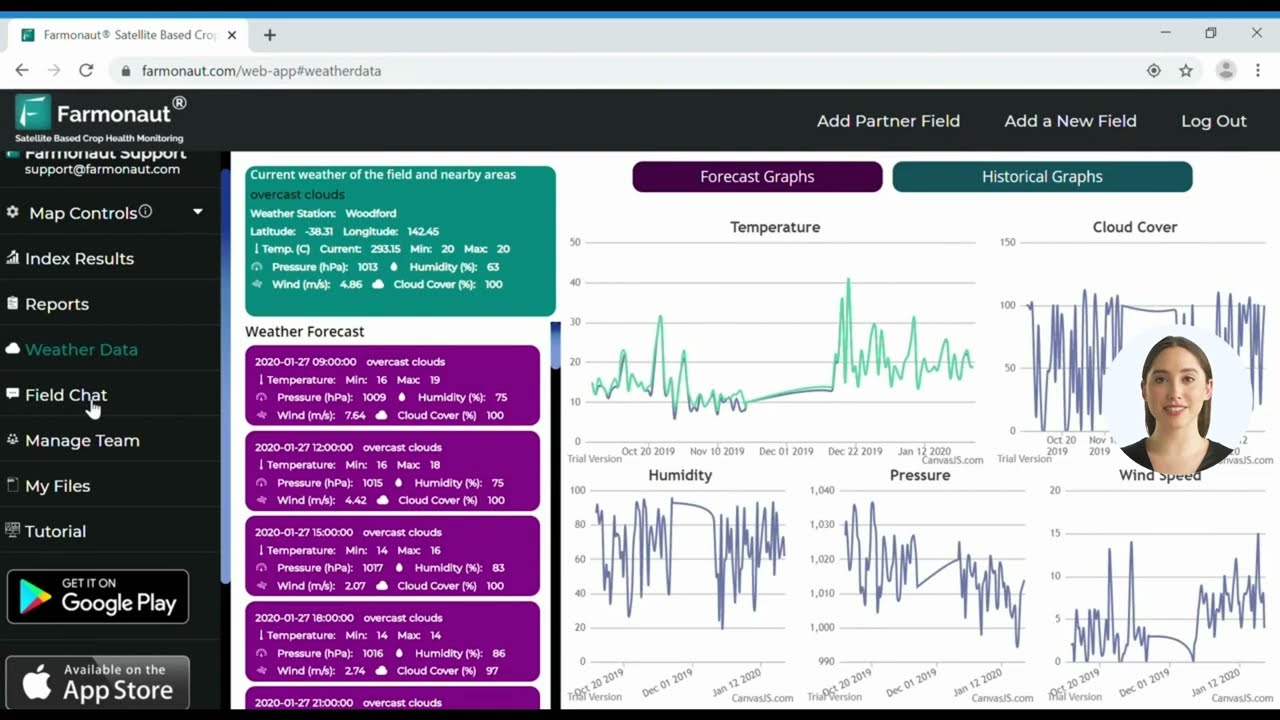
- Satellite-driven crop and soil monitoring: Multispectral satellite imagery, including NDVI and soil indices, for field-level insight without a drone deployment.
- AI-powered advisory: The Jeevn AI Advisory System pairs satellite and weather data into field-specific operational guidance, complementing drone-level detail where you have it.
- Traceability: Our product traceability platform for supply-chain transparency and compliance documentation.
- Fleet and large-scale management: The agro admin app for coordinating machinery and logistics across large operations.
- Carbon footprinting: Satellite-based emissions analytics through our carbon footprinting service.


Farmonaut's Platform for Data-Driven Agriculture
Our goal is to put remote sensing within reach of any farm or agribusiness, combining the field-level granularity that drone GIS mapping provides with the wide-area repeatability of satellite monitoring. Alongside the products above, Farmonaut offers:
- Real-time satellite monitoring apps for web and mobile
- Fleet management and machinery tracking tools
- Crop loan and insurance verification backed by satellite analytics
- API access for teams integrating drone and satellite data into the same GIS workflow
Subscription tiers and API packages scale from single-farm operators to enterprise and government accounts. Details and sign-up are available at farmonaut.com.
Durable Checklist: Choosing and Budgeting a GIS Drone Program
Drone models and prices will keep changing; the checklist for evaluating them does not. Work through these steps whenever you're buying hardware or hiring a contractor, regardless of what year it is:
- Confirm RTK or PPK is present, not just "high-accuracy GPS." Marketing copy sometimes calls standard GPS with a "high-precision" label; ask for the specific horizontal/vertical spec in centimeters plus ppm, and confirm whether it needs a base station (RTK) or corrects in post-processing (PPK).
- Match sensor to question. RGB alone answers "what does this field look like." Multispectral answers "which zones are stressed." Thermal answers "where is water pooling or leaking." Buying sensors you won't use inflates cost without adding usable data.
- Price the whole job, not just the drone. Use the per-acre and per-day benchmarks above (or the calculator) to sanity-check a contractor's quote, and separately budget GIS software, batteries, insurance, and certification if you're flying in-house.
- Verify accuracy in the field before trusting output. Fly over at least one known survey point or ground control marker and check the reported coordinate against it — don't rely on the spec sheet alone.
- Re-check current pricing before committing. Drone hardware prices and promotions move faster than most industry guides get updated; confirm the manufacturer's current listed price the week you buy, not the price in any article — including this one.
- Decide where satellite coverage should substitute for repeat drone flights. If you need the same field mapped weekly, a drone crew is expensive to repeat; a satellite feed often covers that cadence at a fraction of the cost, reserving drone flights for the times centimeter-level detail is actually required.
Further reading:
FAQ
What is the difference between drone GIS mapping and regular drone photography?
Regular drone photography produces standalone images. Drone GIS mapping captures overlapping, georeferenced images specifically to be stitched into a coordinate-accurate orthomosaic or 3D model that a GIS platform can measure, layer, and analyze against other spatial data.
What are the best drones for GIS mapping right now?
Among models with verifiable current pricing, the DJI Matrice 4E RTK ($5,189) is built specifically for survey-grade mapping with an integrated RTK module and multispectral option. The Autel EVO II Pro RTK V3 ($2,999 promotional) offers the same RTK-class accuracy spec at a lower entry price, per Global Drone HQ and Autel-focused industry buying guides. The right choice depends on whether you need the Matrice's sensor flexibility or the Autel's lower upfront cost.
How much does drone mapping cost per acre?
Photogrammetry-based drone surveying for large projects runs $15–$50 per acre, per SkyeBrowse's 2026 drone services pricing guide. Smaller or irregular jobs are more commonly billed at $300–$600 per hour or $500–$1,500 per day rather than per acre.
What RTK accuracy should I expect from a mapping drone?
Current survey-grade RTK drones specify 1 cm ± 1 ppm horizontal accuracy and 1.5 cm ± 1 ppm vertical accuracy. The "± 1 ppm" term means error grows with distance from your RTK correction source, so real-world accuracy depends on how far you are flying from your base station or network correction service — verify against a known ground point rather than trusting the spec sheet alone.
How big is the drone GIS mapping market?
Research and Markets sized the global drone GIS mapping market at $1.17 billion for 2025. The broader commercial drone surveying market — which includes construction and inspection use beyond GIS mapping — was sized at $1.97 billion for 2025 by industry analysis cited in Barchart, with a projected 19.3% compound annual growth rate from 2025 to 2035.
How many US farms actually use drones for mapping?
There is no published figure specific to GIS drone adoption. The closest available data is USDA Economic Research Service's broader aerial-imagery adoption figures (which bundle drones, manned aircraft, and satellite imagery together): 9.8% of soybean acres in 2018 and 7.0% of corn acres in 2016. Check the USDA ERS chart-of-note page for any newer release before citing these as current.
How does Farmonaut complement drone mapping?
Farmonaut provides satellite-based crop and soil monitoring, AI-driven advisory, traceability, and fleet management tools that cover the repeat, wide-area monitoring drones aren't practical for on their own. Many operations use drones for detailed, occasional mapping passes and satellite data for the coverage in between.
Pair a drone's centimeter-level detail with Farmonaut's satellite coverage between flights — explore the platform above.

 KJBN Labs
 SFX
SFX BACF Africa
 Doodlakine
 Exurbia Geospatial
 FieldZero
 Indico Company
 Kubota
 FFBS
FFBS Jontra
 Tucor
Tucor
