

Arkansas lithium · Map and project guide
Arkansas Lithium Map: Deposits, Locations, Projects
Arkansas lithium is in brine, not a mine: USGS estimates 5.1 to 19 million tons of lithium in place in the Smackover Formation (2024). This page maps the brine units by county, shows project status and royalty facts, and adds a brine output calculator.
Key takeaways
- USGS estimates 5.1 to 19 million tons of lithium in place in Smackover brine in southern Arkansas; this is a model estimate, not a reserve (Knierim and others, Science Advances, 2024).
- The brine areas are in Lafayette, Columbia, Union and Miller counties; the AOGC lists the Reynolds, Pine and Evergreen brine units (AOGC, accessed October 2026).
- No lithium mine operates in Arkansas. South West Arkansas targets first commercial production in 2029, after a final investment decision targeted for 2026 (Standard Lithium, August 2026).
- The first approved lithium royalty, for the Reynolds Unit, is 2.5% of gross revenue plus a brine fee, a yearly per-acre payment to brine owners (AOGC decision, as reported by Arkansas Money & Politics, May 2025).
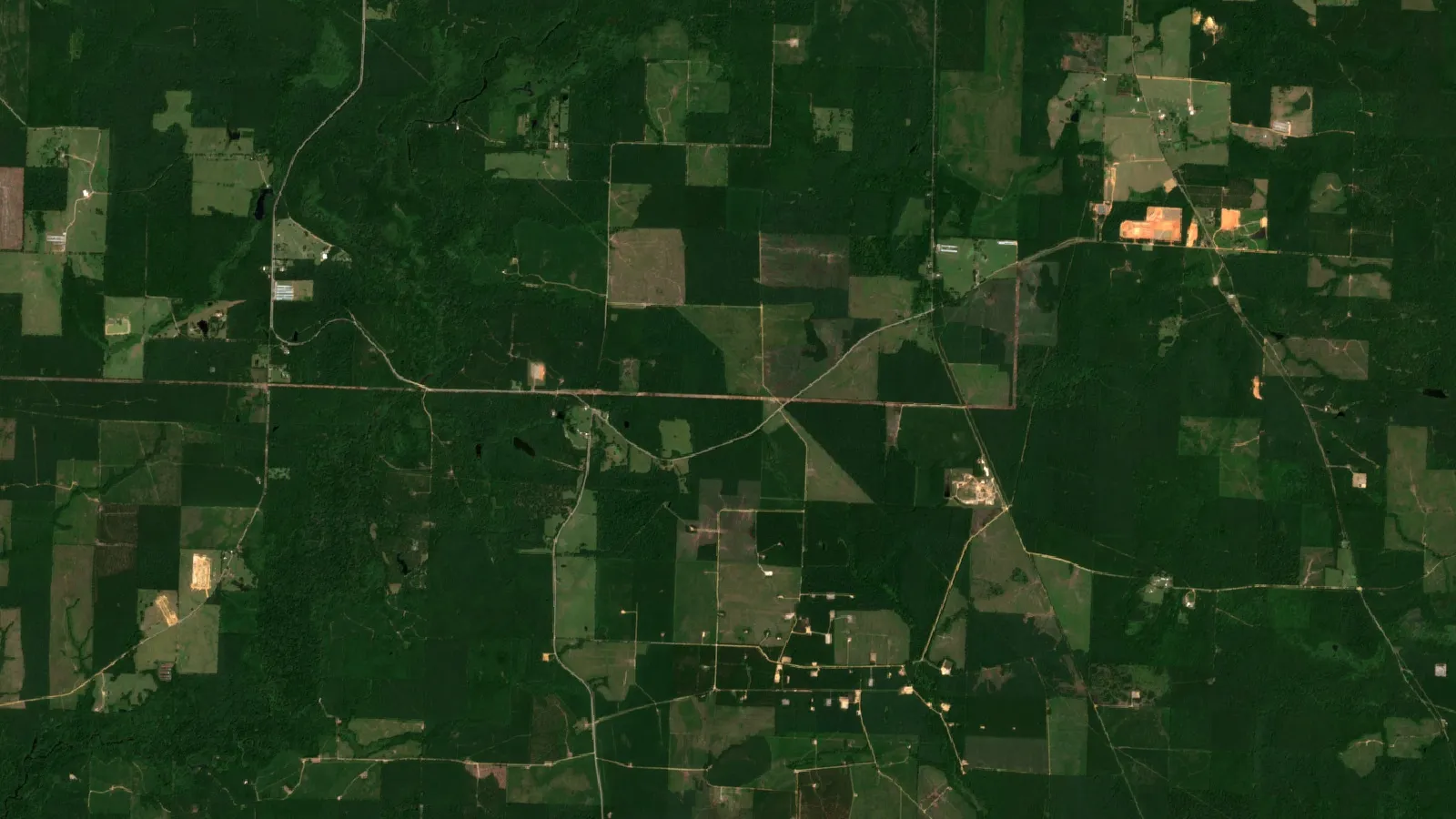
- Satellites cannot see brine at depth; they screen surface geology and land cover, so they suit the small hard-rock occurrences in the Ouachita Mountains.
In this article
- Introduction: Why Focus on Lithium in Arkansas?
- Arkansas Lithium Map Overview & Key Locations
- Lithium deposits in Arkansas: brine units by county
- How much lithium is in Arkansas?
- Arkansas lithium mines: are there any?
- Smackover lithium stocks: who holds what
- Mining, Processing & Environmental Management in Arkansas
- Farmonaut: Satellite-Driven Lithium Mapping & Detection
- Callouts: Key Insights, Pro Tips & Common Mistakes
- FAQ: Arkansas Lithium Exploration & Land Management
- Conclusion: Aligning Lithium Development With Sustainable Growth
Introduction: Why Focus on Lithium in Arkansas?
The Arkansas lithium map is mostly a map of deep brine, not open pits, and no commercial-scale plant is running yet. This guide covers lithium deposits in Arkansas by county, the USGS resource estimate, project status, royalties and what satellites can show, for landowners, investors and planners.
Quick answer. Arkansas lithium sits in salty water, not in a mine. The Smackover Formation, a deep limestone under the south of the state, holds brine that the US Geological Survey (USGS) estimates may contain 5.1 to 19 million tons of lithium in place (USGS, 2024). The brine areas are in Lafayette, Columbia, Union and Miller counties (Arkansas Oil and Gas Commission). No commercial-scale lithium plant is running yet: the South West Arkansas project targets first production in 2029 (Standard Lithium). Hard-rock lithium minerals occur in the Ouachita Mountains but are too weak to be economic so far (Arkansas Geological Survey).
Arkansas Lithium Map Overview & Key Locations
Locating Lithium in Arkansas: A Regional Perspective
Although Arkansas is not traditionally known as a major lithium producer, recent evaluations and the growing relevance of the Arkansas lithium map illuminate a landscape rich with potential. Key regions for lithium exploration and potential extraction are distributed across the southern and southwestern counties. These include, but are not limited to: Union County, Columbia County, Lafayette County, Miller County and Ouachita County (Arkansas Geological Survey). These areas have attracted attention due to their unique brine deposits and geological formations.
- ✔️ Union County: Home to significant historical brine extraction, with lithium-bearing horizons under exploration.
- ✔️ Columbia County: Holds part of the Reynolds Brine Unit and the Evergreen units, set in forested corridors and farmland.
- ✔️ Lafayette County: Holds parts of the Reynolds and Pine brine units, which plan to use direct lithium extraction, one of the new mineral extraction techniques .
The lithium deposits Arkansas features are increasingly relevant, as battery and electric vehicle (EV) supply chains seek secure, domestic sources of critical minerals.
Visual List: Top Lithium Hotspots in Arkansas
- 📍 Union County – Long-running bromine brine units, plus a lithium pilot plant authorized by AOGC orders (LANXESS and Arkansas Lithium Corporation).
- 🌲 Columbia County – Holds parts of the Reynolds, Evergreen and West Brine Field units .
- ✨ Lafayette County – Holds part of the Reynolds Brine Unit, the first lithium brine unit with an approved royalty.
- 💧 Miller & Ouachita Counties – Miller holds part of the Pine Brine Unit and Ouachita is in the state geologist’s resource area; both need environmental safeguards.
Lithium deposits in Arkansas: brine units by county
Most maps of lithium deposits in Arkansas are really maps of brine units. A brine unit is an area that the Arkansas Oil and Gas Commission (AOGC) sets up so one operator can produce brine from the Smackover Formation and pay the owners a share. The state geologist lists Union, Columbia, Miller, Lafayette and Ouachita counties as the Smackover lithium resource area (Arkansas Geological Survey). The table covers the units and projects named on the AOGC lithium page and in company reports, with the stage as last reported.
| Unit or project | Operator | Counties | Stage and latest figures |
|---|---|---|---|
| Reynolds Brine Unit (South West Arkansas project) | SWA Lithium LLC, for Smackover Lithium (Standard Lithium 55%, Equinor 45%) | Lafayette, Columbia | 20,854-acre unit approved in April 2025; 2.5% royalty approved in May 2025; plans 22,500 tonnes a year of lithium carbonate; first production targeted for 2029 (Standard Lithium). Final investment decision still pending in August 2026 (Q2 report). |
| Pine Brine Unit | Saltwerx LLC, an ExxonMobil subsidiary | Lafayette, Miller | AOGC order establishing the unit in 2025 (docket 024-2025-04); the application covered about 56,245 acres (Arkansas Times, April 2025). |
| Evergreen and Evergreen Expansion Brine Units | TETRA Technologies | Lafayette, Columbia | Expansion unit established in 2025 (docket 023-2025-04); a combined Evergreen docket is listed for 2026 (001-2026-01). |
| West Brine Field pilot plant | Albemarle Corporation | Columbia | A 2024 AOGC order (docket 040-2024-07) confirms the lithium chloride pilot plant is not “profitable extraction”. |
| Union County brine units (South, Central Expansion, West Plant) | LANXESS Corporation, with Arkansas Lithium Corporation on the pilot plant | Union | Bromine brine units; AOGC orders from 2022 and 2023 authorize and extend a lithium pilot plant on the South Brine Unit (dockets 092-2022-12, 058-2023-08, 083-2023-10). |
The Smackover does not stop at the state line. The USGS data cover brine wells across the Gulf Coast, and Standard Lithium is also working on a project in East Texas (Standard Lithium, August 2026). To look at maps yourself, start with the Lithium Development Map linked from the AOGC page, then the predicted lithium maps in the USGS fact sheet.
How much lithium is in Arkansas?
USGS and the Arkansas state geologist trained a machine-learning model on brine samples collected from 1965 to 2022. It predicts 5.1 to 19 million tons of lithium, or 27 to 100 million tons of lithium carbonate equivalent (LCE), in the Reynolds oolite unit of the Smackover in southern Arkansas. The range comes from porosity (the share of rock that is open space holding brine, 10 to 30%) and from low, median and high lithium predictions (Knierim and others, Science Advances, 2024). This is metal in place, not reserves: the authors did not test how much is technically recoverable. For scale, the authors compared it with the 2023 US lithium resource estimate of 14 million tons (about 36% to 136%). USGS has since raised its US figure: the 2026 Mineral Commodity Summaries give 30 million tons of measured and indicated US lithium resources, so the Arkansas range is about 17% to 63% of that.
Chart
USGS estimate of lithium in place, Smackover brine
Million tons of lithium, by model case and porosity
Grade matters more than the headline tonnage. The model’s average predicted lithium in the brine is about 96 to 119 mg/L (milligrams per liter), and the highest value in the southern Arkansas brine data is 477 mg/L. Standard Lithium’s feasibility study for the South West Arkansas project uses an average of 481 mg/L over the plant life. It reports 447,000 tonnes LCE of proven reserves and a measured and indicated resource of 1.18 million tonnes LCE at 442 mg/L (Standard Lithium, 2025). Reserves are the part shown to be economic; resources are not. USGS reports metric tons of lithium metal, while the company reserves are in tonnes of lithium carbonate equivalent (LCE), so check metal versus LCE before you compare.
Chart
Lithium in Smackover brine: model average vs project grade
Milligrams of lithium per litre of brine (mg/L)
Arkansas lithium mines: are there any?
Not at present. Arkansas has no operating lithium mine, and the projects under way are brine wells and extraction plants, not open pits. The Arkansas Geological Survey records a second type of lithium in the Ouachita Mountains: lithium minerals such as cookeite and taeniolite in quartz veins in Polk, Montgomery, Garland, Perry, Saline, Hot Spring and Pulaski counties, and lithium tied to the alkaline rocks of the Magnet Cove complex (Arkansas Geological Survey). The Survey says these occurrences are not concentrated enough to be considered economic, and little exploration has taken place outside Magnet Cove.
A brine project works differently from a mine. Wells bring salty water to the surface, and a direct lithium extraction (DLE) unit pulls the lithium out of it. The South West Arkansas project plans to use a sorption process licensed from Aquatech (Standard Lithium). For the full range of lithium deposit types, see our guide to pegmatite, brine and clay lithium deposits.

▶ Farmonaut video: a satellite lithium exploration case study in Nigeria. · 10:49
Smackover lithium stocks: who holds what
Facts only, from the AOGC list and company reports. This is not investment advice, and a listing below is not a recommendation.
| Company | Listing | Role in the Arkansas Smackover |
|---|---|---|
| Standard Lithium | TSXV and NYSE American: SLI | 55% of Smackover Lithium and operator of the South West Arkansas project. At 30 June 2026 it reported cash of US$137.3 million and no debt (Q2 report). |
| Equinor ASA | Oslo and NYSE: EQNR | 45% partner in Smackover Lithium. |
| ExxonMobil Holdings Corporation (formerly Exxon Mobil Corporation) | NYSE: XOM | Holds the Pine Brine Unit through Saltwerx LLC, an ExxonMobil subsidiary (Lafayette and Miller counties). The listed parent changed to a Texas holding company on 1 July 2026; the ticker did not change. |
| TETRA Technologies | NYSE: TTI | Operates the Evergreen units (Lafayette and Columbia counties). |
| Albemarle | NYSE: ALB | Pilot plant in the West Brine Field, Columbia County. |
| Occidental | NYSE: OXY | Objected to the Pine unit application, saying it may own brine interests there (Arkansas Times, April 2025). |
On 31 August 2026 Smackover Lithium signed a binding offtake (a contract to buy the plant’s output) with LG Energy Solution for 8,000 tonnes a year of lithium carbonate over 10 years, worth about US$1.5 billion. With the Trafigura contract of March 2026, roughly 90% of the target offtake volume was committed at that date (Arkansas Department of Commerce, 31 August 2026). On 28 September 2026 Smackover Lithium added an option for up to 4,000 more tonnes a year to the Trafigura contract, which lifts possible offtake to 20,000 tonnes a year, above its 18,000-tonne target (Standard Lithium release, 28 September 2026). The final investment decision was still pending. Price is the other swing factor. China’s lithium carbonate price fell to about CNY 100,000 per tonne in mid-October 2026, the lowest in nearly ten months (Trading Economics, “Lithium Slides to 10-Month Low”, 15 October 2026), while the feasibility study assumed US$22,400 per tonne. Check today’s price before you use either number in the calculator below.
Chart
South West Arkansas offtake vs plant size
Tonnes of lithium carbonate per year
Calculator
How much lithium carbonate can a brine well field make?
Enter brine flow, grade, recovery and price. Defaults follow the South West Arkansas feasibility study.
- Lithium metal in that product: 4,220
- Gross revenue at your price (US$ a year): $503,217,610
- Royalty pool at your rate (US$ a year): $12,580,440
Example values only, not a forecast. Defaults use the study’s average brine flow (168,000 barrels a day) and average grade (481 mg/L) from Standard Lithium (2025). The 90% recovery is an example, not a reported figure. One barrel is 0.158987 cubic meters, and 1 mg/L equals 1 g per cubic metre. Lithium carbonate holds 18.8% lithium (factor 5.323). The price is the study’s US$22,400 per tonne assumption: example, use today’s price. Operating costs and taxes are not included.
Mining, Processing & Environmental Management in Arkansas
Extraction Techniques and Surface Impact: Brine vs. Hard Rock
Lithium extraction in Arkansas primarily uses the state’s extensive brine aquifers, especially the Smackover Formation. Compared to hard rock mining, brine extraction can offer reduced surface disturbance (if properly managed), but still poses challenges:
- Water Usage: Processing brine requires significant water input. A 2025 study of environmental impact reports for two Argentine brine projects puts the water footprint at 51.0 and 135.5 cubic meters per tonne of lithium carbonate, with the higher figure for the direct extraction project (Heliyon, 2025). Those are not Arkansas figures, so ask the operator for its permitted water use.
- Byproduct Management: Brine extraction generates spent brine and saline waste to manage. Smackover brine has been produced for bromine since the 1950s, so lithium is an added product from brine that operators already handle (AOGC).
- Containment: Strong lining, containment, and monitoring are essential to prevent leachate from contaminating groundwater used for irrigation and livestock.
Land Reclamation: Returning Sites to Productive Use
Reclamation conditions are set in each permit, so ask the operator and the state for the actual terms. Common goals are:
- 🌱 Restoring surface contour and soil profile for renewed agricultural use.
- 🌳 Replanting with native flora, especially in adjacent forested regions.
- 💧 Water quality monitoring for a period after site closure.
Reclamation plans that incorporate post-mining agricultural, forestry, or recreational uses give surface owners something concrete to agree to.
Royalties, permits and water for Arkansas brine projects
Brine owners inside a unit are paid a royalty that the AOGC sets. In May 2025 the commission approved the first lithium royalty, for the Reynolds Unit: 2.5% of gross lithium revenue, paid quarterly, on top of a brine fee reported at US$65.05 per acre per year (Arkansas Money & Politics, 29 May 2025). Orders for “unleased mineral interest integration” bring owners who have not signed a lease into a unit (AOGC order titles). Check your deed: mineral rights and surface rights can belong to different parties.
On permits, the US Department of Energy finished its environmental review of the South West Arkansas project in the second quarter of 2026 with a finding of no significant impact, a step tied to its US$225 million grant (Standard Lithium, August 2026).

▶ Farmonaut explainer: the seven environmental impacts of mining, in clay animation. · 2:31
Farmonaut: Satellite-Driven Lithium Mapping & Detection
Modernizing Exploration With Satellite Technology
At Farmonaut, we use earth observation, remote-sensing, and AI to bring mineral exploration into the future. Our advanced satellite-based platform supports lithium mapping projects in many countries, helping clients limit environmental disturbance and accelerate resource discovery across large or complex areas.
- 🛰️ Satellite-based mineral detection—limits ground disturbance in early-stage exploration.
- 📊 Rapid prospectivity mapping—shortens early exploration from months to days.
- 🌎 Supports global and local projects—across North America, Africa and other regions.
- 🔬 Target definition—uses multispectral and hyperspectral imaging to map surface rock types and alteration that point to hard-rock lithium targets. It cannot see brine at depth.
Learn more about our satellite based mineral detection and see how it supports sustainable, responsible resource development:
Satellite Based Mineral Detection—Farmonaut
Mapping Your Mining Site with Farmonaut
Precise location intelligence begins by providing your site coordinates or boundaries digitally. Use our interactive mapping platform—Map Your Mining Site Here—to upload your area of interest and select lithium or any other mineral. We then deliver a comprehensive, georeferenced mineral intelligence report, typically within 5–20 business days.
For companies needing 3D prospectivity analysis or smart drilling target recommendations, explore our visual satellite driven 3D mineral prospectivity mapping. This offering is ideal for high-stakes lithium projects looking for the best intersection of geological, environmental, and economic opportunities.
- ✔️ Streamlined workflow—efficient digital communication, minimizing delays.
- 🛡️ ESG-aligned exploration—no ground disturbance in initial mineral mapping phases.
- 💱 Quantified cost & time savings—up to 80–85% lower early-exploration cost than traditional surveys.
- 💡 Decision-ready reports—professional, GIS-compatible outputs for technical and business users.
To discuss your Arkansas lithium mapping needs or sustainable mineral exploration plans, Get a Quote or Contact Us for more details.
What satellite imagery can and cannot show in Arkansas
Satellites cannot see brine in rock several kilometres down. They can show what is at the surface: cleared pads and roads, forest and wetland cover, and flooding around a lease. For hard-rock lithium, such as the Ouachita quartz veins, multispectral data can map rock units and alteration before anyone walks the ground. A satellite report is a screening step that ranks exploration targets ahead of a resource estimate. It does not replace sampling or an environmental review.
▶ Farmonaut explainer: what remote sensing for mining measures, in three minutes. · 2:01
Callouts: Key Insights, Pro Tips & Common Mistakes
Satellite screening helps most on surface hard-rock targets. For Smackover brine, the evidence is wells, brine samples and state unit orders.
Check who owns the surface and who owns the brine before you plan access: they can be different parties.
Treating a USGS in-place estimate as a reserve. Only reserves have been tested for economics.
Arkansas lithium map data changes as new wells, unit orders and company updates arrive. Check the AOGC list and company releases for the latest status. Not investment advice.
Sound reclamation plans—not just high lithium grades—differentiate market-leading projects in investor and regulatory eyes.
FAQ: Arkansas Lithium Exploration & Land Management
What is the Arkansas lithium map, and why is it important?
An Arkansas lithium map shows where lithium-rich Smackover brine has been measured and which brine units regulators have approved. The Arkansas Oil and Gas Commission and the USGS publish the main public maps, and they guide exploration and land and water planning. Most Arkansas lithium sits in Smackover brine in Lafayette, Columbia, Union and Miller counties, and the state geologist also lists Ouachita County.
Are there any lithium mines in Arkansas?
No lithium mine is operating. The projects are brine wells with extraction plants, and the first commercial-scale plant is targeted for 2029 (Standard Lithium).
How much lithium is in Arkansas?
USGS estimates 5.1 to 19 million tons of lithium in place in Smackover brine in southern Arkansas. That is an in-place model estimate, not a reserve (USGS, 2024).
Which companies are developing Arkansas lithium?
Standard Lithium and Equinor (Smackover Lithium), ExxonMobil (through Saltwerx), TETRA Technologies and Albemarle all appear in AOGC orders (AOGC). The table above lists each unit. Not investment advice.
When will Arkansas lithium production start?
Smackover Lithium targets first commercial production from the South West Arkansas project in 2029, after a final investment decision that it targets for 2026 (Standard Lithium, August 2026). These are company targets, not confirmed dates.
How is the Arkansas lithium royalty set?
The Arkansas Oil and Gas Commission sets it unit by unit. The first approved rate, for the Reynolds Unit in May 2025, was 2.5% of gross lithium revenue plus a brine fee (Arkansas Money & Politics).
Can satellites map lithium in Arkansas?
Not the brine itself, which lies far below the surface. Satellites can screen surface geology for hard-rock lithium and monitor land cover around leases. Public brine maps come from the AOGC and USGS.
Conclusion: Aligning Lithium Development With Sustainable Growth
The Arkansas lithium map is mostly a map of brine units. USGS estimates 5.1 to 19 million tons of lithium in place, but only units with approved orders, project-grade brine above 440 mg/L and signed offtake contracts are close to production. First commercial production is targeted for 2029, after a final investment decision that the company still targets for 2026. Check unit orders, royalty terms and today’s lithium price before you decide anything.
Next step:
For forward-thinking geologists, mining companies, planners, and rural stakeholders, sustainable lithium exploration in Arkansas is mostly a brine story; satellites help on surface hard-rock ground. To map your own site, Map Your Mining Site Here with our satellite-driven platform (reports typically take 5-20 business days) or Get a Quote to start your project consultation.
This page is for information only. It is not investment advice or legal advice. Company names and tickers are facts, not recommendations. Confirm brine rights, unit rules and royalties with the Arkansas Oil and Gas Commission. Satellite results are exploration targets that sit ahead of a resource estimate.
Farmonaut mining
Screen your ground from space
Request a quote to screen a claim or licence area with satellite data and get ranked exploration targets for surface-exposed lithium, ahead of a resource estimate.

Mining Pro sample view, synthetic data
Keep reading
Sources
- Knierim and others, Evaluation of the lithium resource in the Smackover Formation brines of southern Arkansas (Science Advances, 2024): pmc.ncbi.nlm.nih.gov
- USGS, Fact Sheet 2024-3052: Lithium resource in the Smackover Formation brines of southern Arkansas: pubs.usgs.gov
- Arkansas Geological Survey, Critical Minerals in Arkansas: geology.arkansas.gov
- Arkansas Oil and Gas Commission, Lithium from brine: orders and dockets: dataexplorer.aogc.arkansas.gov
- Standard Lithium, South West Arkansas project page (DFS highlights): standardlithium.com
- Standard Lithium, Second Quarter 2026 Results (Nasdaq, 10 August 2026): nasdaq.com
- Arkansas Department of Commerce, Smackover Lithium offtake with LG Energy Solution (31 August 2026): commerce.arkansas.gov
- Arkansas Times, Exxon, Standard Lithium asking state to approve 70,000 acres of lithium brine production (21 April 2025): arktimes.com
- Arkansas Money & Politics, Arkansas approves first lithium royalty rate (29 May 2025): armoneyandpolitics.com
- Trading Economics, Lithium Slides to 10-Month Low (15 October 2026): tradingeconomics.com
- Heliyon, The water footprint of lithium extraction technologies: Argentina’s salt flats (2025): pmc.ncbi.nlm.nih.gov
- Standard Lithium, Form 6-K release on Trafigura offtake option (SEC, 28 September 2026): sec.gov
Discussion
Questions, corrections or field experience? Share them below. First-time comments are reviewed before they appear, and your email is never published.
No comments yet. Be the first to add a question or your experience.

 Geotech Mining Solutions plc
 Vulcan International Limited
 Kidepo Associates
 GKY Mining
 Alkimy SARL
 Double A Trading
 GemSprout Metals Limited
 Qader Group
 Ileys General Trading
 SG Gold Mining LLC
 VRV Global Pte Ltd
 Omsri International FZE
 G.I.T.T.
 Jaunita Erss Ltd
 Almosi SARL
 SRK Consulting
 Berks Gold Limited
 Mwerezi Minerals Company Limited
 Mining SARL
 SenGold Invest SAS

 Exploration consultancy · South Africa · Gold










