

Lithium deposits · World and US map guide
World Lithium Deposits Map: Top Countries and Key Mines
Chile and Australia hold the most lithium reserves (9.2 and 8.4 million tonnes), Australia mines the most, and the United States has one producing mine (USGS, 2026). Country charts, 12 key mines with owners and status, US deposits and a lithium-to-carbonate calculator.
Key takeaways
- World lithium reserves are about 37 million tonnes: Chile 9.2 million, Australia 8.4 million, China 4.6 million, Argentina 4.4 million and the United States 4.4 million (USGS, Mineral Commodity Summaries 2026).
- World mine output was about 290,000 tonnes in 2025 (estimate): Australia 92,000, China 62,000 and Chile 56,000. US output is withheld and not in the total (USGS, 2026).
- Identified resources are about 150 million tonnes: United States 30 million, Argentina 28 million and Bolivia 23 million. Resources are not reserves (USGS, 2026).
- The only producing US lithium mine is Silver Peak, Nevada, running since 1965; BLM approved its expansion on 27 February 2026. In June 2026 the USGS estimated 1.43 million tonnes of undiscovered lithium oxide in the southern Appalachians.
- Battery-grade lithium carbonate averaged US$63,700 a tonne in 2022 and an estimated US$9,000 in 2025, in real dollars (USGS, 2026).
In this article
- World lithium reserves by country
- Lithium resources: where the largest deposits are mapped
- Lithium production by country
- Lithium deposit types: brine, pegmatite, clay and geothermal
- Key lithium mines and projects on the world map
- Open the official maps
- Lithium deposits in the United States
- Lithium in Africa, Canada and Europe
- Lithium price and why the map keeps changing
- How to read lithium numbers: lithium, lithia and carbonate
- How satellites help map lithium targets
- What to check before you act on a point on a lithium map
- Frequently asked questions
On a world map of lithium, the largest reserves sit in Chile (9.2 million tonnes of contained lithium) and Australia (8.4 million), followed by China, Argentina and the United States. The USGS counts about 37 million tonnes of reserves worldwide and about 290,000 tonnes of mine output in 2025 (an estimate). Australia mined the most (92,000 tonnes), then China (62,000) and Chile (56,000). The United States has one producing lithium mine, in Nevada.
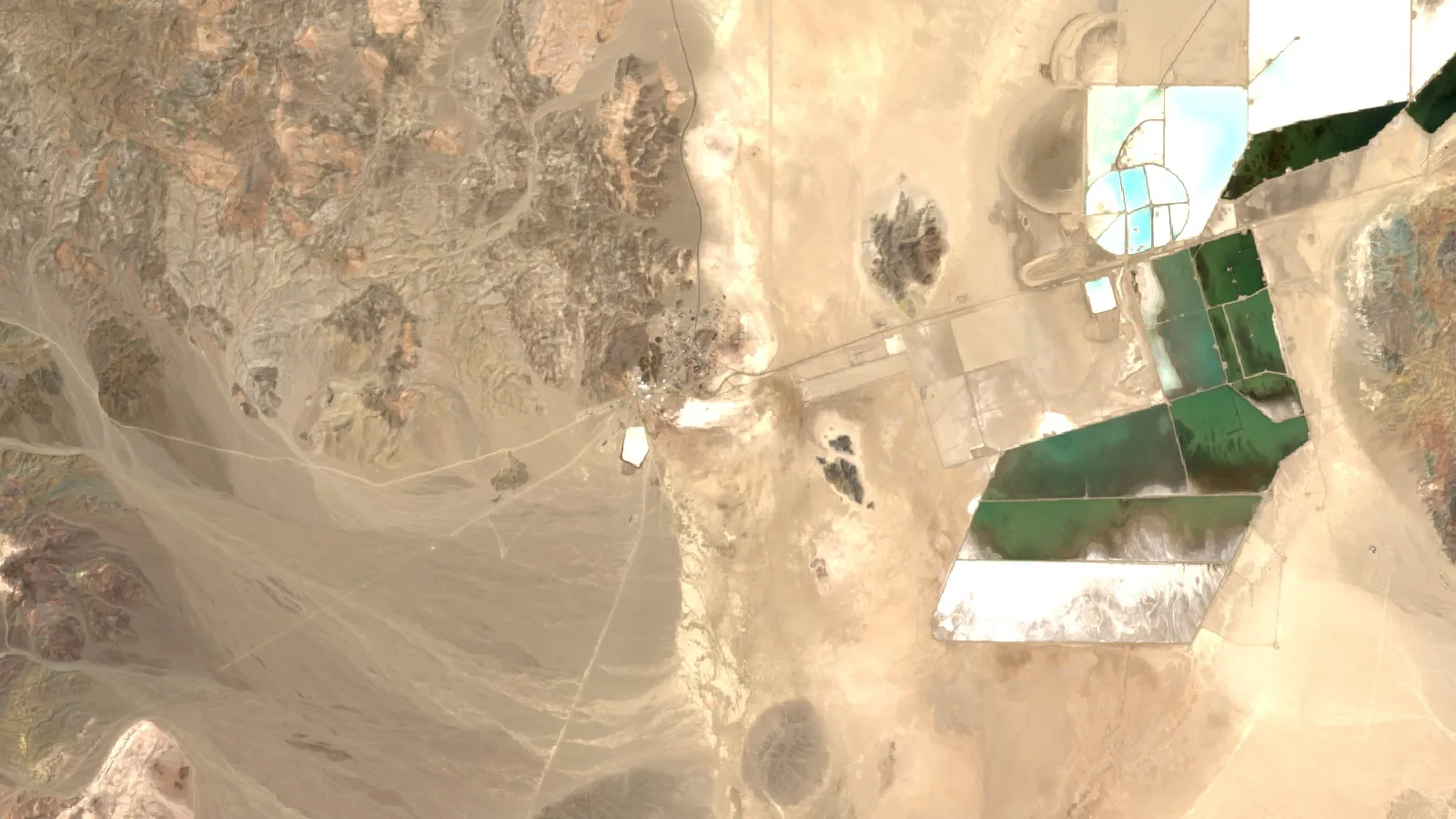
This page puts those numbers on the map. It ranks countries by reserves, resources and output, lists 12 key mines and projects with their owners and status as filed in 2026, and goes through the United States deposit by deposit. It also explains why the figures are quoted in three different units, with a calculator that converts between them. The satellite picture at the top shows Clayton Valley in Nevada, the dry lake bed where the Silver Peak brine operation sits.
Terms used below. A reserve is the part of a deposit that can be mined at a profit with today’s methods and prices. A resource is the wider amount that has been located and measured, whether or not it pays today. Brine is salty water pumped from underground. A pegmatite is a coarse-grained igneous rock, and spodumene is its main lithium mineral. Li2O (lithia) and LCE (lithium carbonate equivalent) are other ways to state the same metal, explained near the end. The USGS gives its country figures as tonnes of lithium content.
World lithium reserves by country
Ten countries are named in the USGS reserve table. Chile leads with 9.2 million tonnes, then Australia with 8.4 million. China has 4.6 million, Argentina 4.4 million and the United States 4.4 million. Canada has 1.6 million, Brazil 540,000 and Zimbabwe 500,000, with Mali (370,000) and Portugal (60,000) the smallest. Other countries add 2.4 million tonnes, which brings the world total to 37 million. The USGS revised the 2026 reserve figures for Argentina, Australia, Brazil, Canada, Chile, China, the United States and Zimbabwe using company and government reports.
Chart
Lithium reserves, eight leading countries
Thousand tonnes of contained lithium; USGS reserve estimates, 2026 edition
Check the footnote before quoting Australia. The 8.4 million tonnes is the USGS figure, and reserves that meet the JORC Code or an equivalent standard are 5.1 million tonnes (JORC is the Australasian rulebook for reporting mineral resources and reserves). The two numbers measure different things, so state which one you use. For a wider comparison with another metal, see our page on global lithium and uranium reserves.
Lithium resources: where the largest deposits are mapped
Resources are far bigger than reserves because they include deposits that are not yet worth mining. The USGS puts measured and indicated lithium resources at about 150 million tonnes worldwide, of which 30 million tonnes are in the United States and 120 million in other countries. The United States figure covers continental brines, claystone, geothermal brines, hectorite, oilfield brines and pegmatites. Argentina follows with 28 million tonnes and Bolivia with 23 million, then Chile (13), Australia (10), China (10), Germany (8.9) and Canada (8.1).
Chart
Measured and indicated lithium resources, leading countries
Million tonnes of lithium; the US figure covers brines, claystone, geothermal brines, hectorite, oilfield brines and pegmatites
Bolivia shows why a resource map and a mine map differ. It has the third-largest resource on the list but no entry in the USGS production table, and the USGS lists Bolivian brine sources among those still in development or exploration. Smaller resources the USGS names include Congo (Kinshasa) at 3 million tonnes, Mexico at 1.7 million, Brazil at 1.4 million, Czechia at 1.3 million, Mali at 1.2 million and Serbia at 1.2 million.
Lithium production by country
World mine output rose about 31% in 2025 to roughly 290,000 tonnes, from 222,000 in 2024, according to the USGS. That total leaves out United States production, which the agency withholds to protect company data. Australia, China and Chile together produced about 210,000 tonnes of the 2025 world total. Batteries take 88% of lithium use, and world consumption was estimated at 263,000 tonnes in 2025.
Chart
Lithium mine production, eight countries
Thousand tonnes of contained lithium; United States withheld by the USGS
The USGS counts the operations behind those tonnes: seven mineral (hard-rock) operations in Australia, nine mineral and six brine operations in China, four brine operations in Argentina, two brine operations in Chile, five mineral operations in Zimbabwe, two in Mali, two in Canada and one in Brazil. The USGS notes that Namibia was temporarily removed from mine production because of legal uncertainties.
Lithium deposit types: brine, pegmatite, clay and geothermal
Where lithium sits on the map depends on how it formed. The USGS database of United States lithium sites separates closed-basin brines, lithium-cesium-tantalum (LCT) pegmatites, lithium-bearing clays, oilfield brines and geothermal reservoirs. The table shows where each type is found and one example from this page.
| Type | What it is | Where on the map | Example |
|---|---|---|---|
| Closed-basin brine | Lithium-rich salty water under a dry lake bed, pumped into ponds or a plant | Chile, Argentina, China, Nevada | Salar de Atacama; Clayton Valley |
| LCT pegmatite | Coarse granite-like rock with spodumene and related minerals, mined in open pits | Australia, Zimbabwe, Canada, North Carolina | Greenbushes; Pilgangoora; Kings Mountain |
| Lithium clay | Clay-rich sediment that holds lithium, mined in an open pit and processed | Nevada, Mexico | Thacker Pass |
| Oilfield brine | Salty water produced with oil and gas, rich in lithium | Arkansas | Smackover Formation |
| Geothermal brine | Hot brine from geothermal power wells | California | Salton Sea |
The USGS says lithium-clay sources were in development or exploration in Mexico and the United States in 2025. Brine sources were at some stage of work in Argentina, Bolivia, Canada, Chile, China and the United States.
Key lithium mines and projects on the world map
How we chose: this is a selection, not a ranking and not a complete list. Each row is a mine or project that a company filing, a regulator or a government survey places in operation or in advanced development in 2026, picked to cover every deposit type and main region above. Tanco is the exception: it is included as a reference pegmatite deposit, with no owner or current status given. The sources I opened give no coordinates, so the table gives country and region instead, and China, Zimbabwe and Mali have no row because I could not source an owner for a specific mine. Owners and status come from the filings linked in the notes below the table, and each row carries its date where the source gives one, because these facts change.
| Deposit | Type | Country and region | Operator or owner | Status in the source |
|---|---|---|---|---|
| Salar de Atacama | Brine | Chile | NovaAndino Litio: SQM’s Salar de Atacama unit merged with Codelco’s subsidiary | SQM announced the merger complete on 27 December 2025, subject then to a court appeal (later outcome not checked here). SQM manages to 2030 and Codelco from 2031 to 2060. |
| Fénix, Salar del Hombre Muerto | Brine | Argentina | Rio Tinto (100%) | Line 1B ramp-up under way (Rio Tinto, 14 October 2026). |
| Olaroz | Brine | Argentina | Rio Tinto (66.5% in its production table) | Output hit by maintenance and weather in the third quarter of 2026. |
| Rincon | Brine | Salta, Argentina | Rio Tinto (100%) | 60,000 t a year carbonate expansion; first production planned for 2028. |
| Greenbushes | Pegmatite | Western Australia | Talison Lithium, owned 51% by TLEA (Tianqi Lithium Energy Australia, in which IGO holds 49%) and 49% by Albemarle | 1.35 Mt of spodumene concentrate in 2025; resource 457 Mt at 1.6% Li2O. |
| Pilgangoora | Pegmatite | Pilbara, Western Australia | PLS Group (100%) | 879,543 t of spodumene concentrate in the year to 30 June 2026. |
| Tanco | LCT pegmatite | Manitoba, Canada | Not stated | Manitoba Geological Survey calls it a world-class deposit; current status not stated here. |
| Silver Peak | Brine | Clayton Valley, Nevada | Albemarle | BLM approved an expansion on 27 February 2026; operating since 1965. |
| Thacker Pass | Clay | Humboldt County, Nevada | Joint venture: Lithium Americas 62%, GM 38% | Mechanical completion targeted for late 2027 (company, 13 August 2026). |
| Kings Mountain | Pegmatite | North Carolina | Albemarle | Federal permitting complete on 30 March 2026; state and local approvals continue. |
| South West Arkansas | Oilfield brine | Arkansas | Smackover Lithium: Standard Lithium 55%, Equinor 45% | First commercial production targeted for 2029; the company page lists a final investment decision as the next step. |
| Hell’s Kitchen | Geothermal brine | California | Controlled Thermal Resources | An appeals court sent the county’s environmental review back in August 2026. |
Notes on the table. SQM’s filing gives the Atacama merger date, and the partnership site gives the 2030 and 2031 management handover. The Argentine rows come from Rio Tinto’s third-quarter 2026 production report; Rio Tinto owns these assets after it completed its US$6.7 billion purchase of Arcadium Lithium. Greenbushes figures are from IGO’s February 2026 resource update, and ownership is from IGO’s 2026 annual report. The Pilgangoora figure is from the PLS 2026 annual report. The Tanco row follows the Manitoba Geological Survey.
Greenbushes stands out for grade. IGO’s annual report describes it as having the highest ore reserve grade of any hard-rock lithium mine in the world, and the February 2026 update added a first underground resource of 132 Mt at 1.5% Li2O below the open pit. Grade means the share of lithium oxide in the rock. IGO’s statement is a company claim, so treat it as one.
Two more details from the filings. Rio Tinto lists Rincon as a 3,000 t a year starter plant plus a 57,000 t a year expansion in Salta province. PLS reports that Pilgangoora ore averaged 1.31% Li2O in the year, and that concentrate shipments averaged 5.3% Li2O.
Open the official maps
These are the interactive and downloadable maps behind the numbers on this page, all published by the USGS. The USMIN viewer shows mine and prospect symbols on topographic maps and offers web map services and state KMZ files for Google Earth. The Lithium Deposits in the United States data release gives site descriptions for about 20 sites. The Basin and Range playa maps rank lithium-brine prospects from satellite data. For places outside the United States, the USGS Mineral Resources Data System remains its best collection of reports, though updates stopped in 2011. National geological surveys hold newer data.
Lithium deposits in the United States
The USGS puts United States reserves at 4.4 million tonnes and measured and indicated resources at 30 million. Output is withheld, but the agency says commercial production came from one continental brine operation in Nevada. Imports were 3,800 tonnes in 2025 (an estimate), exports 2,000 tonnes, and net import reliance stayed above 50%. Chile supplied 54% of imports and Argentina 43% over 2021 to 2024.
A USGS data release lists about 20 United States sites with more than 15,000 tonnes of contained lithium metal or past production, in Arkansas, California, Nevada, North Carolina and Utah. To plot mines and prospects yourself, the USGS USMIN service offers web map services and state-by-state KMZ downloads of mine and prospect symbols taken from topographic maps.
Nevada: the only producing operation, and the next big mine
Clayton Valley is the sole lithium brine-producing playa in the United States, in the words of a USGS prospectivity study of Basin and Range playas. BLM approved the expansion of Albemarle’s Silver Peak mine in Esmeralda County on 27 February 2026. The mine is authorised on 8,058 acres, 1,601 of them public land, has run since 1965 and is the only producing lithium mine in the country, BLM says.
Thacker Pass in Humboldt County is a lithium clay project. Its operator, Lithium Americas, reported on 13 August 2026 that more than 1,600 workers were on site, mechanical completion was still targeted for late 2027, and Phase 1 is designed for 40,000 tonnes a year of battery-quality lithium carbonate. The company estimates total Phase 1 capital cost at US$2.93 billion (December 2024 technical report; the company notes later cost pressures, such as tariffs, are not in that figure) and says cumulative advances on its US Department of Energy loan reached US$1.209 billion. The company also says Thacker Pass holds the largest known measured lithium resource in the world. That is its own claim.
Appalachians: pegmatites in the Carolinas
North Carolina’s Kings Mountain pegmatite belt produced lithium until the Kings Mountain and Hallman-Beam mines closed in the 1990s, the USGS says. Albemarle’s Kings Mountain project finished federal permitting on 30 March 2026, the 12th mining project to do so under the FAST-41 process and the first completed project of any kind in North Carolina. The company says it still needs state and local approvals.
In June 2026 the USGS estimated 1.43 million tonnes of undiscovered, economically recoverable lithium oxide in the southern Appalachians, mostly in the Carolinas, and 900,000 tonnes in the northern Appalachians. Both numbers are median estimates of deposits not yet found, so they are not reserves. For the contained undiscovered lithium oxide before economic screening, the USGS paper gives a median of 2.24 million tonnes, a 90% chance of at least 130,000 tonnes and a 10% chance of 10.7 million tonnes.
Arkansas and California: brines still in development
In October 2024 USGS researchers estimated 5 to 19 million tonnes of lithium in place in Smackover Formation brines in southwest Arkansas, and said they had not estimated how much is technically recoverable. Standard Lithium and Equinor’s South West Arkansas project plans an initial 22,500 tonnes a year of carbonate. The company’s project page targets first commercial production in 2029 and says the project would be the first commercial lithium production from the Smackover Formation.
A 2023 U.S. Department of Energy fact sheet on the Salton Sea region, based on Lawrence Berkeley National Laboratory work, labels three tiers of lithium: 760 kilotons proven, 2,600 accessible today and 3,400 probable with future technology. The sheet does not say whether the tiers add up, so do not sum them. Progress has been slower than hoped. CalMatters reported in September 2026 that the Hell’s Kitchen project was delayed by lawsuits and that an appeals court had sent the environmental review back to Imperial County to fix water and air quality gaps.
For other United States maps in this series, see our guides to rare earth deposits in the US and the US gold deposits map.
Lithium in Africa, Canada and Europe
Zimbabwe has five mineral operations, 28,000 tonnes of 2025 output, reserves of 500,000 tonnes and resources of 860,000 tonnes in the USGS tables. Mali moved from a minor producer to 9,400 tonnes in 2025 and holds 370,000 tonnes of reserves and 1.2 million of resources. For the continent as a whole, see our guide to lithium in Mali, Zimbabwe and Ghana.
Nigeria appears on the USGS list of countries with mineral-based lithium sources in development or exploration. A 2025 review in Frontiers in Geochemistry says Nigeria’s lithium sits in pegmatite fields in Kogi, Nasarawa, Ekiti, Kwara, Cross River, Oyo and Plateau states, in minerals such as lepidolite, spodumene, petalite and amblygonite. The same review lists Kushaka in Niger State among pegmatite sites with petalite. Do not mix this up with the Republic of Niger. The USGS 2026 lithium summary names Nigeria but not Niger, so a map that shows commercial lithium in Niger needs its own source.
Canada has two mineral operations, 5,600 tonnes of 2025 output, reserves of 1.6 million tonnes and resources of 8.1 million. The Manitoba Geological Survey says granitic pegmatite holds the largest known lithium resources in that province, in the Winnipeg River to Cat Lake pegmatite field, which includes the Tanco deposit. For Quebec, see our guide to spodumene in James Bay, and for Australia our page on Australian spodumene deposits.
In Europe the USGS lists resources of 8.9 million tonnes in Germany, 1.3 million in Czechia, 1.2 million in Serbia, 1 million in France, 320,000 tonnes in Spain and 260,000 in Portugal. Portugal is the only European country with mine output in the table, at 380 tonnes a year in both 2024 and 2025, against reserves of 60,000 tonnes.

▶ Walks through a satellite-based lithium study of Nigeria’s pegmatite regions, using Sentinel-2 spectral indices and statistical anomaly detection. · 10:49
Lithium price and why the map keeps changing
Price decides which part of a resource becomes a reserve, so the map moves with it. The USGS gives the annual average price of battery-grade lithium carbonate in real dollars: US$63,700 a tonne in 2022 and an estimate of US$9,000 in 2025, about 86% lower. The agency says low prices led some producers to cut output or postpone expansions in 2025, yet capacity grew in Argentina, Brazil, Canada, Chile, China, Mali, the United States and Zimbabwe.
Chart
Battery-grade lithium carbonate, annual average price
US dollars per tonne, real (constant) dollars as published; 2025 is an estimate
Spot prices moved the other way in the second half of 2025. The USGS reports that Chinese spot carbonate rose from about US$9,300 a tonne in January to about US$10,300 in November, and Australian spodumene (6% Li2O, f.o.b. Australia, meaning loaded at the port) from about US$800 to US$970. On 15 October 2026 Trading Economics showed Chinese lithium carbonate at CNY 104,400 a tonne, about 43% above a year earlier and 21% below a month earlier. Use a price you have checked on the day when you run the calculator below.
How to read lithium numbers: lithium, lithia and carbonate
The same deposit can be quoted three ways, and mixing them up is a common source of error when comparing lithium maps. The USGS reports contained lithium metal. Mining companies in hard-rock projects usually report grade as Li2O, and the chemical plant sells lithium carbonate. Using the molar masses listed by PubChem for lithium carbonate (73.9) and lithium oxide (29.9) and an atomic weight of 6.94 for lithium, one tonne of lithium metal equals about 2.15 tonnes of Li2O and about 5.32 tonnes of LCE. One tonne of Li2O equals about 2.47 tonnes of LCE.
That is why Greenbushes at 1.6% Li2O is not a 1.6% lithium deposit: the metal content is about 0.74%. The calculator below turns an ore tonnage and a Li2O grade into carbonate equivalent, then applies your own recovery and price. It gives gross carbonate value, not mine value, because it ignores mining, processing and royalty costs.
Calculator
How much carbonate is in your lithium ore?
Enter your own ore tonnage, Li2O grade, recovery and price.
- Lithium metal contained (kt): 464
- Recoverable carbonate (kt LCE): 1,729
- Gross value of that carbonate (US$ million): $15,561
Example values only, not a benchmark and not a resource estimate. Conversion factors use the molar masses listed by PubChem (lithium carbonate 73.9, lithium oxide 29.9) and a lithium atomic weight of 6.94: 1 tonne of Li2O is about 2.47 tonnes of carbonate equivalent (LCE) and 0.464 tonnes of lithium. The 1% grade and 70% recovery are assumed examples. Price is an input: example, use today’s price; USGS gave US$9,000 a tonne as the 2025 annual average in real dollars. The result is gross carbonate value only: spodumene concentrate sells at a different price, and mining, processing and royalty costs are not deducted. Amounts are in US dollars.
How satellites help map lithium targets
Satellites cannot read lithium grade from orbit, and lithium is hard to see directly. What they can do is rank ground. The USGS ranked the playas of the Basin and Range using size, the presence of source rocks, vegetation as a sign of water, known prospects and data from the ASTER sensor, which covers a 60-kilometre swath. That kind of screen shortlists basins before anyone drills or leases.
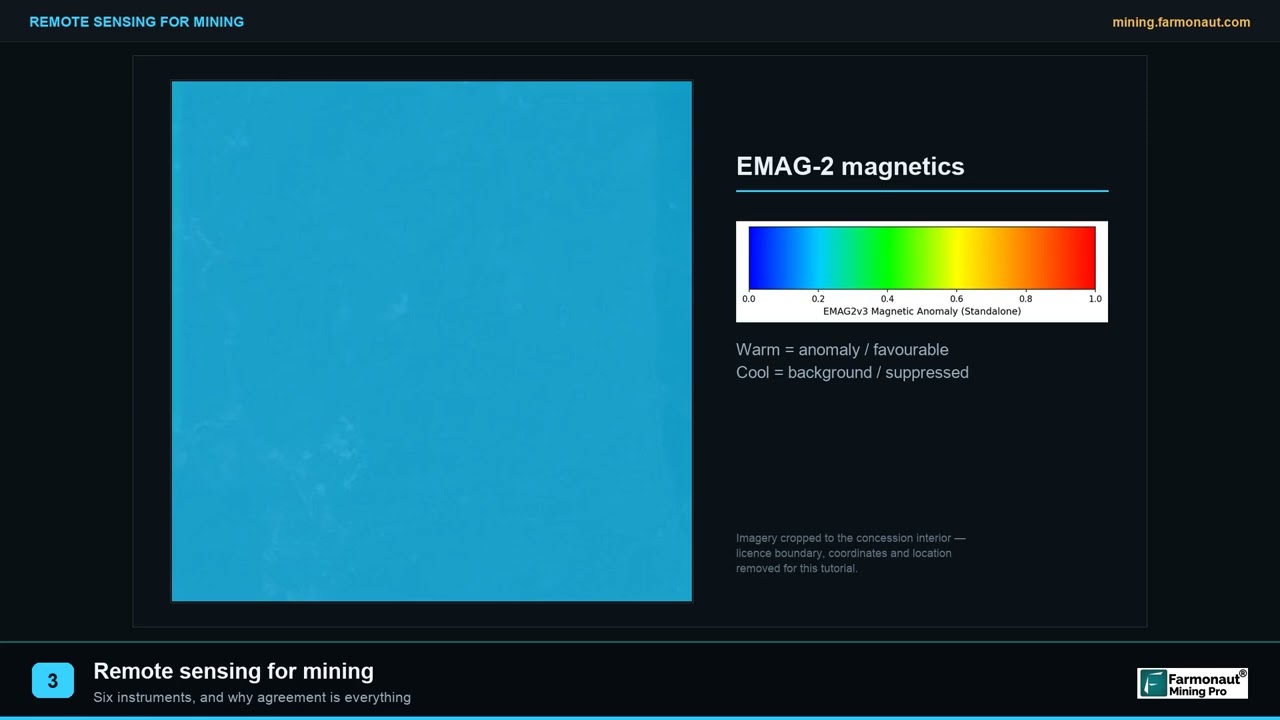
▶ Explains that remote sensing means measuring the ground from a distance, and why agreement between six instrument families is the core of the argument. · 2:01
It cannot tell you the brine chemistry, the depth of the brine, who holds the tenure, or whether water and permits are available. Farmonaut works at the first step: it screens a licence boundary sent as KML, KMZ or a polygon for lithium and more than 20 other minerals and returns satellite-derived exploration targets in 5 to 20 business days. Those targets sit ahead of any resource estimate and do not meet JORC or NI 43-101 rules. See the satellite mineral detection service, ask for a quote on the mining query form, or contact us.
What to check before you act on a point on a lithium map
- Find who holds the ground. A mine on a map can sit on land that is already staked or licensed. Use the national cadastre; our guide to mining cadastre portals lists where to look.
- Read the resource category. Measured and indicated resources carry more confidence than inferred ones, and only a reserve has passed economic tests.
- Check the unit. Ask whether a figure is lithium metal, Li2O or LCE, and whether it is in the ground or in a saleable product.
- Check the type. Brine, pegmatite and clay need different water, power, reagents and permits.
- Check the dates. Owners, schedules and court rulings change often. Every status in the table above carries its source date.
Frequently asked questions
Which country has the most lithium?
It depends on the measure. By reserves, Chile leads with 9.2 million tonnes of lithium and Australia follows with 8.4 million. By identified resources, the United States has about 30 million tonnes and Argentina 28 million, ahead of Bolivia at 23 million (USGS, 2026).
Which country produces the most lithium?
Australia, with an estimated 92,000 tonnes in 2025, then China at 62,000 and Chile at 56,000. The USGS figure for the world, about 290,000 tonnes, leaves out United States production.
Where are the lithium deposits in the United States?
The USGS lists sites in Nevada, Arkansas, California, North Carolina and Utah. Nevada has the producing Silver Peak brine operation and the Thacker Pass clay project under construction. Arkansas holds oilfield brines in the Smackover Formation, California has geothermal brines at the Salton Sea, and North Carolina has the Kings Mountain pegmatite belt.
How much lithium does the United States have?
The USGS counts 4.4 million tonnes of reserves and 30 million tonnes of measured and indicated resources. It also estimates 1.43 million tonnes of undiscovered recoverable lithium oxide in the southern Appalachians and 900,000 tonnes in the northern Appalachians. Net import reliance was above 50% in 2025.
What is the difference between lithium reserves and resources?
A resource is lithium that has been located and measured. A reserve is the part that can be mined at a profit under current conditions. The resource number is always larger, and a rise in price can move tonnes from one to the other.
Is there lithium in Nigeria and Niger?
Nigeria has lithium-bearing pegmatites in states including Kogi, Nasarawa, Ekiti, Kwara, Cross River, Oyo and Plateau, and the USGS lists it among countries with sources in development or exploration. The USGS 2026 summary does not name the Republic of Niger. Niger State is a Nigerian state, which is a common source of confusion.
Is there a lithium map I can download?
For the United States, the USGS publishes a data release of about 20 lithium sites and the USMIN service with KMZ files by state. For other countries, the USGS Mineral Resources Data System (MRDS) is its best collection of reports, although the agency stopped systematic updates in 2011. Check national geological surveys for newer data.
What is lithium carbonate equivalent (LCE)?
LCE restates lithium from any source as the weight of lithium carbonate it would make. One tonne of lithium metal equals about 5.32 tonnes of LCE, using the molar masses of lithium carbonate and lithium.
How much is lithium worth per tonne?
The USGS estimated an annual average of US$9,000 a tonne for battery-grade carbonate in 2025, down from US$63,700 in 2022 (real dollars). On 15 October 2026 Trading Economics showed Chinese carbonate at CNY 104,400 a tonne. Prices change daily, so check a live source.
How do satellites help find lithium?
They rank large areas by clues such as basin size, source rocks, vegetation and alteration minerals, so teams can choose where to sample. They do not measure lithium grade, and any target still needs ground sampling and drilling.
This page is for information only. It is not investment advice. Reserve, resource and production figures, owners and project status change often, so check the latest filing before you rely on them.
Farmonaut mining
Map your mining site from space
Consultants can send a licence boundary as KML, KMZ or a polygon and receive satellite-derived exploration targets for lithium and 20+ other minerals, ahead of any resource estimate.
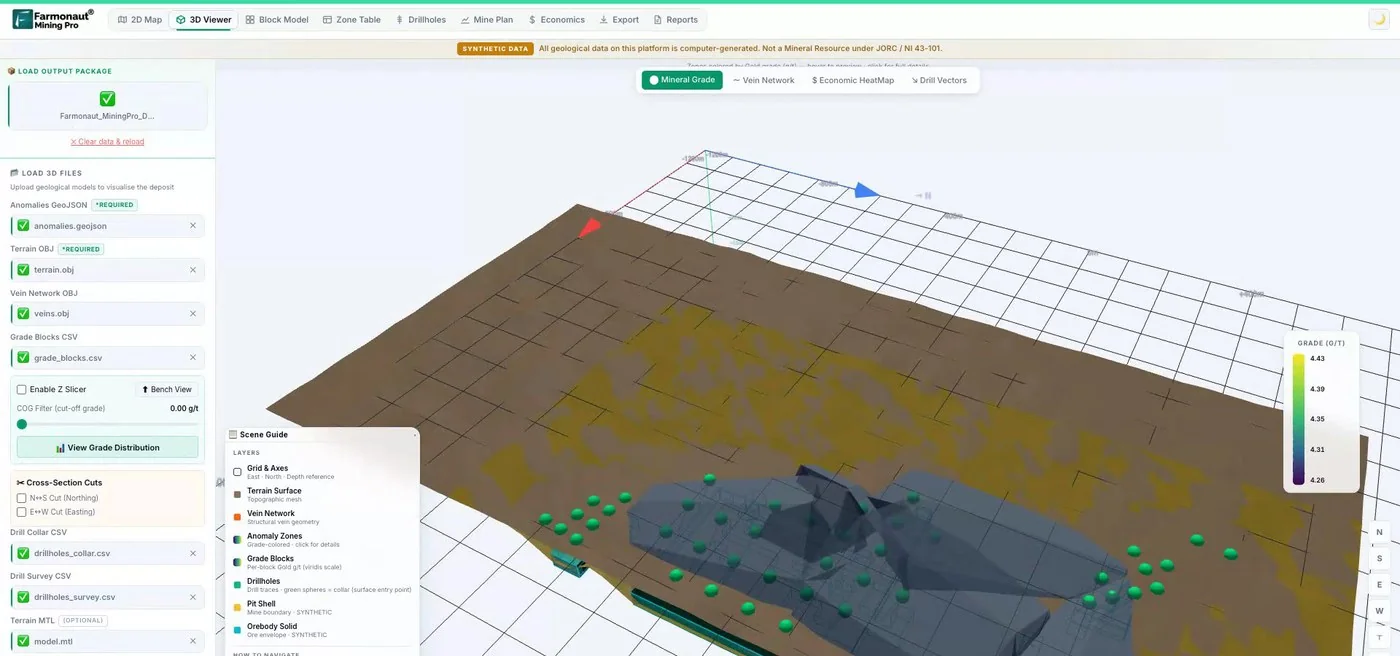
Mining Pro sample view, synthetic data
Keep reading
Sources
- USGS, Mineral Commodity Summaries 2026: Lithium (February 2026): pubs.usgs.gov
- USGS news release, Lithium in Carolinas could replace imports for a century or more (18 June 2026): usgs.gov
- USGS data release, Lithium Deposits in the United States: data.usgs.gov
- USGS, Scientific Investigations Map 3554: Spectral characteristics and mapping of lithium-rich playas in the Basin and Range Province: pubs.usgs.gov
- USGS, USMIN: prospect- and mine-related features on USGS topographic maps: mrdata.usgs.gov
- BLM, BLM approves Silver Peak lithium mine expansion (27 February 2026): blm.gov
- Lithium Americas, Second Quarter 2026 results (13 August 2026): nasdaq.com
- Permitting Council, Kings Mountain lithium project completes federal permitting (30 March 2026): permitting.gov
- Standard Lithium, South West Arkansas project page: standardlithium.com
- US Department of Energy, Improved Quantification of Lithium Resources in the Salton Sea Region (November 2023): energy.gov
- CalMatters, Is California’s ‘lithium valley’ dream fading? (September 2026): calmatters.org
- SQM, Form 6-K: completion of the association agreement with Codelco (27 December 2025): sec.gov
- Codelco and SQM, NovaAndino Litio partnership page: acuerdocodelcosqm.cl
- Rio Tinto, Third quarter 2026 production results (14 October 2026), Form 6-K: sec.gov
- Rio Tinto, Arcadium Lithium acquisition completed: riotinto.com
- IGO, Greenbushes CY25 resource and reserve estimates (ASX release, 12 February 2026): igo.com.au
- IGO, Annual Report 2026: igo.com.au
- PLS Group, Annual Report 2026 (24 August 2026): pls.com
- Manitoba Geological Survey, Lithium in Manitoba: manitoba.ca
- Olajuyi and others, Mechanistic insights into Nigerian lithium ores, Frontiers in Geochemistry (2025): frontiersin.org
- Trading Economics, Lithium carbonate price (viewed 15 October 2026): tradingeconomics.com
- PubChem, Lithium carbonate (CID 11125): pubchem.ncbi.nlm.nih.gov
- PubChem, Lithium oxide (CID 166630): pubchem.ncbi.nlm.nih.gov
- USGS, Mineral Resources Data System (MRDS): mrdata.usgs.gov
Discussion
Questions, corrections or field experience? Share them below. First-time comments are reviewed before they appear, and your email is never published.
No comments yet. Be the first to add a question or your experience.

 GKY Mining
 Alkimy SARL
 Double A Trading
 GemSprout Metals Limited
 Qader Group
 Ileys General Trading
 SG Gold Mining LLC
 VRV Global Pte Ltd
 Omsri International FZE
 G.I.T.T.
 Jaunita Erss Ltd
 Almosi SARL
 SRK Consulting
 Berks Gold Limited
 Mwerezi Minerals Company Limited
 Mining SARL
 SenGold Invest SAS
 Sean Mining Limited
 NTS Group (Pty) Ltd










