

Copper minerals · Field and process guide
Atacamite Mineral: Formula, Properties and Where It Forms
A green copper chloride that marks the oxide zone of dry-climate copper deposits. Here is how to identify it, where it is mined and why its chlorine matters in the leach plant.
Key takeaways
- Atacamite is Cu2Cl(OH)3; the pure mineral is about 59.5% copper and 16.6% chlorine (Webmineral, Handbook of Mineralogy).
- It forms when copper sulfides weather under arid, saline conditions, which is why it is common in Chile’s Atacama Desert.
- It is listed as an ore mineral at Chuquicamata, and Mantos Blancos began heap leaching atacamite ore in 1961 (SONAMI).
- Dissolving one tonne of atacamite releases about 166 kg of chloride into the leach solution.
- Chile mined an estimated 5.3 million tonnes of copper in 2025, the most of any country (USGS).
In this article
- Atacamite formula and composition
- Atacamite properties and identification
- How atacamite forms
- Where atacamite is found
- Atacamite mining in Chile
- How atacamite ore is processed
- Atacamite grade and value: what licence owners should check
- Copper market context
- Other uses of atacamite
- Frequently asked questions
Atacamite is a green copper chloride hydroxide mineral with the formula Cu2Cl(OH)3. Pure atacamite holds about 59.5% copper by weight (Webmineral), and it forms where copper sulfides weather in dry, salty ground, which is why it was first described from Chile’s Atacama Desert. For a licence owner, consultant or investor it matters for one practical reason: it is a copper ore in oxide zones, but its chlorine changes how that ore is leached and refined.
This guide covers the formula and composition, how to tell atacamite from look-alikes, where it forms and where it is mined, how oxide plants treat it, and what to check on a property that shows green copper staining. A calculator near the end turns an atacamite content into a copper grade and an example metal value.
Atacamite formula and composition
The chemical formula is Cu2Cl(OH)3: two copper atoms, one chlorine atom and three hydroxide groups. Copper is in the +2 (cupric) state, so chemists call it a copper(II) chloride hydroxide. Mineralogists group it with the copper halides, because chlorine is a halogen (Wikipedia).
Chart
What pure atacamite is made of
Percent by weight, ideal Cu2Cl(OH)3
The Handbook of Mineralogy gives the ideal composition as 55.87% CuO, 16.60% Cl and 12.65% H2O (with an oxygen correction for chlorine). Expressed as elements, that works out to roughly 59.5% copper, 16.6% chlorine, 22.5% oxygen and 1.4% hydrogen. Analysed samples from Collahuasi in Chile and Boleo in Mexico sit within a fraction of a percent of these ideal values.
Two numbers matter on a mine site. First, the copper content is high: one tonne of pure atacamite contains close to 595 kg of copper, more than chalcopyrite (about 34.6% copper) and similar to malachite (about 57.5%). Second, every tonne of atacamite dissolved in acid releases about 166 kg of chloride into the leach solution. That chloride is the reason plants treat atacamite ore differently from carbonate or silicate oxide ore.
Polymorphs: paratacamite, clinoatacamite and botallackite
Atacamite shares its formula with three other minerals: botallackite, clinoatacamite and paratacamite. These are polymorphs, meaning the same chemistry with a different crystal structure (Handbook of Mineralogy). In a drill log or an assay report the difference rarely matters: all four are copper hydroxy-chlorides, all dissolve in acid, and all add chloride to the circuit. Process papers and patents often write “atacamite/paratacamite” for that reason.
Atacamite properties and identification
Atacamite crystallises in the orthorhombic system. It grows as slender prisms up to about 10 cm long, as tabular crystals, as fibres, or as granular and massive crusts (Handbook of Mineralogy). The key properties for field identification are in the table.
| Property | Atacamite | What it tells you |
|---|---|---|
| Formula | Cu2Cl(OH)3 | Copper ore that carries chlorine |
| Colour | Bright green, emerald green to blackish green | Darker than most malachite |
| Streak | Apple green | Rub on unglazed porcelain |
| Lustre | Adamantine to vitreous | Glassy, often sparkling crystal faces |
| Hardness (Mohs) | 3 to 3.5 | Scratched by a steel knife |
| Density | About 3.75-3.78 g/cm3 | Heavier than quartz (2.65) |
| Cleavage | Perfect in one direction | Splits into thin plates |
| Crystal system | Orthorhombic | Prismatic, striated crystals |
| Reaction to dilute acid | Dissolves without fizzing | Separates it from malachite and azurite |
Hardness, density, streak, lustre and crystal data are from the Handbook of Mineralogy. Mohs hardness is a scratch scale from 1 (talc) to 10 (diamond); a value of 3 to 3.5 means a knife blade or a copper coin edge will mark it.
Atacamite vs malachite, brochantite and chrysocolla
Several green copper minerals occur together in oxide zones, and hand-specimen identification is often uncertain. Useful field tests:
- Malachite (copper carbonate) fizzes in dilute hydrochloric acid and is usually banded and lighter green. Atacamite does not fizz.
- Brochantite (copper sulfate hydroxide) looks very similar; a sulfate test or a laboratory method is normally needed to separate them.
- Chrysocolla (hydrated copper silicate) is blue-green, softer, opaque and often glassy-enamel in look, without crystal faces.
- Atacamite tends to form sharp dark-green prisms with a bright lustre and a pale apple-green streak.
For a resource or metallurgical decision, do not rely on colour. X-ray diffraction (XRD) or automated mineralogy on drill core identifies the species, and a chloride assay on oxide samples shows how much chlorine the ore will add to a leach. The core sample logging and assay guide covers how those samples are collected.
How atacamite forms
Atacamite is a secondary mineral. It does not crystallise from the original ore fluids; it forms later, near the surface, when primary copper sulfides such as chalcopyrite, bornite and chalcocite are exposed to oxygen and water. The Handbook of Mineralogy describes it as an oxidation product of other copper minerals, “especially under arid, saline conditions”.
Infographic
How atacamite forms in 4 steps
- 1Sulfides exposedErosion brings chalcopyrite and chalcocite close to surface.
- 2OxidationOxygen and water dissolve copper from the sulfides.
- 3Salty groundwaterDry climate concentrates chloride in soil and groundwater.
- 4Atacamite precipitatesCopper and chloride crystallise as Cu2Cl(OH)3 in the oxide zone.
In a typical porphyry copper deposit the top of the system is weathered into three layers: a leached cap at surface, an oxide zone below it, and a supergene enrichment blanket of chalcocite above unweathered (hypogene) sulfide ore. The USGS porphyry copper deposit model lists atacamite among the common copper minerals of oxide ores, with malachite, azurite, cuprite, tenorite, chrysocolla and native copper. The same report notes that copper in “exotic” oxide deposits, where copper-rich water travelled sideways out of the porphyry and precipitated in gravels, is mostly chrysocolla, copper wad and atacamite.
Chlorine is the limiting ingredient. In very dry deserts, groundwater and soil collect salts, including sodium chloride, because rain rarely flushes them out. Where these chloride-rich waters meet dissolving copper, atacamite is the stable copper mineral. In wetter climates the same copper usually ends up as malachite or chrysocolla instead. That is why the mineral is abundant in the Atacama and in other arid copper belts, and only a minor species elsewhere.
Atacamite also forms in three less common settings: as a deposit around volcanic fumaroles (Vesuvius and Etna in Italy), as a weathering product of sulfide chimneys (“black smokers”) on the sea floor, and as a corrosion crust on ancient bronze and copper objects (Handbook of Mineralogy). For general background on how oxide and supergene zones fit into deposit types, see our guide to types of ore deposits and the porphyry copper deposits guide.
Where atacamite is found
The mineral was first described in 1802 from an undefined locality in the Atacama Desert, which gave it its name (Wikipedia). Small amounts occur in many copper deposits worldwide. Localities named in the Handbook of Mineralogy include:
Chart
Top copper mine producers
Thousand tonnes of copper, 2025 estimate
- Chile: Copiapó, Carrizal, Tierra Amarilla and Remolinos in the Atacama Region; Collahuasi in Tarapacá; and Chuquicamata in Antofagasta, where it is listed as an ore mineral.
- Mexico: Boleo, Baja California.
- United States: Bisbee in Cochise County and the Mammoth-St. Anthony and San Manuel mines in Pinal County, Arizona, with large amounts reported in the Santa Cruz porphyry deposit; the Tintic district in Utah.
- Australia: large crystals from Moonta, the Burra district and Mt. Howden in South Australia.
- Europe and Central Asia: Vesuvius and Etna in Italy, Laurium in Greece (in old slag), the Ural Mountains of Russia, Kazakhstan, and Caldbeck Fells in Cumbria, England.
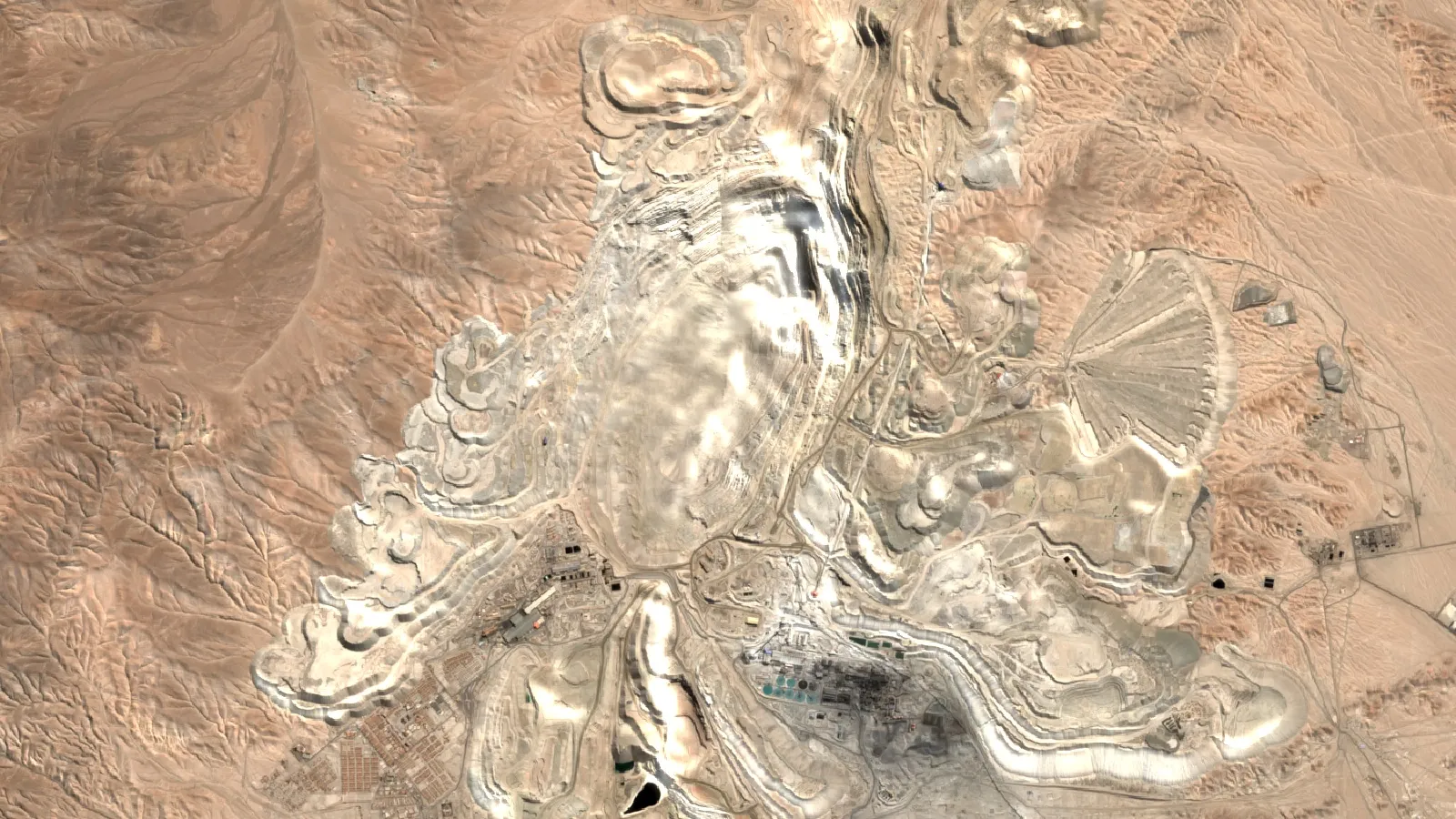
Chile matters most because it combines huge porphyry copper systems with one of the driest climates on Earth. It was the world’s largest copper mine producer in 2025, at an estimated 5.3 million tonnes of contained copper, and holds an estimated 180 million tonnes of reserves (USGS Mineral Commodity Summaries 2026). For a wider view of copper countries and ore types, see where copper is found.
Atacamite mining in Chile
Atacamite is not mined on its own. It is one of several copper minerals in the oxide part of a deposit, and it is treated with the rest of the oxide ore. Two Chilean examples show how this works in practice.
Mantos Blancos
Mantos Blancos, near Antofagasta, is a classic atacamite operation. A Chilean industry presentation on seawater hydrometallurgy records that Mantos Blancos began heap leaching atacamite ore in 1961 with sulfuric acid in solutions carrying 25-35 grams per litre of chloride (SONAMI). The mine is now owned by Capstone Copper (TSX: CS, ASX: CSC), which runs both a sulfide concentrator and a cathode plant there. In the second quarter of 2026 Mantos Blancos produced 9,600 tonnes of copper in concentrate and 2,882 tonnes as cathode (Capstone Copper Q2 2026 results).
Chuquicamata and other oxide plants
At Codelco’s Chuquicamata, atacamite is recorded as an ore mineral (Handbook of Mineralogy). The same SONAMI review lists the Tocopilla plant (1987) and the Lince plant (late 1991) as early Chilean operations that leached ore in chloride-rich solutions; Lince overcame chloride transfer to the electrowinning stage and still produced grade A cathode. Other Chilean operations named in that review for chloride leaching include Las Luces and Mantos de la Luna.
For a list of the companies that run these mines, see the largest copper mining companies. This page gives facts only and is not investment advice.
▶ Copper mining explained: why so much of the world’s copper starts in the Atacama Desert. · 6:03
How atacamite ore is processed
Oxide copper ore, including atacamite, is normally treated by hydrometallurgy rather than by flotation and smelting. The standard route has three steps:
- Leaching (LX): crushed ore is stacked on lined pads and irrigated with dilute sulfuric acid. Atacamite dissolves readily, releasing copper and chloride into the pregnant leach solution (PLS).
- Solvent extraction (SX): an organic reagent picks up copper from the PLS and transfers it into a clean, concentrated electrolyte.
- Electrowinning (EW): electric current plates copper from the electrolyte onto cathode sheets of about 99.99% purity.
The chlorine in atacamite is the main process issue. Chloride carried from SX into the electrolyte can corrode lead anodes and steel cathode blanks and spoil cathode quality, so plants with chloride-rich ore control entrainment carefully, wash the loaded organic and bleed solutions. Another approach, described in US patent 4,292,281, washes chloride out of atacamite/paratacamite ore with a basic sodium, potassium, calcium or magnesium salt before acid leaching, and bleeds the wash solution for chloride disposal.
Chloride is not always a problem. Several Chilean operations have deliberately added salt or used seawater in leaching, because chloride speeds up the leaching of secondary sulfides such as chalcocite (SONAMI). On those sites, the chloride released by atacamite is less of a burden than on a plant designed for low-chloride sulfate solutions.
Hydrometallurgy also carries an energy cost. Chile’s copper commission Cochilco estimates that producing electrowon cathodes used 4.9 TWh of electricity in 2025, 18% of the copper industry’s demand, falling to a projected 13% by 2034 as oxide deposits run down and concentrator output grows (Cochilco).
Atacamite grade and value: what licence owners should check
Green staining at surface is a useful clue, but it is not a resource. A property with visible atacamite needs answers to five questions before anyone can put a value on it:
- How much copper is soluble? Ask for total copper and acid-soluble copper assays. Atacamite is acid soluble; chalcopyrite is not.
- How much chloride is there? A chloride assay tells the buyer or the plant how the ore will behave in SX-EW.
- How thick and continuous is the oxide zone? Oxide zones are often tens of metres thick and can be patchy. Drilling, not surface sampling, defines tonnes.
- What sits underneath? An oxide cap may sit above an enrichment blanket or primary sulfides, which need a concentrator rather than a leach pad.
- Is there a plant within trucking distance? Small oxide deposits often only work if ore can be sold to an existing leach or SX-EW plant.
Grade is the share of metal in rock, given here as percent copper (% Cu). Because pure atacamite is about 59.5% copper, an ore containing 1% atacamite by weight carries about 0.6% copper from that mineral alone. Use the calculator below with your own assay numbers; the price is an input. On 5 November 2026 copper traded at about US$6.27 per pound (Trading Economics); check the day’s price before using it.
Satellite imagery can help before drilling. Iron-oxide staining, clay alteration and the outline of leached caps show up in multispectral data, which helps decide where to sample first. Farmonaut’s satellite-based mineral detection maps these surface signs over a licence area; any target still needs sampling and drilling to confirm copper. The same caution applies to other oxide ores; our guide to oxidized gold ore covers the gold equivalent.
Calculator
How much copper does your atacamite ore hold?
Enter your own tonnage, atacamite content, recovery and copper price.
- Copper grade from atacamite (% Cu): 0.60
- Contained copper (tonnes): 595
- Chloride released if all atacamite dissolves (tonnes): 166
- Gross value of recoverable copper (US$): $5,903,862
Example values only, not a benchmark. Copper share of atacamite (59.51%) and chloride share (16.6%) are from Webmineral and the Handbook of Mineralogy. Copper from other minerals in the ore is not counted. Price is an input: example, use today’s price. 1 tonne = 2,204.62 lb.
▶ Remote sensing for mining in plain words: the main instrument families and what each measures. · 2:01
Copper market context
Atacamite ore is sold as copper, so its value tracks the copper price. The London Metal Exchange grade A cash price averaged 384.8 US cents per pound in 2023, 414.7 cents in 2024 and an estimated 440 cents in 2025 (USGS). Prices moved higher again in 2026: Trading Economics records an all-time high of about US$6.85 per pound in September 2026 and a price of US$6.27 on 5 November 2026.
Chart
LME copper cash price, annual average
US cents per pound
World mine production was about 23 million tonnes of copper in 2025, led by Chile, Congo (Kinshasa) at 3.2 million tonnes and Peru at 2.7 million tonnes (USGS). Higher prices can make smaller, lower-grade oxide deposits worth leaching, but they also bring more competition for plant capacity, acid and water in northern Chile.
Other uses of atacamite
Outside mining, atacamite has a few notable roles:
- Pigment: it has been identified as a green pigment in sculpture, manuscripts, maps and frescoes (Wikipedia).
- Corrosion product: it forms part of the green patina on ancient bronze, which conservators study and sometimes treat because chloride-bearing corrosion can keep attacking the metal.
- Biomineral: bloodworms (Glycera) build atacamite into their jaws, a rare example of a copper mineral made by an animal (Wikipedia).
- Collector specimens: well-formed crystals from Chile and South Australia are sought by mineral collectors.
These uses are small. The economic value of atacamite is the copper it contains.
▶ What satellite exploration cannot do: the limits to understand in mining due diligence. · 2:08
Frequently asked questions
What is the formula of atacamite?
Cu2Cl(OH)3, a copper(II) chloride hydroxide. Paratacamite, clinoatacamite and botallackite share the same formula with different crystal structures.
How much copper is in atacamite?
About 59.5% copper by weight in the pure mineral, plus about 16.6% chlorine. Real ore contains far less, because atacamite is mixed with rock.
Is atacamite a copper ore?
Yes. It is a copper ore in the oxide zones of deposits in dry climates and is listed as an ore mineral at Chuquicamata. It is leached together with other oxide copper minerals.
Where does the name atacamite come from?
From the Atacama Desert in northern Chile, where it was first described in 1802.
How can you tell atacamite from malachite?
Malachite fizzes in dilute acid and is usually banded and lighter green; atacamite does not fizz, is darker green and often forms sharp prisms. Laboratory XRD confirms the species.
Is atacamite rare?
Good crystals are uncommon, but small amounts occur in many copper deposits. It is abundant only where arid, salty conditions let chloride-rich water react with weathering copper ore.
Why does chlorine in atacamite matter for processing?
When the ore is leached, the chloride enters the solution. If it reaches electrowinning it can corrode equipment and lower cathode quality, so plants control or remove it.
What is the hardness of atacamite?
3 to 3.5 on the Mohs scale, so a steel knife scratches it. Its density is about 3.76 g/cm3.
Is atacamite toxic?
Like other soluble copper compounds it should not be swallowed or inhaled as dust. Wash hands after handling specimens and do not grind them without a dust mask.
How is atacamite ore turned into copper metal?
By heap or vat leaching with sulfuric acid, solvent extraction and electrowinning, which produces copper cathode on site without a smelter.
Questions about a specific property can go through our mining query form or the contact page.
This page is for information only. It is not investment or legal advice. Sample only with the licence holder’s permission, follow local mining rules, and never use mercury.
Farmonaut mining
Check your copper licence before you drill
Request a quote for a satellite screen of your licence area to see where oxide and alteration signs point first.

Mining Pro sample view, synthetic data
Keep reading
Sources
- Handbook of Mineralogy, Atacamite: handbookofmineralogy.org
- Webmineral, Atacamite mineral data: webmineral.com
- Wikipedia, Atacamite: en.wikipedia.org
- USGS SIR 2010-5070-B, Porphyry copper deposit model: pubs.usgs.gov
- USGS, Mineral Commodity Summaries 2026: Copper: pubs.usgs.gov
- SONAMI, Experiencias de uso de agua de mar en hidrometalurgia: sonami.cl
- Capstone Copper, Q2 2026 results: capstonecopper.com
- US patent 4,292,281, Selective leaching of chloride from copper oxide minerals: patents.google.com
- Cochilco, Proyección de consumo de energía eléctrica de la minería del cobre 2025-2034: cochilco.cl
- Trading Economics, Copper price: tradingeconomics.com
Discussion
Questions, corrections or field experience? Share them below. First-time comments are reviewed before they appear, and your email is never published.
No comments yet. Be the first to add a question or your experience.

 VRV Global Pte Ltd
 Omsri International FZE
 G.I.T.T.
 Jaunita Erss Ltd
 Almosi SARL
 SRK Consulting
 Berks Gold Limited
 Mwerezi Minerals Company Limited
 Mining SARL
 SenGold Invest SAS
 Sean Mining Limited
 NTS Group (Pty) Ltd
 Mine4Africa
 Lithspo Minerals Limited
 Tintina Mining Group

 Licence holder · Nigeria · Gold + lithium
 Client · Somalia · Gold










