

Copper mine profile · Arizona
Bagdad Arizona Mine: Output, Reserves, Expansion
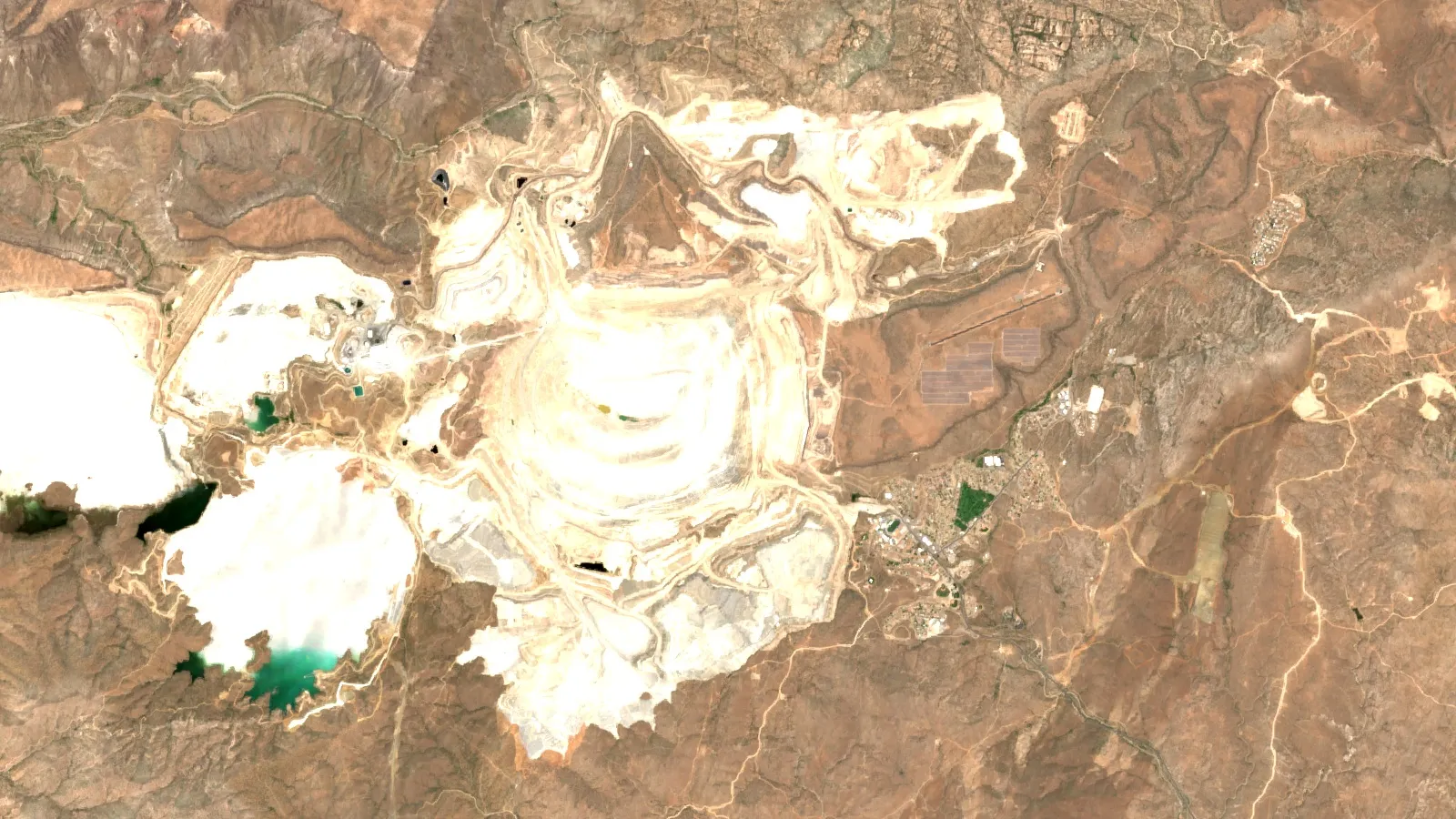
Bagdad is Freeport-McMoRan’s open-pit copper and molybdenum mine in Yavapai County. It made 149 million lb of copper in 2025, and a decision on doubling the mill is due by end-2026.
Key takeaways
- Bagdad made 149 million lb of copper and 11 million lb of molybdenum in 2025 (Freeport 10-K, 2025).
- Mill reserves are 2,567 million tonnes at 0.34% copper; Freeport says reserve life exceeds 80 years.
- Gold is a by-product: about 0.2 million oz recoverable against 16.1 billion lb of copper.
- An expansion would add 200 to 250 million lb of copper a year; a decision is due by end-2026 (Freeport, Oct 2026).
- First-half 2026 copper output was 68 million lb, down from 80 million lb a year earlier (Freeport, July 2026).
In this article
- Bagdad Arizona mine at a glance
- Where is the Bagdad mine and who owns it
- Is Bagdad a copper mine or a gold mine
- How Bagdad turns rock into metal
- Recent output
- Bagdad compared with Freeport's other US copper mines
- Ore reserves and grade at Bagdad
- The planned Bagdad expansion
- Bagdad's numbers in tonnes and short tons
- Why Bagdad matters for US copper supply
- History: from underground workings to autonomous trucks
- Environment and land at a large open pit
- Jobs, tours and visiting Bagdad
- What to check when you study a copper mine
Bagdad Arizona mine at a glance
Bagdad is a large open-pit copper and molybdenum mine in Yavapai County, west-central Arizona. It is wholly owned and operated by Freeport-McMoRan, and it produced 149 million pounds of copper and 11 million pounds of molybdenum in 2025, according to the company’s annual report. That is about 67,600 tonnes (74,500 short tons) of copper, or roughly 7% of the 1.0 million tonnes of US mine output that the US Geological Survey estimates for 2025 (our own division of the two figures).
It is a copper mine first. Gold and silver are small by-products, and Freeport lists Bagdad’s gold as a small reserve by-product. If you came here from a search for gold mines in Arizona, the short answer is in the section on gold below.
- Type: porphyry copper deposit with both sulfide and oxide copper minerals (Freeport 10-K, 2025).
- Mining method: open pit, in continuous operation since 1945, after earlier underground work.
- Mill: concentrator with a design capacity of 77,100 metric tonnes of ore per day.
- Fleet: 33 autonomous 235-tonne haul trucks, loaded by 6 electric shovels and 2 loaders.
- Reserve life: Freeport states that it currently exceeds 80 years.
- Next step: an investment decision on doubling the concentrator is expected by the end of 2026.
Where is the Bagdad mine and who owns it
The mine sits about 60 miles (97 km) west of Prescott and 100 miles (160 km) northwest of Phoenix. The mine road is Arizona Highway 96, which ends at the town of Bagdad. The nearest railroad is at Hillside, 24 miles (39 km) to the southeast. The area is desert, with average rainfall of about 15 inches (380 mm) a year (Freeport 10-K, 2025).
Freeport-McMoRan, headquartered in Phoenix, owns 100% of Bagdad. The land package covers about 61,600 acres (24,900 hectares): 48,300 acres of fee land that Freeport owns outright, and 13,300 acres of unpatented mining claims on public land. An unpatented claim gives the holder the right to mine the minerals but not title to the surface; a fee parcel is ordinary private land. That split matters when you read any US mine’s property description.
Bagdad is one of seven copper operations Freeport manages in the United States. Five are in Arizona (Morenci, Bagdad, Safford, Sierrita and Miami) and two in New Mexico (Chino and Tyrone). For a wider state view, see our guide to copper and gold mining in Arizona.
Is Bagdad a copper mine or a gold mine
Bagdad is a copper and molybdenum mine. Molybdenum is a metal used mainly to harden steel; here it comes from the mineral molybdenite, found in the same rock as the copper. The company’s reserve table lists recoverable metal in the mill ore of about 16.1 billion pounds of copper, 0.9 billion pounds of molybdenum, 0.2 million ounces of gold and 56.5 million ounces of silver. Next to 16.1 billion pounds of copper, the gold is a footnote.
Arizona does have mines that were opened for gold, but Bagdad is not one of them. If you want Arizona gold claims or small-scale prospecting, the rules, costs and ground are a different subject.
How Bagdad turns rock into metal
Copper ore comes in two main kinds, and Bagdad has both. Sulfide ores such as chalcopyrite are crushed and ground, then separated by froth flotation into a concentrate of roughly 30% copper, which goes to a smelter. Oxide ores such as chrysocolla and malachite are treated with weak acid in a process called leaching, and the copper is then recovered from the solution as cathode. The University of Arizona Superfund Research Center explains both routes in plain language.
Infographic
From pit to metal at Bagdad in 5 steps
- 1Drill and blastRotary drills and blasting break rock in the pit.
- 2Haul33 autonomous 235-tonne trucks carry ore and waste.
- 3MillThe concentrator grinds sulfide ore and floats copper and molybdenum concentrates.
- 4LeachLow-grade stockpiles are leached and copper cathode is made by SX/EW.
- 5Moly plantA pressure-leach plant processes the molybdenum concentrate.
At Bagdad the mill produces copper and molybdenum concentrates. A separate plant can make about 9 million pounds of copper cathode a year from solution made by leaching low-grade stockpiles, and a pressure-leach plant processes the molybdenum concentrate. This is leaching of stockpiled rock on the surface, not in-situ leaching of ore left in the ground.
Recent output
Bagdad made 146 million pounds of copper in 2023, 146 million in 2024 and 149 million in 2025 (Freeport 10-K, 2025). Molybdenum moved more: 10 million pounds in 2023, 13 million in 2024 and 11 million in 2025.
Chart
Freeport’s US copper mines: output, first half of 2025 and 2026
Million pounds of recoverable copper, six months to 30 June
The first half of 2026 was lower. Freeport’s second-quarter report for 2026 shows Bagdad at 68 million pounds for the six months to 30 June, against 80 million in the same period of 2025, and 35 million pounds in the second quarter against 44 million a year earlier. One half-year is not a trend. Freeport reports the next quarter on 27 October 2026.
Bagdad compared with Freeport’s other US copper mines
The table below uses Freeport’s own 2025 filing, so it covers the mines Freeport runs and is not a list of every Arizona producer. USGS notes that Arizona accounted for about 70% of US copper output in 2025 and that 17 US mines produced more than 99% of the national total, so other operators matter too.
Chart
Copper produced by Freeport’s US mines, 2025
Million pounds of recoverable copper
| Mine | State | 2025 copper (million lb) | 2024 copper (million lb) |
|---|---|---|---|
| Morenci (Freeport’s 72% share) | Arizona | 497 | 505 |
| Safford, including Lone Star | Arizona | 287 | 249 |
| Sierrita | Arizona | 184 | 165 |
| Chino | New Mexico | 150 | 133 |
| Bagdad | Arizona | 149 | 146 |
| Tyrone | New Mexico | 32 | 43 |
| Miami | Arizona | 9 | 9 |
Bagdad ranks fourth among Freeport’s US mines by 2025 output, behind Morenci, Safford and Sierrita, and just ahead of Chino. Freeport calls Morenci its flagship mine and says the Bagdad expansion would make Bagdad the second largest copper mine in the US, behind Morenci.
Ore reserves and grade at Bagdad
A reserve is the part of a deposit that can be mined at a profit under stated prices and costs. Grade is the share of metal in the rock. At the end of 2025, Bagdad’s mill ore reserves were 2,567 million tonnes at 0.34% copper and 0.02% molybdenum (proven plus probable). Of that, 2,129 million tonnes are proven at 0.34% and 439 million tonnes are probable at 0.31%. Expected recovery in the mill is 84.0% for copper and 76.6% for molybdenum. A smaller leach reserve adds 19 million tonnes at 0.29% copper (Freeport 10-K, 2025).
Chart
Copper in mill ore reserves, kg per tonne
Proven and probable mill reserves, end of 2025 (percent grade times 10)
A grade of 0.34% sounds tiny, but it equals 3.4 kg of copper in every tonne of rock. Chino’s mill ore is richer, and Sierrita’s is poorer. A low-grade mine works only because it moves very large volumes: the fleet can handle an average of 236,000 tonnes of material a day.
The calculator below lets you check the arithmetic with your own inputs. The mill figure is Freeport’s design capacity; the other defaults are Bagdad’s published reserve numbers, and the price is an example only.
Calculator
How much copper is in a mill reserve, and how long is the mill life?
Enter ore tonnes, grade, recovery, mill rate and a copper price of your own.
- Mill life at this rate: 91.2 years
- Gross recoverable copper value: $72,732,803,608
- Contained copper in the ore: 8.7 Mt
Defaults are Bagdad’s published mill reserve, grade, recovery and design mill rate (Freeport 10-K, 2025). The price is an example, use today’s price. Result is gross metal value, not profit; it leaves out costs, royalties and the time value of money.
The planned Bagdad expansion
Freeport has defined a project to more than double Bagdad’s concentrator capacity. According to its July 2026 earnings release, new concentrating facilities would add 200 to 250 million pounds of copper a year and 10 to 12 million pounds of molybdenum a year. That would take the mine from 149 million lb to roughly 350 to 400 million lb a year, more than double today’s output.
- Cost: the 2023 estimate was about US$3.5 billion; the 2026 estimate is about 30% higher and still being finalised.
- Price needed: the economics are supported at an incentive copper price of about US$4.00 per pound.
- Build time: three to four years.
- Decision: Freeport’s operational update of 2 October 2026 says it is finalising work to reach an investment decision by the end of 2026.
Until Freeport announces a decision, the expansion is a plan and not a commitment. Compare the US$4.00 figure with the 2025 average COMEX price of about US$4.80 per pound that USGS estimates. An incentive price is the level Freeport says the project needs to be worthwhile; it is not a forecast.
Bagdad’s numbers in tonnes and short tons
Mining companies report in several unit systems, which makes figures hard to compare. Freeport reports metal in pounds and ore in metric tonnes. A metric tonne is 2,204.6 pounds, and a US short ton is 2,000 pounds. The conversions below are our own arithmetic from the Freeport figures.
| Figure | As reported | Converted |
|---|---|---|
| 2025 copper output | 149 million lb | about 67,600 tonnes, or 74,500 short tons |
| 2025 molybdenum output | 11 million lb | about 5,000 tonnes |
| Expansion, added copper | 200 to 250 million lb a year | about 90,700 to 113,400 tonnes a year |
| Mill capacity | 77,100 tonnes a day | about 28.1 million tonnes a year at full rate |
| Mill reserve | 2,567 million tonnes at 0.34% Cu | about 8.7 million tonnes of contained copper |
| Land package | 61,600 acres | about 24,900 hectares |
Two cautions apply. First, “recoverable” pounds are what the plants are expected to produce after losses in processing; they are lower than the copper in the rock. Second, a mine’s output depends on the grade it happens to mine in a given year, so annual figures move even when nothing changes in the plant. When you read a production figure, always check whether it is a share or 100% of the mine, recoverable or contained metal, and the year.
Why Bagdad matters for US copper supply
USGS estimates that the United States imported about 57% of its apparent copper consumption in 2025 (net import reliance, USGS 2026), and that US mine output fell 5% from 2024 to about 1.0 million tonnes. Against that, a project that adds 90,000 to 113,000 tonnes a year at one mine is a visible share of national supply, roughly 9 to 11% of 2025 mine output. The expansion would also take three to four years to build, so any effect on supply would arrive after the late 2020s at the earliest, and only if Freeport approves it.
History: from underground workings to autonomous trucks
Wikipedia dates the first copper mining at the site to 1882 and says the company town of Bagdad was built to house the workers (Wikipedia). The mine started as a set of underground workings. Freeport reports that the open pit has run continuously since 1945.
The most recent change is in the pit itself. Freeport completed the conversion of Bagdad’s haul trucks to autonomous operation in 2025, which it describes as the first major US mine with a fully autonomous haulage fleet. Seven manned trucks stay for pit development and maintenance work.
Environment and land at a large open pit
An open pit of this size changes the land in several ways: the pit, waste-rock dumps, leach stockpiles, tailings and the water used in the mill. Freeport is working on tailings storage expansion and local infrastructure at Bagdad ahead of any expansion, and says it has enough water sources for current operations and for the expansion (10-K, 2025). The pit’s highest bench is at 1,250 m above sea level, and the final pit bottom is planned at 120 m above sea level.
Federal agencies must carry out a National Environmental Policy Act review before approving mining plans on federal land, and an Arizona permitting guide from the Bureau of Land Management and the Arizona Department of Mines and Mineral Resources lists the other permits a mine may need. The US EPA technical document on copper describes how leach stockpiles, waste rock and tailings are managed at copper sites.
Those are company statements. The detail that outsiders can check is in permits and monitoring data held by regulators, and in time-series satellite images of the footprint. The video below explains the main environmental effects of mining in plain terms.

▶ A plain-language claymation on the seven environmental impacts of mining. · 2:31
Jobs, tours and visiting Bagdad
Bagdad is a working industrial site, not a visitor attraction, and access is controlled. Freeport employs about 13,900 people in the United States (10-K, 2025); the filing does not give a figure for Bagdad alone. Openings for Bagdad appear on Freeport’s own careers pages, and our Bagdad jobs and tours guide covers that topic in more detail.
One documented visit: the Mining History Association held a 2012 field trip to the pit with Freeport as host, with a photo record of the pit overlook, the in-pit crusher and conveyor, and the mill. For any current visit, ask Freeport directly.
What to check when you study a copper mine
If you are a consultant, investor or licence holder comparing mines like Bagdad, these checks come from the way the 10-K is built:
- Basis of the figures. Is production on a 100% basis or the company’s share (Morenci is 72%)? Is it recoverable metal or contained metal?
- Reserve versus resource. Reserves carry economic assumptions; resources do not. Read the price used.
- Tenure. Fee land and unpatented claims carry different rights, as at Bagdad’s 48,300 and 13,300 acres.
- Recovery. The mill recovers 84.0% of copper here; leaching on stockpiles recovers much less (43.9% from the run-of-mine leach reserve).
- Price sensitivity. A project that needs US$4.00 per pound may not go ahead if prices fall.
- By-products. Molybdenum, silver and gold change the economics. USGS reports that in the US molybdenum from by-product mines came from seven operations, four of them in Arizona (USGS, 2026).
Satellite data suits the early part of this work. It can map alteration and rock contrasts across a licence area and track a pit’s footprint over time, giving exploration targets that come ahead of any resource estimate. Farmonaut does this for licence areas from a polygon or KML file. For the deposit model behind a mine like Bagdad, see our guides to porphyry copper deposits and copper deposits by type and country.

▶ Explains what satellites can and cannot map when exploring for minerals. · 4:25
We cover a connected topic in Niobium Mines and Producers: Output, Reserves, Uses.
For a closer look at a related question, see our guide: Fresnillo Silver Mine: Output, Reserves and Shares.
Frequently asked questions
What does the Bagdad mine in Arizona produce?
Copper and molybdenum, with small amounts of gold and silver. In 2025 it produced 149 million pounds of copper and 11 million pounds of molybdenum (Freeport 10-K, 2025).
Who owns the Bagdad mine?
Freeport-McMoRan owns 100% and operates it.
Where is the Bagdad mine located?
In Yavapai County, west-central Arizona, about 60 miles west of Prescott and 100 miles northwest of Phoenix, next to the town of Bagdad.
Is Bagdad a gold mine?
No. It is a porphyry copper and molybdenum mine. Its reserves include about 0.2 million ounces of recoverable gold, which is small beside 16.1 billion pounds of copper.
How big is the Bagdad mine?
The land package covers about 61,600 acres. The mill can process 77,100 tonnes of ore a day, and the fleet moves an average of 236,000 tonnes of material a day.
How long will the Bagdad mine last?
Freeport says the reserve life currently exceeds 80 years. As a rough check, 2,567 million tonnes of mill reserve at 77,100 tonnes a day is about 91 years at current capacity.
Is Bagdad being expanded?
Freeport is finalising studies to more than double the concentrator and expects an investment decision by the end of 2026. It has not yet approved the project.
Does Bagdad use autonomous trucks?
Yes. The conversion of the haul fleet to autonomous trucks was completed in 2025; 33 autonomous 235-tonne trucks work alongside 7 manned trucks used for development and maintenance.
Can you tour the Bagdad mine?
Regular public tours are not advertised. A history association visited in 2012 as Freeport’s guest. Contact Freeport before planning any visit.
How much of US copper comes from Arizona?
About 70% in 2025, according to USGS, which makes Arizona the leading copper-producing state.
Why did Bagdad produce less in the first half?
Freeport reported 68 million pounds for the six months to June 2026 against 80 million a year earlier. Freeport’s release gives the figures but no Bagdad-specific reason; half-year output can move with the grade of ore mined.
This page is for information only. It is not investment advice. Company figures are as reported by Freeport-McMoRan on the dates shown.
Farmonaut mining
Map your mining site from space
Consultants can screen a licence or site area with satellite data as an exploration target, ahead of any resource estimate.

Mining Pro sample view, synthetic data
Keep reading
Sources
- Freeport-McMoRan, Form 10-K for 2025 (Bagdad, reserves, production): s22.q4cdn.com
- Freeport-McMoRan, second-quarter 2026 earnings release: s22.q4cdn.com
- Freeport-McMoRan, third-quarter 2026 operational update (2 Oct 2026): s22.q4cdn.com
- USGS, Mineral Commodity Summaries 2026: Copper: pubs.usgs.gov
- USGS, Mineral Commodity Summaries 2026: Molybdenum: pubs.usgs.gov
- University of Arizona Superfund Research Center, Processing copper ores: superfund.arizona.edu
- Wikipedia, Bagdad mine: en.wikipedia.org
- Mining History Association, 2012 field trip to Bagdad copper mine: mininghistoryassociation.org
- US EPA, Copper ore mining and processing background document: archive.epa.gov
- BLM and Arizona Department of Mines and Mineral Resources, Arizona Mining Permitting Guide: blm.gov
Discussion
Questions, corrections or field experience? Share them below. First-time comments are reviewed before they appear, and your email is never published.
No comments yet. Be the first to add a question or your experience.

 Riverside Resources Limited
 Congo Mining Solutions
 Mining SARL
 SenGold Invest SAS
 Sania Corporation
 Sean Mining Limited
 NTS Group (Pty) Ltd
 Mine4Africa
 Lithspo Minerals Limited
 Tintina Mining Group
 Dalgety Minerals Pty Ltd
 Vortex Minerals Pty Ltd
 Faith At Work (Pty) Ltd
 Geotech Mining Solutions plc
 Vulcan International Limited
 Kidepo Associates
 GKY Mining
 Alkimy SARL
 Double A Trading

 Licence holder · Nigeria · Gold + lithium










