

Butte, Montana · Water level and status
Berkeley Pit Butte Montana: Water Level and Status
The Berkeley Pit stood at 5,356 feet at the end of 2025, 54 feet below its 5,410-foot legal limit, held there by pumping. Here are the chemistry, treatment, Superfund status and a margin calculator.
Key takeaways
- End of 2025: pit water at 5,356 ft against a 5,410 ft Protective Water Level, about 49.5 billion gallons (MBMG, July 2026).
- If pumping stopped on 2 January 2026, MBMG’s model reaches the limit at the Pilot Butte Mine in about 4.4 years.
- The acid comes from pyrite in Butte’s rock and about 10,000 miles of tunnels; pH was about 2.5 and treatment lifts it to 4.0 or higher (PitWatch).
- Treatment: Horseshoe Bend plant treats up to 7 million gallons a day; about 7.65 billion gallons of pit water have been used in the neighbouring mill (EPA, MBMG).
- Superfund: EPA has run cleanup actions at Butte since 1983; PitWatch says the pit is to be managed forever.
In this article
- Berkeley Pit facts at a glance
- How the Berkeley Pit formed and why Butte mined it
- Why is the Berkeley Pit water so acidic
- Berkeley Pit water level: how close is it to the limit
- How the Berkeley Pit water is treated
- Is the Berkeley Pit a Superfund site
- The geese: what happened at the Berkeley Pit in 1995 and 2016
- Can you visit the Berkeley Pit
- Seven lessons from Butte for mine closure planning
- How satellite data fits with ground monitoring at a legacy site
- Frequently asked questions
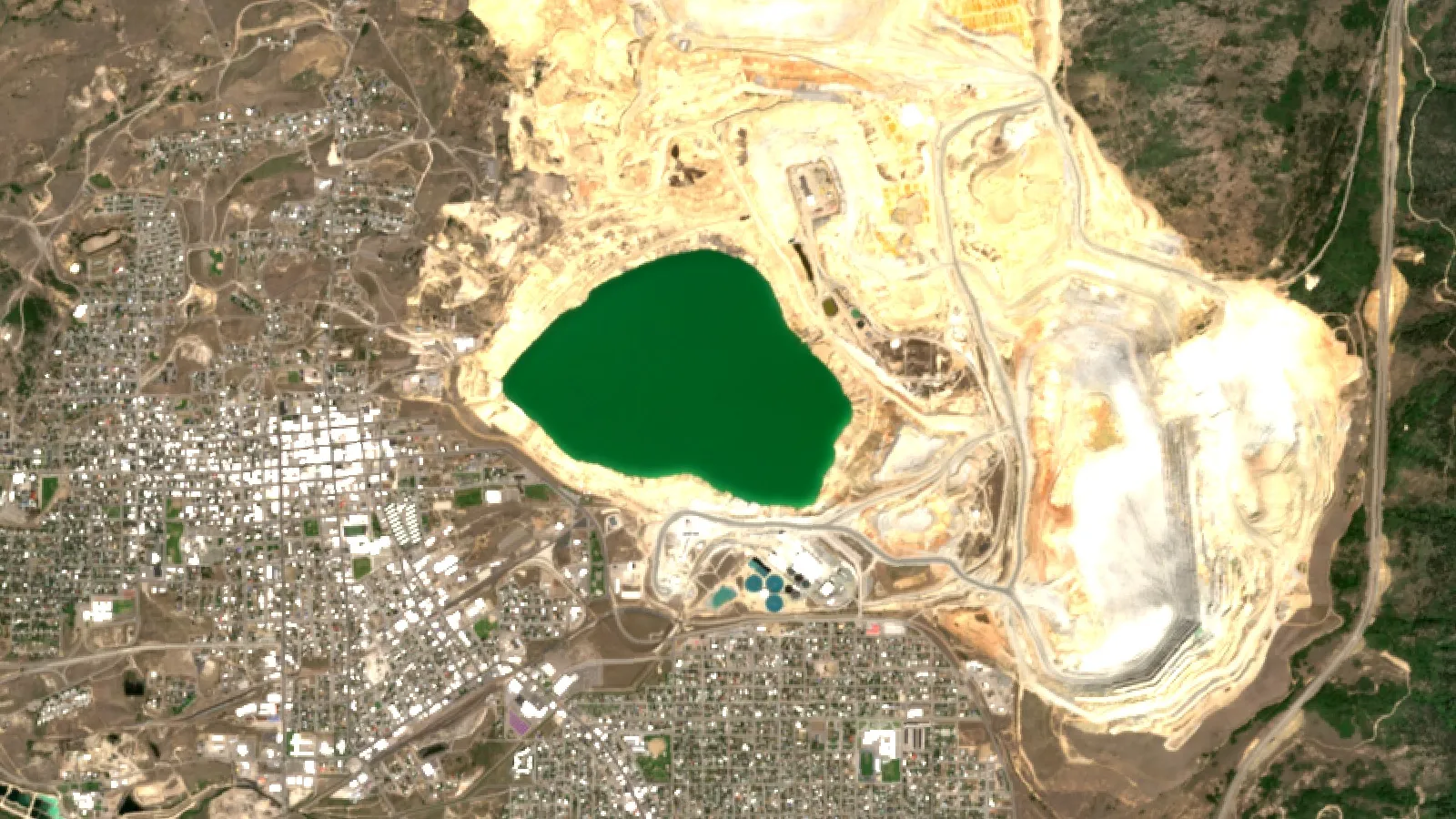
The Berkeley Pit is a flooded former open-pit copper mine on the east side of Butte, Montana. It holds about 49.5 billion gallons of acidic, metal-laden water, and the US Environmental Protection Agency (EPA) requires that water to stay below 5,410 feet above sea level. At the end of 2025 the pit stood at 5,356 feet, 54 feet under that line; the tightest compliance point, the Pilot Butte Mine, was 30 feet under it (Montana Bureau of Mines and Geology, Open-File Report 781, July 2026). Pumping and treatment, not geology, is what holds it there.
This page is written for mining consultants, licence holders and closure planners who want the facts in one place: the current water level against the legal limit, why the water is acid, how it is treated, the Superfund status, the bird deaths and what Butte teaches about planning a mine closure. Every figure carries its source and date. A calculator lets you test how long the margin would last if pumping stopped.
Berkeley Pit facts at a glance
The table gathers the numbers people search for most. Where two sources give slightly different values, the footnote text under the table says which one we used.
| Item | Value | Source |
|---|---|---|
| Location | Butte, Silver Bow County, Montana | EPA site profile |
| Open-pit mining began | July 1955 (Anaconda Company) | MBMG, 2026 |
| Pumping and pit mining stopped | Pumps shut off 23 April 1982; pit mining ended May 1982 | MBMG, 2026 |
| Depth of the pit | About 1,600 feet | EPA, site status page |
| Depth of the water | About 900 feet | EPA, site status page |
| Water volume, end of 2025 | 49.5 billion gallons | MBMG, 2026 |
| Water level, end of 2025 | 5,356 feet above sea level | MBMG, 2026 |
| Protective Water Level | 5,410 feet above sea level | PitWatch; 1994 Record of Decision |
| Acidity (pH) | About 2.5 historically; recent range 2.5 to 4.5, with treatment lifting it to 4.0 or higher | PitWatch |
| Responsible parties | Atlantic Richfield Company and Montana Resources | PitWatch |
| Superfund listing | Silver Bow Creek/Butte Area site; EPA cleanup actions since 1983 | EPA National Priorities List |
Some sources quote 1,780 feet, and older press reports gave other figures. EPA’s current site description says about 1,600 feet, so we use EPA’s number. A pit this size has no single agreed depth because the rim is irregular and the floor is under water.
How the Berkeley Pit formed and why Butte mined it
Butte sits on the Boulder Batholith, a mass of granite about 70 miles long and 40 miles wide that cooled roughly 76 million years ago. Hot, metal-bearing fluids later moved through cracks in that rock and left copper, silver, zinc, lead, manganese and molybdenum in a district only five or six square miles across (PitWatch, geology of Butte). The deposit is zoned like an onion. The core, where the pit now sits, is richest in copper. A belt of lead and zinc surrounds it, and an outer zone carries manganese and silver. A 2026 US Geological Survey (USGS) fact sheet on the same region shows that research on this district’s critical minerals is still active (USGS Fact Sheet 2026-3064).
Underground mining in Butte began in the 1800s and eventually left about 10,000 miles of tunnels. For about 100 years, pumps kept groundwater out of those workings. As ore grades fell and mining got deeper and costlier, the Anaconda Company moved to open-pit mining in July 1955 at the Berkeley Pit (MBMG, 2026). Atlantic Richfield bought Anaconda in 1977. The company suspended pumping at the 3,900-level Kelley Mine station on 23 April 1982 and stopped mining in the original pit a few weeks later. The eastern extension, the East Berkeley Pit, ran until 30 June 1983, when Anaconda closed all of its Butte operations.
Mining did not end for good. In December 1985 Anaconda’s remaining Butte assets passed to a company that became Montana Resources, which renamed the East Berkeley Pit the Continental Pit and restarted mining in July 1986. The company says it has produced more than 2.5 billion pounds of copper and 300 million pounds of molybdenum since then, employs about 400 people and has reserves projected to support mining through 2054 (Montana Resources, About, read October 2026). So the Berkeley Pit is closed, but open-pit copper mining continues beside it. For a plain-language look at how copper is produced from ore like this, see our beginner’s guide to copper extraction.
Why is the Berkeley Pit water so acidic
The acid comes from the rock, not from anything added to the pit. Much of Butte’s ore and surrounding rock contains iron sulfides such as pyrite (“fool’s gold”). Left buried, pyrite stays stable. Once mining exposed it to air in the pit walls and the tunnels, and groundwater returned, pyrite reacted with water and oxygen to make sulfuric acid. That acid then dissolved other metals out of the rock (PitWatch, water composition). Chemists call this acid mine drainage, or acid rock drainage.
The result is water with a pH of about 2.5 in its early decades. pH measures acidity on a scale where 7 is neutral and each whole step down is ten times more acidic. PitWatch reports a range of 2.5 to 4.5 over time, with treatment now keeping the pit at 4.0 or higher. MBMG’s sampling shows pH rising by about two-tenths of a unit between fall 2017 and fall 2025, and iron and arsenic concentrations at least ten times lower than in 2011 and 2012. PitWatch counts more than 21 metals and minerals in the water. Major dissolved solids include sulfate, aluminum, manganese, cadmium, sodium, magnesium, fluoride, chloride and potassium.
Arsenic has a geological explanation too. Butte ore contains enargite, a copper-arsenic sulfide, and in parts of the ore body as much as 40 percent of the copper came from it. Compare that with the Keweenaw Peninsula in Michigan, where most copper is native metal rather than sulfide and the water legacy is milder. The lesson for explorers is simple: sulfide-rich copper ground has a built-in acid risk that can be predicted before a mine opens.
Berkeley Pit water level: how close is it to the limit
The water level is the number that matters most. The 1994 Record of Decision, the EPA’s legal cleanup plan for the Butte Mine Flooding Operable Unit, sets a maximum of 5,410 feet above sea level. The limit was long called the Critical Water Level and was renamed the Protective Water Level in 2019. It sits 50 feet below the elevation where groundwater could begin to flow away from the pit. While the pit stays below it, groundwater keeps flowing toward the pit, so the contaminated water cannot move out into Silver Bow Creek (PitWatch, Protective Water Level).
Chart
Where the groundwater rose most
Water-level rise in feet, first 20 years versus the next 24 years
Chart
How fast the pit filled
Rise in Berkeley Pit water level per period, feet
Compliance is measured at 14 points (the ‘points of compliance’): seven underground mines and seven bedrock wells. MBMG surveys the pit level every month and tracks the 14 compliance points (seven underground mines and seven bedrock wells) in its wider network of 56 monitoring wells and 12 mine shafts. At the end of 2025 the highest of the 14 points was the Pilot Butte Mine, about half a mile north of the pit, at 5,380 feet, 30 feet below the limit. The pit itself was lowest at 5,356 feet, which confirms groundwater is still flowing toward it (MBMG, 2026).
How fast did it rise? The pit gained 12 feet in the first decade after 1982, then 202 feet in the 1990s, when filling was fastest. After Montana Resources diverted Horseshoe Bend seep water away from the pit in late 2003, the pace of rise fell by 50 to 60 percent. Since pumping from the pit began in September 2019, the level has been almost flat: it rose less than half a foot in total from 2022 to 2025, the net level has fallen 0.28 feet since the pilot began, and filling stayed below 1 million gallons a day in 2025.
Will it overflow? No, as long as pumping continues. MBMG’s model says that if pumping were suspended on 2 January 2026, the 5,410-foot limit would be reached at the Pilot Butte Mine in 1,617 days, or about 4.4 years. That is a stress test, not a forecast. The calculator below lets you run your own version.
Calculator
How long would the margin last if pumping stopped?
Enter a compliance-point level, the limit and a rise rate to see the time left.
- Margin remaining: 30.0
- Days to the limit: 1,610
Example values only, not a forecast. Defaults use the Pilot Butte Mine at 5,380 ft and the 5,410 ft limit (MBMG, 2026); 6.8 ft a year is 30 ft divided by the 4.4 years in MBMG’s stress test. The calculator assumes a constant rise rate; real filling slows as the pit and workings fill.
How the Berkeley Pit water is treated
Treatment has three steps: raise the pH, let the metals settle, then reuse or discharge the water. Lime, which has a pH near 12.5, is added to the acidic water so that metals drop out as solids at different pH levels. The solids then need time to settle. Finally the water is either returned to the mining circuit or polished and released to Silver Bow Creek (PitWatch, water treatment).
Chart
Margin below the legal limit
Feet below the 5,410 ft Protective Water Level, end of 2025
The site has two systems. The Horseshoe Bend Water Treatment Plant, online since 2003, uses clarifier tanks and can treat 7 million gallons a day (EPA, current site status). The Horseshoe Bend Capture System, started in 2019 as part of the Berkeley Pit and Discharge Pilot Project, mixes acid water and lime into the tailings slurry of Montana Resources and lets metals settle in the Yankee Doodle Tailings Impoundment. Before 2019, water had never been pumped out of the pit for treatment. By the end of 2025 about 7.65 billion gallons of pit water had been used in the Montana Resources milling process, and a polishing facility discharges part of the return water to Silver Bow Creek. The pilot moved into long-term remedy status at the end of 2025.
Two points are worth a consultant’s attention. First, the Horseshoe Bend Capture System reuses pit water inside an operating mine’s milling circuit, which only works because that mine is next door. Second, the system produces sludge that has to go somewhere; at Horseshoe Bend the sludge is placed back in the pit. Closure planning has to name the disposal route for treatment solids, not only the water.
Is the Berkeley Pit a Superfund site
Yes. The pit is the main feature of the Butte Mine Flooding Operable Unit, one of seven active parts of the Silver Bow Creek/Butte Area Superfund site, where EPA has run cleanup actions since 1983. Superfund is the common name for the Comprehensive Environmental Response, Compensation and Liability Act (CERCLA) of 1980. It lets EPA require the parties responsible for contamination to clean it up or repay the government. The responsible parties for the pit are Atlantic Richfield and Montana Resources (PitWatch, Superfund).
The word “remediation” matters here. A remedy contains or removes a hazard. It does not promise a return to natural conditions. PitWatch states that the pit is federally mandated to be managed to protect human health and the environment forever, with monitoring and maintenance that have no end date. That is a different goal from “restoration”, which tries to rebuild a self-sustaining natural system.
The wider Butte cleanup has several parts, listed on EPA’s site-status page: the Streamside Tailings unit along about 26 miles of Silver Bow Creek, where the bulk of work ran from 1999 to 2015; the Warm Springs Ponds, a 2,600-acre set of settling ponds holding about 19 million cubic yards of sediment; the Butte Priority Soils unit centred on the Butte Hill; and the small Rocker timber-treating plant site. EPA’s pages describe work continuing, including the Grove Gulch project, where construction began in August 2024, and a Record of Decision amendment on the residential soil-lead cleanup level (EPA, Silver Bow Creek/Butte Area).
The geese: what happened at the Berkeley Pit in 1995 and 2016
Two mass bird deaths shaped the site’s reputation. In November 1995, 342 snow geese were found dead on the pit, and officials first counted only 149 because the water turned the snow-white birds brownish-orange and hid them from the count (High Country News, December 1995). All 342 were snow geese, one species. The companies started a waterfowl protection program in 1996.
On 28 November 2016, a snowstorm after a warm autumn forced a late flock of roughly 60,000 snow geese to take shelter on the pit, the only open water around. The Associated Press reported several thousand dead, and High Country News later put the toll at about 3,000 birds (AP via Explore Big Sky, December 2016). The companies were never fined for the event (High Country News, 2022).
After 2016 the companies upgraded the program. It now runs every day of the year, with trained staff who count and identify every bird, and uses lasers, propane cannons, unoccupied vehicles, drones and fireworks to haze birds off. PitWatch says the program has had a 99.8 percent success rate in moving birds on since 2018. The pit covers more than 450 acres, so nets, covers and floating balls were judged impractical; High Country News reports that floating balls alone were priced at $70 million by mine staff.
Can you visit the Berkeley Pit
Yes. The Berkeley Pit viewing stand on the southwest rim is run by the Butte Chamber of Commerce. It is open daily from 10 am to 5 pm, May to October, weather permitting, and charges an admission fee. You can phone the Chamber on (406) 723-3177 for the current price. School, agency and community groups can book tours by appointment through PitWatch from March to November, with a week’s notice recommended (PitWatch, visit). From the stand you can see the pit lake and the active Continental Pit workings together.
Seven lessons from Butte for mine closure planning
Each lesson is tied to a source above. They are our reading of the Butte record, not an official ranking.
- Turning off the pumps is a closure decision. The groundwater system that miners held down for about 100 years came back as soon as pumping stopped in 1982. If a mine dewaters, the closure plan must say what happens to that water.
- Test the rock for acid before you dig. Butte’s sulfides were known. A pre-feasibility acid-base account of the host rock tells you whether pyrite will be a long-term liability.
- Fix a numeric trigger level and monitor it on a schedule. The 5,410-foot line, checked monthly at 14 compliance points, turns a vague worry into a number a regulator can enforce, with penalties for exceeding it.
- Treat water inside the operation where you can. Reusing pit water in the neighbouring mill has moved 7.65 billion gallons through the process and kept the pit level flat since 2019.
- Plan for wildlife from day one. A 1995 die-off led to a 1996 program, and the 2016 event showed that a good program can still be overwhelmed by weather. Budget for daily staff, not a one-time fence.
- Restore streams in phases, and monitor after. Silver Bow Creek’s tailings cleanup ran for years from the upper reach downstream, with native plants used for revegetation, and EPA still lists monitoring and extra work. Butte also inspects capped and revegetated sites for cover, erosion and bare patches through its reclamation evaluation system.
- Expect remediation to last forever. PitWatch states plainly that the pit is to be managed in perpetuity. Cost models should carry water treatment as a long-term line, not a closure-year expense.
For a wider view of mine-site risks beyond Butte, see our post on the environmental impacts of mining, and for another US copper-town case, Anaconda copper mining and land use.
▶ The seven environmental impacts of mining, explained in a short claymation. · 2:31
How satellite data fits with ground monitoring at a legacy site
The Berkeley Pit is watched with wells, shaft gauges, a drone sampling boat and twice-yearly chemistry, because water level and chemistry cannot be seen from orbit. Satellites help on a different question: where to look. Multispectral imagery can flag alteration and iron-oxide zones across a licence, which can point to sulfide-bearing ground that may later cause acid drainage. This is a first screen to decide where ground crews should sample, not a measure of acid-generating potential.
Farmonaut maps mineral targets on a licence from satellite data, without ground disturbance, for explorers who want a first look before spending on fieldwork. It does not replace the water sampling, borehole data or regulatory sign-off described above, and it is not an environmental clearance. Consultants can send a boundary through the satellite-based mineral detection page or request a quote through the mining query form.
▶ Remote sensing for mining in about two minutes, with no jargon. · 2:01
Frequently asked questions
Where is the Berkeley Pit?
It is on the east side of Butte, Montana, in Silver Bow County, next to the active Continental Pit operated by Montana Resources.
How deep is the Berkeley Pit?
EPA describes the pit as about 1,600 feet deep, filled with roughly 900 feet of acidic water. Some older sources quote 1,780 feet.
What is the water level in the Berkeley Pit now?
At the end of 2025 it was 5,356 feet above sea level, 54 feet below the 5,410-foot Protective Water Level, according to MBMG’s July 2026 report. PitWatch shows a live reading on its home page.
What happens if the Berkeley Pit reaches the critical water level?
Under the 1994 Record of Decision and the 2002 consent decree, the responsible companies face monetary penalties if any compliance point exceeds 5,410 feet. The limit is a safety buffer: groundwater would only begin to flow out of the pit if the water reached about 5,460 feet, which is 50 feet higher. MBMG’s model says pumping stopped on 2 January 2026 would reach the limit at the Pilot Butte Mine in about 4.4 years.
Will the Berkeley Pit ever overflow?
PitWatch says it will not, because the water is pumped and treated to keep it under the limit, and the pit is the lowest point in the Butte groundwater system.
Why is the water in the Berkeley Pit acidic?
Groundwater reacted with pyrite and other sulfides exposed in the pit walls and about 10,000 miles of tunnels, forming sulfuric acid. The acid then dissolved other metals.
Is the Berkeley Pit still being mined?
The Berkeley Pit itself stopped in 1982. Montana Resources mines copper and molybdenum in the adjacent Continental Pit, which was part of the East Berkeley Pit.
Who owns the Berkeley Pit and who pays for the cleanup?
Atlantic Richfield Company and Montana Resources are the responsible parties named by PitWatch, and they carry the water management obligations under the Superfund decisions.
How many birds died in the Berkeley Pit?
342 snow geese in 1995, and several thousand snow geese in November 2016, according to High Country News and the Associated Press.
Can you swim in or touch the Berkeley Pit water?
No. The water is acidic and has high metal concentrations that are not suitable for human or aquatic life, according to PitWatch. Visitors view the pit from the platform.
Is any life found in the Berkeley Pit?
Yes, but only extremophiles, which are microorganisms that survive in extreme acidity and metal concentrations. Researchers have identified many species of them in the pit.
This page is for information only. It is not legal or investment advice. Confirm site rules and levels with EPA, Montana DEQ and the responsible parties. The pit water is hazardous: view it only from the public platform.
Farmonaut mining
Map your mining site from space
Send your licence boundary and get a satellite mineral report that shows where to look first, without ground disturbance.
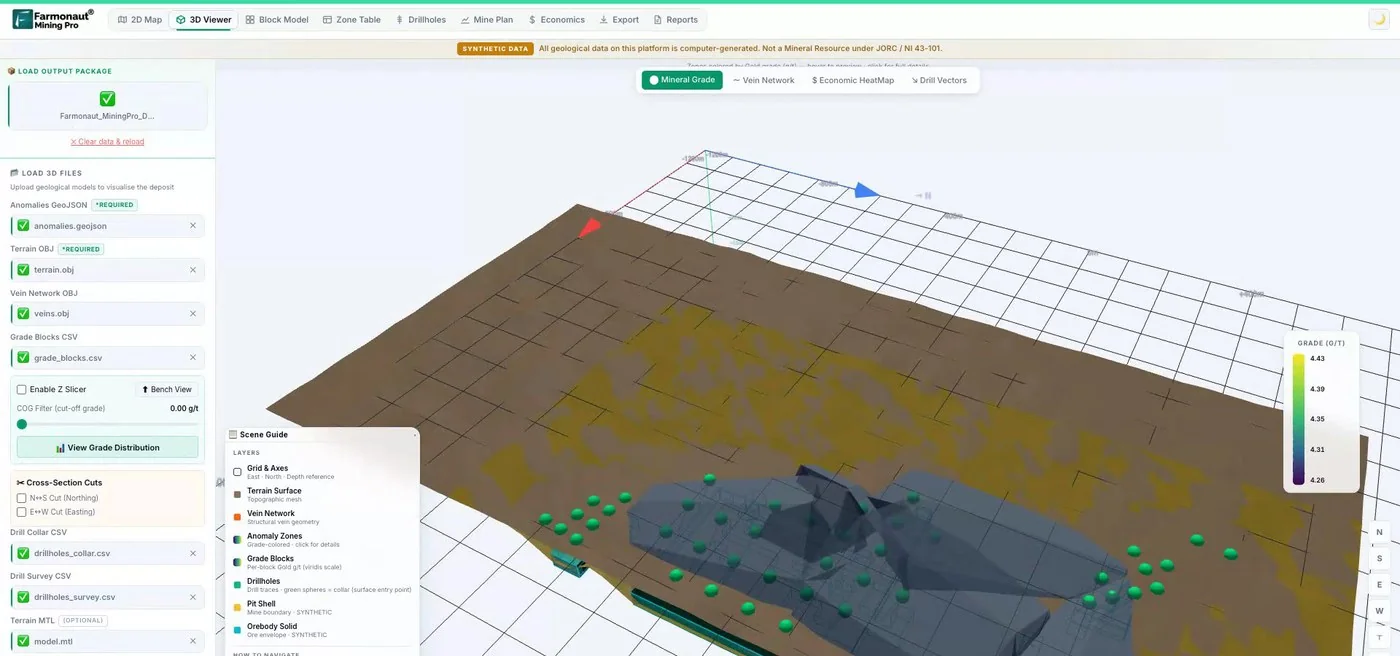
Mining Pro sample view, synthetic data
Keep reading
Sources
- MBMG, Open-File Report 781: Butte Mine Flooding monitoring, 1982-2025 (July 2026): pitwatch.org
- PitWatch, Protective Water Level: pitwatch.org
- PitWatch, Water composition: pitwatch.org
- PitWatch, Water treatment: pitwatch.org
- PitWatch, History of Berkeley Pit water: pitwatch.org
- PitWatch, Superfund: pitwatch.org
- PitWatch, Waterfowl protection: pitwatch.org
- PitWatch, Geology of the Berkeley Pit: pitwatch.org
- PitWatch, Visit us: pitwatch.org
- EPA, Silver Bow Creek/Butte Area: current site status: epa.gov
- EPA, Silver Bow Creek/Butte Area Superfund site profile: cumulis.epa.gov
- Montana Resources, About: montanaresources.com
- USGS, Fact Sheet 2026-3064: Critical minerals in the Boulder Batholith region: pubs.usgs.gov
- High Country News, 1995: Did toxic stew cook the goose?: hcn.org
- High Country News, How do you keep migrating birds off a giant toxic lake?: hcn.org
- Associated Press via Explore Big Sky, Snow geese deaths from mine pit number in the thousands: explorebigsky.com
Discussion
Questions, corrections or field experience? Share them below. First-time comments are reviewed before they appear, and your email is never published.
No comments yet. Be the first to add a question or your experience.

 Ileys General Trading
 SG Gold Mining LLC
 VRV Global Pte Ltd
 Omsri International FZE
 G.I.T.T.
 Jaunita Erss Ltd
 Almosi SARL
 SRK Consulting
 Berks Gold Limited
 Mwerezi Minerals Company Limited
 Mining SARL
 SenGold Invest SAS
 Sean Mining Limited
 NTS Group (Pty) Ltd
 Mine4Africa
 Lithspo Minerals Limited
 Tintina Mining Group
 Licence holder · Nigeria · Gold + lithium










