

Coal mining · Tools and equipment guide
Coal Mining Tools: 15 Tools and Machines by Mine Type
Underground coal is cut by continuous miners or longwall shearers and propped by bolts or shields; surface coal needs drills, draglines or shovels and trucks. This guide lists 15 tools with US rules, EIA output and productivity data, and a staffing calculator.
Key takeaways
- US mines produced 512.5 million short tons of coal in 2024; surface mines gave 305.8 million and underground mines 206.2 million (EIA Annual Coal Report, 2024 data).
- Underground, longwall mines produced 112.8 million short tons and continuous-miner mines 92.8 million; hand and other conventional methods gave 0.6 million (EIA, 2024).
- A machine-mounted methane monitor must warn at 1.0% methane and cut power at 2.0%, and must be calibrated at least every 31 days (30 CFR 75.342).
- Productivity averaged 3.24 short tons per employee hour underground and 8.94 at surface mines (EIA, 2024).
- MSHA counted 8 coal mining deaths in 2025, against 643 in 1950 (MSHA coal fatality table, 1900-2025).
In this article
- The 15 coal mining tools at a glance
- How we chose these 15 coal mining tools
- Which coal mining method decides the toolkit
- Underground machines for cutting, bolting and hauling
- Productivity and price by method
- Safety and monitoring tools for underground coal
- Why the monitoring tools matter: coal fatality trend
- Hand tools: coal miner tools by name
- Surface coal mining equipment
- How to choose coal mining equipment: a buyer checklist
- Calculate employee hours and sales value from your coal output
- Common mistakes when buying coal mine tools
- Planning the site before the tools arrive
- Frequently asked questions
Coal miners use two kinds of tools: machines that cut, support and haul the coal, and small instruments that keep people alive. In a modern US underground mine the cutting is done by a continuous miner or a longwall shearer, the roof is held by roof bolts or movable shields, and the machines at the face carry a methane monitor. At a surface mine the list changes to drills, a dragline or shovel, and haul trucks. Hand tools such as pry bars, shovels and wrenches stay in the kit, but they do very little of the cutting.
This guide ranks nothing. It lists 15 tools and machines, sorted by the kind of mine they belong to, with the job each one does, the rule or number that matters, and what a buyer or consultant should check. The production, price and productivity figures come from the US Energy Information Administration (EIA), the safety rules from the US Code of Federal Regulations, and the death counts from the Mine Safety and Health Administration (MSHA). Rules outside the US differ, so treat the US numbers as a worked example and confirm local law with your regulator.
The 15 coal mining tools at a glance
The table sorts the toolkit by mine type. Underground coal mining is the harder case, because the roof, the air and the machines all share a tight space.
| # | Tool or machine | Mine type | Main job |
|---|---|---|---|
| 1 | Continuous miner | Underground, room-and-pillar | Cuts coal from the face and loads it |
| 2 | Longwall shearer | Underground, longwall | Shears coal across a long face |
| 3 | Longwall roof supports (shields) | Underground, longwall | Hold the roof over the face and advance with it |
| 4 | Roof bolter | Underground | Drills and installs roof bolts |
| 5 | Shuttle car | Underground, room-and-pillar | Carries coal from the miner to the belt |
| 6 | Belt conveyor | Underground and surface | Moves coal out of the working area |
| 7 | Machine-mounted methane monitor | Underground | Warns at 1.0% methane, cuts power at 2.0% |
| 8 | Handheld gas detectors | Underground | Spot checks of methane and oxygen |
| 9 | Self-contained self-rescuer (SCSR) | Underground | Breathing unit for escape |
| 10 | Permissible cap lamp | Underground | Light that will not ignite methane |
| 11 | Proximity detection system | Underground | Stops a machine before it hits a miner |
| 12 | Rock duster | Underground | Spreads rock dust to dilute coal dust |
| 13 | Hand tools | All | Barring down, clearing, repairs, small jobs |
| 14 | Blasthole drill | Surface | Drills holes for explosives in overburden and coal |
| 15 | Dragline, shovel and haul-truck fleet | Surface | Removes overburden and hauls coal |
How we chose these 15 coal mining tools
We picked tools by three tests. First, the tool appears in US federal coal rules, in an EIA production table, or in a National Academies or EPA description of how coal is mined. Second, a mine of that type cannot run without it. Third, a consultant advising on a coal licence or a mine purchase would need to price, inspect or audit it. Consumables such as bits, resin and belting are left out. The list covers both mine types because EIA shows that most US coal comes from surface mines while the underground mines carry most of the safety rules.
Which coal mining method decides the toolkit
The mining method comes first and the tools follow. The National Academies describe underground coal mining as mostly room-and-pillar or longwall, and say the choice depends on seam thickness, depth, inclination, the roof and floor rock, and the gas content of the coal and the strata (National Research Council, 2007). EIA adds a simple depth rule for the US: surface mining is often used when coal lies less than 200 feet (about 60 m) down, and underground mining when it is deeper (EIA, Coal explained).
Chart
US coal output by mining method
Million short tons, 2024
EIA’s Annual Coal Report shows what that means in tonnes. US mines produced 512.5 million short tons in 2024 (about 465 million tonnes) from 524 producing mines. Surface mines supplied 305.8 million short tons, or about 60%, and underground mines 206.2 million short tons. Within underground output, longwall mines produced 112.8 million short tons and continuous-miner mines 92.8 million; the “conventional and other” group (shortwall, scoop loading, hand loading and other small methods, plus mines under 50,000 short tons) produced only 0.6 million (EIA Annual Coal Report, 2024 data).
Underground machines for cutting, bolting and hauling
These six items make up the production line of an underground coal section. They are listed in the order the coal travels, from the face to the belt.
1. Continuous miner
A continuous miner cuts coal with a rotating drum and loads it in one machine. In room-and-pillar mining it replaced the older routine of undercutting, drilling, blasting and loading. The National Academies report that room-and-pillar accounted for about half of US underground production in 2007, that continuous mining made up more than 90% of that share, and that under favourable conditions one machine can produce over 800,000 tons a year (National Research Council, 2007). Best where a longwall panel would not fit, because the National Academies say longwall suits only flat-lying, thick, uniform seams. Check the proximity detection system, the methane monitor and dust controls first.
2. Longwall shearer
The shearer is a high-powered cutting machine that passes back and forth across the coal face while a floor-level conveyor carries the broken coal away. Longwall mining takes all the machine-minable coal in a block, called a panel, and suits flat-lying, thick, uniform seams. The National Academies give panels as averaging about 900 feet wide and over 8,000 feet long (2007). Best for large, regular reserves. The National Academies note that longwall needs large reserves to justify the capital cost of the equipment.
3. Longwall roof supports (shields)
Longwall mining is done under movable roof supports that advance as the seam is cut, and the roof behind them is allowed to fall (National Research Council, 2007). Shields are bought as a set for the face width, so their capacity must match the roof conditions found in drilling data. Best for operations that already have a proven longwall block. Watch for hydraulic leaks and for the time it takes to move the face line to the next panel.
4. Roof bolter
A roof bolter drills holes in the roof and installs bolts so that crews work under supported ground. US rules require roof bolts and accessories covered by the ASTM F432-95 specification to come with a manufacturer’s certification, and require a bearing plate on every bolt, at least 6 inches square where the plate sits directly against the roof (5 inches where the roof is firm and not prone to sloughing) (30 CFR 75.204). NIOSH has also developed canopy air curtains for roof bolting machines to protect operators from respirable dust. Best for every underground section, since all of them need roof support. Check the dust controls, the drill steel and the bit tolerances.
5. Shuttle car
In a room-and-pillar section the coal goes from the continuous miner into a transport vehicle, usually a shuttle car, and then onto the panel belt. Shuttle car operators are exposed to dust. A NIOSH-funded study found that overexposures are a concern when blowing ventilation is used at the miner face, and that many measurements at the operator position exceeded 1.5 mg/m³ of respirable dust (Laboratory testing of a shuttle car canopy air curtain, NIOSH-supported research). Best for sections that need short, flexible hauls. Check operator-cab dust protection and the ventilation plan.
6. Belt conveyor
Conveyors, trams and trucks move coal around mines, according to EIA. In underground mines the belt is also a safety item. US rules treat an air course with a belt conveyor as a place where methane of 1.0% or more requires action: power is cut to electrical equipment in the affected area and ventilation is changed until methane is below 1.0% (30 CFR 75.323). Best for continuous, high-volume haulage. Check belt fire protection and the methane monitoring along the route.
Productivity and price by method
Output per worker depends on the mining method and the seam as well as the tools. EIA’s 2024 survey measured 3.24 short tons per employee hour at underground mines and 8.94 at surface mines. Within underground mining, longwall mines averaged 4.54 and continuous-miner mines 2.79; among surface methods, open-pit mines averaged 15.20 and contour-strip mines 9.65 (EIA Annual Coal Report, 2024 data). The average sales price per short ton was US$85.88 from underground mines and US$29.61 from surface mines in 2024. Coal rank (the grade of the coal) also matters: bituminous coal averaged US$86.72 and subbituminous US$18.06 per short ton.
Chart
Average sales price of coal by mine type
US$ per short ton
Chart
Coal produced per employee hour by method
Short tons per employee hour, US, 2024
The same report counts 177 underground and 339 surface producing mines, and an average of 44,060 employees across all mines in 2024. Use these as an order-of-magnitude check, not as a benchmark for a specific mine. The calculator below turns them into staffing and sales value for your own output.
Safety and monitoring tools for underground coal
US underground coal is the most closely regulated part of mining, and several tools on this list are mandatory rather than optional. The rules below are quoted from 30 CFR Part 75, which MSHA enforces.
7. Machine-mounted methane monitor
MSHA-approved methane monitors must be installed on face cutting machines, continuous miners, longwall face equipment, loading machines and other mechanised coal-extracting equipment in the working place. The monitor gives a warning signal at 1.0% methane and must automatically de-energise electric equipment, or shut down diesel equipment, when methane reaches 2.0% or when the monitor is not working properly. Monitors must be calibrated with a known air-methane mixture at least once every 31 days, and calibration records are kept for one year (30 CFR 75.342). Best for any mechanised face. Check calibration records before anything else.
8. Handheld gas detectors
Methane tests must be made by a qualified person with an MSHA-approved detector calibrated at least every 31 days. Oxygen detectors must be able to detect 19.5% oxygen with an accuracy of plus or minus 0.5%, and must be calibrated at the start of each shift in which they are used (30 CFR 75.320). Action levels sit in the same part: at 1.0% methane in a working place, electrical equipment is de-energised and ventilation is adjusted, and at 1.5% everyone except those allowed under the Act is withdrawn. Best for examiners, foremen and anyone moving between sections.
9. Self-contained self-rescuer (SCSR)
The SCSR is a breathing unit for escape. Under US rules each person underground must wear or carry a self-rescue device at all times. Where carrying it is hazardous, it must be placed in a readily accessible location no more than 25 feet away, and a device may be left on equipment where a person works on or around that equipment. Storage locations carry reflective signs (30 CFR 75.1714-2). Best for every person underground, including visitors. Check storage locations and the sign trail on each shift.
10. Permissible cap lamp
A cap lamp lights the work area, but in a coal mine it also has to be safe near methane. MSHA calls an electric cap lamp “permissible” only when it meets the design requirements in 30 CFR Part 19, which exist to promote lamps that can be used in mines that may contain dangerous concentrations of methane (30 CFR 19.1). Do not buy a lamp for underground coal on brightness alone.
11. Proximity detection system
Proximity detection is now part of the standard kit on continuous miners. The rule requires that machine-mounted and miner-worn parts cause a tramming or repositioning continuous miner to stop before it contacts a miner, with audible and visual warnings on the miner-worn component, and it keeps the machine from moving if a machine-mounted component is not working. Full-face continuous mining machines are excluded (30 CFR 75.1732). Best for any section with miners on foot near moving machines.
12. Rock duster
Coal dust burns, so US rules require the combined coal dust, rock dust and other dust in underground areas to stay at least 80% incombustible, with an extra 0.4 percentage points for each 0.1% of methane in the air (30 CFR 75.403). A mechanical duster is how the rock dust is applied to the return air course in the alternative return-air arrangement described in 30 CFR 75.323. Firefighting kit is regulated in the same way: waterlines must deliver 50 gallons a minute at 50 psi at the nozzle, and new portable extinguishers must carry a 2A 10BC or higher rating (30 CFR 75.1100-1).
Why the monitoring tools matter: coal fatality trend
MSHA’s coal table counts fatalities and miners for every year from 1900 through 2025. Deaths fell from 643 in 1950, when 483,239 coal miners were employed, to 260 in 1970, 66 in 1990, 38 in 2000 and 5 in 2020. The count was 10 in 2024 and 8 in 2025, with 66,794 and 62,246 miners respectively. By our arithmetic from MSHA’s counts, that is about 1.3 deaths per 1,000 miners in 1950 and about 0.13 in 2025 (MSHA, Coal fatalities 1900-2025). MSHA’s table does not attribute the long decline to any one cause: rules, training, ventilation, machine design and a much smaller workforce all play a part.
Chart
US coal mining fatalities by year
Deaths per year, selected years
Hand tools: coal miner tools by name
13. Hand tools
If you came for a list of miner tools by name, these are the hand tools still carried in coal mines and what each does:
- Pry bar or bar lifter: levers loose rock and repositions heavy items.
- Shovel: clears spilled coal from the belt line and the floor.
- Sledgehammer: frees stuck pins, jacks and wedges.
- Hand saw: cuts timber for blocking and cribs.
- Chain block or hand winch: lifts and shifts heavy parts during repairs.
- Wrench and socket set: services bolts, supports and machines.
- Measuring tape or laser distance meter: checks entry width and bolt spacing against the mine plan.
- Pickaxe: a legacy tool; modern coal is cut by machine.
The numbers explain why. EIA groups shortwall, scoop loading, hand loading and other small methods into “conventional and other” underground mining, which produced 0.6 million short tons in 2024 out of 206.2 million, about 0.3% of underground output (the group also holds mines under 50,000 short tons that use any method). Hand tools remain essential for repair and clean-up work, and for emergencies, but a pickaxe is not how modern coal is won. Choose hand tools for fit, grip and weight, and check that any powered or electrical tool you take underground is permitted by the mine’s approved plans.
Surface coal mining equipment
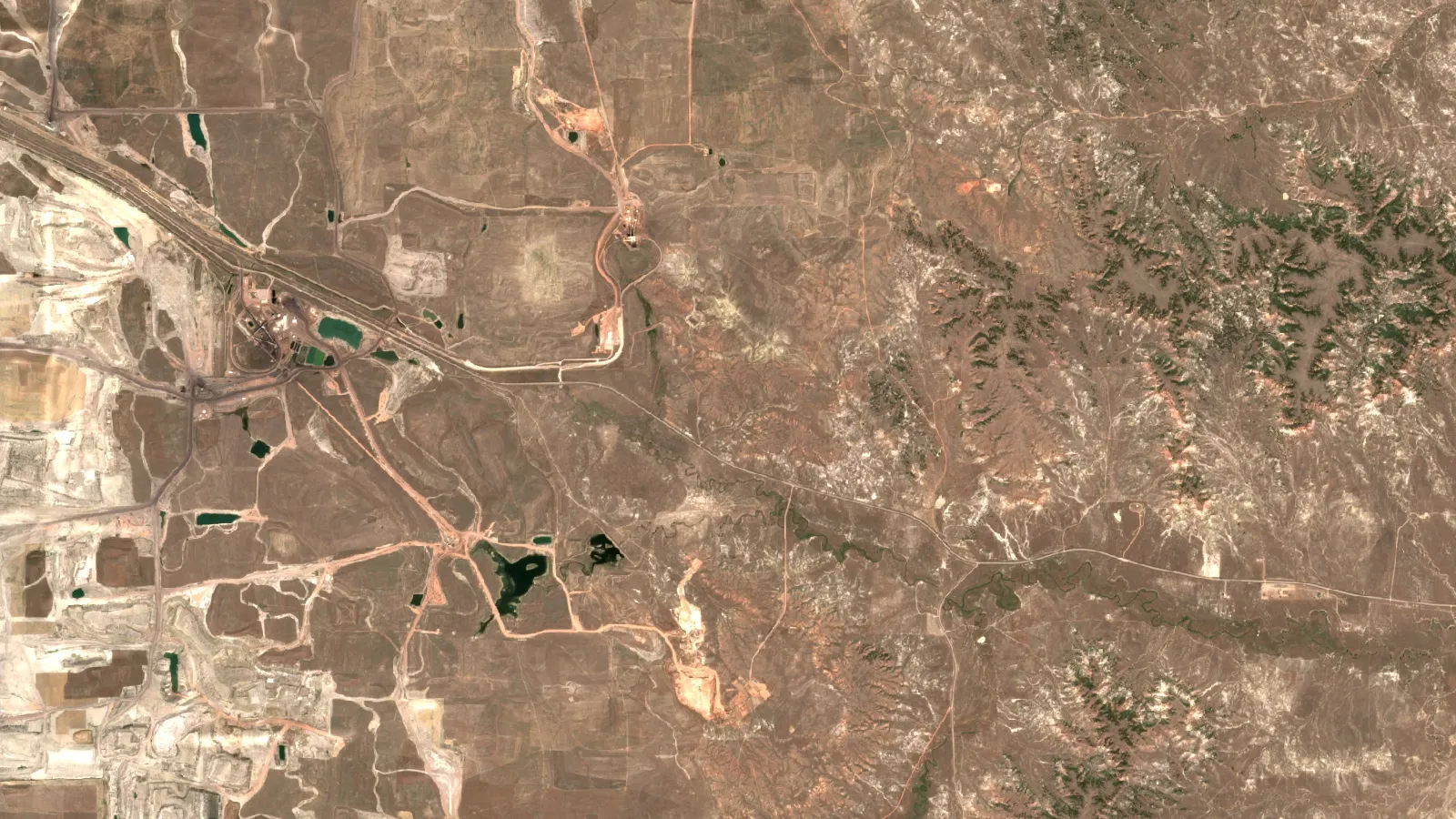
Surface coal mining digs the rock above the seam, called overburden, then removes the coal. The US Office of Surface Mining defines overburden as the material of any nature, consolidated or unconsolidated, that lies over a coal deposit, and the highwall as the face of exposed overburden and coal in an open cut (OSMRE glossary). EIA’s 2024 table splits US surface output by method: open pit 134.7 million short tons, contour strip 132.3, area 20.8, mountaintop 2.1 and other methods 15.9.
14. Blasthole drill
EPA’s description of western surface coal mines is a good plain account of the cycle. The overburden is levelled, drilled and blasted, then removed to the seam. The exposed coal seam is drilled and blasted again (US EPA, AP-42 section 11.9). The drill is therefore the first machine on the bench. Best for hard overburden. Check hole-pattern control, because the blast pattern sets fragmentation and dust.
15. Dragline, shovel and haul-truck fleet
EPA describes overburden removal as usually done by a dragline or a shovel-and-truck operation, with the material placed in the adjacent mined cut as a spoil pile. A shovel or front-end loader then loads the broken coal into haul trucks, which carry it out of the pit on graded haul roads to the tipple or truck dump (US EPA, AP-42 section 11.9). Best for thick, shallow seams with large reserves. For a consultant the key checks are the strip ratio, haul distance and tyre and fuel cost per tonne hauled, which this guide does not price because they vary by fleet.
Strip mining is easier to understand with pictures. This short clay-animation video explains how surface mining peels back the cover and where the trade-offs are.

▶ Explains surface (strip) mining in clay animation: how the cover is removed, the pros and cons, and how to plan and track the land. · 4:37
How to choose coal mining equipment: a buyer checklist
For a mining consultant or a licence owner weighing a purchase, work through these steps in order.
- Fix the method first. Seam thickness, depth, inclination, roof strata and gas content decide between room-and-pillar, longwall and surface mining, according to the National Academies. Do not shortlist machines before this is settled.
- Check approvals. In the US, methane monitors, gas detectors and cap lamps must be MSHA-approved or permissible. Ask for the approval documents, not just a brochure.
- Ask for maintenance records. Monitors and detectors have a 31-day calibration cycle in the US. A used machine with no calibration history is a warning sign.
- Match the dust and ventilation plan. Shuttle cars, bolters and miners all produce respirable dust, and the right controls depend on the mine’s ventilation design.
- Compare output with the benchmarks. Use the EIA productivity figures as a rough range, not as a promise for your seam.
- Price parts, service and training. Unplanned downtime and operator training often cost more than the price difference between two machines.
- Confirm the local rules. The figures here are US federal rules. Other countries use different limits, approvals and certificates.
Calculate employee hours and sales value from your coal output
This section links the tools back to the economics. Enter a planned annual output, a productivity figure in short tons per employee hour, and a price. The defaults are US 2024 underground averages from EIA and are examples only.
Calculator
How many employee hours does your coal output need?
Enter your planned output, productivity and price.
- Full-time employees needed: 154
- Sales value (US$ million): 85.9 US$m
- Sales value per employee hour (US$): $278
Defaults are the 2024 US underground averages from EIA (3.24 short tons per employee hour; US$85.88 per short ton) and a round 2,000 hours per employee a year. They are examples, not benchmarks for any mine. Price is an input: example, use today’s price.
Common mistakes when buying coal mine tools
- Buying on price alone. A cheaper lamp or detector that is not approved for gassy mines cannot be used underground in the US.
- Ignoring calibration. A monitor that is not calibrated within 31 days does not meet the US rule, however new it is.
- Skipping dust controls on haulage. NIOSH has shown that shuttle car operators can be overexposed, so the cab and ventilation matter as much as the car.
- Treating hand tools as production equipment. They support the work, but the EIA tables show machines do the cutting.
- Assuming one country’s rules apply everywhere. A tool that is legal in the US may need a different certificate elsewhere.
- Forgetting the site. Roads, rail loadout and land access shape the choice of fleet as much as the seam does.
Planning the site before the tools arrive
Choosing equipment comes after choosing ground. Our guide to mining cadastre portals by country shows where to check who holds a licence, and channel sampling explains one of the cheapest ways to test an exposed seam. If you also compare hand and field instruments for other minerals, see our guide to gold detectors.
Farmonaut’s satellite-based mineral detection screens licence areas for the minerals on its list, and coal is not on that list. If your licence also covers gold, copper, lithium or other listed minerals, you can send the boundary for a quote, or contact the team with questions about a specific site. Satellite results are exploration targets, ahead of any resource estimate.
The video below explains in plain words what remote sensing for mining means.

▶ Explains remote sensing for mining in plain words: the instrument families and why agreement between them matters. · 2:01
Frequently asked questions
What tools do coal miners use?
Underground coal miners use a continuous miner or longwall shearer to cut coal, roof bolters or shields to support the roof, shuttle cars and belts to haul it, and methane monitors, gas detectors, self-rescuers and permissible cap lamps for safety. Surface miners use drills, draglines or shovels, and haul trucks.
What are the main hand tools in coal mining?
Pry bars, shovels, sledgehammers, hand saws, chain blocks, wrench sets and measuring tapes. They are used for clean-up, repairs and small jobs rather than for cutting coal.
What machine cuts coal underground?
In room-and-pillar mines it is the continuous miner, which cuts with a rotating drum and loads the coal. In longwall mines it is the shearer, which moves across a long face under movable roof supports.
What is the difference between a continuous miner and a longwall?
A continuous miner cuts rooms and leaves pillars of coal to hold up the roof, while a longwall takes all the coal in a block called a panel with the roof falling behind the supports. EIA’s 2024 data show longwall mines produced 112.8 million short tons in the US and continuous-miner mines 92.8 million.
What equipment is used in surface coal mining?
Blasthole drills, a dragline or shovel-and-truck system for overburden, a shovel or front-end loader for coal, haul trucks and graded haul roads, according to EPA’s description of western surface coal mines.
What safety equipment must underground coal miners carry in the US?
Each person underground must wear or carry a self-rescue device at all times, with limited exceptions for hazardous situations (30 CFR 75.1714-2). Permissible cap lamps are used for light, and qualified persons test the air with MSHA-approved detectors.
At what methane level do coal mine machines shut off?
A machine-mounted methane monitor warns at 1.0% methane and must automatically de-energise electric equipment or shut down diesel equipment at 2.0% methane, or if it is not working properly (30 CFR 75.342).
How often must methane monitors and detectors be calibrated?
At least once every 31 days for machine-mounted methane monitors and for methane detectors used for tests. Oxygen detectors must be calibrated at the start of each shift in which they are used (30 CFR 75.342 and 75.320).
How many coal mines and miners are there in the US?
EIA counted 524 producing coal mines in 2024, including 177 underground and 339 surface mines, with an average of 44,060 employees. Output was 512.5 million short tons.
Are pickaxes still used in coal mining?
Rarely for production. EIA records only 0.6 million short tons from the “conventional and other” underground category in 2024, a group that also holds shortwall, scoop loading and mines under 50,000 short tons, so it is only a rough guide to hand work, against 205.6 million short tons from continuous and longwall mining.
Does Farmonaut map coal deposits?
Coal is not on Farmonaut’s list of detectable minerals. The platform maps licence areas for listed minerals such as gold, copper and lithium, and its results are exploration targets rather than a resource estimate.
This page is for information only. It is not legal advice and it is not investment advice. The safety rules quoted are US federal rules; confirm the rules that apply to your mine with the regulator, and use only equipment approved for your mine.
Farmonaut mining
Map your mining site from space
Consultants can send a licence boundary for a quote and see satellite results as exploration targets for listed minerals, ahead of a resource estimate.

Mining Pro sample view, synthetic data
Keep reading


Sources
- US EIA, Annual Coal Report 2024 (November 2025): eia.gov
- US EIA, Coal explained: Mining and transportation: eia.gov
- National Research Council, Coal: Research and Development to Support National Energy Policy, Appendix E (2007): nap.nationalacademies.org
- US EPA, AP-42 section 11.9, Western Surface Coal Mining: epa.gov
- MSHA, Coal Fatalities 1900 through 2025: arlweb.msha.gov
- 30 CFR 75.342, Methane monitors: ecfr.gov
- 30 CFR 75.323, Actions for excessive methane: ecfr.gov
- 30 CFR 75.320, Air quality detectors and measurement devices: ecfr.gov
- 30 CFR 75.1714-2, Self-rescue devices: ecfr.gov
- 30 CFR 75.204, Roof bolting: ecfr.gov
- 30 CFR 75.1732, Proximity detection systems: ecfr.gov
- 30 CFR 75.403, Maintenance of incombustible content of rock dust: ecfr.gov
- 30 CFR 75.1100-1, Firefighting equipment: ecfr.gov
- 30 CFR 19.1, Electric cap lamps: purpose: ecfr.gov
- NIOSH-supported research, shuttle car canopy air curtain (PMC): pmc.ncbi.nlm.nih.gov
- OSMRE, Glossary: osmre.gov
Discussion
Questions, corrections or field experience? Share them below. First-time comments are reviewed before they appear, and your email is never published.
No comments yet. Be the first to add a question or your experience.

 Sahel Shipping SA
 Sania Corporation
 Sean Mining Limited
 NTS Group (Pty) Ltd
 Mine4Africa
 Lithspo Minerals Limited
 Tintina Mining Group
 Dalgety Minerals Pty Ltd
 Vortex Minerals Pty Ltd
 Faith At Work (Pty) Ltd
 Geotech Mining Solutions plc
 Vulcan International Limited
 Kidepo Associates
 GKY Mining
 Alkimy SARL
 Double A Trading
 GemSprout Metals Limited
 Qader Group
 Ileys General Trading
 SG Gold Mining LLC
 VRV Global Pte Ltd
 Omsri International FZE
 G.I.T.T.
 Jaunita Erss Ltd











