

Copper · Cathode price data and premiums
Copper Cathode Prices: Chart, Premiums and Drivers
LME grade A copper cathode settled at US$14,751 per tonne on 14 October 2026. Buyers pay that plus a regional premium: US$135 in Shanghai, an offered US$347 in Europe for 2027. Charts, tariff effects and a cost calculator follow.
Key takeaways
- LME cash settled at US$14,751 per tonne on 14 October 2026; the three-month price at US$14,635 (Westmetall).
- The Shanghai Yangshan premium reached US$135 per tonne, a four-year high, and Aurubis offered European customers US$347 per tonne for 2027 (International Copper Association Australia; Mining.com, October 2026).
- COMEX stocks hit a record 711,609 tonnes against 233,025 tonnes at the LME, about 70% of visible exchange stock sitting in the US (ICA, 15 October 2026).
- Refined cathode has stayed outside the 50% US Section 232 tariff; a phased 15% and 30% duty from 2027 and 2028 is still undecided (White House; ICA, October 2026).
- Forecasts for 2027 range from US$12,750 (Macquarie) to US$22,050 per tonne (Deutsche Bank), depending on how US stockpiles are counted.
In this article
- Copper cathode prices: the benchmarks on 14 October
- How a cathode price is built: benchmark plus premium
- LME, COMEX and Shanghai: why the three prices differ
- Cathode prices year by year
- US tariffs and the COMEX premium
- Where the cathode is stored
- What forecasters expect
- Cathode cost calculators
- How to price a cathode purchase in five steps
- What mine supply means for cathode prices
- Frequently asked questions
On 14 October 2026 the London Metal Exchange (LME) cash settlement for grade A copper cathode was US$14,751 per tonne and the three-month contract settled at US$14,635, according to the Westmetall table of LME prices. That is the base price. What a buyer actually pays for a cathode load is that benchmark plus a regional premium, which was US$135 per tonne in Shanghai in the week to 15 October 2026 (International Copper Association Australia), while Aurubis has offered European customers a separate US$347 per tonne for 2027 supply.
A copper cathode is a plate of refined copper, usually at least 99.99% pure, made by electrorefining or by electrowinning from leach solutions; the US Geological Survey counts both kinds of plant when it lists American refineries. This page covers the cathode market only: the LME, COMEX and Shanghai prices, the premiums on top, the tariff that keeps New York above London, where the metal is stored, what forecasters expect, and a calculator for your own load. For the general price per tonne of the metal, see our separate page on the copper price per tonne.
Copper cathode prices: the benchmarks on 14 October
Three exchanges set the reference prices, and each is quoted in its own unit. The LME quotes US dollars per tonne. COMEX, part of CME Group in New York, quotes US cents or dollars per pound. The Shanghai Futures Exchange quotes yuan per tonne. To compare them, multiply a price per pound by 2,204.62 to get a price per tonne.
Chart
Monthly average LME cash price in 2026
US$ per tonne, grade A copper, October covers 1 to 14 October only
The Westmetall daily table of LME settlements shows cash settlement at US$14,751 per tonne on 14 October 2026, after US$14,822 on 12 October, which Mining.com reports as a record cash settlement. LME warehouse stocks stood at 228,000 tonnes. The International Copper Association Australia quotes different figures for the same day (US$14,741 cash and US$14,436 three-month close); this page uses Westmetall. COMEX copper for December delivery traded near US$6.67 per pound, about US$14,704 per tonne, late morning on 14 October, according to Mining.com, which also reports that the most-active COMEX contract set a record settlement of US$6.89 per pound on 9 September.
The monthly pattern in 2026 is a climb with a dip in the spring. The average LME cash price was US$13,089 per tonne in January, fell to US$12,499 in March, and rose to US$14,483 in September, according to Westmetall’s monthly averages. October’s figure of US$14,566 covers only the first two weeks of the month.
How a cathode price is built: benchmark plus premium
Almost no physical cathode contract is written as a flat price. The usual formula is the LME price on a pricing date, plus a premium that covers the cost and tightness of getting metal to a particular place. The premium is quoted in US dollars per tonne and is set by negotiation or by a published assessment.
Fastmarkets publishes one such assessment. Its grade A cathode premium for Shanghai is defined as an in-warehouse, duty-unpaid premium on top of the LME cash price, for lots of at least 25 tonnes delivered within six weeks, on copper of at least 99.9935% purity that conforms to LME specifications. Those details matter when you compare quotes: a premium for a bonded warehouse is not the same number as one for duty-paid metal delivered to a factory gate.
Recent premiums, with their dates:
- Shanghai (Yangshan) premium: US$135 per tonne, a four-year high, in the week to 15 October 2026 (International Copper Association Australia).
- Europe: Aurubis, Europe’s largest copper producer according to Mining.com, offered customers a record US$347 per tonne premium for 2027 supply, 10% above the 2026 level (reported 14 October 2026).
- United States: the COMEX price was about US$420 per tonne above the LME price at the end of July 2026, while heavy imports were arriving, and close to parity in mid-October: the ICA brief puts COMEX about US$135 per tonne above the LME three-month close on 14 October, while Mining.com reports October COMEX below LME cash (International Copper Association Australia; Mining.com).
Treatment and refining charges (TC/RCs), the fees smelters earn for turning concentrate into metal, sit behind the premium. The 2026 benchmark was settled at US$0 per tonne and 0 cents per pound, so smelters earn almost nothing from processing concentrate.
LME, COMEX and Shanghai: why the three prices differ
The LME contract is the global reference for grade A cathode (cathode grade Cu-CATH-1 under BS EN 1978:2022), and its special contract rules list the maximum level of every impurity. COMEX sets the price that US consumers and producers use. Shanghai prices reflect Chinese demand, which took 58.9% of the world’s refined copper in 2025 according to the copper analyst John Gross, quoted by Mining.com.
The gap between New York and London is the figure to watch. In normal years it is small. The USGS annual averages show the two within a few cents per pound until 2024, then a wide gap in 2025, when American buyers bid for metal ahead of possible import duties.
Cathode prices year by year
Averaging the twelve monthly LME cash prices published by Westmetall gives a simple annual series: about US$6,169 per tonne in 2020, US$9,315 in 2021, US$8,815 in 2022, US$8,483 in 2023, US$9,144 in 2024 and US$9,939 in 2025. For 2026 the average of the ten months so far, January to mid-October, is about US$13,546, which is roughly 36% above the 2025 average. The 2021 to 2024 averages sat between US$8,400 and US$9,400; 2026 broke out of it.
Chart
Average LME cash price by year
US$ per tonne, mean of twelve monthly averages; 2026 is January to mid-October
The USGS gives its own annual averages in cents per pound. Its US producer cathode price, which is COMEX plus a premium, was 432.3 cents per pound in 2021, 410.8 in 2022, 395.3 in 2023, 431.8 in 2024 and an estimated 490 in 2025. Because USGS gives 2025 as an estimate and averages differently, its LME figure of 440 cents (about US$9,700 per tonne) differs from the Westmetall-based figure above.
US tariffs and the COMEX premium
The US Section 232 copper proclamation of 30 July 2025 put a 50% tariff on semi-finished copper products and copper-intensive derivatives from 1 August 2025. It did not tariff refined cathode, but it told Commerce to report by 30 June 2026 on whether a phased duty on refined copper of 15% from 1 January 2027 and 30% from 1 January 2028 is warranted, as set out in the White House proclamation.
Chart
LME and COMEX annual average prices
US cents per pound, 2025 is a USGS estimate
As of 15 October 2026 there was still no decision, according to the ICA brief, and refined cathode stayed exempt from the tariff. The threat alone moved metal. USGS data show US refined copper imports of an estimated 1.7 million tonnes in 2025 against 903,000 in 2024, and year-end refined stocks of an estimated 450,000 tonnes against 123,000. Buyers brought cathode into the US to beat a possible duty, and the COMEX price stayed above London while they did.
Now the gap is almost shut. The ICA brief puts COMEX at US$14.57 per kilogram on 14 October, about US$135 per tonne over the LME three-month close it quotes (US$14,436), against roughly US$420 at the end of July. Against LME cash the gap is gone: Mining.com reports October COMEX copper trading below LME cash, while December COMEX sat about US$170 over the LME three-month price. Macquarie, quoted by Mining.com, warns that a definitive decision against a duty could collapse the New York price and invert the gap, while a tariff announced with a few weeks’ notice would pull one more wave of metal into the US. The outcome is a decision by the US government, so treat any single forecast as a scenario, not a prediction.
Where the cathode is stored
Exchange stocks are a quick read on tightness. In the week to 15 October 2026, COMEX warehouses held a record 711,609 tonnes, LME warehouses 233,025 tonnes (a six-week low; Westmetall shows 228,000 tonnes on 14 October) and Shanghai Futures Exchange warehouses 58,744 tonnes, all as reported by the ICA brief. The three together are about a million tonnes, and about 70% of it sits in the United States.
Chart
Copper stocks in exchange warehouses
Tonnes, week to 15 October 2026
That split explains why a record price can sit beside a large stock number. The metal is in New York, while the rest of the world is short: LME cash traded at a backwardation, meaning buyers paid more for prompt metal than for three-month delivery, of US$109 per tonne on 8 October according to Mining.com (the ICA brief of 15 October gives US$97). Macquarie, quoted by Mining.com, counts visible stocks outside the US as down 168,000 tonnes this year.
What forecasters expect
Banks and agencies disagree by a wide margin, because they disagree about whether the metal held in US warehouses is surplus or reserve. The table shows each view with the date it was published. They are forecasts, not guidance.
| Forecaster | LME view, US$ per tonne | Date of view |
|---|---|---|
| Morgan Stanley | 14,250 in the fourth quarter of 2026 | July to September 2026 (ICA brief) |
| Goldman Sachs | 13,735 at end 2026; about 13,800 average 2027 | June 2026 |
| J.P. Morgan | 14,800 in the fourth quarter of 2026; 13,800 average 2027 | August 2026 |
| Macquarie | 12,750 average 2027 | October 2026 (Mining.com) |
| BMI (Fitch Solutions) | 12,900 in 2027 | October 2026 (Mining.com) |
| BMO Capital Markets | 14,675 in 2027; 16,000 in 2028 | October 2026 (Mining.com) |
| Deutsche Bank | 22,050 peak in the second quarter of 2027 | 28 September 2026 (ICA brief) |
| Cochilco (Chile) | about 13,120 average 2026; about 11,240 average 2027 | August 2026 (ICA brief) |
The International Copper Study Group, meeting in October 2026, expects a refined surplus of 104,000 tonnes in 2026 and 368,000 tonnes in 2027, according to Mining.com. Goldman Sachs, by contrast, models a deficit of 640,000 tonnes outside the United States for 2026. A surplus on paper and a shortage outside the US can both be true if the metal sits in the wrong place.
Cathode cost calculators
Use the first calculator to turn an LME price and a premium into a delivered cost per tonne, per kilogram and per pound, including a duty rate you choose. Use the second to see how far New York is trading from London. Enter your own figures; the defaults are examples only.
Calculator
What does a cathode load cost delivered?
Enter your own LME price, premium and costs. The result is the price before tax and financing.
- Per kilogram: 14.73
- Per pound: 6.68
- Cost of the whole load: $368,375
Example values only, not a quote or a benchmark. The LME price and premium are inputs: example, use today’s price. A premium of US$135 per tonne matches the Yangshan figure of 15 October 2026 (International Copper Association Australia). Duty applies to the price plus premium in this simple model; check your customs rules.
Calculator
How far is New York from London?
Enter a COMEX price per pound and an LME price per tonne.
- COMEX in US$ per tonne: $14,550
- Gap as share of LME: 0.3%
Example values only. Both prices are inputs: example, use today’s price. Uses 1 tonne = 2,204.62 pounds. Compare prices taken at the same time.
How to price a cathode purchase in five steps
- Fix the specification. Say whether you need LME grade A (Cu-CATH-1 under BS EN 1978:2022) or an equivalent grade that is not deliverable on the exchange, because the two can carry different premiums.
- Choose the benchmark and the pricing period: the LME cash price on the day, the monthly average, or a three-month price. Say which in the contract.
- Get the premium in writing, with the delivery point. Duty-paid, bonded and in-warehouse premiums are different numbers.
- Add freight, insurance, duty and financing. Convert the total to your unit; use 2,204.62 pounds per tonne when comparing with COMEX.
- Decide the hedge. Buyers can fix the LME leg with a futures contract or a forward quote; the premium is usually agreed separately.
This is information about how the market works, not a recommendation to buy, sell or hedge.
What mine supply means for cathode prices
Cathode comes from two places: refineries that process smelted copper and electrowinning plants at leach operations. Both depend on mines. The USGS puts world mine production at 23 million tonnes in 2025 and refinery output at 29 million tonnes, with the difference coming partly from scrap, which refineries also process. In 2026 the supply risk is concentrated in Chile: the ICA brief reports a strike at Antofagasta’s Centinela mine from 7 October, a landslide that halted part of Codelco’s El Teniente operation, and a strike at BHP’s Escondida that was averted on 14 October when supervisors approved a new 36-month contract. Chile mined 3.2 million tonnes between January and August, down 8%.
New supply starts with discovery. Our guides to copper deposit types and top countries and to porphyry copper deposits explain where the metal comes from, and our profile of Jiangxi Copper covers one Chinese refiner. Farmonaut offers satellite-based mineral detection that screens an area for copper-bearing alteration as an exploration target; ask for a quote on your licence area.
▶ Explains why electric cars need more copper and how mined copper reaches buyers. · 6:03
We cover a connected topic in Gold and Copper Price Trends: Chart and Drivers.
Frequently asked questions
What is a copper cathode?
It is a flat sheet of refined copper, usually at least 99.99% pure, produced by electrorefining or electrowinning. Cathodes are the form that exchanges trade and that wire-rod and brass mills melt.
What is grade A cathode?
Grade A is the LME’s delivery standard: cathode grade Cu-CATH-1 under BS EN 1978:2022, with a maximum for each impurity listed in the LME’s special contract rules.
How much does a tonne of copper cathode cost?
On 14 October 2026 LME cash settled at US$14,751 per tonne and the three-month price at US$14,635 (Westmetall). Add the regional premium for your delivery point.
What is the cathode price per kilogram?
Divide the tonne price by 1,000. LME cash of US$14,751 per tonne is about US$14.75 per kilogram; the ICA brief gives COMEX at US$14.57 per kilogram on 14 October.
How do I convert cents per pound to dollars per tonne?
Multiply cents per pound by 22.0462. USGS’s 2025 estimate for COMEX of 480 cents per pound is about US$10,582 per tonne.
What is a cathode premium?
It is the amount paid above the LME price for physical metal delivered to a given place. The Shanghai Yangshan premium was US$135 per tonne in the week to 15 October 2026.
Why is COMEX copper usually above the LME price?
Because US buyers have been paying for metal that can be delivered in the US while a possible import duty on refined copper is undecided. The gap was about US$420 per tonne at the end of July 2026. By 14 October it was about US$135 against the LME three-month close in the ICA brief, and COMEX was below LME cash on a spot basis (Mining.com).
Is refined copper cathode subject to US tariffs?
Not as of 15 October 2026. The 50% Section 232 tariff covers semi-finished products and derivatives, and a phased 15% and 30% duty on refined copper from 2027 and 2028 is under review with no decision reported.
Where can I check the daily LME cathode price?
Westmetall publishes the LME cash settlement, the three-month price and LME stocks as a daily table. The LME itself publishes official prices on its website.
Can the price fall as fast as it rises?
Yes. Mining.com reports that a report of a stalled White House tariff plan knocked more than 5% off COMEX copper on 10 September 2026. Exchange prices can move several percent in a day.

▶ Looks at whether AI-based exploration tools find new mines, the long-run source of new cathode supply. · 4:37
This page is for information only. It is not investment advice. Prices and premiums change daily; check the exchange or your supplier for a live quote.
Farmonaut mining
Screen a licence area for copper from space
Request a quote to see how satellite data screens your area for copper-bearing alteration as an exploration target, ahead of any resource estimate.
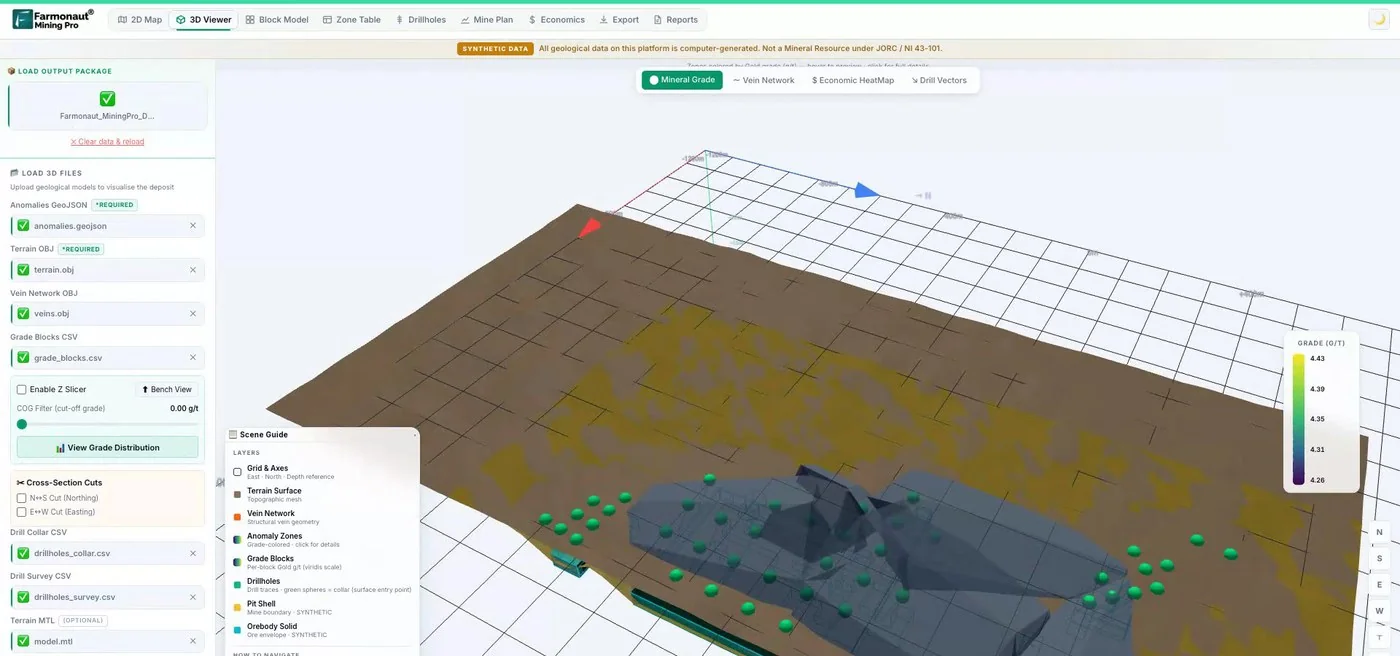
Mining Pro sample view, synthetic data
Keep reading



Sources
- International Copper Association Australia, Copper Weekly Brief, 15 October 2026: copper.com.au
- International Copper Association Australia, Copper Weekly Brief, week ending 9 October 2026: copper.com.au
- Westmetall, LME copper daily cash settlement and stocks: westmetall.com
- Westmetall, LME copper monthly averages: westmetall.com
- Westmetall, LME copper monthly averages 2020: westmetall.com
- Westmetall, LME copper monthly averages 2021: westmetall.com
- Westmetall, LME copper monthly averages 2022: westmetall.com
- Westmetall, LME copper monthly averages 2023: westmetall.com
- Westmetall, LME copper monthly averages 2024: westmetall.com
- Westmetall, LME copper monthly averages 2025: westmetall.com
- USGS, Mineral Commodity Summaries 2026: Copper: pubs.usgs.gov
- White House, Adjusting Imports of Copper into the United States (30 July 2025): whitehouse.gov
- Mining.com, Copper price forecasts lifted for 2026 but tariff collapse still on the table (14 October 2026): mining.com
- LME, Special Contract Rules for Copper Grade A: lme.com
- Fastmarkets, Clarification of copper grade A cathode premium assessment specifications (2024): fastmarkets.com
Discussion
Questions, corrections or field experience? Share them below. First-time comments are reviewed before they appear, and your email is never published.
No comments yet. Be the first to add a question or your experience.

 Energy and Resources Ltd
 Mwerezi Minerals Company Limited
 Congo Mining Solutions
 Mining SARL
 SenGold Invest SAS
 Sania Corporation
 Sean Mining Limited
 NTS Group (Pty) Ltd
 Mine4Africa
 Lithspo Minerals Limited
 Tintina Mining Group
 Dalgety Minerals Pty Ltd
 Vortex Minerals Pty Ltd
 Faith At Work (Pty) Ltd
 Geotech Mining Solutions plc
 Vulcan International Limited
 Kidepo Associates
 GKY Mining
 Alkimy SARL
 Licence holder · Nigeria · Gold + lithium










