

Copper prospecting · Practical guide
Copper Prospecting: 7 Steps, Indicators and Claim Fees
Copper prospecting starts with the deposit type: porphyry deposits supply about 60% of the world’s copper at an average 0.44% Cu (2008), and sediment-hosted deposits about 20% at 2.1% Cu (USGS). Indicator minerals, what satellites can see, and what a US claim or Western Australia licence costs.
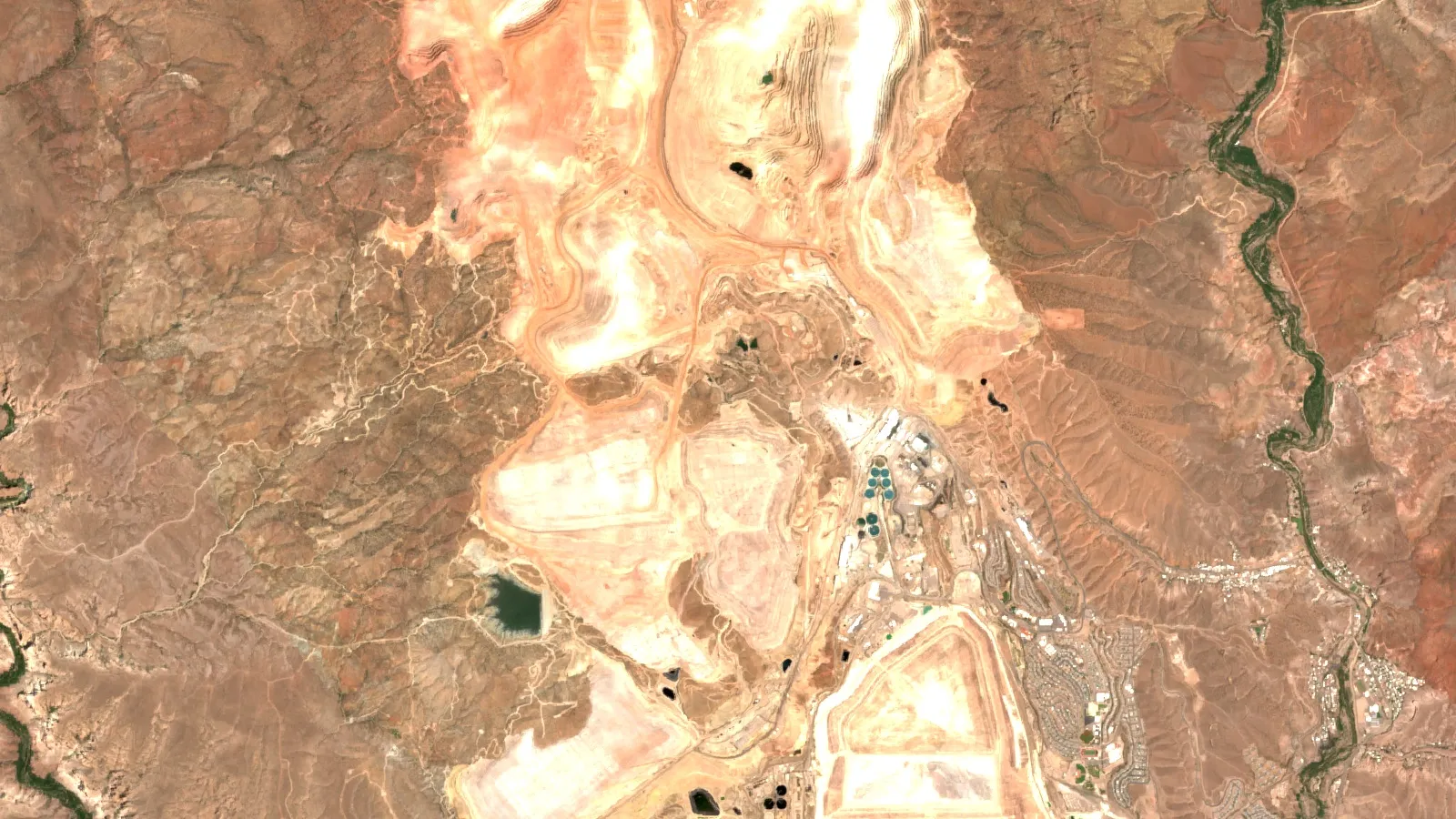
Key takeaways
- Porphyry deposits supply about 60% of world copper at an average 0.44% Cu (2008), and sediment-hosted stratabound deposits about 20% at about 2.1% Cu (USGS SIR 2010-5070-B and -M).
- Green and blue stains (malachite, azurite, chrysocolla) and rusty leached caps are the classic surface clues; chalcopyrite and bornite are the main primary sulfides (Handbook of Mineralogy; USGS).
- Satellites map the clay, mica and iron-oxide minerals around copper, not the metal: clay and mica absorb near 2.2 µm. Sentinel-2 and Landsat 9 each have two SWIR bands; ASTER’s SWIR stopped working in 2008 (USGS; NASA).
- A new US lode claim on BLM land costs US$274 in year one and US$200 a year after (BLM, claims filed from 1 September 2024); a one-block Western Australia exploration licence costs A$503 to apply for and needs A$10,000 spend a year in years 1 to 3 (DMPE, from 1 July 2026).
- Chile mined an estimated 5.3 Mt of the world’s 23 Mt of copper in 2025, and copper joined the US critical minerals list in November 2025 (USGS; Federal Register).
In this article
- Copper prospecting in 7 steps
- Where copper occurs: deposit types and grades
- Which countries mine the most copper
- Copper indicator minerals and field signs
- How remote sensing helps copper prospecting
- Alteration minerals that satellites can map near copper
- Which satellite for copper prospecting
- What satellites cannot tell you
- Where Farmonaut fits in a copper programme
- From satellite screen to field: mapping, sampling and geophysics
- Copper claim and licence costs: US lode claims and Western Australia
- Copper in the ground: grade, tonnes and price
- Safety, permission and no mercury
- Frequently asked questions
Copper prospecting is the search for ground that could hold a copper deposit. It works best in a fixed order. Choose a deposit type, check that the land is open and screen the area with maps and satellite images. Then confirm with field mapping, sampling and geophysics. Two deposit types matter most. Porphyry copper supplies about 60% of the world’s copper at an average grade of 0.44% Cu (2008 figure), and sediment-hosted stratabound copper supplies around 20%, averaging about 2.1% Cu. This guide covers where copper occurs, the indicator minerals to look for, what satellites can and cannot see, and what a claim or licence costs, with a claim-cost calculator and a copper-in-the-ground calculator.
Terms used below. Grade is the share of copper in the rock, written as % Cu. Hypogene ore forms at depth, and supergene ore forms later when weathering moves copper downward. A leached cap is the rusty, copper-poor rock left above supergene ore. A claim or licence is the legal right to explore a block of ground. SWIR means short-wave infrared light (about 1.4 to 2.5 micrometres, written µm). This page gives facts from official sources. It is not legal advice or investment advice.
Copper prospecting in 7 steps
Teams order these steps differently depending on the country. In some places you stake first to protect the ground, in others you screen first and apply later. The sequence below suits most programmes, and each step is explained in a section further down.
- Choose a deposit type. Porphyry, sediment-hosted and a few smaller types each leave different clues, so the type decides your indicators, sensors and geophysics.
- Check that the land is open. In the United States, search the BLM’s Mineral and Land Records System. Elsewhere, use the national cadastre; our guide to mining cadastre portals lists where to look.
- Do a desk study. Read geological maps, old mine records and published reports. Search the USGS Mineral Resources Data System too. USGS stopped updating it systematically in 2011 but still calls it the best collection of reports it has for sites outside the United States.
- Screen with satellite images. Map iron oxides, clay and mica minerals, and faults, to cut a large area down to a short list.
- Walk the ground. Map rock types, alteration and veins, and sample outcrops. The USGS calls geological mapping the single most important exercise in judging where altered and mineralised rock lies.
- Sample soil and stream sediment, then run geophysics. Induced polarization and magnetic surveys show where sulfide minerals and altered rock sit below cover.
- Drill only the best-ranked targets. A drill hole is the first test of grade and thickness, so rank targets on several independent clues before you commit money.
Where copper occurs: deposit types and grades
The USGS assessed undiscovered copper in two deposit types that together account for about 80% of the world’s copper supply, and, in its 2013 assessment, estimated a mean of 3,500 million tonnes of undiscovered copper in those two types among 225 tracts. The final 2015 assessment (SIR 2018-5160) reports at least 3,500 million tonnes in 236 areas. Those two types are porphyry and sediment-hosted stratabound deposits.
Chart
Average copper grade by deposit type
% Cu; porphyry as mined in 2008; sediment-hosted is the USGS class average; Copperbelt is the reduced-facies average there
Porphyry copper
Porphyry deposits form around igneous intrusions. They are large, with hundreds of millions to billions of tonnes of rock, and low in grade. USGS reports grades from several tenths of 1% to more than 1% Cu, with an average of 0.44% in 2008. At that grade a tonne of ore holds about 4.4 kg of copper. Chalcopyrite occurs in nearly all porphyry deposits and bornite in about 75% of them, while copper and molybdenum minerals together make up only 1 to 2% of the ore by volume, so the metal is spread thinly through a lot of rock. Our guide to porphyry copper alteration, grades and discovery goes deeper on this type.
Sediment-hosted stratabound copper
These deposits sit in layers of sedimentary rock. USGS describes three subtypes: reduced-facies, sandstone and red-bed. Outside the Central African Copperbelt, reduced-facies deposits average 1.38% Cu, sandstone deposits 1.08% and red-bed deposits 2.09%, while Copperbelt deposits run higher. These deposits are the basis of the economies of the Democratic Republic of Congo, Poland and Zambia. A typical host is grey or green reduced rock sitting inside thick sequences of red beds.
Other types
Copper also comes from volcanogenic massive sulfide deposits, which USGS puts at an average of 1.3% Cu for the Kuroko type, from skarns, and from native copper in altered basalt, such as the Keweenawan lavas of Michigan’s Upper Peninsula. Our overview of copper deposit types, top countries and where to explore compares them.
The chart compares the average grades the USGS reports. Higher grade does not mean a better project on its own, because porphyry deposits make up for low grade with size.
Which countries mine the most copper
World mine production was estimated at 23 million tonnes in 2025, and Chile alone mined an estimated 5.3 million tonnes, according to the USGS Mineral Commodity Summaries 2026. Congo (Kinshasa), Peru, China and Russia follow. In the United States, Arizona accounted for about 70% of 2025 output, and copper was also mined in Alaska, Michigan, Missouri, Montana, Nevada, New Mexico and Utah. For a state-by-state view, see our page on where copper is found in the United States, and for company and country rankings, the largest copper producers.
Chart
Copper mine production, eight leading countries
Thousand tonnes of recoverable copper, 2025 estimate
Production tells you where mines are, not where the next discovery will be. USGS notes that most recent major discoveries were made where the ore itself did not crop out, and that virtually all future discoveries in the heavily explored continental United States will be concealed. That is one reason prospectors read indirect signs such as alteration and geochemistry rather than looking for copper at the surface alone.
Copper indicator minerals and field signs
Most copper minerals are easy to spot once you know the colours. The oxidised minerals form when sulfides weather near the surface, so green and blue stains on outcrop are the classic first clue. The table gives standard properties from the Handbook of Mineralogy, published by the Mineralogical Society of America. Our page on copper minerals and copper ore minerals has more detail on each one.
| Mineral | Type | Colour | Streak | Hardness (Mohs) |
|---|---|---|---|---|
| Malachite | Oxidised carbonate | Bright to dark green, often banded | Pale green | 3.5 to 4 |
| Azurite | Oxidised carbonate | Azure to dark blue | Pale blue | 3.5 to 4 |
| Chrysocolla | Oxidised silicate | Blue, blue-green or green | White when pure | About 2 to 4 |
| Chalcopyrite | Primary sulfide | Brass-yellow, may tarnish iridescent | Greenish black | 3.5 to 4 |
| Bornite | Primary sulfide | Copper-red when fresh, tarnishes iridescent purple | Pale greyish black | 3 to 3.25 |
| Chalcocite | Enriched sulfide | Blackish lead-grey | Blackish lead-grey | 2.5 to 3 |
Streak is the colour of the powder left when you rub a mineral on unglazed porcelain, and it is more reliable than surface colour. Malachite is a common secondary mineral in the oxidation zone of copper deposits, and it often occurs with azurite and chrysocolla, so one stain usually leads to the others.
Native copper, the pure metal, occurs as veins and cavity fillings in altered basalt and also forms near the surface from other copper minerals. According to the Wisconsin Geological and Natural History Survey, it survives weathering but is often coated with green or black rinds of malachite, azurite and cuprite.
Leached caps and gossans
Over a sulfide-rich copper system, weathering leaves a rusty cap of iron oxides. USGS explains that the iron oxide type hints at what lies below: pyrite leaves yellow to brown to black limonite, chalcopyrite leaves goethite with a rectangular boxwork texture, and chalcocite leaves mostly hematite. Acid water dissolves copper from the cap and redeposits it lower down, below the water table. This can build a blanket of supergene chalcocite. In Andean porphyry deposits its grades reach up to 3 times those of the primary ore, and enrichment factors approach 8 in some southwestern North American deposits. Reading the cap correctly is a standard way to rank drill targets.
Pathfinder elements and copper clearings
Porphyry systems spread arsenic, antimony and mercury along fractures far from the copper itself, and USGS says these distal signatures can extend 10 km or more from the centre. In Zambia and the Congo, early prospectors searched aerial photographs for copper clearings, patches where vegetation changes over copper-bearing ground, and USGS suggests similar vegetation anomalies may still be found elsewhere.
How remote sensing helps copper prospecting
Satellites cannot see copper metal under rock. They record sunlight reflected from the ground in many wavelength bands, and the minerals in the altered rock around a deposit absorb light at known wavelengths. The USGS states that in areas of good exposure with limited vegetation, multispectral and hyperspectral imaging can map alteration minerals, iron oxides and silica in porphyry systems.
▶ Explains that remote sensing means measuring the ground from a distance, and why agreement between six instrument families is the core of the argument. · 2:01
For a prospector the value is triage. A satellite screen can reduce several thousand square kilometres to a short list of places worth a field visit, before you spend on travel, sampling or title. Our guide to geology and remote sensing with Landsat, ASTER and Sentinel-2 covers the sensors and processing in more depth, so this page keeps to what matters for copper.
Alteration minerals that satellites can map near copper
The idealised porphyry model has a core of quartz and potassium-bearing minerals surrounded by zones of hydrous minerals, and each zone has at least one mineral with a clear absorption feature. The table follows the USGS porphyry copper deposit model.
| Zone or product | Typical minerals | Where it absorbs light |
|---|---|---|
| Sericitic (phyllic) | Sericite, a fine-grained muscovite | Strong feature at 2.2 µm, weaker at 2.35 µm |
| Advanced argillic | Kaolinite, alunite, pyrophyllite | Features at 2.165 and 2.2 µm |
| Propylitic | Chlorite, epidote, calcite | Features at 2.31 to 2.33 µm |
| Weathered iron caps | Goethite, hematite, limonite | Iron features at 0.97 to 0.83 µm and 0.48 µm |
| Weathered iron caps | Jarosite | Features at 0.94 and 2.27 µm |
| Silica-rich rock | Quartz, opal | Thermal infrared feature near 9.1 µm |
The practical reading is simple. Rock rich in clay and mica sits in the SWIR, rock rich in iron oxide sits in the visible and near-infrared, and the two together draw the rings of alteration that porphyry systems are known for. Landsat 9 band 7 (2.11 to 2.29 µm) and Sentinel-2 band 12 (centred at 2190 nm) sit on the 2.2 µm feature, and ASTER band 8 (2.295 to 2.365 µm) sits on the 2.31 to 2.33 µm feature.
The same approach works in other settings. For sediment-hosted copper, USGS notes that bleaching of red beds is easily mapped with Landsat, AVIRIS or ASTER imagery, by simple colour mapping or by mapping iron oxides, because current thinking holds that sandstone copper deposits mineralise only the bleached sandstones.
▶ Explains what a spectral signature is, why short-wave infrared does the work, and what multispectral and hyperspectral imaging can never tell you. · 1:49
Which satellite for copper prospecting
Four sensors cover most needs. Pixel size matters because each pixel gives one average spectrum, so a 30 m pixel blends everything within a 30 m square. USGS adds that airborne hyperspectral sensors such as HyMap and AVIRIS map more minerals than multispectral satellites, but they cover far less ground.
| Sensor | Pixel size in SWIR | SWIR bands | Revisit | Note |
|---|---|---|---|---|
| Sentinel-2 | 20 m | 2 (1610 and 2190 nm) | 5 days at the equator with two satellites | 13 bands; visible and near-infrared bands at 10 m; 290 km swath |
| Landsat 9 | 30 m | 2 (1.57 to 1.65 and 2.11 to 2.29 µm) | 16 days | 11 bands in all; 185 km swath |
| ASTER | 30 m | 6 (1.6 to 2.43 µm) | SWIR archive only | SWIR data since April 2008 are not usable; scenes before then still work |
| EnMAP | 30 m | Hyperspectral, 900 to 2450 nm | 27 days at nadir, 4 days off-nadir | 242 spectral channels, 420 to 2450 nm; 30 km swath |
Sentinel-2 and Landsat 8 both produced useful alteration maps in a study of an epithermal system in southeast Spain, with image correlation of about 0.8 or higher between them, though the value ranges differed. That supports using either one for a first screen and treating the results as targets, not as a measurement of copper.
What satellites cannot tell you
- Copper content. Remote sensing maps minerals that travel with copper, not the metal. The USGS notes that it does not directly separate hypogene from supergene mineral assemblages.
- What lies under cover. Thick soil, dense vegetation or transported gravel hide the rock. Optical sensors see only the surface, so covered ground needs geophysics and drilling.
- Clouds. Optical bands do not see through cloud. Sentinel-1 carries a C-band radar that gives all-weather, day-and-night imagery, which helps with terrain and structure in cloudy regions, while the mineral clues still come from the optical and infrared bands.
- Old data. ASTER’s six SWIR bands, the most of the three multispectral sensors in the table, stopped producing usable data in 2008.
Treat every satellite anomaly as an exploration target that needs ground checking, and never as a resource estimate.
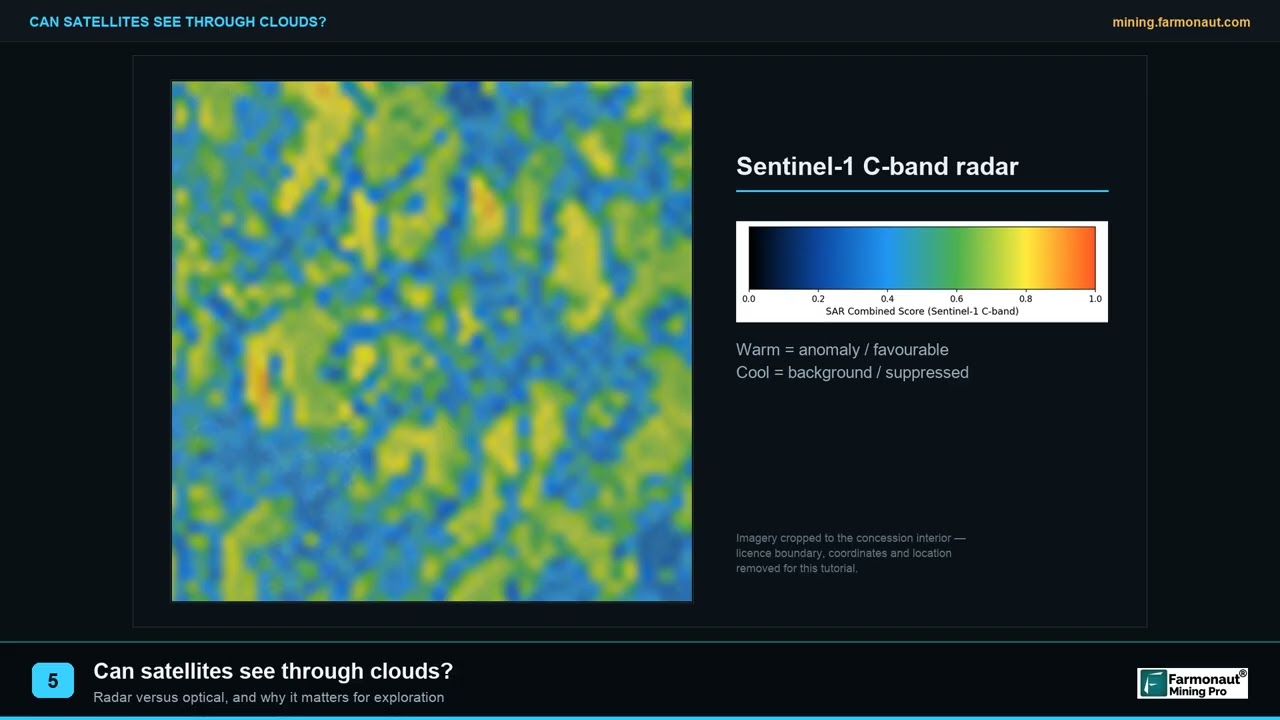
▶ Explains why optical satellites cannot see through cloud, and how radar satellites make a difference in cloudy exploration regions. · 2:14
Where Farmonaut fits in a copper programme
Farmonaut’s satellite mineral detection takes a licence area as a KML, KMZ or polygon and returns a report of target zones, alteration and structure, typically in 5 to 20 business days. It is built to screen large areas before field teams go out, and its results are exploration targets that sit ahead of a resource estimate, not a JORC or NI 43-101 figure. See satellite mineral detection for the service itself.
From satellite screen to field: mapping, sampling and geophysics
A satellite target becomes a prospect only after ground work. The USGS porphyry model lists the main tools and their limits.
- Geological mapping. Record rock types, alteration minerals, sulfide and oxide minerals and vein density, and map each alteration mineral to its limit against fresh rock. USGS calls this the most fundamental approach to porphyry exploration.
- Soil and stream-sediment sampling. Trace-element analyses of soils and sediments have been used for decades to explore for porphyry deposits. Contouring many samples and drilling the centre of the pattern is the simplest vectoring method, but with distance dilution pulls values down to background and the method stops working.
- Induced polarization (IP). IP measures how well rock holds an electrical charge, and it suits porphyry systems because the sulfides are dispersed. The limit is that pyrite and economic copper sulfides respond alike, so IP cannot tell them apart without other data.
- Magnetic surveys. Alteration zones produce predictable magnetic patterns, so ground and airborne surveys can map them, and magnetic anomalies can also point to the intrusions and structures that control porphyry deposits.
Copper claim and licence costs: US lode claims and Western Australia
Fees differ by country, so the figures below are examples from two regulators, both read in October 2026. Check the current schedule before you pay.
United States: lode claims on BLM land
On federal public land, metallic minerals are staked as mining claims. A lode claim covers veins and other rock in place bearing valuable minerals, and federal law limits one to 1,500 feet in length and 600 feet in width. A claim does not give exclusive rights to the surface, and states add their own rules for locating and recording. For new lode claims filed on or after 1 September 2024, the BLM fee schedule sets these amounts per claim:
| Item | Amount | When due |
|---|---|---|
| Processing fee | US$25 | With the notice of location, within 90 days of locating |
| Location fee | US$49 | With the notice of location |
| Maintenance fee | US$200 | First year with the notice, then each year on or before 1 September |
| Total in year one | US$274 |
A claimant who, with all related parties, owns 10 or fewer claims nationwide can file a maintenance fee waiver instead of paying the US$200, by 1 September each year. The waiver route adds an affidavit of assessment or notice of intent to hold at US$15 per claim by 30 December. County recording fees are separate and vary by county.
Western Australia: exploration licence
The Department of Mines, Petroleum and Exploration lists these amounts in its fee schedule effective 1 July 2026, in Australian dollars. An exploration licence is made of graticular blocks.
| Item | Amount (A$) |
|---|---|
| Application, one block | 503 |
| Application, more than one block | 1,800 |
| Rent, one-block licence applied for after 1 July 1999 | 493 |
| Rent per block, years 1 to 3, other licences | 177 |
| Rent per block, years 4 and 5 | 318 |
| Minimum spend, years 1 to 3 | 1,000 per block, at least 10,000 for one block and 15,000 for 2 to 5 blocks |
The schedule lists a flat rent of A$493 for a one-block licence applied for after 1 July 1999, and the rent in the table applies to other licences. The minimum spend is the bigger cost: for one block it is A$10,000 a year in the first three years, about twenty times the one-block application fee. Our guide to Western Australian tenements explains the tenement types and where to apply.
Other countries
Every country runs its own title system, with its own cadastre, fees and work commitments. Our cadastre portal guide links to the official search tools by country. Before you apply anywhere, confirm who holds title now, whether the ground is protected or reserved, and what the licence obliges you to spend.
Calculator
What would it cost to hold your lode claims?
Enter your own number of claims, years and fees.
- Cost in year one: $3,040
- Cost in each later year: $2,000
- Average cost per year: $2,347
Defaults follow the BLM fee schedule for new lode claims filed on or after 1 September 2024 (US$25 processing, US$49 location, US$200 maintenance in year one, then US$200 a year). County recording fee is an example: check your county. If you qualify for the small-claimant waiver (10 or fewer claims), set the yearly fee to your waiver filing costs. Fees change, so confirm them with the BLM. Amounts are in US dollars. BLM charges maintenance for two assessment years when a notice for a claim located earlier is filed on or after 1 September, so add one year’s fee in that case. The calculator charges the yearly fee every year and does not model the waiver.
Copper in the ground: grade, tonnes and price
Grade, tonnes and price decide whether a prospect can ever pay. USGS says the average grade of mined porphyry ore fell from 0.49% Cu in 2002 to 0.44% in 2008, which USGS links to several factors, among them higher copper prices, better mining efficiency and more low-grade oxide ore recovered by leaching. Price still moves the case: the USGS puts the annual average London Metal Exchange grade A cash price at 440 cents per pound in 2025 (an estimate), up from 384.8 cents in 2023.
Chart
Annual average copper price, 2021 to 2025
US cents per pound; 2025 is a USGS estimate
Copper has also become a policy metal. In November 2025 the Department of the Interior, through the USGS, added copper to the List of Critical Minerals, and the final list names 60 minerals.
The second calculator below gives a first look at contained and recovered copper. It is a gross metal value only, so it leaves out smelter charges, mining and processing cost, royalties and tax. Use it to compare prospects, not to value one.
Calculator
How much copper is in your ore, and what is it worth?
Enter your own tonnes, grade, recovery and price.
- Contained copper (tonnes): 4,400 t
- Copper per tonne of ore (kg): 4.4 kg
- Gross metal value at your price: $36,278,000
Example values only, not a benchmark; the 85% recovery is an assumed example, not a sourced figure. The default grade, 0.44% Cu, is the USGS average for porphyry ore in 2008; the default price of 9,700 US$ per tonne is the USGS 2025 estimate of 440 cents per pound converted by us (1 tonne = 2,204.62 lb). Price is an input: example, use today’s price. The result is gross metal value only: smelter charges, penalties, mining and processing cost, royalties and tax are not included.
Safety, permission and no mercury
Get written permission from the landholder before you enter or sample, and check the licence rules for the ground. On BLM land, casual use, such as collecting rock and mineral specimens with hand tools, causes negligible disturbance and needs no notice or plan of operations, although the BLM says to contact the field office first where the combined effect of casual use could be more than negligible. Exploration that disturbs 5 acres or less needs a notice to the BLM field office, and anything larger, or a bulk sample of 1,000 tons or more, needs a plan of operations. Operators may not split a project into several notices to avoid a plan.
Old workings are the main physical danger. The BLM says as many as half a million abandoned mines are believed to exist on the land it manages and that sites usually carry no warning signs, so stay out of shafts and adits. Copper recovery does not need mercury, which is a poison, so never bring it near a sample or a stream.
We cover a connected topic in BLM Mining Claims Map California: 7 Steps and Fees.
For a closer look at a related question, see our guide: Where Foreigners Can Legally Prospect for Gems: 12 Places.
Frequently asked questions
What is copper prospecting?
It is the early search for copper-bearing ground, from reading maps and satellite images to field mapping, sampling and geophysics. It ends when a target is either dropped or ready for a first drill hole.
What are the best indicator minerals for copper?
Malachite and azurite are the most common surface signs, with chrysocolla and native copper as other oxidised clues. Chalcopyrite and bornite are the main primary sulfides in porphyry deposits, and chalcocite is the key enriched sulfide. The table above gives the colour, streak and hardness of each.
How do I tell malachite from other green minerals?
Malachite leaves a pale green streak and has a hardness of 3.5 to 4, so a steel nail scratches it. Confirm any find by assay, because colour alone can mislead.
Can satellites find copper?
They cannot see copper directly. They map the clay, mica and iron-oxide minerals around copper deposits, and those maps narrow the search. The USGS notes this works best where rock is exposed and vegetation is limited.
Which satellite is best for copper prospecting?
For a first screen, Sentinel-2 and Landsat 9 each carry two SWIR bands and cover large areas on a regular schedule. ASTER had six SWIR bands, but they stopped working in 2008. EnMAP gives hyperspectral data at 30 m but revisits a given spot only every 27 days at nadir.
What rocks host copper deposits?
Porphyry deposits sit in and around igneous intrusions, with zoned alteration in the surrounding rock. Sediment-hosted deposits sit in sedimentary basins, usually in grey or green reduced rock within or above thick red beds.
How much does it cost to stake a copper claim in the United States?
On BLM land, a new lode claim costs US$274 in the first year under the fee schedule for claims filed on or after 1 September 2024, then US$200 a year. A waiver is available for owners of 10 or fewer claims. County recording fees are extra.
Do I need a licence to collect copper samples?
On BLM land, collecting rock and mineral specimens with hand tools is casual use, which needs no notice or plan; check with the BLM field office first in busy or protected areas. Private land needs the owner’s permission, and other countries have their own rules, so check with the regulator before you collect.
How much copper is in a typical deposit?
Porphyry deposits averaged 0.44% Cu in 2008, volcanogenic massive sulfide deposits of the Kuroko type about 1.3%, and sediment-hosted stratabound deposits about 2.1%, according to the USGS deposit models. A grade of 0.44% is about 4.4 kg of copper per tonne of ore.
Which countries produce the most copper?
Chile was first in 2025, with an estimated 5.3 million tonnes out of about 23 million tonnes worldwide, followed by Congo (Kinshasa) at 3.2 million and Peru at 2.7 million (USGS estimates).
Is copper on the US critical minerals list?
Yes. The final 2025 list, published in the Federal Register on 7 November 2025, includes copper among its 60 minerals.
How long does a satellite mineral screening take?
Farmonaut delivers its mineral intelligence report in 5 to 20 business days, depending on the size of the area and the complexity of the minerals. The output is a set of targets that still need field checks.
This page is for information only. It is not legal advice or investment advice. Confirm claim, licence and permit rules with the regulator. Get the landholder’s permission before you enter or sample, stay out of old workings and never use mercury.
Farmonaut mining
Map your mining site from space
Consultants can send a licence boundary as KML, KMZ or a polygon and receive satellite-derived exploration targets, ahead of any resource estimate.
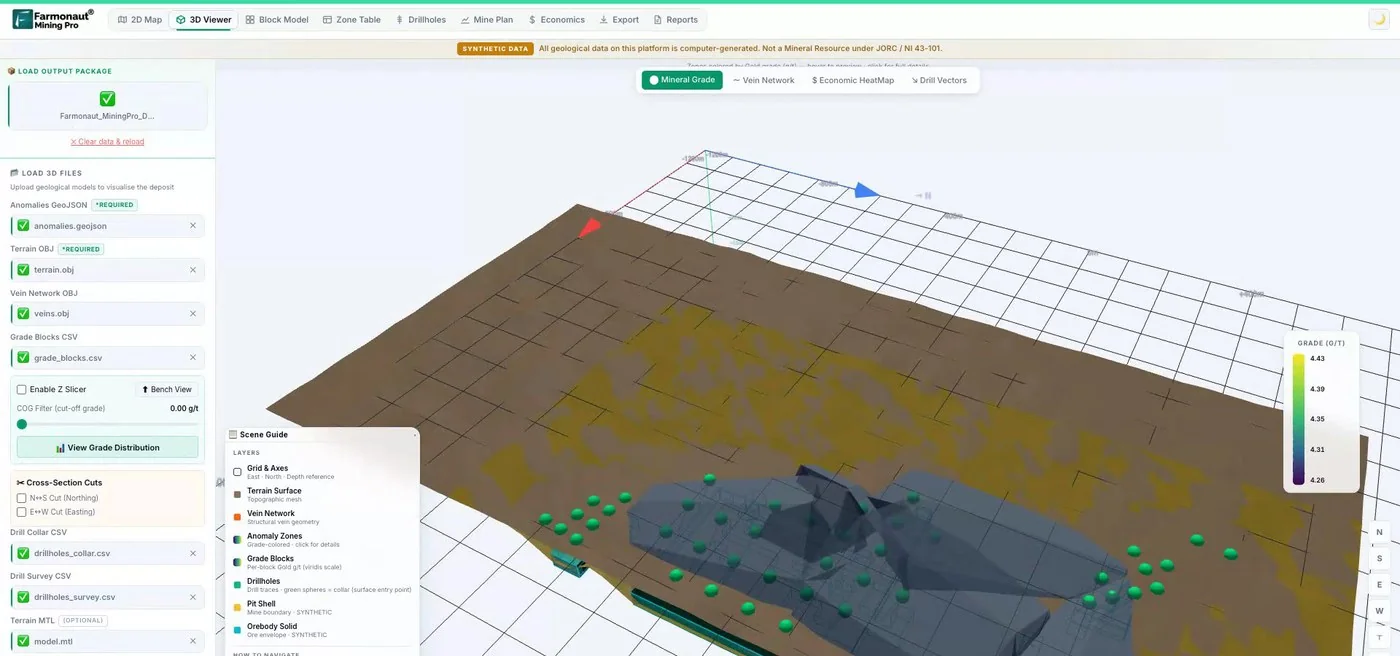
Mining Pro sample view, synthetic data
Keep reading
Sources
- USGS, Mineral Commodity Summaries 2026: Copper (February 2026): pubs.usgs.gov
- USGS SIR 2010-5070-B, Porphyry copper deposit model (John and others, 2010): pubs.usgs.gov
- USGS SIR 2010-5070-M, Sediment-hosted stratabound copper deposit model (Hayes and others, 2015): pubs.usgs.gov
- USGS Fact Sheet 2014-3004, Estimate of undiscovered copper resources of the world, 2013: pubs.usgs.gov
- USGS, Mineral Resources Data System (MRDS): mrdata.usgs.gov
- Federal Register, Final 2025 List of Critical Minerals (90 FR 50494, 7 November 2025): federalregister.gov
- BLM, Mining Claims: blm.gov
- BLM, Mining Claim Fees: blm.gov
- BLM, Surface Management of Locatable Minerals: blm.gov
- BLM, Abandoned Mine Lands: blm.gov
- Western Australia DMPE, Fees and Charges 2026-27, Mining Act 1978 (effective 1 July 2026): wa.gov.au
- Handbook of Mineralogy, Malachite: handbookofmineralogy.org
- Handbook of Mineralogy, Azurite: handbookofmineralogy.org
- Handbook of Mineralogy, Chrysocolla: handbookofmineralogy.org
- Handbook of Mineralogy, Chalcopyrite: handbookofmineralogy.org
- Handbook of Mineralogy, Bornite: handbookofmineralogy.org
- Handbook of Mineralogy, Chalcocite: handbookofmineralogy.org
- Wisconsin Geological and Natural History Survey, Copper (native copper): home.wgnhs.wisc.edu
- ESA SentiWiki, Sentinel-2 mission: sentiwiki.copernicus.eu
- NASA, Landsat 9 instruments: landsat.gsfc.nasa.gov
- NASA JPL, ASTER instrument characteristics: asterweb.jpl.nasa.gov
- NASA Earthdata, ASTER SWIR anomaly alert (13 January 2009): earthdata.nasa.gov
- EnMAP, Mission outline: enmap.org
- DLR, EnMAP commissioning and routine operations (December 2022): countdown.dlr.de
- ESA, Introducing the Sentinel-1 mission: esa.int
- van der Werff and van der Meer, Sentinel-2A MSI and Landsat 8 OLI for geological remote sensing, Remote Sensing 2016: doi.org
- USGS SIR 2010-5070-B, Porphyry copper deposit model (full report PDF): pubs.usgs.gov
- USGS SIR 2010-5070-M, Sediment-hosted stratabound copper deposit model (full report PDF): pubs.usgs.gov
- USGS SIR 2018-5160, Global copper assessment (2015 final): pubs.usgs.gov
Discussion
Questions, corrections or field experience? Share them below. First-time comments are reviewed before they appear, and your email is never published.
No comments yet. Be the first to add a question or your experience.

 Enterprise Takreem
 Sean Mining Limited
 NTS Group (Pty) Ltd
 Mine4Africa
 Lithspo Minerals Limited
 Tintina Mining Group
 Dalgety Minerals Pty Ltd
 Vortex Minerals Pty Ltd
 Faith At Work (Pty) Ltd
 Geotech Mining Solutions plc
 Vulcan International Limited
 Kidepo Associates
 GKY Mining
 Alkimy SARL
 Double A Trading
 GemSprout Metals Limited
 Qader Group
 Ileys General Trading
 SG Gold Mining LLC
 VRV Global Pte Ltd
 Omsri International FZE
 G.I.T.T.
 Jaunita Erss Ltd
 SRK Consulting
 Berks Gold Limited










