

Molybdenum · Price guide
Price of Molybdenum Today: Chart and Drivers
Molybdenum spot stood at US$33.3 per pound on 30 September 2026, up from US$22.7 at the end of 2025 (Antofagasta). Benchmarks, drivers, producers, mine costs and tube limits.
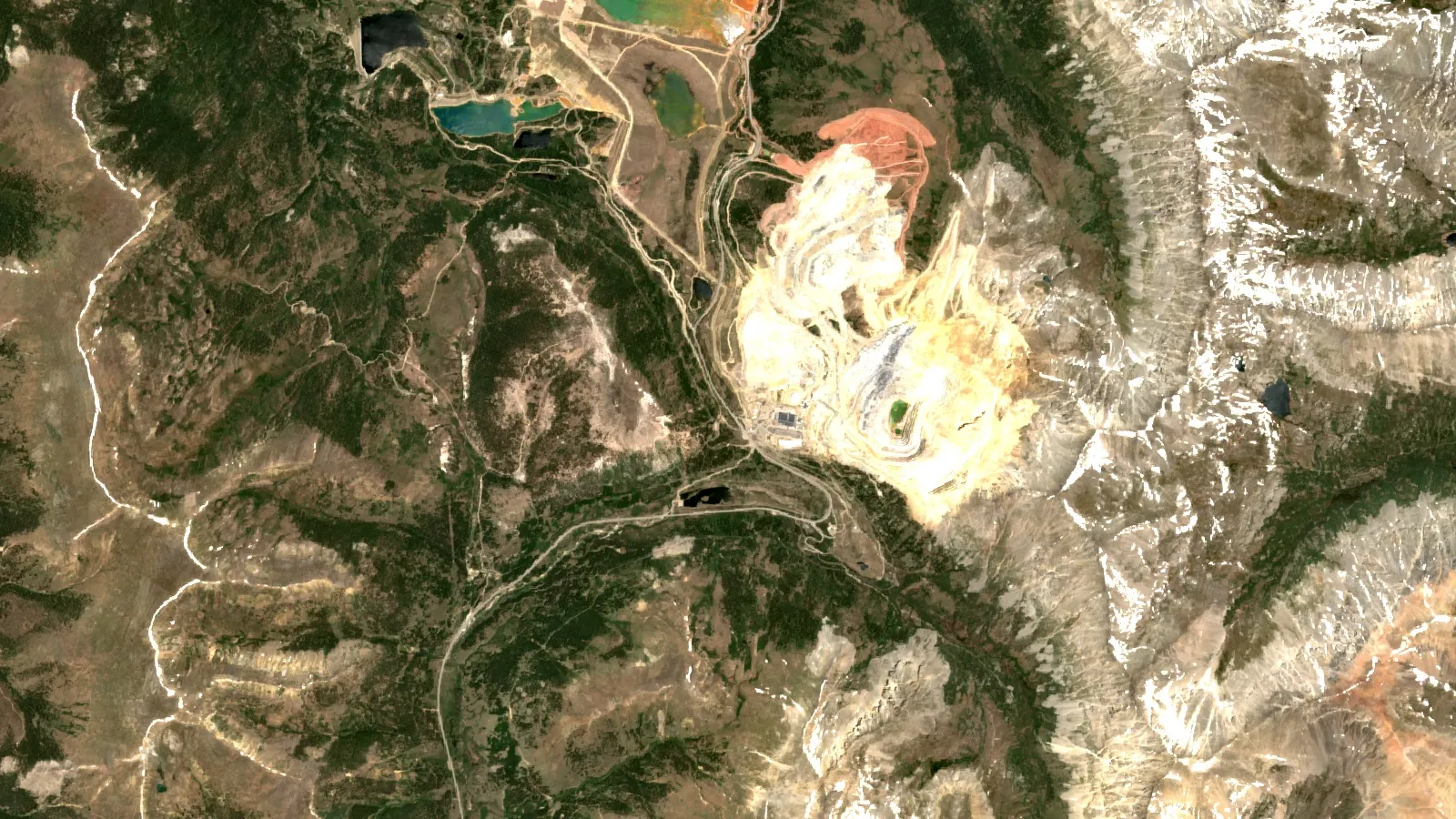
Key takeaways
- Spot molybdenum was US$33.3 per pound on 30 September 2026, against US$22.7 on 31 December 2025 (Antofagasta Q3 2026 report).
- The Shanghai Metals Market oxide benchmark, FOB China, was US$36.20 per pound on 30 September 2026 (as published by Critical Minerals News).
- Freeport-McMoRan realised US$28.75 per pound in the second quarter of 2026 and reported a Molybdenum mines cash cost of US$19.20 per pound.
- China, Chile, the United States, Peru and Mexico make 90% of world mine output, mostly as a by-product of copper (USGS, 2026).
- Molybdenum tube is for vacuum, inert gas or hydrogen; it oxidises in air above roughly 400-600 degrees C.
In this article
- Price of molybdenum per pound: what the main benchmarks show
- How to read a molybdenum price quote
- What is pushing molybdenum prices up
- Molybdenum price history: what producers actually received
- Who supplies molybdenum
- Where molybdenum demand comes from
- What the molybdenum price means for a mine: costs and break-even
- Value the molybdenum in your ore or concentrate
- Properties that matter to buyers
- Tubing: where it works and where it does not
- Finding molybdenum: porphyry systems and satellite screening
- What to check before you rely on a price quote
- Frequently asked questions
Price of molybdenum per pound: what the main benchmarks show
Molybdenum oxide, the form most buyers quote, traded at about US$33 per pound of contained molybdenum at the end of September 2026. Antofagasta, a Chilean copper miner that sells molybdenum as a by-product, reported a spot price of $33.3 per pound on 30 September 2026, against $31.4 on 30 June 2026 and $22.7 on 31 December 2025. That is a rise of roughly 47% in nine months (our arithmetic from those three figures).
Chart
Spot molybdenum price at three dates
US$ per pound of molybdenum; quarter-end spot as reported by Antofagasta
No single number is “the” molybdenum price. The figure you see depends on the product (oxide, ferromolybdenum or metal), the place (Europe, the United States or China), the delivery term and the day. The table lists the latest benchmarks, each with its date and source.
| Benchmark | Price | Date and basis |
|---|---|---|
| Spot molybdenum price, Antofagasta report | US$33.3 per lb Mo | 30 September 2026, quarter-end spot |
| Market price average, Antofagasta report | US$33.0 per lb Mo | Third quarter 2026 average |
| Realised price, Antofagasta | US$35.7 per lb Mo | Third quarter 2026, price the company actually received |
| Realised price, Freeport-McMoRan | US$28.75 per lb Mo | Second quarter 2026 average, all its molybdenum sales |
| Oxide, FOB China (Shanghai Metals Market) | US$36.20 per lb Mo | 30 September 2026, FOB (shipped on board), no VAT adjustment |
| Molybdenum bar, ex-works China (Shanghai Metals Market) | US$92.26 per kg | 30 September 2026 |
| US molybdic oxide, 57% Mo (Argus, via USGS) | US$51 per kg Mo (about US$23.1 per lb) | 2025 average, estimate |
The Shanghai Metals Market (SMM) oxide and bar figures come from a monthly price page of Critical Minerals News that quotes SMM benchmark codes; treat those two rows as second-hand figures. The Antofagasta, Freeport and USGS figures come from company reports and a government survey.
The gaps between rows are normal. A producer’s realised price can differ from the market average because it reflects the timing of sales and contract terms. A China FOB quote excludes the delivery cost to a US or European mill. Always check which row matches your contract.
How to read a molybdenum price quote
Molybdenum is not sold as a pure metal in most trades. The mine makes a molybdenite (MoS2) concentrate, a roaster turns it into technical-grade molybdenum oxide, and the oxide is then sold as it is, turned into ferromolybdenum, or reduced to metal powder. The International Molybdenum Association (IMOA) describes technical oxide as containing at least 57% molybdenum and ferromolybdenum (FeMo) as typically 60-70% molybdenum with the rest iron.
- Price per pound of contained Mo. Oxide is quoted in US dollars per pound of molybdenum inside the oxide, not per pound of oxide. A tonne of 57% oxide holds 570 kg of molybdenum, about 1,257 lb.
- Price per kilogram. USGS reports the US oxide price in dollars per kilogram of molybdenum content, from Argus Media data. Multiply dollars per pound by 2.2046 to get dollars per kilogram.
- Ferromolybdenum. FeMo is usually quoted per kilogram of molybdenum, so the price of the iron is not paid for.
- Metal products. Bar, plate, wire and tube are priced per piece or per kilogram of product and include conversion cost on top of the oxide price.
- Delivery term. FOB means the seller loads the goods on board at the port of departure. CIF adds cost, insurance and freight to the buyer’s port.
The converter below turns a per-pound oxide quote into dollars per kilogram, and into the molybdenum value of a tonne of oxide at the grade you enter.
Calculator
What is a molybdenum oxide quote worth per kilogram and per tonne?
Enter a quote in US$ per pound of molybdenum and the molybdenum content of your product.
- Molybdenum in the product (lb): 1,257 lb
- Molybdenum value of the product: $41,846
Example values only. The default price of 33.3 US$ per pound is the Antofagasta spot price at 30 September 2026; use today’s price. The default 57% is the minimum molybdenum content of technical oxide described by the IMOA. 1 lb = 0.45359 kg. Gross material value only; no delivery, treatment or payable terms.
What is pushing molybdenum prices up
Four forces show up in company reports and market analysis, and the first two are the most documented.
Use is running ahead of production. The IMOA reported world molybdenum production of 168.4 million pounds in the first quarter of 2026, while use was 180.7 million pounds, according to a Mining and Metal News summary of the IMOA data. China was both the largest producer (78.5 million pounds) and the largest user (91.1 million pounds).
Supply barely responds to price. Most molybdenum outside China is a by-product of copper mining, so output follows copper ore grades and plans, not the molybdenum price. PricePedia’s August 2026 analysis makes the same point and adds China’s 2025 export authorisation rules, higher energy costs, and interest in molybdenum as a substitute for tungsten in some semiconductor uses. The USGS notes that China imposed export controls on molybdenum powders in February 2025.
Falling grades at big by-product mines. Antofagasta’s Los Pelambres mine had a molybdenum head grade of 0.018% and a recovery of 76.5% in the third quarter of 2026, and the company’s nine-month molybdenum output fell 21.1% to 9,000 tonnes, mainly from lower grades there (Antofagasta Q3 2026 production report). Grade is the percentage of the metal in the ore, so a small change at a large mine moves world supply.
Steel demand. Most molybdenum goes into steels. The IMOA’s 2024 end-use split below shows how widely it is spread across industries, which is why no single sector sets the price.
Tungsten is the closest comparison. For another critical metal with a China-led supply chain, see our guide to tungsten projects in Canada.
Molybdenum price history: what producers actually received
Spot quotes are noisy, so a producer’s yearly average realised price is a steadier record. Freeport-McMoRan, which runs the Climax and Henderson molybdenum mines in Colorado and sells by-product molybdenum from its copper mines, reports its average realised price every year. Its annual report (Form 10-K) shows US$15.56 per pound in 2021, rising to US$24.64 in 2023, easing to US$21.77 in 2024 and US$22.63 in 2025. In the first half of 2026 it averaged US$27.03 (Freeport second-quarter 2026 earnings release).
Chart
Molybdenum prices: 2025 against 2026, by reporting company
US$ per pound; Antofagasta nine months to 30 September, Freeport six months and second quarter
Chart
Freeport-McMoRan average realised molybdenum price
US$ per pound; calendar years 2021-2025 and first half of 2026
The USGS series, which tracks the Argus US oxide price instead of one company’s sales, shows the same shape: US$35.62 per kilogram of molybdenum in 2021, US$54.32 in 2023, US$47.72 in 2024 and an estimated US$51 in 2025.
The year-on-year jump in 2026 is clear in the comparisons companies publish. The dumbbell chart above puts the 2025 and 2026 periods side by side for the Antofagasta and Freeport-McMoRan reports.
Who supplies molybdenum
The USGS estimates world mine output at 260,000 tonnes of molybdenum content in 2025, with China, Chile, the United States, Peru and Mexico together making 90% of it. China alone produced 97,000 tonnes, about 37% of the total (our arithmetic from the USGS table). Only China and the United States produce molybdenum from both primary molybdenum mines and by-product copper mines; the other major producers rely on copper mines (USGS Mineral Commodity Summaries, February 2026).
Chart
Largest molybdenum mine producers
Thousand tonnes of molybdenum content, 2025 estimate; the eight largest producers
Some nations hold little. Geoscience Australia reported economic demonstrated resources of 248,000 tonnes of molybdenum in Australia in 2019, about 1% of world resources in its 2020 review (figures from before the USGS revisions in the 2026 table above).
In the United States, the USGS lists two primary molybdenum mines, both in Colorado (the Colorado Geological Survey names them as the Climax and Henderson mines), and seven by-product operations (four in Arizona and one each in Montana, Nevada and Utah). It also reports that a Canadian company plans to restart an idled molybdenum mine in Idaho in the second half of 2027.
World reserves are put at 17 million tonnes of molybdenum, with 7.8 million in China, 3.5 million in the United States and 2.6 million in Chile. The USGS describes resources as adequate for foreseeable needs, so the price story is about how fast mines and copper by-product streams can deliver, not about running out. Recycling matters too: molybdenum in steel and superalloy scrap may supply as much as 30% of apparent supply.
Because so much molybdenum sits in porphyry copper systems, exploration for it overlaps with copper work; see our guides to porphyry copper deposits and to copper deposit types and top countries.
Where molybdenum demand comes from
The IMOA estimated end-use demand for molybdenum, including molybdenum in scrap, at 398,000 tonnes in 2024, a small increase on 2023, and gives the split by sector in its 2024/2025 Annual Review. Chemical and petrochemical use is the largest slice at 15%, followed by oil and gas with refining at 14%, and mechanical engineering and automotive at 12% each. The USGS adds that molybdenum is mainly an alloying agent in cast iron, steel and superalloys, with chemical uses in catalysts, lubricants and pigments, and that there is little substitution in its main steel uses.
Chart
Molybdenum end-use demand by sector
Share of demand in 2024, %; eight largest of eleven sectors
What the molybdenum price means for a mine: costs and break-even
For a by-product producer, molybdenum is a credit that lowers the net cost of copper. Freeport’s earnings release states that each US$2 per pound change in the average molybdenum price moves its second-half 2026 unit net cash cost of copper by about US$0.03 per pound. For a primary molybdenum mine, the price matters directly. Freeport reported a unit net cash cost of US$19.20 per pound for its Molybdenum mines in the second quarter of 2026 (US$14.20 a year earlier) and expects about US$17.91 per pound for the year. Net cash cost is the cash cost of production after by-product credits, before depreciation and financing.
Set against a realised price of US$28.75 in the same quarter, that is a margin of about US$9.55 per pound (our arithmetic). It is an indication for one company’s two mines in Colorado, not a rule for other deposits, where depth, grade and processing differ.
Your own project’s break-even depends on grade, recovery, mining method and payable terms. Our video on mine plan costs and break-even prices shows how an all-in cost and a break-even price are built.
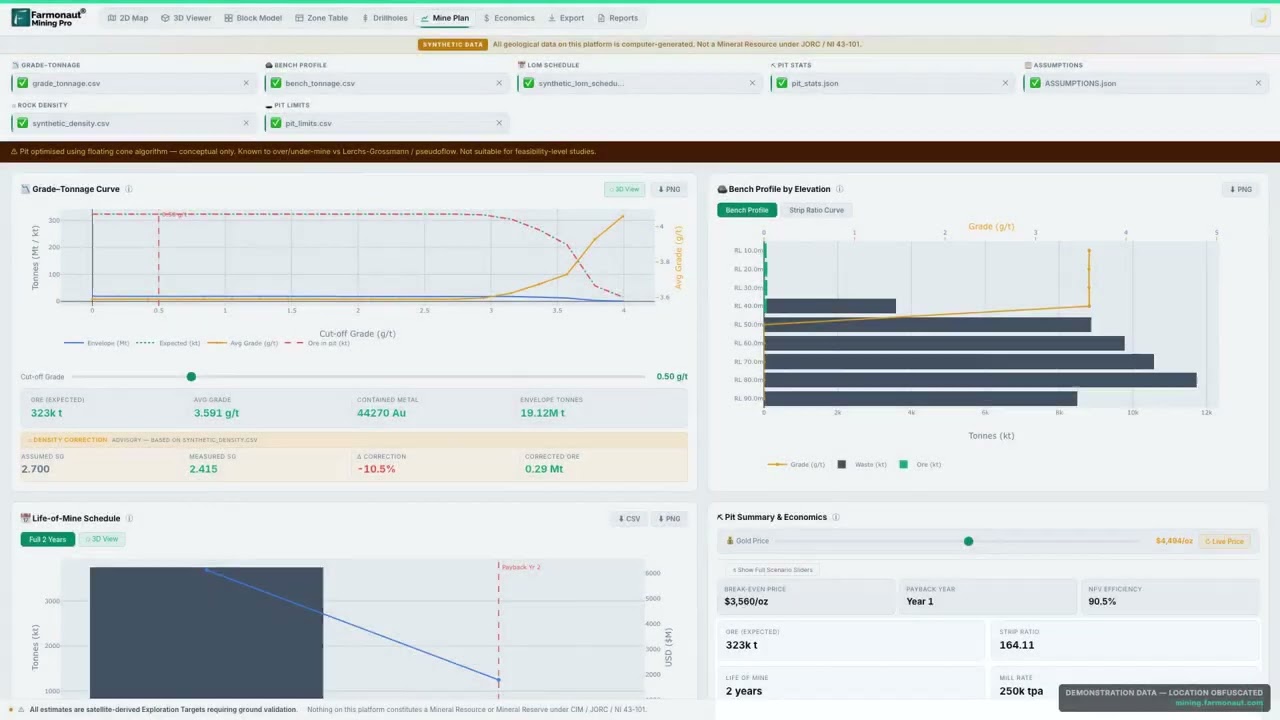
▶ Shows how an all-in cost, break-even price, NPV and payback are built in Farmonaut Mining Pro; the worked example uses gold, so costs are per ounce. · 14:58
Value the molybdenum in your ore or concentrate
For a copper-molybdenum porphyry, the useful question is how much molybdenum a plant would recover and what it is worth at a stated price. The second calculator below does the arithmetic: ore tonnes, head grade, recovery and payable share. The default 0.02% Mo and 75% recovery are round examples near the grades Antofagasta reports at its Chilean mines (0.016-0.018% Mo), not a forecast. The price is an input; enter today’s price from a source you trust.
This is gross metal value only. Treatment charges, roasting, freight, mining and processing cost, royalties and tax all come off it. Resource and reserve statements must follow your jurisdiction’s reporting code; satellite results are exploration targets that sit ahead of a resource estimate.
Calculator
How much molybdenum would your ore yield, and what is it worth?
Enter your own ore tonnes, grade, recovery, payable share and price.
- Contained molybdenum (tonnes): 2,000 t
- Revenue per tonne of ore: $10
- Gross value at your price: $104,614,731
Example values only, not a benchmark or a forecast. The 0.02% Mo grade is a round figure near the 0.016-0.018% reported at Antofagasta’s Chilean mines (Q3 2026); the 75% recovery and 95% payable share are assumed examples. Price is an input: example, use today’s price. Result is gross metal value; treatment charges, freight, costs, royalties and tax are not included. 1 tonne = 2,204.62 lb.
Properties that matter to buyers
Molybdenum has atomic number 42 and the symbol Mo. It is a silvery-white refractory metal, which means it keeps its strength at very high temperatures. The values below are from the IMOA brochure (a 1998 publication; these are physical constants) with a second source for tube users.
| Property | Value | Source |
|---|---|---|
| Density | 10.22 g/cm3 | IMOA |
| Melting point | 2,610 degrees C (supplier listings give about 2,623 degrees C) | IMOA; Goodfellow |
| Thermal conductivity | 142 W/m.K at 20 degrees C (a supplier lists about 138) | IMOA; Goodfellow |
| Thermal expansion | 4.3 x 10⁻⁶ per degree C, the lowest of the engineering metals (a supplier lists about 5.1 x 10⁻⁶ per K) | IMOA; Goodfellow |
| Crystal structure | Body-centred cubic | IMOA |
| Air limit | Forms a volatile oxide in air above about 600 degrees C (IMOA); a tube supplier gives about 400 degrees C | IMOA; Goodfellow |
The small differences between sources come from purity, temperature range and test method. For a design, use the datasheet of the product you will buy, not a general table.
Tubing: where it works and where it does not
Molybdenum tube is a specialist product. A supplier such as Goodfellow lists high-purity molybdenum tube in the as-drawn state for vacuum furnace heating-element mandrels and support tubes, sintering and crystal-growth systems under protective gas, evaporation sources for vacuum coating, and hydrogen-atmosphere furnaces. The same listing states the key limit: molybdenum oxidises to a volatile oxide above roughly 400 degrees C in air, so the tube is used in vacuum, inert gas or hydrogen, where it can serve close to its melting point.
That limit matters for buyers. Because of it, molybdenum tube is a furnace and vacuum-process component, not a pipe for water, fertiliser, food or slurry lines in open air. In ordinary plant piping, molybdenum appears as an alloying addition: the IMOA notes that stainless steel grade S31600 contains 2-3% molybdenum.
- Price. Tube is quoted per piece, by outer diameter, wall thickness, length and purity. The oxide price is only the raw-material input; drawing, machining and testing add cost on top, so ask suppliers for a quote.
- Specify the atmosphere. Tell the supplier the temperature, gas and cycle count before you order.
- Joining. Molybdenum needs specialised welding and machining practice, so ask the supplier about tolerances and finishing.
Finding molybdenum: porphyry systems and satellite screening
The USGS notes that molybdenum occurs as the main sulfide in large low-grade porphyry molybdenum deposits and as an associated sulfide in low-grade porphyry copper deposits. Farmonaut turns a licence boundary (KML, KMZ or polygon) into satellite-derived exploration targets in 5-20 business days, ahead of any resource estimate. If you hold ground in a porphyry belt, you can read how satellite mineral detection works, request a quote or contact the team.
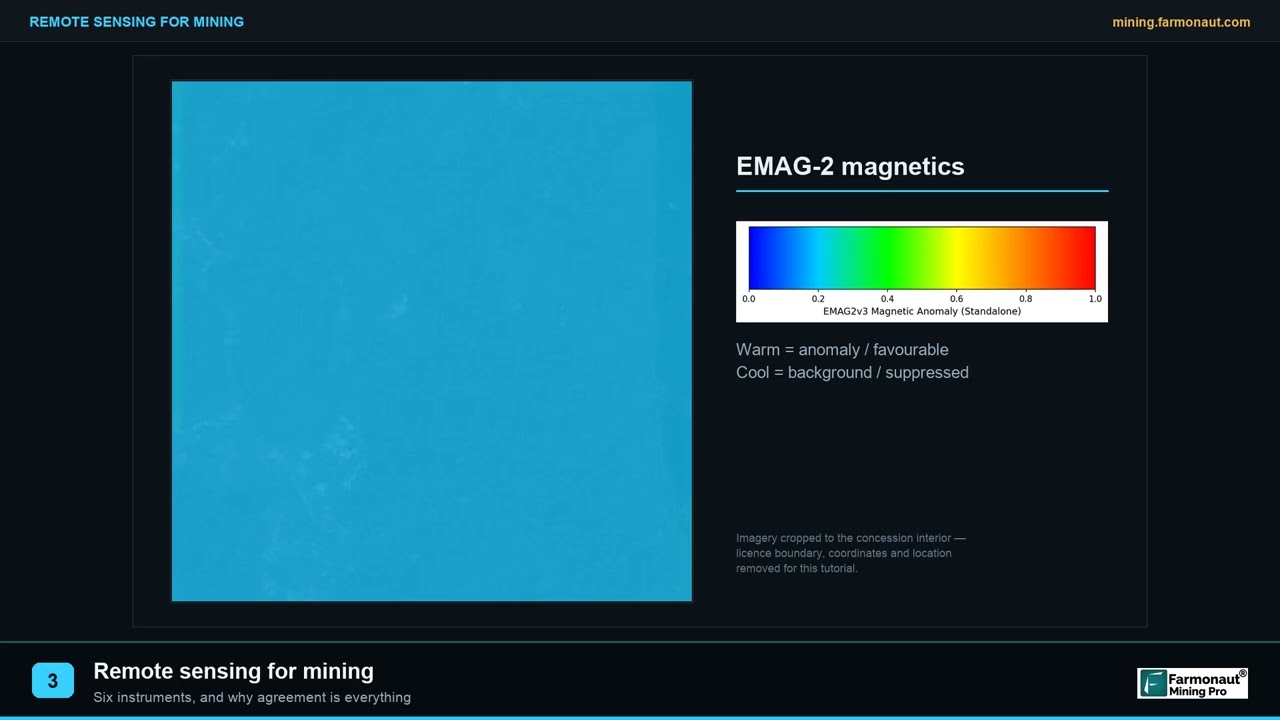
▶ Explains remote sensing for mining in plain words and the six instrument families. · 2:01
What to check before you rely on a price quote
- Which product is it: oxide, ferromolybdenum, metal or a finished part?
- What is the unit: per pound of contained molybdenum, per kilogram, or per tonne of product?
- What is the delivery term, region and currency?
- What is the date, and is it a spot quote, a monthly average or a contract price?
- Who published it, and can you open the primary report?
We cover a connected topic in Ferro Vanadium Price Today: Chart and Drivers.
Frequently asked questions
What is the price of molybdenum per pound?
Antofagasta reported a spot price of US$33.3 per pound of molybdenum on 30 September 2026. The Shanghai Metals Market oxide benchmark, FOB China, stood at US$36.20 per pound on the same date, as published by Critical Minerals News. Prices are quoted per pound of contained molybdenum.
What is the price of molybdenum per kilogram?
Multiply the per-pound price by 2.2046. At US$33.3 per pound, that is about US$73.4 per kilogram of molybdenum; the SMM oxide figure of US$36.20 per pound is US$79.81 per kilogram. USGS reported an estimated 2025 average of US$51 per kilogram for US oxide.
Is molybdenum traded on an exchange?
Check which index your contract names. The USGS takes its US oxide price from Argus Media.
Why have molybdenum prices risen recently?
Reported drivers are use ahead of production in the first quarter, supply tied to copper mining, lower grades at some Chilean mines, Chinese export controls on molybdenum powders from February 2025 (USGS) and higher energy costs.
Which companies produce molybdenum?
Freeport-McMoRan (NYSE: FCX) runs the Climax open-pit and Henderson underground mines in Colorado and sells molybdenum from its copper mines. Antofagasta (London: ANTO) sells by-product molybdenum from Los Pelambres and Centinela in Chile. Facts only; this is not a recommendation.
What is molybdenum used for?
Mainly as an alloying agent in steels, cast iron and superalloys, and in chemicals such as catalysts, lubricants and pigments (USGS).
What is the melting point of molybdenum?
About 2,610 degrees C per IMOA; some suppliers list about 2,623 degrees C.
Can molybdenum tubing be used in air?
Only at modest temperatures. It forms a volatile oxide in air above roughly 400-600 degrees C depending on the source, so high-temperature use is in vacuum, inert gas or hydrogen.
How much molybdenum is in ferromolybdenum?
Typically 60-70% molybdenum, with the remainder iron (IMOA).
Is molybdenum a by-product of copper?
Often. Outside China and the United States, the USGS says the major producers rely on by-product copper production, and in the United States seven of nine operations are by-product mines.
How do I convert a molybdenum oxide price into the value of a tonne?
Multiply the price per pound by the pounds of molybdenum in the tonne. A tonne of 57% oxide holds about 1,257 lb of molybdenum; use the converter on this page and enter the current quote.
This page is for information only. It is not investment advice. Prices change daily; confirm any quote with the publisher or your supplier.
Farmonaut mining
Screen porphyry ground from space
Send a licence boundary as KML, KMZ or a polygon and receive satellite-derived exploration targets, ahead of any resource estimate.

Mining Pro sample view, synthetic data
Keep reading
Sources
- Antofagasta plc, Q3 2026 production report (15 October 2026): antofagasta.co.uk
- Freeport-McMoRan, second-quarter 2026 earnings release (23 July 2026): s22.q4cdn.com
- Freeport-McMoRan, Form 10-K for 2025: s22.q4cdn.com
- USGS, Mineral Commodity Summaries 2026: Molybdenum (February 2026): pubs.usgs.gov
- IMOA, About Molybdenum brochure (1998): imoa.info
- IMOA, Annual Review 2024/2025: imoa.info
- IMOA, Facts and figures: imoa.info
- Mining and Metal News, Global usage of molybdenum rises while production remains static (7 July 2026): miningmetalnews.com
- PricePedia, New tensions in the molybdenum market (3 August 2026): pricepedia.it
- Critical Minerals News, Molybdenum price (SMM benchmarks, updated 4 October 2026): critical-minerals-news.com
- Goodfellow, Molybdenum tube: goodfellow.com
- Colorado Geological Survey, Metals in Colorado: coloradogeologicalsurvey.org
- Geoscience Australia, Australian Mineral Resources Assessment 2020: commodity summaries: ga.gov.au
Discussion
Questions, corrections or field experience? Share them below. First-time comments are reviewed before they appear, and your email is never published.
No comments yet. Be the first to add a question or your experience.

 Southbridge & Wess PDC Ltd
 Qader Group
 Ileys General Trading
 SG Gold Mining LLC
 VRV Global Pte Ltd
 Omsri International FZE
 G.I.T.T.
 Jaunita Erss Ltd
 Almosi SARL
 SRK Consulting
 Berks Gold Limited
 Mwerezi Minerals Company Limited
 Mining SARL
 SenGold Invest SAS
 Sean Mining Limited
 NTS Group (Pty) Ltd
 Mine4Africa
 Lithspo Minerals Limited











