

Surface mining · Step-by-step guide
Process of Surface Mining: 5 Steps and Calculator
Surface mining removes the soil and rock above a deposit, then digs the ore or coal from open ground, in five steps: plan and permit, strip, drill and haul, process, reclaim. Surface mines made about 60% of US coal in 2024 (EIA).
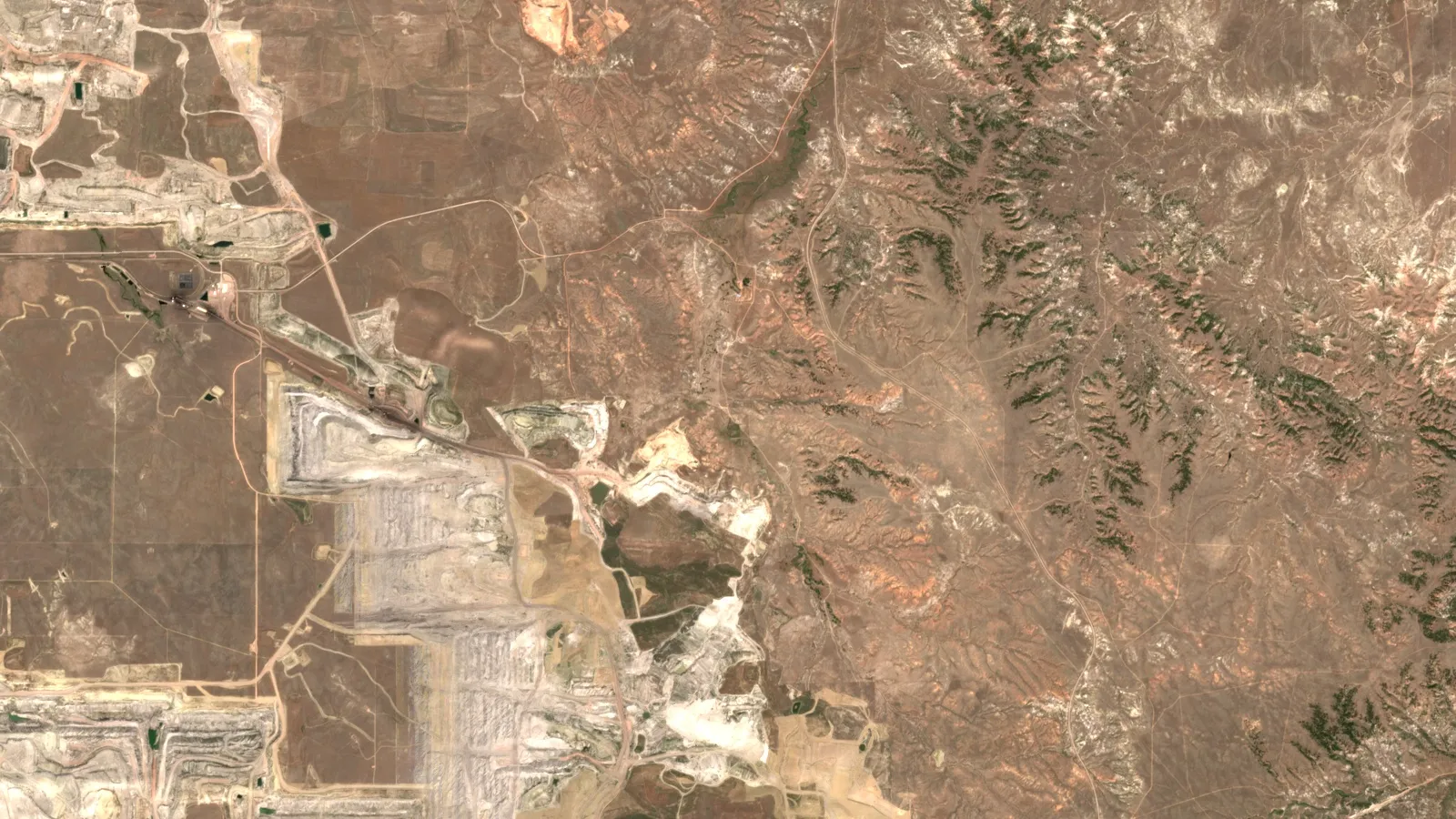
Key takeaways
- The five steps are planning and permits, clearing and stripping, drilling, blasting and hauling, crushing and processing, and reclamation.
- Surface mines produced about 60% of US coal in 2024: roughly 306 of 512 million short tons (EIA, Annual Coal Report 2024, Table 1; share is our sum).
- Surface is not always more productive: in 2024 western surface coal mines made 17.49 short tons per employee hour against 4.38 underground, but Appalachian surface mines made 2.01 against 2.66 (EIA).
- The stripping ratio, tonnes of waste per tonne of ore, sets the cost; the calculator finds your break-even ratio from your own costs and price.
- US coal reclamation bonds can be 60% released after backfilling and regrading (30 CFR 800.40), and revegetation duty lasts at least 5 years above 26 inches of rain, 10 years at or below (30 CFR 816.116).
In this article
- The process of surface mining in five steps
- Step 1: Exploration, mine planning and permits
- Step 2: Clearing, topsoil and overburden removal
- Stripping ratio: why overburden decides the cost
- Step 3: Drilling, blasting, loading and hauling
- Step 4: Crushing, processing and transport
- Step 5: Reclamation, bonds and bond release
- Types of surface mining: strip, open pit, quarry and mountaintop
- Where surface mining is used: US coal and aggregate numbers
- Surface mining vs underground mining: which one pays
- Environmental and safety controls in surface mining
- What to check before you plan a surface mine
- Frequently asked questions
Surface mining removes the soil and rock that lie on top of a deposit, then digs the ore or coal from the open ground. The work runs in five steps: plan and permit, clear and strip the cover, drill and blast then load and haul, crush and process, and finally backfill and replant. In the United States, surface mines produced about 60% of the coal mined in 2024: roughly 306 of 512 million short tons (EIA, Annual Coal Report 2024, Table 1; the share is our sum of the regional rows).
This guide is written for people who own or plan a mine, not for students. It walks through each step with the equipment, the legal checkpoints and the numbers that decide cost. It then compares the main types of surface mine, shows where the method is used, and ends with a calculator that turns a stripping ratio into a cost per tonne.
The process of surface mining in five steps
A surface mine has one job before it can sell anything: get rid of the material that covers the ore. Everything in the five steps below follows from that. The cover is called overburden. It is the soil and rock that sit on or beside the ore body, and the first task is to move it out of the way (US EPA, Technical Resource Document: Gold, 1994).
Infographic
Surface mining in 5 steps
- 1Plan and permitDrill the deposit, design the pit or strips, and file the permit and bond.
- 2Clear and stripStore the topsoil and move the overburden.
- 3Drill, blast, haulBreak the rock, load it, and truck it out.
- 4Crush and processReduce size, wash or concentrate, and ship.
- 5ReclaimBackfill, regrade, replace topsoil and replant.
The table below is a quick map. Each row is covered in its own section after it.
| Step | What happens | Typical equipment | Rule or check that applies |
|---|---|---|---|
| 1. Plan and permit | Drill the deposit, model it, design the pit or strips, file the permit | Core drills, mine-planning software, satellite and drone maps | On US public land, a plan of operations for work beyond casual use |
| 2. Clear and strip | Remove vegetation, store topsoil, move overburden | Bulldozers, shovels, draglines | Topsoil kept as a separate layer for reuse |
| 3. Drill, blast, load, haul | Break the rock, load it, truck it out | Blast-hole drills, shovels or loaders, haul trucks, conveyors | Miner training before work starts |
| 4. Crush and process | Reduce size, wash or concentrate, send to market | Crushers, preparation plants, conveyors, rail | Waste, dust and water controls |
| 5. Reclaim | Backfill, regrade, replace topsoil, replant | Dozers, trucks, seed and planting crews | Bond held until revegetation is proven |
Step 1: Exploration, mine planning and permits
Every surface mine starts as a set of drill holes and a map. Geologists drill to find the size, grade and shape of the deposit and the thickness of the overburden. That data goes into a block model, which is a grid of small cells, each with an estimated grade. The planner then decides how deep the pit can go before the waste costs more than the ore is worth.
Two numbers drive that decision. The first is the ore grade, which is the amount of metal or quality of coal in each tonne. The second is the stripping ratio, covered in its own section below. The depth to which a gold ore body can be mined depends on grade, the nature of the overburden and the stripping ratio, according to the EPA gold profile.
Permits come before earthmoving. On US federal land managed by the Bureau of Land Management, you must submit a plan of operations and get approval before any work beyond casual use. A bulk sample of 1,000 tons or more of presumed ore also needs a plan (43 CFR 3809.11). You must also post a financial guarantee for reclamation, either an individual one, a blanket one for several operations, or proof of one already held under state law (43 CFR 3809.551). Coal mines have their own federal law, the Surface Mining Control and Reclamation Act, which requires a performance bond before the permit is issued (30 U.S. Code 1259). Outside the US the rules differ by country, so check the national regulator before you budget.
Satellite images are a cheap way to cover the first desk work: land cover, access roads, drainage lines and old disturbance. Farmonaut screens a licence area from satellite data before ground crews go in; see the end of this page for how to ask for a quote.
Step 2: Clearing, topsoil and overburden removal
Crews clear and level the area first. A US Department of Energy profile of the coal industry describes the usual order: bulldozers clear and level the ground, topsoil is removed and stored for reclamation, holes are drilled and blasted through the overburden, and power shovels or draglines then clear it away until the coal is exposed (US DOE, Energy and Environmental Profile of the U.S. Mining Industry: Coal, 2002). The same profile says a dragline is a very large machine with a bucket on cables that can scoop up to 250 tons per pass.
Topsoil needs special care because it is hard to replace. For US coal mines the federal law requires the operator to remove topsoil in a separate layer and either put it straight onto regraded ground or store it in its own pile, protected from erosion and contamination, until it is needed (30 U.S. Code 1265). Metal mines follow the same logic: the EPA notes that topsoil may be kept apart from overburden and development rock for later use in reclamation (EPA gold profile).
What happens to the overburden depends on the mine. In some coal methods it fills the previous cut. In open pits it goes to a waste rock dump. At copper mines, overburden piles make up the largest volume of waste from surface extraction (US EPA, Technical Resource Document: Copper, 1994). Where the rock contains sulfide minerals, a waste dump can start to make acid drainage soon after it is built, so the dump design and cover matter (EPA gold profile).
Stripping ratio: why overburden decides the cost
The stripping ratio is the amount of overburden you must remove for each unit of ore you mine (EPA gold profile). A ratio of 3 means three tonnes of waste for every tonne of ore. Because waste earns nothing, a higher ratio raises the cost of every tonne you sell.
That is why a pit has a limit. As it deepens, the ratio rises until the last tonne of ore costs more to uncover than it will sell for. The ratio at that point is the break-even stripping ratio. Planners often run the numbers for several pit shells and pick the one with the best margin.
The calculator below uses simple arithmetic. It assumes ore and waste cost the same per tonne to move, which is a simplification: waste may travel a shorter distance, and hard rock costs more to drill. Replace the example inputs with your own quotes.
Calculator
What is your break-even stripping ratio?
Enter your own costs and price. Results update as you type.
- Mining cost per tonne of ore: $10.00
- Reclamation cost per tonne of ore: $0.25
- All-in cost per tonne of ore: $20.25
- Margin per tonne of ore: $4.75
- Break-even stripping ratio: 4.9
Example values only, not benchmarks or quotes. Prices and costs are inputs in US$ per tonne: use today’s price. The calculation assumes ore and waste cost the same per tonne to mine and haul, and spreads reclamation cost evenly over the tonnes mined in the years entered.
Step 3: Drilling, blasting, loading and hauling
Once the ore is exposed, the next job is to break it. Crews drill rows of blast holes and fill them with explosive. At copper open pits, the EPA describes holes of 6 to 12 inches in diameter filled with an ammonium nitrate and fuel oil mix, usually fired one bench segment at a time (EPA copper profile). A bench is one step in the pit wall; a pit is a stack of benches joined by ramps. Samples taken from the blast holes are assayed, which means tested for grade, so the crew knows which blasted rock is ore and which is waste.
After the blast, large electric or diesel shovels or front-end loaders put the broken rock on trucks, trains or conveyor belts. Trucks carry ore to a mill or leach pad and waste to the dump, depending on the ore type and grade (EPA copper profile). Every extra kilometre of haul adds fuel, tyres and truck hours, so planners try to keep haul roads short and waste dumps close.
Coal is mined in a similar order. In coal surface mines the drilling and blasting go into the overburden, shovels or draglines clear it until the coal is exposed, and smaller shovels then load the coal onto trucks for the preparation plant (DOE coal profile).
Safety rules start before the first shift. At US surface mines, each new miner must receive at least 24 hours of training, and at least 8 hours of it before being assigned to work duties (30 CFR 48.25). Dust from haul roads and blasting is a constant issue; our guide to dust suppression methods in mines covers the options.
Step 4: Crushing, processing and transport
Run-of-mine ore, meaning ore straight from the pit, rarely goes to a customer as it is. At a copper mine, primary crushing cuts pieces that may be 2 to 4 feet across down to about 8 to 10 inches, often at crushers placed in or near the pit (EPA copper profile). Later stages grind the rock finer, and the metal is then separated, for example by flotation. Flotation uses chemicals and air bubbles to float the metal-bearing grains away from the waste.
Coal follows its own route. Coal preparation, also called washing, can include crushing, screening, cleaning, de-watering and drying, and not every plant uses all of these (DOE coal profile).
Iron ore needs work too. USGS notes that US iron resources are mainly low-grade taconite ores from the Lake Superior district that need beneficiation and agglomeration before commercial use, and that eight open pit iron ore mines in Michigan, Minnesota and Utah, each with concentration and pelletizing plants, shipped 98% of US usable iron ore in 2025 (USGS, Mineral Commodity Summaries 2026, Iron Ore). Our guide to magnetic separation methods in mining explains one way ore is concentrated.
Finished product leaves by conveyor, truck, rail or barge. Haul distance to the customer or port is a large part of the delivered price, so a deposit near rail or a port can beat a richer one far from both.
▶ A clay nugget followed from rock to ring: gold is found, drilled, crushed, dissolved and refined. · 5:27
Step 5: Reclamation, bonds and bond release
Reclamation means putting the land back into a stable, useful state. For US coal mines the law is specific. The operator must backfill, compact where advisable and grade to restore the approximate original contour, with highwalls, spoil piles and depressions eliminated, and must replace the saved topsoil or the best available subsoil (30 U.S. Code 1265). Then plants are established, and the operator stays responsible until the cover is proven.
That period is set in the federal rules. Where average annual precipitation is above 26.0 inches, responsibility for revegetation continues for at least five full years. Where it is 26.0 inches or less, the minimum is ten full years (30 CFR 816.116); for lands eligible for remining under an approved permit, the periods are shorter, two full years and five full years respectively.
The bond is the money behind this promise. It must be enough to finish the reclamation plan if the regulator had to do the work after a forfeiture, and it can never be below $10,000 for an entire permit (30 U.S. Code 1259). Release comes in phases. At the end of Phase I, after backfilling, regrading and drainage control, up to 60% of the bond may be released. Phase II follows once revegetation is established, and the last part is held until the responsibility period ends (30 CFR 800.40). Metal and industrial mineral mines are covered by state law and by the BLM rules above rather than this coal law, so the exact numbers differ.
Plan reclamation at the start. It is cheaper to put topsoil in one pile and to dump waste in its final shape than to move material twice.
Types of surface mining: strip, open pit, quarry and mountaintop
The method follows the shape of the deposit. The DOE profile names four types of surface coal mine: area, contour, mountaintop and auger (DOE coal profile).
Chart
Coal output per employee hour by surface mining method
Short tons per employee hour, US, 2024
- Area and strip mining: on flat land with coal at a roughly even depth, the overburden from each cut fills the cut before it. This is the method most people mean by strip mining. Our guide to the benefits of strip mining and the best ways to strip mine goes deeper.
- Contour mining: follows a coal bed along a hillside until the overburden gets too thick to remove for a fair price.
- Open-pit mining: the usual choice for large metal deposits. The EPA says open-pit mining is the most common method in copper mining because the ore bodies are large and the overburden is usually shallow, and that pits are shaped as benches in a spiral or in levels joined by ramps (EPA copper profile).
- Quarries and gravel pits: the same idea for stone, sand and gravel. USGS estimates that about 3,500 crushed stone quarries and 6,500 sand and gravel pits operated in the US in 2025 (USGS crushed stone; USGS sand and gravel).
- Mountaintop removal: removes the top of a ridge to reach coal seams near the summit. US law allows a permit without restoring the original contour where the mine removes the whole seam through the upper part of a mountain and leaves a level plateau or gently rolling land with no highwalls, capable of supporting a planned post-mining use (30 U.S. Code 1265(c)).
Productivity differs a lot by method. In 2024, US open-pit coal mines produced 15.2 short tons per employee hour, against 3.10 at mountaintop operations (EIA, Annual Coal Report 2024, Table 22.1). The chart shows the gap.
▶ Strip mining explained in clay: how soil and rock are peeled off to reach the coal, with the pros and cons. · 4:37
Where surface mining is used: US coal and aggregate numbers
Coal is the clearest example because the US government publishes it by state and by mine type. EIA says surface mining is often used when coal lies less than 200 feet down (EIA, Coal explained: mining and transportation). In the flat, thick seams of the Powder River Basin, 15 surface mines produced 204.9 million short tons in 2024 (EIA, Annual Coal Report 2024, Table 1). Wyoming alone produced 190.7 million short tons from its 15 surface mines, and the chart lists the leading states.
Chart
US output of two quarry and pit materials
Million metric tons produced; 2025 is an estimate
Chart
Leading US states for surface coal production
Million short tons, 2024; the eight largest states
By tonnage, the biggest surface mining industry is not coal or metals but building materials. USGS estimates that US producers made about 1.5 billion tons of crushed stone and 870 million tons of construction sand and gravel in 2025, valued at $27 billion and $12.6 billion (USGS crushed stone; USGS sand and gravel). An estimated 72% of crushed stone went into construction aggregate, mostly for roads. Both series slipped between 2023 and 2025 in the USGS tables (2025 figures are estimates).
Surface mining vs underground mining: which one pays
Surface mining is not always the cheaper or more productive option. It wins when the deposit is shallow, thick and wide. It loses when the ore is deep, thin or steeply dipping. For coal, EIA says surface mining is used for shallower seams and underground mining for deeper ones (EIA).
Chart
Coal output per employee hour, underground vs surface
Short tons per employee hour, 2024
The productivity numbers show this. In the western US region, surface mines averaged 17.49 short tons per employee hour in 2024 against 4.38 at underground mines. In Appalachia the order flips: 2.01 at surface mines and 2.66 underground. In the Interior region surface mines were slightly ahead, at 6.07 against 5.16 (EIA, Annual Coal Report 2024, Table 21). Productivity is only one input; price, haul distance, coal quality and the cost of bonds also matter.
Other differences are practical. Surface mines can change their output without damaging the workings, give selective mining and grade control, and are safer for workers than underground work. They also use land, and large pits with prestripping waste can cost more up front than an established underground mine (EPA copper profile).
Environmental and safety controls in surface mining
Surface mining changes the landscape more than underground mining does, because the land above the deposit is removed. The main issues are habitat loss while the mine is open, soil erosion if topsoil is lost, water that picks up suspended solids or metals, and dust. Controls are built into the five steps: topsoil is kept apart, waste dumps are shaped and covered, runoff is captured in ponds, and haul roads are watered.
The EPA warns that acid drainage can start in piles of crushed or broken rock soon after they are built, because the rock has more surface area and sits in air (EPA gold profile). That is why test work on waste rock is part of mine planning, not an afterthought.
Satellite images help here because they show change over time: stripped area, dump growth, water ponding and regrowth on reclaimed ground. They show what changed, not why, so ground checks remain necessary.
▶ The seven environmental impacts of mining, explained in clay with satellite maps. · 2:31
What to check before you plan a surface mine
- Depth and thickness of cover. Get the overburden thickness from drilling, then compute the stripping ratio for several pit outlines.
- Break-even ratio. Use the calculator with your own costs and a price you can defend.
- Land and access. Check who owns the surface and the minerals, and whether roads, power and water are within reach.
- Permits and bonds. Ask the regulator for the permit list, the plan format and the financial guarantee rules before you spend on design.
- Waste and water. Test the waste rock for acid potential and design the dump and ponds from the start.
- Reclamation cost. Add the cost of regrading, topsoil and planting to the budget in the first year, not the last.
- Land screening. A desk review of satellite data on your licence can flag access, drainage and disturbance before you drill; Farmonaut offers this and delivers in 5 to 20 business days.
Related reading on this site: Copper Mining Risk Management: 7 Steps and Calculator.
We cover a connected topic in Copper Beneficiation Process: 7 Steps and Recoveries.
Frequently asked questions
What is the process of surface mining?
It is five steps: exploration and permitting, clearing the site and stripping the overburden, drilling and blasting then loading and hauling the ore or coal, crushing and processing, and reclamation. The overburden is moved first, so the ore is exposed from above rather than reached by tunnels.
What are the main types of surface mining?
The main types are strip or area mining, contour mining, open-pit mining, quarrying, and mountaintop removal for coal. The shape and depth of the deposit decide which one is used (DOE coal profile).
What is overburden?
Overburden is the soil and rock that cover or sit beside an ore body. It has no sale value, so it is removed, stored or used in backfilling (EPA gold profile).
What is a stripping ratio?
It is the amount of waste removed for each unit of ore mined. A ratio of 3 means 3 tonnes of waste for each tonne of ore. A higher ratio raises the cost per tonne of ore sold.
How much US coal comes from surface mines?
About 60%. Surface mines produced roughly 306 million of 512 million short tons in 2024, by our sum of the EIA regional rows (EIA, Annual Coal Report 2024).
Is surface mining cheaper than underground mining?
Often, but not always. EIA says surface mining is used for shallower coal, and 2024 data show surface mines out-producing underground mines per employee hour in the western and Interior regions but not in Appalachia (EIA, Annual Coal Report 2024).
What happens to the land after surface mining?
At US coal mines, operators must backfill and regrade to the approximate original contour, replace topsoil and revegetate, and stay responsible for at least five or ten years depending on rainfall (30 CFR 816.116).
How long does reclamation take?
Earthwork can be done soon after mining stops in each area, but the legal responsibility period for revegetation is at least five full years where rainfall is above 26 inches a year, and at least ten years in drier areas (30 CFR 816.116).
Do I need a permit for a small surface mine?
On US public land, work beyond casual use needs a plan of operations approved by the BLM, and a bulk sample of 1,000 tons or more also needs one (43 CFR 3809.11). Private land and other countries have their own rules, so ask the regulator.
What training do surface miners need?
At US surface mines, new miners need at least 24 hours of training, with at least 8 hours before they are assigned to work (30 CFR 48.25).
Can satellite data help a surface mine?
Yes, for screening land cover, access, drainage and change over time, and for finding mineral targets before drilling. It does not replace drilling or a formal resource estimate.
This page is for information only. It is not legal advice. Confirm permit, bond and reclamation rules with the regulator for your country, state or province. Mine sites are dangerous: get the owner’s permission, a licence where needed and proper training before you enter one.
Farmonaut mining
Get a quote to map your licence area from space
Send a KML, KMZ or polygon and Farmonaut screens the area from satellite images before ground crews go in.
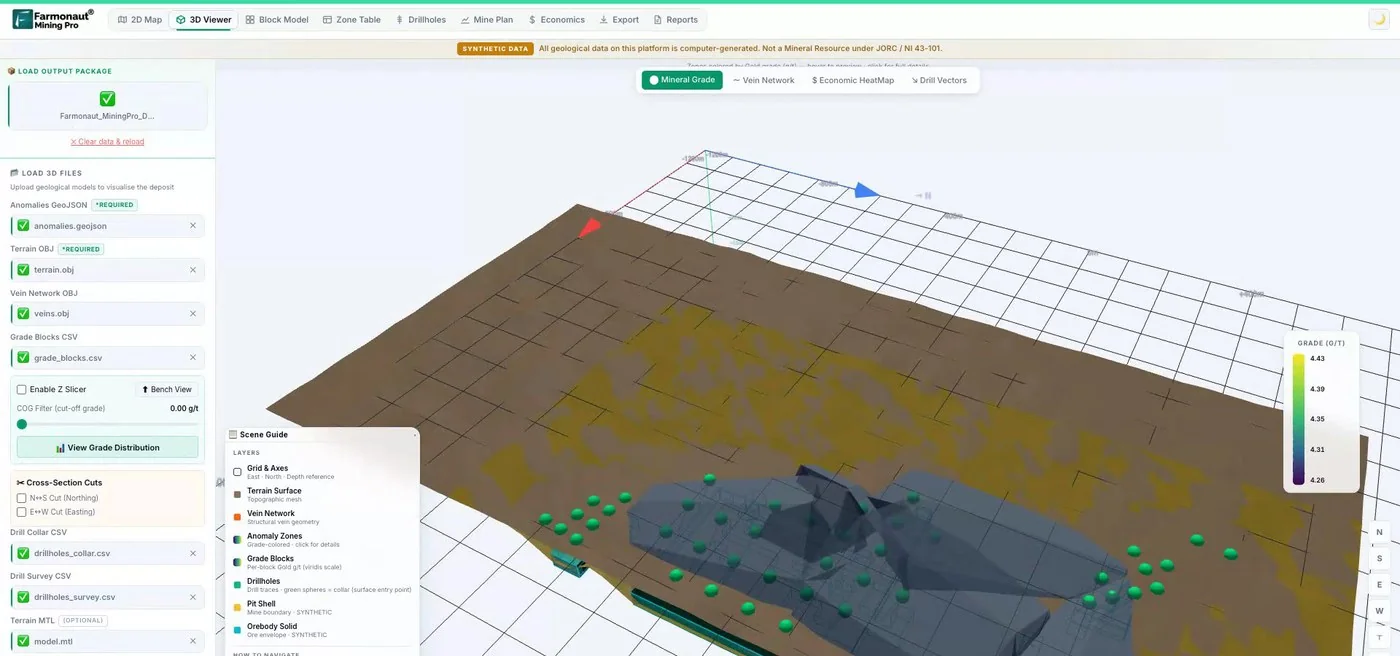
Mining Pro sample view, synthetic data
Keep reading
Sources
- US EPA, Technical Resource Document: Extraction and Beneficiation of Ores and Minerals, Vol. 4 Copper (August 1994): archive.epa.gov
- US EPA, Technical Resource Document: Extraction and Beneficiation of Ores and Minerals, Vol. 2 Gold (August 1994): archive.epa.gov
- USGS, Mineral Commodity Summaries 2026: Iron Ore (February 2026): pubs.usgs.gov
- USGS, Mineral Commodity Summaries 2026: Sand and Gravel, Construction (February 2026): pubs.usgs.gov
- USGS, Mineral Commodity Summaries 2026: Stone, Crushed (February 2026): pubs.usgs.gov
- EIA, Annual Coal Report 2024 (November 2025): eia.gov
- EIA, Coal explained: Mining and transportation of coal: eia.gov
- 30 CFR 48.25, Training of new miners at surface mines (eCFR via Cornell LII): law.cornell.edu
- 30 CFR 800.40, Requirement to release performance bonds (eCFR via Cornell LII): law.cornell.edu
- 30 CFR 816.116, Revegetation: standards for success (eCFR via Cornell LII): law.cornell.edu
- 43 CFR 3809.11, When do I have to submit a plan of operations? (eCFR via Cornell LII): law.cornell.edu
- 43 CFR 3809.551, Choices for providing BLM with a financial guarantee (eCFR via Cornell LII): law.cornell.edu
- 30 U.S. Code 1259, Performance bonds (Cornell LII): law.cornell.edu
- 30 U.S. Code 1265, Environmental protection performance standards (Cornell LII): law.cornell.edu
- US DOE, Energy and Environmental Profile of the U.S. Mining Industry: Coal (2002): www1.eere.energy.gov
Discussion
Questions, corrections or field experience? Share them below. First-time comments are reviewed before they appear, and your email is never published.
No comments yet. Be the first to add a question or your experience.

 Mine4Africa
 Lithspo Minerals Limited
 Tintina Mining Group
 Dalgety Minerals Pty Ltd
 Vortex Minerals Pty Ltd
 Faith At Work (Pty) Ltd
 Geotech Mining Solutions plc
 Vulcan International Limited
 Kidepo Associates
 GKY Mining
 Alkimy SARL
 Double A Trading
 GemSprout Metals Limited
 Qader Group
 Ileys General Trading
 SG Gold Mining LLC
 VRV Global Pte Ltd
 Omsri International FZE
 G.I.T.T.
 Jaunita Erss Ltd
 Almosi SARL
 SRK Consulting
 Berks Gold Limited
 Mwerezi Minerals Company Limited
 Exploration consultancy · South Africa · Gold










