

Arizona copper · Mine profile
Asarco Mission Mine: Output by Year and Site Facts
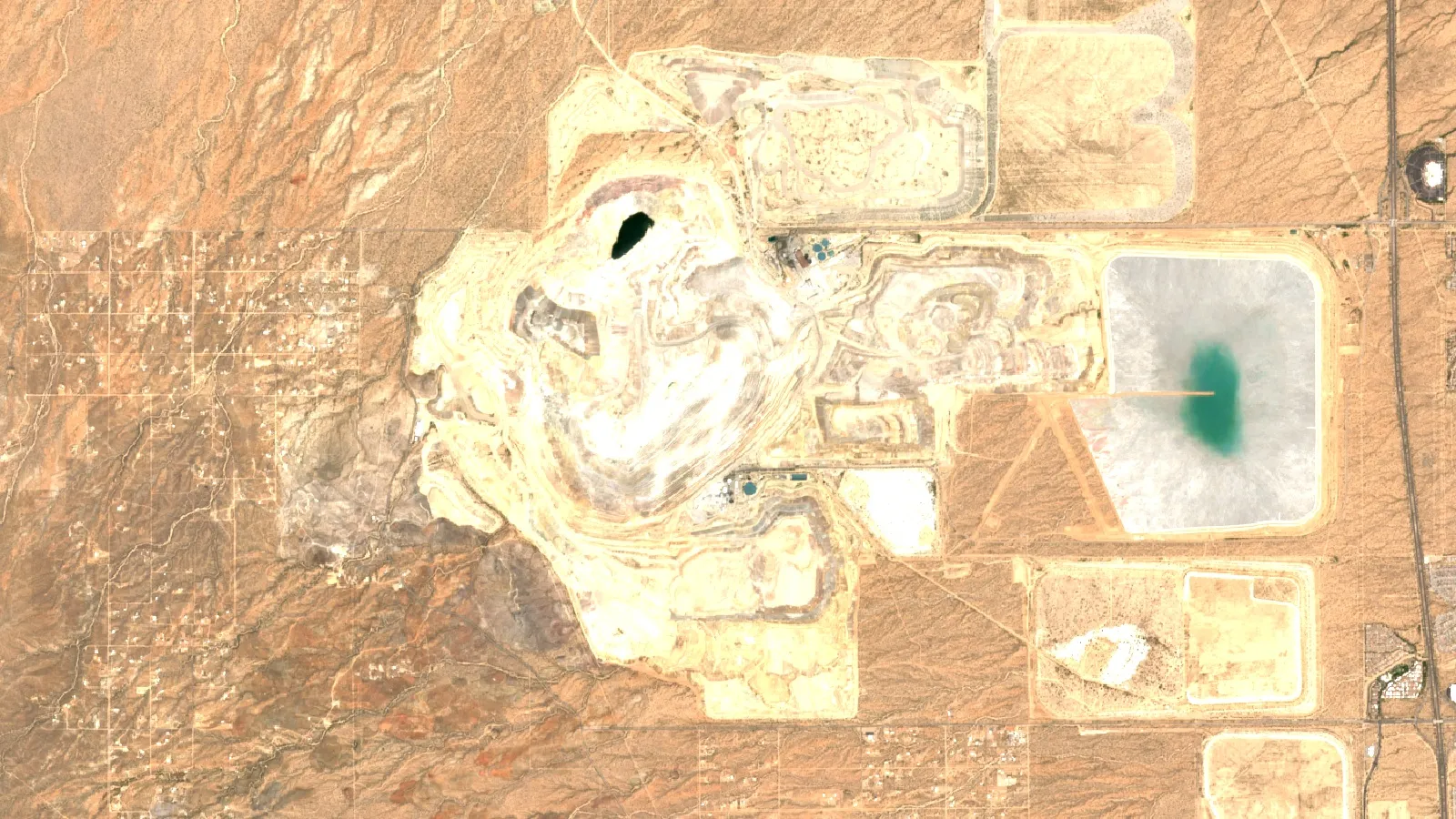
The Asarco Mission Mine is Grupo México’s open-pit copper mine near Sahuarita, 18 miles south of Tucson. USGS reported 42,800 tonnes of copper in concentrate in 2022, tenth among US copper mines. Below: output by year, the Arizona ranking, Asarco’s projects and a calculator.
Key takeaways
- Mission is an open-pit copper mine near Sahuarita, Pima County, run by Asarco LLC, a Grupo México subsidiary (Asarco; Grupo México 3Q26).
- USGS reported 54,900 t of copper in concentrate in 2021 and 42,800 t in 2022, when Mission ranked 10th among US copper mines (USGS Minerals Yearbook 2022).
- A pit landslide on 21 March 2018 cut output to 43,500 t from 61,900 t in 2017 (USGS Minerals Yearbook 2018).
- The pit is 2.5 miles long, 1.5 miles wide and 1,200 feet deep on about 19,000 to 20,000 acres (Asarco; US EPA 2021).
- Arizona supplied about 70% of the 1.0 million tonnes of copper mined in the US in 2025 (USGS MCS 2026).
In this article
- Asarco Mission Mine at a glance
- Where is the Asarco Mission Mine, and what is Mission South?
- What the Mission Complex is made of
- Mission mine history and mill capacity
- Asarco Mission Mine production by year
- How Mission compares with other Arizona copper mines
- Asarco mines in Arizona: Mission, Ray and Silver Bell
- Grupo México's plans for Asarco
- Copper price and what Mission's copper is worth
- Environment, water and land at the Mission Complex
- Other copper projects near Tucson
- What to check before you rely on a Mission figure
- Frequently asked questions
Asarco Mission Mine at a glance
The Asarco Mission Mine is an open-pit copper mine near Sahuarita, Arizona, about 18 miles south of Tucson, run by Asarco LLC, the US arm of Grupo México. It produced 42,800 metric tons of copper in concentrate in 2022, which made it the tenth-largest copper mine in the United States that year, according to the USGS Minerals Yearbook for copper, 2022. Its main pit is 2.5 miles long, 1.5 miles wide and 1,200 feet deep, per Asarco’s mines page.
This guide is for consultants, analysts and anyone who needs the facts on Mission in one place: where the pit and mills sit, what “Mission South” means, a mine-by-mine output record from USGS yearbooks, how Mission compares with its Arizona neighbours, what Grupo México has said about Asarco’s plans, and a calculator that turns a mill rate and an ore grade into pounds of copper. Every changeable number carries its year and source.
Two terms first. Copper in concentrate is the copper metal contained in the flotation concentrate a mill ships to a smelter; it is not the weight of the concentrate itself, which is mostly sulfur, iron and rock. Ore grade is the share of copper in the rock that is mined, usually given as a percentage; porphyry copper mines in Arizona work rock that is well under 1% copper.
| Item | Mission Complex fact | Source |
|---|---|---|
| Location | Near Sahuarita, Pima County, Arizona; about 18 miles south of Tucson | US EPA permit fact sheet (2021) |
| Operator and owner | Asarco LLC, a subsidiary of Grupo México | Grupo México 3Q26 report |
| Mine type | Open pit; crushing, grinding and flotation to copper concentrate; molybdenum circuit restarted 2006 | Asarco |
| Pit size | 2.5 mi long, 1.5 mi wide, 1,200 ft deep; 40 ft benches | Asarco |
| Site area | About 19,000 acres (EPA) to 20,000 acres (Asarco) | EPA; Asarco |
| Copper in concentrate | 54,900 t (2021); 42,800 t (2022) | USGS Minerals Yearbook 2022 |
| US rank | 10th among leading US copper mines in 2022 | USGS Minerals Yearbook 2022, table 2 |
| Reported reserve life | To about 2033 | Center for Land Use Interpretation |
Where is the Asarco Mission Mine, and what is Mission South?
The Mission Complex lies on the west side of the Santa Cruz River valley between Tucson and Green Valley. The EPA’s 2021 permit fact sheet describes a site of about 19,000 acres (29.7 square miles) with the open pit, crushing, grinding and flotation plants, tailings facilities, waste rock dumps and maintenance and office areas. Asarco gives 20,000 acres for the same complex.
The land has two owners. The EPA fact sheet says the part of the complex north of Pima Mine Road, called Mission North, sits on Tribal land of the San Xavier District of the Tohono O’odham Nation, while the part south of the road is on private and state land. That is why water discharge permits for the site are split: the EPA issues the permit for discharges on Tribal land, and the Arizona Department of Environmental Quality (ADEQ) issues the state permit and the aquifer protection permits that cover the tailings.
“Mission South” is the second mill. Asarco bought the Pima mine, next to Mission, in 1985 and the Pima mill in 1989, then refurbished and rebuilt that plant as the Mission South Mill in 1991. The South Mill was placed on care and maintenance in 2001, and Asarco lists a South Mill expansion as completed in 2013. People who search “asarco mission south” or “mission mine asarco” are looking at the same integrated site.
The complex sits beside Freeport-McMoRan’s Sierrita mine and the old Twin Buttes pit, according to the Center for Land Use Interpretation. Together they form one of the largest blocks of open-pit copper ground in the United States, all within the Pima mining district south of Tucson.
What the Mission Complex is made of
Asarco describes Mission as one open pit made up of five former properties, plus a sixth mine nearby:
- Mission, the original pit, prepared from 1959, with its mill starting in 1961.
- Eisenhower, between the Mission and South San Xavier pits; mined with the Anamax Mining Company from 1979 and bought outright by Asarco in 1987.
- Pima, the neighbouring mine bought in 1985, which brought the Pima mill (now Mission South).
- Mineral Hill and South San Xavier, folded into the same pit as it grew.
- North San Xavier, a nearby mine that Asarco lists as part of the complex.
Mined ore is crushed, ground and floated. Flotation uses air bubbles and reagents to lift copper sulfide minerals into a froth, which is skimmed and dried as concentrate. Mission’s molybdenum circuit, which separates molybdenite from the copper concentrate, restarted in 2006. Asarco also lists two environmental steps in its timeline: a pumping system to use Central Arizona Project (CAP) water from 2009, and reclamation of tailings dams 1 to 3 and the Mission North dump from 2011.
Mission mine history and mill capacity
Asarco’s own timeline shows how the mill grew and then shrank. The Mission mill started at 15,000 tons of ore per day in 1961. New rod mills and flotation capacity took it to 22,000 tons per day in 1967 and 28,000 by 1987. After crusher and control-system upgrades in 1995, the Mission Mill could handle 43,000 tons per day, or 63,000 with the 20,000-ton South Mill. Then copper prices fell. Asarco cut Mission Mill throughput in steps to 17,000 tons per day by 2003, when it also closed a small underground mine it had opened in the 1990s.
Chart
Mission Mill design throughput
Short tons of ore per day, Mission Mill only (excludes South Mill)
The company behind the mine changed hands in the same years. Asarco began in 1899 as the American Smelting and Refining Company. Grupo México bought it in 1999, according to CLUI. Asarco later went through a Chapter 11 case, and Grupo México reports that Asarco was reincorporated into the group on 9 December 2009.
▶ How copper goes from an open pit to wire, and why demand is rising. · 6:03
Asarco Mission Mine production by year
Asarco does not publish annual output for each mine on its website, but the USGS Minerals Yearbook for copper has reported Mission’s copper in concentrate from Grupo México’s reports. The figures below are metric tons of contained copper. They are not tons of concentrate, which is how some older summaries described them.
Chart
Mission Mine copper in concentrate
Thousand metric tons of contained copper; years USGS reported
- 2014: 60,800 t; 2015: 68,300 t (USGS Minerals Yearbook 2015).
- 2017: 61,900 t; 2018: 43,500 t. A landslide in the pit on 21 March 2018 affected operations for the rest of the year (USGS Minerals Yearbook 2018).
- 2019: 54,800 t; 2020: 57,800 t (USGS Minerals Yearbook 2020).
- 2021: 54,900 t; 2022: 42,800 t. USGS links the 2022 drop of 12,100 t to lower ore grades at Mission and a labour shortage (USGS Minerals Yearbook 2022).
So Mission’s output moved between about 43,000 and 68,000 tonnes a year over that period, a swing driven by ground conditions, ore grade and staffing rather than by a change in mill size. In 2022, Asarco’s three Arizona mines together produced 79,600 t of copper in concentrate and 32,500 t by SX-EW, 11% less than in 2021, per USGS.
More recent per-mine figures are not broken out in Grupo México’s quarterly reports. The third-quarter 2026 report says group copper output to September 2026 fell 2.8% to 775,997 tonnes, mainly because of lower ore grades projected for 2026 in Peru and at the Asarco operations.
How Mission compares with other Arizona copper mines
Arizona was the leading copper-producing state in 2025, with about 70% of US mine output, according to USGS Mineral Commodity Summaries 2026. The country mined an estimated 1.0 million tonnes of recoverable copper in 2025, 5% less than in 2024, worth about US$11 billion.
Chart
Leading Arizona copper mines, 2022
Thousand metric tons of copper (contained or recoverable, as USGS reports)
Within Arizona, Mission is a mid-sized producer. In the USGS table of leading US copper mines for 2022, Arizona’s order was Morenci, Safford, Sierrita, Bagdad, Pinto Valley, Ray, Mission and Silver Bell. Older profiles that call Mission the third-largest mine in the state do not match that table. Note that USGS reports some mines as contained copper and others as recoverable copper, so small gaps between neighbours are not exact.
The closest comparison is next door. Freeport-McMoRan’s Sierrita mine, which shares the same district, produced 184 million pounds of copper (about 83,500 tonnes) and 17 million pounds of molybdenum in 2025, according to Freeport-McMoRan’s 2025 Form 10-K. Bagdad produced 149 million pounds and Safford 287 million pounds in 2025, from the same filing.
Asarco mines in Arizona: Mission, Ray and Silver Bell
Grupo México says Asarco has three mines and one smelter in Arizona and one refinery in Texas. Asarco’s mines page and the USGS yearbooks describe them this way:
- Mission, Pima County: open pit and flotation mills making copper concentrate, with molybdenum as a by-product.
- Ray, Pinal County: open pit with a concentrator and an SX-EW plant, 18 miles west of Asarco’s Hayden Operations. In 2022 it produced 47,800 t of copper (concentrate and SX-EW combined), per USGS. People searching “asarco ray mine kearny” are looking for this operation near Kearny.
- Silver Bell, Pima County, northwest of Tucson: four open pits (North Silver Bell, El Tiro, West Oxide and East Oxide) where copper is recovered by dump leaching and SX-EW as cathode. It produced 21,500 t in 2022, per USGS.
- Hayden Operations, Gila and Pinal counties: Asarco’s smelter and main offices, 70 miles northeast of Tucson. USGS reported the Hayden smelter and the Amarillo refinery idle in 2022, and Asarco’s chief executive said in a 2025 Global Business Reports interview that the smelter would stay inactive while the company decided how to restart it.
- Amarillo Copper Refinery, Texas: refines cathode and makes copper rod.
SX-EW (solvent extraction and electrowinning) dissolves copper from oxide ore with acid, concentrates it in an organic solvent and then plates it as pure cathode with electricity, so it skips the smelter. In the same 2025 interview, the chief executive said that while Hayden is idle, concentrates from Mission and Ray are trucked to Guaymas, Mexico, and that Ray’s output was expected to rise slightly while Mission’s might not grow as much.
Grupo México’s plans for Asarco
Grupo México’s third-quarter 2026 report lists three US projects that it says are aimed at doubling Asarco’s mine output and bringing smelting and refining back in the United States:
- Ray concentrator expansion: Ray now makes 36,000 tonnes of copper in concentrate a year; the project could add 58,000 tonnes, for 94,000 tonnes a year.
- Silver Bell expansion: a new concentrator to treat low-grade sulfide ore, with gold, silver and molybdenum by-products; at an early stage, with feasibility work to follow drilling.
- Hayden smelter and Amarillo refinery: a technical review of reopening and modernising both, at first to smelt 600,000 tons of concentrate, with a longer-term option of 1.4 million tons of concentrate and 500,000 tons of refined copper in Amarillo. The report says feasibility studies are nearing completion.
The report does not list a Mission expansion. For Mission, the planning question is ore grade and reserve life: CLUI’s site profile gives a reserve life to about 2033, and Grupo México’s 2026 reports point to lower grades at Asarco this year. Grupo México trades on the Mexican stock exchange as GMEXICOB, and its other copper unit, Southern Copper Corporation, trades in New York and Lima. Asarco itself is not listed.
Copper price and what Mission’s copper is worth
Copper prices have risen sharply. Grupo México reports an average COMEX copper price of US$6.48 per pound in the third quarter of 2026, up from US$4.83 a year earlier, and US$6.15 per pound on average for January to September 2026. For comparison, USGS gives a COMEX annual average of about 480 cents per pound for 2025 and 421.6 cents for 2024.
At US$6.48 per pound, 42,800 tonnes of contained copper (about 94 million pounds) would be worth roughly US$610 million before smelting charges, transport and royalties. That is a gross figure only: a mine that sells concentrate is paid for most, not all, of the copper it contains, and pays treatment and refining charges to the smelter. Use the calculator below with today’s price and your own mill rate, grade and recovery.
Calculator
How much copper does a mill rate and grade give you?
Enter your own mill rate, ore grade, recovery, operating days and copper price.
- Copper recovered, metric tonnes per year: 26,989
- Gross copper value per year (US$): $297,500,000
- Gross value per short ton of ore (US$): 42.50
Example values only, not a benchmark or Mission’s actual grade or recovery. 1 short ton = 2,000 lb and 1 metric tonne = 2,204.62 lb (fixed in the formula). The result is gross contained value: it ignores payable terms, smelter treatment and refining charges, transport and royalties. Price is an input: example, use today’s price.
Environment, water and land at the Mission Complex
Water is the main environmental issue for any mine in the Tucson basin. The Mission Complex has three kinds of water permits described by the EPA: an EPA discharge permit for the Tribal-land part of the site, a state discharge permit issued by ADEQ in August 2019, and ADEQ aquifer protection permits for the tailings impoundments and other facilities. The EPA’s 2021 fact sheet also covers a stormwater control project tied to these permits.
Asarco’s timeline records the use of Central Arizona Project water from 2009, reclamation of tailings dams 1 to 3 and the Mission North dump from 2011, and the use of biosolids from Pima County’s Green Valley wastewater plant from 2011. For volumes of water used or acres reclaimed to date, the records sit with ADEQ and the EPA, which publish permit documents for the site.
Satellite imagery is a practical way for a consultant to follow a site like Mission between site visits: pit growth, new waste dumps, tailings beach changes and revegetated slopes all show up in Sentinel-2 images every few days. Farmonaut offers this kind of satellite monitoring for mine sites, and also runs carbon footprinting, fleet management, product traceability and a satellite and weather API for wider operations.
Other copper projects near Tucson
Mission is no longer the only big copper name south of Tucson. On 21 October 2026, Hudbay Minerals (TSX, NYSE: HBM) and its 30% partner Mitsubishi approved construction of the Copper World project, about 50 km (31 miles) southeast of Tucson, with first production targeted for the second half of 2029 and about 102,000 tonnes of copper a year over the first ten years, according to Hudbay’s release. If those numbers are met, Copper World would produce more than twice Mission’s 2022 output.
For a wider view of US operations, see our US mining map of active mines by state and our ranking of US copper mining companies by US output. The rock that hosts Mission, Sierrita and Copper World is the porphyry type described in our guide to copper porphyry deposits, and our page on where copper is found covers the main producing countries.

▶ Arizona’s porphyry copper belt and how new targets are being found. · 2:37
What to check before you rely on a Mission figure
- Check the unit. Copper in concentrate (contained metal), recoverable copper and tons of concentrate are three different numbers. A figure of several hundred thousand tons a year, as one older profile gives, is likely to describe concentrate or ore, not copper.
- Check metric or short tons. USGS yearbooks use metric tons; Asarco’s mill rates are in short tons per day.
- Check the year. Mission’s output fell by about a third in 2018 and by a fifth in 2022, so a single “annual output” without a year can mislead.
- Check who reported it. USGS per-mine numbers come from company reports; Grupo México’s quarterly reports give Asarco totals and project plans, not Mission alone.
- Check the land and permit status with the EPA and ADEQ if your work touches water or the Tribal-land part of the site.
Frequently asked questions
What is the Asarco Mission Mine?
It is an open-pit copper mine near Sahuarita, Arizona, run by Asarco LLC, a subsidiary of Grupo México. It mills ore to copper concentrate and recovers molybdenum as a by-product.
Where is the Mission Mine in Arizona?
In Pima County, about 18 miles south of Tucson near Sahuarita, beside Freeport-McMoRan’s Sierrita mine. Part of the site north of Pima Mine Road is on Tribal land of the San Xavier District of the Tohono O’odham Nation.
How much copper does the Mission Mine produce?
USGS reported 42,800 metric tons of copper in concentrate in 2022 and 54,900 tons in 2021. Between 2014 and 2022 the yearly figure ranged from 42,800 to 68,300 tons.
Who owns Asarco?
Grupo México, through its mining unit Americas Mining Corporation. Grupo México bought Asarco in 1999, and Asarco was reincorporated into the group in December 2009 after its Chapter 11 case.
What is Asarco Mission South?
It is the Mission South Mill, the former Pima mill, which Asarco refurbished and rebuilt in 1991. It is part of the same Mission Complex.
How big is the Mission pit?
Asarco gives 2.5 miles long, 1.5 miles wide and 1,200 feet deep, with 40-foot benches, on a site of about 20,000 acres.
What happened at Mission Mine in 2018?
A landslide in the pit on 21 March 2018 affected operations for the rest of the year. Copper in concentrate fell to 43,500 tons from 61,900 tons in 2017, per USGS.
How long will the Mission Mine operate?
The Center for Land Use Interpretation gives a reserve life to about 2033. Asarco does not publish a closure date, and reserve life changes with copper prices and grade.
What other mines does Asarco run?
Ray in Pinal County and Silver Bell in Pima County, plus the Hayden smelter in Arizona and the Amarillo refinery in Texas, which USGS reported idle in 2022.
Can you visit the Asarco Mission Mine?
The pit is an active industrial site and is not open to walk-in visitors. Check Asarco’s website for any public tours or visitor centre hours before you go.
Is Asarco a listed company?
No. Asarco is a subsidiary. Its parent Grupo México is listed in Mexico as GMEXICOB, and its sister company Southern Copper trades in New York and Lima.
This page is for information only. It is not investment advice and makes no recommendation on any company or security. Company figures change; check the latest filings.
Farmonaut mining
Map your mining site from space
Consultants use Farmonaut satellite mapping to follow pits, dumps and tailings and to screen a client's ground for alteration before field work.

Mining Pro sample view, synthetic data
Keep reading
Sources
- Asarco, Mines (Mission, Silver Bell, Ray, Amarillo): asarco.com
- US EPA, NPDES permit fact sheet AZ0024635, Asarco Mission Complex (2021): epa.gov
- USGS, Minerals Yearbook: Copper, 2022: pubs.usgs.gov
- USGS, Minerals Yearbook: Copper, 2020: pubs.usgs.gov
- USGS, Minerals Yearbook: Copper, 2018: pubs.usgs.gov
- USGS, Minerals Yearbook: Copper, 2015: d9-wret.s3.us-west-2.amazonaws.com
- USGS, Mineral Commodity Summaries 2026: Copper: pubs.usgs.gov
- Grupo México, Third Quarter 2026 results (20 October 2026): gmexico.com
- Freeport-McMoRan, 2025 Form 10-K: s22.q4cdn.com
- Center for Land Use Interpretation, Asarco Mission Mine site profile: clui.org
- Global Business Reports, Asarco and Hudbay interviews, Western USA Mining 2025: projects.gbreports.com
- Hudbay Minerals, Copper World construction approval release (21 October 2026): s23.q4cdn.com
Discussion
Questions, corrections or field experience? Share them below. First-time comments are reviewed before they appear, and your email is never published.
No comments yet. Be the first to add a question or your experience.

 Jaunita Erss Ltd
 Almosi SARL
 SRK Consulting
 Berks Gold Limited
 Mwerezi Minerals Company Limited
 Mining SARL
 SenGold Invest SAS
 Sean Mining Limited
 NTS Group (Pty) Ltd
 Mine4Africa
 Lithspo Minerals Limited
 Tintina Mining Group
 Dalgety Minerals Pty Ltd
 Vortex Minerals Pty Ltd
 Faith At Work (Pty) Ltd

 Licence holder · Nigeria · Gold + lithium










