

Western Australia · Mine profile
Kirkalocka Mine: Gold Output, Owner and Restart Plan
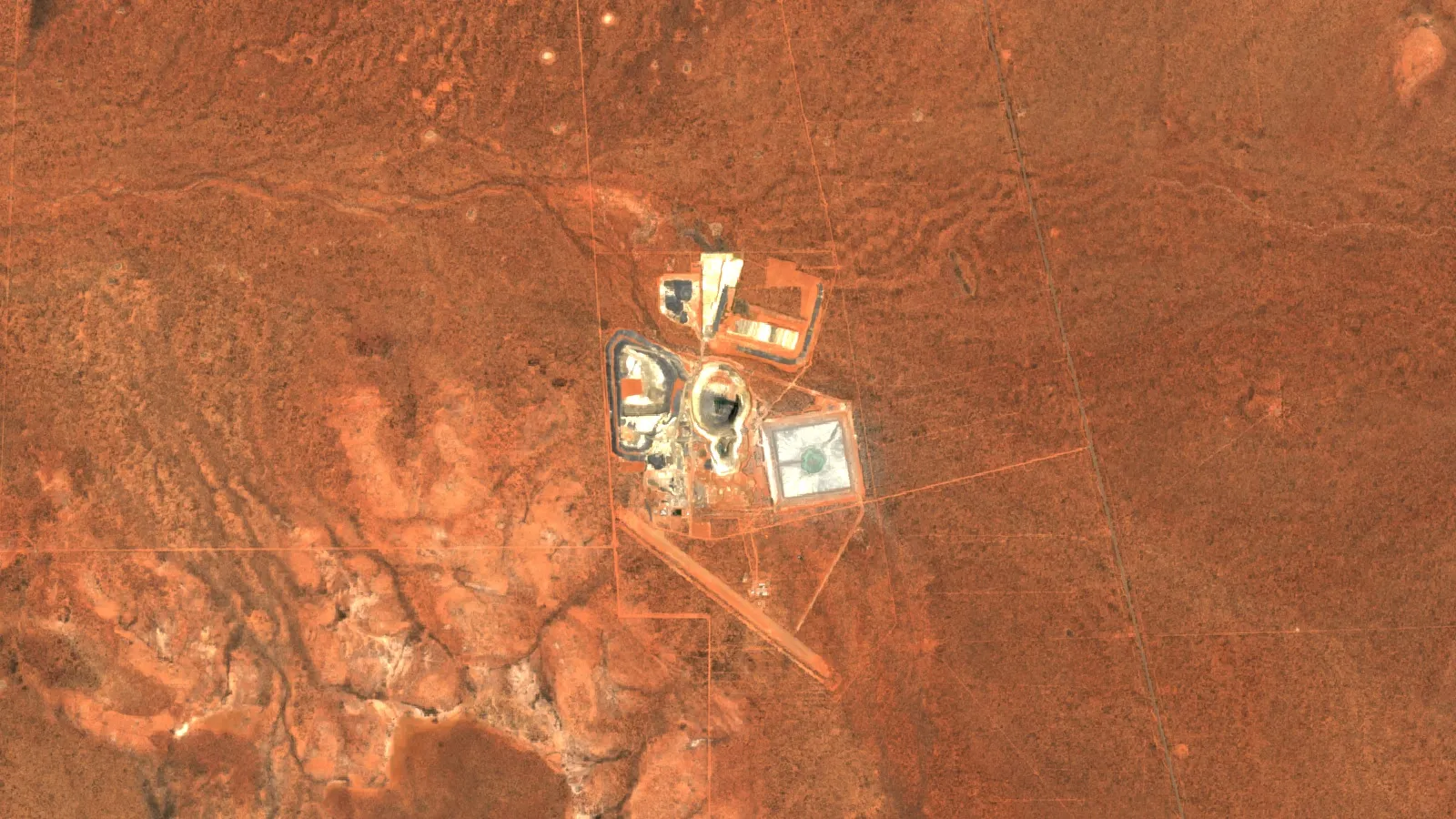
The Kirkalocka mine is an open-pit gold site 75 km south of Mount Magnet, on care and maintenance under Gylden Resources, with about 240,000 oz in resource and a plant restart planned for mid Q1 2027.
Key takeaways
- Gylden Resources owns the site and schedules a plant restart for mid Q1 2027; open-pit mining stays on care and maintenance (company site, November 2026).
- Recorded output from 2002-03 to 2008-09 totals 307,621 oz at 1.52 g/t (company reports via Wikipedia).
- The company cites about 240,000 oz of resource, against 360,000 oz in 2011 and 506,000 oz in 2012, on different bases.
- The carbon-in-leach plant is rated at 2.0 million tonnes a year by Gylden and 2.1 million by Odyssey Gold, which holds a conditional toll deal for up to 750,000 tonnes.
- Catalina Resources explores a neighbouring project with a similar name; it does not own the mine.
In this article
- Kirkalocka mine at a glance
- Who owns the Kirkalocka gold mine
- Kirkalocka mine production history
- Geology of the Kirkalocka deposit
- How the Kirkalocka resource has changed
- Kirkalocka processing plant and toll milling
- Toll treatment costs: test your own ore
- Exploration around the Kirkalocka mine
- Environmental and social record: what is public
- What to check before relying on the restart date
- Frequently asked questions
The Kirkalocka mine is an open-pit gold operation about 75 km south of Mount Magnet in Western Australia. It is on care and maintenance, with about 240,000 ounces of gold in resource, and its owner plans to restart the processing plant in mid Q1 2027. The pit itself is not part of that first step: Gylden Resources says open-pit mining will stay on care and maintenance, so the near-term plan is a mill treating ore, including ore from other companies.
That makes this site more useful to a consultant or a nearby project owner than most idle mines. The sections below give the production record year by year, how the plant works, how the resource figure has moved between owners, who holds the ground next door, and what toll treatment could mean for a small project. A calculator lets you test your own tonnes, grade and costs.
Kirkalocka mine at a glance
| Item | What the sources show | Source and date |
|---|---|---|
| Location | Beside the Great Northern Highway, 75 km south of Mount Magnet and 75 km north of Paynes Find | Gylden Resources, viewed November 2026 |
| Coordinates | About 28.675° S, 117.762° E | Geoscience Australia mine record, viewed November 2026 |
| Owner | Gylden Resources, owned by an affiliate of Värde Partners | Gylden Resources, viewed November 2026 |
| Status | Care and maintenance, with the plant being refurbished | Gylden Resources and Geoscience Australia, November 2026 |
| Resource | About 240,000 oz of gold (company figure; tonnes, grade and categories are not given on its site) | Gylden Resources, November 2026 |
| Plant | Carbon-in-leach, 2.0 million tonnes a year (a May 2026 partner filing says 2.1) | Gylden Resources; Odyssey Gold |
| Recorded output | 307,621 oz between 2002 and 2009 at 1.52 g/t | Wikipedia table citing Equigold and Lihir reports |
| Mining method | Open pit (Curara Well pit) | Mount Magnet South, July 2011 |
Grade means the amount of gold in each tonne of rock, given in grams per tonne (g/t). Small differences in distance exist between sources: Gylden uses 75 km, while a 2013 trade report gave 65 km and Wikipedia gives 70 km. Mining staff may also know the site by its older names, as Geoscience Australia lists Curara Well and Kirkalocka Gold Project as synonyms.
Who owns the Kirkalocka gold mine
Gylden Resources holds the mine and plant today. Its corporate page says the company is owned by an affiliate of Värde Partners, and the national mine database also lists Gylden as the company against the site. The chain of owners matters when you read old reports, because each owner published its own resource and restart plan.
| Period | Owner | What happened |
|---|---|---|
| Before 2001 | Several explorers, including Sons of Gwalia | Exploration only |
| 2001 to 2008 | Equigold | Built the plant, mined from 2002 to October 2005, then milled stockpiles until August 2008 |
| 2008 to 2015 | Mount Magnet South | Bought the tenements in April 2008 and the plant in 2009, and studied a restart |
| 2015 to 2017 | Minjar Gold | Bought the project in November 2015 |
| 2017 to 2021 | Adaman Resources | Bought it for A$12 million, restarted mining in late 2018, entered voluntary administration in May 2021 |
| Now | Gylden Resources | Refurbishing the plant for a restart |
The table up to 2021 follows the Wikipedia history of the mine, which cites company announcements. Sources differ by two months on the plant sale (March or May 2009). For the date and terms of the transfer to Gylden, check the state tenement register.
Kirkalocka mine production history
Equigold ran the first phase. Mount Magnet South later described it as campaign mining of the Curara Well open pit from October 2002 to October 2005, followed by stockpile processing to August 2008. Gold was about US$420 an ounce when mining stopped, according to the same presentation, against more than US$1,550 in 2011.
Chart
Milled grade fell after pit mining ended
Gold grade in g/t, by financial year
Chart
Kirkalocka gold output by financial year
Ounces of gold, 2002-03 to 2008-09
Yearly figures show a pattern that consultants will recognise. Output peaked at 67,454 oz in 2003-04, then grade fell sharply once mining stopped and the mill moved to lower-grade stockpiles: 1.94 g/t in 2004-05 became 1.06 g/t by 2007-08. Reported cost per ounce stayed within A$292 to A$432 across the period.
| Financial year | Gold (oz) | Grade (g/t) | Cost per oz (A$) |
|---|---|---|---|
| 2002-03 | 45,375 | 1.64 | 359 |
| 2003-04 | 67,454 | 1.74 | 341 |
| 2004-05 | 59,367 | 1.94 | 399 |
| 2005-06 | 47,638 | 1.39 | 384 |
| 2006-07 | 37,472 | 1.07 | 432 |
| 2007-08 | 42,589 | 1.06 | 423 |
| 2008-09 | 7,726 | 1.26 | 292 |
Those seven lines add up to 307,621 oz. Other totals exist: a 2013 trade report said 294,000 oz between 2002 and 2008, and Mount Magnet South quoted an average grade of 1.46 g/t rather than 1.52 g/t. The gap probably reflects different cut-off dates, so quote the source along with the number.
The 2018 to restart
Adaman Resources restarted mining in late 2018 and went into voluntary administration in May 2021, reportedly owing creditors more than A$100 million. Administrators Cor Cordis announced a refinancing that August. Odyssey Gold reports that the plant last operated in 2022 and has been on care and maintenance since. The table stops at 2008-09 because it covers the years reported in Equigold and Lihir Gold filings.
Geology of the Kirkalocka deposit
Gylden places the deposit on the eastern margin of the Meekatharra-Wydgee Greenstone Belt and interprets it as a typical Late Archean orogenic gold deposit of the Yilgarn Craton. Greenstone belts are ancient, deformed volcanic and sedimentary rocks. Orogenic gold forms when hot fluids move along major faults during mountain building, so structure is usually the main control on where ore sits. For more on how this style compares, see our guide to gold deposit types.
Geoscience Australia classes the site in the Murchison Province of the Yilgarn Craton, in the Big Bell gold metallogenic province, with an Archean age. Gylden says historical exploration points to potential at depth and along strike, subject to more drilling. That is a company view and not a resource. In 2011 Mount Magnet South said its tenements covered about 500 square kilometres; check the current area, since the ground has since been split between holders.
Ore comes in three types, and each behaves differently in a mill. Oxide ore has been weathered near surface and is soft and easy to leach. Fresh ore is hard and unweathered, and transitional ore sits between them. Our note on oxidized gold ore explains why this split shapes a process plan.
How the Kirkalocka resource has changed
The published ounces have moved a long way. In July 2011 Mount Magnet South reported a JORC resource of 10.1 million tonnes at 1.1 g/t for 360,000 oz, made up of 270,000 oz Indicated and 90,000 oz Inferred. A November 2012 broker summary put the figure at 13.8 million tonnes at 1.1 g/t for 506,000 oz, with reserves of 250,000 oz. Gylden now cites approximately 240,000 oz.
Chart
Published Kirkalocka resource figures
Ounces of gold, as quoted at each date; bases differ
These numbers cannot be compared directly. A resource is gold with reasonable prospects of extraction, while a reserve is the part shown to be economic in a mine plan. Each estimate used its own gold price, cut-off grade and tenement area. The mined pit also differs between dates. Before relying on any of them, ask for the current estimate with its date, categories, cut-off grade and Competent Person statement.
Kirkalocka processing plant and toll milling
The plant has grown on paper over time. Reports from 2011 and 2013 describe a 1.2 million tonne a year plant with one 1.4-megawatt SAG mill, a gravity circuit and six leach tanks. Gylden now gives 2.0 million tonnes a year, while Odyssey Gold’s May 2026 filing gives 2.1 million. A 2012 broker summary already listed 1.6 to 2.1 million tonnes a year, and the 2013 report described added circuits to reach 1.6 million. No source explains why 2.0 and 2.1 differ today, so confirm throughput for your ore type directly.
The flow is conventional. Ore goes to a run-of-mine stockpile holding 500,000 to 700,000 tonnes, then through single-stage crushing and a semi-autogenous grinding (SAG) mill, which uses the rock itself as part of the grinding charge. A gravity circuit takes out coarse gold. The rest passes through six tanks of carbon-in-leach (CIL), where cyanide dissolves the gold and activated carbon captures it, with about 24 hours of retention. Gylden quotes recovery above 90% on its project and plant pages, and mid to high 90% on its home page.
Toll milling means a plant owner treats another company’s ore for a fee. Gylden says it will run discrete campaigns for each parcel, with compatibility and metallurgical test work before scheduling, and that it may also buy third-party ore. Haulage and contract mining can be coordinated through SMS Mining Services, according to the company.
One public customer is on record. Odyssey Gold has a binding but conditional agreement for at least 600,000 tonnes and up to 750,000 tonnes from its Tuckanarra project, 191 km north according to its May notice and 195 km according to its annual report. Its May 2026 notice pointed to a first quarter 2027 start, while its annual report of 30 September 2026 says the agreement begins in Q2 2027. Conditions in the May notice include commercial operations at the plant. Gylden also reports feasibility studies on dry-stack tailings and a tungsten circuit, without further detail so far.
▶ How gold moves from rock to refined metal, including the carbon step used in plants like this one. · 5:27
Toll treatment costs: test your own ore
For a small project owner within haulage range, the question is what is left after haulage, the toll fee and royalty. Toll fees are set privately: Odyssey describes its fee as fixed and competitive but does not publish it. So the fee is an input below. The state royalty is public: Western Australia’s regulations set 2.5% on gold, with no royalty on the first 2,500 oz produced in a financial year from the same gold royalty project. For scale, WA gold sales reached A$29 billion and about 6.7 million ounces in 2024-25, according to the state digest, and gold was about US$4,046 an ounce on 4 November 2026, according to Fortune.
Calculator
What is a toll-milled ore parcel worth?
Enter your own parcel, costs and gold price in Australian dollars.
- Gold revenue (A$): $26,042,085
- WA royalty at 2.5% (A$): $651,052
- Mining, haulage and toll cost (A$): $9,850,000
- Left before other costs and tax (A$): $15,541,033
Example values only, not a benchmark or a quote from any plant. Toll fee and haulage are placeholders because plant fees are private. Gold price: example, use today’s price. Fixed constants: 31.1035 g per troy ounce and the 2.5% WA gold royalty (Mining (Royalties) Regulations 2025); the 2,500 oz exemption is not applied. All money is A$.
Exploration around the Kirkalocka mine
Neighbouring ground is held by another company. Catalina Resources (ASX: CTN) owns 100% of a separate project also called the Kirkalocka Gold Project, next to the mine and plant. Do not confuse the two: the 240,000 oz resource belongs to the mine, and Catalina’s July 2026 announcement describes that figure as sitting on the adjacent mine, not on its own ground. Its four prospects are Highway, Capra, Avis and 2 Mile Bore.
- Highway: a fold closure with an amphibolite core. Historical drilling includes 6 m at 1.79 g/t gold from 42 m.
- Capra: limited historical drilling, with mapping and soil data guiding targets.
- Avis: old workings in basalt-hosted quartz veins, with historical rock chips up to 9.89 g/t. A rock chip is a single surface sample and says little about tonnage.
- 2 Mile Bore: beside the north-south Cuddingwarra Shear, with 1 m at 4.66 g/t from 34 m in historical drilling.
The explorer planned about 2,200 m of reverse circulation drilling in July 2026, and by its later update had collected about 1,500 soil samples and moved to about 3,000 m, with a heritage survey with Badimia Traditional Owners set for the week of 7 September 2026. Check the company’s ASX page for later results. For wider context see our lists of Australian exploration companies and the Australia mineral deposits map.
For a consultant reviewing ground in this belt, satellite imagery can be a first screen before soil lines and drilling: it can show alteration, structure and old disturbance across a large area. Farmonaut offers satellite-based mineral detection for that stage, and its results are exploration targets that sit ahead of any resource estimate. Our guide to exploration targeting shows how such layers feed a drill ranking.

▶ How satellites map the rocks around gold systems, and what they cannot see. · 4:25
Environmental and social record: what is public
Be careful with per-ounce water and emissions figures for this mine that circulate online: treat them as unconfirmed unless they trace to a company report or regulator record. Gylden’s own statement is general: it says it meets regulatory requirements and aims to limit impact and engage with local communities. Primary records are better for due diligence: the state mines and environment regulators hold approvals, licences, mine closure plans and compliance reports for WA sites.
Reviewers working on a restart should ask for four things: the current tailings storage plan, the water balance, the rehabilitation liability, and heritage agreements. The dry-stack study mentioned above shows that tailings options are under review. Dry stacking removes more water from tailings before placement.

▶ The seven main environmental impacts of mining, explained in plain words. · 2:31
What to check before relying on the restart date
- Plant status. Dates have moved before: restarts were planned for 2012 and 2013 under Mount Magnet South, and Odyssey’s own start has moved a quarter this year.
- Throughput. Ask which capacity applies to your ore. Hard fresh ore usually mills slower than oxide.
- Recovery. Run your own test work. A plant-wide recovery figure does not predict the result for your parcel.
- Slot availability. Odyssey’s minimum takes up a share of 2027 capacity, so ask what remains.
- Haulage. Cost per tonne per kilometre can decide a low-grade parcel, so price the actual route.
- Title and approvals. Check the tenement register and your mining proposal before you commit to a schedule.
If you need a quote for desktop screening of a nearby tenement, use our mining query form or contact the team. Consultants looking for local firms can also read our list of mining consultants in Australia.
Frequently asked questions
Where is the Kirkalocka mine?
It is in the Murchison district of Western Australia, on the Great Northern Highway, about 75 km south of Mount Magnet and 75 km north of Paynes Find, according to the owner.
Who owns Kirkalocka mine?
Gylden Resources, which says it is owned by an affiliate of Värde Partners. Earlier owners were Equigold, Mount Magnet South, Minjar Gold and Adaman Resources.
Is the Kirkalocka gold mine operating?
Not as of November 2026. The site is on care and maintenance, and the plant is being refurbished for a restart that Gylden schedules for mid Q1 2027.
Will the Kirkalocka pit reopen?
Gylden says open-pit mining stays on care and maintenance while the plant restarts. Its project pages give no date for the pit.
How much gold has Kirkalocka produced?
Recorded output from 2002-03 to 2008-09 totals 307,621 oz at 1.52 g/t. That record excludes the 2018 to 2022 phase.
How much gold is left at Kirkalocka?
Gylden cites a resource of about 240,000 oz. That is gold in the ground before mining and processing losses, and it is not a reserve.
What type of mine is Kirkalocka?
It is an open-pit gold mine with an adjoining carbon-in-leach plant. The deposit is interpreted as a Late Archean orogenic gold system.
Can other companies process ore at the Kirkalocka plant?
Gylden says it plans campaign toll treatment and may buy third-party ore, subject to test work and commercial terms. Odyssey Gold has a conditional agreement for up to 750,000 tonnes.
Is Catalina Resources the owner of the Kirkalocka mine?
No. Catalina holds a neighbouring exploration project with a similar name. The mine and plant belong to Gylden.
What royalty applies to gold from Kirkalocka?
WA regulations set 2.5% on gold, with an exemption for the first 2,500 oz per financial year from the same gold royalty project. Confirm how this applies with the state regulator.
This page is for information only. It is not investment or legal advice. Confirm the rules with the regulator.
Farmonaut mining
Map your mining site from space
Screen a tenement with satellite imagery before you plan field work or a drilling program.

Mining Pro sample view, synthetic data
Keep reading
Sources
- Gylden Resources, Kirkalocka Project: gyldenresources.com.au
- Gylden Resources, Kirkalocka Processing Plant: gyldenresources.com.au
- Gylden Resources, About: gyldenresources.com.au
- Gylden Resources, home page: gyldenresources.com.au
- Gylden Resources, news on dry-stack and tungsten studies: gyldenresources.com.au
- Geoscience Australia, Kirkalocka Mine record: linkeddata.pid.geoscience.gov.au
- Odyssey Gold, toll milling announcement (20 May 2026): bulletin.webull.com
- Odyssey Gold, Annual Report (30 September 2026): announcements.asx.com.au
- Catalina Resources, ASX announcement (8 July 2026): investorpa.com
- Kalkine Media, Catalina soil survey and heritage update (2026): kalkinemedia.com
- Mount Magnet South, investor presentation (July 2011): asx.com.au
- Industrial Info Resources, Kirkalocka refurbishment (March 2013): industrialinfo.com
- FNArena, Mount Magnet South broker summary (November 2012): fnarena.com
- Wikipedia, Kirkalocka Gold Mine (citing company reports): en.wikipedia.org
- Government of Western Australia, Mining (Royalties) Regulations 2025: legislation.wa.gov.au
- Government of Western Australia, Statistics Digest 2024-25: wa.gov.au
- Fortune, Current price of gold (4 November 2026): fortune.com
Discussion
Questions, corrections or field experience? Share them below. First-time comments are reviewed before they appear, and your email is never published.
No comments yet. Be the first to add a question or your experience.

 Critica Metals Limited
 Congo Mining Solutions
 Mining SARL
 SenGold Invest SAS
 Sania Corporation
 Sean Mining Limited
 NTS Group (Pty) Ltd
 Mine4Africa
 Lithspo Minerals Limited
 Tintina Mining Group
 Dalgety Minerals Pty Ltd
 Vortex Minerals Pty Ltd
 Faith At Work (Pty) Ltd
 Geotech Mining Solutions plc
 Vulcan International Limited
 Kidepo Associates
 GKY Mining
 Alkimy SARL
 Double A Trading
 GemSprout Metals Limited
 Qader Group
 Ileys General Trading











