

Australia · Company guide
Australian Mining Exploration Companies: ASX Explorers
Australian explorers spent A$1,189.8 million in the June 2026 quarter, with gold taking A$565.6 million. Seven ASX names by metal, with stage and dated figures.
Key takeaways
- Mineral exploration spending in Australia was A$1,189.8 million in the June 2026 quarter, up about 18% on a year earlier (ABS).
- Gold took A$565.6 million of it, up from A$402.5 million; iron ore was second at A$234.7 million (ABS).
- Southern Cross Gold holds an Exploration Target of 3.0 to 4.6 million oz AuEq at Sunday Creek, not a resource (August 2026).
- Chalice reported A$53 million of cash and listed investments at 30 September 2026 and targets a final investment decision in the first half of 2028.
- Ausgold has agreed a scheme with OceanaGold worth about A$776 million; completion is expected by December 2026 subject to votes and approvals.
In this article
- What counts as an ASX exploration company
- How this list was chosen
- Where Australian exploration money goes
- Exploration spending over five years
- Gold explorers
- Lithium explorers
- Nickel, platinum-group metals and copper explorers
- Rare earth explorers and developers
- Uranium explorers
- Explorer, developer or producer: reading the stage
- How to read a quarterly report from an explorer
- How much runway does an explorer have
- How to check a company's ground before trusting the pitch
- Takeovers and changes to watch
Australian mining exploration companies listed on the ASX spent most of their money on gold in the June 2026 quarter: the Australian Bureau of Statistics counted A$565.6 million of gold exploration out of A$1,189.8 million for all minerals (ABS, released 31 August 2026). The names below are explorers with a named project, a dated resource or target figure and a recent company filing, grouped by the metal they are looking for.
This page is a reference list, not a ranking of which share will do best. Explorers move between stages quickly, and one company below, Ausgold, has agreed to be taken over, which is a common end for a junior with a proven project. Each entry shows what the company filed, with the date, so you can check it against the ASX announcement yourself.
What counts as an ASX exploration company
An exploration company holds mineral tenements, spends money drilling and sampling them, and has not yet built a mine. Most are small, listed on the Australian Securities Exchange (ASX) and funded by selling new shares. Because they have no sales, they report spending and cash every quarter. The reporting rulebook for results is the JORC Code, the Australasian code published by the Joint Ore Reserves Committee; its 2012 edition has been mandatory since 1 December 2013, and it sorts findings by confidence into Exploration Results, Mineral Resources and Ore Reserves.
Three terms matter when you read a company announcement. A drill intercept is a short length of core or chips with a measured grade, for example metres at grams of gold per tonne (g/t). An Exploration Target is a range of tonnes and grade that the company says might exist, and it is not a resource. A Mineral Resource is an estimate with enough drilling behind it to be called Inferred, Indicated or Measured. The difference between a target and a resource is the single most useful thing to check on any explorer’s page.
How this list was chosen
We included ASX-listed companies whose main project is in Australia (Chalice also holds copper ground in the Northern Territory and Western Australia), that published a figure or milestone in 2026, and whose numbers we could read in a company filing or a named news report. We left out producers that run large operating mines. We did not use market value, because it changes daily and different websites give different values for the same company on the same day.
The table gives the commodity, project, state and latest stage. After it, each commodity group has its own section with dates and sources. For maps of where these projects sit, see our Australia mining map by state.
| Company (ASX code) | Main metal | Project and state | Latest stage and figure | Source date |
|---|---|---|---|---|
| Southern Cross Gold (SX2) | Gold, antimony | Sunday Creek, Victoria | Exploration Target of 3.0 to 4.6 million oz AuEq; no resource yet | August 2026 |
| Ausgold (AUC) | Gold | Katanning, Western Australia | Feasibility study; OceanaGold takeover agreed | August 2026 |
| Antipa Minerals (AZY) | Gold, copper | Minyari Dome, Paterson, Western Australia | 69 Mt at 1.33 g/t gold, 2.9 million oz gold; pre-feasibility study under way | April 2026 |
| Delta Lithium (DLI) | Lithium, tantalum, rubidium | Mt Ida, Western Australia | 14.8 Mt at 1.21% Li2O resource; scoping study under way | November 2025 resource; June 2026 cash |
| Chalice Mining (CHN) | Palladium, platinum, nickel, copper | Gonneville, Western Australia | Pre-feasibility study done; Ore Reserve 7.1 million oz 3E | October 2026 |
| Arafura Rare Earths (ARU) | Neodymium-praseodymium (rare earths) | Nolans, Northern Territory | Final investment decision taken; construction targeted from September 2026 | May 2026 |
| DevEx Resources (DEV) | Uranium | Nabarlek, Northern Territory | 15,000 m drill program for a first resource | July 2026 |
Source for each row is in the section below it. Resource figures use each company’s own reporting date and are not comparable between metals.
Where Australian exploration money goes
Before looking at single companies, look at the whole country. The ABS survey of mineral exploration found A$1,189.8 million spent in the June 2026 quarter on the original series, or A$1,142.9 million seasonally adjusted, and drillers covered about 3,462 km of holes (ABS mineral and petroleum exploration, June quarter 2026). The same quarter a year earlier was A$1,009.9 million, so spending rose about 18%.
Chart
Exploration spending by commodity, June quarter 2026
A$ million, original series
Gold took almost half the total and was the main reason for the rise: A$565.6 million, up from A$402.5 million in the June 2025 quarter. Iron ore came second at A$234.7 million. Copper, silver, lead, zinc, nickel and cobalt together (the ABS calls them selected base metals) fell to A$177.9 million from A$191.1 million a year earlier. The group the ABS calls all others, which holds mineral sands, uranium and diamonds, was A$152.0 million, and coal was A$59.6 million. The ABS page does not split lithium or rare earths out, so those sit inside other groups.
What this means for a reader: if you hold ground that could carry gold, you are competing with the best-funded group of explorers. If your ground is for base metals or battery metals, fewer companies are active, and a larger share of the buyers are single-project juniors.
Exploration spending over five years
Spending in the June quarter was flat to lower from 2022 to 2025 and then jumped in 2026. The chart shows the original series for the June quarter of each year. The sections below show some of the larger drilling campaigns now under way.
Chart
Total mineral exploration, June quarters
A$ million, original series
Gold explorers
Gold explorers in Australia fall into two groups: companies drilling a new discovery to build a first resource, and companies with a resource that are moving toward a mine. Three show the range.
Southern Cross Gold: Sunday Creek, Victoria
Southern Cross Gold (ASX: SX2) is drilling a gold and antimony system at Sunday Creek in Victoria. In August 2026 it lifted its Exploration Target to 10.4 to 11.9 million tonnes at 8.9 to 12.1 g/t gold-equivalent, which is 3.0 to 4.6 million ounces gold-equivalent, covering the central 1.5 km of an 11 km corridor (Mining Stock Education copy of the company release). Gold-equivalent (AuEq) converts antimony into its gold value, so the number depends on the price ratio the company assumes.
The company says there has not been enough drilling to state a Mineral Resource and that nine diamond rigs were working on the target when it published. Metallurgical tests reported in August 2025 showed a gold recovery of 92.3% to 95.6% into a high-grade, low-arsenic antimony-gold concentrate. For a reader, the point is that SX2 holds a target, not a resource, so any value placed on it is an estimate of an estimate.
Ausgold: Katanning, Western Australia
Ausgold (ASX: AUC) owns the Katanning gold project, about 275 km south-east of Perth. In August 2026 OceanaGold signed a scheme implementation deed to buy all Ausgold shares at an equity value of about A$776 million, paying 0.03365 OceanaGold shares per Ausgold share with a cash option capped at A$194 million in total (Mining Technology report on the deal). The feasibility study describes a conventional open pit producing more than 100,000 oz of gold a year for over ten years, with first production scheduled for 2029.
Completion is expected by December 2026 and needs at least 75% of votes cast at the scheme meeting, court approval and regulatory approvals including the Foreign Investment Review Board. Until the scheme completes, Ausgold stays listed, and a deal of this kind can fail. It is a clear example of the path many explorers hope for: drill, publish a resource, complete a feasibility study, then sell to a larger producer.
Antipa Minerals: Minyari Dome, Western Australia
Antipa Minerals (ASX: AZY) focuses on the 100%-owned Minyari Dome gold-copper project in the Paterson Province of Western Australia. Its 2026 resource update gives 69 million tonnes at 1.33 g/t gold, holding 2.9 million ounces of gold or 3.6 million ounces gold-equivalent, plus 91,000 tonnes of copper, 880,000 ounces of silver and 13,000 tonnes of cobalt; 76% is in the Indicated class, and the resource supports a pre-feasibility study now under way (Smallcaps summary of the April 2026 update). A report of 25 October 2024 also says Antipa sold its non-controlling interest in the Citadel joint venture to Rio Tinto Exploration for A$17 million in cash (Investing.com report).
Check the ASX announcement for the exact date and wording of the update. Antipa is useful as an example of a junior that funded itself by selling part of a project to a major and then grew the rest.
For gold ground by state, our guides to gold deposits in Australia by state and satellite gold targets by state show where the districts sit.
Lithium explorers
Delta Lithium (ASX: DLI) is a clear example of the stage between discovery and mine. Its Mt Ida project in Western Australia has a Mineral Resource of 14.8 million tonnes at 1.21% lithium oxide (Li2O), 170 parts per million tantalum oxide and 0.42% rubidium oxide (updated in November 2025), and the company reported a cash balance of about A$49.6 million at the end of the 2026 financial year (Delta Lithium annual report 2026). Delta also names a Mt Ida scoping study among its priorities and has moved the project’s gold into a spin-out called Ballard Mining (ASX: BM1).
Spodumene is the lithium mineral mined from hard-rock pegmatites in Western Australia. Our guide to lithium in Australia: spodumene deposits, output and targets shows where the deposits are, and the background on types of ore deposits explains how pegmatites differ from other hosts.
Nickel, platinum-group metals and copper explorers
Chalice Mining (ASX: CHN) owns the Gonneville palladium, platinum, gold, nickel, copper and cobalt deposit in Western Australia outright. The Mineral Resource of 23 April 2024 is 660 million tonnes holding 17 million oz of 3E (palladium, platinum and gold), 960,000 tonnes of nickel, 540,000 tonnes of copper and 96,000 tonnes of cobalt. A maiden Ore Reserve from the December 2025 pre-feasibility study is 260 million tonnes holding 7.1 million oz 3E, 400,000 tonnes of nickel, 260,000 tonnes of copper and 43,000 tonnes of cobalt (Chalice September 2026 quarterly report).
The quarterly report dated 27 October 2026 targets a definitive feasibility study in the third quarter of calendar 2027 and a final investment decision in the first half of 2028. Cash and listed investments were A$53 million at 30 September 2026. Chalice also drilled greenfield copper-gold targets at Warrego North in the Northern Territory and found a copper-silver-gold system at the Deep Blue prospect in Western Australia. This is a useful example of an explorer that has a large resource but needs years and large capital before a mine opens.
Rare earth explorers and developers
Arafura Rare Earths (ASX: ARU) holds the Nolans project in the Northern Territory. Its board took a final investment decision on 21 May 2026, backed by binding commitments from sovereign-backed institutions in four countries, and the company said it was targeting construction from September 2026; check the company’s latest update for whether it has begun (Motley Fool Australia report). Arafura is now a developer rather than an explorer, and its place in this list shows how far an explorer can move.
Rare earth elements are a group of 17 metals; neodymium and praseodymium (NdPr) are the two used in strong magnets. Our US guide to rare earth deposits in Wyoming compares what a project of this kind needs in size and grade.
Uranium explorers
DevEx Resources (ASX: DEV) wholly owns the Nabarlek uranium project in the Northern Territory. A report dated 21 July 2026 describes a 2026 campaign of about 15,000 metres of reverse circulation and diamond drilling in 66 holes at targets called Big Radon, KP and Sandfire, with a first Mineral Resource as the stated goal and no date given (Kalkine Media report). Reverse circulation drilling blows rock chips to the surface; diamond drilling brings up solid core.
Explorer, developer or producer: reading the stage
The label a company gives itself changes how its news should be read. The table uses the same companies as above.
Chart
Gold drove the year-on-year rise
A$ million, original series, June quarters
| Stage | What the company holds | Example from this page | Main risk |
|---|---|---|---|
| Early explorer | Tenements and drill results; no resource | DevEx at Nabarlek | Drilling may not find a resource |
| Target or resource builder | Exploration Target or Inferred resource | Southern Cross Gold; Antipa | Targets can shrink when drilled |
| Studies | Resource plus scoping or feasibility study | Delta Lithium; Chalice | Metal prices and approvals |
| Developer | Funding and construction decision taken | Arafura at Nolans | Cost overruns and start-up delays |
| Takeover target | Studied project with a larger buyer | Ausgold and OceanaGold | Scheme vote and approvals can fail |
The first two stages use shareholders’ money only. From the studies stage onward, the company may also take debt, government funding or a strategic investor, as Arafura’s backing from sovereign-backed institutions shows.
▶ Farmonaut video following one gold nugget from discovery and drilling through to refining. · 5:27
How to read a quarterly report from an explorer
Listed explorers must file a quarterly activities report and a cash-flow statement, which is what Chalice’s October 2026 document is. Follow these steps for any company on this page or off it.
- Find the cash line. Read the quarter-end cash and the net cash used. Divide one by the other to get quarters of runway (the calculator below does this).
- Check the resource date. The date is in the footnote. Chalice’s resource is from 2024, Delta’s from 2025.
- Separate target from resource. Look for the words Exploration Target. A target is not a resource.
- Look at what was drilled. Metres drilled and the number of holes show how much of a target is tested.
- Read the tenement table. It lists each licence, the ownership share and any earn-in, so you can see who really controls the ground.
- Note approvals. Environmental review and native title steps govern the time to a mine.
How much runway does an explorer have
Most explorers do not make money; they spend cash raised from shareholders until they find something a larger company will buy, or until the money runs out. Chalice’s report shows net cash use of about A$6.7 million in the quarter, against about A$44.7 million of cash. That is about 6.7 quarters at the same pace, before any new raising. Use the calculator below with the numbers from a company you are reading. It also converts a drilling budget into metres.
Calculator
How long will an explorer’s cash last?
Enter cash and quarterly spend from a company’s own quarterly report.
- Quarters of cash: 6.7
- Drilling spend per quarter (A$): $3,350,000
- Metres drilled per quarter: 11,167
Example values only, not a benchmark. The cash and spend defaults are taken from Chalice Mining’s quarterly report of 27 October 2026 (cash about A$44.7 million, net cash use about A$6.7 million); drilling share and cost per metre are examples, use the company’s own numbers.
How to check a company’s ground before trusting the pitch
Every Australian state publishes tenement maps and geological data. Western Australia’s Geological Survey of Western Australia sits within the Department of Mines, Petroleum and Exploration and publishes statewide datasets and maps. Use the state register to confirm who holds a licence, its expiry date and any ground conditions, and compare it with the ASX announcement. If a company says it controls a district, the tenement table should match the register.
Satellite imagery gives a first look at ground before drilling. Sentinel-2 and similar sensors map iron staining, clay minerals and fault lines at the surface, which helps decide where to put the first drill lines. A satellite result is an exploration target, not a resource estimate. Farmonaut returns a satellite mineral-detection report for a licence boundary in 5 to 20 business days, and the sections in the video below explain what such a map shows.

▶ Farmonaut video on what satellites can and cannot show about gold ground. · 4:25
Takeovers and changes to watch
Three kinds of event move an explorer’s status. First, a larger company buys it, as OceanaGold agreed to do with Ausgold. Second, a larger company buys part of a project, as Rio Tinto did with Antipa’s Citadel stake. Third, a company changes stage, as Arafura did when it took a final investment decision. A takeover scheme has a vote and regulator approvals, so an agreed deal is not a completed one.
If you own a licence and want to know who might buy it, our guide on how to sell a mine explains the valuation methods and deal types buyers use. We do not promise a discovery or a sale for any property.
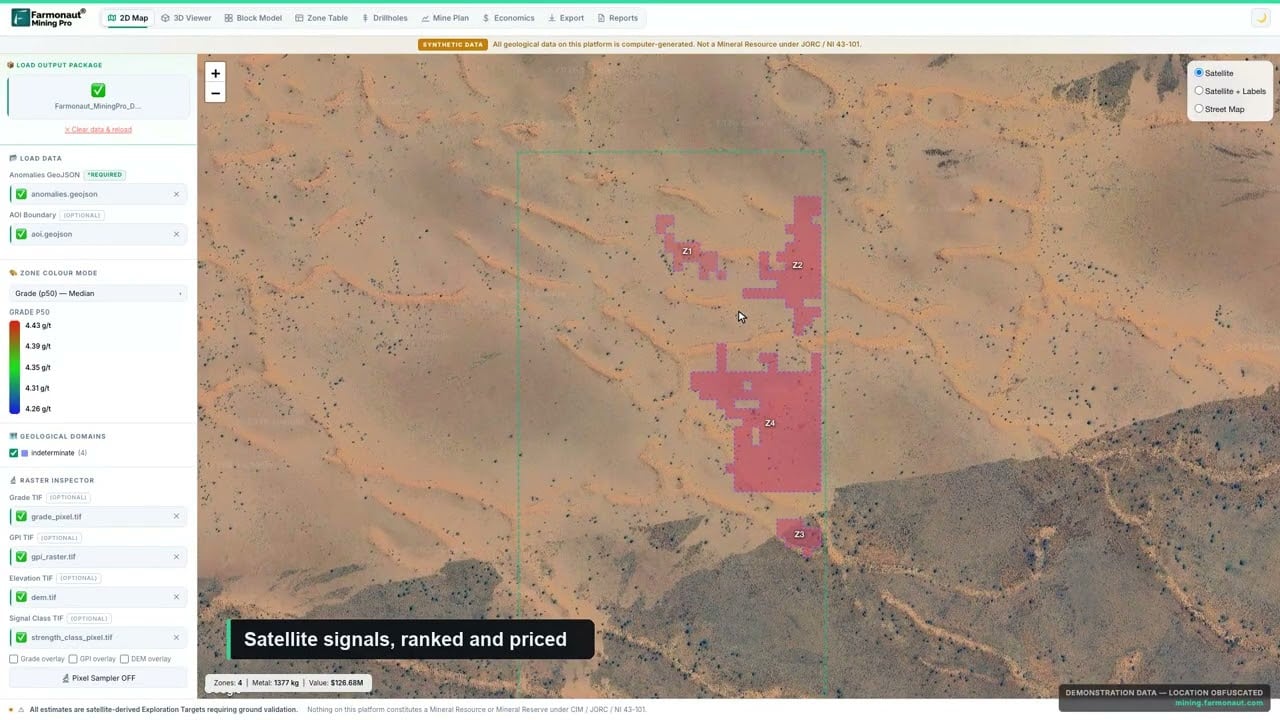
▶ Farmonaut Mining Pro: what a platform does with a licence boundary. · 4:56
Frequently asked questions
What are the main Australian mining exploration companies?
There is no official list, and the ASX has hundreds of explorers. This page covers seven with a named project and a filing from 2024 to 2026: Southern Cross Gold, Ausgold, Antipa, Delta Lithium, Chalice, Arafura and DevEx. The ABS counts total spending, not companies.
Which ASX gold exploration companies are drilling now?
Southern Cross Gold said in August 2026 that nine diamond rigs were working at Sunday Creek, and Ausgold was working toward a mine at Katanning before the OceanaGold offer. Gold took A$565.6 million of the A$1,189.8 million spent on exploration in the June 2026 quarter, so many other companies are also active.
Who are the lithium exploration companies in Australia?
Delta Lithium is one example, with a 14.8 million tonne resource at Mt Ida. Other lithium names exist, but this page only lists companies whose figures we could read in a filing.
How much do Australian explorers spend each year?
The ABS recorded A$1,189.8 million of mineral exploration in the June 2026 quarter alone. Multiply by four only as a rough guide, because spending changes by season and with metal prices.
What is the difference between an Exploration Target and a Mineral Resource?
A target is a range of tonnes and grade that the company thinks may exist, with too little drilling to call it a resource. A Mineral Resource is a stated estimate classed as Inferred, Indicated or Measured under the JORC Code.
Is an exploration company a safe investment?
Exploration is high risk because most projects never become mines, and company share prices move on drill results and funding. This page gives facts only and is not investment advice. Read a company’s own filings and speak to a licensed adviser.
How do I find an Australian exploration licence holder?
Search the state mining register for the tenement number, which shows the holder, the area and the dates. In Western Australia the state survey publishes tenement and geological data. Compare it with the ASX announcement.
Can a foreign investor buy shares in ASX explorers?
Shares trade on the ASX and can be bought through brokers, but takeovers of Australian companies by foreign buyers, such as the OceanaGold scheme for Ausgold, need Foreign Investment Review Board approval. Check the tax and legal rules in your own country.
How long does it take an explorer to reach a mine?
Chalice, with a resource from 2024 and a pre-feasibility study from December 2025, targets a final investment decision in the first half of 2028 and expects an 18-month build after that. Timelines vary by metal, approvals and funding.
Where can I see a map of Australian mines and projects?
State surveys publish tenement and geology maps, and Geoscience Australia holds national data. Our own overview is the Australia mining map.
This page is for information only. It is not investment advice and does not recommend any share. Company figures use each company’s own reporting date; check the latest ASX announcement before relying on them. Confirm licence and tenement rules with the state regulator.
Farmonaut mining
Screen your licence area from space
Send a licence boundary and get a satellite mineral-detection report in 5 to 20 business days.

Mining Pro sample view, synthetic data
Sources
- ABS, Mineral and Petroleum Exploration, Australia, June quarter 2026: abs.gov.au
- Chalice Mining, September 2026 Quarterly Activities Report (ASX, 27 October 2026): announcements.asx.com.au
- Delta Lithium, Annual Report 2026 (ASX): announcements.asx.com.au
- Mining Stock Education, Southern Cross Gold updates Sunday Creek Exploration Target (August 2026): miningstockeducation.com
- Mining Technology, OceanaGold to acquire Ausgold (August 2026): mining-technology.com
- Kalkine Media, DevEx Nabarlek drilling program (21 July 2026): kalkinemedia.com
- Investing.com, Antipa Minerals Citadel sale to Rio Tinto (25 October 2024): au.investing.com
- JORC Committee, the JORC Code: jorc.org
- Government of Western Australia, Geological Survey of Western Australia: wa.gov.au
- Smallcaps, Antipa Minerals boosts Minyari resource to 3.6 Moz gold equivalent (April 2026): smallcaps.com.au
- Motley Fool Australia, Arafura Nolans final investment decision (21 May 2026): fool.com.au
Discussion
Questions, corrections or field experience? Share them below. First-time comments are reviewed before they appear, and your email is never published.
No comments yet. Be the first to add a question or your experience.

 Comfix & Engineering Limited
 Congo Mining Solutions
 Mining SARL
 SenGold Invest SAS
 Sania Corporation
 Sean Mining Limited
 NTS Group (Pty) Ltd
 Mine4Africa
 Lithspo Minerals Limited
 Tintina Mining Group
 Dalgety Minerals Pty Ltd
 Vortex Minerals Pty Ltd
 Faith At Work (Pty) Ltd
 Geotech Mining Solutions plc
 Vulcan International Limited
 Kidepo Associates
 GKY Mining
 Alkimy SARL
 Double A Trading
 GemSprout Metals Limited
 Qader Group











