

Colorado mining · District guide
Gold and Lead Mining in Colorado: Districts and Output
Gold mining in Colorado now centres on one open pit, Cripple Creek & Victor, and no lead mine operates. This guide ranks the historic districts, shows the output figures and explains heap-leach recovery.
Key takeaways
- Cripple Creek & Victor produced 152,600 oz of gold in 2025 and is guided to 125,000 to 150,000 oz in 2026 by SSR Mining (SSR Mining guidance dated 4 August 2026; deck of 30 September 2026).
- Leadville’s lifetime output through 1999 included 265 million oz of silver, about 1.18 million tons of lead and 3.3 million oz of gold (Colorado Geological Survey).
- USGS lists US lead mines in Missouri, Alaska and Idaho, with none in Colorado; lead-acid batteries took about 67% of US lead use in 2025 (USGS, 2026).
- CC&V reserves are 2.65 million oz at 0.37 g/t, and life-of-mine heap-leach recovery is assumed at 51.6% (SSR Mining, 2026).
- Climax and Henderson made 37 million lb of molybdenum in 2025, Colorado’s other active metal mines (Freeport-McMoRan 10-K, 2025).
In this article
- Gold and lead mining in Colorado: the short answer
- Where Colorado's gold and lead came from: the 1858 rush to Leadville
- Why the ore sits where it does: the Colorado Mineral Belt
- Leadville, Gilman and Aspen compared: silver, lead and zinc
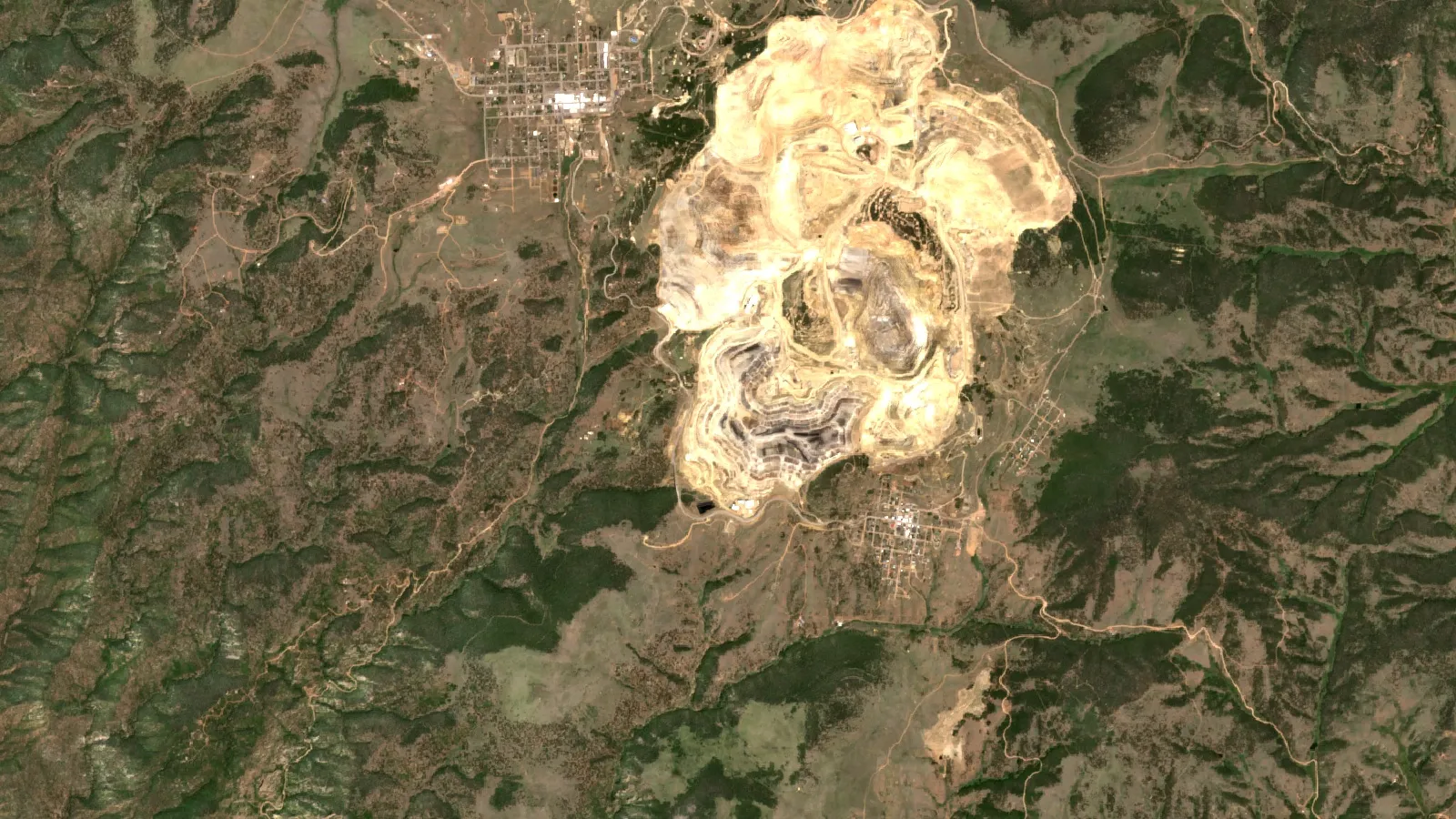
- Cripple Creek and Victor: Colorado's main gold mine today
- How heap-leach gold extraction works at an open pit
- Heap-leach ounces calculator: what stacked ore could yield
- Lead in Colorado: no active mine, and where lead comes from now
- Molybdenum at Climax and Henderson: Colorado's other active metal mines
- Cleaning up old mines: California Gulch and state permits
- How to check ground before staking or buying a claim in Colorado
- What to watch at Colorado mines next
- Frequently asked questions
Gold and lead mining in Colorado: the short answer
Colorado has one large gold mine left, the Cripple Creek & Victor open pit in Teller County, and no active lead mine. The pit produced 152,600 troy ounces of gold in the 2025 calendar year and is now owned by SSR Mining, which bought it from Newmont on 28 February 2025 (SSR Mining site-tour presentation, 30 September 2026). The lead that built Leadville came out of the ground long ago, mostly as a partner of silver and zinc. The USGS lists the mines that supply US lead today as five in Missouri plus byproduct output in Alaska and Idaho, with none in Colorado (USGS Mineral Commodity Summaries 2026, lead).
This guide covers where the gold and lead came from, which districts produced the most, how the one big gold mine works, what the numbers look like, and what to check before you stake or buy ground. Every figure carries its source and date. Ounces are troy ounces and tons are short tons unless the text says tonnes (metric tons).
| Metal | Where in Colorado | Status | Source |
|---|---|---|---|
| Gold | Cripple Creek & Victor, Teller County | Operating open-pit heap-leach mine; 125,000 to 150,000 oz in SSR’s 2026 guidance | SSR Mining, guidance of 4 August 2026 |
| Silver | Byproduct of CC&V gold | Silver is recovered as a byproduct of CC&V gold; the historic silver camps are closed | Colorado Geological Survey |
| Molybdenum | Climax and Henderson (Freeport-McMoRan) | Both operating; 37 million lb combined in 2025 | Freeport-McMoRan 10-K, 2025 |
| Lead and zinc | Leadville, Gilman, Aspen, Kokomo | Historic production; not listed among US lead mines | CGS; USGS 2026 |
| Uranium and vanadium | Uravan mineral belt, western Colorado | Historic; the belt supplied about 77% of the state’s uranium | Colorado Geological Survey |
Where Colorado’s gold and lead came from: the 1858 rush to Leadville
The Colorado Geological Survey (CGS) dates the first well-documented gold find to the summer of 1858, when prospectors panned placer gold (loose gold in stream gravel) near the meeting of Cherry Creek and the South Platte River, now downtown Denver. Its gold-occurrences volume, RS-28, gives 1859 for the Cherry Creek discovery. Either way, the find set off the first Colorado gold rush and led to the discovery of the state’s other metals.
The same CGS page explains how lead entered the story. In the early 1860s miners working placer gold in California Gulch near Leadville were annoyed by heavy blue-black sands. Those sands were lead carbonate, and some of it carried silver. Shipping it to a distant smelter only paid if the silver content was high. After richer silver ore was found around 1876 and closer smelters, including a lead-silver smelter at Georgetown, were built, the Fryer Hill discovery of 1877 started a silver boom. Leadville grew from about 200 people in 1877 to more than 15,000 within two years, and in 1880 the district produced over 10 million ounces of silver and 66 million pounds of lead (CGS).
That is why Colorado lead belongs to the history of silver. The main lead mineral is galena, lead sulfide, which is about 86.6% lead by weight when pure (Handbook of Mineralogy, galena). In Colorado it usually sat in the same veins and replacement bodies as silver, zinc, copper and some gold, so one mine often sold several metals.
The gold districts that passed one million ounces
According to the CGS, seven districts each produced more than about one million troy ounces of gold over their lives: Cripple Creek (Teller County), Central City (Gilpin), Telluride (San Miguel), Leadville (Lake), Sneffels (Ouray), Silverton (San Juan) and Breckenridge (Summit). Idaho Springs and Empire in Clear Creek County and Summitville in Rio Grande County each passed about 500,000 ounces. The Gilman district in Eagle County added about 400,000 ounces, mostly as a byproduct of zinc mining. For the whole state, RS-28 puts cumulative gold output above 42 million troy ounces.
Cripple Creek is the outlier. In 1900 its underground mines produced about 900,000 ounces, around two-thirds of US gold output that year, and by 1950 the district had yielded nearly 20 million ounces (SSR Mining presentation, 2026). Most underground mining there stopped in 1962, and modern surface mining began in 1994.
Why the ore sits where it does: the Colorado Mineral Belt
Most Colorado gold lies in a northeast-trending zone called the Colorado Mineral Belt. It runs from the Jamestown district in Boulder County to the La Plata Mountains in the southwest and coincides with a band of Laramide-to-Tertiary igneous rocks (CGS, RS-28 Gold Occurrences of Colorado). Hot, mineral-rich water moving through those rocks left veins and replacement deposits. The Cripple Creek district, overall the state’s most productive gold camp, lies east of the belt.
Not all ore is gold. Molybdenum deposits at Climax and Henderson belong to a separate “Climax-type” family: of the 13 known deposits of that type, six are in Colorado, and so far they are known only in western North America (CGS). Uranium and vanadium came from the Uravan mineral belt in the west, which produced almost 14 million tons of ore averaging 0.24% U3O8 (CGS).
Leadville, Gilman and Aspen compared: silver, lead and zinc
The CGS gives lifetime production for four silver and base-metal districts: Leadville, Gilman, Kokomo and Aspen. Together they produced roughly 502 million ounces of silver, 1.7 million tons of lead, 1.8 million tons of zinc, 160,000 tons of copper and 3.6 million ounces of gold. About half the gold and silver came from Leadville, mostly gold from the California Gulch placers. The table and charts below use the three districts for which the survey lists figures on a comparable basis. The periods differ: Leadville is through 1999, Gilman covers 1880 to 1972, and Aspen runs to about 1952.
Chart
Silver produced by three historic Colorado districts
Million troy ounces over each district’s life (Leadville to 1999, Aspen to about 1952, Gilman 1880 to 1972)
| District | Silver (million oz) | Lead (thousand tons) | Zinc (thousand tons) | Gold (thousand oz) |
|---|---|---|---|---|
| Leadville, Lake County | 265 | 1,180 | 968 | 3,300 |
| Aspen, Pitkin County | 111 | 294 | 11 | not listed |
| Gilman, Eagle County | 66 | 148 | 858 | 393 |
The pattern is clear. Leadville was a silver, lead and zinc district with a large gold bonus, Aspen was almost purely silver and lead, and Gilman was a zinc district where lead, copper, silver and gold followed. Leadville’s output through 1999 came from about 28.9 million tons of ore and also included about 55,000 tons of copper (CGS). Gilman’s figures are for Eagle County, where over 99% of production came from the Gilman district.
Cripple Creek and Victor: Colorado’s main gold mine today
The Cripple Creek & Victor mine, usually written CC&V, works the district where gold was found at Poverty Gulch in the 1890s. The CGS calls it the largest gold producer in the state. A short timeline from SSR Mining’s 2026 presentation: heap leaching of low-grade waste rock from old underground workings began in 1985, AngloGold took control of CC&V in 1999, Newmont acquired 100% in 2015, and SSR Mining bought the mine on 28 February 2025 for US$100 million upfront plus up to US$175 million in milestone payments.
Chart
Cripple Creek & Victor gold output, selected years
Thousand troy ounces per year; each bar’s source is in its label
Output has fallen from the 2010s. The USGS recorded 6,840 kg (about 220,000 oz) in 2021 and 5,660 kg (about 182,000 oz) in 2022, a 17% drop attributed to lower leach-pad recovery and less ore milled; milling was idled in 2022 (USGS Minerals Yearbook 2022, gold). SSR reports 152,600 oz for calendar 2025, of which 124,600 oz fell after the sale closed, above its 90,000 to 110,000 oz guidance for that period.
What the reserves say
Reserves are the part of a deposit that can be mined at a profit under a stated price and plan. Resources are mineralisation with reasonable prospects of eventual extraction, but with less proof of economics. SSR’s end-2025 statement for CC&V is below. Grades are in grams per tonne (g/t); a gram per tonne is one part per million by weight, so 0.37 g/t is very low grade that works only because the ore is cheap to mine and leach.
| Category (end 2025) | Ore (million tonnes) | Grade (g/t gold) | Contained gold (thousand oz) |
|---|---|---|---|
| Proven and probable reserves | 220.2 | 0.37 | 2,650 |
| Measured and indicated resources, excluding reserves | 338.1 | 0.44 | 4,805 |
| Inferred resources | 149.4 | 0.41 | 1,963 |
The 2025 technical report gives an initial 12-year mine life. SSR says the plan is limited by the leach-pad capacity now permitted, and that the Cresson permit amendment filed by Newmont in April 2024, called Amendment 14, is expected by the end of 2027. For 2026 SSR’s guidance (dated 4 August 2026) is 125,000 to 150,000 oz of gold at all-in sustaining cost (AISC) of US$1,780 to US$1,850 per ounce. AISC is the miner’s yardstick that adds mine, processing, overhead and sustaining capital costs per ounce sold. First-half 2026 output was 66,023 oz at US$1,802 per ounce, and the 125,000 to 150,000 oz range needs about 59,000 to 84,000 oz more in the second half.
The quarterly pattern shows why the weighting matters. Production was 44,062 oz in the second quarter of 2025, 29,821 oz in the third, 39,392 oz in the fourth, 38,298 oz in the first quarter of 2026 and 27,725 oz in the second. Ore stacked ran at 0.40 to 0.50 g/t over the same period. The 2026 guidance is a company forecast, not a result, and SSR notes in the 30 September 2026 deck that it is neither updating nor reaffirming guidance as of 4 August 2026.
How heap-leach gold extraction works at an open pit
CC&V uses conventional open-pit mining at about 10,000 feet of elevation. Most ore is stacked as run-of-mine (ROM), meaning it goes from the pit to the pad without crushing; about 5% of the ore in the life-of-mine plan is put through the two-stage crusher. The mine blends softer and harder ore to keep the pads stable and permeable, and it has to map voids left by old underground workings (SSR Mining presentation, 2026). The US Environmental Protection Agency’s industry profile describes the basic method. Crushed ore goes onto a lined pad, a dilute cyanide solution trickles through it and dissolves the gold, and the gold-bearing solution is collected and passed through carbon, or treated with zinc, to pull the gold out. Leaching takes weeks to several months depending on the pile’s permeability (EPA, Mining Industry Profile: Gold, 1994). CC&V stacks ore on two valley leach facilities (VLFs), lined pads built in valleys: VLF1 took its first ore in December 1994 and VLF2 in October 2015, and each has its own carbon recovery plant (adsorption-desorption-recovery, or ADR). SSR gives the leach cycle as about 120 days from ore placement to gold pour.
Infographic
Heap-leach gold in 5 steps
- 1MineOpen-pit drilling and blasting; most ore goes to the pad as run-of-mine rock.
- 2CrushAbout 5% of CC&V’s planned ore passes a two-stage crusher; the rest is stacked uncrushed.
- 3Stack and leachOre sits on a lined pad while a dilute cyanide solution trickles through it for months.
- 4RecoverThe gold-bearing solution passes through carbon columns (ADR plant).
- 5PourGold is stripped from the carbon and poured into doré bars, then refined elsewhere.
Heap leaching suits low-grade ore like Cripple Creek’s because it avoids grinding every tonne. The trade-off is partial recovery: only part of the gold in the pile dissolves. SSR’s 2025 technical report assumes 51.6% gold recovery over the life of mine at an average stacked grade of 0.39 g/t. The district’s mill, built to process telluride ores, was idled in 2022 because little sulfide ore was available, leaving leach-only processing (SSR Mining).
▶ Follows a small clay nugget through the steps from rock to refined gold. · 5:27
Heap-leach ounces calculator: what stacked ore could yield
The calculator turns tonnes stacked, grade and recovery into recovered ounces, then compares revenue with an all-in cost per ounce. The defaults borrow CC&V’s published grade, recovery and 2026 cost guidance but use a round tonnage; replace them with your own numbers. The price is an input: use today’s price from a source such as the LBMA or Kitco.
Calculator
How many ounces could stacked ore yield?
Enter your own tonnage, grade, recovery, price and cost per ounce.
- Gold contained in the ore (oz): 12,539
- Gross revenue at your price (US$): $19,560,500
- Cost at your AISC (US$): $11,736,300
- Margin before tax and royalty (US$): $7,824,200
Example values only, not a forecast. Default grade (0.39 g/t) and recovery (52%) round the life-of-mine figures in SSR Mining’s 2025 technical report for CC&V; the cost of US$1,800 per ounce sits inside SSR’s 2026 guidance range for AISC. Tonnage is a round example. Price is an input: example, use today’s price (US$ per troy ounce). Royalties, tax and the timing of recovery are left out, so the margin is before tax and royalty.
Lead in Colorado: no active mine, and where lead comes from now
The CGS describes the metals now mined in the state, as of 2020, as gold, molybdenum and silver, with silver recovered as a byproduct of CC&V gold. USGS names the sources of US mined lead as five Missouri lead mines, two zinc mines in Alaska and two silver mines in Idaho. Mine output of recoverable lead in the United States was about 270,000 tonnes in 2025 (estimate), against 286,000 tonnes in 2021. Nearly all the lead concentrate produced is exported, because the last primary lead refinery in the country closed in 2013 (USGS, 2026).
Chart
Lead and zinc by district: two different kinds of camp
Thousand short tons over each district’s life
Most US lead demand is met from scrap. USGS puts the value of secondary (recycled) lead at about US$2.4 billion in 2025 versus about US$650 million for lead from mined ore, and says lead-acid batteries made up an estimated 67% of US apparent consumption. That is why claims that Colorado lead is vital for batteries are hard to support: the state is not a source of mined lead, and recycling supplies much of the market.
For the history of lead as a partner of silver in other camps, see our lead and silver ore overview.
Molybdenum at Climax and Henderson: Colorado’s other active metal mines
The Climax deposit, brought into production in 1917, supplied about 80% of world molybdenum demand at its World War II peak, according to the CGS. Today Freeport-McMoRan owns both Climax and Henderson. Climax is an open pit on Fremont Pass, 13 miles northeast of Leadville; it was on care and maintenance from 1995 and returned to commercial production in 2012. Henderson, 42 miles west of Denver, is a block-cave underground mine, operating since 1976, whose ore travels to its mill by a 10-mile conveyor tunnel under the Continental Divide (Freeport-McMoRan Form 10-K for 2025).
Chart
Molybdenum output at Colorado’s two active mines
Million pounds of molybdenum per year
Climax produced 24 million pounds of molybdenum in 2025, up from 17 million in 2023. Henderson made 13 million pounds in 2025. Capacity is about 30 million pounds a year at Climax and 15 million at Henderson, so both ran below capacity. Molybdenum is not gold or lead, but it is the reason Lake County still has an operating large mine near Leadville.
Cleaning up old mines: California Gulch and state permits
Old workings left lasting damage. The California Gulch Superfund site covers about 18 square miles of Lake County, including Leadville, parts of the Leadville historic mining district and 11 miles of the Arkansas River. The US EPA reports that cleanup is complete at over 90% of the site and that operation and maintenance continues (EPA, California Gulch Superfund site profile).
New mines need state approval. The Colorado Division of Reclamation, Mining and Safety (DRMS) issues and enforces permits for all non-coal mines in the state, on private, state and federal land. A 110 Limited Impact permit covers disturbance under 5 acres (110(1)) or 10 acres (110(2)) and a hard-rock tonnage cap. A 112 Regular permit applies above 10 acres or 70,000 tons a year of hard rock. Operations that use toxic chemicals or disturb acid-producing material, such as cyanide heap leaching, fall under the stricter Designated Mining Operation classes (DRMS minerals program summary).
▶ A plain-language claymation on the seven environmental impacts of mining. · 2:31
How to check ground before staking or buying a claim in Colorado
If you are weighing a claim or mineral interest in the Colorado Mineral Belt, work in this order.
- Confirm the land status. Public, private, patented and claimed ground each carry different rules. A federal mining claim gives rights to the minerals, not title to the surface. Our guide to Colorado claim deadlines, permits and targets covers the filing steps.
- Ask DRMS before you disturb anything. The division asks anyone to contact it before starting any mining operation, and a prospecting Notice of Intent permit does not grant a right of entry. Landowner or land-manager permission is still needed (DRMS).
- Read the district history. The CGS publishes ON-007-08, Historic Metal Mining Districts of Colorado, with a data download and online map, and RS-28 for gold occurrences. Old production records show metals and grades that surface geology alone will not.
- Screen with remote sensing, then sample on the ground. Satellite imagery maps iron-oxide staining, clay alteration and fault patterns around hydrothermal systems. It shows exploration targets, not a resource, and it does not replace drilling. Farmonaut works from a KML, KMZ or polygon boundary of your licence area.
For a wider view, see where gold is found across US states, and for casual prospecting questions our guides on where gold nuggets are found and public gold sites. Pan only where you have permission, follow land-manager rules, and never use mercury.
▶ The honest answer on what a satellite can and cannot tell you about gold. · 2:00
What to watch at Colorado mines next
- CC&V permitting: Amendment 14 decides how much of the 2.65 million ounces of reserves can be stacked on permitted pads. SSR expects a decision by the end of 2027.
- Output against guidance: SSR’s 125,000 to 150,000 oz range for 2026 needs a stronger second half than the 66,023 oz made in the first half. Quarterly results show whether it holds.
- Resource conversion: The 4.8 million ounces of measured and indicated resources outside reserves could extend mine life if permitting and economics allow.
- Molybdenum output: Climax and Henderson production, reported yearly in Freeport-McMoRan’s 10-K filing.
- Cleanup progress: The EPA’s California Gulch site profile lists remaining work in Leadville.
Gold output across the country has slipped from 187 tonnes in 2021 to an estimated 160 tonnes in 2025, with Nevada at about 64% and Alaska about 22% of the 2025 total. The USGS gold price for 2025 was US$3,300 per troy ounce (USGS Mineral Commodity Summaries 2026, gold).
If this topic matters to you, read Colorado Gold and Gems: Top 7 Districts by Gold Output next.
Frequently asked questions
Is there still gold mining in Colorado?
Yes. The Cripple Creek & Victor open pit in Teller County produced 152,600 oz in 2025 and is guided to 125,000 to 150,000 oz in 2026 by its owner, SSR Mining (guidance dated 4 August 2026). Smaller amounts of placer gold are recovered from sand and gravel operations, which are minor next to CC&V (CGS).
Does Colorado still mine lead?
The USGS lists US lead mines in Missouri, Alaska and Idaho, and Colorado is not among them. Colorado lead was historic, produced mainly at Leadville, Gilman and Aspen alongside silver and zinc.
Who owns the Cripple Creek and Victor gold mine?
SSR Mining owns 100% after buying it from Newmont on 28 February 2025, for US$100 million upfront and up to US$175 million in milestone payments.
How much gold has Colorado produced in total?
The CGS gold-occurrences volume RS-28 puts the cumulative figure above 42 million troy ounces. The Cripple Creek district alone had yielded nearly 20 million ounces by 1950.
Which Colorado district produced the most lead?
Of the districts the CGS quantifies, Leadville, with about 1.18 million tons of lead through 1999, ahead of Aspen at about 294,000 tons to about 1952 and Gilman at about 148,000 tons.
Why is Leadville called Leadville if it was also a silver camp?
The first heavy sands miners found in California Gulch were lead carbonate, and the later silver boom was built on lead-silver ores. The CGS details the sequence. Lead was often the bulk metal and silver the value.
What are the main gold-bearing areas of Colorado?
The Colorado Mineral Belt, from Jamestown in Boulder County to the La Plata Mountains, plus the Cripple Creek district just east of it. Seven districts each passed about one million ounces of gold: Cripple Creek, Central City, Telluride, Leadville, Sneffels, Silverton and Breckenridge (CGS).
Do you need a permit to mine gold in Colorado?
Mining on state, private or federal land needs a DRMS reclamation permit; the division advises contacting it before starting any operation. Small operations may qualify for a 110 Limited Impact permit. Check federal land rules with the land manager as well. This is general information, not legal advice.
What does AISC mean in gold mining?
All-in sustaining cost per ounce adds site operating costs, sustaining capital, overhead and reclamation, divided by ounces sold. CC&V’s 2026 guidance is US$1,780 to US$1,850 per payable ounce.
Is Colorado molybdenum still being mined?
Yes. Freeport-McMoRan reported 24 million pounds from Climax and 13 million pounds from Henderson in 2025.
Can satellites find gold in Colorado?
Not directly. They map rock alteration, iron staining and faults associated with hydrothermal systems, which narrows where to sample. Ground checking and drilling decide whether gold is present.
This page is for information only. It is not investment advice or legal advice. It gives no share prices or targets; company guidance is a forecast, not a result. Confirm permit and claim rules with the Colorado Division of Reclamation, Mining and Safety and the land manager. If you prospect, get permission, follow land-manager rules and never use mercury.
Farmonaut mining
Screen a licence area from space
Consultants can map alteration and structure across a client's boundary from KML, KMZ or polygon files to rank exploration targets before fieldwork.
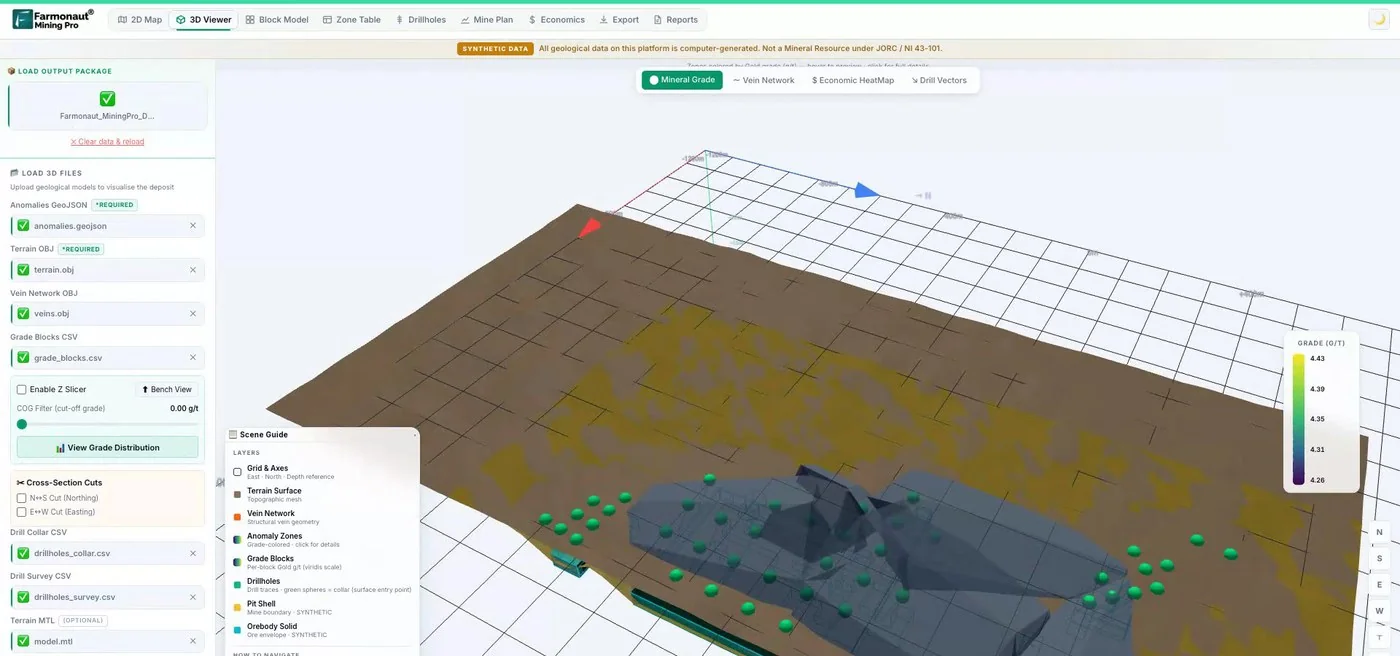
Mining Pro sample view, synthetic data
Keep reading
Sources
- Colorado Geological Survey, Metals: coloradogeologicalsurvey.org
- Colorado Geological Survey, RS-28 Gold Occurrences of Colorado: coloradogeologicalsurvey.org
- USGS, Mineral Commodity Summaries 2026: Gold: pubs.usgs.gov
- USGS, Mineral Commodity Summaries 2026: Lead: pubs.usgs.gov
- USGS, Minerals Yearbook 2022: Gold: pubs.usgs.gov
- SSR Mining, Cripple Creek & Victor site tour presentation (30 September 2026): s22.q4cdn.com
- Newmont, completion of the CC&V sale (3 March 2025): minedocs.com
- Freeport-McMoRan, Form 10-K for 2025: s22.q4cdn.com
- US EPA, California Gulch Superfund site profile: epa.gov
- US EPA, Mining Industry Profile: Gold (EPA 530-R-94-013, 1994): archive.epa.gov
- Colorado DRMS, Minerals program and mine permitting requirements: drms.colorado.gov
- Handbook of Mineralogy, galena: handbookofmineralogy.org
Discussion
Questions, corrections or field experience? Share them below. First-time comments are reviewed before they appear, and your email is never published.
No comments yet. Be the first to add a question or your experience.

 Enterprise Takreem
 Sean Mining Limited
 NTS Group (Pty) Ltd
 Mine4Africa
 Lithspo Minerals Limited
 Tintina Mining Group
 Dalgety Minerals Pty Ltd
 Vortex Minerals Pty Ltd
 Faith At Work (Pty) Ltd
 Geotech Mining Solutions plc
 Vulcan International Limited
 Kidepo Associates
 GKY Mining
 Alkimy SARL
 Double A Trading
 GemSprout Metals Limited
 Qader Group
 Ileys General Trading
 SG Gold Mining LLC
 VRV Global Pte Ltd
 Omsri International FZE
 G.I.T.T.
 Jaunita Erss Ltd
 SRK Consulting
 Berks Gold Limited










