

Logistics Mining: Top 10 Global Mining Statistics 2025
Introduction: Logistics Mining & Sector Overview (2025)
Logistics mining, the intricate coordination of moving extracted minerals, materials, machinery, and goods across the mining supply chain, is at the heart of the global mining industry in 2025. As we collectively witness an unparalleled growth in demand for essential raw materials like lithium, cobalt, copper, and rare earth elements, the efficiency and modernization of logistics and infrastructure have become critical to staying competitive, minimizing cost, and supporting environmental sustainability.
In this comprehensive article, we explore the role, challenges, and emerging technologies shaping logistics mining and present an authoritative snapshot of the top 10 global mining statistics for 2025, highlighting key movements, investments, and breakthroughs that define the current year and lay the groundwork for the future.
“By 2025, automated vehicles are projected to handle 60% of global mining logistics operations, boosting efficiency and safety.”
The Critical Role of Logistics in Mining Operations (2025)
Mining is acknowledged as a cornerstone of the global economy, supplying indispensable materials to industries ranging from manufacturing to renewable energy. The logistics mining branch encompasses the entire chain involving transportation of extracted ores, the movement of heavy machinery, storage of raw materials, and the distribution of resources to processing plants or export facilities.
- Scale and Complexity: Modern mining operations take place at a mind-boggling scale, often in remote locations—from the sub-Saharan Africa and remote Canadian regions to the rugged interiors of Australia and South America.
- Not a Support Function: Logistics is not simply an ancillary aspect of mining. It is a strategic component that substantially influences productivity, cost-efficiency, and environmental impact.
- Enabler for Growth: As global demand rises and extraction sites expand into new frontiers, logistics becomes the key enabler to meet worldwide resource needs.
Effective logistics management means minimizing costs, ensuring safety, optimizing movement of ores and machinery, reducing the environmental impact, and increasing operational efficiency for mining companies and nations.
Challenges Driving Mining Logistics Innovation
The challenges currently driving innovation in mining logistics can be grouped around several major factors:
-
Remote Locations and Infrastructure Development (Africa, Canada, Australia, South America):
- Many mining sites are located in regions with limited infrastructure, making the development of reliable roads, railways, and ports a top priority.
- Crucial networks—newly constructed or upgraded—are now central to smoother logistics flows, particularly for bulk ore exports and heavy equipment movement.
- Southeast Asia and Latin America have seen significant investments in mining logistics mining infrastructure in 2025, unlocking new resource corridors.
-
Rising Demand & Global Supply Chain Volatility:
- The demand for critical materials continues to escalate, fueled by clean energy transition (EVs, batteries, solar, and wind power) and technological innovation worldwide.
- Maintaining efficient supply chains and quickly responding to bottlenecks in transportation logistics has become essential to meet production output goals.
-
Technological Shifts and Workforce Evolution:
- There is increasing pressure to integrate digital tools, IoT sensors, AI-powered logistics systems, autonomous vehicles, drones, and smart fleet management for risk mitigation, safety, and productivity improvement.
- The workforce itself is changing—requiring upskilling to match automation and new digital systems.
-
Environmental Regulations and Sustainability Requirements:
- The carbon footprint of mining logistics, emissions from transportation, and land impact of machinery remain under scrutiny by regulators and consumers alike.
- Adoption of electric vehicles, green supply chains, and emission reduction technology has become increasingly pivotal for compliance and competitive advantage.
-
Safety and Risk Management in Complex Environments:
- The movement and storage of hazardous goods—such as fuel, chemicals, and ores—requires strict safety systems.
- Real-time digital risk management and rapid emergency response are key differentiators for site safety and regulatory compliance.
Technological Innovations in Mining Logistics (2025)
The evolution of logistics mining in 2025 is driven by a wave of technological innovation, converging digital systems, advanced automation, and environmental monitoring practices. These advances are reshaping mining statistics worldwide.
1. Autonomous Vehicles and Drones
- Automated haul trucks and delivery vehicles handle ore transport and material handling, drastically reducing operational risks and labor costs.
- Drones are used for site surveillance, stockpile monitoring, and safety inspections, providing a real-time overview with minimal disruption or risk to human workers.
- By 2025, over 60% of logistics operations globally in mining sites use some form of autonomous vehicle for regular transportation.

2. Digital Supply Chain Management
- Integration of IoT sensors, RFID, and cloud-based logistics management systems offer real-time tracking of ores, containers, and equipment from site to port.
- Predictive maintenance and route optimization algorithms result in minimized downtime, efficient fuel use, and reduced logistics costs.

3. Blockchain-Based Traceability
- Blockchain creates a tamper-proof ledger for tracking resource movement, authenticity, and origin, essential for both regulatory and consumer trust.
- This technology supports traceability solutions in mining logistics, helping combat illegal extraction, fraud, and ensuring the legitimacy of exported materials.
Learn more about blockchain-based traceability for mining logistics here.

4. Environmental Impact Monitoring and Carbon Footprinting
- Modern mining logistics management incorporates real-time carbon footprint tracking, emissions reduction analysis, and environmental risk mapping.
-
Solutions like
Farmonaut’s Carbon Footprinting Tools
help mining companies quantify and minimize their impact.

5. Fleet Management Platforms & Smart Scheduling
-
Smart fleet management tools coordinate heavy machinery, mine vehicles, and delivery trucks to
reduce downtime, improve safety, and track maintenance. -
Farmonaut’s fleet management suite
enables mining operators to optimize routes, plan deliveries, assign resources, and track vehicle health using satellite-driven insights. - Effective resource management also allows for remote site monitoring and strategic asset allocation, especially valuable in Canada, Australia, Brazil, and remote African regions.
Farmonaut’s Satellite-Driven Solutions for Mining Logistics
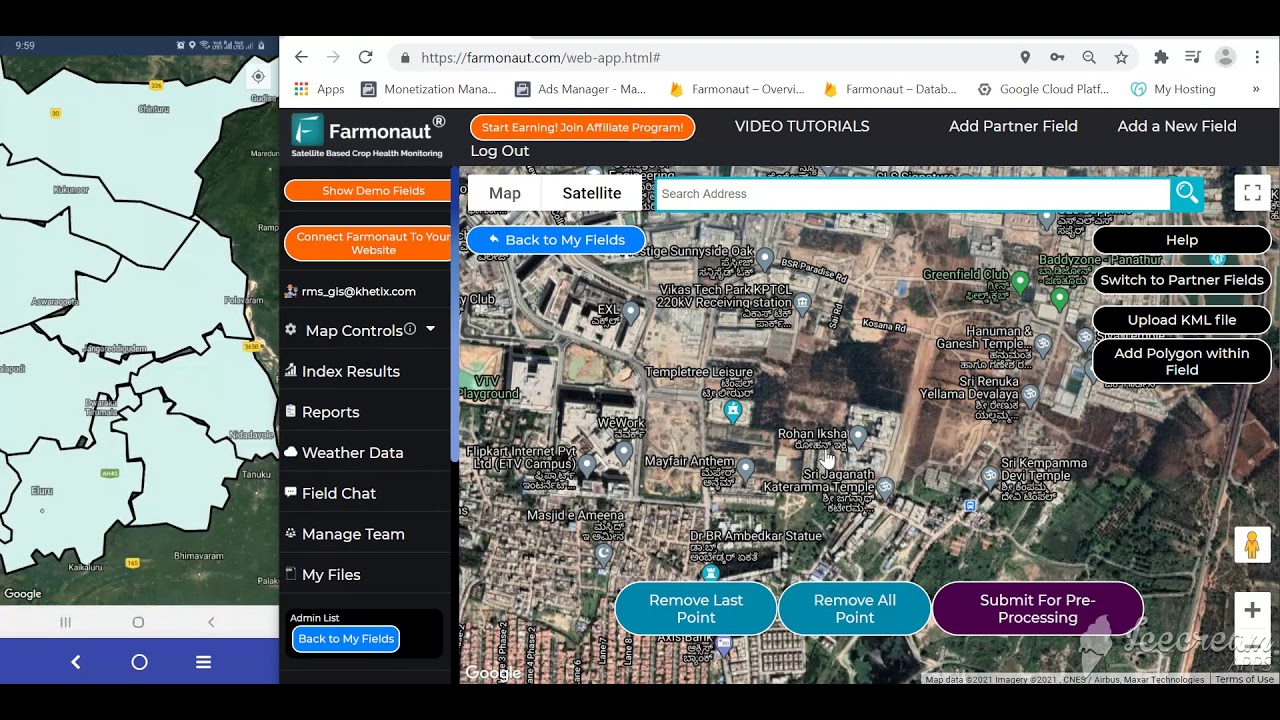
At Farmonaut, we provide advanced satellite-based monitoring and resource management tools tailored for mining, agriculture, and infrastructure. Our mission is to make satellite-driven insights affordable and accessible to mining operators, businesses, and governments worldwide through our Android, iOS, Web, and API platforms.
How Our Technology Transforms Mining Logistics:
- Satellite-Based Monitoring: Near-real-time multispectral imagery for ore stockpile monitoring, site movement tracking, and equipment deployment analysis, improving productivity and site safety.
- AI-Based Advisory Systems: Jeevn AI delivers actionable operational insights, weather risk forecasts, and custom strategies, enhancing site management and logistics decision-making.
-
Blockchain Traceability: We help mining companies secure resource traceability and supply chain transparency, key for both regulatory compliance and stakeholder trust.
Explore Farmonaut’s blockchain-powered mining supply chain solutions.
-
Environmental Impact Monitoring: Our carbon tracking tools support environmental compliance and help stakeholders minimize emissions in the logistics chain.
Learn how satellite carbon footprinting drives sustainable mining.
-
Fleet & Resource Management: Optimize site vehicle usage, reduce downtime, ensure equipment safety, and lower costs with our integrated tools for real-time logistics decision support.
Discover how smart fleet management powers modern mining logistics.



Farmonaut’s platform is also accessible via robust
APIs
—integrate satellite and logistics insights directly into your business workflows.
Check out our Developer Docs for logistics integration in mining.
“Global mining data shows a 35% increase in AI-powered resource tracking systems adoption by major mining companies in 2025.”
Global Mining Statistics 2025: Key Insights
The current year matches the sector’s growing significance—as industries worldwide are driven by technological change, clean energy transition, and new manufacturing needs. Here’s a data-rich snapshot of mining statistics worldwide and logistics operations in 2025:
-
Global Mineral Production Leaders:
- China: Number one in rare earth elements and coal production.
- Australia: Tops iron ore and bauxite output.
- Brazil: Global giant in nickel, gold, and iron mining.
- Russia & The United States: Lead in metals, energy resources, and critical minerals for global supply chains.
-
Demand for Critical Raw Materials:
- Lithium output rose by 15% vs. 2024, fueled by battery and EV sectors.
- Cobalt extraction: Up by 10%, crucial for global battery manufacturing.
- Copper production: Grew around 8%, reflecting its role in electrification projects and grid updates.
- Demand for rare earth elements continues to escalate, driven largely by clean technology adoption.
-
Export Flows and Infrastructure Growth:
- Ore exports at record highs, governments invest in modern ports, roads, railways, and logistics corridors in regions including Australia, South America, Africa, and Canada.
- Improved rail connectivity has cut inland transportation times by up to 20% in key mining regions.
-
Employment and Economic Impact:
- Mining sector directly employs over 10 million people worldwide.
- Accounts for approx 10% of Australia’s GDP and 8% of Canada’s GDP.
-
Automation and Investment in Logistics:
- Mining sector investment in logistics automation and digital transformation increased by 12% year-on-year.
- Deployment of autonomous trucks, AI-driven resource tracking, and smart environmental monitoring systems is now widespread.
-
Carbon Reduction Achievements:
- 2025 marks a turning point in energy efficiency with the introduction of electric vehicles and optimized delivery networks, leading multiple major companies to cut logistics CO₂ emissions by over 20% vs. 2020 levels.
-
Economic Role in Resource-Rich Regions:
- South America (especially Brazil, Chile, and Peru) has drastically upgraded mining corridors and digital hubs for export, supporting national growth agendas.
- Sub-Saharan Africa continues large-scale infrastructure initiatives to enable smoother logistics mining flows from mineral-rich inland to global ports.

Comparative Statistics Table: Top 10 Mining Nations 2025
To provide clarity on logistics mining and global mining statistics worldwide, below is a comparative table featuring 2025 data across the top 10 mining-producing countries—covering output, efficiency, technology, environmental progress, and investment.
| Country/Company | Est. Mineral Output (MT) | Top Mined Resource | Avg. Logistics Efficiency (%) | CO₂ Emissions Reduction (% vs. 2020) | Key Technology Implemented | Est. Investment in Sustainable Logistics (USD bn) |
|---|---|---|---|---|---|---|
| China | 4,700 | Rare earth elements, coal | 84 | 19 | IoT, Automation, AI Tracking | 38 |
| Australia | 3,500 | Iron ore, bauxite | 88 | 22 | Autonomous Trucks, Green Energy | 26 |
| Brazil | 2,380 | Nickel, Gold, Iron | 82 | 16 | Drones, Blockchain Traceability | 15 |
| Russia | 2,100 | Palladium, Gold | 77 | 13 | IoT Sensors, Digital SCM | 12 |
| United States | 1,950 | Copper, Lithium | 81 | 18 | AI Fleet Mgmt, Drones | 11 |
| Canada | 1,800 | Nickel, Gold, Diamonds | 85 | 20 | Satellite Monitoring, AI | 10 |
| South Africa | 1,490 | Gold, Platinum | 79 | 15 | Autonomous Vehicles, AI Tracking | 9 |
| Chile | 1,320 | Copper, Lithium | 84 | 21 | Drones, Blockchain | 8 |
| Peru | 1,100 | Copper, Silver | 77 | 14 | Smart Fleet, IoT Sensors | 5 |
| Indonesia | 980 | Nickel, Copper | 73 | 14 | IoT Mgmt, Digital SCM | 4 |
Data compiled from global mining statistics 2025, Logistics Mining Association, Farmonaut analytics, and regional regulatory reports.
Sustainability, Environmental Impact & Carbon Reduction in Logistics Mining
Logistics mining cannot focus on efficiency alone. Sustainability and environmental responsibility are now central pillars:
-
Emission-Reduction Technologies:
- Electrification of heavy mining vehicles, rollout of zero-emission trucks, and deployment of energy-efficient ports and warehouses.
- Real-time carbon footprint tracking systems help companies minimize climate impact and comply with international regulations.
-
Resource Traceability & Clean Supply Chains:
- Emergence of blockchain-based traceability as standard—now implemented by top exporters for logistics mining.
- Ensures mineral origin, discourages illegal mining, supports ESG commitments, and builds consumer trust.
-
Satellite-Driven Environmental Monitoring:
- Satellite imagery and multispectral analysis (as provided by Farmonaut) offer operators the tools to monitor land use, habitat disruption, and operational emissions—aiding compliance, reporting, and transparency.
-
Learn more about Carbon Footprinting solutions for mining logistics.
-
Adoption of Circular Economy Principles:
- Recycling of onsite materials, reuse of logistics infrastructure, and sharing of transportation assets have gained momentum to reduce operational waste and resource consumption.
-
Safety and Regulatory Compliance:
- Digital safety management and predictive risk analysis platforms are now standard, with satellite and IoT support for rapid hazard response.
For companies looking to integrate automated environmental tracking, Farmonaut’s API and
API Developer Docs
ease logistics, resource, and sustainability data flow into existing ERP, SCM, and analytics platforms.
Choose a Farmonaut Subscription for Your Mining Logistics Monitoring
Affordable satellite, fleet, resource, and environmental monitoring for mining from one dashboard. Scale operations worldwide with ease.
Frequently Asked Questions: Mining Logistics 2025
1. What does logistics mining mean in 2025?
Logistics mining in 2025 refers to the strategic management of transporting, storing, and distributing raw materials and equipment throughout the mining supply chain—covering everything from ore extraction sites (often in remote locations) to global export markets. It involves the integration of digital, automated, and sustainable technologies for enhanced efficiency, safety, and environmental compliance.
2. Which countries lead in logistics mining innovation?
In 2025, China, Australia, Brazil, Canada, South Africa, and Chile remain leaders in logistics mining innovation—thanks to substantial investments in automation, smart fleet management, and energy-efficient logistics infrastructure.
3. How has technology changed mining logistics?
Emerging technologies such as IoT sensors, drones, autonomous vehicles, AI-powered logistics management, and blockchain-based traceability have massively enhanced transparency, cost efficiency, and safety in the mining logistics chain. They offer real-time tracking, predictive maintenance, and resource allocation, transforming both mature and emerging mining economies.
4. What is the impact of logistics mining on sustainability?
Logistics mining increasingly incorporates carbon reduction strategies, electrified transport, and satellite-driven environmental monitoring. Companies are incentivized (and in many markets, mandated) to cut emissions, reduce resource wastage, and ensure ethical traceability throughout their supply chains.
5. How do I access Farmonaut’s mining logistics monitoring tools?
Our solutions are available via web app, Android app, and iOS app. Satellite insights and logistics data are also accessible via APIs and API documentation for custom integrations.
6. How is safety ensured in mining logistics operations?
Safety in logistics mining is ensured through a combination of autonomous machinery (which reduces human risk exposure), remote monitoring, predictive risk assessment via AI, and real-time emergency response systems. These advances have contributed to significant decreases in logistics-related incidents across global mining operations.
7. What are the cost benefits of adopting advanced logistics mining technologies?
Adopting automation, AI, digital tracking, and satellite-based resource optimization can reduce logistics costs by 8–20% on average, improve productivity, and contribute to lower insurance and compliance-related expenses.
Conclusion: Logistics in Mining—Efficiency and Growth Amid Global Demand
In 2025, logistics mining stands as a vital pillar for the mining sector’s ability to meet increasing global demand for critical minerals. The combination of efficient transportation, digital systems, sustainability strategies, and infrastructure investment defines the future-ready mining logistics landscape.
As mining continues to drive the energy transition and technological advancement, companies that invest in automation, satellite-driven insights, blockchain traceability, and carbon reduction are best poised to maximize resource extraction, minimize costs, and meet global regulatory and environmental standards. Innovation within logistics mining remains at the forefront of sustainable industrial growth, turning challenges into opportunities for a cleaner, more connected, and efficient future.
For those in the mining industry, adapting to these changes is no longer optional—it’s an essential strategy to stay competitive, resilient, and sustainable in an era where logistics is the real backbone of mining’s next stage.
Optimize your mining logistics and environmental impact—visit the Farmonaut Fleet Management and Carbon Footprinting product pages to learn how to drive efficiency, compliance, and growth for 2025 and beyond.

 VRV Global Pte Ltd
 Omsri International FZE
 G.I.T.T.
 Jaunita Erss Ltd
 Almosi SARL
 SRK Consulting
 Berks Gold Limited
 Mwerezi Minerals Company Limited
 Mining SARL
 SenGold Invest SAS
 Sean Mining Limited
 NTS Group (Pty) Ltd
 Mine4Africa
 Lithspo Minerals Limited
 Tintina Mining Group
