

Mining · Buyer guide
Machine to Separate Gold From Sand: 6 Types Compared
No single machine does it all: a sluice makes the first pass, a magnet strips magnetite, and a table, bowl or centrifuge cleans up. Gold’s specific gravity is 15.0 to 19.3 against 5.18 for magnetite (USGS), but the size of your gold decides which machine works.
Key takeaways
- Gold has a specific gravity of 15.0 to 19.3, against 5.18 for magnetite and 4.5 to 5.0 for ilmenite (USGS, 1968). Every gravity machine uses that gap.
- Fine gold decides the machine. USGS cites a study in which experienced panners recovered only about 18% of the gold in upper Snake River gravels in Wyoming, and describes Snake River gold that is 90% finer than a 230-mesh sieve (USGS, 1987).
- Dated prices from one US maker (list of 9 February 2026): hand sluice US$174.95, concentrator bowl US$89.95, shaker table US$5,995. A Falcon-type centrifuge, rated up to 2 tonnes of ore per hour, was priced at US$5,000 to 10,000 in UNEP’s 2012 guide.
- A magnet removes magnetite from dry concentrate but can carry gold away. EPA advises care, so check the catch before you discard it.
- Use no mercury, and get a licence and the landowner’s permission. A US mining claim does not include exclusive surface rights (BLM).
In this article
- Quick answer: which machine separates gold from sand
- How we chose these six machines
- Why gold and black sand separate: density, size and shape
- What fine gold does to every machine
- Six machines compared, from sluice to magnet
- Machine prices and capacities: what the sources show
- Step by step: separating black sand from gold
- What a run can recover: a quick calculator
- Test before you buy: a checklist for consultants
- Safety, mercury and permission
- Where satellite screening fits before you buy equipment
- Frequently asked questions
Quick answer: which machine separates gold from sand
No single machine does the whole job. A sluice box or power sluice makes the first pass on washed sand, a magnet pulls out the magnetite, and a shaking table, vortex bowl or centrifugal concentrator cleans what is left. (Tailings are the waste left after the gold is taken out.) The sorting works because gold is far denser than black sand: the USGS gives gold a specific gravity of 15.0 to 19.3, magnetite 5.18 and ilmenite 4.5 to 5.0 (USGS Professional Paper 594-F, 1968). Specific gravity (SG) is density relative to water. What decides the machine is the size and shape of your gold, because fine flakes slip through most equipment.
This guide is written for consultants and operators who must pick equipment for a placer or beach-sand project. The table sums up six machine types. The sections after it give the evidence, dated prices and a test plan. Where a public source gives no capacity or price, we say so instead of guessing.
| Machine | Best for | Sourced limit | Price evidence |
|---|---|---|---|
| Sluice box / power sluice | First pass on washed sand or gravel | Concentrate is low grade and needs cleaning; most gold lands in the first metre of a simple sluice | US$174.95 hand sluice; US$3,099 power sluice (Keene list, 9 Feb 2026) |
| Spiral wheel / spiral chute | Cleaning concentrate (wheel); upgrading heavy-mineral sand (chute) | Wheel: kilograms down to a few hundred grams per batch. Chute: about 45 micrometres to 1 mm | No dated list price found |
| Vortex (blue) bowl | Final cleaning of fine gold | 30 to 50 cm bowl; too much water flow washes gold out | US$89.95 (Keene list, 9 Feb 2026) |
| Shaking table | Upgrading concentrate to high grade | Expensive and needs trained operators | US$5,995 table plus US$493 base (Keene list, 9 Feb 2026) |
| Centrifugal concentrator | Fine gold at higher throughput | Up to 2 tonnes of ore per hour for a Falcon-type unit; 0.5 to 2 hour cycles | US$5,000 to 10,000 (UNEP guide, 2012) |
| Magnetic separation | Stripping magnetite from dry concentrate | Removes magnetic minerals only; can carry gold with it | US$12.95 to 20.95 for a hand magnet (Keene list, 9 Feb 2026) |
How we chose these six machines
We compared machine types, not brands. A type made the list if a government, UN or peer-reviewed source describes it for gold concentration without mercury, if it can handle black sand (the dark, heavy residue left in the pan), and if we could find a dated price or a stated limit. Machines described only in seller marketing were not included; where a seller page was the only source, as for Metso’s spiral limits, we say so. Spiral wheel and spiral chute share one entry, so you may count seven machines.
The evidence base is the US EPA guide to small-scale gold mining without mercury, the UNEP practical guide of 2012, two USGS reports, a 2023 peer-reviewed review in the journal Ambio, a US manufacturer’s price list dated 9 February 2026 (the Keene master price list of 9 February 2026) and a spiral maker’s technical page updated August 2026. We did not test machines ourselves, so this page says what sources report, not what we measured. Prices are list prices from one maker, Keene Engineering of Chatsworth, California. They exclude freight, pumps and import duty, and the maker’s online store showed different prices in October 2026 (for example US$6,495 for the ST1 table with magnetic separator), so get a current quote. Other brands, and tables made overseas, sell at different prices.
The sections follow a normal flowsheet, from bulk recovery to fine cleaning. They are not a quality ranking, because the best machine depends on your gold.
Why gold and black sand separate: density, size and shape
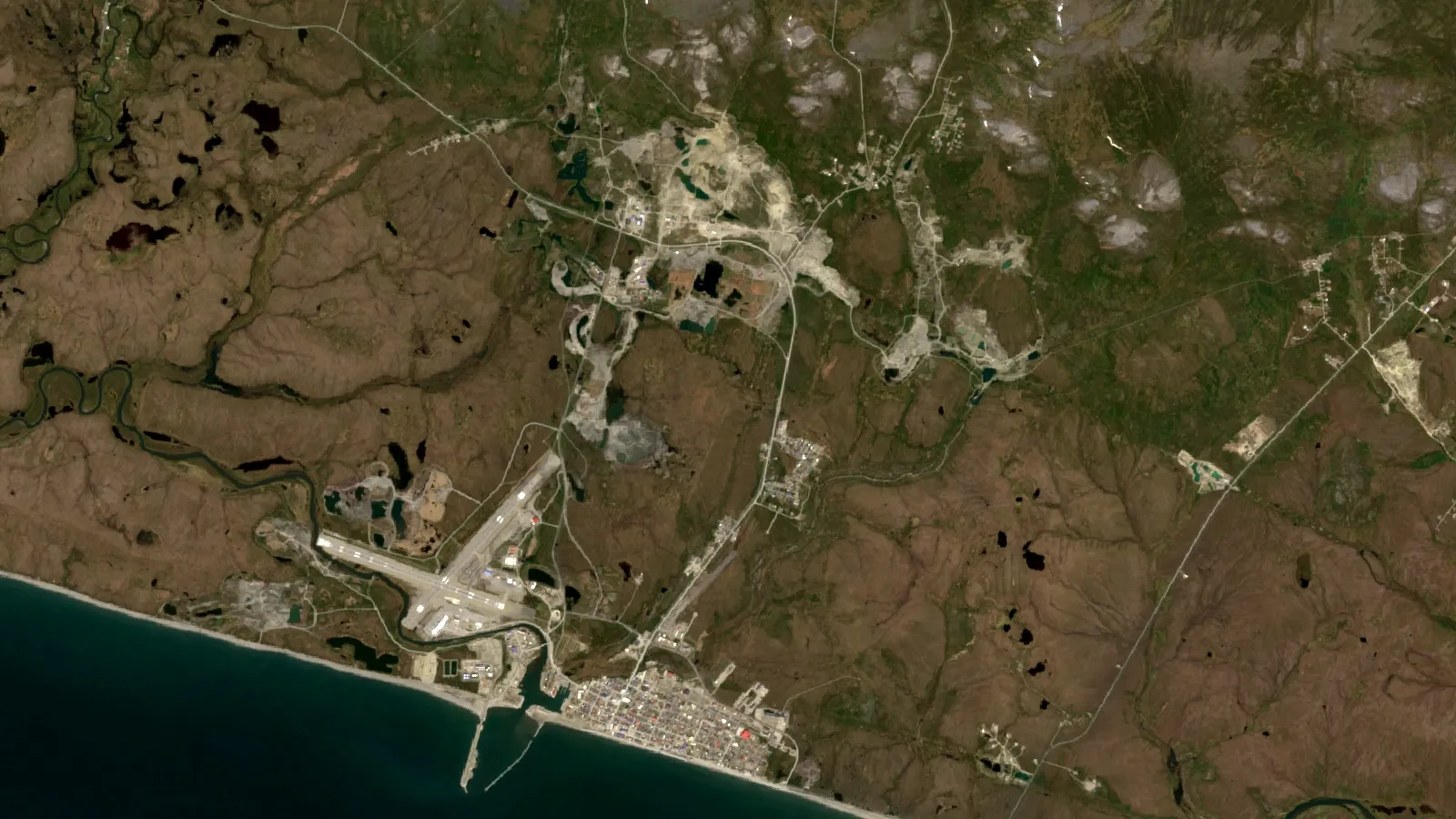
Black sand is the dark heavy-mineral residue that collects in the pan and sluice with the gold. In the USGS record for the Nome beach placers in Alaska, the ore minerals listed with gold are arsenopyrite, hematite, ilmenite, magnetite, pyrite and scheelite, and garnet is the main gangue (USGS Alaska Resource Data File). Gangue is the worthless rock that comes with the ore. The same record says that in the Nome beach deposits the gold was mostly fine grained and was commonly saved by amalgamation, which is the old mercury method.
Magnetite is magnetic and gold is not. That gives two handles: density for gravity machines and magnetism for the magnet step. The chart below plots the USGS densities. USGS notes that the value for most of these minerals depends on composition, which is why gold shows a range.
Chart
Gold is about three to four times denser than black sand
Specific gravity (density relative to water) of common placer minerals
▶ Follows gold from rock to ring, including how it is crushed, concentrated and refined. · 5:27
What fine gold does to every machine
Size and shape matter as much as density. USGS describes the upper Snake River sediments in Idaho and Wyoming, where 90 percent of the gold passes a 230-mesh sieve (openings of about 63 micrometres). A 1987 USGS report cites an 1889 account of panning this gold: the black sand is taken out with a magnet, then the fine gold floats on the water film while the grey sand sinks. The same report cites a 1967 USGS study in which experienced panners recovered only about 18 percent of the gold in gravels of the upper Snake River in Wyoming (USGS Open-File Report 87-0364).
Shape is part of the reason. USGS calculates that a gold flake whose diameter is 30 times its thickness settles at only 12.5 percent of the speed of a gold sphere of the same diameter. A flake 10 times as wide as it is thick settles at about 23 percent. Thin flakes therefore stay in suspension and leave the machine with the tailings.
The chart compares weight, not settling speed, but it shows why grain size and density interact. It gives the sphere diameter that weighs the same as a 1 mm quartz sphere, using the USGS factors. A gold grain carries the same weight in about half the width. For settling speed, USGS finds that gold spheres from 0.0003 to 0.8 mm settle like quartz spheres from 0.001 to 8.0 mm, so a tiny gold grain can travel with a much larger sand grain. That is why screening to a narrow size range before the machine helps.
Get the size of your gold early. Sieve a sample and count the grains under a microscope, as USGS did, or send heavy concentrate for assay. Every machine below has a size window, and your answer to this question rules some of them out.
Chart
Gold weighs the same as sand in about half the width
Diameter of a sphere with the same weight as a 1 mm quartz sphere, as % of 1 mm
Six machines compared, from sluice to magnet
1. Sluice box and power sluice
Best for: a first pass over washed sand or gravel when you need volume.
A sluice washes material down an angled channel, usually inclined at 5 to 15 degrees, where gold sinks and is held by carpet or riffles (US EPA). EPA says sluices are good at concentrating large amounts of material quickly but often do not give a high-grade concentrate, so the output usually goes to a second machine or a pan. The UNEP guide adds that most gold is caught in the first metre of a simple sluice, and that surges from bucket feeding can lift gold off the carpet. A small reservoir, such as a barrel, gives a steady flow (UNEP practical guide, 2012). A zigzag layout, or a primary sluice followed by a scavenger sluice (a second sluice that re-treats the first one’s tailings), breaks the flow speed and keeps more gold.
- Pros: low cost, high volume, simple to run and repair.
- Watch-outs: a low-grade concentrate, a steady water supply, and losses of fine flakes.
- Price evidence: the Keene list of 9 February 2026 shows a high-production hand sluice at US$174.95, a larger sluice box at US$495.95 and a power sluice with a 6.5 hp Honda engine at US$3,099.
- Capacity: we found no independent throughput figure. Ask the seller for a rated feed and water rate and test it on your material.
2. Spiral wheel and spiral chute
Best for: cleaning a sluice concentrate (wheel); upgrading heavy-mineral sand in bulk (chute).
The name covers two different machines. The spiral wheel, also called a spiral pan, is a tilted, motor-driven pan with spiral grooves. Water showers the pan, light grains wash back down and heavy grains, including gold, climb the grooves to a hole in the centre. EPA calls it relatively easy to operate but a larger capital outlay than a pan or sluice. UNEP says it suits concentrates from many kilograms down to a few hundred grams and its concentrate may suit direct smelting.
The spiral chute is a stationary helical trough that runs continuously. The maker Metso states a coarse limit of about 1 mm and a fine limit of about 45 micrometres. It recommends removing slimes, the very fine clay-sized material, if they exceed 10 percent by weight, and notes that a spiral normally gives an upgrading ratio of about 3 to 1, so a multi-pass flowsheet (the planned sequence of machines) is common. A density difference of at least 1 between light and heavy grains is needed (Metso spiral concentrator page, updated August 2026). Metso is a manufacturer, so treat the ratio as a design guide, not a recovery guarantee for your gold.
- Pros: the wheel recovers fine gold from small batches; the chute takes a continuous feed.
- Watch-outs: the wheel is a batch machine; the chute loses grains outside its size window and gold finer than about 45 micrometres.
- Price evidence: we found no dated list price for a complete spiral wheel or chute, so none is given.
3. Vortex bowl (blue bowl)
Best for: the last cleaning step on fine gold, in small batches.
A vortex bowl is a 30 to 50 cm bowl with water entering at an angle. The spinning water lifts light grains and drains them through a raised hole in the centre while heavy grains, including gold, stay in the bottom. UNEP calls vortexes very cheap and simple and good at catching fine gold. EPA warns that too much inflow carries gold out of the bowl, so the operator must watch the flow.
- Pros: low cost, simple, strong on fine gold.
- Watch-outs: small batches and a clean water supply; flow control decides the result.
- Price evidence: the Keene list shows a gold concentrator bowl at US$89.95 (9 February 2026).
4. Shaking table
Best for: upgrading a concentrate to a high-grade product, in a plant run by trained operators.
A shaking table is a slightly tilted deck with ridges. Feed and water enter along the high edge, a motor shakes the deck and the grains spread out by density toward the lower corner. EPA calls tables very effective, able to handle sizeable batches and produce high-grade concentrates, but relatively expensive and dependent on operator skill. UNEP says tables can make concentrates above 50 percent gold, and adds that the cost and training needs mean they are likely to be reached mainly by organised small-scale miners with capital.
The USGS shows that a table can also catch very fine gold when run slowly on small samples. It used a laboratory table at 240 oscillations per minute with a 1.25 cm stroke and a gold pan on the deck to separate fine gold from up to 25 grams of sample in under 15 minutes. The same report lists limits: the method does not work on grains larger than 500 micrometres, and it handles only a small quantity at a time (USGS Open-File Report 87-0364). That is a laboratory technique, not a production rate.
- Pros: high-grade concentrate, good at separating gold from black sand grains of similar size.
- Watch-outs: cost, skill, a steady water and feed rate, and feed that is sized.
- Price evidence: the Keene ST1 shaker table is listed at US$5,995, with a base at US$493 and a pump kit at US$299.95 (9 February 2026).
5. Centrifugal concentrator
Best for: fine gold at a higher throughput than a vortex or wheel, where there is power and water.
A centrifugal concentrator spins a ridged bowl so the feed is pressed outward with 50 to 200 times the force of gravity. Heavy grains are trapped between the ridges and light grains leave as tailings. Feed arrives as a slurry of 60 to 75 percent water. Small units run in cycles of 0.5 to 2 hours, after which the operator cleans the concentrate out of the bowl. UNEP says a Falcon Icon is designed to process up to 2 tonnes of ore per hour and that models of this type range from 5 to 10 thousand US dollars, while a locally built unit in Zimbabwe was about 1 to 2 thousand dollars but not an efficient design. The guide is dated 2012 and does not state a price year, so treat the prices as old and get a current quote. EPA says centrifuges can be more effective than other gravity methods, but they are generally more expensive and need tuning of feed size, feed rate, speed and cycle time (US EPA).
- Pros: the highest throughput in this guide with a stated figure, and a good fit for fine gold.
- Watch-outs: capital cost, power and water supply, uniform feed size and a concentrate bed that can pack down.
- Price evidence: US$5,000 to 10,000 for a Falcon-type unit in UNEP’s 2012 guide (price year not stated); no current list price found.
6. Magnetic separation: the black sand step
Best for: removing magnetite from a dry concentrate before the final clean-up.
EPA describes the simplest method: dry the concentrate in a pan, hold a hand magnet under the pan and lift the magnetic grains away. Covering the magnet with a sheet of paper lets you drop the magnetic grains in one move, and EPA warns that care is needed to avoid losing gold. UNEP also shows magnets used to make a sluice liner that holds a bed of magnetite for fine gold to settle into. The USGS laboratory method also uses a hand magnet to take the magnetic fraction off the heavy fraction. Magnetite is magnetic, and gold is not, so the magnetic step can cut the bulk that the next machine has to handle.
- Pros: very low cost, no water, no chemicals.
- Watch-outs: it only removes magnetic minerals; fine gold can ride along with the magnetic grains, so check the magnet’s catch before you discard it.
- Price evidence: a gold magnet is US$12.95 and a large one US$20.95 on the Keene list of 9 February 2026.
What about flotation and electrostatic machines?
They are not the first choice for loose gold in black sand. EPA says flotation works best on complex ores that are hard to treat by gravity, usually needs substantial capital, and calls for care with frothing agents and waste. Our guides to flotation in copper beneficiation and electrostatic separation cover those methods, and our page on separating gold from hard-rock ore covers the crushed-rock case.
For a closer look at a related question, see our guide: Best Strip Mining Technique: 5 Methods Compared.
Machine prices and capacities: what the sources show
US placer mining is a working industry. USGS reports that US gold comes from lode mines, several large placer mines in Alaska and numerous smaller placer mines, mostly in Alaska and the western states, and that Alaska produced about 22 percent of US gold in 2025 (estimate) (USGS Mineral Commodity Summaries 2026). The chart shows one maker’s list prices for items that map to the machines above.
Chart
List prices run from pocket money to a plant purchase
US dollars, rounded to the nearest dollar; one US maker’s list dated 9 February 2026
Read the bars with care. They are US dollars from one list dated 9 February 2026. The power sluice price is for the sluice with its engine and excludes the pump, hose and water supply. The shaker table price excludes the base and pump kit. A hand magnet and a pan cost almost nothing next to a table, but they do different jobs. A cheap machine is not a cheaper way to the same result.
The only throughput figure we could source is UNEP’s 2 tonnes of ore per hour for a Falcon-type centrifuge. For sluices, tables and spirals, capacity depends on feed size, water rate and gold size, and public sources give no single number. Keane and co-authors note in their 2023 review that most gravity-based technologies need a clean, consistent water supply and most need electricity, and that some are beyond the means of poorly capitalised operations (Ambio, 2023). Add the cost of water, power and labour to any machine price.
Step by step: separating black sand from gold
This sequence follows the EPA and UNEP guidance. It also applies to a beach or river sand project. For more field detail, see our guides on black sand gold extraction, removing gold from black sand and black sand separators.
- Screen the feed. EPA says concentration works best when the grain size is fairly even, and that screens or sieves give that. Remove oversize rock and roots first.
- Run it over a sluice. Set the slope between 5 and 15 degrees and keep the water flow steady. Use a primary and a scavenger sluice or a zigzag layout if you can.
- Clean the carpets into a bucket. Wash the carpet or riffle catch in water. This concentrate is still mostly black sand.
- Take a second pass. Use a spiral wheel, vortex bowl, shaking table or centrifugal concentrator, depending on the batch size and gold size.
- Dry the concentrate and remove the magnetite. Use a magnet under the pan, covered with paper, as EPA describes. Check the magnetic catch for gold before you discard it.
- Pan out the last of the gold. A pan is the finishing tool, not the main machine, and the 18 percent USGS figure above shows why.
- Melt it without mercury. UNEP describes direct smelting for small masses of high-grade concentrate, usually no more than about 100 g at a time.
- Sample the tailings. Count grains or assay a tailings sample. It is the only way to know what the machine lost.
Our walk-through of separating gold from sand with pans and simple tools and the gold panning guide for beginners cover the manual end of this sequence.
What a run can recover: a quick calculator
Use the calculator after you have a head grade (the gold content of the feed) from sampling. Enter the feed rate your machine can handle, the hours you run it, the gold grade of the feed and the recovery you expect. The recovery default of 70 percent is an example, not a benchmark. The USGS panning figure of about 18 percent shows how far recovery can fall when the gold is fine. Use your own test results, and use today’s gold price.
Calculator
How much gold could one run recover?
Enter your own feed rate, run time, gold grade and recovery.
- Recovered gold in troy ounces: 1.80 oz
- Value at your price (US dollars): 5,600 US$
- Concentrate to clean: 3,200 kg
- Gold left in the tailings: 24 g
Example values only, not a benchmark or forecast. The gold price is an input in US dollars per gram (US$100/g is about US$3,110 per troy ounce); use today’s price. 31.1035 grams per troy ounce is the standard conversion. Grade is grams of gold per tonne of feed; convert a placer grade in grams per cubic metre using your bulk density. Machine, labour, water and fee costs are not included.
Test before you buy: a checklist for consultants
Keane and co-authors report that equipment that avoids mercury is often deployed as a one-size-fits-all circuit, with mixed results, because the ore mineralogy is poorly understood. They also say gravity concentration is limited by mineralogy, gold liberation (how much gold is freed from the rock) and gold particle size (Ambio, 2023). A short test programme before purchase avoids that.
- Gold size distribution: sieve a sample and count grains by size class. This tells you whether a sluice, wheel, bowl or centrifuge suits.
- Slimes content: if clay-sized material exceeds 10 percent by weight, plan desliming (washing out the clay-sized fines) before a spiral chute (Metso).
- Magnetic fraction: measure what share of the concentrate is magnetic, and check the magnetic catch for gold.
- Tailings assay: USGS asked contractors to return their tailings so it could judge their recovery by grain counts. Do the same with any seller’s demonstration.
- Water and power: confirm a steady water supply and electricity for tables and centrifuges.
- Quote basis: ask each seller for the rated feed rate, the feed size window and the engine, pump and freight, so quotes compare like with like.
Safety, mercury and permission
Do not use mercury. EPA states that heating a mercury-gold amalgam is dangerous and can cause serious exposure, that mercury use may be illegal or restricted in some places, and that gold can be recovered safely and economically without it. The Minamata Convention on Mercury calls on countries to reduce and, where feasible, end mercury use in small-scale gold mining. Every machine in this guide works without it.
Get a licence and the landowner’s permission first. A US mining claim gives a right of possession of the mineral, but the BLM states that it does not include exclusive surface rights, and a placer claim is limited to 20 acres per locator (US Bureau of Land Management). Outside the US, ask the mining regulator for the licence and the surface owner for access. Contain tailings so fine sediment does not reach streams, and keep dust down when you handle dry material.
Where satellite screening fits before you buy equipment
Machine choice depends on where the gold is and how fine it is, and only sampling tells you the second part. Satellite screening can narrow where to sample first. It does not measure gold size or recovery. Farmonaut’s satellite-based mineral detection takes your licence boundary as a KML, KMZ or polygon and returns ranked exploration targets, typically in 5 to 20 business days. You can map your mining site online or request a quote. For help locating placer ground, see our guide to finding gold deposits.
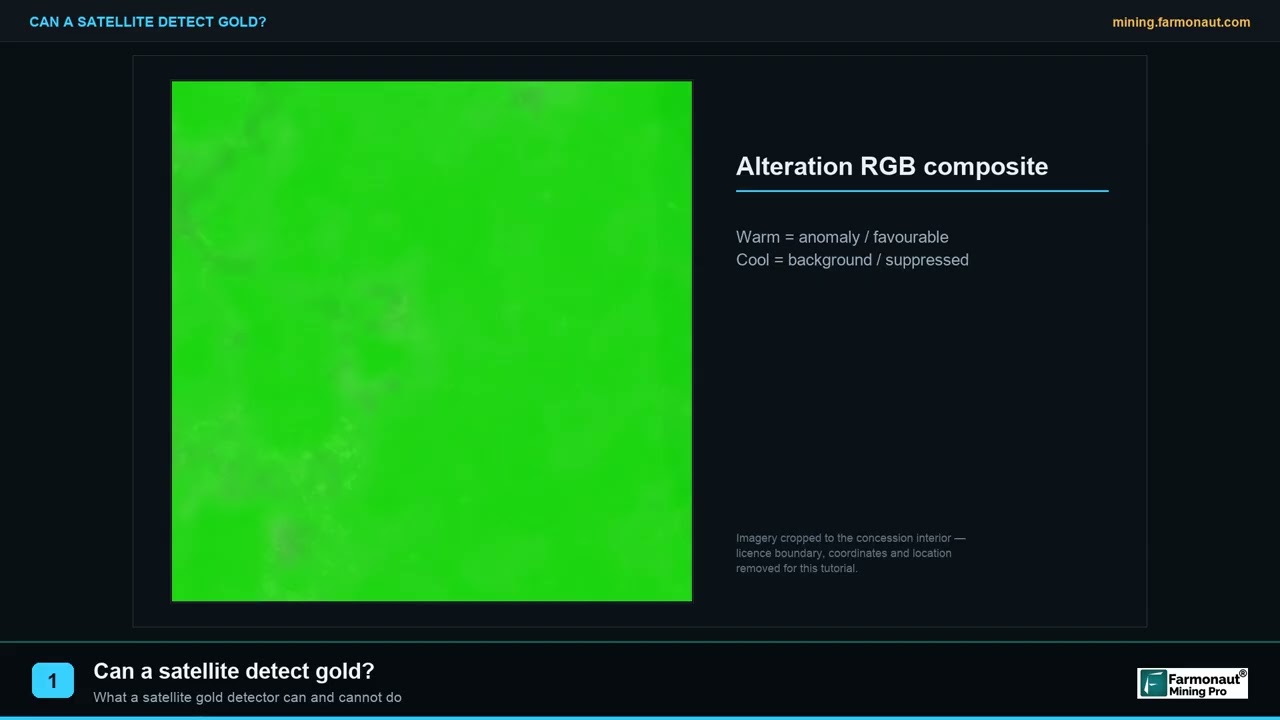
▶ Explains that satellites cannot see gold but can map the alteration halo around a gold system, useful before buying equipment. · 2:00
Frequently asked questions
What is the best machine to separate gold from sand?
There is no single best machine. A sluice is the usual first pass, a shaking table or centrifugal concentrator cleans the concentrate, and a magnet removes magnetite. The right choice depends on how fine your gold is and how much material you must process.
How do you separate black sand from gold?
Concentrate with a sluice, dry the concentrate, remove the magnetite with a magnet under the pan, then clean the remainder with a spiral wheel, vortex bowl or shaking table. Pan out the last of the gold at the end. Check the magnet’s catch for gold before you throw it away.
Does a magnet separate gold from black sand?
A magnet separates the magnetic part, mainly magnetite. Gold is not magnetic and stays behind. Some gold can be carried off with the magnetic grains, so EPA advises care, and a sheet of paper over the magnet helps you drop the catch in one move.
Can a spiral wheel recover fine gold?
UNEP describes it as a cleaning step for concentrates from many kilograms down to a few hundred grams. It is a batch machine, not a bulk recovery plant. A spiral chute is a different machine, and Metso gives it a fine limit of about 45 micrometres.
How much does a gold shaking table cost?
One US maker lists a shaker table at US$5,995, with a base at US$493 and a pump kit at US$299.95 (list of 9 February 2026). Other makers, and tables made overseas, sell at other prices, and freight and duty come on top. Ask for a delivered quote.
Is a centrifugal concentrator worth it for a small operation?
It can be, if you have power, water and capital. UNEP’s 2012 guide gave US$5,000 to 10,000 for a Falcon-type unit rated at up to 2 tonnes of ore per hour. Treat that as a pointer, ask for a current quote and test your own ore first.
Why does fine gold float off in the pan or sluice?
Thin flakes settle very slowly. USGS calculates that a flake 30 times as wide as it is thick settles at only 12.5 percent of the speed of a gold sphere of the same width. Wetting the sample and slowing the water help, and a vortex bowl or table helps more.
How much gold does a sluice recover?
There is no single figure. Recovery depends on gold size, slope, water rate and how steadily you feed it. UNEP notes that most gold stays in the first metre of a simple sluice, and a tailings sample is the only way to measure your own loss.
Do I need mercury to separate gold from sand?
No. EPA lists panning, sluicing, shaking tables, spirals, vortex bowls, centrifuges and magnets as ways to concentrate gold without mercury, and direct smelting as a way to melt the concentrate.
Do I need a licence or permission to run a machine?
Yes. You need the licence or claim rights that apply in your country and the permission of the surface owner. In the US, the BLM says a mining claim does not include exclusive surface rights, so check who owns the ground and the local rules.
What size gold can a spiral concentrator catch?
Metso gives a working window of roughly 45 micrometres to 1 mm for its spiral chutes, and recommends removing slimes if they exceed 10 percent by weight. Gold finer than that window is outside Metso’s stated range. EPA says a vortex bowl is good at capturing fine gold.
What is black sand made of?
It is a mix of heavy minerals. In the USGS record for the Nome beach placers, the ore minerals listed with gold include magnetite, ilmenite and hematite, with garnet as the main gangue. The mix changes from one deposit to the next.
This page is for information only. It is not legal advice. Confirm the rules with the regulator. Prices are dated list prices from one maker and change; get a current quote. Do not use mercury, and get a licence and the landowner’s permission before you prospect or process material.
Farmonaut mining
Map your site before you buy a machine
Send your licence boundary and get ranked satellite exploration targets, so you know where to sample before you choose equipment.
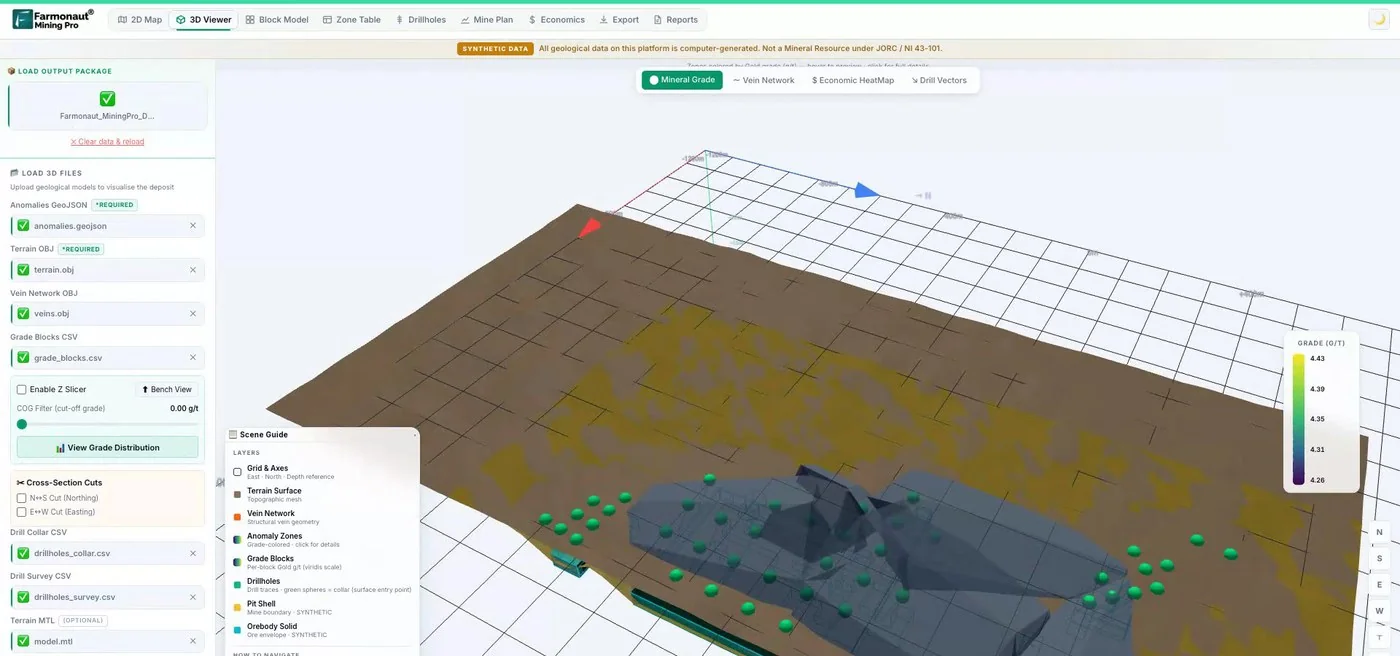
Mining Pro sample view, synthetic data
Keep reading
Sources
- USGS, Professional Paper 594-F: Hydraulic equivalence of grains of quartz and heavier minerals (Tourtelot, 1968): pubs.usgs.gov
- USGS, Open-File Report 87-0364: A mechanical panning technique for separation of fine-grained gold (English and others, 1987): pubs.usgs.gov
- US EPA, Artisanal and small-scale gold mining without mercury: epa.gov
- UNEP, Reducing mercury use in artisanal and small-scale gold mining: a practical guide (2012), hosted by UNIDO: unido.org
- Keene Engineering Company, Master Price List (9 February 2026): keeneeng.com
- Metso, Spiral concentrator (page updated August 2026): metso.com
- US Bureau of Land Management, Mining claims: blm.gov
- USGS, Alaska Resource Data File: Nome Beach and Abrasion Deposits (NM252): mrdata.usgs.gov
- USGS, Mineral Commodity Summaries 2026: Gold: pubs.usgs.gov
- Keane and others, Mercury and artisanal and small-scale gold mining, Ambio (2023): pmc.ncbi.nlm.nih.gov
Discussion
Questions, corrections or field experience? Share them below. First-time comments are reviewed before they appear, and your email is never published.
No comments yet. Be the first to add a question or your experience.

 Almosi SARL
 SRK Consulting
 Berks Gold Limited
 Mwerezi Minerals Company Limited
 Mining SARL
 SenGold Invest SAS
 Sean Mining Limited
 NTS Group (Pty) Ltd
 Mine4Africa
 Lithspo Minerals Limited
 Tintina Mining Group
 Dalgety Minerals Pty Ltd
 Vortex Minerals Pty Ltd
 Faith At Work (Pty) Ltd
 Geotech Mining Solutions plc
