

Industrial minerals · Producer guide
Where Is Mica Mined? Top Countries, US and Australia
China, Madagascar, Finland and the United States lead world mica output (USGS, 2026). In the US, mica comes from Georgia and North Carolina; Western Australia has only historic workings. Charts, prices and a landed-cost calculator follow.
Key takeaways
- World scrap and flake mica output was an estimated 350,000 tonnes in 2025, down from 376,000 in 2024 (USGS, 2026).
- China (85,000 t), Madagascar (70,000 t), Finland (57,000 t) and the US (26,000 t) made about two-thirds of it (USGS, 2026).
- US mica was mined only in Georgia and North Carolina in 2025; net import reliance was 100% for sheet and 34% for scrap and flake (USGS, 2026).
- Western Australia’s mica record is historic, such as Yinnietharra muscovite known since 1913 (Geoscience Australia).
- US scrap and flake mica averaged $130 a tonne in 2025; dry-ground $320 and wet-ground $350 (USGS, 2026).
In this article
- Where is mica mined? The short answer
- Types of mica and what each is used for
- Is mica a major or minor mineral?
- Mica mining in the United States
- Is there mica mining in Western Australia?
- Top mica-producing countries compared
- How mica is mined and processed
- Mica prices and a buyer cost calculator
- Supply-chain and labour risks buyers check
- Screening a mica licence area from space
- Frequently asked questions
Where is mica mined? The short answer
Mica is mined mainly in China, Madagascar, Finland and the United States, which together made about two-thirds of the world’s scrap and flake mica in 2025 (238,000 of 350,000 tonnes). The US Geological Survey (USGS) Mineral Commodity Summaries 2026 estimates world scrap and flake output at 350,000 tonnes for 2025, down from 376,000 tonnes in 2024. In the United States, mica comes from Georgia and North Carolina only. In Western Australia the public record is historical: old muscovite workings, not a current mine.
Chart
World scrap and flake mica mine output, 2025
Thousand tonnes, estimated
This guide covers the types of mica, whether mica counts as a major or minor mineral, the US and Western Australian picture, the countries that lead output, what mica costs, and the supply-chain risks a buyer should check. Every figure carries its source and year. Scrap and flake mica is the low-cost ground material used in fillers and paint; sheet mica is the rare, hand-split material used in electrical parts. We explain both below.
Types of mica and what each is used for
The mica group has dozens of layered silicate minerals (34 in the 2014 USGS note, 37 in the NSW profile), but only a few matter commercially. The USGS names biotite, muscovite and phlogopite as the principal commercial micas in its Mineral Resource of the Month: Mica note. A New South Wales government mica profile adds lepidolite and zinnwaldite, both lithium-bearing micas, to its list of mica types.
| Mica | Colour and host rock | Main uses |
|---|---|---|
| Muscovite | Pale, silvery. Sheet mica is recovered only from pegmatite (a coarse igneous rock). | Capacitors and other electrical parts that must work at high temperature or frequency; ground mica filler |
| Phlogopite | Brown to amber, magnesium-rich. Sheet mica comes from pyroxenite (a dark igneous rock). | Plastic composites for cars, where it adds stiffness and heat resistance; filler |
| Biotite | Dark brown to black, iron-rich. Common in granite and schist. | Mostly ground, as a soil additive |
| Zinnwaldite | Lithium-iron mica. | Listed with lepidolite as a lithium-bearing mica in the NSW profile |
| Lepidolite | Lilac to pink, lithium-bearing. | Mined mainly for lithium rather than for its mica properties |
Commercial mica also splits by form. Sheet mica is cut from large crystals. Scrap mica is material below sheet specification because of size, colour or quality, and most of it is ground. The USGS describes two ground grades. Dry-ground mica has rough flakes and goes into drywall joint compound, roofing coatings and insulation. Wet-ground mica keeps its sheen and is used in pearlescent automotive paint and cosmetics.
Is mica a major or minor mineral?
Both answers are right, depending on the question. Geologically, mica is everywhere: the USGS says scrap mica resources occur in clay deposits, granite, pegmatite and schist, and are more than enough for expected demand. Economically, it is a small industrial mineral. US scrap mica output in 2025 was about 26,000 tonnes worth $3.8 million (USGS, 2026), a rounding error next to metals such as copper or gold.
The mica mineral uses guide on this site covers the chemistry and uses in more detail. Here the question that matters is supply: scrap is abundant, but sheet mica is not. The USGS reports that world sheet resources have not been formally evaluated because the material occurs sporadically.
Mica mining in the United States
The USGS says mica was mined in Georgia and North Carolina in 2025. Scrap mica is recovered mainly from mica and sericite schist (sericite is a fine-grained white mica) and as a byproduct of feldspar, kaolin and industrial sand. Eight companies made about 59,000 tonnes of ground mica worth about $20 million from domestic and imported material. The main end uses were joint compound, oil-well drilling additives, paint, roofing and rubber.
Chart
US scrap and flake mica: production, imports and use
Thousand tonnes a year
North Carolina: Spruce Pine and feldspar byproduct mica
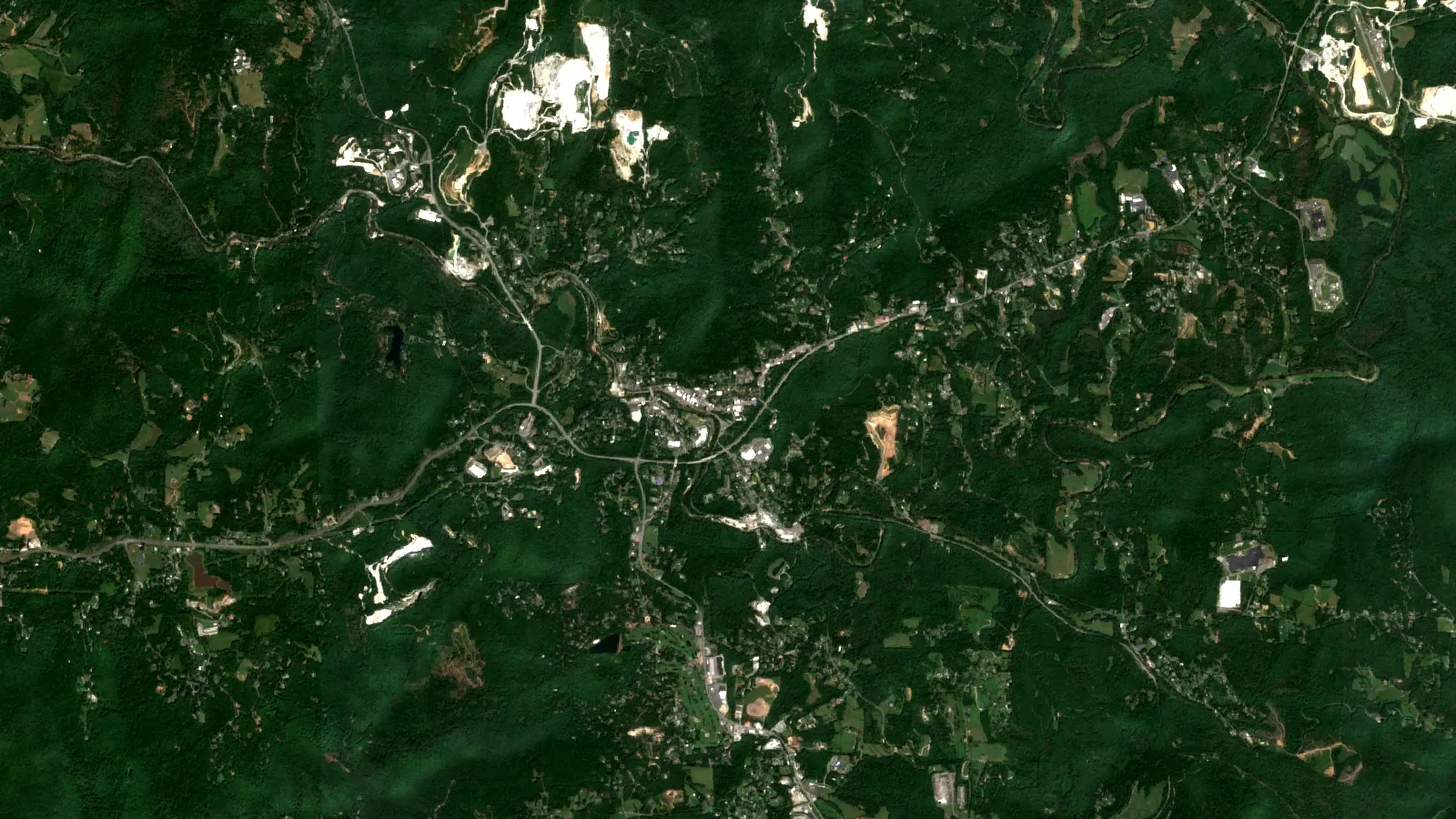
North Carolina’s mica now comes largely as a byproduct. In its 2026 feldspar summary the USGS counts eight US feldspar mines and plants, four of them in North Carolina, and notes that processors also recover mica and silica sand. At Spruce Pine, Sibelco listed (page viewed 16 October 2026) a site that mines and separates minerals for high-purity quartz with feldspar and mica as byproducts.
Sheet mica: almost all imported
The US makes almost no sheet mica. The USGS says a minor amount has come from feldspar mining in North Carolina, that domestic resources are very small, and that mining them by hand from pegmatites costs too much. Net import reliance for sheet mica was 100% in each year from 2021 to 2025e, with imports of 5,100 tonnes in 2025e, mostly from China (73% of 2021-24 sheet imports) and smaller shares from Vietnam and Brazil. For scrap mica, net import reliance was 34% in 2025e, and Canada supplied 35% of imports in 2021-24.
The USGS also ties scrap demand to the oil patch: it notes that the US drilling rig count fell from 582 to 549 between early and late 2025, which likely meant less mica went into drilling mud.
Is there mica mining in Western Australia?
Western Australia has historic mica workings, documented in Geoscience Australia records dated 2025 in its catalogue and describing 1913-1942 activity. Geoscience Australia holds an old report on muscovite at Yinnietharra Station in the Gascoyne region, where commercial-sized muscovite was known from 1913 and a syndicate began operating in 1926 before activity lapsed the next year. It also holds descriptions of mica deposits at Yinnietharra and Bidgemia and a record on mica deposits near Northampton. These are historical inspections, not production data.
Australia has no separate line in the USGS table, so it sits inside “other countries”. The New South Wales profile says Australia’s best-known muscovite source is a shear zone in the Williamstown kaolin-sillimanite deposit near Adelaide in South Australia, at about 1,000 tonnes a year, and that Australia has produced no phlogopite. If you hold or plan a licence in Western Australia, check the state’s MINEDEX records and mineral titles before assuming a mica target.
What about Washington state?
Searches for “mica WA” often mean Washington state. The USGS names only Georgia and North Carolina as mica-mining states in 2025, so Washington is not a producing state in that source.
Top mica-producing countries compared
Only countries with USGS figures are ranked here, using 2025 estimated scrap and flake mine output in thousand tonnes. “How we chose”: we took the USGS 2026 world table and listed every country with a stated 2025 figure of 14,000 tonnes or more. Smaller producers named by the USGS, plus its “other countries” line, are grouped as “all others”. Sheet mica has too little reliable data to rank.
Chart
Change in scrap and flake output, 2024 to 2025
Thousand tonnes, selected countries (those with 14,000 t or more in 2025)
| Country | 2024 (t) | 2025e (t) | Reserves (t) |
|---|---|---|---|
| China | 85,000 | 85,000 | 1,100,000 |
| Madagascar | 90,000 | 70,000 | Large |
| Finland | 56,900 | 57,000 | Large |
| United States | 24,000 | 26,000 | Large |
| South Korea | 21,000 | 15,000 | 12,000,000 |
| Canada | 14,000 | 14,000 | Large |
| France | 14,000 | 14,000 | Large |
| All others | about 71,000 | about 69,000 | Large |
Madagascar’s output fell by about 20,000 tonnes in a year (USGS, 2026), the biggest swing in the table, while South Korea’s fell by 6,000. Reserve figures are reported for only some countries, so do not read “Large” as a ranking.
How mica is mined and processed
Scrap mica is recovered from mica and sericite schist, or from the waste stream of feldspar, kaolin and sand plants (USGS, 2026). Sheet mica comes from pegmatites and pyroxenites. The USGS says the hand labour needed to mine and process it is why US sheet resources are subeconomic. After mining, ore is crushed and screened, then ground dry or wet to the grade the buyer needs. Hand-cut sheet is graded, trimmed and fabricated into electrical parts.
Infographic
From rock to ground mica in 4 steps
- 1MineMica schist is dug, or mica is recovered from feldspar, kaolin and sand plants.
- 2SeparateFlake is separated from the other minerals.
- 3GrindScrap is ground dry or wet to the grade the buyer needs.
- 4SellGround mica goes to joint compound, paint, roofing, rubber and drilling mud.
▶ Explains the seven environmental impacts of mining in plain words. · 2:31
Mica prices and a buyer cost calculator
US mica prices are low and stable compared with metals. The USGS estimates the average value of scrap mica at $130 a tonne in 2025, up from $100 in 2021-23. Dry-ground mica averaged $320 a tonne and wet-ground $350 (USGS, 2026, all in US$). Mica splittings (thin sheet pieces) averaged $1.80 a kilogram. These are averages, so a specific grade, particle size or certification can cost much more.
Chart
US average price, scrap and flake mica
US$ per tonne, estimates
The calculator below turns a ground-mica order into a landed cost, allowing for processing loss and freight. Prices are examples, so enter a current quote from your supplier.
Calculator
What does a ground mica order cost landed?
Enter your own tonnage, loss, price and freight.
- Material cost (US$): $166,667
- Freight (US$): $31,250
- Landed cost per usable tonne (US$): $396
Example values only, not a benchmark. The USGS 2026 average US ground mica prices (dry $320, wet $350 a tonne for 2025e) are shown above for context. Use your supplier’s quote.
Supply-chain and labour risks buyers check
Where mica is mined by hand, labour conditions are the main risk. NBC News reported in 2020 that the US Department of Labor had listed mica mined in Madagascar among goods produced with child labour, citing a Terre des Hommes estimate of at least 10,000 children in Madagascar’s mica sector (NBC News, 10 November 2020). The Responsible Mica Initiative, an industry-civil society group, summarised the Terre des Hommes study of Madagascar’s three southern regions in its November 2019 statement. Madagascar is also the country whose output moved most in the USGS table, so sourcing teams track it closely.
Practical checks for a buyer:
- Ask for the mine or processor of origin, not only the exporter.
- Ask for audit or traceability records from an industry scheme.
- Compare the declared origin with where the mica is processed, since much trade passes through a second country.
- Consider synthetic fluorophlogopite or mica paper, which the USGS lists as substitutes for some uses.
Screening a mica licence area from space
Mica forms in pegmatites, schists and altered granites, so geology maps and satellite imagery help rank ground before fieldwork. Our satellite-based mineral detection service takes a polygon or KML/KMZ file and returns exploration targets in 5 to 20 business days. Mica is not on our list of detectable minerals, so ask first through the mining query form or contact us. Satellite results are exploration targets that sit ahead of any resource estimate.
Related reading on this site: where quartz is found, biotite uses and the muscovite formula.
▶ Explains remote sensing for mining in about two minutes. · 2:01
If this topic matters to you, read Real Diamond Mining: Where Diamonds Are Mined and How next.
Frequently asked questions
Where is mica mined in the world?
China, Madagascar, Finland and the United States lead scrap mica output in the USGS 2026 table, with South Korea, Canada and France next. Sheet mica data are incomplete.
What are the main types of mica?
Muscovite, phlogopite, biotite and lepidolite. Muscovite and phlogopite are used as sheet and ground mica, biotite is mostly a ground soil additive, and lepidolite is mined mainly for lithium.
Is mica a major or minor mineral?
It is a common rock-forming mineral group but a small industrial commodity. US scrap and flake output was worth $3.8 million in 2025 (USGS, 2026).
Which US states mine mica?
Georgia and North Carolina, according to the USGS for 2025. Mica there is mainly a byproduct of schist, feldspar, kaolin and sand operations.
Is mica mined in Western Australia?
Western Australia has historic muscovite workings, such as Yinnietharra in the Gascoyne region, documented by Geoscience Australia.
Is mica mined in Washington state?
The USGS does not list Washington among mica-mining states for 2025.
Who is the largest mica producer?
China, at 85,000 tonnes of scrap mica in 2025, was the highest single figure in the USGS table. Madagascar led in 2024 at 90,000 tonnes.
How much does mica cost?
The USGS average for US scrap mica was $130 a tonne in 2025, with dry-ground at $320 and wet-ground at $350. Sheet splittings averaged $1.80 a kilogram.
Is mica mining linked to child labour?
Reports by Terre des Hommes and the US Department of Labor link some hand-mined mica in southern Madagascar to child labour. Buyers should ask for traceability.
Does the United States import mica?
Yes. Net import reliance was 100% for sheet mica and 34% for scrap mica in 2025e (USGS, 2026).
Can synthetic mica replace natural mica?
For some uses. The USGS lists synthetic fluorophlogopite and mica paper made from scrap as substitutes where thermal and electrical properties matter.
This page is for information only. It is not investment advice or legal advice. Confirm licence and sourcing rules with the regulator and your supplier. Field work on any licence area needs a site safety plan and landowner and regulator permission.
Farmonaut mining
Map your mining licence area from space
Consultants can ask for a satellite screen of a licence area, delivered as exploration targets ahead of a resource estimate.

Mining Pro sample view, synthetic data
Keep reading

Sources
- USGS, Mineral Commodity Summaries 2026: Mica (natural): pubs.usgs.gov
- USGS, Mineral Commodity Summaries 2026: Feldspar and nepheline syenite: pubs.usgs.gov
- USGS (J. Willett), Mineral Resource of the Month: Mica, Earth Magazine: earthmagazine.org
- NSW Resources, Mica mineral profile: resources.nsw.gov.au
- Geoscience Australia, Report on mica deposits on Yinnietharra and Bidgemia stations: data.gov.au
- Geoscience Australia, Mica deposits near Northampton, Western Australia: data.gov.au
- Sibelco, Spruce Pine site: sibelco.com
- NBC News, Labor Department lists mica mined in Madagascar (2020): nbcnews.com
- Responsible Mica Initiative, statement on the Terre des Hommes Madagascar report (2019): responsible-mica-initiative.com
Discussion
Questions, corrections or field experience? Share them below. First-time comments are reviewed before they appear, and your email is never published.
No comments yet. Be the first to add a question or your experience.

 Almosi SARL
 SRK Consulting
 Berks Gold Limited
 Mwerezi Minerals Company Limited
 Mining SARL
 SenGold Invest SAS
 Sean Mining Limited
 NTS Group (Pty) Ltd
 Mine4Africa
 Lithspo Minerals Limited
 Tintina Mining Group
 Dalgety Minerals Pty Ltd
 Vortex Minerals Pty Ltd
 Faith At Work (Pty) Ltd
 Geotech Mining Solutions plc
