

US mining · State ranking and data guide
US Mining Industry by State: Value, Jobs, Top Minerals
The US mined an estimated US$112 billion of nonfuel minerals in 2025. Nevada, Arizona and Texas lead, with about 30% of the total between them (USGS, 2026).
Key takeaways
- Nonfuel mineral production was an estimated US$112 billion in 2025, up from US$106 billion in 2024 (USGS, 2026).
- Nevada (US$12.6 billion), Arizona (US$10.4 billion) and Texas (US$10.2 billion) are the three largest states by published value.
- Gold was 43% and copper 29% of US$38.1 billion in metal mine value; crushed stone was the largest single commodity at US$26.8 billion.
- Nonfuel mining employed about 150,000 people in 2025; MSHA counted 28 mining deaths in fiscal 2025 against 34 in fiscal 2019.
- Imports supplied more than half of US consumption for 54 mineral commodities in 2025, and 50 mining projects had FAST-41 permitting coverage by November 2025.
In this article
- How big is the mining industry in the United States
- US mining industry by state: ranked by production value
- What the United States mines: metals, industrial minerals and coal
- Gold and copper: the two metals that set the totals
- How many people work in US mining, and how safe is it
- Critical minerals and import reliance
- Permitting: how long a US mine takes to approve
- Environmental footprint and reclamation
- Seven trends shaping US mining, with the numbers
- Where satellite screening fits in US exploration
- Estimate the revenue from a US gold mine
- What to watch next
- How we built this guide
- Frequently asked questions
The mining industry in the United States produced an estimated US$112 billion of nonfuel minerals in 2025, up from US$106 billion in 2024, according to the USGS Mineral Commodity Summaries 2026. Nevada, Arizona and Texas lead by value, and together they account for about 30% of the national total. Coal, which USGS counts separately, added another US$27.6 billion. This guide ranks the states, shows what each one mines, and then covers jobs, safety, critical minerals, permitting and the environmental footprint, with the source and year beside every number.
How big is the mining industry in the United States
Start with what “nonfuel” means. USGS tracks every mineral dug out of the ground except the fuels, and splits the value in three. In 2025 metals were worth about US$38.1 billion, natural aggregates (crushed stone, plus construction sand and gravel) about US$39.4 billion, and other industrial minerals such as cement inputs, salt, lime and phosphate about US$34.3 billion (USGS, 2026, estimates). Crushed stone alone was the single largest commodity at US$26.8 billion, or 24% of the total.
Fourteen commodities were each worth more than US$1 billion in 2025 and together made up 92% of production value. In order, USGS lists crushed stone, gold, construction sand and gravel, portland cement, copper, industrial sand and gravel, lime, iron ore, salt, zinc, molybdenum, phosphate rock, soda ash and silver. The mining industry is small next to what it feeds: USGS estimates that US raw and recycled mineral materials worth US$950 billion, plus US$185 billion of net imports of processed minerals, supported downstream industries worth US$4.09 trillion in 2025.
Coal is tracked separately by the Mine Safety and Health Administration (MSHA), the federal mine safety regulator. MSHA reports 523 million tons of coal produced in fiscal year 2025 from 886 coal mines, down from 734 million tons in fiscal 2019 (MSHA at a Glance, 27 February 2026). Everything below is about nonfuel mining unless stated.
▶ Benefits of mining to the economy: exports, jobs, revenue and energy-transition minerals. · 5:03
US mining industry by state: ranked by production value
USGS publishes a value for every state each year. The ten leading states in 2025, counting values that were withheld to protect company data, were Nevada, Arizona, Texas, Alaska, California, Florida, Utah, Missouri, Minnesota and Michigan. Nine states each had more than US$3 billion of publishable production and another 14 had more than US$1.5 billion. The table follows USGS order. Values are the published figures in USGS Table 3 (preliminary, US$ millions); for Florida and Minnesota the published figure leaves out withheld data, which is why their order does not follow the numbers.
Chart
Published nonfuel mineral value, eight largest states by published figure
US$ billion, 2025 preliminary; Florida (US$3.0 billion published) ranks sixth once withheld values are added
| State | Published value (US$ million) | Share of US total | Main commodities named by USGS |
|---|---|---|---|
| Nevada | 12,600 | 11.3% | Copper, diatomite, gold, sand and gravel, silver |
| Arizona | 10,400 | 9.3% | Cement, copper, molybdenum, sand and gravel, crushed stone |
| Texas | 10,200 | 9.1% | Cement, lime, sand and gravel, crushed stone |
| Alaska | 6,410 | 5.7% | Gold, lead, silver, zinc, sand and gravel |
| California | 5,860 | 5.2% | Boron minerals, cement, gold, sand and gravel, crushed stone |
| Florida (partial) | 3,020 | 2.7% | Cement, phosphate rock, sand and gravel, crushed stone |
| Utah | 3,930 | 3.5% | Cement, copper, gold, salt, sand and gravel |
| Missouri | 3,420 | 3.1% | Cement, lead, lime, industrial sand, crushed stone |
| Minnesota (partial) | 3,160 | 2.8% | Iron ore, lime, sand and gravel, crushed stone |
| Michigan | 2,870 | 2.6% | Cement, iron ore, salt, sand and gravel, crushed stone |
Three patterns stand out. First, the top three states are mixed: Nevada and Arizona are driven by metals, while Texas is led by cement, lime, sand and gravel and crushed stone. Second, several states reach the top ten on mixed output: Missouri combines cement, lead and lime, and Michigan combines cement, iron ore and salt. Third, the long tail is real. Delaware reported US$19 million and North Dakota US$90 million, so “the US mining industry” is a collection of very different regional industries.
Nevada deserves a closer look because it is the metal leader. The Nevada Division of Minerals reports that Nevada produced 3.48 million troy ounces of gold worth US$8.29 billion in 2024, and that the industry employed more than 14,000 people at an average yearly pay of US$121,000 (Nevada Division of Minerals, State of the State, 4 May 2026). That presentation also cites the Fraser Institute’s 2025 survey as ranking Nevada first among mining jurisdictions for investment attractiveness. Arizona holds the copper: USGS puts its share of domestic copper output at about 70%. For permits, claims and licence rules by state and country, see our guide to mining cadastre portals.
What the United States mines: metals, industrial minerals and coal
Metal mining is the smaller of the two nonfuel halves but the more volatile one. Its value rose 13% in 2025, from a revised US$33.6 billion to US$38.1 billion, mostly because gold and silver prices were among the highest on record: USGS reports gold up 38% and silver up 34% on average. Industrial minerals grew just 2%, and natural aggregates by volume actually fell 1% while their value rose 4%. The chart below shows five years of USGS estimates, with coal for comparison.
Chart
US mine production value by sector
US$ billion, 2021 to 2025 (2025 estimated)
Capacity use tells the same story. USGS estimates metal mining ran at 57% of capacity in 2025, unchanged from 2024, while nonmetallic mineral mining ran at 85%, up from 83%.
Gold and copper: the two metals that set the totals
Gold was 43% and copper 29% of the US$38.1 billion of metal mine value in 2025, followed by iron ore (9%), zinc (6%) and molybdenum (5%), per USGS. Gold output was an estimated 160 metric tons (about 5.1 million troy ounces) worth US$17 billion. That is 2% less metal than in 2024 but 32% more value, because the average price rose from US$2,388 to an estimated US$3,300 per troy ounce. Gold came from more than 40 lode mines in 12 states plus placer mines in Alaska; Nevada made about 64% of it and Alaska about 22%, and the top 25 operations produced about 94% (USGS gold chapter). Mine and mill employment for gold was about 13,000 people.
Chart
What makes up US metal mine value
Share of US$38.1 billion, 2025 estimate
Copper mine output was an estimated 1.0 million metric tons in 2025, down 5%, valued at about US$11 billion, up 10% on price. Arizona produced about 70%, and the rest came from Alaska, Michigan, Missouri, Montana, Nevada, New Mexico and Utah. Only 26 mines recover copper, and 17 of them make more than 99% of production (USGS copper chapter). For how these deposits form and where to look, see copper deposits by type and country and porphyry copper deposits.
Iron ore went the other way. Eight open-pit mines in Michigan, Minnesota and Utah shipped 98% of US iron ore, and the value fell 25% to about US$3.38 billion; in March one company idled a Minnesota mine indefinitely and partly idled another (USGS iron ore chapter). A mining term used above: a lode mine works hard-rock veins or orebodies, while a placer mine recovers gold from loose gravel.
How many people work in US mining, and how safe is it
The US Bureau of Labor Statistics figures that USGS reports put nonfuel mining employment at about 150,000 workers in 2025 (138,000 in 2021), and coal mining at about 40,000. A wider group of mineral-processing sectors, including chemicals, stone, clay and glass, and primary metals, brings the total to about 1.82 million jobs (USGS, 2026, estimates).
Chart
Mining deaths by sector, fiscal 2019 and 2025
Number of fatalities, operators and contractors
MSHA counts more people because its figures include contractor employees. For fiscal year 2025 it reports 12,568 mines and 327,465 miners, of which 11,682 mines and 264,564 miners were metal and nonmetal operations. Fatalities fell from 34 in fiscal 2019 to 28 in fiscal 2025, and MSHA’s all-injury rate dropped from 2.06 to 1.77. MSHA’s own figure for 1978, the first year under the current federal mine safety law, is 242 deaths. In the metal and nonmetal sector, deaths were 23 in fiscal 2025 against 19 in fiscal 2019, while coal deaths fell from 15 to 5 over the same period.
Critical minerals and import reliance
Critical minerals are the metals and materials the US government has judged essential and exposed to supply risk. USGS published the final 2025 list with 60 mineral commodities. In 2025, imports supplied more than half of apparent consumption for 54 nonfuel mineral commodities, and the United States was 100% net import reliant for 16 of them. Of the 58 listed critical minerals (excluding metallurgical coal and uranium), 13 were fully import reliant and another 20 depended on imports for more than half of use. China was the leading supplier of eight of the more than 50% import-reliant critical minerals and a major supplier of six more; Canada was a major supplier of 16.
The year showed how fast the picture can shift. China imposed export controls in 2025 on bismuth, indium, molybdenum, tellurium and tungsten (February) and on seven rare earths (April); in late October it suspended a further set of controls for one year while leaving the April controls in force. Prices for antimony rose 144% in 2025, and a company began mining antimony in Montana, which USGS says is the first significant antimony mine production since 2001; another company started building an antimony mine in Idaho (USGS antimony chapter). Lithium moved the other way (USGS full volume): price fell 24%, and the US production value of lithium fell 16% while quantity was unchanged. Commercial-scale US lithium production still comes from one continental brine operation in Nevada (USGS lithium chapter).
Permitting: how long a US mine takes to approve
Permitting is the step that decides when a deposit becomes a mine. In March 2025 an executive order told federal agencies to speed up domestic mineral production, and the Permitting Council began adding mining projects to FAST-41, a law that sets a published schedule and a public dashboard for large federal reviews. By 20 November 2025 the Council said 50 critical mineral and mining projects were receiving FAST-41 coverage, and that six of the 39 transparency-dashboard projects had finished federal permitting: 3PL Railroad Valley Exploration, Amelia A&B, Aqqaluk Pit Exploration and Expansion, Caldwell Canyon Mine, Lisbon Valley Copper and Stibnite Gold (Permitting Council, 20 November 2025). The Council’s executive director said the average time to permit a mining project had been 29 years before this effort, as stated by the Council.
For a licence owner the practical lesson is that federal approval is one layer. State agencies, such as Nevada’s Bureau of Mining Regulation and Reclamation, add their own permits, and exploration disturbance is handled separately from a production permit.
Environmental footprint and reclamation
Mining moves a lot of rock, and the EPA’s Toxics Release Inventory shows it. In 2023 the metal mining sector accounted for 45% of all reported releases, 1.50 billion of 3.3 billion pounds, mostly as on-site land disposal such as engineered waste rock piles (EPA 2023 TRI National Analysis, August 2025). The same report shows that the waste quantity managed by metal mining fell by 306 million pounds (16%) between 2014 and 2023. TRI measures reported quantities of listed chemicals, including metals that were already in the rock, so it describes where waste is placed rather than harm done. Closure and reclamation plans, water management and tailings design are the tools operators use to control this footprint, and state programmes set the financial assurance.
▶ The seven environmental impacts of mining, explained in clay animation. · 2:31
Seven trends shaping US mining, with the numbers
- Metal value is rising on price, not volume. Metal mine value rose 13% in 2025 while gold output fell 2% and copper output fell 5% (USGS, 2026).
- Aggregates dominate by value. Crushed stone, sand and gravel were US$39.4 billion, more than all metals combined (USGS, 2026).
- Import reliance is the policy driver. Imports supplied more than half of consumption for 54 commodities (USGS, 2026).
- Domestic restarts are beginning in niche metals. Antimony mining resumed in Montana after roughly 25 years (USGS, 2026).
- Permitting is being tracked in public. Fifty mining projects had FAST-41 coverage by November 2025 (Permitting Council).
- Bulk commodities are weaker than precious metals. Iron ore value fell 25% and lithium value 16% in 2025 (USGS, 2026).
- The workforce is stable and its safety record is improving. Nonfuel mining employment rose from 138,000 to 150,000 between 2021 and 2025, and fatalities fell from 34 to 28 between fiscal 2019 and 2025 (USGS; MSHA).
Where satellite screening fits in US exploration
Most of the production above comes from deposits found decades ago. New supply starts with exploration, where the first questions are which ground is worth a permit and a drill. Satellite imagery cannot see ore, but it maps iron staining, clay minerals and fault patterns that point to alteration, and it can be run over a licence boundary before any ground disturbance. Farmonaut offers satellite-based mineral detection for a polygon you provide (KML, KMZ or similar), with results as exploration targets that sit ahead of a resource estimate. To plan how a deposit could become a mine, read our guide to mine modeling. For a quote or questions on your own area, use the mining query form or contact us.
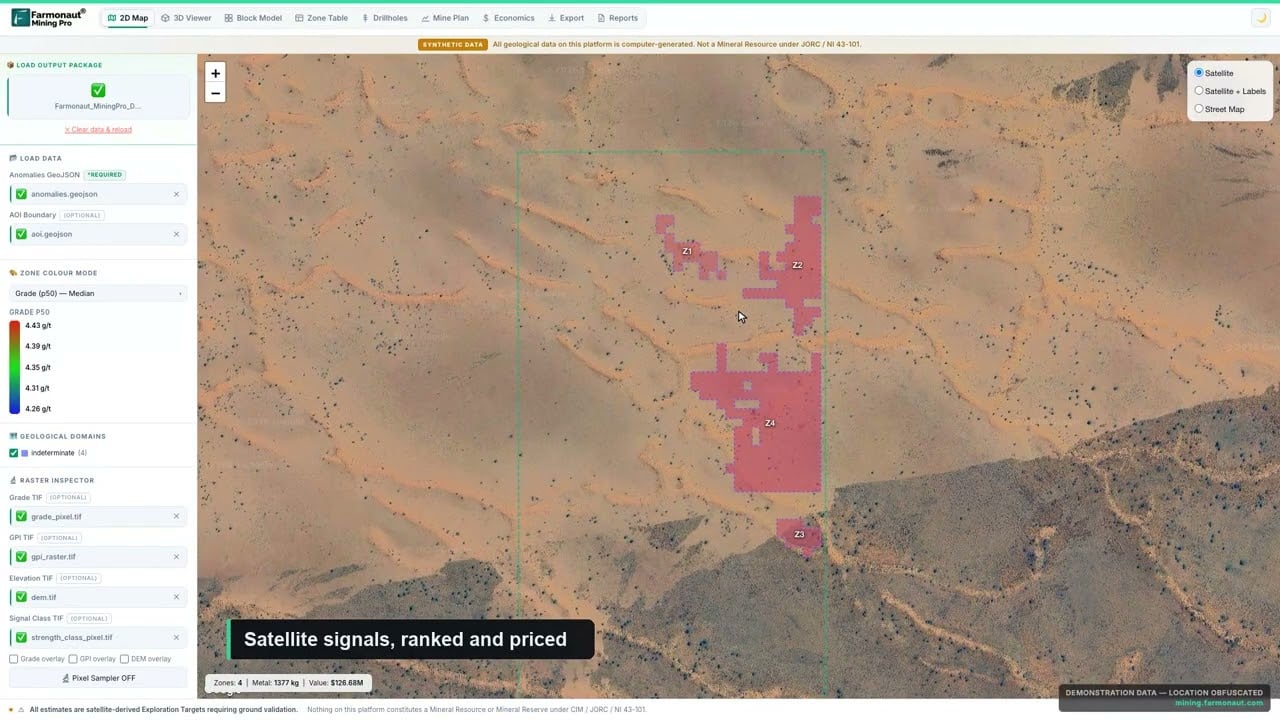
▶ A quick look at Farmonaut Mining Pro, which turns a licence boundary into a screening report (de-identified demo data). · 4:56
Estimate the revenue from a US gold mine
The calculator below turns a mining rate and grade into recovered ounces, gross revenue and a royalty payment. Grade is grams of gold per tonne of ore (g/t), recovery is the share of the gold in the ore that the plant captures, and a royalty is a share of revenue paid to the owner of the rights. The USGS average gold price for 2025 was an estimated US$3,300 per troy ounce, but the price field is an input: enter today’s price. Defaults are round examples, not a forecast or a benchmark for any mine.
Calculator
What could a gold mine earn per year?
Enter your own mining rate, grade, recovery, price and royalty.
- Gross revenue (US$): $86,806,951
- Royalty payment (US$): $2,604,209
Example values only, not a benchmark or forecast. Gold price is an input: example, use today’s price. Ounces use 31.1035 grams per troy ounce. Prices in US$.
What to watch next
Three dated releases will update the numbers on this page. USGS publishes the next edition of its Mineral Commodity Summaries each year, and the 2026 edition’s 2025 figures are preliminary and may be revised. MSHA posts its fiscal-year statistics each autumn and winter. The Permitting Council dashboard shows live status for each FAST-41 mining project.
How we built this guide
All state, commodity and trade figures are from the USGS Mineral Commodity Summaries 2026 (edition dated February 2026; 2025 values are estimates). Safety and employment counts are from MSHA’s fiscal-year 2025 summary. Nevada detail is from the state’s own mining division. States are shown in the order USGS publishes in its top-ten list, and we did not add any figure that a named source does not give. USGS data are rounded to three significant digits, so shares may not add exactly.
Frequently asked questions
How big is the mining industry in the United States?
USGS estimates the value of nonfuel minerals mined in 2025 at US$112 billion, up from US$106 billion in 2024. Metals were US$38.1 billion and industrial minerals US$73.7 billion. Coal added about US$27.6 billion.
Which state has the biggest mining industry?
Nevada, with US$12.6 billion of published nonfuel mineral value in 2025, followed by Arizona (US$10.4 billion) and Texas (US$10.2 billion), per USGS preliminary figures.
What does the US mining industry produce the most of by value?
Crushed stone, at an estimated US$26.8 billion, then gold, construction sand and gravel, portland cement and copper (USGS, 2026).
How many people work in US mining?
USGS reports about 150,000 employees in nonfuel mining and about 40,000 in coal in 2025 (estimates). MSHA, which also counts contractors, reports 327,465 miners at 12,568 mines in fiscal year 2025.
How much gold does the United States mine?
An estimated 160 metric tons in 2025, valued at about US$17 billion. Nevada produced about 64% and Alaska about 22% (USGS, 2026).
Where does the US get its copper?
Mine output was about 1.0 million metric tons in 2025, with Arizona making roughly 70%. Imports of refined copper were about 1.7 million metric tons (USGS, 2026).
How many mineral commodities does the US rely on imports for?
Imports supplied more than half of apparent consumption for 54 nonfuel mineral commodities in 2025, and the United States was fully import reliant for 16 of them (USGS, 2026).
How long does it take to permit a US mine?
There is no single figure. The Permitting Council’s director said the average had been 29 years before the 2025 effort, and six FAST-41 mining projects had completed federal permitting by 20 November 2025. State permits come on top.
Is the US mining industry growing?
Value is up: nonfuel production rose 6% in 2025. Most of the rise came from higher gold and silver prices, while gold and copper output were lower than in 2024 (USGS, 2026).
Where can I check whether a claim or licence is open?
Use the federal and state land and claim records. Our cadastre portal guide lists where to search. Confirm any rules with the regulator.
This page is for information only. It is not investment advice or legal advice. Confirm permit and claim rules with the regulator. Before any prospecting or sampling, get the landowner’s or agency’s permission, follow mine and site safety rules, and never use mercury.
Farmonaut mining
Map your mining site from space
Send a licence boundary and get a satellite screening report with exploration targets for your area.
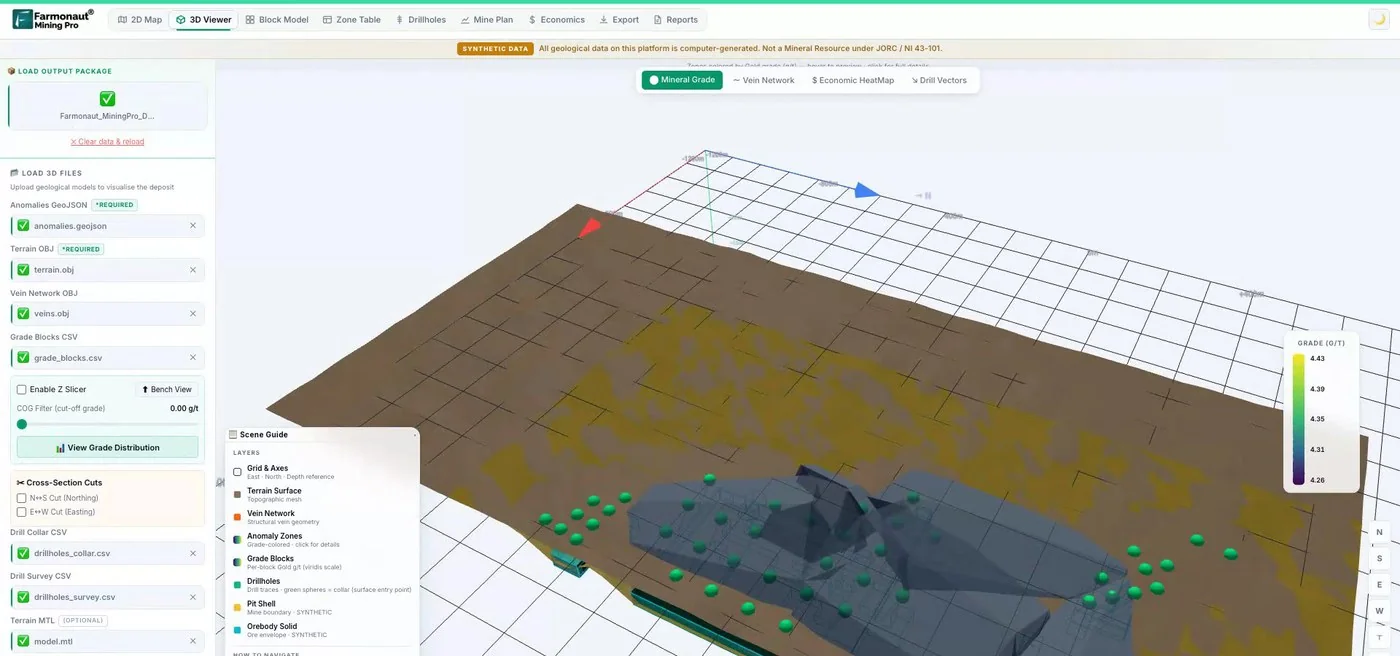
Mining Pro sample view, synthetic data
Keep reading
Sources
- USGS, Mineral Commodity Summaries 2026 (full volume): pubs.usgs.gov
- USGS MCS 2026, Gold: pubs.usgs.gov
- USGS MCS 2026, Copper: pubs.usgs.gov
- USGS MCS 2026, Iron ore: pubs.usgs.gov
- USGS MCS 2026, Antimony: pubs.usgs.gov
- USGS MCS 2026, Lithium: pubs.usgs.gov
- MSHA, Mine Safety and Health At a Glance (27 February 2026): msha.gov
- Permitting Council, 50 mining projects milestone (20 November 2025): permitting.gov
- Nevada Division of Minerals, State of the State (4 May 2026): minerals.nv.gov
- US EPA, 2023 TRI National Analysis (August 2025): epa.gov
Discussion
Questions, corrections or field experience? Share them below. First-time comments are reviewed before they appear, and your email is never published.
No comments yet. Be the first to add a question or your experience.

 Vulcan International Limited
 Kidepo Associates
 GKY Mining
 Alkimy SARL
 Double A Trading
 GemSprout Metals Limited
 Qader Group
 Ileys General Trading
 SG Gold Mining LLC
 VRV Global Pte Ltd
 Omsri International FZE
 G.I.T.T.
 Jaunita Erss Ltd
 Almosi SARL
 SRK Consulting
 Berks Gold Limited
 Mwerezi Minerals Company Limited
 Mining SARL
 SenGold Invest SAS
 Sean Mining Limited
 Exploration consultancy · South Africa · Gold










