

Mining software · Buyer guide
Mining Operations Software: 7 Types and Who Owns Them
Planning, dispatch, autonomy, maintenance, safety, proximity and reporting: what each system does, who sells it now and where it pays.
Key takeaways
- Powered haulage caused 13 of 33 US mining deaths in 2025 (MSHA).
- Komatsu commissioned its 1,000th FrontRunner autonomous truck in April 2026; customers have moved over 11.5 billion metric tons.
- Deswik is part of Sandvik (2022); Micromine joined Weir on 30 April 2025.
- Modular Mining (DISPATCH) belongs to Komatsu; Wenco to Hitachi Construction Machinery.
- MSHA’s written safety program rule for surface mobile equipment applies from 17 July 2024.
In this article
- What mining operations software covers
- 7 Ways Mining Operations Software Boosts Safety & Efficiency
- Crucial Modules in Mining Operations Management Software
- Why mine safety still needs better systems
- Powered haulage: where software makes the most difference
- Best Practices: Mining Operations Management Workflows
- What mining operations software costs
- Implementation Tips & Change Management in Mining Operations Software
- How to choose: what to ask vendors
- Frequently asked questions
Mining operations software is the set of systems a mine uses to plan, dispatch, maintain, monitor and report its daily work: mine planning, fleet management, maintenance, safety and compliance, and production reporting. Safety is the main reason these systems matter: in 2025, powered haulage accidents caused 13 of the 33 mining deaths in the United States, according to MSHA, and most fleet and proximity tools are built to cut exactly that risk.
This guide is written for mine owners, operations managers and site staff who are choosing or replacing systems. It sorts the market into seven types of software by the job each one does, names who owns the main products today, shows the US safety record the tools are meant to improve, and gives a calculator to test whether a fleet system pays for itself at your own mine.
What mining operations software covers
A mine runs as a chain: geology becomes a mine plan, the plan becomes a shift schedule, the schedule sends trucks and shovels to faces, ore goes to the plant, and everything is measured and reported. Each link has its own software. Very few mines use one product for the whole chain; most combine a planning package, a fleet management system (FMS), a maintenance system and a safety or compliance platform, then join them with a data layer or reporting tool.
The useful question for a buyer is not “which platform is best” but “which job is costing us most today”. A quarry losing hours to truck queues needs fleet dispatch first. An underground mine with poor equipment availability needs maintenance software first. A mine that keeps failing inspections needs a compliance system first.
- Plan: geological models, pit or stope designs and schedules.
- Execute: dispatch of trucks, loaders and drills, plus autonomy where used.
- Maintain: work orders, parts and condition monitoring.
- Protect: hazard reporting, inspections, training records and proximity alerts.
- Measure: production reconciliation, cost and environmental reporting.
▶ What an AI mining app does: finding places to look, planning the mine and running it. · 3:52
7 Ways Mining Operations Software Boosts Safety & Efficiency
The seven types below are ordered from the plan to the report. Each entry gives what the software does, who it suits, the main vendors with their current owners, and the honest limits.
1. Mine planning and scheduling software
Planning software turns a geological block model (a 3D grid of blocks, each with an estimated grade, the amount of metal per tonne of rock) into pit shells, designs and schedules for years, months and weeks. Deswik is part of Sandvik: Sandvik completed the purchase in April 2022 and placed it in a new Digital Mining Technologies division, according to Sandvik, which reported Deswik’s rolling 12-month revenue at AUD 79 million to October 2021. Micromine is now owned by The Weir Group, which completed the purchase on 30 April 2025 at an enterprise value of GB£624 million, according to Global Mining Review. Our guide to Deswik and mine planning software compares the planning packages in more detail.
Best for: mines with an engineering team that re-plans often. Limit: a schedule is only as good as the block model and the data feeding back from the pit.
2. Fleet management and dispatch systems
A fleet management system tracks every truck, shovel and loader by GPS and tells each truck where to go next. Komatsu describes its DISPATCH system, built by its wholly owned subsidiary Modular Mining, as assigning trucks to the most efficient loading and dumping points to reduce idle time and raise equipment use, while keeping a live digital twin of the mine (Komatsu). Komatsu added an app layer called the Modular ecosystem in September 2024. Wenco, another major FMS supplier, is a wholly owned subsidiary of Hitachi Construction Machinery based in Vancouver, according to Wenco. Caterpillar sells fleet and autonomy tools under the Cat MineStar name.
Best for: open pits and large quarries with ten or more haul trucks. Limit: gains depend on operators following the assignments; on a small fleet a good dispatcher with a radio can capture much of the value.
3. Autonomous haulage and remote operation
Autonomous haulage systems drive trucks without an operator on board, using the fleet system for traffic control. Komatsu commissioned its 1,000th autonomous ultra-class truck in April 2026, a 930E at Barrick’s Nevada Gold Mines, and says FrontRunner customers have moved more than 11.5 billion metric tons since its 2008 launch (Komatsu, 21 April 2026). In November 2019 Fortescue reported 1 billion tonnes moved with Cat MineStar Command for hauling, with its autonomous trucks covering more than 33.5 million km without a safety incident (MINING.COM). Autonomy is also reaching smaller sites: Luck Stone’s Bull Run quarry in Virginia has hauled more than 3.5 million tons with autonomous Cat trucks since November 2024 (Skillings Mining Review).
Best for: long-life mines with stable haul roads and the budget for site-wide change. Limit: it takes people out of trucks, but mixed traffic with light vehicles still needs strict access rules.
4. Maintenance and asset management software
Maintenance software (often called a CMMS or enterprise asset management system) holds the asset register, schedules planned work, issues work orders and tracks spare parts. Condition-monitoring add-ons read oil, vibration, temperature and engine fault data to warn before a failure. Mines usually run this inside an enterprise resource planning (ERP) suite or a dedicated asset management package, and connect it to the fleet system so engine hours and fault codes create work orders automatically.
Best for: any mine where unplanned downtime on a few critical machines (primary crusher, conveyors, haul trucks) stops production. Limit: predictive alerts are worthless unless the maintenance team trusts them and has parts on hand.
5. Safety, health and compliance (EHS) software
EHS software records hazards, incidents, inspections, training, permits and corrective actions, and produces the reports regulators ask for. In the United States this matters more since MSHA’s rule requiring written safety programs for surface mobile equipment at surface mines and surface areas of underground mines (MSHA). The rule was published in the Federal Register on 20 December 2023 with a compliance date of 17 July 2024. Software helps an operator show that the program exists, that hazards were identified and that training happened. For a wider look at site safety tools, see our mine safety solutions guide.
Best for: operators with several sites or contractors who must keep consistent records. Limit: a well-kept database does not stop an accident by itself; the value is in acting on the near-miss reports.
6. Collision avoidance and proximity detection
Proximity detection systems warn or stop a machine when a person or another vehicle is too close. They sit between the safety and fleet categories: the hardware is on the machine, but the software logs every interaction so managers can see which roads, intersections and loading areas create the most near misses. Given that powered haulage was behind 39% of US mining deaths in 2025, this is often the system with the clearest safety case.
Best for: mines with mixed traffic of haul trucks, light vehicles and people on foot. Limit: too many false alarms make operators ignore them, so tuning and road design matter as much as the device.
7. Production reporting, reconciliation and site monitoring
Reporting tools compare what the plan said, what the fleet moved and what the plant received. Reconciliation is the check that the ore tonnes and grade in the plan match what the mill processed; large gaps point to dilution (waste mixed into ore) or ore loss. Drill and blast monitoring belongs here too; our drill and blast software guide covers it. Satellite imagery adds a regular, independent view of the whole site, including pit growth, waste dumps, tailings and haul roads, which helps owners of remote or multiple sites see change between visits. Farmonaut provides satellite-based mineral detection and site mapping for exploration and monitoring.
Best for: owners and investors who need one trusted number for tonnes, grade and cost. Limit: reports reflect data quality at every earlier step.
Crucial Modules in Mining Operations Management Software
The table maps each job to the module that handles it and the main data it needs. Use it as a checklist when comparing vendors: a product that claims to cover everything should show each of these screens working with real site data in a demonstration.
| Job | Module | Main data in | Main output |
|---|---|---|---|
| Plan the mine | Design and scheduling | Block model, survey, costs | Life-of-mine and short-term plans |
| Run the fleet | Fleet management (FMS) | GPS, payload, shift plan | Truck assignments, cycle times |
| Haul without drivers | Autonomous haulage | FMS, mine map, sensors | Driverless haul cycles |
| Keep machines running | Maintenance (CMMS) | Engine hours, fault codes | Work orders, availability |
| Prove compliance | EHS | Inspections, incidents, training | Regulator reports, actions |
| Prevent collisions | Proximity detection | Machine and tag positions | Alerts, interaction logs |
| Report results | Reconciliation and reporting | Plan, fleet, plant, survey | Tonnes, grade, cost per tonne |
Integration is the hard part. Ask every vendor which open data standards and interfaces they support, and whether their fleet data can be read by another vendor’s maintenance or reporting tool. Komatsu presented its 2024 platform as interoperable for this reason (Komatsu, September 2024).

▶ Why a mineral management system keeps maps, samples and targets in one place. · 3:21
Why mine safety still needs better systems
US mining has become much safer over four decades, but the improvement has stalled. MSHA’s fiscal-year figures show deaths falling from more than 100 a year in the early 1990s to between 22 and 41 a year over the past decade (MSHA At a Glance). The figure for fiscal 2025 was 28 deaths among about 327,000 miners across 12,568 mines.
Chart
US mining fatal injury rate
Deaths per 200,000 hours worked, selected fiscal years
Chart
US mining deaths by fiscal year
All US mines, MSHA fiscal years (October to September)
The fatal injury rate, deaths per 200,000 hours worked, tells the same story: it moved between about 0.008 and 0.016 over the decade without a steady downward trend. That flat line is why regulators and large operators now focus on the biggest single cause, moving equipment.
Powered haulage: where software makes the most difference
Powered haulage means any machine that moves people or material: haul trucks, loaders, shuttle cars, locomotives and conveyors. In calendar 2025 it accounted for 13 of 33 US mining deaths (39%) and 426 of 4,792 non-fatal injuries (9%), according to MSHA. Note that MSHA’s calendar-year and fiscal-year totals differ, because the fiscal year runs from October to September.
Chart
Powered haulage share of US mine harm, 2025
Percent of calendar-year 2025 totals
Three software types act directly on this risk: fleet management (fewer vehicles waiting and crossing in loading areas), proximity detection (alerts before contact) and autonomous haulage (no driver in the cab). EHS software then makes sure that near misses are recorded and fixed.
Best Practices: Mining Operations Management Workflows
Software works best when it follows a clear daily routine. A simple loop used at many sites:
- Plan: the short-term plan sets the week’s tonnes and faces.
- Brief: each shift starts with targets, hazards and machine availability on one screen.
- Dispatch: the fleet system assigns trucks and flags delays in real time.
- Maintain: fault codes become work orders before the next shift.
- Record: incidents and near misses are logged from the field on a phone or tablet.
- Reconcile: at month end, planned, mined and milled tonnes and grade are compared and the plan is updated.
The loop matters more than the brand. Mines that skip the reconcile step often keep paying for systems whose data nobody checks.
What mining operations software costs
Vendors rarely publish prices. Fleet systems and autonomy are quoted per site, usually with hardware per machine, installation, training and an annual support or subscription fee. Planning and geology packages are usually licensed per user. EHS and maintenance systems are often sold as cloud subscriptions per user or per site. Because public price lists do not exist, the sensible test is value: work out what one percentage point more truck productivity is worth at your mine, then compare it to the quoted annual cost. The calculator below does that sum with your own numbers. Our article on mining profitability explains the cost-per-tonne side.
Calculator
Would a fleet system pay for itself at your mine?
Enter your fleet size, hours and margin, and the productivity gain you expect.
- Extra tonnes per year: 1,440,000
- Gross value of extra tonnes (US$): $2,880,000
- Payback (years): 0.17
Example values only, not benchmarks. The productivity gain and software cost are your own estimates or vendor quotes. Margin is an input: example, use today’s price and your own costs.
Implementation Tips & Change Management in Mining Operations Software
- Start with the biggest loss. Measure idle time, unplanned downtime and incident types for a month before you buy.
- Ask for references at similar sites. A system proven at a 300-tonne truck fleet may not suit a 40-tonne underground fleet.
- Check connectivity. Fleet systems and autonomy need reliable site-wide wireless coverage; budget for it.
- Own your data. Make sure the contract lets you export your data in a standard format if you change vendor.
- Train supervisors first. Operators follow what shift supervisors use and enforce.
- Run a pilot with a target. Set a measurable goal (for example, a set cut in queue time) and a date to review it.
- Plan for support. Remote sites need local or remote support with agreed response times.
If you are building a new project, our guide to working with a mine development company covers how systems are chosen during construction.
How to choose: what to ask vendors
- Which of the seven jobs above does the product actually do, and which does it hand to partners?
- How many sites with a similar fleet size and mining method use it today?
- What data formats and interfaces does it export and accept?
- What hardware is needed on each machine, and who installs it?
- What is the full annual cost, including support, updates and network?
- Who owns the company now, and what is the product roadmap after recent acquisitions?
The last question matters because the market has consolidated: Deswik joined Sandvik, Micromine joined Weir, Modular Mining is part of Komatsu and Wenco is part of Hitachi Construction Machinery. Ownership changes can bring new integrations, and can also change pricing and support.
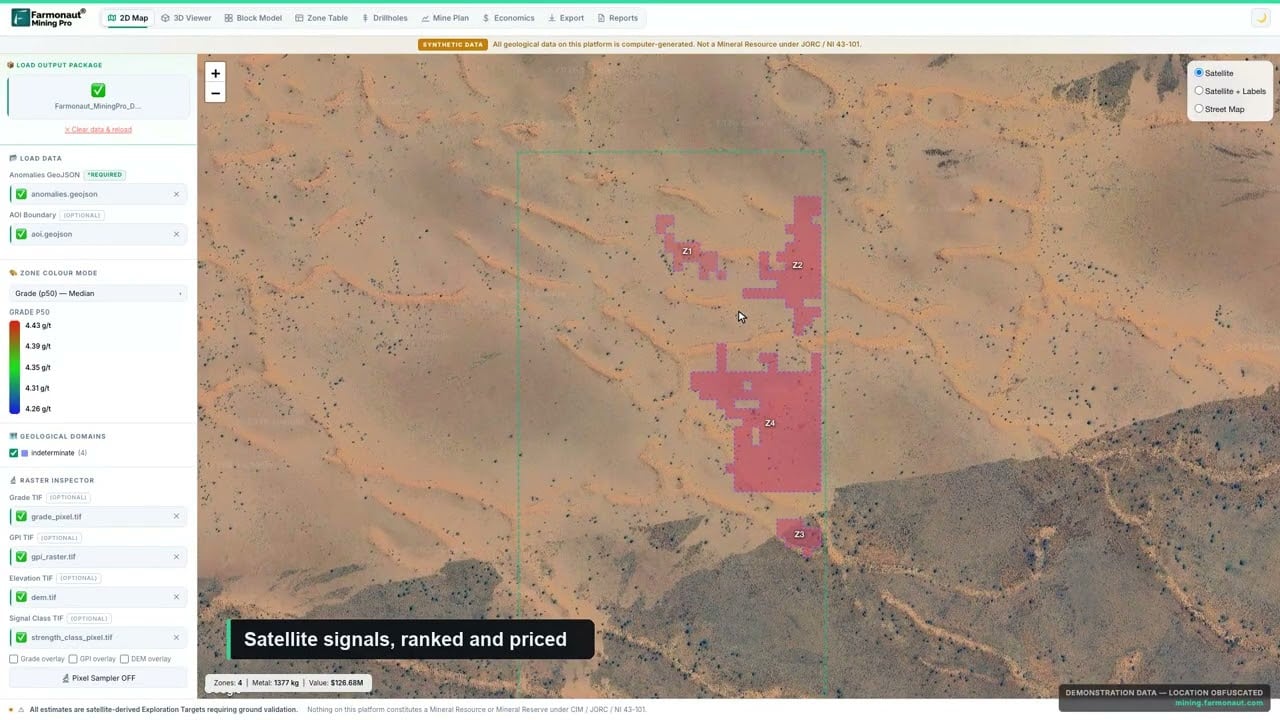
▶ A short look at Farmonaut Mining Pro, which maps a licence area from satellite data. · 4:56
Frequently asked questions
What is mining operations software?
It is the group of systems a mine uses to plan, dispatch equipment, maintain machines, manage safety and report production. Most mines combine several products rather than one platform.
What are the main mining operations solutions?
Mine planning, fleet management, autonomous haulage, maintenance, EHS and compliance, proximity detection, and production reporting with reconciliation.
What is a fleet management system in mining?
A system that tracks haul trucks and loaders by GPS and assigns each truck to a loading and dumping point to cut idle time. Komatsu’s DISPATCH and Wenco are two widely used examples.
What is mining automation software?
Software that runs equipment without an operator in the cab or from a remote room, such as Komatsu FrontRunner and Cat MineStar Command for hauling.
What is mining maintenance software?
A maintenance or asset management system that plans work, issues work orders, manages spare parts and can use machine sensor data to warn of failures.
What are the best safety management systems for mining operations?
The best fit combines an EHS system for hazards, incidents, inspections and training with proximity detection on mobile equipment, since powered haulage caused 39% of US mining deaths in 2025 (MSHA).
What is mining EHS software?
Environment, health and safety software that records incidents, inspections, permits, training and corrective actions and produces regulator reports.
Does MSHA require a written safety program for mobile equipment?
Yes. MSHA’s rule requires written safety programs for surface mobile equipment, excluding belt conveyors, at surface mines and surface areas of underground mines, with compliance from 17 July 2024.
How much does mining operations software cost?
Prices are quoted per site, user or machine and are rarely published. Compare the quoted annual cost against the value of productivity and downtime gains at your own mine.
Can small mines use these systems?
Yes. Cloud EHS and maintenance tools suit small sites, and autonomy has reached quarries such as Luck Stone’s Bull Run in Virginia. Full fleet dispatch pays best on larger fleets.
This page is general information, not legal or investment advice. Confirm safety obligations with MSHA or your regulator, and test any vendor claim at your own site.
Farmonaut mining
Map and monitor your mine site from space
Get a quote for satellite mapping of your licence or mine site: pits, dumps, tailings and haul roads, with regular updates for remote operations.

Mining Pro sample view, synthetic data
Keep reading
Sources
- MSHA, Powered Haulage Safety: msha.gov
- MSHA, Mine Safety and Health At a Glance FY1978-2025: msha.gov
- MSHA, Safety Program for Surface Mobile Equipment: msha.gov
- Komatsu, 1,000 ultra-class autonomous haul trucks commissioned (21 April 2026): komatsu.com
- Komatsu, DISPATCH fleet management system: komatsu.com
- Komatsu, Interoperable mine management platform (24 September 2024): komatsu.com
- Sandvik, Completion of Deswik acquisition (April 2022): mining.sandvik
- Global Mining Review, Weir completes acquisition of Micromine (30 April 2025): globalminingreview.com
- Wenco Mining Systems, company site: wencomine.com
- MINING.COM, Caterpillar moves a billion tonnes autonomously at Fortescue (November 2019): mining.com
- Skillings Mining Review, Caterpillar puts autonomous haulage on Cat 775 trucks: skillings.net
- Wikipedia, Modular Mining Systems (ownership history): en.wikipedia.org
- Federal Register, Safety Program for Surface Mobile Equipment, final rule (20 December 2023): govinfo.gov
Discussion
Questions, corrections or field experience? Share them below. First-time comments are reviewed before they appear, and your email is never published.
No comments yet. Be the first to add a question or your experience.

 VRV Global Pte Ltd
 Omsri International FZE
 G.I.T.T.
 Jaunita Erss Ltd
 Almosi SARL
 SRK Consulting
 Berks Gold Limited
 Mwerezi Minerals Company Limited
 Mining SARL
 SenGold Invest SAS
 Sean Mining Limited
 NTS Group (Pty) Ltd
 Mine4Africa
 Lithspo Minerals Limited
 Tintina Mining Group

 Licence holder · Nigeria · Gold + lithium
 Client · Somalia · Gold










