

Legacy gold mine · Facts, cleanup and restart
Mount Morgan Mine: History, Cleanup and Gold Restart
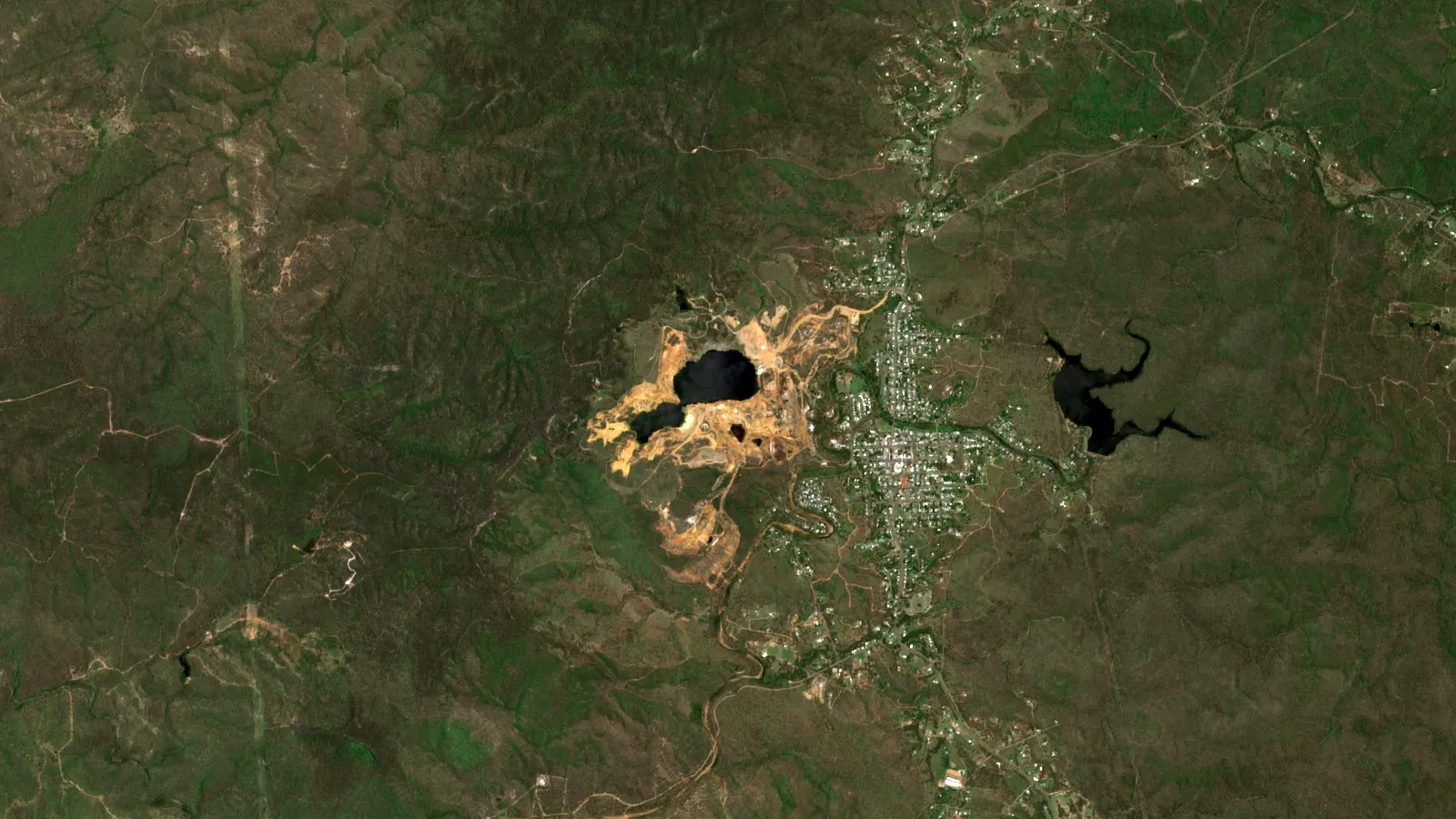
Mount Morgan mine, 32 km south-west of Rockhampton, produced about 239 to 262 t of gold to 1990. Heritage Minerals now plans to treat 17.3 Mt of old tailings, with production due in the fourth quarter of 2026.
Key takeaways
- Published gold totals for Mount Morgan range from 238.9 t to 262 t; the Queensland Government says about 250 t (1882 to 1990).
- The ore mined averaged 4.75 g/t gold; the tailings reserve is 12.67 Mt at 1.22 g/t, about a quarter of that (Heritage Minerals, October 2024).
- The Queensland Government has managed the site since 1993; the pit water is acidic (pH 1.9 to 3.8 in a University of Queensland study).
- Restart dates have slipped from 2023 to a fourth-quarter 2026 start; Mercuria announced an A$40 million prepayment on 14 October 2026.
- Plans are company figures: 57,000 to 60,000 oz of gold a year for about nine years, not guarantees.
In this article
- Mount Morgan mine at a glance
- How much gold did Mount Morgan produce?
- History of Mount Morgan mine, from discovery to closure
- What kind of ore body was Mount Morgan?
- Why the site needs a cleanup: acid mine drainage
- Seven fixes at Mount Morgan, from lime dosing to cyanide recycling
- What is left in the tailings: grades and tonnes
- Mount Morgan mine reopening: schedule, money and output
- How tailings reprocessing works at Mount Morgan
- What the tailings gold could be worth: a calculator
- Stage 2: sulphuric acid from the pyrite
- Can you visit Mount Morgan mine?
- How satellites are used on legacy mine sites
- Frequently asked questions
Mount Morgan mine, about 32 km south-west of Rockhampton in Central Queensland, produced roughly 240 to 260 tonnes of gold and about 360,000 to 387,000 tonnes of copper between 1882 and 1990, depending on which published total you use. Today it is a Queensland Government legacy site, and a private company, Heritage Minerals, is finishing a plant to recover more gold from the old tailings, with production due to start in the fourth quarter of 2026. The Queensland Government’s project page gives the official facts; this page puts the numbers, the cleanup and the restart side by side.
Mount Morgan mine at a glance
| Item | What the sources say |
|---|---|
| Location | Central Queensland, 32 km south-west of Rockhampton (Queensland Government) |
| Discovery | 1882, when a syndicate opened a gold mine at Ironstone Mountain, later renamed Mount Morgan (Heritage Minerals) |
| End of mining | Ore body exhausted in 1981; operations, including tailings treatment, ended in November 1990 |
| Metal produced | Gold 239 to 262 t, copper 360,000 to 387,000 t, silver about 37 t (see the next section) |
| Waste left behind | About 134 million tonnes of waste rock and tailings, a water-filled open-cut pit and several tailings dams (Queensland Government) |
| Status | State-managed legacy site with ongoing water treatment; tailings reprocessing by Heritage Minerals due to start in the fourth quarter of 2026 |
How much gold did Mount Morgan produce?
There is no single agreed total. A geological database that records production to closure gives 50 million tonnes of ore at 4.75 g/t gold, which is 238.9 tonnes of gold and 360,616 tonnes of copper. A University of Queensland conference paper quotes 247 t of gold, 37 t of silver and 387,000 t of copper. The Queensland Government says about 250 t of gold and 360,000 t of copper. Wikipedia and Australian Mining quote 262 t of gold. The spread is about 10 per cent, so treat any single figure as an estimate.
Chart
Published totals for gold produced, 1882 to 1990
Tonnes of gold; four sources disagree by about 10 per cent
A grade of 4.75 g/t means 4.75 grams of gold in each tonne of rock. One troy ounce is 31.1035 grams, so 4.75 g/t is about 0.15 ounces per tonne. That is a high grade for a mine that ran for a century, and it explains why the site mattered so much.
History of Mount Morgan mine, from discovery to closure
A syndicate of six men opened the mine in 1882. It included William Knox D’Arcy and Walter Russell Hall, whose later ventures grew out of its profits. A Queensland Government statement from 2022 quotes the Treasurer calling Mount Morgan the world’s largest gold mine in the early 1900s and Heritage Minerals’ managing director saying its wealth gave the impetus for BP and for the Walter and Eliza Hall Institute, Australia’s oldest medical research institute. The Queensland Historical Atlas adds that the open cut was at one time the deepest in the southern hemisphere.
| Period | What happened |
|---|---|
| 1882 to 1886 | Syndicate opens the mine; the Mount Morgan Gold Mining Company is formed in October 1886 |
| To 1927 | Underground and glory-hole mining; a fire in the mid-1920s wrecks the underground workings and the company goes into liquidation in 1927 |
| 1932 to 1981 | A new company, Mount Morgan Ltd, forms in 1928; open-cut mining starts in 1932 and runs until the ore body is exhausted in 1981 |
| 1982 to 1990 | Tailings from earlier operations, and material from other company sites, are processed |
| 1990 to 1993 | Operations end in November 1990; the Queensland Government takes over management of the legacy in January 1993 |
| 2020 | Mining leases transfer to Heritage Minerals |
The dates come from the Wikipedia entry on the mine, the Queensland Government page and the geological database above. The PorterGeo database dates the start of open-pit mining to 1932; Wikipedia gives 1928, which is when the new company was formed.
What kind of ore body was Mount Morgan?
The mine worked a pipe-shaped body of massive pyrite (iron sulphide) with copper and gold, hosted in Devonian volcanic rock. When the folded rocks are restored to flat, the pipe measures at most about 750 by 250 by 300 metres, according to the geological database. Chalcopyrite (the main copper mineral) and pyrite were the main sulphides. Most of the recoverable gold was ultrafine, in grains too small to see.
The ore-bearing volcanic rocks are cut by the Mount Morgan Tonalite, a granite-like intrusion of late Devonian age, which overprinted the earlier alteration with its own mineralisation. Heritage Minerals calls the ore refractory, meaning the gold does not dissolve easily, and notes that the mine pioneered several metallurgical processes to cope with it. The pyrite matters today for a second reason: that same mineral is what makes the waste acidic.
Why the site needs a cleanup: acid mine drainage
When rock rich in sulphide minerals meets air and water, it produces sulphuric acid and releases metals. The US Environmental Protection Agency describes this as acid mine drainage, a common form of water pollution at old mines. At Mount Morgan the University of Queensland paper reports more than 100 million tonnes of sulphide-rich waste rock, with pyrite typically 5 to 10 per cent of the volume and up to 50 per cent in places. The drainage it measured had a pH between 1.9 and 3.8 and was rich in aluminium, iron, copper and zinc. The open-cut pit is the main store, with a capacity of 11,555 megalitres.
The Queensland Government lists the main risks as the pit overtopping in a wet season, poor-quality water in the Dee River downstream, and unstable old buildings, shafts and embankments. It also warns that water near the site is not suitable for drinking, swimming or fishing.

▶ A plain-language claymation on the seven environmental impacts of mining. · 2:31
Seven fixes at Mount Morgan, from lime dosing to cyanide recycling
These seven measures come from Queensland Government and Heritage Minerals records, and they show how a legacy site is managed in practice.
| Measure | What it does |
|---|---|
| 1. Lime-dosing water treatment plant | Built in 2006 to treat pit water with lime before release to the Dee River; Heritage Minerals now operates it under contract |
| 2. Seepage interception and pump-back | Intercepts acidic seepage from the dumps and tailings before it reaches the Dee River, with evaporation and pump-back |
| 3. Dam 8 sealing and larger pumps | Cuts the pit’s catchment by more than 40 per cent, so less fresh water enters the pit in a wet season |
| 4. Removal of unstable old dams | 400,000 cubic metres of tailings and acidic water removed from dams beside the mine |
| 5. Cofferdam | Separates the open-cut pit from Sandstone Gully, helping water management and giving access to the tailings |
| 6. River monitoring and alerts | Routine water and groundwater sampling down the Dee and Don rivers, with notice to downstream landholders before large rain events |
| 7. Tailings reprocessing with cyanide recycling | Recovers gold and copper from the old tailings; a resin step recycles cyanide, and a new water treatment plant is part of the plan |
Rows 3 to 6 are completed works on the Queensland Government remediation page (updated 14 September 2026), which lists seepage interception and pump-back (row 2) as continuing work and says Heritage Minerals operates the water treatment plant (row 1). The 2006 build date and the lime dosing in row 1 come from the University of Queensland paper below. The University of Queensland team also tested the lime treatment and found that it works, but that it produces very large amounts of metal-rich sludge and gypsum that can block pipes. That is a trade-off the reprocessing project is meant to ease by removing the source material. In 2021 the ABC reported that the abandoned site was costing taxpayers almost A$2 million a year.
The Queensland Government has also made safe 18 unstable historic buildings, removed asbestos in line with Queensland Heritage Council approvals, and made a 3D image survey of the site. About half the site is on the Queensland Heritage Register or the National Trust of Australia (Queensland) register.
What is left in the tailings: grades and tonnes
Tailings are the finely ground waste that remains after ore has been crushed and the metal extracted. The old plants left gold behind, partly because earlier owners could not make the economics work. The Peko operation, which reprocessed about 25 million tonnes of tailings, stopped because of a low gold price and high cyanide cost, according to Heritage Minerals’ October 2024 investor presentation. Copper in the tailings was a big part of the problem: it dissolves in cyanide and uses it up.
Chart
Gold grade: ore mined versus tailings reserve by deposit
Grams of gold per tonne; reserve grades are Probable reserves, March 2024
Heritage Minerals’ October 2024 presentation lists an ore reserve of 12.67 million tonnes at 1.22 g/t gold (495,000 ounces) and 0.16 per cent copper, in five tailings and residue deposits. The company’s life-of-project plan treats 17.3 million tonnes, made up of 12.7 million tonnes of reserves and 4.6 million tonnes of resources. Reserves are the part of a deposit shown to be economic to mine; resources carry less certainty.
| Deposit | Reserve tonnes (Mt) | Gold grade (g/t) | Gold (thousand oz) |
|---|---|---|---|
| No.2 Mill | 3.73 | 1.11 | 132.6 |
| Mundic Gully | 1.70 | 2.08 | 113.7 |
| Red Oxide | 0.53 | 2.02 | 34.4 |
| Shepherds | 3.80 | 0.84 | 103.4 |
| Sandstone Gully | 2.90 | 1.19 | 110.8 |
| Total | 12.67 | 1.22 | 495.0 |
The grades are about a quarter of the average grade that was mined, yet they are still worth treating at modern gold prices because the tailings are already ground and sit at the surface. The company expects to recover about 74 per cent of the gold and 46 per cent of the copper from the 17.3 million tonnes, which would be 487,000 ounces of gold and 12,100 tonnes of copper from 658,000 ounces and 27,100 tonnes contained. These are company figures, not guarantees.
The numbers have also changed over time. In 2022 the Queensland Government described a project of nearly 10 million tonnes, recovering an estimated 263,000 ounces of gold and 5,600 tonnes of copper. The later plan is larger after further drilling; the company’s 2024 resource update lists significant additions. Always check the date on any Mount Morgan resource figure.
Mount Morgan mine reopening: schedule, money and output
The restart has slipped more than once. Each date below was the company’s or its financier’s forecast at the time.
Chart
Planned gold output by year of operation
Thousand ounces of gold a year, Heritage Minerals plan of October 2024 (life of project 487,000 oz)
| Forecast made in | Target for gold production | Source |
|---|---|---|
| May 2021 | Operating by 2023 | ABC News |
| October 2024 | First gold late in the fourth quarter of 2025 | Heritage Minerals presentation |
| September 2025 | First gold pour in mid-2026 | Capricorn Enterprise |
| July 2026 | Commercial operations from October, with commissioning over three to five months | Industry Queensland |
| 14 October 2026 | Production due to commence in the fourth quarter | Mercuria news release |
On 14 October 2026 the trading group Mercuria announced a prepayment of A$40 million and an offtake agreement (a contract under which Mercuria buys the gold produced) for the first 210,000 ounces of doré over four years. Doré is the unrefined gold-silver alloy poured at the mine. The earlier funding was a Queensland Government grant and a concessional loan of up to A$66 million from the Northern Australia Infrastructure Facility (investment decision December 2022), A$30 million from Merricks Capital and a A$26 million cost-overrun facility, with A$155 million of capital cost in the October 2024 plan. Spending on site was nearing $100 million by September 2025, according to Capricorn Enterprise.
Industry Queensland reported in July 2026 that the construction workforce peaked at almost 400 and that the operation is expected to employ 150 to 170 people. It also says the first stage should produce about 60,000 ounces of gold and up to 5,000 tonnes of copper a year for about nine years. The October 2024 plan is lower on both counts, averaging 57,000 ounces of gold and about 1,500 tonnes of copper a year, so quote them as company ranges. The plan for each year is below.
How tailings reprocessing works at Mount Morgan
Trucks carry tailings to a delivery pad at the top of a run-of-mine wall, and the material runs down a chute to an IsaMill, a fine-grinding mill. The slurry then goes into a carbon-in-leach circuit, a standard gold process in which cyanide dissolves the gold and activated carbon captures it. What is different here is ReCYN, a technology from GreenGold that uses treated resin beads to take cyanide and copper-cyanide compounds out of the solution so the cyanide can be reused. Copper goes to Glencore’s Mount Isa smelter and gold to ABC Bullion for refining, according to Industry Queensland.
Infographic
Tailings to gold in 5 steps
- 1HaulTrucks deliver tailings to a pad at the top of a run-of-mine wall.
- 2GrindMaterial runs down a chute into an IsaMill fine-grinding mill.
- 3LeachA carbon-in-leach circuit dissolves the gold with cyanide and captures it on carbon.
- 4RecycleReCYN resin beads take cyanide and copper out of solution so the cyanide is reused.
- 5ShipGold goes to ABC Bullion for refining; copper goes to Glencore’s Mount Isa smelter.
The 2022 Queensland Government statement said the new technology would cut cyanide consumption by 50 per cent. Heritage Minerals describes the earlier failures as a copper problem and says ReCYN overcomes it; its chief executive told Australian Mining that ReCYN has turned around five struggling projects internationally.
▶ Follows a gold nugget from rock to refined metal: drilling, crushing, leaching, carbon and refining. · 5:27
What the tailings gold could be worth: a calculator
Gross value is only the start. Mining and processing cost, royalties, tax and repaying the capital all come out of it, and the company’s own plan assumed a processing and mining cost of A$46 per tonne treated. Use the calculator to test your own numbers against the published grade and recovery.
Calculator
What is a year of tailings gold worth?
Enter your own tonnes, grade, recovery, price and cost.
- Gold contained per year: 75,876 oz
- Gross value of recovered gold (US$): $168,444,066
- Treatment cost (US$): $60,000,000
- Margin before royalty, tax and capital (US$): $108,444,066
Example values only, not a forecast. Defaults follow Heritage Minerals’ October 2024 plan: 2 Mt a year, 1.18 g/t gold and 74 per cent recovery. Gold price and cost per tonne are examples, so use today’s price and your own cost in US$. The result is gross of royalties, tax and capital repayment.
Stage 2: sulphuric acid from the pyrite
Heritage Minerals has said that after gold and copper it wants to study a second stage, roasting pyrite from the tailings to make sulphuric acid, a key input for mineral processing that Industry Queensland says is expected to be in short supply in Queensland. The company’s October 2024 presentation sizes this as a separate acid, metals and power project. Heritage Minerals’ news page says it has started a feasibility study for this stage and expects it would further reduce the risk of acid mine drainage. It is not part of the gold start-up.
Can you visit Mount Morgan mine?
Not the working site. The Queensland Government says tours of the mine site ended in 2018 for safety reasons, and tours of the Fireclay Caverns stopped in 2010 after rockfalls. The caverns, dug between 1906 and 1927 for brick clay, contain fossil dinosaur footprints in the ceiling. The government removed mining tenure over several tourism areas, including the caverns, so safe tourism could be possible in future. Do not enter the site without permission; the pit, shafts and water are dangerous.
How satellites are used on legacy mine sites
Satellite images cannot show acid chemistry or ore underground, but they do show surface change. The Sentinel-2 satellites carry a camera with 13 spectral bands, four of them at 10 m resolution, and the pair revisits the same place about every five days at the equator, according to the Copernicus Sentinel-2 mission page. That is enough to track the size and colour of water in a pit or dam, bare ground against regrowth on rehabilitated areas, and new disturbance. At Mount Morgan the formal checks still rely on sampling in the Dee and Don rivers.
Farmonaut uses the same kind of imagery earlier in the mining cycle: it screens licence areas for alteration and structure patterns and gives exploration targets, which sit ahead of a resource estimate. To see how this works for a site you hold, read our satellite-based mineral detection guide or send an area for a quote. For the tailings side of the story, our guide to tailings management in gold mining covers the engineering. Other legacy sites we have written about include the Anaconda copper smelter lands, Comstock in Nevada and the Argo Gold Mine and Mill. Questions about your own project can go to the Farmonaut team.

▶ Explains what satellites can and cannot show about gold-bearing ground. · 4:25
We cover a connected topic in Consolidated Gold Mine Georgia: Tour Cost and History.
Frequently asked questions
Where is Mount Morgan mine?
It is in Central Queensland, Australia, about 32 km south-west of Rockhampton, at latitude -23.64 and longitude 150.37 according to the Queensland Government.
How much gold did Mount Morgan produce?
Published totals run from 238.9 t to 262 t of gold, with the Queensland Government saying about 250 t. Copper totals are 360,000 to 387,000 t and silver about 37 t.
When did Mount Morgan mine close?
The ore body was exhausted in 1981. Tailings and other processing carried on until November 1990, when the Queensland Government says operations ended.
Is Mount Morgan mine reopening?
Heritage Minerals is building a tailings plant on the site. A release from Mercuria on 14 October 2026 says production is due to commence in the fourth quarter. Earlier target dates have slipped.
Who owns Mount Morgan mine now?
The mining leases passed to Heritage Minerals Pty Ltd in 2020, and the company says it owns the project outright. The Queensland Government remains responsible for the legacy cleanup and still manages the site.
How much gold is left at Mount Morgan?
Heritage Minerals reports an ore reserve of 12.67 million tonnes at 1.22 g/t, holding 495,000 ounces of gold, and plans to treat 17.3 million tonnes with 658,000 ounces contained. It expects to recover about 74 per cent.
Why is the water in the Mount Morgan pit acidic?
Pyrite in the waste rock reacts with air and water to form sulphuric acid. A University of Queensland study measured drainage at pH 1.9 to 3.8, far more acidic than natural river water.
Can you visit the Mount Morgan mine site?
Site tours ended in 2018 for safety reasons, and cavern tours ended in 2010. The Queensland Government says safe tourism could be possible in future, but the site is not open to the public now.
Is Mount Morgan the same as Mount Morgans in Western Australia?
No. Mount Morgans Gold Mine is a different mine near Laverton in Western Australia. Mount Morgan is in Queensland.
Why did earlier attempts to reprocess the tailings fail?
Heritage Minerals describes copper in the tailings as the main obstacle, because it uses up cyanide and raises operating cost. Australian Mining reported in 2020 that Heritage was the fifth company in 30 years to try, and the ABC said four earlier attempts had failed.
What did Mount Morgan have to do with BP?
William Knox D’Arcy, one of the original syndicate, used his profits to fund oil exploration in Persia, which led to the Anglo-Persian Oil Company, later BP, according to Heritage Minerals’ history page and Wikipedia, which dates the change to BP to 1954.
This page is for information only. It is not investment advice. Production dates, tonnes and ounces for the Heritage Minerals project are company forecasts and may change. The Mount Morgan site is dangerous and closed to the public: do not enter without permission.
Farmonaut mining
Map your own mining site from space
Send us your area of interest for a quote on a satellite screen of surface alteration, structure and land change.

Mining Pro sample view, synthetic data
Keep reading
Sources
- Queensland Government, Mount Morgan remediation project (updated 14 September 2026): qld.gov.au
- Queensland Government ministerial statement, New tech turning old gold mine into future jobs (23 November 2022): statements.qld.gov.au
- Heritage Minerals, Corporate Presentation: Mt. Morgan Gold Tailings Treatment and Rehabilitation Project (October 2024): v2.imarcexpo.com
- Heritage Minerals, Project page: heritageminerals.com.au
- Heritage Minerals, News: heritageminerals.com.au
- Industry Queensland, New life draws closer for historical gold site (6 July 2026): industryqld.com.au
- Mercuria, Gold offtake agreement with Heritage Minerals (14 October 2026): prnewswire.com
- Gasparon et al., Acid mine drainage at Mount Morgan, IMWA Symposium (2007): imwa.info
- PorterGeo database, Mount Morgan ore deposit description: portergeo.com.au
- Wikipedia, Mount Morgan Mine: en.wikipedia.org
- US EPA, Abandoned Mine Drainage: epa.gov
- ABC News, Heritage Minerals’ plan to revive abandoned Mount Morgan gold mine (16 May 2021): abc.net.au
- Australian Mining, Heritage Minerals develops historic Mount Morgan gold mine (21 October 2020): australianmining.com.au
- Capricorn Enterprise, Heritage Minerals major milestone (September 2025): capricornenterprise.com.au
- Queensland Historical Atlas, Gold: qhatlas.com.au
- Copernicus SentiWiki, Sentinel-2 mission: sentiwiki.copernicus.eu
- NAIF, Mount Morgan Tailings Processing and Rehabilitation project: naif.gov.au
Discussion
Questions, corrections or field experience? Share them below. First-time comments are reviewed before they appear, and your email is never published.
No comments yet. Be the first to add a question or your experience.

 Timestream Mining
 Lithspo Minerals Limited
 Tintina Mining Group
 Dalgety Minerals Pty Ltd
 Vortex Minerals Pty Ltd
 Faith At Work (Pty) Ltd
 Geotech Mining Solutions plc
 Vulcan International Limited
 Kidepo Associates
 GKY Mining
 Alkimy SARL
 Double A Trading
 GemSprout Metals Limited
 Qader Group
 Ileys General Trading
 SG Gold Mining LLC
 VRV Global Pte Ltd
 Omsri International FZE
 G.I.T.T.
 Jaunita Erss Ltd
 Almosi SARL
 SRK Consulting
 Berks Gold Limited
 Mwerezi Minerals Company Limited

 Exploration consultancy · South Africa · Gold










