

Navajo Nation uranium · Cleanup status guide
Uranium Mining on the Navajo Nation: Cleanup Status
EPA counts 523 abandoned uranium mines on and near the Navajo Nation and says funds are available to begin work at 230 of them (EPA, 2026). This guide covers who pays, cleanup status by site, the 2005 ban and nearby projects.
Key takeaways
- Nearly 30 million tons of uranium ore were mined on Navajo land from 1944 to 1986; EPA counts 523 abandoned mines (EPA, 2026).
- EPA enforcement agreements and settlements are worth over US$1.7 billion; funds are available to begin work at 230 of the 523 mines (EPA, read 16 October 2026).
- Northeast Church Rock: a consent decree lodged on 11 August 2025 requires about one million cubic yards of waste to be moved, at nearly US$63 million over more than a decade (DOJ, 2025).
- The Navajo Nation banned uranium mining and processing on its land in April 2005; hauling is covered by a January 2025 agreement with Energy Fuels (High Country News; World Nuclear News).
- Uranium worker compensation under RECA pays US$100,000 and claims must be filed by 31 December 2027 (DOJ).
In this article
- Uranium mining on the Navajo Nation: how it started and what it left
- How many abandoned uranium mines are on the Navajo Nation?
- Who is paying for the cleanup
- Cleanup status by site: Lukachukai, Northeast Church Rock and Mesa V
- Health effects and drinking water: what the studies show
- The Navajo ban on uranium mining, and the transport rules
- Uranium projects near the Navajo Nation and their permit stage
- Seven challenges that remain, and who is working on them
- Compensation for uranium workers: RECA
- Budgeting a waste-removal cleanup: a rough calculator
- Where satellite screening fits
- Frequently asked questions
The US Environmental Protection Agency (EPA) counts 523 abandoned uranium mines on and near the Navajo Nation. From 1944 to 1986 nearly 30 million tons of uranium ore came out of Navajo land under leases with the Nation, and EPA says funds are now available to begin assessment and cleanup at 230 of the 523 mines (EPA, read 16 October 2026). The Navajo Nation itself banned new uranium mining on its land in 2005. This page sets out where cleanup stands, who is paying, what the health and water studies show, and which new projects sit just outside the reservation.
It also covers the seven main challenges that remain. Every figure below carries its source and date. Where two official counts differ, both are shown.
Uranium mining on the Navajo Nation: how it started and what it left
Uranium and vanadium were mined across the Navajo Nation from the 1940s to the 1980s, first for nuclear weapons and later for power stations. EPA puts the total at nearly 30 million tons of ore between 1944 and 1986. Many Navajo people worked the mines and lived beside the mines and mills. Today the mines are closed, but what remains includes the abandoned mines (AUMs, in EPA’s shorthand), homes and water sources with elevated radiation, and waste rock piles (EPA). High Country News reported in 2005 that thousands of Navajos had worked underground between 1947 and 1970, and that hundreds had been diagnosed with lung cancer or silicosis (High Country News).
The largest single accident was at Church Rock, New Mexico. On 16 July 1979 a tailings dam at United Nuclear Corporation’s mill breached. About 1,100 tons of solid waste and 94 million gallons of radioactive water flowed into the Puerco River (Rachel Carson Center, Environment and Society Portal). Tailings are the finely ground rock left after uranium is extracted, and they stay radioactive for a very long time.
▶ Walks through the seven environmental impacts of mining in plain words. · 2:31
How many abandoned uranium mines are on the Navajo Nation?
EPA’s cleanup page says there are 523 abandoned mines, and that funds are available to begin assessment and cleanup at 230 of them. EPA’s September 2025 settlements fact sheet uses a slightly different count: it says assessment and cleanup has started at 253 of the 523 mines, about half. EPA does not explain the difference, so this guide shows both.
Chart
Abandoned mines by who pays for work
Number of the 523 mines
EPA and the Navajo Nation Environmental Protection Agency (NNEPA) ranked 46 mines as priorities, using gamma radiation levels, closeness to homes and the chance of water contamination. Detailed investigations of the priority mines took place in 2018. Forty-four of the 46 are now in the assessment stage, which includes biological and cultural surveys, radiation scanning, and soil and water sampling (EPA).
The chart splits the 523 mines by the agreement that pays for work at each. The largest group, 270 mines, falls under “other”: no settlement covers it yet. EPA says it is working to identify the companies responsible for the unfunded mines and to bring them to the table.
Who is paying for the cleanup
EPA says its enforcement agreements and settlements on Navajo uranium mines are worth more than US$1.7 billion. They come in separate pieces, and the amounts below are as EPA and the Department of Justice (DOJ) state them.
Chart
Main cleanup agreements by stated value
US$ million, as stated by EPA and DOJ; values are not additive
| Agreement | Mines covered | What EPA or DOJ states |
|---|---|---|
| Tronox (successor to Kerr-McGee) | 48 on or near the Nation | Part of a US$5 billion national settlement in 2014; EPA received almost US$900 million for more than 50 mines, plus close to US$90 million for the Quivira mine. The Navajo Nation received US$44 million. |
| Cyprus Amax and Western Nuclear | 93 | 2017 consent decree, estimated value US$600 million. The US pays about half, through a trust funded at US$335 million; the companies fund the rest. |
| Seven private parties (including BNSF, Chevron, Homestake and United Nuclear) | 43 | Agreements to assess contamination or take removal actions, and to fit fencing and signs. Amounts vary by agreement. |
| Trust settlements, phases 1 and 2 | 55 priority mine sites (EPA fact sheet count; EPA’s own priority list has 46) | US$13.2 million (phase 1, 2015) and US$21.5 million (phase 2, 2016) provided so far for assessment work. |
| United Nuclear and General Electric, Northeast Church Rock | 1 mine plus the mill site | Consent decree lodged 11 August 2025; cleanup expected to cost nearly US$63 million and take more than a decade. |
Sources: EPA, Abandoned Uranium Mine Settlements fact sheet (September 2025) and DOJ press release (11 August 2025). Fourteen mines are funded directly by EPA.
Cleanup status by site: Lukachukai, Northeast Church Rock and Mesa V
Lukachukai Mountains Mining District, Arizona
EPA added the Lukachukai Mountains Mining District to the Superfund National Priorities List on 5 March 2024 (EPA news release). Superfund is the federal programme for cleaning up the most contaminated sites, and a listing makes a site eligible for federal funding. Past uranium and vanadium mining in the district, in the Cove, Round Rock and Lukachukai Chapters, left more than 100 piles of waste rock that contain radium-226, uranium and other heavy metals. EPA says waste has washed downstream along washes, and ore hauling spread contamination along miles of old roads. The listing also gives a possible funding source for 11 mines not covered by the Tronox settlement or the Cyprus Amax consent decree (EPA site page).
In May 2026 EPA put forward a proposed plan for the whole district and one for the Mesa I complex; the public comment period closed on 30 July 2026. The cleanup of the Mesa V complex has already started: EPA announced on 3 November 2025 that it was beginning to remove 13,000 cubic yards of uranium mine waste rock there (EPA).
Northeast Church Rock, New Mexico
Under the consent decree DOJ announced on 11 August 2025 (lodged in court, and subject to public comment and final court approval at that time), United Nuclear Corporation and General Electric must dig up about one million cubic yards of mine waste and move it to the nearby UNC Mill Site, a federally licensed tailings disposal facility next to the Nation. The Navajo Nation and the State of New Mexico are co-plaintiffs. DOJ puts the cost at nearly US$63 million over more than a decade. Local reports say work began at the Pinedale Chapter; the Navajo Nation EPA director said the move to a managed repository is a good step but that the waste stays near the community, and that groundwater remains a worry (KRQE).
The wider plan is EPA’s Ten-Year Plan for 2020 to 2029, which follows the first Five-Year Plan of 2007 and a second of 2014. It involves the Interior Department’s tribal affairs bureau, Department of Energy, Nuclear Regulatory Commission, federal tribal health service (IHS) and the federal toxic-substances agency (ATSDR) alongside NNEPA.
Health effects and drinking water: what the studies show
EPA lists lung cancer from breathing radioactive particles, and bone cancer and kidney damage from radionuclides in drinking water, as the potential health effects. A 1995 cohort study of 757 Navajo uranium miners followed from 1960 to 1990. It found a standardized mortality ratio (SMR, the number of deaths seen divided by the number expected in a comparison group) of 3.3 for lung cancer, 2.6 for tuberculosis, and 2.6 for pneumoconiosis and other respiratory disease. The authors concluded that these light-smoking miners still faced excess lung cancer deaths more than two decades after their last exposure (Roscoe et al., American Journal of Public Health, 1995).
For families, the Navajo Birth Cohort Study, run by the University of New Mexico with ATSDR, the federal tribal health service (IHS) and the Navajo Nation, is the first prospective study of pregnancy and newborn outcomes in a uranium-exposed population (ATSDR).
Water is the other route. A 2004 NNEPA study found that about 30% of Navajo residents hauled drinking water because they had no piped supply at home. In an October 2009 sampling round, EPA and partners tested 36 unregulated water sources in the Eastern Agency: 12 exceeded a primary drinking water standard, and five of those exceeded the uranium standard (EPA Region 9 sampling report). The sources were picked because they sat near abandoned mines or had earlier high readings, so the results do not describe every well. NNEPA advises against drinking from unregulated sources.
The Navajo ban on uranium mining, and the transport rules
The Navajo Nation Council passed a ban on uranium mining and processing on the Nation’s roughly 17 million acres, and on lands owned by Navajo families, and President Joe Shirley Jr. signed it in April 2005 (High Country News). It is known as the Diné Natural Resources Protection Act. Cibola Citizen reported, after Laramide Resources’ 16 June 2026 announcement, that under that act, the Navajo Nation controls access to Sections 8 through 17 at Church Rock and will not grant access for any mining purpose (Cibola Citizen).
Moving ore across the Nation is a separate matter. On 31 July 2024, after the first shipment from the Pinyon Plain mine in northern Arizona, President Buu Nygren signed an executive order banning transport of radioactive material through the Nation without an agreement. Energy Fuels suspended hauling in August 2024. In January 2025 it signed an agreement with the Navajo Nation Department of Justice and NNEPA that sets routes and hours, requires Navajo transport licences, covered trucks and emergency procedures, and lets the Nation inspect trucks. Energy Fuels also agreed to take up to 10,000 tons of uranium-bearing cleanup material from abandoned mines at no cost to the Nation (World Nuclear News, 30 January 2025). The ore travels from Pinyon Plain to the White Mesa Mill in Utah.
Uranium projects near the Navajo Nation and their permit stage
Federal policy has moved the other way from the Nation’s ban. Uranium was added to the US critical minerals list in the final 2025 list (USGS), and the two Laramide Resources projects below were named FAST-41 covered projects in June 2025, which speeds up federal permitting (World Nuclear Association). These projects are on land outside the Nation’s reservation, but close to it. Church Rock Section 8 is private land inside the Church Rock Chapter that EPA and the Tenth Circuit (2009) treat as tribal jurisdiction land, and the Nation says it will not grant access.
Chart
US uranium production
Tonnes of uranium (tU) per year
| Project | Where | Developer | Stage, with source date |
|---|---|---|---|
| Churchrock-Crownpoint (Church Rock Section 8) | Near Church Rock, New Mexico | Laramide Resources | In-situ recovery (ISR) means pumping a solution through the ore underground and pulling the uranium out. A Nuclear Regulatory Commission licence exists; on 16 June 2026 Laramide said the state had advanced its groundwater discharge permit application to public notice (World Nuclear Association; Cibola Citizen). |
| La Jara Mesa | Grants mineral belt, New Mexico | Laramide Resources | Underground project with 18,500 tonnes of uranium (tU) in indicated resources; FAST-41 covered project from June 2025 (World Nuclear Association). |
| Roca Honda | Mount Taylor, McKinley County, about 22 road miles northwest of Grants | Energy Fuels | On 14 September 2026 the Forest Service said it intends to prepare an environmental impact statement; comments on scope closed on 14 October 2026 (Federal Register, 91 FR 58056). |
| Pinyon Plain | Northern Arizona | Energy Fuels | Producing since December 2023; the 2025 ore held about 1.53 million pounds of U3O8 at 1.62% (World Nuclear Association). Ore is hauled to White Mesa. |
For Roca Honda, the Forest Service lists the project area in Township 13 North, Range 8 West and says the review will cover federal, state and private land (Federal Register). Uranium mining also came up in the final debate of the Navajo Nation presidential race on 13 October 2026, ahead of the November election (KNAU, 15 October 2026).
The line chart shows why developers are interested. US production, which was 6 tU in 2020, reached 831 tU in 2025 (World Nuclear Association, from EIA data).
Seven challenges that remain, and who is working on them
This table sets out seven challenges and replaces unsourced percentages with figures from the sources above.
| Challenge | What the sources show | What is being done |
|---|---|---|
| Open mines and waste piles | 523 mines; more than 100 waste rock piles in the Lukachukai district alone (EPA) | Superfund listing, time-critical removals at Mesa V, proposed plans for Mesa I |
| Drinking water | About 30% of residents hauled water in 2004 (NNEPA); 12 of 36 sampled sources failed a standard in 2009 (EPA) | EPA and NNEPA sampling near mines; NNEPA advice not to drink unregulated water |
| Health burden | Lung cancer SMR of 3.3 among Navajo miners (Roscoe, 1995) | Navajo Birth Cohort Study; compensation under RECA |
| Funding gap | Funds for 230 of 523 mines (EPA) | EPA is identifying the companies responsible for the unfunded mines |
| Where the waste goes | Northeast Church Rock waste stays beside the community (Navajo Nation EPA, via KRQE) | Engineered repository at the mill site; Energy Fuels to take up to 10,000 tons of cleanup material |
| Sovereignty over new mining and hauling | 2005 ban; 2024 transport order | January 2025 transport agreement with inspection rights for the Nation |
| Compensation | Claims close 31 December 2027 (DOJ) | RECA payments of US$100,000 to qualifying workers |
Compensation for uranium workers: RECA
The Radiation Exposure Compensation Act (RECA) pays a one-time US$100,000 to qualifying uranium workers or their survivors. DOJ says the covered period for uranium work runs from 1 January 1942 to 31 December 1990. Covered jobs include miner, miller, core driller, ore transporter and remediation worker at mines or mills in Arizona, New Mexico, Utah, Colorado and several other states. A worker needs at least one year in a covered job, or 40 working level months (a unit of radon exposure), and a diagnosis of a listed disease such as lung cancer, pulmonary fibrosis, silicosis or chronic kidney disease. All claims must be filed by 31 December 2027 (DOJ RECA programme). Check the DOJ page for the current forms and for downwinder rules.
Budgeting a waste-removal cleanup: a rough calculator
Cleanup budgets are driven by how many cubic yards of waste move and how far. As a yardstick, the Northeast Church Rock decree works out to roughly US$63 per cubic yard (nearly US$63 million for about one million cubic yards, DOJ, 2025). That figure covers a mill-site repository and more than ten years of work, so it is not a quote for any other site. The calculator lets you test a different volume, unit cost and contingency, and see how many truckloads that means.
Calculator
What might moving this much waste cost?
Enter your own volume, unit cost and contingency. Results update as you type.
- Base cost before contingency: $819,000
- Truckloads: 867
- Cost per truckload: $945
- Share of the US$63 million Church Rock cost (%): 1.3
Example values only, not a benchmark or an EPA estimate. The default of US$63 per cubic yard is the Northeast Church Rock decree (nearly US$63 million for about one million cubic yards, DOJ, 2025), which includes a repository and more than ten years of work. The default volume is the 13,000 cubic yards EPA is removing at Mesa V (EPA, 2025), but EPA put that job at about US$13 million, close to US$1,000 per cubic yard, so site costs can differ a lot from the US$63 default. Use your own quote.
Where satellite screening fits
Satellite images cannot measure radiation at a mine portal; EPA and NNEPA use gamma scans, soil and water sampling for that. What imagery can do is map bare ground, spoil piles, old haul roads and drainage lines across a large area, so ground crews can plan where to walk first. Farmonaut turns a KML, KMZ or polygon of your licence area into a satellite mineral screen, with results in 5 to 20 business days. Results are exploration targets and not a radiation survey or an environmental clearance. You can request a quote, read about satellite-based mineral detection, or contact the team. For wider reading on the region’s other uranium issues, see our guide to uranium mining on the Navajo Nation.
▶ Explains remote sensing for mining in about two minutes, without jargon. · 2:01
If this topic matters to you, read 7 Cobalt Mines in Africa: Owners, Output and Status next.
Frequently asked questions
How many abandoned uranium mines are on the Navajo Nation?
EPA counts 523 on and near the Nation. Its cleanup page says funds are available to begin work at 230; a September 2025 fact sheet says work has started at 253.
Is uranium still mined on the Navajo Nation?
No. The Navajo Nation banned uranium mining and processing on its land in 2005. Mines near the reservation, such as Pinyon Plain in Arizona, operate on other land, and trucks may cross the Nation under the January 2025 transport agreement.
Why were the mines left abandoned?
Mining ran from 1944 to 1986 under leases, with little regulation in the early decades. When the mines closed, many were left with open workings and waste rock. Cleanup has depended on tracing companies and settling with them, which is why funding exists for some mines and not others.
Who pays for the cleanup?
A mix of company settlements and the federal government. EPA lists agreements worth more than US$1.7 billion, including Tronox, Cyprus Amax and Western Nuclear, and agreements with seven private parties. The August 2025 United Nuclear and General Electric decree is a separate DOJ announcement.
What is the Lukachukai Mountains Mining District?
A Superfund site in northeast Arizona, listed on 5 March 2024. It has more than 100 waste rock piles containing radium-226 and uranium, and EPA began removing waste at the Mesa V complex in November 2025.
Is the water safe to drink?
Regulated public water systems must meet drinking water standards. Some unregulated sources do not: in EPA’s 2009 sampling of 36 sources near mines, 12 failed a standard. NNEPA advises against drinking from unregulated sources.
How long will cleanup take?
EPA’s current plan runs from 2020 to 2029, but the largest single project, Northeast Church Rock, is expected to take more than a decade from its 2025 decree. Many mines have no cleanup funding yet.
Can former uranium workers claim compensation?
Yes, under RECA, if they meet the work history and disease rules. The payment is US$100,000 and claims must be filed by 31 December 2027 (DOJ).
Are new uranium mines proposed near the Navajo Nation?
Yes. Projects at Church Rock, La Jara Mesa and Roca Honda are at different permitting stages, as the table above shows. Church Rock Section 8 is private land that EPA treats as tribal jurisdiction land; the Nation says it will not grant access.
What does the Navajo ban cover?
Mining and processing on the Nation’s roughly 17 million acres and on Navajo family lands. Hauling is dealt with separately, through the 2024 executive order and the January 2025 agreement.
This page is for information only. It is not legal or investment advice. Confirm compensation and permit rules with the Department of Justice and the regulator.
Farmonaut mining
Get a quote to map your licence area from space
Send a KML, KMZ or polygon and Farmonaut screens the area from satellite images before ground crews go in.
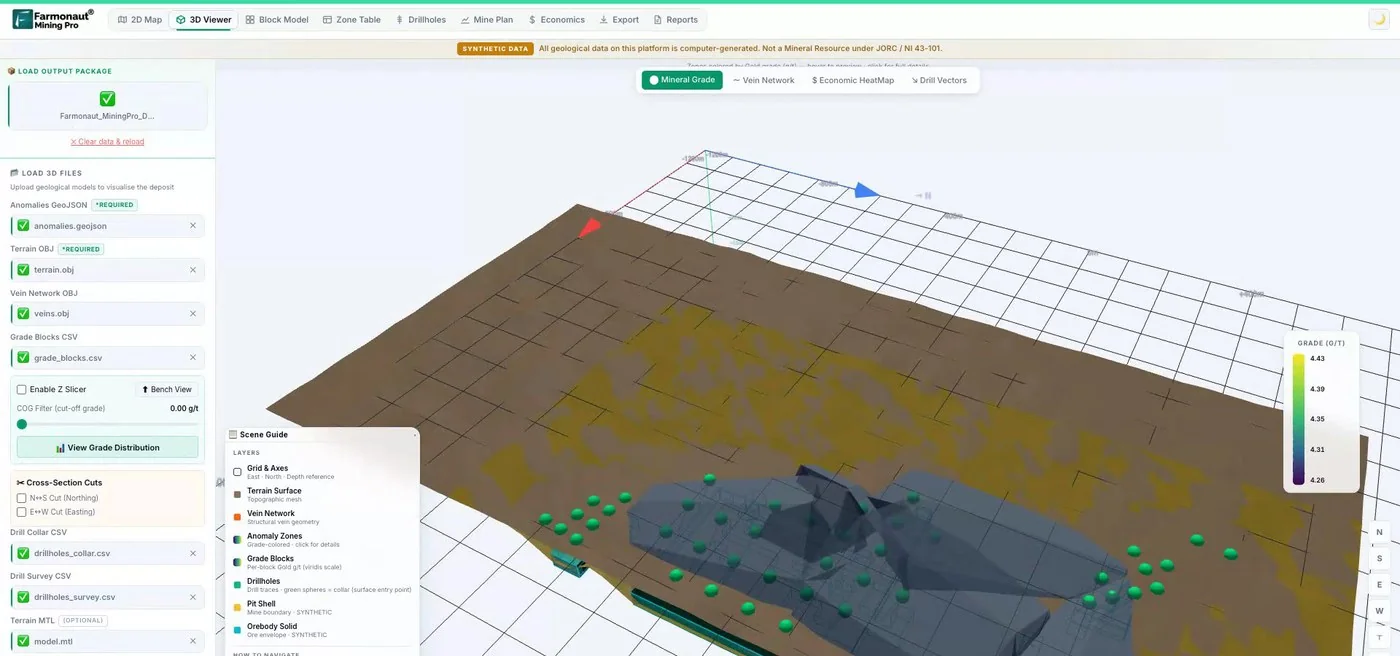
Mining Pro sample view, synthetic data
Keep reading
Sources
- EPA, Navajo Nation Abandoned Uranium Mines Cleanup: epa.gov
- EPA Region 9, Abandoned Uranium Mine Settlements fact sheet (September 2025): epa.gov
- EPA, Lukachukai Mountains Mining District: epa.gov
- EPA, news release adding Lukachukai to the National Priorities List (5 March 2024): epa.gov
- US Department of Justice, UNC and GE $63M cleanup (11 August 2025): justice.gov
- US Department of Justice, Radiation Exposure Compensation Program: justice.gov
- EPA Region 9, Navajo Nation unregulated water source sampling results, October 2009: epa.gov
- Roscoe et al., Mortality among Navajo uranium miners, American Journal of Public Health (1995): pmc.ncbi.nlm.nih.gov
- ATSDR, Navajo Birth Cohort Study: archive.cdc.gov
- High Country News, Navajos put more than 17 million acres off-limits (2005): hcn.org
- World Nuclear News, Landmark agreement clears way for restart of uranium transport (30 January 2025): world-nuclear-news.org
- World Nuclear Association, US Uranium Mining and Exploration: world-nuclear.org
- Federal Register, Roca Honda Mine Project notice (14 September 2026): federalregister.gov
- USGS, Interior releases final 2025 list of critical minerals: usgs.gov
- KRQE, Long-awaited cleanup begins at radioactive uranium mine on the Navajo Nation: krqe.com
- Cibola Citizen, State advances discharge permit for Laramide project: cibolacitizen.com
- KNAU, Navajo Nation presidential candidates discuss water rights, mining in final debate (15 October 2026): knau.org
- Rachel Carson Center, The Church Rock Uranium Mill Spill: environmentandsociety.org
Discussion
Questions, corrections or field experience? Share them below. First-time comments are reviewed before they appear, and your email is never published.
No comments yet. Be the first to add a question or your experience.

 Viahara Mining
 Mining SARL
 SenGold Invest SAS
 Sania Corporation
 Sean Mining Limited
 NTS Group (Pty) Ltd
 Mine4Africa
 Lithspo Minerals Limited
 Tintina Mining Group
 Dalgety Minerals Pty Ltd
 Vortex Minerals Pty Ltd
 Faith At Work (Pty) Ltd
 Geotech Mining Solutions plc
 Vulcan International Limited
 Kidepo Associates
 GKY Mining
 Alkimy SARL
 Double A Trading
 GemSprout Metals Limited
 Qader Group
 Ileys General Trading
 SG Gold Mining LLC
 VRV Global Pte Ltd
 Omsri International FZE










