

Opal and gold titles · Buyer guide
Opal Mining Leases for Sale: Costs and Checks
A lease sale transfers a government title, not land or opal. See who must approve the transfer in NSW, South Australia, Queensland and Western Australia, the fees regulators publish, US claim costs, and a year-one cost calculator.
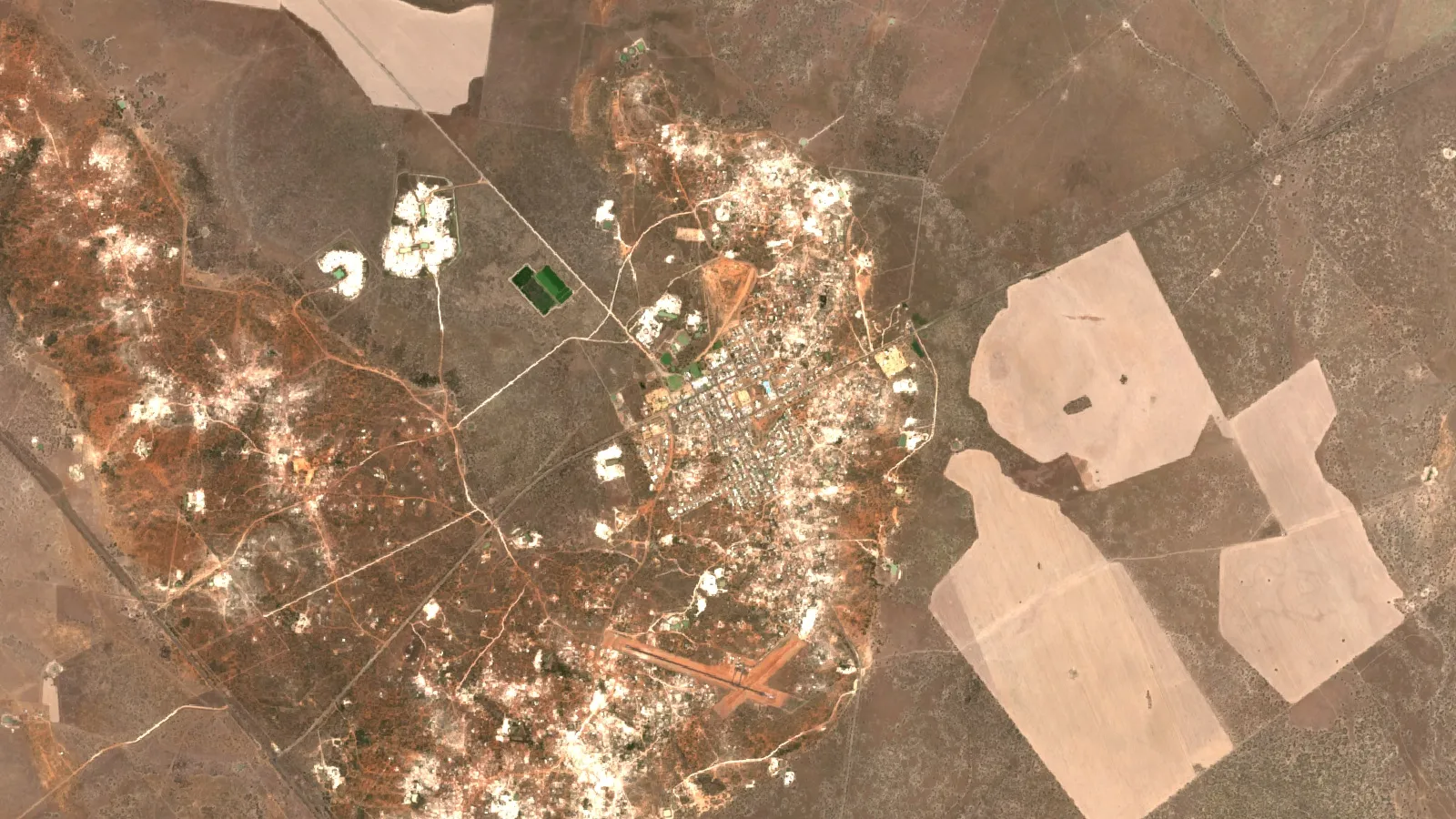
Key takeaways
- Buying a claim is not buying property or minerals; in Queensland you are not the holder until the department approves the transfer (Business Queensland, 29 September 2026).
- NSW opal claims are mostly 50 m by 50 m, one person may hold 2, and buyers face stamp duty and a security deposit usually set at A$700 (NSW Resources).
- In Western Australia a transfer needs Ministerial consent, a A$5,000 security per tenement and a A$159 fee; a 10 ha mining lease owes A$301 rent and at least A$10,000 spend (DMPE, 2026-27 schedule).
- A new US lode claim costs $274 in government fees, then $200 a year; only US citizens, or people who have declared intent to become citizens, may hold a claim (BLM, 2026).
- Satellites map the surface around a claim; only sampling and drilling prove opal or gold.
In this article
- What opal mining leases for sale actually give the buyer
- Opal claims and leases by state: size, limits and transfer route
- Mining tenements for sale: how a transfer works in Western Australia
- Mining permit for sale: what a permit can and cannot transfer
- Gold leases for sale: prices move, rent and work rules do not follow
- What a lease purchase costs in year one
- Seven checks before you pay a deposit
- Screening ground from space before you buy
- Land access and rehabilitation on opal and gold leases
- Frequently asked questions
What opal mining leases for sale actually give the buyer
Opal mining leases for sale are not sales of land or of opal in the ground. A seller hands over a government title: the right to explore for, or mine, a defined area under conditions. In Queensland the state spells it out: buying a claim is not the same as buying property or buying minerals in the ground, and you are not the holder until the department approves the transfer, even if money has changed hands (Business Queensland, reviewed 29 September 2026). The same logic runs through every opal and gold title in this guide, so the first job is to learn which kind of title is on offer and what the regulator must sign off.
The word “lease” is used loosely in listings. In practice a seller may be offering a small opal claim at Lightning Ridge, a registered precious stones claim at Coober Pedy, a prospecting licence, or a full mining lease for gold. Each has its own size, term, holding cost and transfer route. The sections below take them in turn, with the fees the regulators publish, a worked cost calculator and a short list of checks to run before any deposit is paid. Gold titles are covered here too, because gold leases are sold through the same transfer routes.
Two cautions apply throughout. A title can be cancelled or forfeited if its conditions are not met, so a low asking price can hide a debt of unpaid rent, unmet work commitments or unfinished rehabilitation. And a title is only a right to try: neither a seller nor a satellite map can promise that a claim holds opal or gold.
▶ Why owning a gold claim is not owning the land, and how to check the ground before buying a claim. · 3:19
Opal claims and leases by state: size, limits and transfer route
Opal is mined mainly under state law, and the rules differ sharply between New South Wales, South Australia and Queensland. The table sets out what each regulator publishes. It covers the small-scale titles most often advertised, not large company leases.
| Where | Title | Size and holding limits | What a buyer must know |
|---|---|---|---|
| New South Wales (Lightning Ridge, White Cliffs) | Mineral claim; opal prospecting licence inside an Opal Prospecting Block | Most claims are square, up to 50 m by 50 m (2,500 square metres); up to 2 hectares for reward claims or puddling; no one may hold more than 2 mineral claims | Newcomers must attend the mandatory opal mining courses; a qualified mine operator must be nominated; stamp duty is payable on the price; a security deposit is usually set at A$700 |
| South Australia (Coober Pedy, Andamooka) | Precious stones claim under the Opal Mining Act 1995 | Up to 20,000 square metres; needs a current precious stones prospecting permit; first registration lasts 3 months, with an extension of 12 months possible | The national business-licence portal’s transfer entry for this service reads “This permit cannot be transferred”, so ask the Opal Mining Registrar how a change of holder is handled before paying anyone |
| Queensland | Mining claim | Set by the claim conditions; search the department’s claim register for the details | Transfer needs a duty statement, an approved application, a security self-assessment and a registered suitable operator; the buyer is not the holder until approval |
New South Wales publishes the most detail for buyers. Opal prospecting is only allowed with an authorisation: an exploration licence or assessment lease, or, inside a mineral claims district, an opal prospecting licence or a mineral claim (NSW Resources, opal prospecting). Opal prospecting licences are only granted over Opal Prospecting Blocks, most of them around Lightning Ridge, with a few at White Cliffs. A mineral claim holder gets a right of way to a public road, but must mark it with posts at least every 250 m, pay for the gates and grids on it, and may not use it before 7 am or after 6 pm without the landholder’s consent (NSW Resources).
The department also warns buyers to check the claim before agreeing a price: the name of the holder, the expiry date, the location and any outstanding matter that must be fixed before a transfer can be considered (NSW Resources, transfers). A claim can be cancelled if the holder breaks a condition or the Mining Act 1992, fails to pay compensation, is convicted of a mining offence, or if the land is later found to be agricultural land or is needed for a public purpose. If a claim is cancelled, the holder has 14 days after written notice of the decision to ask the Land and Environment Court to review it.
One recent change matters for White Cliffs. The Commonwealth Attorney-General made a determination under section 26C of the Native Title Act on 8 May 2026 for the Main Field in the White Cliffs Mineral Claims District to be an approved opal and gem mining area, so grants and renewals there can restart, subject to the legislative requirements (NSW Resources, mineral claim process). A claim whose renewal was held up should be checked against that history.
A new claim is not the only route. New claims at Lightning Ridge must be marked out against a survey mark, with the compass-rose mark-out form, a possession notice on site and the landholder notified, and applications are lodged in person at the Lightning Ridge office. Buying an existing claim skips that stage but not the transfer checks above. For a wider view of mines and districts, see the Australia mineral deposits map by state.
Mining tenements for sale: how a transfer works in Western Australia
“Tenement” is the Australian word for a mining title: a prospecting licence, exploration licence, mining lease or similar grant. Western Australia publishes its fees and rules clearly, so it is a good model for what a buyer should expect elsewhere. Two ideas shape every sale. The government must consent to the transfer, and duty is charged on the deal.
Chart
Rent against minimum spend per hectare, Western Australia
A$ per hectare per year, 2026-27 schedule (prospecting licence also has a A$2,000 floor)
The Mining Act 1978 and its regulations require the prior written consent of the Minister, or an officer acting for the Minister, before a legal interest in a mining lease can be transferred or mortgaged; for exploration licences consent is needed only in the first year of the term, with some exceptions (Government of Western Australia, mining tenure dealings). A caveat recorded on the tenement stops the transfer being registered until it is removed or a Warden’s Order is obtained, and a mortgage blocks registration unless it is removed or the mortgagee consents. The lodgement package has a separate transfer form and a A$5,000 security for each tenement, plus the duty assessment certificates and the consent letter.
The cost side is public. The Department of Mines, Petroleum and Exploration lists a transfer fee of A$159 per transfer and a caveat fee of A$168 per caveat on its 2026-27 schedule, effective 1 July 2026 (DMPE, Fees and Charges 2026-27). The same schedule gives the holding costs that a buyer inherits. A prospecting licence covers up to 200 hectares for 4 years, renewable once for 4 years. A mining lease runs for 21 years and is renewable. The chart compares rent and minimum spend per hectare.
Duty is the line that surprises buyers. WA treats transactions involving mining tenements as liable for transfer duty when transferred directly, and possibly for landholder duty when transferred indirectly, for example by buying shares in a company that owns the tenement (WA Department of Finance, mining transactions). Farm-in deals, where a party earns an interest by spending on exploration, have their own treatment to avoid double duty. A buyer should ask the Office of State Revenue to assess the contract before lodging, as the transfer package requires.
The holding cost is not a minor point. WA sets a minimum annual spend on the ground (A$100 per hectare, with a floor of A$10,000, for a mining lease over 5 hectares) as set in the DMPE fee schedule, and the Mining Act has forfeiture provisions for leases that fall short (Mining Act 1978 (WA), sections 96 and 97). If the seller has underspent, ask for the expenditure record, because the new holder inherits the title and the obligation to meet it. For selling rather than buying, see how to sell a mine: valuation, buyers and deal types.
Mining permit for sale: what a permit can and cannot transfer
A listing that says “mining permit for sale” needs a close read. A permit, licence or claim is a personal grant from a government. It is not a commodity that can be moved by contract alone. In every jurisdiction above, the seller’s agreement is only the start: the regulator decides whether the buyer is allowed to hold the title, and the buyer is not the holder until it does. A seller who accepts a deposit and promises the paperwork later is asking the buyer to carry that risk.
Chart
First-year government fees for one new US lode claim
US dollars per claim; maintenance then repeats each year
Who may hold the title is a second gate. On United States federal land, a person who is a citizen, or has declared an intention to become one, may locate and hold a mining claim, and non-citizens are not permitted to own or have an interest in mining claims or sites (BLM Montana-Dakotas mining claim packet, March 2026). Queensland asks for an eligible incoming holder who can meet the claim’s obligations, and an incoming holder registered as a suitable operator. Some countries reserve small-scale licences for citizens or local companies, so read the licensing law of the country in question rather than a broker’s summary.
A US claim also shows how little a claim can include. A mining claim is a parcel of federal land on which the claimant has a right to develop and extract a valuable mineral deposit. The surface is not private property; ownership and management stay with the United States, and the public keeps conditional access across the claim (BLM, March 2026). Exploration of 5 acres or less needs a Notice of Operations, and surface disturbance over 5 acres needs a Plan of Operations. If the claim is held under a small miner waiver, a buyer who ends up with an interest in more than 10 claims nationwide, counting related parties, no longer qualifies for the waiver and owes the maintenance fee.
The chart shows the first-year government fees for a new US lode claim. The BLM lists the first-year fees as a $25 processing fee, a $49 location fee and a $200 maintenance fee, $274 in all, and the $200 maintenance fee is then due each year by 1 September (BLM, mining claim fees). For placer claims the $200 applies per 20 acres or part of it. These are only government fees; the price paid to a seller is separate. For California rules, see California gold mining claims: 9 steps to stake and hold, and for how concession rights differ abroad, what a mining concession is.
If a seller outside these systems offers a “permit” for a country you cannot verify, the safe test is the same everywhere: ask for the registry entry in the regulator’s own database, check the holder’s name matches the seller, and ask the regulator in writing whether the transfer is allowed.

▶ Whether a foreigner can get a small-scale mining licence in Africa, and the routes that are open. · 5:16
Gold leases for sale: prices move, rent and work rules do not follow
A gold lease sale is a bet on ground as much as on price, but price sets the mood. The USGS gives the annual average gold price as US$1,801 per troy ounce in 2021, US$1,802 in 2022, US$1,945 in 2023, US$2,388 in 2024 and an estimate of US$3,300 for 2025, about 83% above 2021 (USGS, Mineral Commodity Summaries 2026). The same report estimates US gold mine output at 160 tonnes in 2025, worth about US$17 billion, a 32% rise in value from 2024.
Chart
Annual average gold price
US dollars per troy ounce; 2025 is an estimate
A rising price pushes up asking prices for tenements. Duty rises with the price paid, but rent, minimum spend and security are set by the regulator’s schedule and do not follow the gold price. A buyer who pays a price that assumes high gold still owes the same rent and the same work commitments if the ground disappoints. That is why a lease with no drilling record should be priced as an exploration right, not as a mine. An exploration licence is only a right to look: in New South Wales the regulator notes that it does not permit mining, that progress to a mining lease is unlikely, and that development consent must be in force before a mining lease can be granted (NSW Resources, exploration licence).
Opal is different from gold in one practical way. There is no single quoted price: value depends on colour, pattern and size of each stone, and claim values reflect that. For that reason this page gives fees and rules, not opal valuations; a buyer should ask a qualified valuer or an experienced local miner to see recent claim sales.
What a lease purchase costs in year one
The cash needed in the first year is more than the price. It includes duty on the deal, the transfer fee, the security the regulator asks for, a year of rent and the minimum spend on the ground. The calculator adds these using Western Australian mining lease numbers as defaults, so you can swap in the figures for your own tenement. Prices and duty rates are inputs, and the defaults are examples, not quotes.
A worked example with the schedule figures: a 10 hectare mining lease in WA pays rent of A$30.10 per hectare, which is A$301 a year, and a minimum spend of A$10,000 because the lease is over 5 hectares. Add the A$159 transfer fee and the A$5,000 security, and the holding side of the purchase is about A$15,460 before duty and before the price itself. NSW opal claims have a smaller footprint, with a security of about A$700 and duty on the price, so the same calculator works with those numbers typed in.
Calculator
What does the first year of a lease cost?
Enter your own price, area and fees; defaults show a 50 ha WA mining lease.
- Duty at your rate (A$): $5,000
- Year-one rent (A$): $1,505
- Minimum spend on the ground (A$): $10,000
- Holding cost without the price (A$): $16,664
Example values only, not a quote or benchmark. Defaults use the WA 2026-27 schedule (DMPE): rent A$30.10 per ha, minimum spend A$100 per ha with a A$10,000 floor over 5 ha (A$5,000 floor for 5 ha or less: change the floor field), A$5,000 security and a A$159 transfer fee. The purchase price and duty rate are examples: use the real price and ask the state revenue office for the duty.
Seven checks before you pay a deposit
- Find the title in the official register. Use the state or federal system: MinView in NSW, Mineral Titles Online in WA, the claim search in Queensland and the Mineral and Land Records System for US claims. Confirm the holder, status, expiry and serial number.
- Ask for the expenditure and rent record. Unpaid rent or unmet spend can lead to cancellation or forfeiture, and the buyer inherits the title as it stands.
- Search for caveats, mortgages and encumbrances. In WA either one blocks registration until it is cleared.
- Ask who must approve the transfer. Ministerial consent in WA, departmental approval in Queensland, and BLM filing in the US.
- Price the duty and the security before you sign. They sit on top of the price.
- Check land access and native title. Landholder notices, rights of way and, in Australia, native title steps may apply (Queensland asks for evidence that native title requirements have been met).
- Check the ground, not just the paper. Look at the geology, past workings, drilling and rehabilitation liabilities before you pay a premium.
Screening ground from space before you buy
Satellites cannot see opal or gold at depth. What they can show is the surface around a claim: rock and soil types, iron and clay alteration, faults, past workings, vegetation and land cover. Sentinel-2 scenes are public, and a buyer can use them to see whether a tenement sits on ground that matches the district’s known deposits and whether disturbed ground is already present. Farmonaut offers satellite mineral screening of a boundary file as part of its satellite mineral detection service, and a licence owner or buyer can ask for a quote. The results are exploration targets, not a resource estimate.

▶ How satellites help in exploration: they map the rock around gold rather than the gold itself. · 4:25
Land access and rehabilitation on opal and gold leases
Opal and gold leases can sit on land held by someone else, so the surface relationship matters as much as the minerals. In NSW, mineral claim holders must notify landholders before applying, must keep to rights-of-way rules, and can lose a claim if the land is found to be agricultural land. Opal claims carry a rehabilitation obligation under their conditions, which is why the regulator takes a security deposit and sets rehabilitation standards for claims that are cancelled. In Queensland, a transfer application is assessed against whether the outgoing holder has met council rates, charges and outstanding non-compliance actions, and the buyer must complete a small-scale mining security calculation with a sketch of structures and workings.
For a buyer, the practical lesson is to count rehabilitation as a cost. A claim with open shafts, tailings or unfilled workings carries a cost that the price should reflect. Ask the regulator for the claim’s conditions, and walk the ground with the holder before the transfer, noting any dwellings or structures on it. NSW has a separate fact sheet for mineral claims that contain dwellings.
Frequently asked questions
Can I buy an opal mining lease?
You can apply to take over a title, but you cannot buy one by contract alone. In Queensland you are not the holder until the department approves the transfer, and in NSW newcomers must complete the mandatory opal mining courses before a claim is transferred to them.
How many opal claims can one person hold in NSW?
No more than 2 mineral claims at one time. Most claims are square and up to 50 m by 50 m, with larger areas up to 2 hectares allowed for reward claims or puddling operations.
Which taxes and fees apply when a mining tenement is sold?
Duty is the main one. In NSW stamp duty is payable on the price paid for a mineral claim; in Queensland a dutiable transaction statement goes to the Queensland Revenue Office; in WA, transfers are liable for transfer duty and indirect sales may attract landholder duty. Add the regulator’s transfer fee, such as A$159 in WA.
What does a mining tenement sale need in Western Australia?
A transfer form for each tenement, a A$5,000 security for each, the duty assessment certificates and the Minister’s consent, which is generally required before a legal interest is transferred. A caveat or mortgage must be cleared first.
Is a mining permit for sale the same as owning the land?
No. A US mining claim leaves the surface in federal ownership, and a Queensland claim sale is explicitly not a property sale. Check the surface owner and access rights separately.
Can a foreigner buy a US mining claim?
The BLM states that only US citizens, or people who have declared an intention to become citizens, may locate and hold a claim, and non-citizens are not permitted to own an interest in claims or sites.
How much does it cost to hold a US mining claim?
A new lode claim costs $274 in the first filing: $25 processing, $49 location and $200 maintenance, then $200 a year by 1 September. Holders of 10 or fewer claims can file a small miner waiver instead, with $100 of annual work and a $15 processing fee per claim.
What happens if the holder does not pay rent or spend the required money?
The title can be cancelled or forfeited. NSW lists breach of conditions as a ground for cancelling a mineral claim, and the WA Mining Act has forfeiture rules for leases.
Can satellite imagery tell me if a claim has opal or gold?
No. It maps surface geology, alteration, structures and land cover that can be compared with known deposits, which helps decide where to look first. Only sampling and drilling prove metal or stones.
Where can I check who holds a title?
Use the official register: MinView for NSW, Mineral Titles Online for WA, the department’s claim search in Queensland, and BLM’s Mineral and Land Records System for US claims.
This page is for information only. It is not legal or investment advice. Confirm title, fees and transfer rules with the regulator and a solicitor before paying a deposit. Fossicking and prospecting need permission from the landholder and the right licence.
Farmonaut mining
Screen the ground before you buy
Send a boundary file to see what satellite imagery shows around a lease before you commit money.

Mining Pro sample view, synthetic data
Keep reading
Sources
- BLM, Mining Claim Fees: blm.gov
- BLM Montana-Dakotas, Mining Claim Packet (12 March 2026): blm.gov
- Government of Western Australia, DMPE Fees and Charges 2026-27: wa.gov.au
- Government of Western Australia, Mining tenure dealings: wa.gov.au
- WA Department of Finance, Mining transactions (duty): finance.wa.gov.au
- Mining Act 1978 (Western Australia), consolidated text: wa.gov.au
- Business Queensland, Buying a mining claim (29 September 2026): business.qld.gov.au
- NSW Resources, Opal prospecting: resources.nsw.gov.au
- NSW Resources, Mineral claim application and renewal process: resources.nsw.gov.au
- NSW Resources, Transfers, cancellations and suspensions: resources.nsw.gov.au
- NSW Resources, Apply for an exploration licence: resources.nsw.gov.au
- ABLIS, Registration of a Precious Stones Claim, South Australia: ablis.business.gov.au
- USGS, Mineral Commodity Summaries 2026, Gold: pubs.usgs.gov
Discussion
Questions, corrections or field experience? Share them below. First-time comments are reviewed before they appear, and your email is never published.
No comments yet. Be the first to add a question or your experience.

 Mulopwe Metals Mining Ltd
 Tintina Mining Group
 Dalgety Minerals Pty Ltd
 Vortex Minerals Pty Ltd
 Faith At Work (Pty) Ltd
 Geotech Mining Solutions plc
 Vulcan International Limited
 Kidepo Associates
 GKY Mining
 Alkimy SARL
 Double A Trading
 GemSprout Metals Limited
 Qader Group
 Ileys General Trading
 SG Gold Mining LLC
 VRV Global Pte Ltd
 Omsri International FZE
 G.I.T.T.
 Jaunita Erss Ltd
 Almosi SARL
 SRK Consulting
 Berks Gold Limited
 Mwerezi Minerals Company Limited

 Exploration consultancy · South Africa · Gold










