

Mining concessions · Guide
What Is a Mining Concession? Rights, Terms, Costs
A mining concession is a state grant to explore or mine a mapped area for a set term. See how it differs from a licence, claim or lease, how seven jurisdictions grant it, and what it costs to hold.
Key takeaways
- A mining concession is a right from the state to explore or mine an area on condition of fees and work; Peru’s covers 100 to 1,000 hectares and carries no surface rights (SNMPE Mining Investment Handbook, 2017 edition).
- Mexico’s 2023 reform moved concessions to public bidding and cut the term from 50 years plus 50 to 30 years plus 25 (Norton Rose Fulbright).
- The DRC’s 2018 Mining Code set exploitation permits at 25 years with 15-year renewals and exploration permits at five years, renewable once (Gide, May 2019).
- Holding costs differ widely: US$200 per US lode claim (BLM, unchanged for the 2027 assessment year), C$400 of work per Ontario cell a year (Ontario Ministry of Mines, 2023), US$3 per hectare in Peru (INGEMMET, 2018).
- Chile’s exploitation patent rises from 4/10 UTM per hectare in the first five years to 12 UTM per hectare from year 31 where no qualifying works exist (AZ Abogados).
In this article
- What a mining concession is, and what it is not
- Concession, licence, claim, lease: how the terms differ
- How concessions are granted
- Terms and costs in seven jurisdictions
- How long a concession lasts
- What changed after the Mexico and DRC reforms
- Rights a concession holder gets
- Obligations that keep it alive
- Chile's patent climbs with every five years of holding
- Estimate what it costs to hold a concession
- Who can hold a concession
- What licence holders and investors should check before buying
- Frequently asked questions
A mining concession is a right granted by the state to explore for or extract minerals inside a mapped area, for a set period, on condition that the holder pays fees and keeps to work and reporting rules. The term varies by country. Mexico now grants concessions for 30 years with one renewal of 25 years (Norton Rose Fulbright), while Peru’s unit is a block of 100 to 1,000 hectares that does not carry any surface rights (SNMPE Mining Investment Handbook, 2017 edition).
This page is written for licence holders, consultants and investors. It sets concessions beside licences, claims and leases, shows how seven jurisdictions grant them and what each costs to keep, and ends with a holding-cost calculator and a short due diligence list. For the application steps in a single country, see our guide to mining licences and how to get one, and for the online registers, our list of mining cadastre portals by country.
What a mining concession is, and what it is not
Most countries keep the ownership of minerals in the ground with the state. A private company or person therefore needs a grant before it can dig. “Concession” is the word many countries, especially in Latin America and francophone Africa, use for that grant. English-speaking countries more often say licence, permit, lease or claim. The label matters less than the content: an area, a bundle of rights, a term and a list of duties.
Three features separate a concession from an ordinary contract or a land purchase:
- It is a right in the minerals, not in the land. Peru’s handbook states that the concession is a right distinct and separate from the property rights over the ground where it sits, and that it does not grant surface rights (SNMPE, 2017). The holder still has to deal with the landowner or community.
- It has a defined area. Peru describes the area by UTM coordinates (a map grid) in blocks of 100 to 1,000 hectares. A US lode claim is up to 1,500 feet by 600 feet (US Bureau of Land Management). Western Australia, Ontario and Chile each have their own grid.
- It lasts only while the holder keeps its promises. Fees, minimum work, reports and permits keep it alive. Miss them and the state can cancel it. Peru’s regulator, for example, cancels concessions for unmet obligations and keeps the national register (EITI Peru).
A concession is not a permit to operate. Environmental approvals, water rights, community agreements and a mining plan usually come on top. Mexico’s 2023 reform makes this explicit: the winner of a bid receives the title only after the environmental, social and labour permits are in place (Norton Rose Fulbright).
Concession, licence, claim, lease: how the terms differ
There is no world standard. The table shows how the words are commonly used in the jurisdictions covered on this page. Always read the local act, because the same word can mean different things in two countries.
| Term | Where you meet it | What it usually gives | How it is kept |
|---|---|---|---|
| Concession | Mexico, Peru, Chile, many francophone African countries | The right to explore, to exploit, or both, in a mapped area. Peru: explore and exploit at indefinite depth within the vertical planes of the block. | Annual fee or patent, minimum work or output, reports |
| Licence or permit | Western Australia, Tanzania, DRC (exploration and exploitation permits) | Exploration licences allow search work; a separate lease or exploitation permit allows mining. Tenure is time-limited. | Rent, spending commitments, reporting |
| Claim | United States, Ontario | The US claim gives the right to develop the minerals on public land under the 1872 General Mining Law and could once be patented to convey full title, but Congress has blocked new patents through the annual Interior spending bill since FY1995 (Congressional Research Service, 2009 report). In Ontario a claim is registered online. | US: annual fee per claim. Ontario: assessment work each year |
| Lease | Western Australia, Ontario, US federal coal and other leasable minerals | The right to mine, usually after exploration. A WA mining lease runs 21 years and can be renewed for a further 21 (DMPE Fees and Charges 2026-27). | Rent, royalties, conditions |
| Mining title | Used everywhere as a general word | The document or register entry that proves a right exists. Peru, Tanzania and others keep the register in an online cadastre (EITI). | Depends on the underlying right |
In short: concession and licence are two names for the same idea in different legal families, a claim is a right you obtain by staking, and a lease is normally the stage where mining is allowed. When a news release or a sale agreement says “concession”, ask which of these it is and what it permits.
How concessions are granted
States use three methods. Knowing which one applies tells you whether ground is open, how competitive it is and how long the wait will be.
| Method | How it works | Where it applies |
|---|---|---|
| First come, first served | The first valid application for open ground wins. Priority is set by the filing time on the cadastre. | Peru (INGEMMET) and Tanzania (Mining Commission), according to EITI. The United States works similarly for claims on open federal land. |
| Public bidding | The state offers a lot and picks a winner. Winners often must secure permits and consult communities first. | Mexico since May 2023, although the government has kept a moratorium on new grants (Chambers Mining 2026). Before then, concessions went to the first applicant. Mexican private parties may submit data, but exploration is carried out by the Mexican Geological Service (Norton Rose Fulbright). |
| Staking and online registration | The applicant selects cells on a map and registers the claim. | Ontario, where claims are registered and assessment work is reported online through MLAS (Ontario.ca). See our guide to MLAS and Ontario claims. |
In Peru, a standard concession form is published by INGEMMET, and stability contracts can lock in the financial and economic terms agreed at signing (EITI Peru). EITI notes that Tanzania runs an online mining cadastre, but the public could not get the credentials to open it, and mining contracts and licences were not publicly available at the time of its assessment (EITI Tanzania).
Terms and costs in seven jurisdictions
The table gives the headline term and the main cost to keep ground. Figures come from the sources named and carry their dates. Fees set in local units, such as Chile’s UTM, are shown in those units.
| Jurisdiction | Title | Term | Main cost or duty |
|---|---|---|---|
| United States (federal land) | Unpatented lode or placer claim | No fixed term while fees are paid | US$200 per lode claim; US$200 per 20 acres or part of a placer claim (BLM, effective 1 September 2025 and unchanged for the 2027 assessment year starting 1 September 2026) |
| Ontario, Canada | Cell mining claim | Renewed through annual assessment work | C$400 of assessment work per cell per year (Ontario Ministry of Mines, 2023) |
| Mexico | Mining concession | 30 years plus one renewal of 25 years | Permits before title; transfers need Ministry of Economy approval |
| Chile | Exploration concession | 4 years, renewable for up to 4 more | Annual patent of 3/50 of a UTM (monthly tax unit) per hectare (AZ Abogados) |
| Chile | Exploitation concession | Patent paid every year; geology reports every two years | Patent from 1/10 UTM per hectare with qualifying works, rising to 12 UTM per hectare for old ground without works |
| Peru | Mining concession | Held while the fee is paid and output targets are met | Good standing fee of US$3.00 per hectare a year (US$1.00 and US$0.50 for small and artisanal producers), minimum output of 1 UIT (tax unit) per hectare by year ten, then penalties of 2%, 5% and 10% of that output in years 11-15, 16-20 and 21-30 (INGEMMET, 2018) |
| DR Congo | Exploration permit; exploitation permit | 5 years, renewable once; 25 years, renewable by 15-year periods | Exploitation permit: 10% non-dilutable state shares on application or transfer, plus 5% on each renewal (Zhong Lun Law Firm) |
| Western Australia | Prospecting licence; exploration licence; mining lease | 4 years; 5 years; 21 years with a 21-year renewal | Prospecting licence: rent A$4.40 per hectare and minimum spend A$40 per hectare (at least A$2,000). Exploration licence: rent A$79 per km2 and minimum spend A$300 per km2 (at least A$20,000), both for years 1-7 (DMPE Fees and Charges 2026-27, effective 1 July 2026) |
The Peru fee and penalty figures come from INGEMMET’s 2018 presentation of Supreme Decree 011-2017-EM; the block size and surface-rights point come from the SNMPE handbook. The DRC share transfers were introduced by the 2018 revision of the Mining Code and are described in a recent law firm analysis (Zhong Lun, via Law.asia).
How long a concession lasts
The chart compares the first term of the titles that have a fixed length. Peru, Chile’s exploitation concession and the US claim are left out because they run for as long as the holder meets the conditions, not for a set number of years.
Chart
First term of titles with a fixed length
Years, selected jurisdictions (Mexico concession, DRC permits, Western Australia licences and lease, Chile exploration concession)
What changed after the Mexico and DRC reforms
Two reforms in the last decade show how quickly the rules can move. Mexico’s reform was published on 8 May 2023. It ended first-come-first-served grants, cut the initial term from 50 years to 30 and the renewal from 50 years to 25, and lengthened the time the Ministry of Economy has to check compliance and impose penalties from five to ten years (Norton Rose Fulbright). The DRC’s 2018 revision reduced exploitation permits from 30 years to 25, and replaced the older system for exploration (five years renewable twice) with five years renewable once (Gide Loyrette Nouel, May 2019).
Chart
Concession terms before and after reform
Years; Mexico reform of 8 May 2023, DRC Mining Code revision of 2018
For a holder, the practical lesson is that a concession’s terms are those of the law in force when you buy or renew, and the state may change the rules for new grants. Mexico’s reform also warns that existing contracts may be affected, so investors should review how change-in-law clauses work (Norton Rose Fulbright).
Rights a concession holder gets
The rights below are the common core. Local law adds to them or takes some away.
- Exclusive access to the minerals in the area. The holder is the only party allowed to explore or mine the covered minerals there. Peru’s concession covers exploration and exploitation to an indefinite depth within the block (SNMPE, 2017).
- A tradable asset, with limits. Concessions can usually be sold, mortgaged or joint-ventured, although consent is often needed. In Mexico, a transfer needs prior approval from the Ministry of Economy. In the DRC, transfers trigger the 10% state share requirement.
- Renewal of the mining right. A Western Australian mining lease runs 21 years and is renewable (DMPE Fees and Charges 2026-27). Many countries follow the same ladder from exploration to exploitation.
- Stronger title in some older systems. A US claim could once be patented to convey full title, but Congress has blocked new patent applications since FY1995, so new US claims stay unpatented (CRS, 2009).
What a concession does not give is just as important. It does not grant the surface, an operating permit, or a right to the water. Mexico’s reform also puts water for human and domestic use first, so a mining water concession can be cut or cancelled to protect that supply (Norton Rose Fulbright).
Obligations that keep it alive
Five duties keep a concession alive. Put these dates in a calendar on the day you buy.
- Pay the fee or patent. Peru’s fee is due before 30 June each year; the US federal fee is paid each year per claim unless a small-miner waiver is filed (BLM).
- Do the work. Ontario needs C$400 of assessment work per cell each year (Ontario Ministry of Mines, 2023), or a payment in place of the work (Ontario.ca). Peru requires a minimum yearly output per hectare before the end of year ten, with penalties from year eleven and, for concessions titled since 2009, expiry if the target is still unmet at year 30 (INGEMMET, 2018).
- Report. In Chile, exploration concession holders must file their geological information with the national geology service within 30 days of ending a concession and every two years for exploitation concessions, once the implementing rules are issued (AZ Abogados).
- Hold the permits. Mexico makes permits a condition of receiving the title, and the DRC, Chile and Peru add environmental and community obligations on top.
- Know the end date. A Mexican concession allows one renewal only, after which the holder can bid again; Norton Rose Fulbright notes that existing Mexican concessions are not cancelled by the reform itself. Diary the expiry and the renewal request well ahead of it.
Chile’s patent climbs with every five years of holding
Chile shows how a state can use the fee to push holders from holding to working. Under Law 21,649, exploitation concessions that are not covered by the reduced-rate cases pay a patent that rises from 4/10 of a UTM per hectare in the first five years to 12 UTM per hectare from year 31 (AZ Abogados). A concession with qualifying works, for example, pays the reduced 1/10 UTM per hectare. A government bill (Boletin 18.259-08), being debated in the Senate mining committee in August 2026, would end this progressive scale and set a flat 0.4 UTM per hectare for ground that does not qualify for the reduced rate (Reporte Minero, August 2026). Check the current rule with Sernageomin before you budget.
Chart
Chile: annual patent on exploitation concessions without qualifying works
UTM (monthly tax unit) per hectare, by years since grant
Estimate what it costs to hold a concession
The calculator below adds up the yearly fee on a block and your own annual work or admin spend, and shows the fee for a set of US lode claims alongside for comparison. Enter the fee your regulator currently charges. The default of US$3 per hectare is the Peruvian good standing fee set out by INGEMMET, used only as an example.
Calculator
What will it cost to hold your ground?
Enter your own area, fee, years and annual spend.
- Fees only (US$): $15,000
- Work or admin spend (US$): $200,000
- Fees per hectare per year (US$): 3.00
- US claims fees alone over the same years (US$): $20,000
Example values only, not a quote. The default fee of US$3 per hectare per year is the Peruvian good standing fee in INGEMMET’s 2018 presentation, and US$200 per claim is the BLM lode claim fee effective 1 September 2025 (unchanged for the 2027 assessment year); use the current rate from your regulator. Fees are held flat for all years; local currencies and escalating schedules (for example Chile’s) are not modelled.
Who can hold a concession
Foreign companies usually need a local entity or a state approval. The DRC requires Congolese natural persons to hold at least 10% of the shares of a mining company (Zhong Lun, via Law.asia), and Mexico reviews transfers. If you are a foreign individual looking at small-scale ground in Africa, the video below explains the three routes that are normally open.

▶ Whether a foreigner can get a small-scale mining licence in Africa, and the three routes that are open. · 5:16
What licence holders and investors should check before buying
Treat a concession like any asset: verify the paper, the ground and the cash needs. A short list:
- Title and register. Find the concession on the official cadastre and confirm the holder, area, status and expiry. Our cadastre portal guide lists registers by country.
- Fees paid to date. Ask for the payment receipts. Unpaid fees can cancel a concession.
- Work done against what is owed. Check assessment work credits, output targets and reports against the local rules.
- Overlaps and restrictions. Look for protected areas, other tenure, water rights and community land that sit on top of the block.
- Transfer rules. Confirm whether the state must consent and whether it takes shares, fees or a premium on transfer.
- Ground quality. A valid title is not a deposit. Satellite imagery can map surface alteration, structures and vegetation stress across a whole concession before any drilling, and it shows where to spend the first field dollar. Results are exploration targets that sit ahead of a resource estimate, not a resource or reserve. Farmonaut offers a satellite mineral detection report for a licence boundary, and you can request it through the mining quote form.
For Tanzania specifically, see our note on gold exploration in Tanzania and its licences.
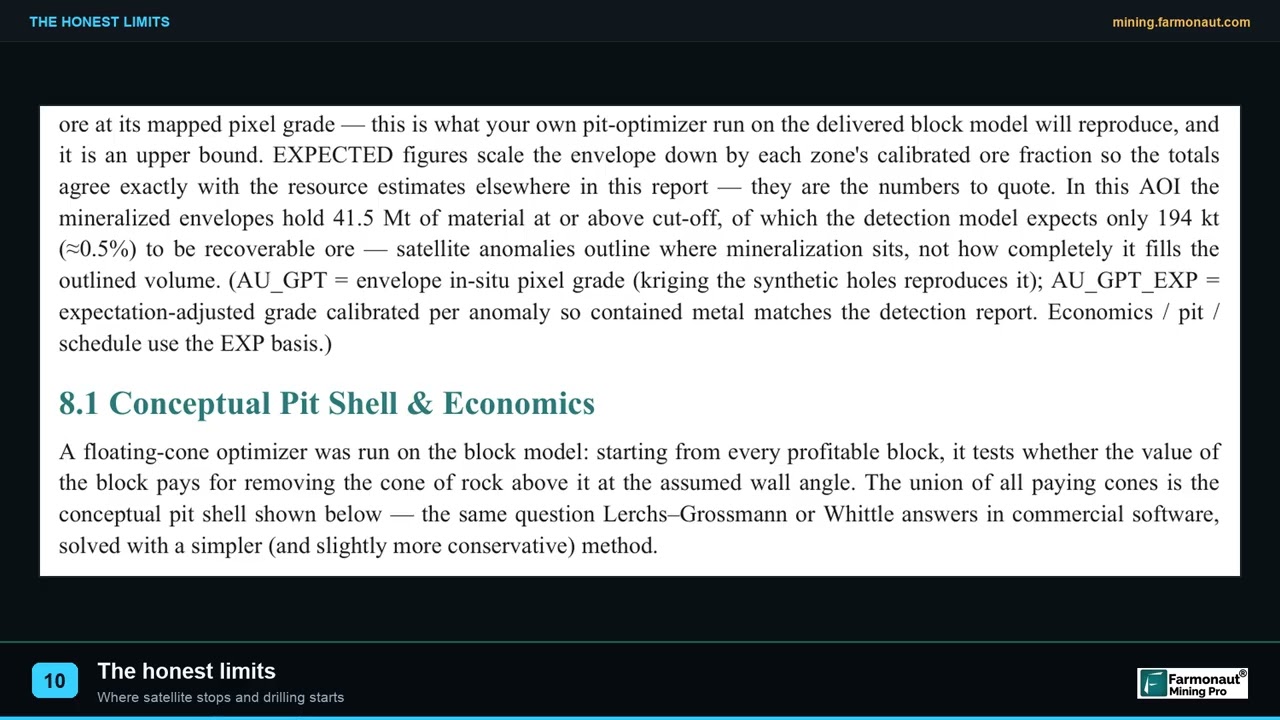
▶ What satellite exploration can and cannot show, and why those limits matter in mining due diligence. · 2:08
If you hold a concession and want to exit, our guide on how to sell a mine or mining property covers valuation, buyers and option deals.
Frequently asked questions
What is a mining concession?
It is a right from the state to explore for or extract minerals in a defined area for a set period, in return for fees and work. In Peru it covers exploration and exploitation to an indefinite depth within the block but gives no surface rights (SNMPE, 2017). In Mexico it lasts 30 years with one renewal of 25 (Norton Rose Fulbright).
What are mining concessions in simple terms?
They are the state-granted permissions that let a company or person mine ground the state owns the minerals under. Different countries call them concessions, licences, leases or claims, but each one bundles an area, a set of rights, a term and duties.
What is a mining title?
A mining title is the document or register entry that proves a mining right. It can be a concession, a licence, a lease or a claim. Peru and Tanzania keep their titles in online cadastres (EITI; Tanzania’s is open only to licence holders), and the United States records federal claims with the Bureau of Land Management.
What is the difference between a mining concession and a mining claim?
A US claim is made by staking on open public land under the 1872 General Mining Law and kept by paying an annual fee. A concession is generally granted by an agency after an application or a bid, with a term and work duties. Ontario sits between the two: you stake cells online, but you must do assessment work each year.
What is the difference between a concession and a mining lease?
A lease normally allows actual mining and follows an exploration licence. Western Australia’s mining lease runs 21 years with a further 21-year renewal (DMPE Fees and Charges 2026-27). A concession can cover exploration, exploitation or both, depending on the country.
Does a concession give me the surface of the land?
No. Peru says the concession is separate from the surface property, and Mexico’s 2023 reform removed the holder’s right to request land access and surface rights, adding permits and consultation before a title is issued (Norton Rose Fulbright). You must still agree access with the landowner or community.
How long does a mining concession last?
It depends on the country. Mexico gives 30 years plus 25 (Norton Rose Fulbright), the DRC 25 years for exploitation permits with 15-year renewals (Gide, 2019), and Western Australia 21 years for a mining lease. Peru and the US have no fixed end date while the holder pays fees and meets conditions.
Can a mining concession be cancelled?
Yes. Non-payment of fees, missed work or output targets, or failure to file reports can end it. Peru’s concession expires if the minimum production target is still not met at year 30 for concessions titled since 2009 (INGEMMET, 2018); the penalty starts in year 11. Mexico lengthened the period in which the state can check compliance and impose penalties from five to ten years.
Can I buy or transfer a mining concession?
Often yes, with state approval. Mexico requires Ministry of Economy approval for any transfer. The DRC requires 10% non-dilutable state shares when mining rights are transferred (Zhong Lun, via Law.asia).
Can satellite data help me evaluate a concession?
It can screen the ground, for example by mapping iron-oxide and clay alteration and fault lines across the licence. Satellite results are exploration targets and do not replace drilling, sampling or a qualified person’s report.
This page is for information only. It is not legal or investment advice. Mining law, fees and terms change; confirm the current rules with the regulator and a local lawyer before you buy, transfer or renew a concession.
Farmonaut mining
Screen a concession from space before you buy
Licence owners can request a quote for a satellite report that maps alteration and structure inside a concession boundary as exploration targets, ahead of any resource estimate.

Mining Pro sample view, synthetic data
Keep reading
Sources
- Norton Rose Fulbright, Major overhaul to Mexico’s mining regulation: nortonrosefulbright.com
- SNMPE, Peru Mining Investment Handbook (first edition, February 2017): pdac.snmpe.org.pe
- AZ Abogados, Modification to Chile’s mining legal framework: az.cl
- US Bureau of Land Management, Mining claim fees effective 1 September 2025: blm.gov
- Congressional Research Service, Mining on Federal Lands: Hardrock Minerals (RL33908, 2009): everycrsreport.com
- EITI, Peru: eiti.org
- EITI, Tanzania: eiti.org
- Gide Loyrette Nouel, DRC mining code revision (May 2019): gide.com
- Zhong Lun Law Firm via Law.asia, Analysis of revised Mining Code in the DRC: law.asia
- Ontario.ca, Mining sequence: exploration: ontario.ca
- Ontario Ministry of Mines, New assessment work policies (2023): ero.ontario.ca
- INGEMMET, Vigencia de las concesiones mineras: derecho de vigencia y penalidad (2018): portal.ingemmet.gob.pe
- Western Australia DMPE, Fees and Charges 2026-27 (Mining Act 1978 tenements): wa.gov.au
- Reporte Minero, Senado analiza reforma: fin a la escala progresiva (August 2026): reporteminero.cl
- US Bureau of Land Management, 2027 Mining Season notice: blm.gov
Discussion
Questions, corrections or field experience? Share them below. First-time comments are reviewed before they appear, and your email is never published.
No comments yet. Be the first to add a question or your experience.

 Timestream Mining
 Lithspo Minerals Limited
 Tintina Mining Group
 Dalgety Minerals Pty Ltd
 Vortex Minerals Pty Ltd
 Faith At Work (Pty) Ltd
 Geotech Mining Solutions plc
 Vulcan International Limited
 Kidepo Associates
 GKY Mining
 Alkimy SARL
 Double A Trading
 GemSprout Metals Limited
 Qader Group
 Ileys General Trading
 SG Gold Mining LLC
 VRV Global Pte Ltd
 Omsri International FZE
 G.I.T.T.
 Jaunita Erss Ltd
 Almosi SARL
 SRK Consulting
 Berks Gold Limited
 Mwerezi Minerals Company Limited

 Exploration consultancy · South Africa · Gold










