

Drilling methods · Comparison guide
Reverse Circulation vs Diamond Drilling Compared
RC drilling returns crushed chips quickly and cheaply; diamond drilling returns solid core with structure. Real figures from OceanaGold’s Macraes mine and a July 2026 Yukon report show recovery, cost and when to use each.
Key takeaways
- At Macraes, 95% of drilling is RC and 5% is sampled core; each 1 m RC interval is split to 2 to 4 kg for the lab (OceanaGold JORC Table 1, October 2019).
- OceanaGold stops RC holes that go wet and finishes them with a diamond tail, because wet RC sampling at Macraes is prone to grade bias (OceanaGold, 2019).
- Core recovery averaged 96.4% over 4,765 runs at Rhosgobel, Yukon (Sitka Gold technical report, July 2026).
- Core drilling is the most expensive method and RC the quicker, cheaper one (Geological Survey Ireland); extras such as helicopters and camp raise the all-in rate.
- Sitka budgets C$400 per metre all-in for summer diamond drilling and C$700 for winter (July 2026); the calculator prices an RC precollar against an all-core hole.
In this article
- Reverse circulation vs diamond drilling at a glance
- How reverse circulation drilling works
- How diamond core drilling works
- Which gives the better sample: chips or core?
- Drilling cost per metre: RC compared with core
- When to choose RC, core or both
- RC precollar with a diamond tail
- Keeping drill data in one place
- Two real programmes: Macraes and the RC Gold Project
- Choosing hole locations before you drill
- Frequently asked questions
Reverse circulation (RC) drilling crushes rock with an air-driven hammer and brings the chips to the surface through the rod, so you get fast, low-cost samples but no intact rock. Diamond drilling cuts a solid cylinder of rock, called core, so you get structure, density and a sample you can re-assay, but it is slower and costs more per metre. Many exploration programmes use both: RC to test many targets cheaply, and core where the geology has to be understood. At OceanaGold’s Macraes gold project in New Zealand, 95% of the drilling was RC and the other 5% was sampled core (OceanaGold JORC Table 1, October 2019).
This page compares the two methods the way a project geologist or a consultant would: what each one returns, how reliable the sample is, what a metre costs, when each one is the right tool, and how to combine them. It uses real figures from a JORC Table 1 report, a July 2026 technical report from Yukon, a geological survey and a conference paper, and ends with a calculator that prices an RC precollar against an all-core hole. Money figures are in the currency each source uses.
A note on the name. “Diamond drilling” has nothing to do with drilling for gem diamonds. It means the bit is set with industrial diamonds, which cut hard rock. For a deeper look at core diameters, see our guide to diamond drill core sizes.
Reverse circulation vs diamond drilling at a glance
The table sets the two methods side by side. The figures in it come from the sources named in the later sections.
| Question | RC drilling | Diamond (core) drilling |
|---|---|---|
| What comes up | Crushed chips, centimetre to millimetre in size | A solid cylinder of rock, stored in trays about 1 m long |
| Typical sample | 1 m interval, split to 2 to 4 kg for the lab (Macraes) | Core sawn in half; half is assayed, half is kept (Macraes) |
| Hole size in a real project | 135 mm face-sampling hammer (Macraes) | HQ triple-tube core (about 61 to 64 mm), NQ core 47.6 mm in poor ground |
| Structure and orientation | Not recorded; chip logging cannot fix a contact exactly | Fractures, veins, contacts and rock strength can be logged |
| Water | Needs no water to drill, but wet holes can bias samples | Needs a steady water supply to cool the bit |
| Speed | Quick; one maker cites about 150 m in a good 12-hour shift | Slow; the same maker cites about 30 m |
| Cost per metre | Lower; no dated public rate found | Higher; one 2026 budget: C$400 to C$700 all-in |
| Best for | Testing many targets, grade control, dry holes | Understanding geology, geotechnical work, wet or broken ground, high-value intersections |
How reverse circulation drilling works
RC drilling uses a dual-wall pipe: a pipe inside a pipe. Dando, a drill-rig maker, describes compressed air pumped down between the two tubes to the bit, where it forces the cuttings back up inside the inner tube, out of the rotary head and along a hose to a cyclone, a funnel-shaped separator that drops the sample into a collector. Most RC bits are hammers, which break rock by repeated blows; a tricone bit, which grinds, is used in softer ground or when the hammer stops working in water. Earth Science Australia explains why: below the water table, the water in the formation cushions a hammer bit and makes it much less effective at shattering rock, while tricone bits are slower in hard rock but work well in soft or wet ground. It also notes that RC needs much larger equipment, including a high-capacity air compressor.
Geological Survey Ireland (GSI) describes RC as a quicker and less expensive form of drilling that returns small rock chips, and notes two practical advantages. It is relatively insensitive to ground conditions such as broken rock, permafrost and glacial till, and it needs no water, which matters where local water is scarce. GSI also points out that in Irish mineral exploration diamond drilling is by far the most popular method, and that much of the RC work there is done for groundwater boreholes.
From the rig to the lab
The cyclone collects each metre of chips, and a riffle or cone splitter cuts the sample down to a size the lab can handle. At Macraes, each 1 m RC interval is split to a 2 to 4 kg sub-sample; the lab pulverises it, takes a 50 g charge and runs a fire assay for gold (OceanaGold, 2019). A fire assay melts the sample with fluxes to collect the gold in a button, and it is the standard way to measure gold in drill samples. Representative chips from every metre are also kept in plastic trays for later checking. Hole size varies by project: Northern Star Resources reports RC drilling with a 5.25-inch or 5.5-inch face-sampling hammer (about 133 to 140 mm) in its resources update as at 31 March 2026, with underground RC chips split off the rig through a rotating cone splitter to roughly 3 kg.
The same Table 1 shows the quality checks around an RC programme: a certified reference sample, a sample of known grade, goes into the sample stream every 20th sample. In an older RC campaign at the RC Gold Project in Yukon, 1.5 m samples were run through a Gilson splitter, a rig duplicate was kept every 15th sample, and a gravel blank went in every 20th sample (Sitka Gold technical report, July 2026). Wet samples were quarter-split at the drill with a rotating splitter.
How diamond core drilling works
A diamond bit has industrial diamonds set in a soft metal matrix. As the matrix wears away, fresh diamonds are exposed. The bit sits on a core barrel, a tube that holds the core as the rig rotates. With wireline drilling, a cable is sent down the rods to latch onto the core and pull it up in segments, as Geological Survey Ireland explains, so the rods do not have to be pulled for every run. Drilling fluid, usually water with additives, cools the bit and washes out the cuttings.
Chart
Core diameter by wireline size
Millimetres of core; standard Q-series sizes
The core is photographed, logged, cut lengthways and sampled. At Macraes the sample lengths are generally 1 m or less, set by lithological contacts, and the remaining half is stored on site. Geological Survey Ireland adds that core can be used to measure fracture density and, from it, rock strength, which is why geotechnical engineers use it as well as explorers. At Macraes, the logging also records RQD (rock quality designation, the length of sound core pieces over 100 mm divided by the length of the run) and major defects.
Core sizes
Core size is a trade-off. Larger core gives more sample and better recovery in broken rock, but the hole costs more to drill. The standard wireline sizes are listed in the chart below, from the standard Q-series table. NQ and HQ are the most widely used in exploration; Macraes drills HQ triple-tube core and drops to NQ where ground is poor. Triple-tube means a third, inner liner that protects fragile core as it enters the barrel.
Which gives the better sample: chips or core?
Core gives the more representative sample, and that is why it is used at advanced stages. But RC samples are good enough for many deposits, and the choice depends on the style of mineralisation.
Where RC works well
Where grade is fairly even over a thick zone, a split of 1 m of chips can be a fair picture of that metre. Macraes is the example in the data: it has used the same RC sampling and logging protocol since 1994, with a target of better than 90% sample recovery by weight, and RC makes up most of its drilling.
Where RC struggles
Two problems show up repeatedly in the sources:
- Water. OceanaGold’s procedure is that if an RC hole goes wet, drilling stops and the hole is finished with a diamond tail. Its Table 1 states that RC sampling under wet conditions at Macraes is prone to grade bias, meaning the grade in the sample can differ from the grade in the rock.
- High-grade, fractured or previously mined ground. A 1996 paper by M. D. Goodz and D. J. D’Astoli in the proceedings of the Third International Mining Geology Conference (AusIMM) compared RC and diamond holes using twin holes, drilled close together to test the same ground. It concluded that face-sampling RC was not acceptable for exploring Woods Point-type gold veins, and that RC should not be used for high-grade vein gold in highly fractured or porous rock or in areas of earlier mining. In its comparison, the diamond hole had nine intersections above 1 g/t (grams of gold per tonne of rock).
RC chips also cannot show the exact position of a contact. OceanaGold notes that RC chip logging at Macraes is not definitive about where the top of the mineralised shear sits, so interpretation combines logged geology with gold grades, while core logging usually picks the contact directly.
Recovery: what to expect from core
Core recovery is the length of core brought up divided by the length drilled on a run. At Macraes, core recovery is generally above 95%, and a comparison of grade against recovery showed no relationship. In Sitka’s Yukon programmes, core recovery averaged 96.4% over 4,765 runs at Rhosgobel, 95.8% over 2,768 intervals at Eiger and 96.4% over 9,102 intervals at Blackjack (technical report, July 2026). The few poor zones matched oxidised sulphide near the top of holes and fault zones. For a reader checking a company’s results, the useful questions are the recovery figures, whether low-recovery intervals were tested for bias, and which method produced which hole.
Drilling cost per metre: RC compared with core
Costs depend on the country, rock, depth, hole size and access, so treat any single number as a starting point. Two published sources show how large the gap is and how much a base rate understates the bill.
Chart
All-in diamond drilling cost per metre, summer and winter
C$ per metre, Phase I budget, RC Gold Project, Yukon
Costs depend on the country, rock, depth, hole size and access, and published per-metre rates for RC and core are rarely given with a date and currency. The one dated, sourced figure we found is a company budget, so treat it as one example and get contractor quotes for your own ground. Diamond drilling is the slower and costlier method, as Geological Survey Ireland and Earth Science Australia both say.
A real all-in budget shows the effect. Sitka Gold’s July 2026 technical report budgets C$400 per metre all-in for summer diamond drilling with six rigs and C$700 per metre for the winter programme with two rigs. Those rates include helicopter support, fuel, analytical work, camp costs, mobilisation and equipment rentals. The company signed a contract for up to 60,000 m of diamond drilling in 2026, and the Phase I budget for that metreage is C$25.8 million. Those inclusions are why an all-in rate is higher than the bare rig rate a contractor may quote.
| Item in the Sitka budget | Metres | All-in cost per metre |
|---|---|---|
| Winter programme, Blackjack, 2 rigs | 6,000 | C$700 |
| Summer programme, 6 rigs (four targets and other) | 54,000 | C$400 |
| Total Phase I drilling | 60,000 | C$25.8 million |
Speed matters as much as price. Dando gives an example of about 30 m drilled in a good 12-hour shift with core, against about 150 m with RC. Slow core drilling means more rig days, more camp costs and a longer wait for results. A 1996 AusIMM paper above makes a counterpoint: on small reconnaissance programmes, the authors argue diamond drilling costs per metre are closer to percussion drilling than is usually assumed. Always get contractor quotes for your own ground. For cost per metre across the whole diamond range, see our diamond drilling cost guide.
When to choose RC, core or both
Use these six rules as a first screen. They come from the sources above and reflect common practice, not a standard.
- Early testing of many targets: RC. GSI calls RC quicker and less expensive than core.
- Dry holes through thick, even mineralisation: RC. Chips from a split metre can represent a large rock volume. Macraes drills most holes this way.
- Vein, structure or contact questions: core. Core preserves orientation, fractures and contacts.
- Geotechnical design: core. Pit slopes and underground openings need fracture and strength data.
- Wet or fractured ground, or a high-value intersection: core, or an RC hole with a diamond tail. This is OceanaGold’s rule at Macraes.
- Water-scarce or broken ground: RC. GSI notes it needs no water and tolerates broken rock, permafrost and glacial till.
Whichever method you choose, report it. A drilling result should state the drill type, hole diameter, recovery and the sample split, which are the items asked for in a JORC Table 1. For wider context on programme design, see our overview of exploration drilling methods, and for modern core-drilling advances see our core drill guide.
RC precollar with a diamond tail
A precollar means the upper part of a hole is drilled with a cheaper method before core drilling starts. A common version is RC to a set depth, then a diamond tail to the target. You pay RC rates and get RC speed through the top of the hole, which is often weathered or barren, and you take core only where it counts. The cost is that you have no core for the precollar interval, so it suits ground where the top section is not part of the target.
At the Tropicana gold project in Western Australia, most diamond holes were drilled as tails to RC holes, and from 2011 many deeper holes used shorter RC precollars of about 60 m (IGO resource statement as at 31 December 2013). The same report says RC recovery was judged by visual estimate until April 2008, when weighing of the splits began. OceanaGold applies the same logic when an RC hole goes wet: the hole is stopped and completed with a diamond tail. The calculator below prices a simple version. Enter your own quotes and speeds; the defaults are round example numbers, not benchmarks.
Calculator
What does an RC precollar save on your holes?
Enter your own quotes and speeds. Results update as you type.
- Cost, all core: $750,000
- Cost, RC precollar plus core tail: $525,000
- Core metres still drilled: 1,500
- Rig-days, all core: 100.0
- Rig-days, precollar plus tail: 65.0
Example values only, not benchmarks. Rates are inputs (example, use today’s price); use your contractor’s quote in US$ per metre. Rig-days assume one rig per method at the metres per day you enter. The precollar interval gives chips only, with no core.
Keeping drill data in one place
Hole collars, surveys, recovery, chip trays, core photos and assays pile up fast, and a mixed RC and core programme produces both kinds. Keep one table of holes with the drill type, diameter and depth, one of samples with recovery and the split used, and link both to the assay certificates. The video below shows the idea of keeping maps, samples and targets in one place rather than in separate spreadsheets.

▶ Shows what a mineral management system holds: maps, samples and targets in one place. · 3:21
Two real programmes: Macraes and the RC Gold Project
Macraes, New Zealand. RC was 95% of drilling in 2019, with 135 mm face-sampling hammers, 1 m samples and a lab charge of 50 g. Core is mainly HQ triple-tube, sawn in half. RC chip logging is combined with grade data to place the top of the mineralised shear, because the chips do not show it directly.
Chart
Budgeted diamond metres by target
Metres, Phase I, RC Gold Project, Yukon
RC Gold Project, Yukon. The project’s name is a label and does not refer to the drilling method. The July 2026 report describes 27 historical RC holes drilled by Kennecott in 1995 at Rhosgobel, and later Sitka programmes with the core recovery figures given above. The chart below shows where the budgeted 60,000 m of diamond drilling would go.
Choosing hole locations before you drill
Drilling is the expensive step, and a hole in the wrong place costs the same as one in the right place. Before the rigs arrive, many teams screen the licence with geology maps, geophysics and satellite data to rank targets. Farmonaut screens a licence area from satellite images and returns exploration targets in about 5 to 20 business days, depending on size and mineral. A Premium+ report adds drilling-angle recommendations and 3D models. These are exploration targets, not a resource estimate, and they do not replace RC or core drilling. To price a screen for your own licence, use the mining query form, read about satellite-based mineral detection, or contact the team.

▶ A short explainer on using satellite data to decide where to drill, and why a hole in the wrong place costs as much as one in the right place. · 4:26
Frequently asked questions
What is the main difference between RC and diamond drilling?
RC returns crushed chips blown up the rod by compressed air. Diamond drilling returns a solid core cut by a diamond-set bit. Chips are quicker and cheaper to get; core shows structure and gives a sample that can be checked again.
Is RC drilling cheaper than diamond drilling?
Yes per metre. Geological Survey Ireland calls RC quicker and less expensive, and calls diamond the most expensive form of drilling. A mixed programme can still cost more per hole than an all-RC one, because core is needed where geology matters.
How accurate are RC samples compared with core?
RC is accurate enough for many disseminated deposits, but wet holes can bias grade and RC is a poor fit for high-grade veins in fractured ground. The AusIMM paper above and OceanaGold’s wet-hole rule are the evidence for that.
What core recovery is considered good?
The sources above report core recovery of about 95% to 96% on average. OceanaGold sets a target of more than 90% sample recovery by weight for RC. Always read recovery together with where the low values occur.
How wide is an RC hole compared with NQ and HQ core?
Macraes uses a 135 mm RC hammer. An NQ hole is 75.7 mm across and gives 47.6 mm core; HQ is 96 mm and 63.5 mm core; PQ is 122.6 mm and 85 mm core.
Can you use RC below the water table?
You can drill, but sample quality may suffer. OceanaGold stops wet RC holes and finishes them with core, and says wet RC sampling is prone to grade bias. Dando notes that tricone bits are used when a hammer stops working because of water.
What is an RC precollar?
It is the top section of a hole drilled with RC before a diamond tail takes over. It saves cost and time, but it gives no core for the precollar interval.
Is diamond drilling used to find diamonds?
Not by name. The term describes the industrial diamonds set in the bit. The method is used for any hard-rock target, from gold and copper to lithium.
Which quality checks should an RC programme include?
Reference standards, blanks and duplicates. Macraes inserts a certified reference sample every 20th sample; the older RC campaign in Yukon kept a rig duplicate every 15th and a blank every 20th sample.
Can satellite data replace drilling?
No. Satellite screening can rank where to drill, but only drilling tests what is underground.
Not investment or legal advice. Drilling rates, permits and safety rules vary by country; confirm them with your contractor and regulator.
This page is for information only. It is not investment advice and not legal advice. Drilling rates, permits and safety rules vary by country; confirm them with your contractor and regulator.
Farmonaut mining
Get a quote to map your licence area from space
Send a KML, KMZ or polygon and Farmonaut screens the area from satellite images before you plan holes.
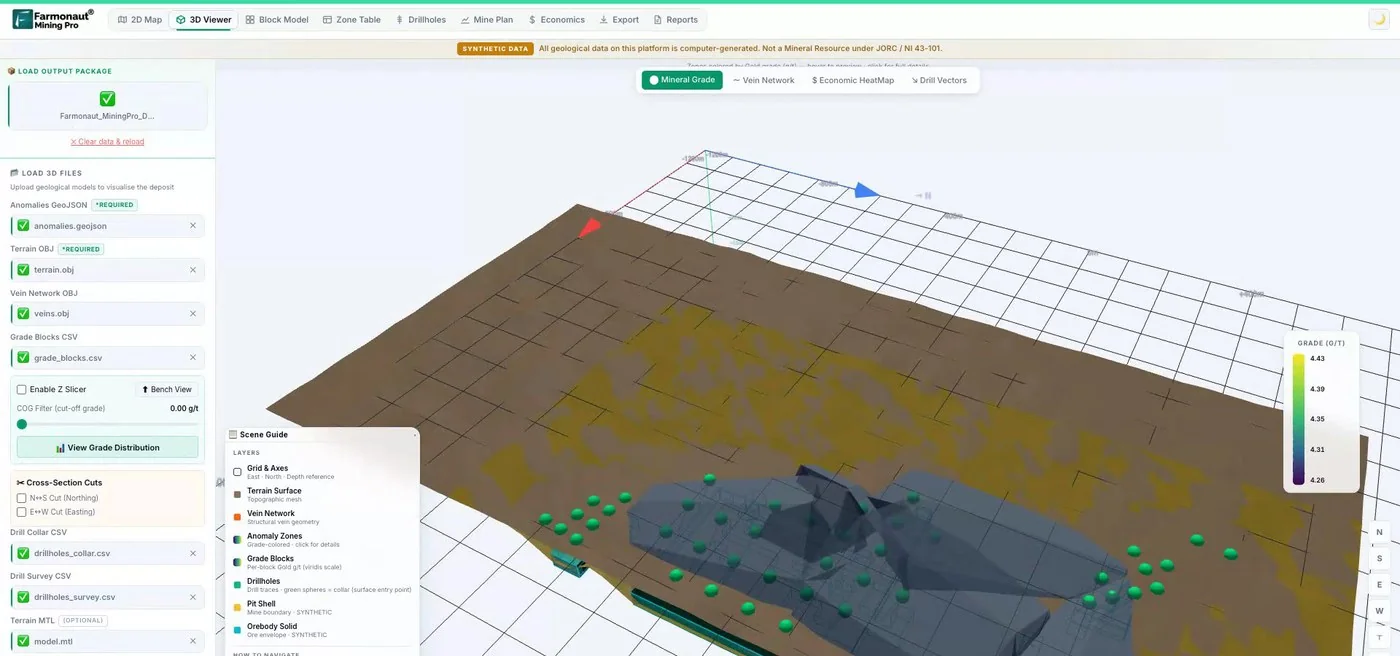
Mining Pro sample view, synthetic data
Keep reading

Sources
- OceanaGold, JORC Code 2012 Table 1 report of exploration results for Macraes (October 2019): assets.oceanagold.com
- Sitka Gold Corp., RC Gold Project NI 43-101 Technical Report (10 July 2026): wp-sitkagold-2024.s3.ca-central-1.amazonaws.com
- Geological Survey Ireland, Mineral exploration: drilling: gsi.ie
- Goodz and D’Astoli, Diamond drill core versus RC chips: the real sample, AusIMM Third International Mining Geology Conference: ausimm.com
- Dando Drilling, Drilling techniques for mineral exploration: dando.co.uk
- Wikipedia, Exploration diamond drilling (Q-series bit sizes): en.wikipedia.org
- FHWA National Highway Institute, Manual on Subsurface Investigations (core recovery and RQD): research.engineering.ucdavis.edu
- Earth Science Australia, Diamond drilling and RVC drilling (e-learning pages): earthsci.org
- Northern Star Resources, Mineral Resources and Ore Reserves update as at 31 March 2026: nsrltd.com
- IGO, Tropicana Mineral Resource and Ore Reserve estimates as at 31 December 2013 (JORC Table 1): igo.com.au
Discussion
Questions, corrections or field experience? Share them below. First-time comments are reviewed before they appear, and your email is never published.
No comments yet. Be the first to add a question or your experience.

 Mining SARL
 SenGold Invest SAS
 Sania Corporation
 Sean Mining Limited
 NTS Group (Pty) Ltd
 Mine4Africa
 Lithspo Minerals Limited
 Tintina Mining Group
 Dalgety Minerals Pty Ltd
 Vortex Minerals Pty Ltd
 Faith At Work (Pty) Ltd
 Geotech Mining Solutions plc
 Vulcan International Limited
 Kidepo Associates
 GKY Mining
 Alkimy SARL
 Double A Trading
 GemSprout Metals Limited
 Qader Group
 Ileys General Trading
 SG Gold Mining LLC
 VRV Global Pte Ltd
 Omsri International FZE
 G.I.T.T.










