

Diamond drilling · Core size guide
Diamond Drill Core Sizes: BQ, NQ, HQ, PQ Compared
NQ core is 47.6 mm across and HQ is 63.5 mm (FHWA). One metre of NQ weighs about 4.8 kg and HQ about 8.6 kg. This guide compares BQ, NQ, HQ and PQ, explains tube types and recovery, and adds Canadian cost per metre and a sample-weight calculator.
Key takeaways
- Wireline core diameters are 36.4 mm for BQ, 47.6 mm for NQ, 63.5 mm for HQ and 85.0 mm for PQ (FHWA manual, 2001); HQ has 1.78 times the core area of NQ.
- One metre of core weighs about 4.8 kg in NQ and 8.6 kg in HQ at a rock density of 2.7 t/m3 (our arithmetic); at Hemi, Northern Star halves NQ2 core and quarters PQ core (ASX release, 3 June 2026).
- Canadian diamond drilling averaged about C$284 per metre in 2024, up from C$173 in 2017; provincial averages ran from about C$208 in Ontario to C$537 in Yukon (NRCan data, our division).
- Triple-tube barrels, the 3 in HQ3, are used in broken ground; Northern Star reports typical core recovery above 95% at Hemi (ASX release, 3 June 2026).
- Natural diamond is less than 1% of industrial diamond used; synthetic diamond is the rest (USGS, Mineral Commodity Summaries 2026).
In this article
- Diamond drill core sizes compared: BQ, NQ, HQ and PQ
- How much does a metre of core weigh? Sample size by core size
- Double-tube or triple-tube barrels: core recovery and RQD
- How diamond drills bring core to the surface
- Diamond drilling cost per metre: what the Canadian data shows
- Cost per metre by province: why your quote differs from the average
- How to choose a core size in 6 steps
- Permits and site checks before the rig arrives
- From trays to digital libraries: scanning drill core
- Where satellite screening fits before the first hole
- Frequently asked questions
Diamond drill core comes in standard diameters. In the common wireline series, BQ core is 36.4 mm across, NQ is 47.6 mm, HQ is 63.5 mm and PQ is 85.0 mm, according to the table in the US Federal Highway Administration’s Manual on Subsurface Investigations. One metre of NQ core weighs about 4.8 kg in rock of 2.7 tonnes per cubic metre, and one metre of HQ core weighs about 8.6 kg (our arithmetic from those diameters). That weight is the sample a geologist has to cut, assay and store, so the core size shapes the cost of the hole, the quality of the assays and how much rock is left for re-testing.
This guide puts the five sizes side by side, shows how core size changes sample weight, explains double-tube and triple-tube barrels, and sets out what diamond drilling costs per metre in Canada, using Natural Resources Canada tables for 2017 to 2024. A calculator turns your core size, rock density and hole length into sample weights and a drilling budget. The field examples come from filings by Northern Star Resources, an ASX-listed gold producer that states the core sizes it drills.
Diamond drill core sizes compared: BQ, NQ, HQ and PQ
A diamond drill cuts a cylinder of rock with a bit set with industrial diamonds. The diameter of that cylinder is the core size, and the letters name the size family. The table below uses the FHWA manual’s figures for wireline sizes. The core column is what reaches the geologist’s tray. The hole column is what the bit has to cut.
Chart
Core diameter by wireline size
Millimetres of core; AQ, BQ, NQ, HQ and PQ wireline sizes
| Size | Core diameter (mm) | Hole diameter (mm) | Core area vs NQ | One metre of core (kg) |
|---|---|---|---|---|
| AQ | 27.1 | 48.0 | 0.32 times | 1.6 |
| BQ | 36.4 | 59.9 | 0.58 times | 2.8 |
| NQ | 47.6 | 75.7 | 1.00 times | 4.8 |
| HQ | 63.5 | 96.3 | 1.78 times | 8.6 |
| PQ | 85.0 | 122.6 | 3.19 times | 15.3 |
Diameters are from FHWA-NHI-01-031, Table 3-5 (July 2001). Core area is the diameter squared, compared with NQ. Weights are our arithmetic for solid rock of 2.7 tonnes per cubic metre, which is an example density, not a measured one.
Going from NQ to HQ raises the core area by a factor of 1.78, and PQ has 3.19 times the area of NQ. The hole grows as well, from 75.7 mm to 96.3 mm to 122.6 mm, so the rig, rods and water supply have to grow with it. Maker tables can differ slightly, and size names carry variants. One Northern Star filing for its Six Mile area gives NQ2 core as 50.5 mm, against 47.6 mm for plain NQ in the FHWA table. Check the data sheet of the barrel your contractor will actually run.
Where each size is used
- AQ and BQ (small core). AQ is the smallest size in the table, with 27.1 mm core. The FHWA manual discourages BQ and BX sizes when rock quality is being logged, because small core has a higher chance of breaking and being lost. Northern Star’s filing for its Mt Percy project in the Kalgoorlie district lists some BQ among mostly NQ core.
- NQ and NQ2 (the main size at Mt Percy and Kanowna Belle underground). Northern Star states that core at Mt Percy is mostly NQ, and that core at its Kanowna Belle underground mine is mostly NQ2, with some BQ, HQ and LTK60. At the Hemi gold project in the Pilbara of Western Australia, the company reports 283 diamond holes drilled in PQ, HQ3 and NQ2, alongside RC holes, in a resource based on 1,399 holes and 406,166 m of drilling.
- HQ and HQ3 (weathered ground and larger samples). For the Crossroads area of Kanowna Belle, the company reports NQ2 in fresh rock and HQ or HQ3 triple-tube drilling through the regolith, the weathered layer above fresh rock, which includes the main mineralised zones.
- PQ (largest sample). Hemi’s database includes PQ core. The company quartered PQ core for assay, which brings each metre of sample down to about 3.8 kg.
Evidence of this kind shows what one operator does in its own ground. It is not a rule for your licence. Hard, unbroken rock can be tested with small core. Broken or soft ground, coarse gold and metallurgical test work can push the choice towards larger core.
How much does a metre of core weigh? Sample size by core size
Core weight explains most of the trade-off. A metre of NQ core is 4.8 kg, so the half of it that goes to the lab weighs 2.4 kg. A metre of HQ core is 8.6 kg, so half is 4.3 kg. A metre of PQ core is 15.3 kg, and a quarter is 3.8 kg. These are our figures for 2.7 tonnes per cubic metre rock. Denser sulphide-rich rock weighs more per metre, and porous or weathered rock weighs less.
Chart
Weight of one metre of solid core
Kilograms per metre at an example rock density of 2.7 tonnes per cubic metre
Northern Star’s resource and reserve update of 3 June 2026 shows how the choice is handled in practice. At Hemi, the geologist marks sample intervals along geological boundaries, between 0.3 m and 1.2 m long, and adjusts sample lengths to the core diameter to keep sample volumes consistent. NQ2 and a subset of HQ3 core is cut in half with a diamond saw, one half is assayed and the other half stays in the core tray. PQ and a subset of HQ3 is quartered, and the same side of the core is always taken. The lab then crushes the sample, pulverises it and takes a 50 g charge for fire assay. A bigger core does not change that final 50 g. It gives the lab a larger, more representative lot to draw it from.
The same filing notes that at Crossroads, regolith core was fully sampled down to the depth where it was competent enough to saw, and fresh core was cut with half taken. That is a reminder that weak, weathered ground may not hold together long enough to saw.
Calculator
How heavy is your core sample, and what does the hole cost?
Enter your core diameter, rock density and hole length. Results update as you type.
- Core weight per metre (kg): 4.8
- Sample length for your target weight (m): 1.25
- Number of assay samples: 3,000
- Total material sent to the lab (tonnes): 7.2
- Drilling cost (C$): $852,000
Example values only, not benchmarks. Core mass per metre is the area of a circle of your core diameter times the rock density; use 47.6 for NQ, 63.5 for HQ and 85 for PQ (FHWA-NHI-01-031). Density 2.7 t/m3 is an example, so enter your own. The cost per metre is an input: the C$284 default is the 2024 Canadian average (NRCan data, our division) and is not a quote, so replace it with your contractor’s price. Money is in C$.
Double-tube or triple-tube barrels: core recovery and RQD
A core barrel holds the rock while the bit cuts it. The FHWA manual describes three types: single-tube, double-tube and triple-tube. The double-tube barrel is the standard. Its inner tube isolates the rock core from the drilling fluid, which gives better recovery. A swivel-type inner tube is less disturbing to the core and suits fractured and friable rock. In triple-tube systems, the inner tube can be split lengthways so the core can be seen and removed with less disturbance. Northern Star’s notation pairs HQ3 with triple-tube drilling, so the 3 in the name signals the third tube.
Core recovery is the length of core brought up from a run divided by the length drilled, expressed as a percentage. If a 3.0 m run returns 2.85 m of core, recovery is 95%. Northern Star reports typical core recovery above 95% at Hemi, and says drillers record core loss on core blocks, which geologists check against core measurements. At its Kanowna Belle underground mine, the company says a hole is usually excluded from the estimate when significant sample loss occurs inside an ore zone.
RQD, rock quality designation, is a modified recovery figure. It adds up the lengths of sound core pieces longer than 100 mm and divides by the length of the run, according to the FHWA manual. A 3.0 m run with 2.1 m of sound pieces over 100 mm long has an RQD of 70%. Weathered, soft, sheared or jointed rock returns lower values. The same manual says larger core generally gives better recovery and less mechanical breakage, and that NQ, HQ and PQ are acceptable for RQD, while BQ is discouraged.
For engineering holes, the FHWA manual advises limiting core runs to 3 m, and shortening them to 1.5 m or less just below the rock surface and in highly fractured or weathered zones. Mineral exploration programmes set their own run lengths, but the principle holds: short runs protect core in poor ground. Record the barrel type and core size on every log, because recovery and RQD cannot be compared across holes without them.
How diamond drills bring core to the surface
The working parts are the bit, the core barrel, the rods and the drilling fluid. Diamond bits fall into two groups, surface-set and impregnated. The FHWA manual calls both the most versatile bits because they produce good core in rock from soft to extremely hard, and says diamond bits generally core faster and put less twisting stress on the core than other bit types. Bit makers vary the size and quality of the diamonds, the metal matrix, the face shape and the waterways to suit the rock, so the bit is chosen for the formation.
Infographic
From drill bit to assay in 5 steps
- 1Cut and flushThe diamond bit grinds a ring of rock while drilling fluid cools it and carries cuttings away.
- 2Fill the inner tubeThe cylinder of rock slides into the inner tube of the core barrel as the bit advances.
- 3Pull it on a wireA wireline hoist raises the inner tube through the rods without pulling the whole string.
- 4Log and measureCore goes into trays, is oriented and measured, and recovery is checked against the driller’s core blocks.
- 5Saw and splitA diamond saw cuts the core lengthways: one half is assayed and the other half stays in the tray.
Wireline drilling lets the crew raise the inner tube on a cable through the rods, without pulling the whole string. The FHWA manual says the main advantage is higher drilling production from the fast removal of core, which cuts labour cost, and that it also gives better core quality in soft rock because the barrel is not handled roughly. It notes wireline is typically used where holes are deeper than 25 m.
Industrial diamond is almost all synthetic, and drilling is one of its uses. The US Geological Survey reports that natural diamond is less than 1% of all industrial diamond used, and that synthetic diamond is the rest. In the US, about 97% of apparent industrial diamond consumption was synthetic, because its quality can be controlled. US manufacturers produced an estimated 160 million carats of industrial diamond bort, grit and powder in 2025, worth $52 million. Drilling for minerals, natural gas and oil is one of the listed consuming sectors, and at least two US companies recover diamond from used drill bits and other diamond-containing waste for recycling (USGS, Mineral Commodity Summaries 2026).
Diamond drilling cost per metre: what the Canadian data shows
Contractor rate sheets are rarely public, so the best public benchmark for what a metre of diamond drilling costs comes from national statistics. Natural Resources Canada (NRCan) collects exploration spending and metres drilled from companies in a federal-provincial-territorial survey and publishes them as data tables. Dividing the 2024 diamond drilling cost of C$1,690.5 million by the 5.959 million metres drilled gives an average of about C$284 per metre. In 2017 the same calculation gives C$173 per metre, so the average rose by 64% in seven years.
Chart
Average cost of a metre of diamond drilling in Canada
C$ per metre, surface and underground, 2017 to 2024 actuals
Diamond drilling was 40.0% of the C$4.23 billion Canadians spent on exploration and deposit appraisal in 2024, and other drilling methods added another 0.8%. Geochemistry and geology took 10.9% and geophysics 3.4%. The detailed analysis of these tables is in our study of Canadian exploration spending.
Read the average with care. It mixes surface and underground holes, every core size and whatever each company books to drilling, and it is a mean of what companies reported, not a contractor quote. It will not tell you whether HQ costs more than NQ in your area. Ask your contractor to price both sizes for the same hole depth, with and without mobilisation, standby and consumables.
Cost per metre by province: why your quote differs from the average
The national average hides a wide spread. The same NRCan tables give the 2024 average as about C$208 per metre in Ontario, C$295 in Quebec, C$364 in British Columbia, C$383 in Saskatchewan and C$537 in Yukon (our division of NRCan cost by metres). Remote access, helicopter support, short seasons and deeper holes are the usual reasons costs differ between regions, although the NRCan tables do not break out causes.
Chart
Diamond drilling cost per metre, selected provinces
C$ per metre; five jurisdictions shown, not all of Canada
All five show a higher average in 2024 than in 2017. Yukon’s rose from about C$315 to C$537 per metre. Ontario’s was the lowest of the five, from about C$152 to C$208. For budgeting, use a regional figure close to your project and then replace it with real quotes as soon as you have them. If you work in Ontario, our guide to MLAS Ontario and the drill permit covers the steps before the first hole. For crews, seasons and rates in Canada, see our guide to diamond drilling companies in Canada.
How to choose a core size in 6 steps
- Decide what the core has to answer. A first-pass hole that tests for presence of mineralisation can often use a smaller size. A hole that feeds a resource estimate, structural logging or metallurgical testing needs more core.
- Check the ground. Fresh, massive rock holds together. Weathered, fractured or clay-rich ground breaks up, which is why Northern Star used HQ or HQ3 triple-tube through the regolith at Crossroads and NQ2 below it.
- Match barrel to ground. Use a triple-tube barrel where you expect broken ground, and record the barrel type on the log.
- Set the sample plan before drilling. Choose half or quarter core, the sample length range and the lab charge, then use the calculator in the sample-size section to check the sample weight per interval.
- Match the rig to the hole. Bigger holes need more drilling power, so confirm that the rig can reach the planned depth in the size you want.
- Get two quotes. Ask for NQ and HQ prices for the same programme, then compare cost per metre with sample weight and recovery in your ground.
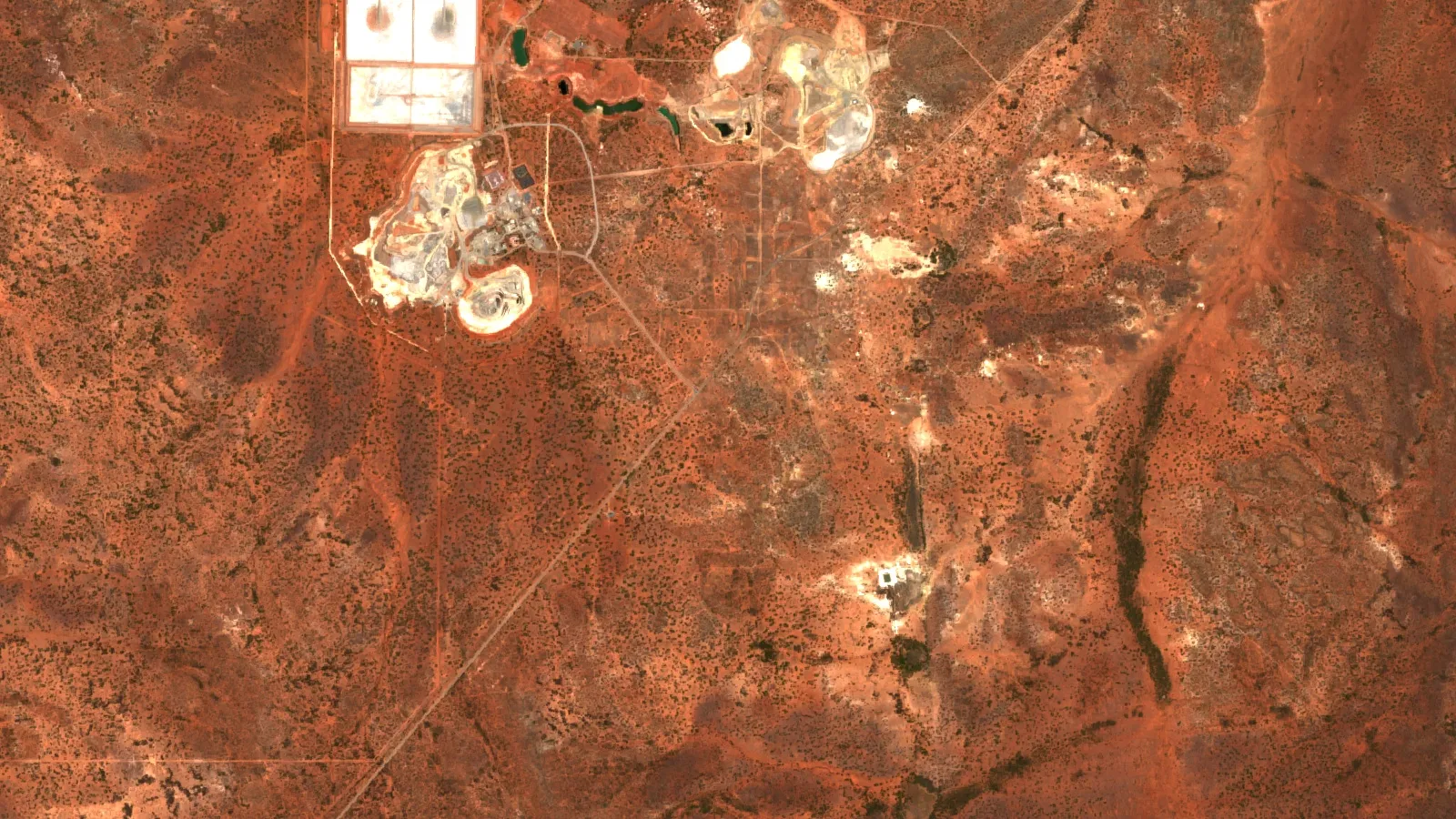
Where the holes go matters as much as how big they are. A hole in the wrong place costs as much to drill as one in the right place, so narrowing the target before the rig mobilises can save more than changing core size.

▶ A short mockumentary about a prospector who drills on instinct and what changes when satellites help pick the next hole. · 2:17
Permits and site checks before the rig arrives
Drilling needs the permission of the tenure holder and landowner, a permit from the regulator and a licensed contractor. Rules differ by country and state. On US public land managed by the Bureau of Land Management, 43 CFR 3809.21 requires a complete notice 15 calendar days before exploration that disturbs 5 acres or less of public land on which reclamation has not been completed. The same section says a project must not be split into a series of notices to avoid filing a plan of operations. Check the BLM rules for larger disturbance.
In Canada, drill permits are issued by the province or territory, and the rules differ in each. In Australia, the state mines department sets the conditions. In every jurisdiction, check access, water use, heritage and cultural sites, and reclamation obligations before a drill pad is built. Follow the contractor’s safety plan and your regulator’s rules on the site.
From trays to digital libraries: scanning drill core
Core is expensive to produce and worth keeping. Australia has more than 10 million metres of drill core samples in warehouses, according to CSIRO’s 2019 article on the National Virtual Core Library. CSIRO’s HyLogger instrument scans core, chips and pulps with visible and infrared light and identifies minerals from their spectral signatures. CSIRO’s page counts seven HyLogging machines in use by Australian state and territory geological surveys, and that the Perth Core Library has collected data on 300,000 m of core from 1,000 drill holes since 2009 (CSIRO, HyLogging).
The practical lesson for an explorer is that scanned and well-stored core keeps paying. Geologists revisit old holes for alteration minerals that suggest they are near a deposit. Keep core trays labelled and dry, photograph them before sampling, and record which half was assayed, because the retained half is the only physical record of the hole. The AuScope programme page describes the National Virtual Core Library and how its data are shared.
Where satellite screening fits before the first hole
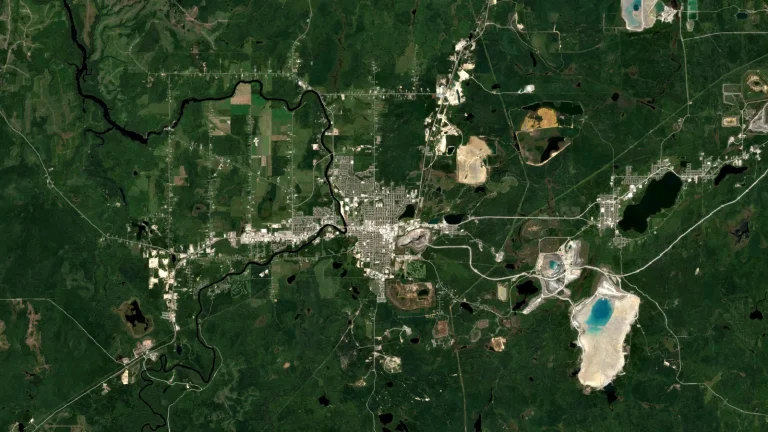
Drill core is the only evidence of what lies below the surface, and satellites do not replace it. Satellite images record the surface. They can show alteration minerals, rock types and structures that help rank areas, so holes go where the signs are best. Farmonaut analyses satellite data over a licence area, flags high-potential zones and delivers a report, usually in 5 to 20 business days depending on the area and minerals. The results are exploration targets that sit ahead of a resource estimate, and they need ground checks and drilling to confirm.
The cost logic is simple. Diamond drilling took 40.0% of Canadian exploration spending in 2024, while geology, geochemistry and geophysics together took 14.3% (NRCan). Drilling is the largest cost line, so narrowing the drill target before the first hole is where screening aims to save money.
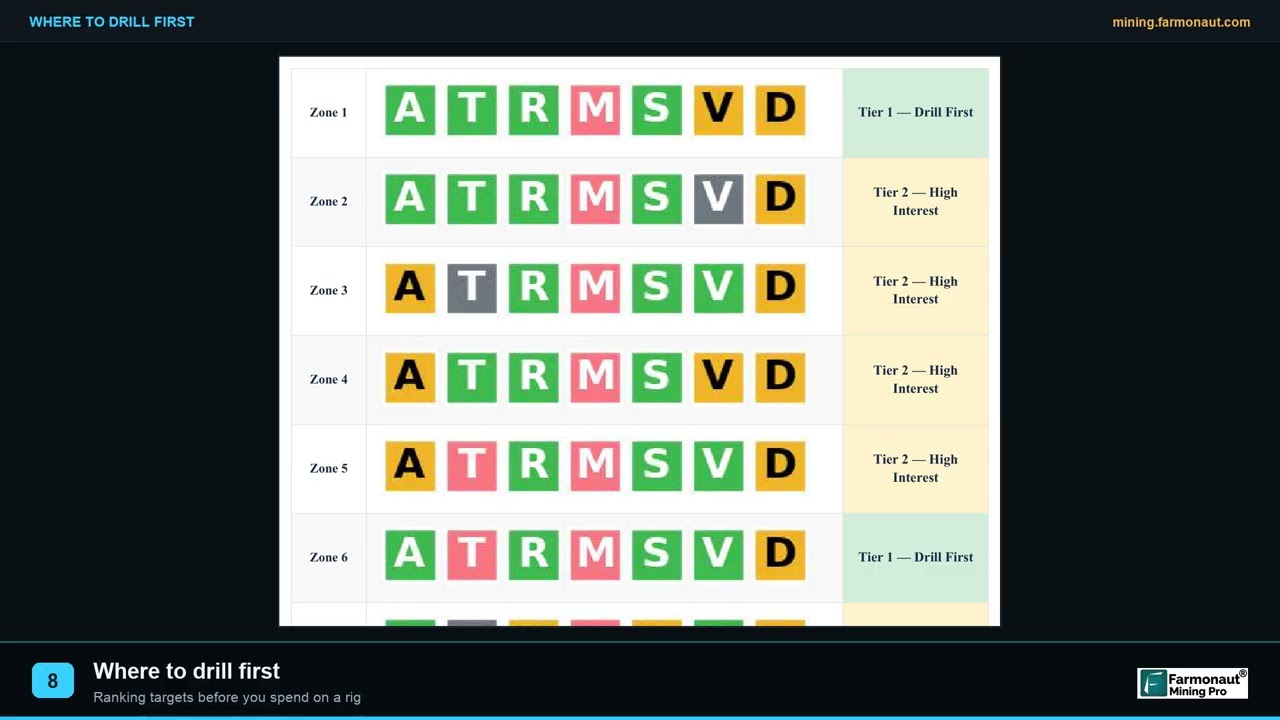
▶ Explains how satellite targets are ranked into a drill order before a programme starts. · 2:19
We cover a connected topic in PDAC Convention for Juniors: Booths, Core Shack, Investors.
For a closer look at a related question, see our guide: Reverse Circulation vs Diamond Drilling Compared.
Frequently asked questions
What is a diamond drill?
A diamond drill is a rotary drill with a bit set with industrial diamonds, which cuts a solid cylinder of rock called core. The core is brought to the surface in a barrel and inspected, logged and assayed. The FHWA manual describes diamond bits as the most versatile type because they cut rock from soft to extremely hard.
What is the difference between NQ and HQ core?
NQ core is 47.6 mm across and HQ core is 63.5 mm across, so HQ has 1.78 times the core area. The hole is also bigger, 96.3 mm against 75.7 mm (FHWA, 2001). One metre of NQ weighs about 4.8 kg and one metre of HQ about 8.6 kg in rock of 2.7 tonnes per cubic metre.
Which core size is used most in mineral exploration?
No public survey counts core sizes across the industry. Northern Star’s June 2026 filing gives NQ or NQ2 as the main size at Mt Percy and Kanowna Belle underground. Its Hemi diamond holes include PQ, HQ3 and NQ2, with no main size stated. HQ, HQ3, PQ and BQ appear where the ground or sample plan calls for them.
What do NQ2 and HQ3 mean?
They are variants of the NQ and HQ sizes. In Northern Star’s filings HQ3 is paired with triple-tube drilling, and NQ2 core is given as 50.5 mm. Variants and maker tables differ, so confirm the core diameter on the barrel’s data sheet.
How much does one metre of drill core weigh?
It depends on the core diameter and the rock density. At 2.7 tonnes per cubic metre, a metre weighs about 1.6 kg in AQ, 2.8 kg in BQ, 4.8 kg in NQ, 8.6 kg in HQ and 15.3 kg in PQ. Use the calculator on this page to enter your own density.
Is half or whole core sent to the lab?
Most core is cut lengthways with a diamond saw, and one half is assayed while the other is kept in the tray. At Hemi, Northern Star halves NQ2 and some HQ3, and quarters PQ and some HQ3. Whole core is sometimes taken where the ground is too weak to cut, as in the regolith at Crossroads.
How much does diamond drilling cost per metre?
The average in Canada in 2024 was about C$284 per metre, from NRCan data on cost and metres drilled, with provincial averages from about C$208 in Ontario to C$537 in Yukon. These are averages across surface and underground holes, not quotes. A contractor’s price depends on core size, depth, access and season.
Why are drill bit diamonds synthetic?
The USGS does not give a drill-bit figure, but it says natural diamond is less than 1% of all industrial diamond used, and synthetic diamond is the rest. In the US, about 97% of apparent industrial diamond consumption was synthetic, because its quality can be controlled (USGS, Mineral Commodity Summaries 2026).
What is core recovery and what is RQD?
Core recovery is the length of core brought up divided by the length drilled in a run. RQD adds up pieces of sound core longer than 100 mm and divides by the run length. Both are logged on every run, and low values flag broken or weak ground.
Do I need a permit to drill on US public land?
You must at least file a notice with the Bureau of Land Management first. For exploration that disturbs 5 acres or less of its land, 43 CFR 3809.21 requires a complete notice 15 calendar days before work starts. Check the BLM rules for larger disturbance. State and private land have their own rules, so confirm with the regulator.
Can satellites replace diamond drilling?
No. Satellites see the surface and help rank areas to drill first, while only core shows what lies below. Satellite results are exploration targets, not a resource estimate.
This page is for information only. It is not legal or engineering advice. Cost figures are national averages from Natural Resources Canada data, not contractor quotes. Confirm drilling permits with the regulator and follow the contractor’s site safety plan.
Farmonaut mining
Rank where to drill before the rig moves
Send a KML, KMZ or polygon and Farmonaut screens the licence from satellite images to rank areas for ground checks and drilling.

Mining Pro sample view, synthetic data
Keep reading
Sources
- US Federal Highway Administration, Manual on Subsurface Investigations, FHWA-NHI-01-031 (July 2001): research.engineering.ucdavis.edu
- Natural Resources Canada, Mineral Exploration and Development: Data Tables: mmsd.nrcan-rncan.gc.ca
- Natural Resources Canada, Exploration and Deposit Appraisal by expenditure category, 2024: mmsd.nrcan-rncan.gc.ca
- Natural Resources Canada, Mineral Exploration and Development statistics overview: mmsd.nrcan-rncan.gc.ca
- USGS, Mineral Commodity Summaries 2026: Diamond (Industrial) (February 2026): pubs.usgs.gov
- Northern Star Resources, Resources and Reserves Update, ASX announcement (3 June 2026): nsrltd.com
- CSIRO, Virtual core: a library of Australia’s mineralogy (August 2019): csiro.au
- CSIRO, HyLogging: saving millions through automated drill core logging: csiro.au
- AuScope, National Virtual Core Library: auscope.org.au
- Legal Information Institute, 43 CFR 3809.21: When do I have to submit a notice?: law.cornell.edu
Discussion
Questions, corrections or field experience? Share them below. First-time comments are reviewed before they appear, and your email is never published.
No comments yet. Be the first to add a question or your experience.

 Imperial Impex FZE
 Congo Mining Solutions
 Mining SARL
 SenGold Invest SAS
 Sania Corporation
 Sean Mining Limited
 NTS Group (Pty) Ltd
 Mine4Africa
 Lithspo Minerals Limited
 Tintina Mining Group
 Dalgety Minerals Pty Ltd
 Vortex Minerals Pty Ltd
 Faith At Work (Pty) Ltd
 Geotech Mining Solutions plc
 Vulcan International Limited
 Kidepo Associates
 GKY Mining
 Alkimy SARL
 Double A Trading
 GemSprout Metals Limited
 Qader Group
 Ileys General Trading
 SG Gold Mining LLC
