

Mine safety · Buyer guide
Mining EHS Software: 6 Vendors and What to Check
Mining EHS software records hazards, incidents, exposure samples, permits and training, and produces regulator reports. US mines recorded 28 deaths in fiscal year 2025 (MSHA). Here are six vendors compared, the reports that matter and a budget calculator.
Key takeaways
- MSHA counted 12,568 US mines, 327,465 miners and 28 fatalities in fiscal year 2025; the all-injury rate fell to 1.77 per 200,000 hours (MSHA, 2026).
- ICMM members reported 42 fatalities in 2024, up from 36 in 2023; mobile equipment was the leading hazard (ICMM, 2025).
- US operators must call MSHA within 15 minutes of a listed accident and file Form 7000-1 within ten working days (30 CFR Part 50).
- MSHA’s silica limit is 50 µg/m³ with a 25 µg/m³ action level; enforcement for metal and nonmetal mines was stayed on 6 April 2026.
- Vendors rarely publish mining prices: compare written quotes on total cost and cost per covered worker.
In this article
- What mining EHS software does
- Why mines buy safety software: the injury and fatality numbers
- What the leading causes of mine deaths tell a buyer
- Mining EHS software vendors compared
- US compliance: what the system must report to MSHA
- Australia, Canada and other regions
- How to choose mining safety software in 7 steps
- Mining EHS software cost and a budget calculator
- Sensors, wearables, fleet and environmental data
- Where satellite imagery fits in mine safety and environment work
- Frequently asked questions
Mining EHS software is a system that records hazards, incidents, inspections, exposure samples, permits, training and environmental data for a mine, and turns them into the reports regulators ask for. In the United States those reports go to the Mine Safety and Health Administration (MSHA), which counted 28 mining deaths and an all-injury rate of 1.77 per 200,000 hours worked in fiscal year 2025 (MSHA at a Glance, February 2026). This guide compares six EHS vendors that sell to mines, explains what the system must report, shows the safety numbers behind the purchase, and gives a calculator for a first budget.
EHS stands for environment, health and safety. In a mine it covers everything from a near-miss on a haul road to a dust sample in a crusher building to a water discharge permit. The software does not make a mine safe on its own. It makes the work of finding, fixing and proving controls faster and harder to skip.
What mining EHS software does
Most products are built from modules. A small quarry may buy two or three; a multi-site miner may buy ten. These are the modules that matter most at a mine site:
- Incident and near-miss reporting. Workers log an event on a phone or tablet, often with photos. The record moves into an investigation, a root-cause analysis and a list of corrective actions with owners and due dates.
- Hazard reports and inspections. Digital checklists for pre-shift workplace exams, equipment pre-start checks, ground-control inspections and supervisor walk-throughs.
- Critical control management. A critical control is a barrier that stops a fatal event, such as a berm on a haul road, isolation of energy before maintenance, or ground support in an underground heading. The software schedules checks of each control and flags any that fail.
- Permit to work and isolation (control of work). Hot work, confined space entry, work at height and lock-out/tag-out (LOTO) permits, with sign-offs before the job starts.
- Industrial hygiene and occupational health. Exposure samples for respirable dust, crystalline silica, noise, diesel particulate and heat; medical surveillance records; and links between a worker, the job they do and the samples taken.
- Training and competency. Who is trained on what, when it expires, and the records the regulator can ask to see.
- Contractor management. Prequalification, induction and performance records for contractors, who make up a large share of hours worked at many mines.
- Chemicals and safety data sheets (SDS). A register of reagents, fuels and explosives precursors with the current SDS for each one.
- Environmental compliance. Air emissions, water sampling and discharge limits, waste, and greenhouse gas data. Some teams also run a separate carbon footprinting tool and import the totals.
- Dashboards and regulatory reports. Leading indicators (inspections done, actions closed on time) and lagging indicators (injury and fatality rates), plus forms ready to file.
A useful test for any product: can a supervisor 300 metres underground, with no signal, complete an inspection on a tablet and have it sync when they reach the surface? Offline capture is one of the features that separates mining-ready tools from general office software.
▶ What an AI mining app does and who makes one (3:52). · 3:52
Why mines buy safety software: the injury and fatality numbers
Mining is one of the more dangerous industries, and the US fatality record has not improved steadily. MSHA’s yearly summary shows 12,568 US mines and 327,465 miners (operators and contractors) in fiscal year 2025. Deaths moved between 23 and 41 a year from 2019 to 2025 with no steady downward trend (MSHA, 2026). For comparison, 242 miners died in 1978, MSHA’s first year.
Chart
All-injury rate, FY2019 vs FY2025
Injuries per 200,000 hours worked, US mines
Chart
US mining fatalities by fiscal year
All mines, operators and contractors
The all-injury rate tells a slightly better story. It fell in all but one year of the same period (it rose slightly from 1.90 to 1.91 in fiscal year 2021), from 2.06 to 1.77 injuries per 200,000 hours worked across all mines. Coal mines still record a higher rate (2.73 in fiscal year 2025) than metal and nonmetal mines (1.52). The gap matters when you set targets for each site.
Enforcement is the other side of the cost. MSHA issued 87,372 citations and orders in fiscal year 2025 and assessed US$62.4 million in penalties, after US$71.1 million in fiscal year 2024 (MSHA, 2026). About 18% of citations were for “significant and substantial” violations, the type that could reasonably lead to a serious injury. Good records do not prevent a citation, but they make it easier to show that an exam was done, a hazard was fixed and a miner was trained.
What the leading causes of mine deaths tell a buyer
Outside the US, the best public benchmark is the International Council on Mining and Metals (ICMM), which pools safety data from its member companies. Its 2024 report counted 42 fatalities across 24 member companies, up from 36 in 2023, 33 in 2022, and down from 45 in 2021. The fatality frequency rate rose to 0.015 per million hours worked, from 0.013 in 2023 (ICMM safety performance, 2024 data).
Chart
ICMM member fatalities by region, 2024
Number of deaths (total 42)
Chart
Fatalities at ICMM member companies
Employees and contractors, calendar years
ICMM’s breakdown by cause reads like a requirements list for software:
- Mobile equipment (haul trucks, loaders, dozers and light vehicles) was the leading hazard, with 21% of fatalities in 2024. That points to vehicle interaction controls, proximity-detection data and traffic management plans.
- Fall of ground was second, with five deaths. ICMM found three of those five happened where mesh-and-bolt support was not yet installed or had been damaged. A system that tracks ground-support inspections and blocks entry until support is signed off answers that directly.
- Falling objects caused four deaths, all linked by ICMM to lapses such as poor secondary retention and ignored no-go zones.
- Energy isolation breaches (lock-out/tag-out failures) increased, which is why permit-to-work and isolation modules sit high on most mining shortlists.
Location also matters. Underground operations and process areas such as mills and leach plants made up 88% of ICMM member fatalities in 2024. Half of all member fatalities (21 of 42) were in Africa and 10 were in South America. Europe recorded none.
Health hazards build up more slowly but harm more people. A study of MSHA dust samples from US metal and nonmetal mines, 2000 to 2019, found that 27.3% of respirable crystalline silica exposures were above the 50 µg/m³ limit recommended by NIOSH, and exposures in 2018 and 2019 were higher than in earlier years (Occupational exposure to respirable crystalline silica, PMC, 2024). This is why industrial hygiene modules are no longer an optional extra.
Mining EHS software vendors compared
The table below lists six established EHS vendors whose own websites describe a mining offering or mining-relevant modules. It is a comparison, not a ranking: each product suits a different kind of operation. Features are taken from the vendors’ own pages, opened in October 2026.
| Vendor | Best for | Mining-relevant modules named by the vendor | Points to check |
|---|---|---|---|
| Cority | Mines that need deep occupational health and hygiene | Incidents (offline mobile), occupational health, industrial hygiene (dust, noise, radiation, heat), air and water, chemicals and SDS, contractors | Broad suite; scope the modules you need |
| VelocityEHS | Operators with large, shifting workforces | Mining page addresses ground conditions, mobile equipment, blasting, dust, chemicals, air and water compliance, training and observations | Confirm MSHA form output in a demo |
| Intelex | Metals and mining groups that also run quality systems | Incident management, risk assessment, real-time analytics, online and offline mobile app | Configuration effort for multi-site rules |
| Sphera | Large sites focused on critical controls and control of work | Risk assessment, permitting, isolations, incident reporting, asset data linked into one risk view | Fits larger operators; ask about small-site pricing |
| IsoMetrix | Groups that want safety and ESG reporting together | Incident, risk, audit and permit to work; occupational health, hygiene and medical surveillance; ESG and governance modules | Ask for mining references of your size |
| Benchmark Gensuite | Multilingual, mobile-heavy workforces | Forms and incident reporting on any device, offline capable, multilingual, AI-guided support | Check depth of hygiene and MSHA features |
How we chose
We included vendors that (1) sell a dedicated EHS platform, not only a checklist app, (2) describe mining or mining-relevant modules on their own website, and (3) offer incident, hygiene or control-of-work features that match the hazards in the ICMM and MSHA data above. We did not test the products, and we did not accept payment from any vendor. Other suppliers exist; treat this list as a starting shortlist, not a complete market map.
Cority
Best for: operations where occupational health and hygiene carry as much weight as safety. Cority’s mining and metals page lists incident capture on desktop or mobile even when offline, health surveillance for remote workers, dust, noise, radiation and heat exposure data, emissions and discharge tracking, chemical and SDS registers, and contractor prequalification. Pros: wide coverage of health and environment in one platform. Cons: a broad suite takes planning to scope and configure. The vendor reports case results such as a more than 50% cut in reporting time at Westmoreland Coal; treat vendor case figures as claims to test with references.
VelocityEHS
Best for: operators with large workforces spread across shifts and sites. The VelocityEHS mining page frames the problem as shifting ground, mobile equipment, blasting zones, dust and confined spaces across large, moving workforces, and it publishes customer stories from Komatsu Mining and Coeur Mining. Pros: mining customer stories are public, so references are easy to request. Cons: check how US MSHA reports are produced before you sign.
Intelex
Best for: metals and mining groups that also want quality and audit management in the same system. Intelex describes tools for occupational hazards and environmental impacts in metals and mining, with real-time analytics and a mobile app that works online and offline. Pros: broad EHS and quality catalogue. Cons: flexible configuration can mean a longer set-up for site-specific rules.
Sphera
Best for: large mines that already have a critical control programme and need to prove the controls still work. Sphera’s mining safety page focuses on connecting risk assessment, permitting, isolations, incident reporting and asset data into one operational risk picture. Pros: strong fit for control of work and process safety. Cons: aimed at larger operators; a small quarry may pay for features it never uses.
IsoMetrix
Best for: groups that report safety and ESG (environmental, social and governance) data to the same audience. IsoMetrix lists incident, risk, audit and permit-to-work management, occupational health, industrial hygiene and medical surveillance, plus ESG and governance modules. Pros: one data model for safety and sustainability reports. Cons: ask for mining customers of your size and region.
Benchmark Gensuite
Best for: sites with many contractors and several languages. Benchmark Gensuite says workers can complete forms and report incidents on any device, offline and in several languages, with AI-guided support and image capture. Pros: field adoption is the focus. Cons: compare the depth of its hygiene sampling and US mine reporting with the specialists.
Published price lists are rare in this market. Ask each vendor for pricing in writing, for mining references of your size, and for a demo that uses your own forms.
US compliance: what the system must report to MSHA
For US mines the software has to fit MSHA rules under Title 30 of the Code of Federal Regulations, not only OSHA’s. Four duties shape the requirements:
- Immediate notification. Under 30 CFR Part 50, an operator must call MSHA within 15 minutes of knowing, or when it should have known, that a listed accident has happened (for example a death, an entrapment or an unplanned inundation). The software should push an alert and timestamp the call.
- Accident, injury and illness reports. MSHA Form 7000-1 is due within ten working days after an accident or occupational injury, or after an occupational illness is diagnosed (30 CFR Part 50).
- Quarterly employment report. Form 7000-2 reports hours worked and, for coal mines, production. It is due within 15 days after the end of each calendar quarter. Hours worked are the denominator of every injury rate, so payroll and EHS data must agree.
- Training records. Training under Part 48 (underground and many surface mines) is recorded on MSHA Form 5000-23, as MSHA’s Part 48 reference guide explains. A good system prints the form and warns before refresher training expires.
Silica is the moving part. MSHA’s respirable crystalline silica rule sets a permissible exposure limit of 50 µg/m³ and an action level of 25 µg/m³, both as 8-hour time-weighted averages. It took effect on 17 June 2024 with staggered compliance dates. MSHA then stayed enforcement for metal and nonmetal mines in a Federal Register notice of 6 April 2026, matching an earlier stay for coal, while the rule awaits judicial review (SGS, April 2026). Check MSHA’s page for the current status before you configure exposure limits. Sampling records built now will still count when enforcement resumes.
Australia, Canada and other regions
Requirements change by jurisdiction, so the system must hold more than one rule set if you run mines in several countries. In Western Australia, the Work Health and Safety (Mines) Regulations 2022 require mine operators to identify principal mining hazards and keep principal mining hazard management plans. Software buyers there look for a hazard register that links each principal hazard to its controls, risk assessments and reviews.
In Canada, mine safety is mostly provincial, and EHS teams often ask how they will manage safety data sheets for the chemicals on site. Look for an SDS register that keeps the current sheet for every product, ties it to storage locations and makes it available offline. Cority, for example, names chemical and SDS registers on its mining page.
In Africa and South America, where ICMM members reported most of their 2024 fatalities, the practical issues are often connectivity, language and contractor turnover. Offline mobile capture and multilingual forms matter more there than dashboard polish.

▶ The seven environmental impacts of mining, explained in clay (2:31). · 2:31
How to choose mining safety software in 7 steps
- List your top fatal hazards. Start from your own risk register and the ICMM causes: mobile equipment, fall of ground, falling objects, energy isolation. Each one needs a matching module.
- Map your legal reports. Write down every form and deadline (in the US: the 15-minute call, Form 7000-1, Form 7000-2, Form 5000-23 and exposure sampling). Ask each vendor to produce them from sample data in the demo.
- Test offline use underground or in a remote pit. Run a pilot on the worst-connected part of your site, not in the office.
- Check contractor workflows. Contractors need to report hazards without a full licence each. Ask how contractor users are priced.
- Plan integrations. Payroll and time systems (for hours worked), fleet and proximity-detection systems, gas and dust monitors, and maintenance software.
- Get the whole cost in writing. Licences, implementation, data migration, training, hardware and the internal administrator’s time. Use the calculator below.
- Agree what success looks like. Pick a few leading indicators before go-live, such as percentage of corrective actions closed on time and critical control checks completed, and review them after six months.
Infographic
Choosing an EHS system in 5 stages
- 1HazardsList fatal hazards and the controls for each.
- 2ReportsMap every legal form and deadline.
- 3PilotTest offline at your worst-connected site.
- 4CostGet licences, set-up and support in writing.
- 5ReviewTrack leading indicators after six months.
Mining EHS software cost and a budget calculator
EHS vendors rarely publish mining prices. Most quote an annual subscription based on the modules, the number of named users and the number of sites, plus a one-off implementation fee. Field users who only report hazards are sometimes priced lower than administrators. Because there is no public price index, the calculator below uses example inputs only. Replace every number with a quote from your shortlist.
Two figures help you judge a quote. First, the cost per covered worker per year, which you can compare across vendors. Second, the share of total cost that falls in year one, which shows how much of the price is set-up rather than use. If implementation is more than the first year’s licences, ask what is included and who owns the configuration afterwards.
Calculator
What will an EHS system cost over its term?
Enter the numbers from your own vendor quotes.
- Annual running cost (US$): $34,000
- Cost per covered worker per year (US$): $110
- Year-one share of total cost: 48.5%
Example values only, not a benchmark or a vendor price. Licence and fee inputs are examples: use the prices in your own quotes. Covered workers include contractors who use the system.
Sensors, wearables, fleet and environmental data
Many searches ask which EHS tools connect to IoT devices for hazard monitoring. In practice, the EHS platform is usually the system of record, and sensors feed it. Common links at mine sites are:
- Gas and dust monitors that send readings or alarms, so an exceedance opens a corrective action automatically.
- Wearables such as personal dust monitors, cap-lamp tags and fatigue or heat-stress bands. Check who owns the data and how privacy is handled before rollout.
- Fleet and proximity-detection systems on haul trucks and loaders, given that mobile equipment led ICMM fatalities in 2024. General fleet management tools track location and use; collision-avoidance systems add the safety layer. Our guide to mine safety solutions covers the hardware side, and drill and blast monitoring software covers blasting records.
- Weather feeds for lightning, heavy rain and heat alerts that trigger stop-work rules in open pits. Developers can pull forecasts through a satellite weather API and push alerts into the EHS workflow.
- Chain-of-custody records for samples, explosives and hazardous waste. Some operators use a separate traceability system and link record IDs into the EHS platform.
Be wary of products sold mainly on “predictive AI”. Prediction needs years of clean incident, exposure and hours data. Most mines get more value first from complete, timely records and closed actions.
Where satellite imagery fits in mine safety and environment work
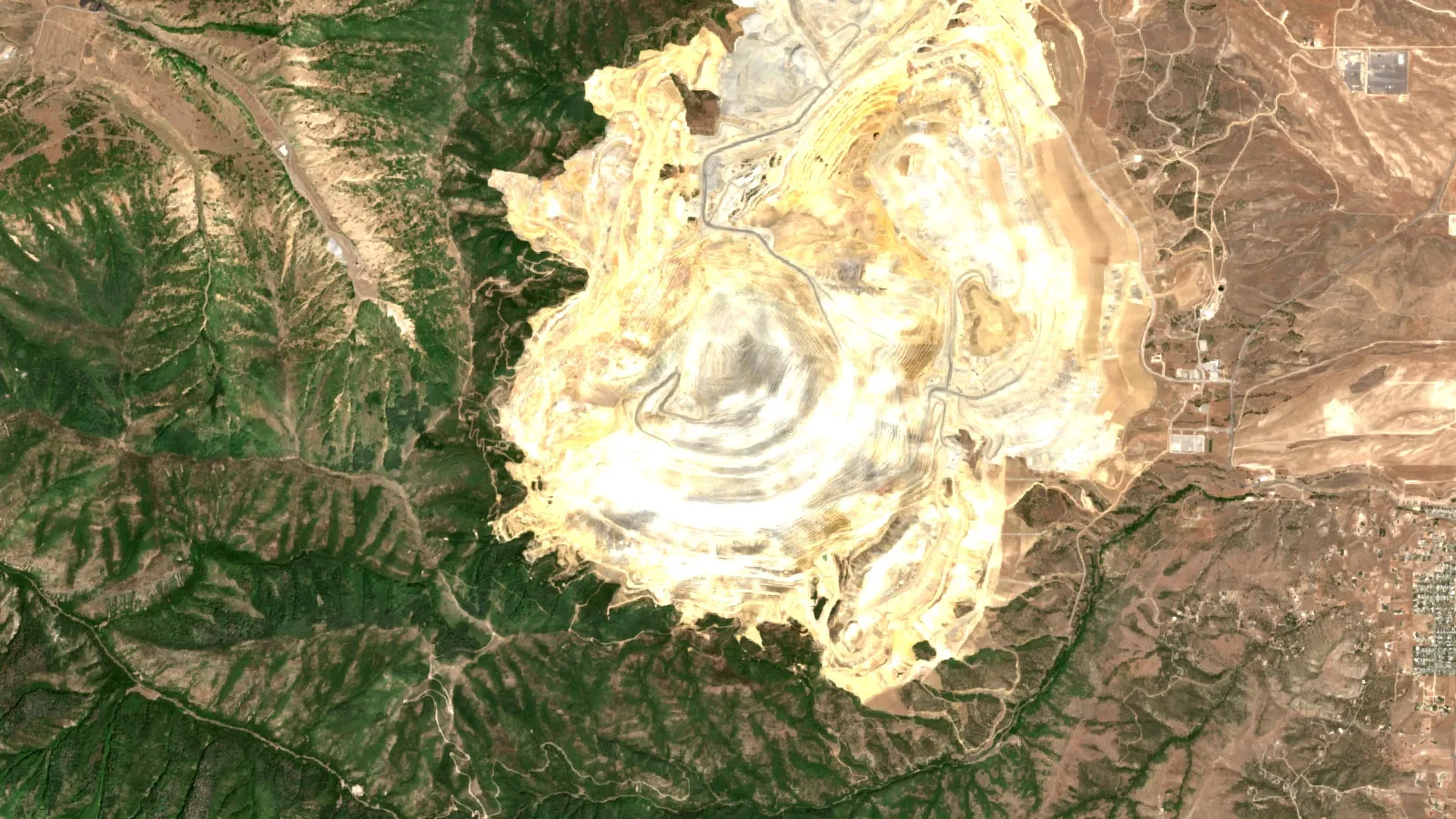
Satellite imagery is not an EHS system, but it adds a site-wide view that ground records lack. Environmental teams use it to track disturbed area, tailings footprints, water bodies and vegetation around a lease over time, and to check reclamation progress. Large operations, such as those in our article on the world’s biggest mines, can be watched month by month from orbit. For a map of where US mines are, see our US mining map by state. Farmonaut provides satellite-based site mapping and mineral exploration targets from a licence boundary; it does not replace an EHS platform or any regulatory sampling.
Frequently asked questions
What is mining EHS software?
It is software that records environment, health and safety data at a mine: incidents, hazards, inspections, permits, training, exposure samples and environmental monitoring. It also produces the reports a regulator such as MSHA requires and tracks corrective actions until they are closed.
Which companies sell EHS software for mining?
Vendors that describe mining offerings or mining-relevant modules on their own sites include Cority, VelocityEHS, Intelex, Sphera, IsoMetrix and Benchmark Gensuite. Other suppliers also sell to mines. Shortlist by your hazards, legal reports and connectivity.
What is the best safety management system for mining operations?
There is no single best system. A large underground mine with a critical control programme needs strong control-of-work and permit features. A quarry group needs simple inspections, training records and MSHA forms. Test each product with your own forms and your worst-connected site.
Which systems automate safety compliance tracking and incident reporting for mines?
All six vendors in the comparison include incident reporting and corrective-action tracking. For US compliance, ask each one to generate MSHA Forms 7000-1 and 7000-2 and training records from sample data during the demo, and to show how the 15-minute notification is logged.
How much does mining EHS software cost?
Vendors seldom publish prices. Quotes are usually an annual subscription by modules, users and sites, plus implementation. Use the calculator on this page with real quotes to compare total cost and cost per worker over several years.
What do EHS teams at Canadian mining companies use for SDS management?
Most use the chemical or SDS module of their EHS platform, or a dedicated SDS service linked to it. Cority names chemical and SDS registers on its mining page. Check that sheets are available offline and tied to storage locations.
Do EHS tools integrate with IoT sensors and wearables?
Many do, through connectors or an API. Typical feeds are gas and dust monitors, personal dust monitors, proximity-detection systems and weather alerts. Ask which devices are supported out of the box and who maintains the integration.
Which contractor safety systems suit mines with heavy plant and equipment?
Look for contractor prequalification, site induction records, equipment pre-start checklists and mobile hazard reporting that contractors can use without full licences. Cority lists contractor management on its mining page, and Benchmark Gensuite focuses on multilingual mobile use.
What safety KPIs should a mining EHS dashboard show executives?
Show lagging indicators such as fatalities, total recordable injury frequency and MSHA citations, alongside leading indicators such as critical control checks completed, corrective actions closed on time and exposure samples above the action level. ICMM reports fatality and total recordable injury frequency per million hours worked.
Is MSHA’s silica rule in force?
The rule sets a 50 µg/m³ limit and a 25 µg/m³ action level. MSHA stayed enforcement for metal and nonmetal mines on 6 April 2026, matching an earlier stay for coal, while the rule is under court review. Check MSHA’s silica page for the current status.
Is there mining safety software for Australian mining companies?
Yes. The global vendors above sell in Australia. In Western Australia the system should support principal mining hazard management plans under the Work Health and Safety (Mines) Regulations 2022, linking each hazard to its controls and reviews.
This page is for information only. It is not legal advice. Confirm reporting and exposure rules with your regulator. Vendor features are as described by each vendor in October 2026.
Farmonaut mining
Map your mining site from space
Mining teams can map a licence area, disturbance and surroundings with satellite imagery before planning field work.

Mining Pro sample view, synthetic data
Keep reading
Sources
- MSHA, Mine Safety and Health at a Glance, FY2025 (February 2026): msha.gov
- eCFR, 30 CFR Part 50: notification, investigation, reports and records: ecfr.gov
- MSHA, Respirable crystalline silica rulemaking: msha.gov
- SGS, MSHA delay of the silica rule for metal and nonmetal mines (April 2026): env.sgs.com
- MSHA, Part 48 training reference guide: msha.gov
- ICMM, Safety performance: benchmarking ICMM members in 2024: icmm.com
- Occupational exposure to respirable crystalline silica among US metal and nonmetal miners, 2000-2019 (PMC): pmc.ncbi.nlm.nih.gov
- Western Australia, Work Health and Safety (Mines) Regulations 2022: legislation.wa.gov.au
- Cority, EHS software for mining and metals: cority.com
- VelocityEHS, Mining: ehs.com
- Intelex, Metals and mining: intelex.com
- Sphera, Mining safety: sphera.com
- IsoMetrix, EHS and sustainability software: isometrix.com
- Benchmark Gensuite, EHS and sustainability software: benchmarkgensuite.com
Discussion
Questions, corrections or field experience? Share them below. First-time comments are reviewed before they appear, and your email is never published.
No comments yet. Be the first to add a question or your experience.

 Double A Trading
 GemSprout Metals Limited
 Qader Group
 Ileys General Trading
 SG Gold Mining LLC
 VRV Global Pte Ltd
 Omsri International FZE
 G.I.T.T.
 Jaunita Erss Ltd
 Almosi SARL
 SRK Consulting
 Berks Gold Limited
 Mwerezi Minerals Company Limited
 Mining SARL
 SenGold Invest SAS
 Sean Mining Limited
 NTS Group (Pty) Ltd
 Mine4Africa











