

Silver minerals · Ranked list
Silver Minerals List: 15 Ranked by Silver Content
Yes, silver is a mineral. Native silver leads the list, acanthite holds about 87% silver by weight, and yet only 26% of mined silver came from primary silver mines in 2025 (Silver Institute, 2026).
Key takeaways
- Native silver is a mineral in its own right; acanthite (Ag2S) is 87.06% silver by formula.
- Argentite is the high-temperature form of the same compound and changes to acanthite at about 173 °C (Handbook of Mineralogy).
- Primary silver mines supplied 26% of global mine output in 2025; lead-zinc mines were the largest source at 249.1 Moz (World Silver Survey 2026).
- Mexico led mine output at an estimated 6,300 tons in 2025, out of 26,000 tons worldwide (USGS, 2026).
- At 150 g/t, acanthite makes up only about 0.017% of the rock, so grade and recovery drive value.
In this article
- Silver minerals list: 15 ranked by silver content
- The silver ore minerals that matter most
- Why a rich mineral does not mean a rich mine
- Calculate silver in your ore
- Where silver minerals form
- Who mines the silver that comes from these minerals
- Most silver comes from other metals' ores
- How silver minerals are processed
- How to identify silver minerals in the field
- What satellites can and cannot show about silver minerals
- What silver is used for and why it matters to miners
- Frequently asked questions
Yes, silver is a mineral: native silver is a naturally occurring mineral with its own crystal form, and the Handbook of Mineralogy lists one analysis at 98.45% silver. Silver minerals are the natural compounds that hold the rest of the metal, and the richest common one, acanthite, is about 87% silver by weight.
The list below ranks 15 silver minerals by how much silver they contain, with the formula, hardness, density and color of each. Further down you will see where each group forms, why a rich mineral does not mean a rich mine, and how to turn an assay into ounces with a calculator.
Silver minerals list: 15 ranked by silver content
How we ranked them: the percentage is the silver share calculated from the ideal chemical formula, using standard atomic weights. Polybasite and freibergite have variable formulas, so they use measured analyses instead and rank by their highest analysis. Hardness, density and color come from the individual Handbook of Mineralogy data sheets. This is a selection of the silver minerals that sources describe as ore minerals or common vein species, not every silver-bearing species known.
Chart
Silver share of eight minerals
% silver by weight, calculated from ideal formula
| Rank | Mineral | Formula | Silver (% by weight) | Mohs hardness | Density (g/cm³) | Color |
|---|---|---|---|---|---|---|
| 1 | Native silver | Ag | Up to 100 (98.45 in one analysis) | 2.5–3 | 10.5 | Silver-white, tarnishes gray to black |
| 2 | Acanthite (argentite) | Ag2S | 87.06 | 2–2.5 | 7.2 | Iron-black |
| 3 | Chlorargyrite | AgCl | 75.26 | 2.5 | 5.6 | Colorless to pale yellow or gray |
| 4 | Naumannite | Ag2Se | 73.2 | 2.5 | 7.0–8.0 | Grayish iron-black |
| 5 | Dyscrasite | Ag3Sb | 72.66 | 3.5–4 | 9.7 | Silver-white, tarnishes |
| 6 | Polybasite | Complex Ag-Cu-Sb sulfosalt | About 68–69 (two analyses) | 2–3 | 6.1 | Iron-black |
| 7 | Stephanite | Ag5SbS4 | 68.33 | 2–2.5 | 6.3 | Iron-black |
| 8 | Proustite | Ag3AsS3 | 65.41 | 2–2.5 | 5.6 | Scarlet-vermilion |
| 9 | Hessite | Ag2Te | 62.84 | 2–3 | 8.2–8.5 | Lead-gray to steel-gray |
| 10 | Pyrargyrite | Ag3SbS3 | 59.76 | 2.5 | 5.8 | Deep red |
| 11 | Bromargyrite | AgBr | 57.45 | 2.5 | 6.5 | Pale yellow to greenish brown |
| 12 | Stromeyerite | AgCuS | 53.0 | 2.5–3 | 6.2–6.3 | Dark steel-gray |
| 13 | Freibergite | (Ag,Cu,Fe,Zn)12 sulfosalt | 36.0–48.9 (two analyses) | Not given | Not given | Gray to black |
| 14 | Iodargyrite | AgI | 45.95 | 1.5 | 5.7 | Colorless, turns yellow in light |
| 15 | Miargyrite | AgSbS2 | 36.72 | 2.5 | 5.25 | Iron-black |
Two points stand out. The top of the list holds minerals that are mostly silver, yet several of them are rare in bulk. And nearly all of them are soft: most sit at 2 to 3 on the Mohs scale, where 1 is talc and 10 is diamond. Softness and high density together are a useful field clue, although lab work is what confirms the species.
The silver ore minerals that matter most
An ore mineral is one that can be mined and processed for profit. The term depends on grade, which is the amount of metal in a tonne of rock, usually given in grams per tonne (g/t). A mineral can be rich in silver but too scarce in a deposit to matter.
Native silver
This is the metal itself, occurring as wires, sheets and crystals. It can form directly from hot fluids or later, in the oxidized parts of deposits. The Handbook names exceptional examples from Kongsberg in Norway and notes occurrences at Cobalt and Silver Islet in Ontario, and important output from many states of Mexico.
Acanthite, also called argentite
Many older books and websites list argentite as the main silver ore. Strictly, argentite is the cubic high-temperature form of silver sulfide, and it changes to acanthite at about 173 °C. Below that temperature acanthite is the stable form, so the mineral in a hand sample is acanthite even when its shape looks cubic. The Handbook calls it a common silver species in moderately low-temperature hydrothermal veins and in zones of secondary enrichment. Hydrothermal means formed from hot, mineral-rich water moving through cracks in rock.
Ruby silvers: pyrargyrite and proustite
These two red minerals are easy to recognize by color. Pyrargyrite is deep red and contains antimony. Proustite is scarlet and contains arsenic. Both darken when exposed to light. The Handbook describes both as late-forming minerals in hydrothermal deposits, and says proustite is rarely an important ore mineral.
Chlorargyrite and the other halides
Silver halides contain chlorine, bromine or iodine. Chlorargyrite can be a rich ore in the oxidized zone above silver deposits, and it is commonly preserved in arid climates. It is soft and sectile, which means it can be cut like wax. Bromargyrite and iodargyrite form in the same oxidized setting but are rarer.
Tetrahedrite and freibergite
Tetrahedrite is a copper-antimony sulfide that can carry silver in its structure. The analysis on its Handbook sheet shows only 0.4% silver, while two freibergite analyses show 36.0% and 48.9%. The Handbook lists freibergite at Mount Isa and the Cannington silver-lead-zinc deposit in Australia. The USGS deposit model also names silver-bearing tetrahedrite-tennantite among the base metal sulfides in epithermal deposits.
Selenides and tellurides
Naumannite and hessite replace sulfur with selenium and tellurium. They are found in hydrothermal veins and matter for assays because they often sit with gold. The same USGS report shows naumannite forming black dendrites in a low-sulfidation vein in the National district of Nevada.
Why a rich mineral does not mean a rich mine
Consider an ore at 150 g/t silver. If all that silver sits in acanthite, each tonne holds only about 172 grams of the mineral, roughly 0.017% of the rock. Everything else is waste rock or other minerals. That is why mine economics depend on grade, recovery and the metals alongside silver, not on the mineral’s own percentage.
The mineral species still matters. It controls how the ore responds in the plant and what the concentrate contains. For a consultant reviewing old assays, a mineralogy report showing where the silver sits can be as useful as the grade itself.
Calculate silver in your ore
The calculator below converts tonnes and grade into contained and recovered ounces. It also shows how little of the mineral it takes to reach your grade. One troy ounce is 31.1035 grams. For reference, Kitco quoted silver at about US$52.68 per ounce on 5 November 2026, and the 2025 London average was US$40.03, so use a current price and test a lower one too.
Calculator
How much silver is in your ore?
Enter your own tonnage, assay grade, mineral, recovery and price.
- Contained silver (troy oz): 4,823
- Gross value of recovered silver (US$): $204,961
- Mineral needed per tonne (grams): 172
Example values only, not a benchmark or forecast. Conversion: 31.1035 grams per troy ounce. Mineral silver share comes from the table on this page (87.06 for acanthite). The silver price is an input (example, use today’s price), in US$ per troy ounce. This is gross metal value, before mining, processing and smelter costs.
Where silver minerals form
Silver minerals occur in a few repeating geological settings. Knowing the setting tells you which species to expect and how to test them.
Epithermal veins
These are veins formed at shallow depth from hot water. The USGS epithermal model lists electrum, acanthite, silver sulfosalts, selenides and silver-bearing tetrahedrite among the ore minerals, with the mix changing by deposit type. The Comstock Lode in Nevada is a classic example: the USGS report shows bonanza ore of electrum and acanthite from the Con Virginia-California mine, and the Handbook calls stephanite an important ore mineral in the same lode. Electrum is a natural alloy of gold and silver.
Lead-zinc and copper deposits
Much of the world’s silver never forms a visible silver ore. It travels with lead, zinc and copper ores. The US EPA notes that sulfide lead-zinc ores can include silver with copper, iron and other metals, and the Handbook lists silver minerals among galena’s associated minerals. Galena is lead sulfide, the main lead ore. Assays of these ores are often the first sign of silver, so it pays to look at both lead-zinc and silver results together.
Oxidized and enriched zones
Near the surface, air and water break down sulfide minerals. Silver may be left as chlorargyrite or native silver in the oxidized zone, and it can move down to form richer acanthite below. This matters when buying a claim: surface samples from an oxidized cap may not represent the fresh rock at depth, and the processing route can differ between the two.
Who mines the silver that comes from these minerals
USGS estimates world mine output at 26,000 metric tons in 2025, with Mexico the largest producer at 6,300 tons, followed by Peru and China. Peru also holds the largest estimated reserves, at 110,000 tons out of 610,000. Reserves are the part of a resource that can be mined economically today. Canadian readers can also look at our notes on silver mines in British Columbia, and at Discovery Silver Corp.
Chart
Mine output in six large producers
Metric tons of silver, selected countries
For individual operations, see the largest silver mines in the world and where the silver mines in Mexico are.
Most silver comes from other metals’ ores
The World Silver Survey 2026 says primary silver mines fell to a new low of 26% of global supply in 2025. Lead-zinc mines were the largest source at 249.1 million ounces (Moz), with by-product silver from copper mines at 237.3 Moz. A by-product is a metal recovered alongside the main one. USGS makes the same point: silver is obtained primarily as a by-product from lead-zinc, copper and gold mines, and polymetallic deposits account for more than two-thirds of US and world silver resources.
Chart
Where mined silver came from in 2025
Million troy ounces, four main types of mine
For a licence owner this has a practical side. A property held for lead, zinc or copper may carry silver that was never valued, so it is worth checking whether old assay programs tested for it.
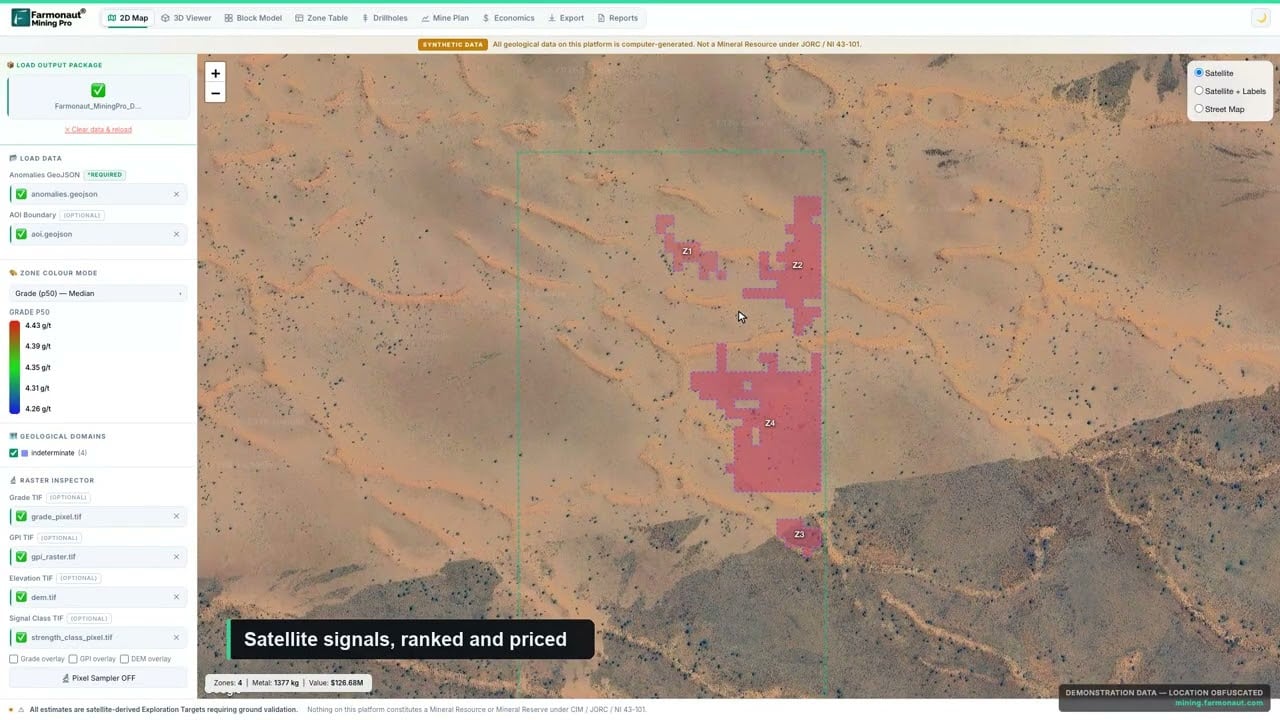
▶ How a licence boundary becomes a geological and economic picture (sample data) · 4:56
How silver minerals are processed
There is no single route. The method follows the mineral and the metals with it.
Infographic
From silver mineral to metal in 4 steps
- 1Crush and grindRock is reduced until mineral grains are freed.
- 2SeparateFlotation makes a concentrate; cyanide leaching dissolves precious metals.
- 3RecoverSmelters treat concentrate; carbon or zinc dust takes metal from solution.
- 4RefineRefineries produce commercial-grade silver.
- Sulfide ores with lead, zinc or copper: the ore is crushed and ground, then froth flotation separates the valuable sulfides into a concentrate, as the EPA lead-zinc report describes. Silver then follows the concentrate to a smelter.
- Gold-silver and oxide ores: a cyanide solution dissolves the precious metals. The EPA gold report describes recovery from solution by carbon adsorption or by zinc dust, known as the Merrill-Crowe process.
- Refining: impure metal goes to a refinery. USGS counted 24 US refiners reporting commercial-grade silver in 2025.
Recovery differs by species and by how finely the mineral is locked in the rock, so a small metallurgical test on representative samples comes before any plant design. Cyanide handling is regulated, and small operators should confirm the rules with the regulator. Never use mercury.
How to identify silver minerals in the field
- Get permission first. Sample only on ground where you hold rights or have written consent, and treat old workings as dangerous.
- Check color and streak. Red points to the ruby silvers. Iron-black covers acanthite, stephanite and polybasite. Note that acanthite leaves a black streak.
- Check weight and softness. Many of these minerals feel heavy for their size and are soft. Acanthite is sectile and can be cut with a knife.
- Note what it sits with. Galena, sphalerite, quartz and tetrahedrite in a vein are reasons to assay.
- Send samples to a lab. Fire assay or a similar method gives the grade. X-ray diffraction or a microprobe names the mineral.
Visual identification can only suggest a mineral. It never gives a grade, and the species names alone say nothing about tonnage.
What satellites can and cannot show about silver minerals
A satellite cannot see a grain of acanthite. It can map what surrounds it at the surface: iron oxide staining, clay and mica alteration, and the long faults along which hot water moved. That makes imagery useful for screening a large licence before sampling, or for comparing a claim with its neighbors before buying. Farmonaut’s satellite mineral detection covers silver among other minerals and produces exploration targets, which sit ahead of a resource estimate and do not replace drilling. To talk through a project, use our mining query form.
If you want to see who is active on the ground, see these silver exploration companies, and for property buyers there is a guide to silver mines for sale.
▶ Remote sensing for mining explained without jargon · 2:01
What silver is used for and why it matters to miners
Silver’s main physical strengths are ductility, electrical conductivity, malleability and reflectivity, as USGS notes. In the World Silver Survey 2026 table, industrial use took 657.4 Moz of the 1,130.6 Moz total demand in 2025. Photovoltaic demand, meaning solar cells, was 186.6 Moz, down from 197.5 Moz in 2024, and the survey forecast 151.0 Moz for 2026. Jewelry took 189.3 Moz and coins and bars 217.7 Moz.
Chart
Silver demand from solar cells and jewelry
Million troy ounces per year; 2026 is the survey forecast
The same table shows demand above supply in every year from 2021 to 2025. For anyone valuing silver in the ground, the point is simple: price can move a long way, as the gap between the 2025 average and recent quotes shows, so test a project at more than one price.
Frequently asked questions
Is silver a mineral?
Yes. Native silver is a recognized mineral. Silver also occurs inside other minerals such as acanthite (about 87% silver) and chlorargyrite (about 75%).
Is silver a mineral or a metal?
Both. Silver is a metallic chemical element, and when it occurs naturally as a crystalline solid it is also a mineral, called native silver.
What minerals contain silver?
The main species include acanthite, chlorargyrite, pyrargyrite, proustite, stephanite, polybasite, freibergite and native silver. Silver also travels with galena, tetrahedrite and other base metal ores.
What is the main ore of silver?
Acanthite is a common silver species in veins, but no single mineral dominates world output, because 2025 supply came mostly from lead-zinc, copper and gold mines (Silver Institute, 2026).
What is the difference between argentite and acanthite?
They have the same chemistry, Ag2S. Argentite is the cubic form stable above about 173 °C. Acanthite is the form stable below it, so it is what you hold at room temperature.
Which silver mineral has the most silver?
Native silver, followed by acanthite at 87.06% by formula.
What is ruby silver?
The term is used for the red minerals pyrargyrite (Ag3SbS3) and proustite (Ag3AsS3).
What is chlorargyrite?
It is silver chloride, AgCl, which can form rich ore in the oxidized zone above silver deposits.
What rocks contain silver minerals?
Mostly hydrothermal veins and replacement ores, often in quartz with galena and sphalerite, plus the oxidized caps above them.
How much silver is in a tonne of ore?
It varies by deposit. Use the calculator above: one tonne at 100 g/t holds 100 grams, or about 3.2 troy ounces, before recovery losses.
More from Farmonaut: contact us.
This page is for information only. It is not investment advice. Sample only with permission, follow safety rules at old workings and never use mercury.
Farmonaut mining
Map your own silver project from space
Consultants can screen a client's licence for alteration and structure and rank targets before fieldwork.

Mining Pro sample view, synthetic data
Keep reading
Sources
- USGS, Mineral Commodity Summaries 2026: Silver: pubs.usgs.gov
- Silver Institute / Metals Focus, World Silver Survey 2026: silverinstitute.org
- USGS, Epithermal gold-silver deposit model, SIR 2010-5070-Q: pubs.usgs.gov
- US EPA, Technical Resource Document: Extraction and Beneficiation of Ores and Minerals, Gold: archive.epa.gov
- US EPA, Technical Resource Document: Lead-Zinc: archive.epa.gov
- Kitco, silver price, 5 November 2026: kitco.com
- Handbook of Mineralogy: Silver: handbookofmineralogy.org
- Handbook of Mineralogy: Acanthite: handbookofmineralogy.org
- Handbook of Mineralogy: Chlorargyrite: handbookofmineralogy.org
- Handbook of Mineralogy: Pyrargyrite: handbookofmineralogy.org
- Handbook of Mineralogy: Proustite: handbookofmineralogy.org
- Handbook of Mineralogy: Stephanite: handbookofmineralogy.org
- Handbook of Mineralogy: Polybasite: handbookofmineralogy.org
- Handbook of Mineralogy: Freibergite: handbookofmineralogy.org
- Handbook of Mineralogy: Tetrahedrite: handbookofmineralogy.org
- Handbook of Mineralogy: Galena: handbookofmineralogy.org
- Handbook of Mineralogy: Hessite: handbookofmineralogy.org
- Handbook of Mineralogy: Naumannite: handbookofmineralogy.org
- Handbook of Mineralogy: Bromargyrite: handbookofmineralogy.org
- Handbook of Mineralogy: Iodargyrite: handbookofmineralogy.org
- Handbook of Mineralogy: Stromeyerite: handbookofmineralogy.org
- Handbook of Mineralogy: Miargyrite: handbookofmineralogy.org
- Handbook of Mineralogy: Dyscrasite: handbookofmineralogy.org
Discussion
Questions, corrections or field experience? Share them below. First-time comments are reviewed before they appear, and your email is never published.
No comments yet. Be the first to add a question or your experience.

 Enterprise Takreem
 Sean Mining Limited
 NTS Group (Pty) Ltd
 Mine4Africa
 Lithspo Minerals Limited
 Tintina Mining Group
 Dalgety Minerals Pty Ltd
 Vortex Minerals Pty Ltd
 Faith At Work (Pty) Ltd
 Geotech Mining Solutions plc
 Vulcan International Limited
 Kidepo Associates
 GKY Mining
 Alkimy SARL
 Double A Trading
 GemSprout Metals Limited
 Qader Group
 Ileys General Trading
 SG Gold Mining LLC
 VRV Global Pte Ltd
 Omsri International FZE
 G.I.T.T.
 Jaunita Erss Ltd
 SRK Consulting
 Berks Gold Limited

 Client · Tanzania · Gold










