

New Mexico · Production data guide
New Mexico Gold and Silver Production: Data by Year
New Mexico mined 8,233 troy ounces of gold and 156,119 ounces of silver in 2024 (MMD), almost all as by-products of copper. See four years of data, the old silver districts, the projects being worked now and an ore value calculator.
Key takeaways
- New Mexico reported 8,233 troy ounces of gold (US$19.7 million) and 156,119 ounces of silver (US$4.4 million) for 2024, about 1.4% of its US$1.77 billion mineral output (MMD, 2024).
- The MMD classes both metals as by-products of copper production; Rowe (2024) says silver in the state now comes only from copper mining.
- The state produced more than 3.2 million ounces of gold and more than 118.7 million ounces of silver from 1848 to 2014 (McLemore, Resource Map 24, 2017); Rowe (2024) puts Mogollon alone at more than 20 million ounces of silver.
- New Mexico is about 0.16% of 2024 United States gold and 0.46% of silver output (our calculation from MMD and USGS, 2026 data).
- Copper Flat is in permitting after a 17 September 2026 hearing, and Silver47 reports an Inferred resource of 12.12 million ounces of silver at Mogollon (company, January 2026).
In this article
- How much gold and silver does New Mexico produce
- How New Mexico compares with the rest of the United States
- Where the precious metals sit among New Mexico's minerals
- Where New Mexico's gold and silver come from today
- The big silver districts of the past
- Precious-metal projects and sites being worked now
- How much are gold and silver in ore worth: a calculator
- Rules and permits for gold and silver work in New Mexico
- Checking a New Mexico gold or silver property before you spend money
- Screening New Mexico ground from space
- Frequently asked questions
New Mexico mines about 8,200 troy ounces of gold and about 156,000 ounces of silver a year, and nearly all of it is a by-product of copper mining. The state’s Mining and Minerals Division (MMD) reports 8,233 ounces of gold worth US$19.7 million and 156,119 ounces of silver worth US$4.4 million for 2024, out of a total mineral output of US$1.77 billion (MMD annual report, 2024). Together the two metals were about 1.4% of the state’s mineral value. The big silver and gold camps of the 1800s, such as Mogollon, Lake Valley and Piños Altos, are now mostly quiet. This page puts the year-by-year numbers, the old districts and the projects being worked today side by side, and includes a calculator for the value of both metals at any ore grade.
How much gold and silver does New Mexico produce
The MMD collects production from operator reports and publishes it every year in its Commission annual report. Both metals are listed in kind (troy ounces) and in dollars. The table below takes four consecutive reports. Dollar values follow the metal price of each year, which is why gold value rose faster than gold ounces.
Chart
Value of New Mexico gold and silver output
US$ million per year, MMD operator reports
| Year | Gold (oz) | Gold value (US$ million) | Silver (oz) | Silver value (US$ million) |
|---|---|---|---|---|
| 2021 | 5,720 | 10.3 | 123,888 | 3.1 |
| 2022 | 7,538 | 13.6 | 148,856 | 3.2 |
| 2023 | 8,677 | 16.9 | 157,022 | 3.7 |
| 2024 | 8,233 | 19.7 | 156,119 | 4.4 |
Source: MMD Commission annual reports for 2021, 2022, 2023 and 2024, Table 8. The 2021 and 2022 reports print the gold quantity with extra digits (5,720,198 and 7,537,979). The matching dollar values, US$10.3 million and US$13.6 million, divided by the average gold prices for those years (about US$1,800 per ounce, USGS Mineral Commodity Summaries 2026) give 5,720 and 7,538 ounces, so the table uses those.
Gold output grew by roughly 44% between 2021 and 2024, and silver by about 26%. The dollar value of gold nearly doubled over the same years, from US$10.3 million to US$19.7 million, because the average gold price rose from US$1,801 to US$2,388 per ounce (USGS, 2026). The silver value in the MMD table works out to about US$28 per ounce for 2024, in line with the USGS bullion average of US$28.37.
How New Mexico compares with the rest of the United States
New Mexico is a very small precious-metal producer by national standards. The USGS puts United States mine production at 163 tonnes of gold and 1,050 tonnes of silver in 2024 (USGS, 2026). Converted at 32,151 troy ounces per tonne, that is about 5.24 million ounces of gold and 33.8 million ounces of silver. New Mexico’s 2024 figures are therefore about 0.16% of national gold and about 0.46% of national silver (our calculation from the MMD and USGS figures).
Nevada is the gold leader, with about 64% of 2025 national output, followed by Alaska with about 22%; Alaska leads in silver, followed by Nevada (USGS gold and silver chapters, 2026). The USGS also notes that about 7% of United States gold is recovered as a by-product of base-metal ore, mainly copper, which is the New Mexico pattern. For a state-by-state view see our guide to gold deposits in the United States.
Where the precious metals sit among New Mexico’s minerals
Copper is the money metal in New Mexico, not gold or silver. In 2024 the MMD valued copper at US$739 million, coal at US$410 million, aggregates (sand, gravel and crushed stone) at US$223 million, industrial minerals at US$222 million and potash at US$157 million. Gold, at US$19.7 million, and silver, at US$4.4 million, are footnotes to the copper line: the MMD states that both are by-products of copper production, and it counts their employment and payroll inside copper.
Chart
New Mexico mineral output by value, 2024
US$ million, selected commodities
The same report ranks New Mexico first in the country for potash and perlite and in the top six for copper, and 23rd among the states for total nonfuel mineral production, at 1.45% of the national total. It records 705 mining operations approved since 1994, most of them recreational or minimal impact sites.
Where New Mexico’s gold and silver come from today
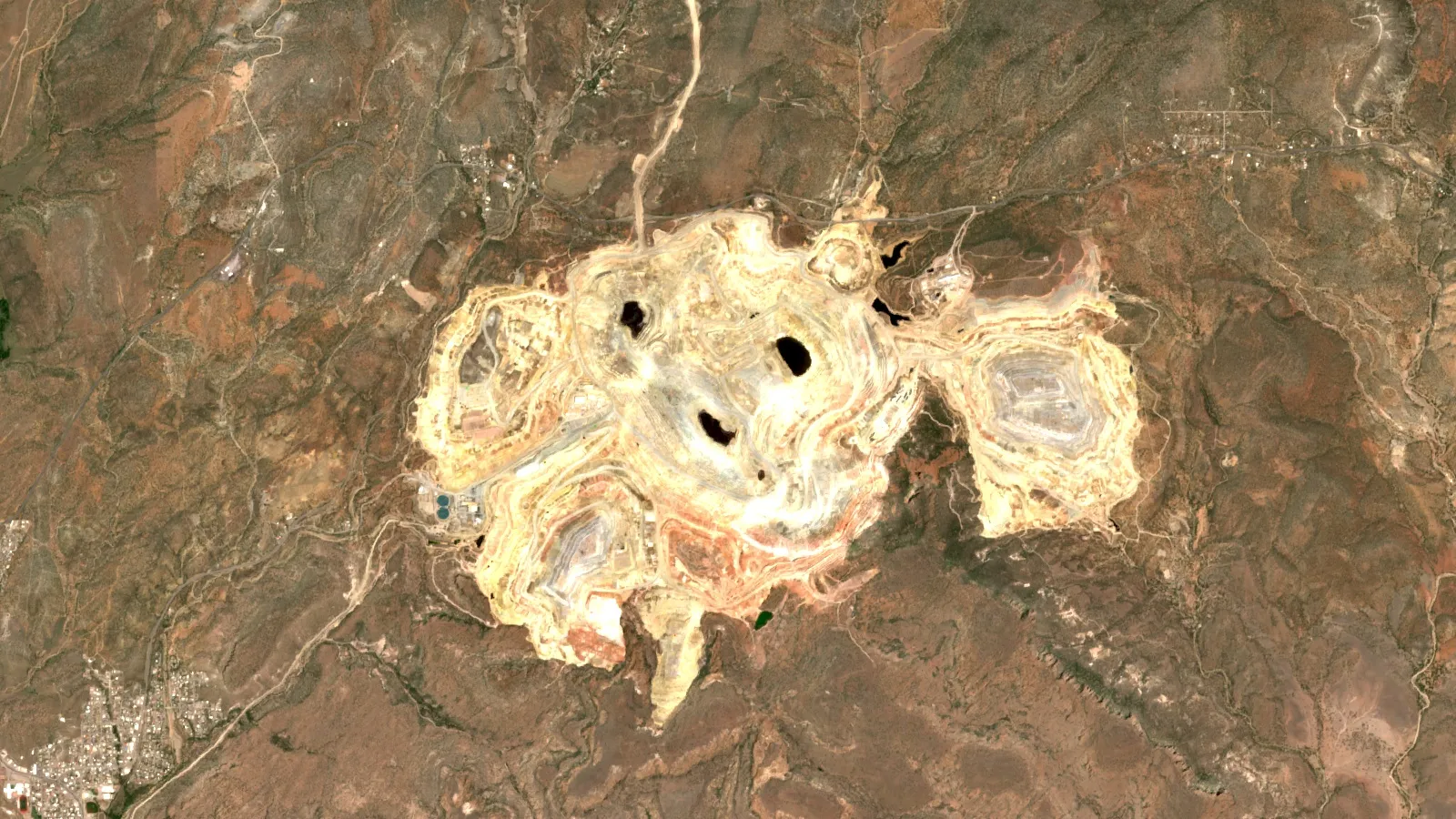
The copper mines are Chino and Tyrone, in southwest New Mexico. The Bureau of Land Management (BLM) describes both as open-pit copper mines operated by Freeport Minerals Corporation, a subsidiary of Freeport-McMoRan, on land that includes public ground (BLM New Mexico locatable minerals). A 2019 status report by Virginia McLemore of the New Mexico Bureau of Geology and Mineral Resources lists Chino’s milling reserves, as stated by the company in 2018, at 274 million metric tons grading 0.54% copper, 0.04 grams per tonne (g/t) of gold and 0.93 g/t of silver (McLemore, 2019).
Plain terms: grade is the concentration of a metal in rock, and g/t means grams of metal per tonne of rock. A gold grade of 0.04 g/t is far below the grade a stand-alone gold mine is built on. Here the mine exists for copper, and the MMD classes both metals as by-products: metals that are sold, but that do not decide whether the mine is built or run.
The same arrangement explains why silver in New Mexico depends on copper today. A 2024 paper by Patrick Rowe for the New Mexico Mineral Symposium states that silver is currently extracted only as a by-product of copper mining in the state (Rowe, 2024). The McLemore 2019 report also notes that copper grades were decreasing and that Tyrone was expected to close in the 2020s (the BLM page still lists it as an operating mine), so the by-product ounces follow copper mine plans rather than gold and silver prices.
What a new copper mine would add
The proposed Copper Flat mine near Hillsboro, in Sierra County, would add precious-metal ounces. A 2019 summary lists planned production of about 12,750 ounces of gold and 455,390 ounces of silver per year for roughly 15 years, together with 50.76 million pounds of copper (McLemore, 2019). Set against the 2024 state totals, that is about 1.5 times the gold and 2.9 times the silver (our calculation). Treat the figures as an old plan: the BLM describes the project as a copper and molybdenum redevelopment, and the MMD scheduled a public hearing for 17 September 2026 on New Mexico Copper Corporation’s amended application, which changes the tailings design to a dry stack on the same footprint. The MMD says no final decision is made at the hearing (MMD notice, August 2026).

▶ How gold is mined and refined, from rock to bar, in a clay-animation walk-through. · 5:27
The big silver districts of the past
New Mexico’s total gold and silver output is mostly history. The Bureau of Geology’s district map reports more than 3.2 million ounces of gold (worth more than US$463 million at the prices of the time) and more than 118.7 million ounces of silver (more than US$279 million) mined from 1848 to 2014, within a total of more than US$43 billion of minerals produced since the early 1800s from 246 districts and prospect areas (McLemore, Resource Map 24, 2017). By Rowe’s count, silver has been found in 163 districts, and 14 of them produced more than 3 million ounces each, together about 80% of the state’s silver.
Chart
Largest historical silver districts
Million troy ounces produced; Mogollon, Burro Mountains and Fierro-Hanover are minimums (more than); Magdalena (4 Moz) not shown
The chart above shows the largest silver districts that Rowe lists from the 1986 Bureau of Mines study by North and McLemore. Mogollon in Catron County leads with more than 20 million ounces. Several entries are given as “more than”, so the bars are minimum values.
A short timeline of the booms
- 1828. Gold is found in the Ortiz Mountains (Old Placers district, Santa Fe County), one of the earliest gold rushes in the West and 21 years before California (McLemore, 2017).
- 1860. Placer gold is found at Piños Altos, where more than 700 miners were soon at work; Fremont and Steeple Rock also open in 1860 (McLemore, 2017).
- 1863. The first major silver discovery of the territory is made in the North Magdalena district (Rowe, 2024).
- 1893. Congress repeals the Sherman Silver Purchase Act and the silver price drops to US$0.62 per ounce. Mines and smelters across the region shut (Rowe, 2024).
- 1942. On 6 October the War Department closes all gold mines in the United States for war production. The ban ends in 1945 (McLemore, 2017). Operators say the Mogollon district has been largely dormant since that shutdown (Silver47, January 2026).
Not all of these were silver camps. Some, such as Piños Altos and the Ortiz placers, were mainly gold. For how the old districts relate to claims and the state Mining Act, see our guide to gold mining in New Mexico. Rowe (2024) lists volcanic-epithermal veins, formed by hot water near the surface, among the five deposit types that produced gold or silver as the main product; our epithermal gold deposits guide explains the style.
Precious-metal projects and sites being worked now
The list below covers the operations and projects named in the MMD 2024 report, the BLM page and company releases. It is not a ranking and it is not a complete census of exploration. Status is as stated in each source on its date.
| Site | Metals | Status in the source | Source |
|---|---|---|---|
| Chino mine | Copper; gold, silver by-products | Open-pit copper operation run by Freeport Minerals Corporation | BLM; McLemore 2019 |
| Tyrone mine | Copper | Open-pit copper operation run by Freeport Minerals Corporation | BLM; McLemore 2019 |
| Copper Flat (Hillsboro, Sierra County) | Copper and molybdenum (BLM); older plan also lists gold, silver | Permitting; MMD public hearing on amended application set for 17 September 2026 | BLM; MMD notice |
| Mogollon (Catron County) | Silver and gold | Exploration by Silver47 Exploration Corp.; winter drill program started January 2026 | Silver47 |
| Alhambra project | Silver, gold | Minimal impact exploration permit approved in 2024 for Standard Silver Corp | MMD 2024 |
| Bella Group lode exploration | Copper, gold | Minimal impact exploration permit approved in 2024 (New Metals Strategies, LLC) | MMD 2024 |
| Peloton Group, Drolte Hole | Gold | Minimal impact exploration permit approved in 2024 (Peloton Group LLC) | MMD 2024 |
Mogollon: a silver resource, with caveats
Silver47 reports an Inferred Mineral Resource at Mogollon of 32.08 million ounces of silver equivalent, made of 12.12 million ounces of silver and 0.24 million ounces of gold, at 367 g/t silver equivalent (139 g/t silver and 2.72 g/t gold) over 2.72 million tonnes (Silver47, January 2026). Three terms matter here. An Inferred resource is the lowest-confidence category of mineral resource: the tonnage and grade are estimated from limited sampling, and it is not a reserve (a reserve is the part of a resource shown to be economic to mine). Silver equivalent converts gold into silver using assumed prices. Silver47 used US$20 per ounce of silver and US$1,800 per ounce of gold, with recoveries of 90% for silver and 95% for gold. On 15 October 2026 Kitco showed gold at US$4,157.70 and silver at US$56.98 per ounce, a ratio of about 73 to 1 compared with 90 to 1 in the company’s assumption (Kitco gold and silver, 15 October 2026, 2:50 pm New York time, an intraday quote), so equivalent figures move with the prices used.
The company says its 2026 holes lie outside the current resource, which means they can add to it but do not change the existing numbers. Nothing in the source states a mine plan, permit application or production date for Mogollon. This is exploration, so it adds no ounces to the state totals today.
How much are gold and silver in ore worth: a calculator
The by-product logic is easy to test with numbers. Enter an ore tonnage, the two grades, the share of each metal that the plant recovers, and your own prices. The defaults use the Chino milling-reserve grades quoted above (0.04 g/t gold and 0.93 g/t silver, a 2018 company figure reported by McLemore, 2019) over one million tonnes of ore, with 70% recovery as an example only. Change them to try Mogollon-type ore: 139 g/t silver and 2.72 g/t gold from the Silver47 resource is a quick check, and 2.72 million tonnes gives the 12.1 million ounces of silver and 0.24 million ounces of gold of contained metal, before any recovery loss.
Calculator
What are the gold and silver in your ore worth?
Enter your ore tonnage, grades, recoveries and prices.
- Contained gold (oz): 1,286
- Contained silver (oz): 29,900
- Recovered gold (oz): 900
- Recovered silver (oz): 20,930
- Recovered gold value (US$): $3,600,881
- Recovered silver value (US$): $1,151,157
Example values only, not a benchmark or a forecast. The grades are the Chino milling-reserve grades from a 2018 company figure reported by McLemore (2019); the 70% recoveries are examples. Prices are inputs: example, use today’s price. Money is in US$; contained ounces use 31.1035 grams per troy ounce.
Rules and permits for gold and silver work in New Mexico
Mining and exploration on state, private or federal land in New Mexico needs a permit class that matches the disturbance. The MMD’s 2024 report counts the operations it has approved since 1994 by type. A minimal impact exploration permit covers less than 5 acres of disturbance, and a regular exploration permit covers more than 5 acres. General (recreational) operations may dig less than 200 cubic yards a year and disturb no more than 2 acres of surface at any one time. The table shows how the 705 operations approved since 1994 split.
| Permit class (MMD) | Disturbance | Operations approved, 1994 to 2024 |
|---|---|---|
| General (recreational) | Under 200 cubic yards a year and 2 acres at a time | 417 |
| Minimal impact exploration | Under 5 acres | 183 |
| Minimal impact new mining | Under 10 or 40 acres | 41 |
| Regular existing mining | Over 10 acres | 31 |
| Minimal impact existing mining | Under 10 or 40 acres | 24 |
| Regular exploration | Over 5 acres | 9 |
| Regular new mining | Over 10 acres | 0 |
Source: MMD annual report, 2024. The MMD received no minimal impact new mining applications and approved no new regular mines in 2024; it approved three minimal impact exploration permits for new projects, shown in the project table above. Whether a given claim or lease needs a state permit, a BLM notice or plan, or both depends on who owns the surface and the minerals, so confirm with the MMD and the BLM field office before any ground is disturbed. Get the landowner’s permission, follow the safety rules for old workings, and never use mercury to recover gold.
Checking a New Mexico gold or silver property before you spend money
A gold claim gives rights to the minerals under US mining law, not title to the land, and old districts are often a patchwork of private, state, federal and patented ground. The video at the end of this section explains the 1872 mining law and the difference between a claim and land ownership, using a Washington example. The steps below are a practical order of checks for a New Mexico property.
Infographic
Five checks before you spend money
- 1Find the district recordLook up the district and its past production at the New Mexico Bureau of Geology and Mineral Resources.
- 2Confirm who owns whatCheck the surface owner, the mineral owner and any active claims.
- 3Match the work to a permitCompare your planned disturbance with the MMD permit classes.
- 4Screen the groundUse maps, geology and satellite clues to rank where to sample first.
- 5Ask for the dataRequest assays, drill logs and a sample plan before paying for a deposit.
First, find the district and its records at the New Mexico Bureau of Geology and Mineral Resources, whose Resource Map 24 lists 246 districts and prospect areas. Second, check who owns the surface and the minerals and whether any claims are active. Third, match the planned work to a permit class in the table above. Fourth, screen the ground with the cheapest tools first. Fifth, ask for assays and drill records before paying for a deposit.
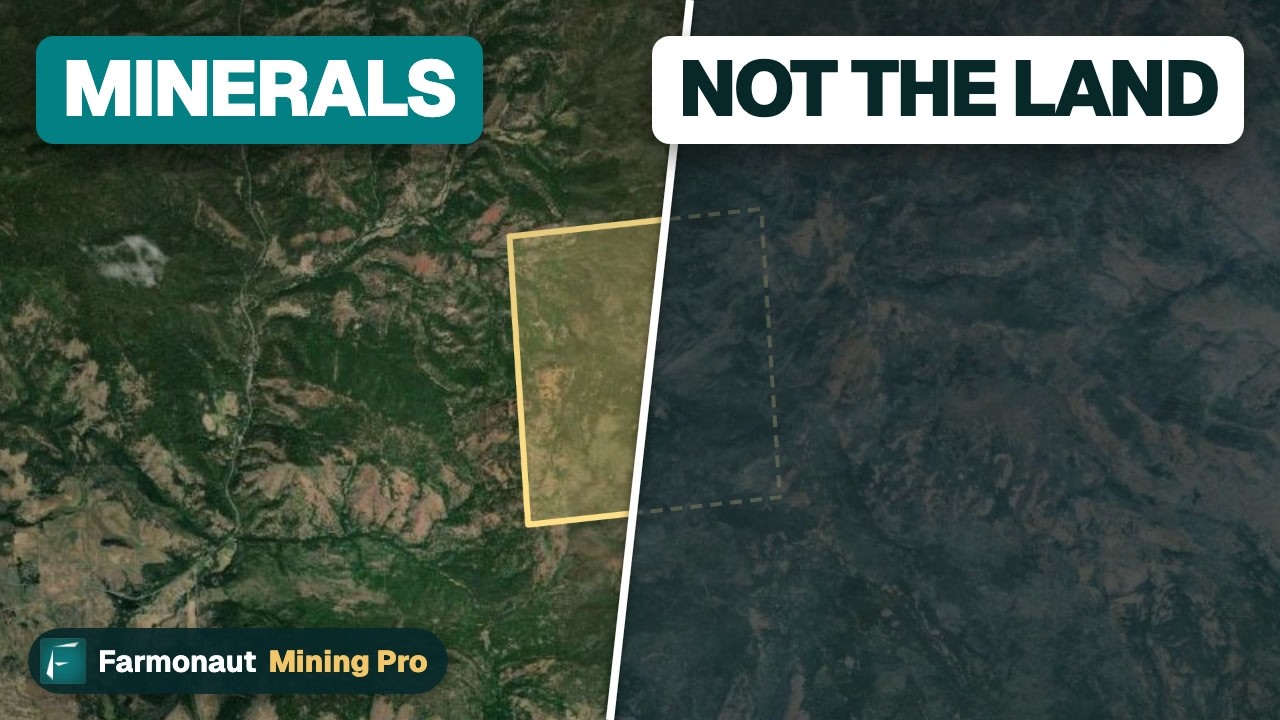
▶ Why a gold claim gives mineral rights but not land title, and how to check the ground first. · 3:19
Screening New Mexico ground from space
Satellites cannot see gold or silver. They map clues in the surface rock: iron-stained and clay-altered ground, silica, and faults that carried hot water. Exploration teams use this to rank where to sample first. Farmonaut’s satellite-based mineral detection covers gold and silver within a list of 20+ minerals and returns exploration targets for a boundary you supply in 5 to 20 business days; the targets sit ahead of a resource estimate and are not a JORC or NI 43-101 result. Our satellite gold exploration guide for the United States covers claims data and screening in more detail.

▶ What satellites can and cannot show for gold exploration. · 4:25
If this topic matters to you, read US Gold Production in Metric Tons, Plus Canada and Silver next.
Frequently asked questions
How much gold does New Mexico produce?
The MMD reports 8,233 troy ounces for 2024, worth US$19.7 million, down slightly from 8,677 ounces in 2023. All of it is a by-product of copper mining (MMD annual reports, 2023 and 2024).
How much silver does New Mexico produce?
The MMD reports 156,119 troy ounces of silver for 2024, worth US$4.4 million, compared with 157,022 ounces in 2023. Rowe (2024) states that silver in the state now comes only as a by-product of copper mining.
Is there an active gold mine in New Mexico?
The MMD table lists gold only as a by-product of copper production, and the BLM names Chino and Tyrone as the notable copper mines in the state. A 2019 state summary listed one gold mine and mill on standby (McLemore, 2019); the 2024 report names no stand-alone gold producer.
What was New Mexico’s largest silver district?
Mogollon in Catron County, with more than 20 million ounces according to the figures Rowe cites from North and McLemore (1986). The Burro Mountains district in Grant County follows with more than 10 million ounces.
How much silver and gold has New Mexico produced in total?
More than 118.7 million ounces of silver and more than 3.2 million ounces of gold from 1848 through 2014 (McLemore, 2017). Recent output is small by comparison: under 10,000 ounces of gold a year in each of 2021 to 2024 (MMD).
When was the first gold rush in New Mexico?
The Bureau of Geology dates the Ortiz Mountains gold rush to 1828, 21 years before California’s. Spanish and Mexican-era mining records before that are sparse and inconsistent (McLemore, 2017; Rowe, 2024).
Why did the silver mines close?
Many shut after the 1893 repeal of the Sherman Silver Purchase Act cut the silver price to US$0.62 per ounce (Rowe, 2024). Gold mines were closed nationally by the War Department on 6 October 1942, and the ban ended in 1945 (McLemore, 2017).
Is the Copper Flat mine approved?
No. The permit has not been decided. The MMD scheduled a public hearing for 17 September 2026 on the amended application; the hearing itself makes no decision, and a summary report goes to the MMD Director (MMD notice, August 2026).
Can I pan or prospect for gold in New Mexico?
Recreational work that moves less than 200 cubic yards a year and disturbs no more than 2 acres at one time is a general (recreational) operation under the MMD classes shown above, but you still need permission from the landowner or land manager, and mercury must not be used. Confirm the current rules with the MMD and the BLM.
What is the difference between silver and silver equivalent?
Silver equivalent adds the value of other metals, usually gold, converted to ounces of silver at assumed prices and recoveries. It is a company reporting convenience, so always read the assumptions that sit next to the figure.
This page is for information only. It is not investment advice and not legal advice. Metal prices are Kitco quotes on the date shown, and permit rules change, so confirm current prices and the rules with the regulator.
Farmonaut mining
Map your mining site from space
Consultants can screen a New Mexico claim block or licence area for alteration clues by satellite before field work; results are exploration targets, ahead of any resource estimate.
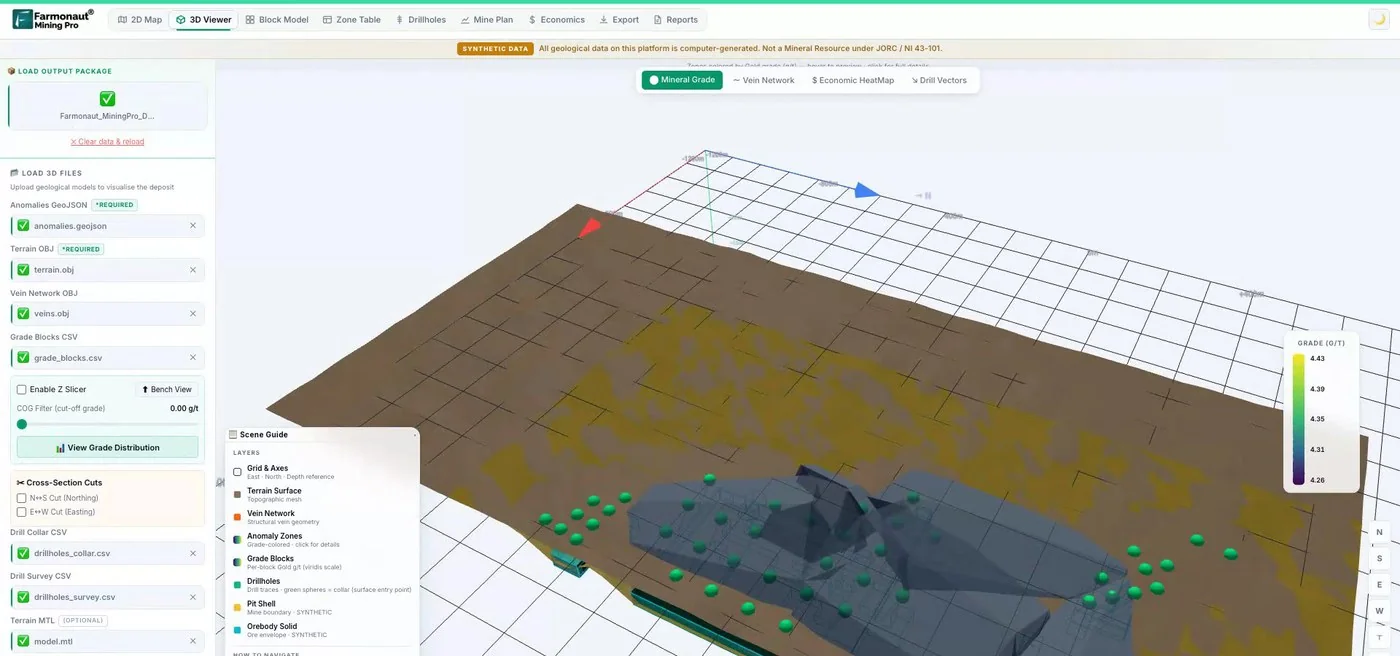
Mining Pro sample view, synthetic data
Keep reading
Sources
- New Mexico Mining and Minerals Division, Commission annual report 2024: emnrd.nm.gov
- New Mexico Mining and Minerals Division, Commission annual report 2023: emnrd.nm.gov
- New Mexico Mining and Minerals Division, Commission annual report 2022: emnrd.nm.gov
- New Mexico Mining and Minerals Division, Commission annual report 2021: emnrd.nm.gov
- McLemore, Mining Districts and Prospect Areas in New Mexico, Resource Map 24 (NMBGMR, 2017): geoinfo.nmt.edu
- Rowe, History of Silver Mining in New Mexico, New Mexico Mineral Symposium (2024): geoinfo.nmt.edu
- McLemore, Status of the Mining Industry in New Mexico (NMBGMR, 2019): assets-002.noviams.com
- USGS, Mineral Commodity Summaries 2026: Gold: pubs.usgs.gov
- USGS, Mineral Commodity Summaries 2026: Silver: pubs.usgs.gov
- Bureau of Land Management, New Mexico locatable minerals: blm.gov
- New Mexico Mining and Minerals Division, Copper Flat Mine amended application hearing notice (August 2026): emnrd.nm.gov
- Silver47 Exploration Corp., Mogollon drilling news release (21 January 2026): newsfilecorp.com
- Kitco, gold price (15 October 2026): kitco.com
- Kitco, silver price (15 October 2026): kitco.com
Discussion
Questions, corrections or field experience? Share them below. First-time comments are reviewed before they appear, and your email is never published.
No comments yet. Be the first to add a question or your experience.

 Vortex Minerals Pty Ltd
 Faith At Work (Pty) Ltd
 Geotech Mining Solutions plc
 Vulcan International Limited
 Kidepo Associates
 GKY Mining
 Alkimy SARL
 Double A Trading
 GemSprout Metals Limited
 Qader Group
 Ileys General Trading
 SG Gold Mining LLC
 VRV Global Pte Ltd
 Omsri International FZE
 G.I.T.T.
 Jaunita Erss Ltd
 Almosi SARL
 SRK Consulting
 Berks Gold Limited
 Mwerezi Minerals Company Limited
 Mining SARL
 SenGold Invest SAS
 Exploration consultancy · South Africa · Gold










