

Tanzania mining · Cadastre guide
Tanzania Mining Cadastre Portal: Licences and Royalties
The Tanzania mining cadastre portal holds the licence map, applications and fee payments. Learn what the public map shows, how login works, the licence types and the Section 87 royalty rates.
Key takeaways
- The portal at portal.madini.go.tz is the Mining Commission’s online system for applications, payments and decisions (Mining Act, Cap. 123).
- The public map shows licence boundaries and status; geology comes from the Geological Survey of Tanzania.
- Login is for holders and applicants; EITI notes the Commission provides a link to request access (EITI, Tanzania).
- Royalties under section 87 are 6% for metallic minerals including gold, 5% for uranium and 3% for industrial minerals.
- Primary mining licences are for Tanzanian citizens only (section 8(2)).
In this article
- Who runs the Tanzania mining cadastre portal
- The Tanzania licence ladder: leseni ya madini explained
- Using the Tanzania mining cadastre portal: public map and sign-in
- How to apply for a prospecting licence on the Tanzania mining cadastre portal
- Mining licences, special mining licences and primary mining licences
- Mining development agreements, state participation and royalties
- Before you file: make sure the ground is worth it
- Frequently asked questions
Prospecting licences, primary mining licences, mining licences and special mining licences in Tanzania are all administered by the Mining Commission (Tume ya Madini) through its online cadastre. Below: the portal, the licence ladder, who can apply for what, the statutory deadlines, royalties and state participation, and how to check ground before you file.
Regulator Mining Commission
Law Mining Act, Cap. 123
Portal portal.madini.go.tz
The Tanzania mining cadastre portal, at portal.madini.go.tz, is where the country’s mineral rights are recorded, searched and applied for. It is run under the Mining Commission, known in Swahili as Tume ya Madini, within the Ministry of Minerals. If you want a leseni ya madini (a mining licence) of any kind, from a prospecting licence over a greenstone belt to a primary mining licence for a small gold pit, your application passes through the Commission’s Mining Cadastre.
The rules are in the Mining Act, Cap. 123 (Revised Edition 2019), which was heavily amended in 2017. Those amendments created the Mining Commission, rewrote the state participation rules, and changed how development agreements work. We go through the process in plain language, from the Commission’s published guidance and the text of the Act, so you know what the portal can do and what it will ask of you. For the same process in other countries, see our guide to mining cadastre portals by country.
The Tanzania mining cadastre portal answers a legal question: is this ground free of existing licences? It cannot answer the geological one: is there anything worth finding here? Fees, work programmes and local-content plans all start with the application, so the strongest applicants answer both first.
Who runs the Tanzania mining cadastre portal
Section 21 of the Mining Act establishes the Mining Commission as a body corporate. It is the licensing authority for most mineral rights and the regulator of mining operations. Section 27G then sets up the Mining Cadastre within that framework, with three jobs:
- Receive and process applications for mineral rights and mineral processing licences.
- Administer those rights and licences once granted.
- Maintain public cadastral maps and cadastre registers that anyone can consult.
The Act defines the Mining Cadastre as the central online system for processing applications. It also defines an “online transactional mining flexicadastre portal” as the web service for submitting applications, making online payments, administering rights and communicating decisions electronically. That portal is the cadastre system described here. The Commission may also set up regional mining cadastre offices, which receive applications and forward them for processing.
The other bodies you will deal with
- Ministry of Minerals: the Minister sets policy, designates reserved and tender areas, and approves certain decisions.
- Geological Survey of Tanzania (GST): established under section 27A. It advises the Minister on geology, carries out geological mapping of Tanzania and provides geological and mineral-resource data to the public. It is also responsible for the National Mineral Resources Data Bank.
- Regional and resident mines offices: the Commission’s local presence, where small-scale applicants in particular often start.
- Environmental authorities: a mining licence requires the relevant environmental certificate issued under the Environmental Management Act before grant.
Assuming a paper licence or a middleman’s promise is enough. The Tanzania mining cadastre portal register is the record that counts. Before you sign anything, look up the licence number, check the holder, the licence type, the expiry date and the boundary, and make sure the area in the deal matches the area on the cadastre.
The Tanzania licence ladder: leseni ya madini explained
Tanzanian mineral rights are graded by scale and capital. The definitions in the Act tie each mining licence to an investment band, which is unusual and worth understanding before you apply. The Mining Commission’s application procedure lists all of these licence types, plus processing, smelting, refining, dealer’s and broker’s licences.
| Licence | What it is for | Scale / capital | Term | Who can hold it |
|---|---|---|---|---|
| Prospecting Licence (PL) | Exclusive prospecting | Area set by regulations | Up to 4 years initially, then up to 3; not renewable after the second renewal (s. 32) | Individuals and companies; holding caps apply |
| Primary Mining Licence (PML) | Small-scale prospecting and mining | Initial capital up to US$5 million | 7 years, renewable | Tanzanian citizens, all-citizen partnerships and companies only |
| Mining Licence (ML) | Medium-scale mining | Capital US$100,000 to US$100 million | Up to 10 years initially, renewable (s. 53) | Qualifying applicants |
| Special Mining Licence (SML) | Large-scale mining | Capital of at least US$100 million | Estimated life of the ore body, or the period requested, whichever is shorter (s. 43) | Qualifying applicants |
| Processing Licence | Milling, beneficiation and dressing of ores | n/a | Up to 10 years, renewable | Registered with the Commission |
| Smelting / Refining Licence | Smelting or refining minerals | n/a | Up to 25 years, renewable | Registered with the Commission |
The terms are just as uneven as the capital bands. A prospecting licence starts at up to 4 years and its first renewal adds up to 3. A primary mining licence runs 7 years, a mining licence up to 10 years at first, a processing licence up to 10 and a smelting or refining licence up to 25. A special mining licence has no fixed number; it follows the ore body.
Prospecting licence limits
Two rules shape how much prospecting ground one group can hold. First, the maximum area for each mineral right is prescribed by regulations under section 70, so check the current limit before you draw a boundary. Second, section 8(8) says a prospecting licence won’t be granted to anyone, or to any partner, shareholder or director, who already holds more than 20 valid prospecting licences, unless their total prospecting area is no more than 2,000 km².
What happens when a prospecting licence runs out
This is one of the most important rules for investors. Under section 32, once a prospecting licence can no longer be renewed, the area reverts to the Government. A new prospecting licence over it can then be issued to a local mining company designated by the Minister with Cabinet approval. Any other company wanting to prospect there must make an arrangement with that local company, again with Cabinet approval. In practice, you have a fixed window to prove up a deposit and move to a mining licence.
Because the Act ties each mining licence to a capital band and a citizenship rule, the first question is which licence you can hold at all. The estimator below answers that from your planned capital and ownership, then applies the section 87 royalty rate for your mineral group to a year of production.
Because prospecting ground reverts to the Government at the end of its last renewal, the clock on a Tanzanian prospecting licence is also the clock on your investment case. Spend the early years on the highest-probability targets, not on blanket coverage. This is general information, not investment advice.
If you are deciding where to put your prospecting boundary, you can get a satellite read on the area first. Draw it on mining.farmonaut.com (Map Your Mining Site), or send the coordinates through our mining query form for a quote.
Using the Tanzania mining cadastre portal: public map and sign-in
The portal is built on the Landfolio (FlexiCadastre) platform, which went live in 2012, the same family of software used by several other African cadastres. It has two layers.
The public layer
- Public map at the portal’s Public Map page, showing licence boundaries across the country.
- Search of cadastre data, so you can find existing licences and applications over an area.
- Due diligence: check a vendor’s licence number, type and holder before you negotiate.
The signed-in layer
- Register applications for new mineral rights.
- Review your licences and their status.
- Submit performance information and reports.
- Pay licence fees and royalties online.
- ⚠ Registration: guidance from 2015 required portal access to be registered in person at a ministry or mines office. Check with your zonal or resident mines office before relying on it.
The Commission’s own application guidance says applications can be submitted online and/or in hard copy, and that the area applied for must be free of existing licences. The portal page is a JavaScript application and can be slow on weak connections. If it doesn’t load, try again later rather than using an unofficial copy. For a neighbouring system, see our guide to the Kenya mining cadastre portal, its fees and deadlines.
Using the Tanzania mining cadastre portal for due diligence
Investors use the public side of the portal as much as applicants do. Before you sign a joint venture, option or share purchase over a Tanzanian licence, run these checks:
- Licence number and type: does the register show the same licence type the vendor describes? A primary mining licence and a mining licence carry very different rights and ownership rules.
- Holder: does the holder on the register match the company or person you are dealing with? Citizen-only rules for primary mining licences make this especially important.
- Status and expiry: is the licence active, and how much of its term is left? A prospecting licence near its final renewal is close to reverting to the Government.
- Boundary: does the area in the deal documents match the boundary on the portal map? Overstated areas are a common problem.
- ⚠ Pending applications nearby: competing applications over the same ground can affect what the vendor can really deliver.
Save dated screenshots of what the portal showed. If questions come up later, a record of the register at the time of the deal is useful evidence. Where anything doesn’t match, ask the Mining Commission or its regional office before you proceed.
Sort out portal access before you need it. Section 14 of the Act gives priority to the application first registered when two applicants want the same ground. If your portal account isn’t ready, another applicant can register first.
Map, login and registration: what the portal offers
Two searches come up most: the portal map and the portal login. The two layers work differently. The map side is built to show where licences sit, so use it to check ground, not to read geology; geological maps come from the Geological Survey of Tanzania. At the 2015 launch, the Minister said customers could register applications, review licences, send performance information and pay licence and royalty fees online (TanzaniaInvest, June 2015). The Mining Act also says the prescribed forms include the electronic forms inside the online portal (African Mining Legislation Atlas, Mining Act text).
On sign-in, the EITI country page says the Mining Commission provides a link where licence holders can request access to the portal, and that outsiders without credentials cannot see the content of licences (EITI, Tanzania country page). So a login is for the holder or applicant. If you are an investor or consultant, ask the holder for the licence number and type, then check them on the public map and ask the Commission or a resident mines office how access is issued.
A short routine for the map: note the licence number, type, holder and status; zoom to the boundary and write down the neighbours; save a dated screenshot; repeat the check just before you pay or sign.
How to apply for a prospecting licence on the Tanzania mining cadastre portal
The prospecting licence is where most exploration projects start, and the Act sets out its contents and deadlines in some detail. Here is the sequence, step by step.
Step 1: confirm the area is available
Search the public map on the portal. The area must not overlap existing licences. It also must not fall in areas the Minister has reserved for primary mining licence holders under section 16, or in areas where rights are to be allocated by tender under section 15. Note every neighbouring licence number.
Step 2: prepare a complete application
Section 28 of the Act sets out what a prospecting licence application must contain. Beyond the prescribed form, it must include:
- The size of the area, within the prescribed maximum, with a plan of the area.
- Particulars of the financial and technical resources available to the applicant.
- A procurement plan for goods and services available in Tanzania.
- Details of any mineral right previously granted to the applicant.
- An integrity pledge in the prescribed form.
- A local content plan.
Step 3: pay the fee and register
An application made in the prescribed form, with the prescribed fee paid, is registered immediately. That registration is what fixes your priority. Under section 14, where two applicants who are not acting together apply for overlapping ground, the one whose application was first registered is granted the right, provided they meet the other conditions. Applications received on the same business day are treated as simultaneous, and the regulations decide between them.
Steps 4 and 5: decision, acceptance and payment
Under section 33, the licensing authority notifies you within four weeks of registration whether the application is granted or rejected, with reasons for any rejection. You then have four weeks to accept the proposed licence and pay the fees in the notification.
Step 6: keep the licence alive
A holder who wants to renew must apply within one month before the licence expires. The first renewal is for up to three years. The licence can’t be renewed after the second renewal period, and the ground then reverts to the Government. Commentary on the Act puts the total life of a prospecting licence at about nine years.
The four-week acceptance window and the one-month renewal window are short. Put both in your diary the day you file on the Tanzania mining cadastre portal, and make sure someone with authority to pay is available when the notification arrives.
Why Tanzanian applications stall
Most problems trace back to the application itself. Using the Act’s own list of required contents, these are the gaps to close before you register:
- ⚠ Missing local content plan or procurement plan. Both are required parts of a prospecting licence application, not optional extras.
- No integrity pledge in the prescribed form.
- An area plan that overlaps existing licences, reserved primary-licence areas or tender areas.
- Thin evidence of financial and technical resources. The Act asks for particulars, so name the team and show the funding.
- Undisclosed previous mineral rights. The application must list them, and the holding cap for prospecting licences depends on them.
- ⚠ Missed acceptance deadline. A granted licence still needs your acceptance and payment within four weeks of notification.
Mining licences, special mining licences and primary mining licences
Mining Licence (medium scale)
A mining licence covers medium-scale operations with capital of US$100,000 to US$100 million. The application states the duration sought, up to ten years, and includes the proposed mining programme, environmental measures, the estimated ore recovery rate and planned annual production. It also needs an employment and training plan for Tanzanians, a succession plan for expatriate staff, and a local content plan. The relevant environmental certificate must be in place before grant. Section 53 lets the holder apply for renewal no later than six months before expiry, with the prescribed fee and a tax clearance certificate.
Special Mining Licence (large scale)
A special mining licence is for large-scale operations with capital of at least US$100 million. It runs for the estimated life of the ore body shown in the feasibility study, or the period the applicant asks for, whichever is shorter. The feasibility study is therefore the core of the application.
Primary Mining Licence (small scale)
The primary mining licence is Tanzania’s small-scale licence, for operations with minimal machinery and initial capital of no more than US$5 million. It is valid for seven years and can be renewed. Section 8(2) reserves it for Tanzanians. An individual must be a citizen. A partnership must be made up only of citizens. A company must have only citizen members and directors, and must be controlled from within Tanzania by citizens. The Minister can also reserve areas exclusively for primary licence holders. For how other countries size and restrict small-scale titles, see our artisanal mining licence and small-scale permit guide.
Types of mining licence in Tanzania at a glance
Four titles cover most projects: the prospecting licence, the primary mining licence (small scale, citizens only), the mining licence (medium scale) and the special mining licence (large scale). The Act also provides for processing, smelting, refining, dealer’s, broker’s and lapidary licences (Mining Act, Cap. 123, as published on tanzanialaws.com). The table above gives terms and capital bands for each. If you are weighing small-scale ground, the key question is eligibility, because section 8(2) limits primary licences to citizens.

▶ Can foreigners get a small-scale mining licence in Africa? · 5:16
Mining development agreements, state participation and royalties
People often search for “mining development agreement Tanzania” expecting the old model, where large projects negotiated bespoke fiscal terms with government. The 2017 amendments changed that. Section 11 now provides that development agreements concluded before it came into force remain in force, but subject to the Natural Wealth and Resources Contracts (Review and Renegotiation of Unconscionable Terms) Act. Section 12 was repealed in 2017. New investors should not assume a stand-alone development agreement is available. Take legal advice on the current position.
State participation
Section 10 gives the Government not less than 16% non-dilutable free carried interest in the capital of a company that holds a mining licence or special mining licence, depending on the mineral and the level of investment. On top of that, the Government may acquire up to 50% of the shares in total, in line with the tax expenditures it has granted to the company.
Royalty rates
Section 87 sets royalties on the gross value of minerals produced. The rates in the 2019 revised Act are shown below. Rates and related charges change, so check with the Mining Commission or the latest revised edition on madini.go.tz before you build a financial model.
Royalty rates and the gold purchase programme
Section 87 sets these royalty rates on gross value: 6% for metallic minerals such as copper, gold, silver and platinum group minerals; 6% for gemstones and diamonds; 5% for uranium; 3% for other minerals including building materials and industrial minerals; and 1% for gems (Mining Act, s. 87). The chart above shows the same bands. Separately, on 1 October 2024 the Bank of Tanzania launched a domestic gold purchase programme with a reduced 4% royalty and no inspection fee for gold sold to the Bank, and the Bank’s notice reminded holders that, under section 59, 20% of minerals produced or purchased must be offered to the Government (TanzaniaInvest, October 2024). The 4% rate is still listed for gold sold to the Bank of Tanzania in 2026 (TanzaniaInvest mining page, which also lists 2% for sales to local refineries). Rates and programmes change, so confirm today’s position with the Mining Commission before you model cash flow.
Calculator
What royalty would a year of gold output pay?
Enter your own tonnes, grade, recovery, price and royalty rate.
- Gold sold: 5,787
- Gross value: $22,500,000
Example values only, not a benchmark. The 6% rate for metallic minerals comes from section 87 of the Mining Act (Cap. 123); use 4% only if you sell under the Bank of Tanzania programme. Gold price is an input: example, use today’s price. Excludes other fees, levies and taxes.
Before you file: make sure the ground is worth it
The portal will tell you an area is free. It won’t tell you whether it is prospective. With a fixed prospecting window, a local content plan to deliver and ground that reverts to the Government at the end, choosing the right boundary is the single most important decision you make before registering an application.
That is where satellite analysis fits. Our satellite-based mineral detection analyses multispectral and hyperspectral imagery of your polygon. Each mineral and alteration zone reflects energy in its own spectral signature. We use that to flag likely mineralised target zones, alteration halos and structures such as faults and fractures, without anyone going on to the land.
- ✔ Input you already have: the coordinates, KML/KMZ or polygon of your planned licence area, plus the target mineral.
- Speed: reports arrive in 5–20 business days, depending on area and mineral complexity.
- Deliverables: prospectivity heatmaps, high-potential zones with estimated location and depth ranges, geological interpretation, and PDF plus georeferenced GIS files. Premium+ adds TargetMax™ drilling intelligence and 3D subsurface models.
- Cost and time: satellite screening can cut early-exploration costs by up to 80–85% and shorten timelines from months to days, compared with starting on the ground.
- ⚠ Limitation: satellite targets are exploration targets, not a mineral resource. They tell you where to sample and drill first, and field work confirms them.
Screening from space involves no ground disturbance. On community land, near protected areas or in districts with many small-scale workings, you can learn a lot about a block before any vehicle, pit or trench arrives. Surface work then goes only where it is likely to be worthwhile.
See a sample deliverable in the satellite-driven 3D mineral prospectivity mapping overview. We have scanned 100,000+ hectares for 20+ mineral types across 25+ countries.
Found open ground on the Tanzania cadastre? Check what’s under it.
Send us the same boundary you plan to register on the portal. We’ll return a satellite prospectivity read, with ranked target zones, geology and next steps, before you commit to fees and a work programme.
A Tanzania mining cadastre portal pre-application checklist
- Choose the right licence for your scale and capital: PL, PML, ML or SML.
- Confirm eligibility, especially the citizen-only rules for primary mining licences and the prospecting licence holding cap.
- Set up portal access with the Mining Commission, and confirm whether you need to register in person.
- Search the public map and record neighbouring licences, reserved areas and tender areas.
- Read the Geological Survey of Tanzania’s maps and data for the area.
- Screen prospectivity over your draft boundary and focus on the strongest ground.
- Prepare every required document: area plan, resources, procurement plan, integrity pledge and local content plan.
- Diary the deadlines: four weeks to accept and pay, one month before expiry to renew a PL, and six months before expiry to renew an ML.
In a first-registered-wins system, speed and quality work together. The applicant who arrives at registration with a well-chosen boundary and a complete file is the one who secures the ground. Satellite screening lets you choose that boundary in days, not a field season.
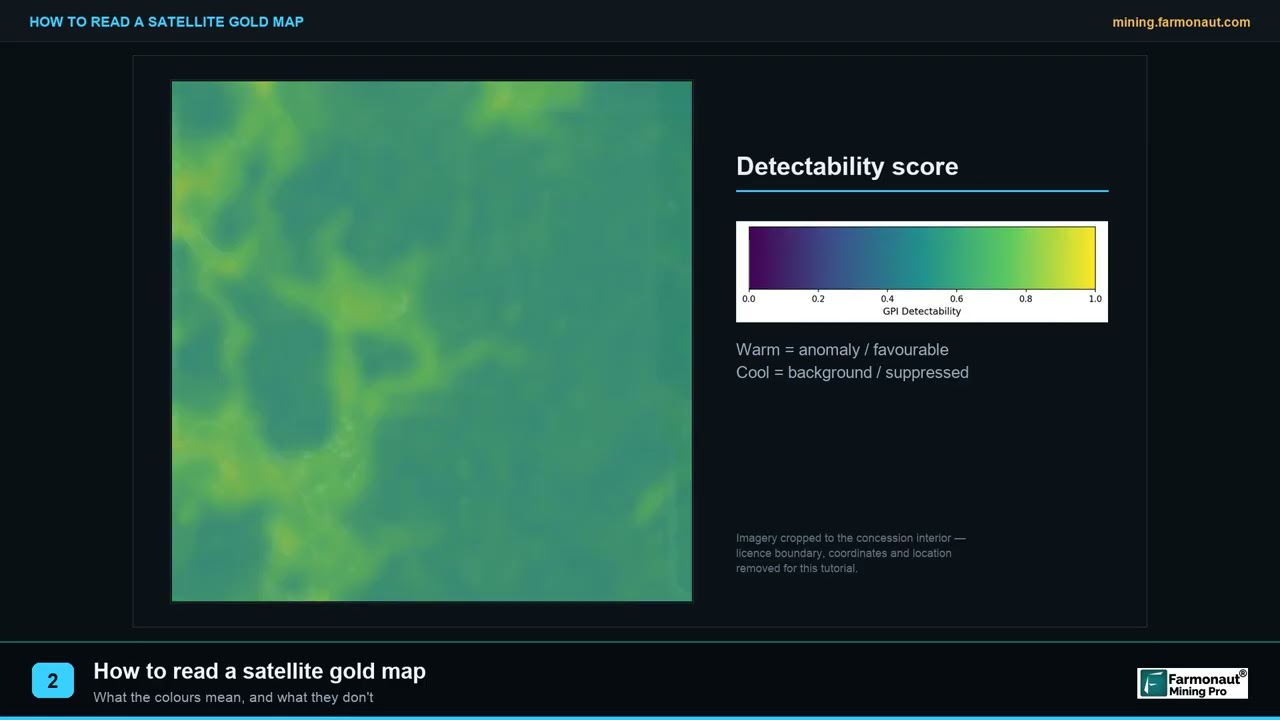
▶ How to read a satellite prospectivity map. · 1:40
Frequently asked questions
What is the Tanzania mining cadastre portal?
It is the Mining Commission’s online transactional cadastre at portal.madini.go.tz. The public map shows licences across the country. Registered users can lodge applications, review licences, submit performance information and pay licence fees and royalties online. The Mining Act defines it as the web service for applications, payments and decisions.
What does “leseni ya madini” mean?
Leseni ya madini is Swahili for a mineral or mining licence. It is used for the whole family of Tanzanian mineral rights: prospecting licences, primary mining licences, mining licences and special mining licences, as well as processing, smelting, refining, dealer’s and broker’s licences.
Can a foreigner get a primary mining licence in Tanzania?
No. Section 8(2) of the Mining Act reserves primary mining licences for Tanzanian citizens, partnerships made up only of citizens, and companies whose members and directors are all citizens and which are controlled from within Tanzania by citizens. Foreign investors look at prospecting, mining and special mining licences instead.
How long does a prospecting licence last in Tanzania?
The initial period is up to four years, and the first renewal is up to three years. The licence can’t be renewed after the second renewal period, which commentary on the Act puts at a total of about nine years. The area then reverts to the Government.
Are mining development agreements still available in Tanzania?
The 2017 amendments changed the regime. Development agreements concluded before the change remain in force, subject to the Natural Wealth and Resources Contracts (Review and Renegotiation of Unconscionable Terms) Act. New investors should take legal advice rather than assume a stand-alone development agreement is available.
What does the Tanzania Geological Survey do?
The Geological Survey of Tanzania, set up under section 27A of the Mining Act, advises the Minister on geology, carries out geological mapping and provides geological and mineral-resource data to the public. It does not grant licences. Its data is useful background when you choose an area and plan a work programme.
Can Farmonaut apply for a Tanzanian licence for me?
No. We are not a licensing agent, law firm or broker, and applications go through the Mining Commission and its cadastre. What we provide is the geological side: a satellite prospectivity analysis of the area you plan to apply for or already hold, so you can choose your boundary and plan exploration with better information.
Licence types, terms, deadlines, royalty rates and statutory references in this guide come from the Mining Commission’s published guidance and the Mining Act, Cap. 123 (Revised Edition 2019). The Act is amended from time to time, and maximum areas and fees are set in regulations. Confirm the current position with the Mining Commission before you file or pay. This guide is general information, not legal or investment advice.
Is there a map on the Tanzania mining cadastre portal?
Yes. The portal has a public map of licence boundaries and a search of licences and applications. It shows tenure, not geology. Use the Geological Survey of Tanzania for geological data.
How do I get a login for the portal?
EITI reports that the Mining Commission gives licence holders a link to request access. Ask the Commission or your resident mines office for the current steps.
What are the types of mining licence in Tanzania?
Prospecting, primary mining, mining and special mining licences, plus processing, smelting, refining, dealer, broker and lapidary licences under the Mining Act.
What is the gold royalty rate?
Section 87 of the Mining Act sets 6% of gross value for metallic minerals including gold. A reduced 4% applies to gold sold to the Bank of Tanzania, a rate launched with the Bank’s October 2024 purchase programme and still listed in 2026 (TanzaniaInvest mining page, which also lists 2% for sales to local refineries). Confirm the current rate with the Commission.
This page is for information only. It is not legal advice. Confirm the rules with the regulator.
Farmonaut mining
Screen your licence area from space
Send your licence boundary to get a quote for a satellite mineral map before you plan field work.

Mining Pro sample view, synthetic data
Keep reading
Sources
- African Mining Legislation Atlas, Tanzania Mining Act (2019): a-mla.org
- EITI, Tanzania: eiti.org
- TanzaniaInvest, Online Mining Cadastre Transactional Portal launch (2015): tanzaniainvest.com
- TanzaniaInvest, Bank of Tanzania domestic gold purchase programme (2024): tanzaniainvest.com
- Mining Act, Cap. 123 (tanzanialaws.com): tanzanialaws.com
Discussion
Questions, corrections or field experience? Share them below. First-time comments are reviewed before they appear, and your email is never published.
No comments yet. Be the first to add a question or your experience.

 Qader Group
 Ileys General Trading
 SG Gold Mining LLC
 VRV Global Pte Ltd
 Omsri International FZE
 G.I.T.T.
 Jaunita Erss Ltd
 Almosi SARL
 SRK Consulting
 Berks Gold Limited
 Mwerezi Minerals Company Limited
 Mining SARL
 SenGold Invest SAS
 Sean Mining Limited
 NTS Group (Pty) Ltd
 Mine4Africa
 Lithspo Minerals Limited
 Tintina Mining Group

 Licence holder · Nigeria · Gold + lithium










