

US mining law · Landowner and claim-holder guide
Mining Act of 1872: 7 Steps to Protect Land and Rights
The Mining Act of 1872 covers hardrock minerals on federal land only, and a claim gives the right to the minerals, not title to the land. Seven steps show how owners and claim holders check ownership, use notice and bond rules, and what BLM charges.
Key takeaways
- The 1872 law opens lands belonging to the United States to US citizens for exploration and claims; private land is outside it (30 U.S.C. 22).
- BLM charges US$274 to record a new lode claim and US$200 a year after that; placer claims pay US$200 per 20 acres or part (BLM fee page, read 16 October 2026).
- Surface owners on Stock Raising Homestead land get 30 days’ written notice before exploration, and consent or a bond and plan for later work (43 U.S.C. 299).
- BLM notices cover 5 acres or less of disturbance with 15 days’ notice; larger work needs an approved plan, a 30-day public comment period and a financial guarantee (43 CFR 3809).
- Withdrawals close land to new claims for up to 20 years, but Congress can reverse them, as it did for 225,504 acres in Minnesota in April 2026.
In this article
- What the Mining Act of 1872 covers, and what it does not
- Where claims can be staked: federal land by state
- Seven steps to protect your land and your rights
- What a claim costs to hold: federal fees
- How a federal permit is reviewed and when land is withdrawn
- Royalties, patents and reform: what the law still lacks
- How the main rules fit together
- Checking claims and land from space
- Frequently asked questions
The Mining Act of 1872 lets US citizens look for hardrock minerals such as gold, silver and copper on federal public land that is open to mining, and stake a claim on a discovery. It does not apply to private land, and a claim gives the holder the right to the minerals, not title to the land (BLM, Locatable Minerals). That one fact is the starting point for anyone trying to protect land, or to hold a claim correctly. This guide gives seven steps for landowners and claim holders, with the federal fees and the legal tests behind each step, a fee calculator and a chart of how much land the law reaches.
Two readers use this page. Surface owners and ranchers want to know what a neighbouring claim can do to their land. Licence and claim holders want to know what the rules ask of them, so that their claim stays valid and their permit is not refused. The law is the same for both, so each step says who it matters to.
What the Mining Act of 1872 covers, and what it does not
The statute says that valuable mineral deposits in lands belonging to the United States are open to exploration and purchase by US citizens, and by people who have declared their intention to become citizens (30 U.S.C. 22). The Bureau of Land Management (BLM) calls the minerals it covers “locatable minerals”: most metallic minerals and some industrial minerals. The law has five elements: discovery of a valuable deposit, location of the claim, recording of the claim, annual maintenance, and the option of a mineral patent, which is a deed to the land (BLM, Locatable Minerals).
Chart
How much of BLM’s mineral estate was open to claims in 2007
Million acres of federal subsurface minerals under BLM, per a BLM study cited by CRS in 2007 (not a current figure)
Three limits matter for land protection.
- Federal land only. The statute covers lands belonging to the United States. Private land is outside it, although a private surface can sit above federal minerals (see the split-estate step below).
- Not every federal acre is open. A BLM study cited by the Congressional Research Service (CRS) in 2007 found that, of about 700 million acres of federal subsurface minerals under BLM, about 165 million acres were withdrawn from mineral entry, leasing and sale, and mining on another 182 million acres needed approval from the surface-managing agency (CRS, Mining on Federal Lands: Hardrock Minerals, 2007). These are 2007 figures; no newer national total was found in the sources used, so treat them as a scale check, not a map of today’s open land.
- Other minerals use other laws. Oil, gas, coal and some other minerals moved to a leasing system in 1920 (CRS, 2007), so this guide covers hardrock minerals only.
A lode claim (a claim on a vein or other hard-rock deposit) may be at most 1,500 feet long along the vein and may extend no more than 300 feet on each side of the vein (30 U.S.C. 23). That is a maximum of about 20.7 acres (1,500 ft by 600 ft, our arithmetic). A placer claim (a claim on loose deposits such as gravel) may include no more than 20 acres for each individual claimant (30 U.S.C. 35). The statute also says no claim may be located until a vein or lode is discovered within its limits, which is the test for a valid claim (30 U.S.C. 23).
The 1872 text says very little about the surface. Later laws fill that gap: the Surface Resources Act of 1955 limits what a claim may be used for, the Federal Land Policy and Management Act of 1976 (FLPMA) orders the Interior Secretary to prevent unnecessary or undue degradation of the lands, and the BLM surface-management rules in 43 CFR 3809 set the permit, reclamation and bonding duties (43 CFR 3809.5). The steps below follow those layers.
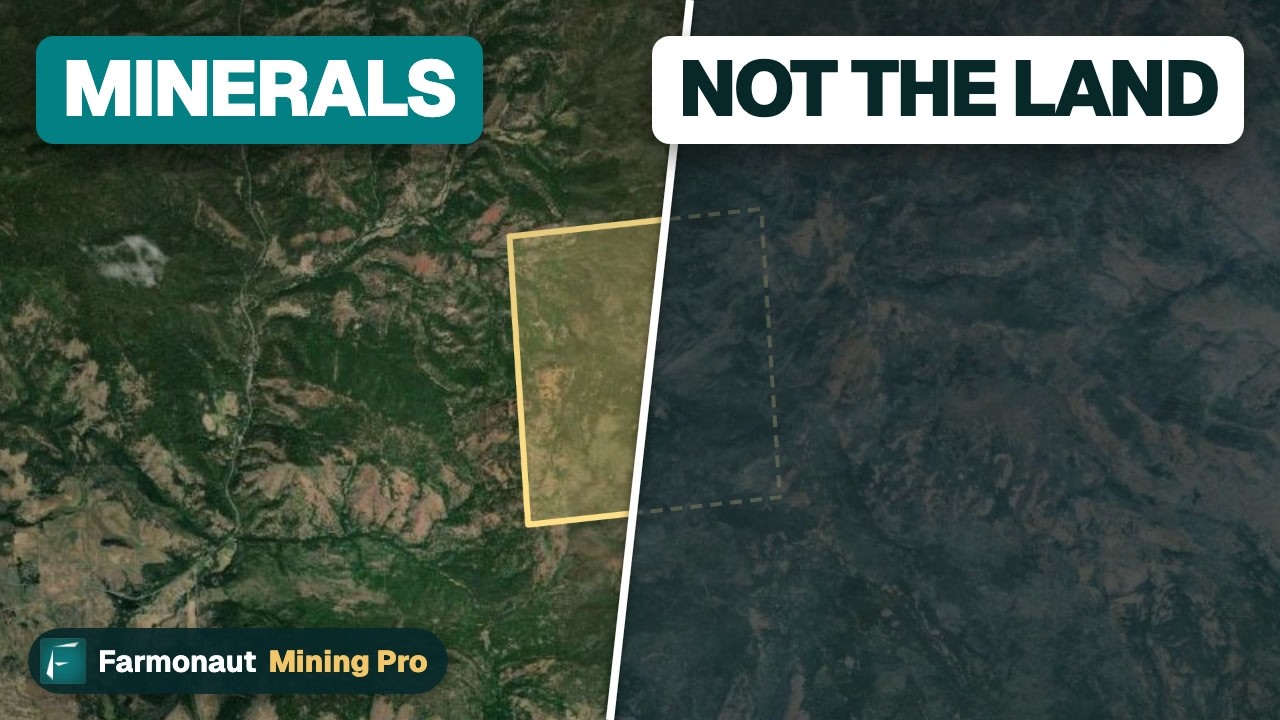
▶ Explains why owning a gold claim is not owning the land and how the 1872 mining law treats claims. · 3:19
Where claims can be staked: federal land by state
Federal land is concentrated in the West and Alaska. The CRS reports that the five main federal land agencies manage 615.2 million acres, about 28% of the US land base, as of 30 September 2024. The share ranges from 0.3% in Connecticut and Iowa to 79.8% in Nevada (CRS, Federal Land Ownership: Overview and Data). Most of that land is not open to claims, because national parks, wilderness and other withdrawn areas are excluded, but the chart shows why the 1872 law matters most in a handful of states.
Chart
Federal land share of selected western states
Per cent of state land managed by the five main federal land agencies, 30 September 2024; selected states
If your land is in a state with a low federal share, a claim next door is unlikely, but the minerals under your own land may still be federal, which is the subject of the first step.
Seven steps to protect your land and your rights
These steps run in the order most owners need them. Costs are the official fees or the cost in your time; legal fees and surveys vary and are not priced here.
Step 1: Find out who owns the surface and the minerals
In parts of the Rocky Mountain West, a buyer may own the surface while the federal government owns the minerals. BLM calls this a split estate (surface and minerals owned separately), and says it comes from the Stock Raising Homestead Act of 1916, which allowed settlers to claim 640 acres but reserved all minerals to the United States (BLM, Split Estate). To check, ask your local BLM office to look at the master title plat for surface and mineral ownership, and read the original land patent to see which Homestead Act applied. Not all Homestead Acts reserved all minerals, which is why the patent matters (BLM, Split Estate).
Who it matters to: surface owners and anyone buying land in the West. Cost: no fee is listed by BLM for a plat check; allow time for the office visit or call.
Step 2: Look up claims and notices near your land
BLM publishes claim and permit records through its Mineral and Land Records System (MLRS). The public can search cases in the MLRS Community portal and view exploration notices and plans of operation on the MLRS Research Map by turning on the right data layers (BLM, Access to Mining Notices and Plans of Operations). A claim on the map is a recorded claim, not proof that the claim is valid, so ask the BLM state office when a record matters to a decision. Our guide to mining cadastre portals by country lists the equivalent search tools elsewhere, and the Walker Lane gold guide shows how BLM records and permits fit together on a Nevada project.
Cost: searching is public; BLM lists no search fee.
Step 3: Know what a claim holder may and may not do on the surface
A claim is not ownership of the land. Under the Surface Resources Act of 1955, a claim located after that date may not be used for anything other than prospecting, mining or processing and uses reasonably incident to them, and the United States keeps the right to manage the vegetation and other surface resources (30 U.S.C. 612). The same section stops claimants from cutting or removing timber except as their operations require or the government allows. CRS adds that using unpatented claim land for anything but mineral purposes violates the Mining Law (CRS, 2007).
For claim holders, this is the line to respect: no cabins, gardens or storage that are not tied to mining. For surface owners, it is the basis for reporting uses that go beyond mining to BLM or the Forest Service.
Step 4: Use the surface-owner rights on Stock Raising Homestead land
If your land was patented under the 1916 homestead law, Congress added stronger surface-owner protections in 1993. A person other than the surface owner may not enter to explore for or locate a claim without filing a notice of intention with the Interior Secretary and giving written notice to the surface owner by registered or certified mail at least 30 days before entry. The exploration allowed is limited to minimal disturbance, with no mechanized earthmoving, explosives, roads or drill pads (43 U.S.C. 299).
For later mineral activities, the law requires the surface owner’s written consent unless the Secretary authorizes the work. To authorize it, the Secretary requires a plan of operations and a bond or other financial guarantee that covers reclamation and payment to the owner for permanent damage to crops and improvements and for lost grazing income. The owner receives the proposed plan at least 45 days before the decision and may comment (43 U.S.C. 299). Who it matters to: owners of homestead-patent surface. Cost: the claimant posts the bond, not the owner.
Step 5: Read the notice and plan rules, then use the comment window
BLM sorts surface-disturbing work into three tiers. Casual use is work that causes no or negligible disturbance, such as hand panning, collecting samples with hand tools or using a metal detector; it needs no notice (43 CFR 3809.5). Exploration that disturbs 5 acres or less of public land needs a notice filed at least 15 calendar days before work starts, and a project may not be split into several notices to avoid a plan (43 CFR 3809.21). Anything larger needs a plan of operations approved by BLM, and so does removing 1,000 tons or more of presumed ore for testing. In special areas, such as wilderness, designated Areas of Critical Environmental Concern, wild and scenic rivers, national monuments, and lands with listed species, a plan is needed for any disturbance beyond casual use (43 CFR 3809.11).
For a plan, BLM reviews it for completeness within 30 calendar days. Before acting, it publishes a notice and accepts public comment for at least 30 calendar days. The review can include an environmental review under the National Environmental Policy Act (NEPA), consultation under the Endangered Species Act and the National Historic Preservation Act, and consultation with the surface owner where the surface is not federal (43 CFR 3809.411). On national forest land, the Forest Service applies its own rule: an operator whose work might cause significant disturbance files a notice of intent with the District Ranger, who tells the operator within 15 days whether a plan of operations is required (36 CFR 228.4).
Who it matters to: both readers. A neighbour can comment on a plan, and an operator who files a complete plan with a real baseline is less likely to be delayed. Cost: comments cost nothing; BLM does not list a fee for filing one.
Step 6: Insist on reclamation and a financial guarantee
FLPMA tells the Interior Secretary to take any action necessary to prevent unnecessary or undue degradation of the public lands (43 U.S.C. 1732). The BLM performance standards turn that into duties: reclaim disturbed land at the earliest feasible time; save topsoil for reuse; control erosion, landslides and runoff; isolate or control toxic materials; reshape and revegetate where reasonably practicable; restore fish and wildlife habitat; and meet federal and state air and water quality standards (43 CFR 3809.420).
A financial guarantee backs those duties. Casual use needs none, but any operator working under a notice or plan must post one before starting (43 CFR 3809.500). The operator can choose an individual guarantee for one notice or plan, a blanket guarantee for several operations, or evidence of an existing state guarantee (43 CFR 3809.551). Ask BLM which type the operator has filed and what it covers. Cost: set case by case from the reclamation cost estimate.
Step 7: Check withdrawals and keep your own record
A withdrawal closes federal land to new claims, subject to valid existing rights. The Interior Secretary can withdraw an area for a maximum of 20 years under FLPMA, and only Congress can make one permanent (US Department of the Interior, 2023). Withdrawals can also be reversed. In April 2026 the President signed a Congressional resolution that ended a 2023 withdrawal covering about 350 square miles of Superior National Forest in Minnesota, after a 50-49 Senate vote (MPR News, 27 April 2026). The practical lesson for a landowner: do not rely on a withdrawal that is not in the land records, and re-check status before each decision.
Keep your own record too. Date-stamped photographs, a boundary map and satellite images from before work starts make it easier to show later what changed. Cost: public Sentinel-2 imagery has no charge; paid high-resolution images and surveys vary by provider.
What a claim costs to hold: federal fees
For claim holders, the main yearly cost is the BLM maintenance fee, which replaced the old rule that required assessment work (30 U.S.C. 28f). The statute set it at $100 per claim in 1993 and requires a CPI adjustment every five years. BLM raised the maintenance fee from $165 to $200 and the location fee from $40 to $49 for fees due from 2024 (BLM, 28 June 2024). CRS reported the earlier steps in 2007: maintenance went from $100 to $125 and location from $25 to $30 in September 2004 (CRS, 2007).
Chart
Federal claim fees per claim, before and after the 2004 and 2024 adjustments
US$ per lode claim; maintenance fee is yearly, location fee is paid once
| Item | Lode claim, mill site or tunnel site | Placer claim |
|---|---|---|
| Processing fee (new claim) | US$25 | US$25 |
| Location fee (new claim) | US$49 | US$49 |
| Maintenance fee, first year | US$200 | US$200 per 20 acres or part |
| Total, first year | US$274 | US$74 plus US$200 per 20 acres or part |
| Maintenance fee, later years (due 1 September) | US$200 | US$200 per 20 acres or part |
| Small-miner waiver (10 or fewer claims nationwide) | No maintenance fee; US$15 per claim to file the affidavit of assessment by 30 December; a Notice of Intent to Hold, also US$15 per claim, is filed for the first calendar year or the first waiver filing | Same waiver rules |
All amounts above are from the BLM fee page, read on 16 October 2026 (BLM, Mining Claim Fees). The notice of location is due within 90 calendar days after the claim is located. BLM adds that a placer claim of 45 acres pays for three 20-acre blocks, so US$600 (BLM, 2024). The Mining Law lets states set recording rules, so county filings and fees come on top; check with the county recorder (BLM, Locatable Minerals).
Use the calculator to total the federal fees for your own claim block. The fees are inputs so you can change them when BLM adjusts them.
Calculator
What will my claim block cost in federal fees?
Enter your own claim numbers and the years you plan to hold them.
- First-year cost (filing plus maintenance): $1,764
- Each later year (maintenance only): $1,200
Defaults are the BLM fees listed on its fee page, read 16 October 2026; change them if BLM adjusts them. The numbers of claims and years are examples, not a recommendation. County recording fees vary by county, so the county figure is an example input. Federal fees only: no survey, legal, permit or bonding costs.
How a federal permit is reviewed and when land is withdrawn
The flow below summarises the BLM path for work beyond casual use. It follows the 43 CFR 3809 rules cited in step 5, so owners can see where their comments fit in. Timing is the regulatory minimum for each stage, not a forecast: environmental review can take far longer, and MPR News notes that a Minnesota mine project would need state and federal permits that could take several years (MPR News, 2026).
Infographic
BLM review of mining work beyond casual use
- 1Notice or planWork on 5 acres or less needs a notice 15 days ahead; larger work needs a plan of operations.
- 2Completeness checkBLM reviews the plan for completeness within 30 calendar days.
- 3Review and commentNEPA review and consultations run, and the public can comment for at least 30 days.
- 4DecisionBLM approves, approves with conditions, or withholds approval.
- 5Guarantee and reclamationA financial guarantee is posted before work starts, and reclamation follows the performance standards.
Two points in the flow are where a landowner has most influence: the public comment window on a plan, and the surface-owner consultation that BLM must carry out where the surface is not federal. Both are written into the rule (43 CFR 3809.411).
▶ A plain-language claymation on the seven environmental impacts of mining. · 2:31
Royalties, patents and reform: what the law still lacks
Critics and supporters of the 1872 law disagree mainly on three points. First, royalties: CRS described the law as allowing a claimant to produce minerals without a patent and without paying royalties or rents to the Treasury, unlike coal, oil and gas on federal land (CRS, 2007). The BLM page on the law lists five elements and no royalty among them (BLM, Locatable Minerals). Second, patents: the $2.50 and $5.00 per acre price for title has not changed since the law was passed, and Congress began a series of one-year patent moratoria in fiscal year 1995 (CRS, 2007). Congress has renewed the ban each year since; BLM’s patents page says it will not accept new patent applications until the moratorium is lifted or expires, and section 404 of the FY2026 Senate Interior bill (S. 2431) carries the same ban, with an exception only for applications filed on or before 30 September 1994 that met the legal requirements by then. In practice, a new patent is not available today. Third, environmental duties: CRS noted that the law has no direct statutory environmental authority, which is why FLPMA, NEPA and the BLM rules in this guide do that work (CRS, 2007).
Reform bills have proposed royalties and new permits. The 2009 House bill, for example, proposed an 8% royalty on net smelter returns from new mines (CRS, 2007 report text on the 2009 bills). Net smelter return is the revenue from selling concentrate after smelting and refining charges. None of this has changed what an owner can do on a claim today, so the practical steps above remain the useful ones.
How the main rules fit together
| Rule | What it does | Who it protects or binds |
|---|---|---|
| Mining Law of 1872 (30 U.S.C. 22 and following) | Opens federal land to claim location after a discovery | Binds claim holders; limits claims to federal land |
| Surface Resources Act of 1955 (30 U.S.C. 612) | Limits a claim to mining uses; the government manages vegetation | Protects federal surface resources |
| Stock Raising Homestead Act, 1993 amendments (43 U.S.C. 299) | Notice, consent, bond and compensation for surface owners | Protects owners of homestead-patent surface |
| FLPMA (43 U.S.C. 1732) | Prevents unnecessary or undue degradation; allows withdrawals | Protects public land; binds operators |
| BLM surface rules (43 CFR 3809) | Notices, plans, performance standards, financial guarantees | Binds operators; gives the public a comment window |
| Forest Service rule (36 CFR 228.4) | Notice of intent and plan of operations on national forest land | Binds operators on forest land |
Checking claims and land from space
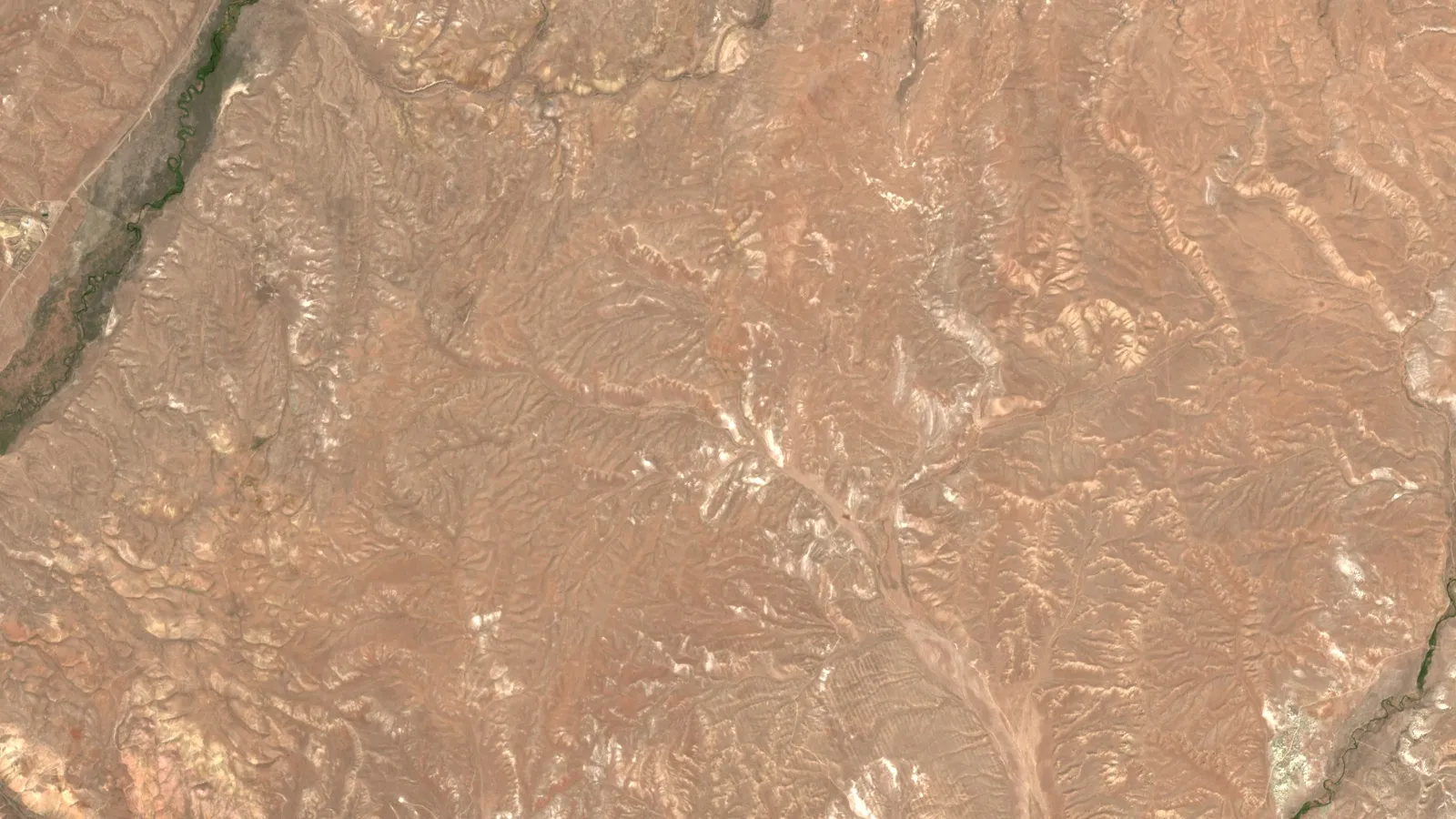
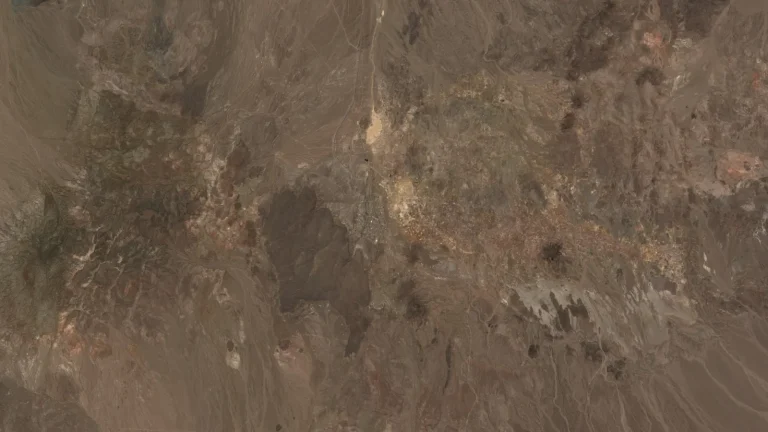
Satellite images cannot show who owns land or whether a claim is valid. They can show where ground has been cleared, where roads and pads have appeared, and where vegetation has changed, using public data such as Sentinel-2 (a European Space Agency satellite that images the Earth every few days). A before-and-after pair from the same season gives a landowner or a permit reviewer a dated record of the disturbance footprint, which can be compared with the acreage in a notice. The hero image at the top of this page is a Sentinel-2 summer composite of a Nevada mining district.
Claim holders can use the same view the other way round. Farmonaut’s satellite-based mineral detection screens a licence boundary for exploration targets before any ground disturbance; the results sit ahead of a resource estimate and are not a mineral reserve or a land-use clearance. You can also request a quote for your area or contact the team with questions. Our guide to gold deposits in the United States by state shows where the geology that draws claims is found.
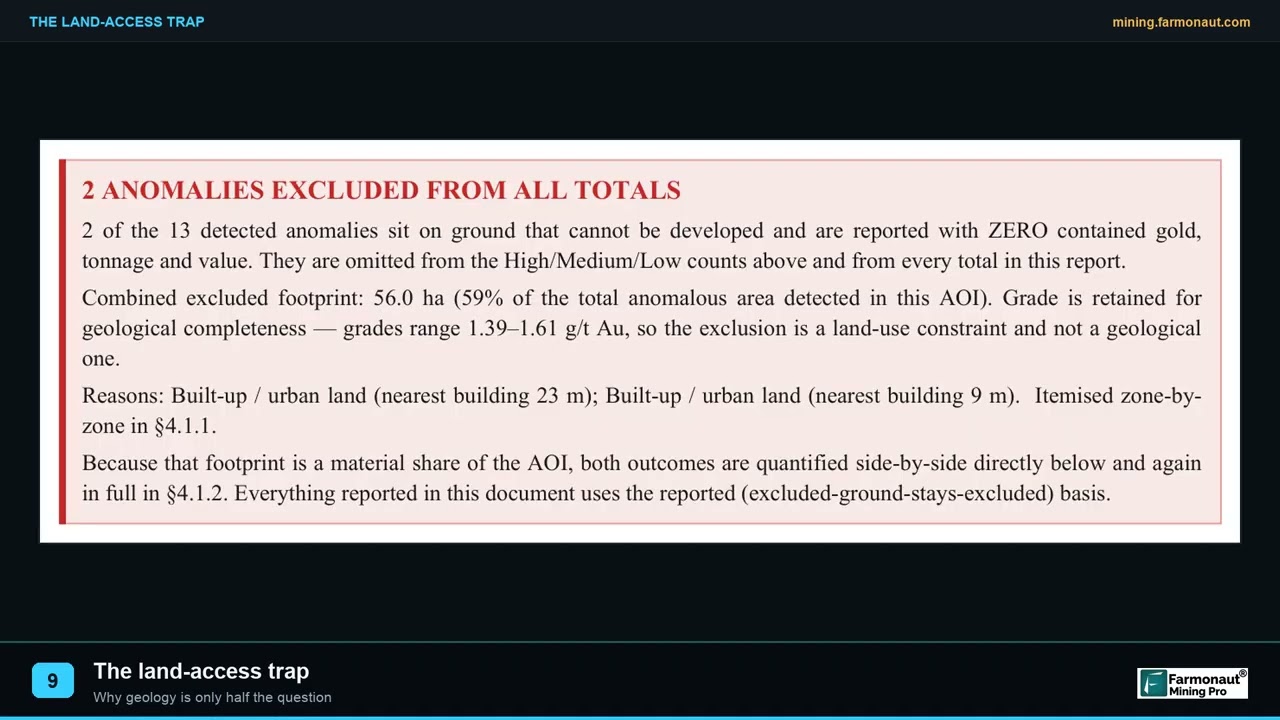
▶ Shows how land use above a deposit can block mining even when the rock is good. · 2:05
Frequently asked questions
What is the Mining Act of 1872?
It is the federal law, passed on 10 May 1872, that lets US citizens explore for and claim valuable mineral deposits on federal land open to mining. BLM calls it the major federal law governing locatable minerals (BLM).
Does the Mining Act of 1872 apply to private land?
No. The statute opens “lands belonging to the United States” (30 U.S.C. 22). A private surface can still sit above federal minerals in a split estate, so check ownership first.
Can someone stake a mining claim on my land?
Not on land you own with the minerals. If you own only the surface and the minerals are federal, a claim can be located on the minerals, but on homestead-patent surface the claimant must give you notice and, for later work, usually needs your written consent or a bond and plan (43 U.S.C. 299).
Does a mining claim give ownership of the land?
No. An unpatented claim gives a right to the minerals and the surface uses reasonably tied to mining. Title passes only through a patent (CRS, 2007).
How much does a mining claim cost to keep?
BLM lists US$200 per lode claim per year, due on or before 1 September, and US$200 per 20 acres or part for a placer claim. A new lode claim costs US$274 in the first year (BLM fee page).
Who can skip the yearly fee?
A claimant who, with related parties, owns 10 or fewer claims nationwide can file a maintenance fee waiver certification and instead file an affidavit of assessment work with a US$15 per claim processing fee by 30 December (BLM fee page).
How big can a mining claim be?
A lode claim can be up to 1,500 feet long and 300 feet to each side of the vein, and a placer claim up to 20 acres per individual claimant (30 U.S.C. 23; 30 U.S.C. 35).
Do miners have to reclaim the land?
Operators working under a BLM notice or plan must meet reclamation standards and post a financial guarantee before starting. Casual use needs no guarantee (43 CFR 3809.500).
How do I find mining claims near my property?
Search BLM’s Mineral and Land Records System. The public portal and Research Map show cases, and the notice and plan layers show exploration notices and plans of operation (BLM).
Can I comment on a proposed mine near me?
Yes, for a BLM plan of operations. BLM publishes a notice and accepts comment for at least 30 calendar days before it acts (43 CFR 3809.411).
Can the government close land to new mining claims?
Yes. The Interior Secretary can withdraw land for up to 20 years, and Congress can make a withdrawal permanent or reverse one (US Department of the Interior; MPR News).
This page is for information only. It is not legal advice. Confirm the rules with the regulator, the BLM state office or the Forest Service district before you stake a claim, sign a surface agreement or comment on a plan. Prospecting needs permission, a safe site and no mercury.
Farmonaut mining
Get a quote for your licence area
Ask for a quote to screen your claim or licence boundary from space for exploration targets before any ground work.
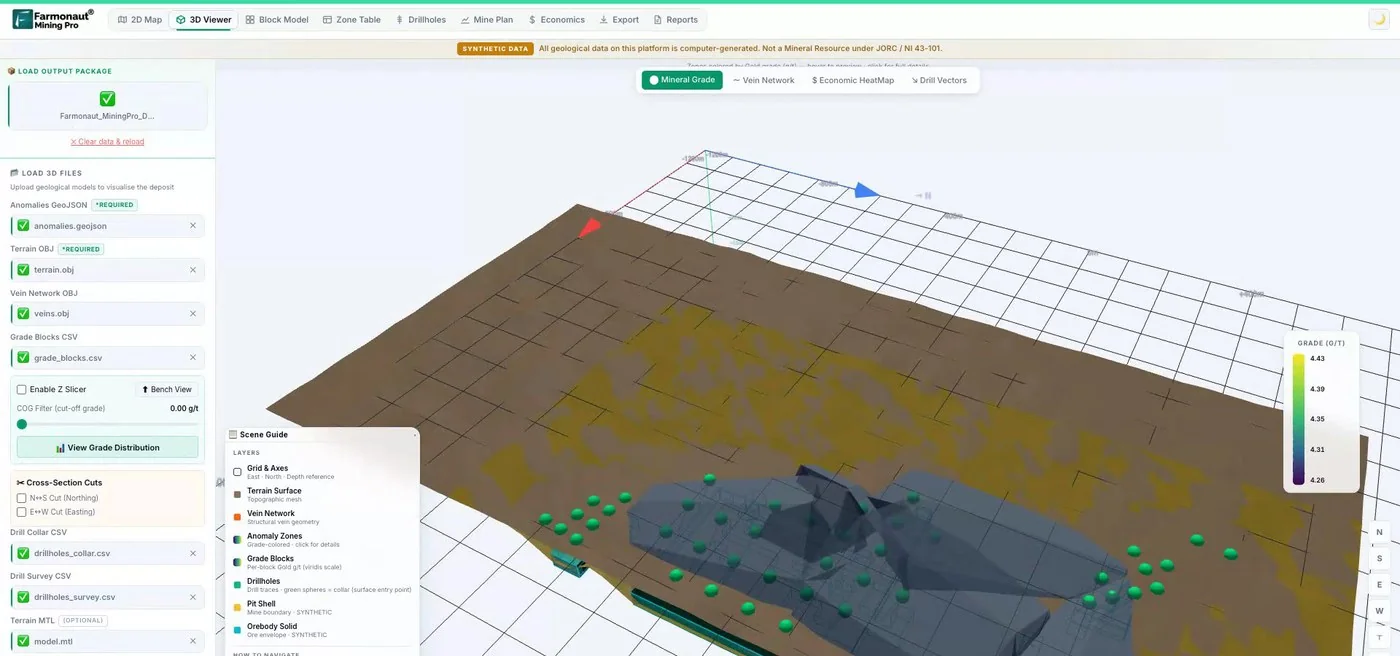
Mining Pro sample view, synthetic data
Keep reading
Sources
- BLM, Locatable Minerals: blm.gov
- BLM, Mining Claim Fees: blm.gov
- BLM, announcement of location and maintenance fee adjustments (28 June 2024): blm.gov
- BLM, Split Estate due to the Stock Raising Homestead Act: blm.gov
- BLM, Access to Mining Notices and Plans of Operations: blm.gov
- 30 U.S.C. 22, Lands open to purchase by citizens: law.cornell.edu
- 30 U.S.C. 23, Length of claims on veins or lodes: law.cornell.edu
- 30 U.S.C. 28f, Claim maintenance fee: law.cornell.edu
- 30 U.S.C. 35, Placer claims: law.cornell.edu
- 30 U.S.C. 612, Unpatented mining claims (Surface Resources Act of 1955): law.cornell.edu
- 43 U.S.C. 299, Reservation of coal and mineral rights (Stock Raising Homestead Act): law.cornell.edu
- 43 U.S.C. 1732, Management of use, occupancy and development of public lands: law.cornell.edu
- 43 CFR 3809.5, Definitions: law.cornell.edu
- 43 CFR 3809.11, When a plan of operations is required: law.cornell.edu
- 43 CFR 3809.21, When a notice is required: law.cornell.edu
- 43 CFR 3809.411, BLM action on a plan of operations: law.cornell.edu
- 43 CFR 3809.420, Performance standards: law.cornell.edu
- 43 CFR 3809.500, Financial guarantee requirements: law.cornell.edu
- 43 CFR 3809.551, Financial guarantee options: law.cornell.edu
- 36 CFR 228.4, Forest Service notice of intent and plan of operations: law.cornell.edu
- CRS, Federal Land Ownership: Overview and Data (R42346): everycrsreport.com
- CRS, Mining on Federal Lands: Hardrock Minerals (RL33908, 8 March 2007): everycrsreport.com
- US Department of the Interior, Boundary Waters watershed withdrawal (2023): doi.gov
- MPR News, Trump ends ban on mining near the Boundary Waters (27 April 2026): mprnews.org
Discussion
Questions, corrections or field experience? Share them below. First-time comments are reviewed before they appear, and your email is never published.
No comments yet. Be the first to add a question or your experience.

 SRK Consulting
 Berks Gold Limited
 Mwerezi Minerals Company Limited
 Mining SARL
 SenGold Invest SAS
 Sania Corporation
 Sean Mining Limited
 NTS Group (Pty) Ltd
 Mine4Africa
 Lithspo Minerals Limited
 Tintina Mining Group
 Dalgety Minerals Pty Ltd
 Vortex Minerals Pty Ltd
 Faith At Work (Pty) Ltd
 Geotech Mining Solutions plc
 Vulcan International Limited
 Licence holder · Nigeria · Gold + lithium










