

Tungsten products · Safety and buyer guide
Thoriated Tungsten: Safety, Color Codes, Alternatives
Thoriated tungsten is tungsten with about 1-2% thorium oxide, mostly sold as welding electrodes. This guide covers color codes, the DOE safety points, alternatives, copper tungsten and the ores behind them.
Key takeaways
- Rods typically hold 1-2% thorium oxide; the average full-time welder’s yearly dose is well below 100 millirem, but grinding and AC welding can raise it (US DOE bulletin, 2007).
- Ceriated and lanthanated electrodes are the usual non-radioactive options; thoriated tips spit particles in AC aluminum welding (GTAW reference).
- Copper tungsten typically holds 70-90 wt.% tungsten; contacts use W-10 to W-30% Cu in low-voltage and W-15 to W-40% Cu in higher-voltage switches (Goodfellow; Oriental J. Chem.).
- China mined an estimated 67,000 of 85,000 tonnes of tungsten in 2025, about 79% (USGS, 2026).
- SMM reported APT at US$3,000-3,200 per mtu CIF Rotterdam on 5 June 2026; this is APT, a different product from the concentrate that the USGS priced at an estimated US$380 per mtu on average in 2025.
In this article
- What thoriated tungsten is and why welders use it
- Tungsten electrode color codes compared
- Is thoriated tungsten dangerous?
- How to reduce exposure when you use thoriated electrodes
- Thoriated, ceriated, lanthanated or zirconiated: which electrode to choose
- Copper tungsten: what it is and where it is used
- Tungsten ores: scheelite and wolframite
- Where tungsten is mined and who holds the reserves
- Tungsten price: what moved it
- Tungsten price and value calculator
- How tungsten projects are explored
- Frequently asked questions
Thoriated tungsten is tungsten metal with about 1 to 2 percent thorium oxide added. It is sold mostly as a TIG welding electrode, and the thorium is mildly radioactive. A US Department of Energy safety bulletin found that the yearly dose for a full-time welder is on average well below 100 millirem, but that grinding the tips, welding with alternating current and poor ventilation can push it higher. This guide explains the electrode color codes, the safety points, the non-radioactive alternatives, and then covers copper tungsten and the tungsten ores that all these products start from.
The page is written for consultants, buyers and site managers who handle tungsten products or assess tungsten projects.
What thoriated tungsten is and why welders use it
Gas tungsten arc welding (GTAW, also called TIG welding) strikes an electric arc between a non-consumable tungsten electrode and the work piece. Tungsten is used because it has the highest melting point of any pure metal, 3,422 °C, so the electrode tip does not melt away while the weld forms. Small oxide additions make the tip emit electrons more easily, which helps the arc start and stay stable.
Thorium oxide (thoria, ThO2) is a widely used addition. The welding reference summary describes thoriated electrodes as giving excellent arc performance and starting, which made them popular general-purpose electrodes. The same source notes that thorium is somewhat radioactive, so breathing its vapor and dust is a health risk and disposal is an environmental one.
Thorium is a naturally occurring radioactive element. It gives off alpha particles, which are stopped by skin and by the tungsten around them. That is why the concern is not an electrode lying on a bench. It is dust and fume that can be inhaled or swallowed.
Tungsten electrode color codes compared
Electrode classes are set by ISO 6848 and by AWS A5.12 in the United States. Each class has a color band on the end of the rod, so you can tell a thoriated electrode from a ceriated or lanthanated one at a glance. The table lists the common classes and their oxide content.
Chart
Oxide added to common TIG electrode classes
Per cent of oxide by weight (approximate class values); WT classes contain thorium
| ISO class | Color band (AWS) | Added oxide | Radioactive? |
|---|---|---|---|
| WP | Green | None (pure tungsten) | No |
| WT10 (EWTh-1) | Yellow | About 1% thorium oxide | Yes, mildly |
| WT20 (EWTh-2) | Red | About 2% thorium oxide | Yes, mildly |
| WT30 | Violet (ISO) | About 3% thorium oxide | Yes, mildly |
| WT40 | Orange (ISO) | About 4% thorium oxide | Yes, mildly |
| WC20 (EWCe-2) | Gray (ISO); orange (AWS) | About 2% cerium oxide | No |
| WL15 (EWLa-1.5) | Gold | About 1.5% lanthanum oxide | No |
| WL20 (EWLa-2) | Blue | About 2% lanthanum oxide | No |
| WZ3 (EWZr-1) | Brown | About 0.3% zirconium oxide | No |
| WZ8 | White | About 0.8% zirconium oxide | No |
Source for the classes and oxide shares: the GTAW electrode table, which summarizes ISO 6848 and AWS A5.12. Check the class printed on your own rods, because suppliers sometimes use their own band colors.
Is thoriated tungsten dangerous?
The answer depends on how the electrode is used. The DOE bulletin of June 2007 sets out the main points:
- Using thoriated rods can produce measurable levels of airborne radioactive material when the tip vaporizes during welding or when rods are ground to a point.
- The average yearly committed effective dose for a full-time welder is well below 100 millirem, but it can be exceeded in some cases.
- Factors that raise the dose are welding with alternating current, no ventilation, welding inside vessels, and a lot of electrode grinding.
- Airborne activity can be higher during grinding than during welding. Someone who welds only a few times a year should not receive a significant dose.
Dust from grinding also settles on benches and floors, so the bulletin asks sites to clean up and check surfaces. It points to NRC report NUREG-1717 and the ANSI Z49.1 safety standard for welding as further reading.
How to reduce exposure when you use thoriated electrodes
The DOE bulletin lists good practices that apply to any shop. They are simple and cheap compared with the cost of a contamination event.
- Run a hazard assessment before you start. Count the hours of welding, the hours of grinding, the ventilation and whether you weld with direct or alternating current.
- Ask whether a non-thorium electrode will do the job. The bulletin asks managers whether dropping thoriated rods would reduce weld quality or change costs, and tells workers to consider alternatives.
- Use local exhaust ventilation so particles and fumes are drawn away from the breathing zone while welding and grinding.
- Wear a face mask or helmet and keep your head out of the fume.
- Clean the work area after welding and grinding, and train welders in the correct operation of the equipment.
- Read the safety data sheet for the electrode and think about storage and disposal of scrap rods and grinder dust.
Rules for storage, labeling and disposal differ between countries and states. Ask your radiation safety officer or regulator what applies on your site.
Thoriated, ceriated, lanthanated or zirconiated: which electrode to choose
Most welders move away from thoria when a non-radioactive electrode gives an equal result. The GTAW reference gives these pointers:
- Ceriated (cerium oxide): improves arc stability and ease of starting and cuts burn-off. It is not as effective as thorium but works well, and cerium is not radioactive.
- Lanthanated (lanthanum oxide): has a similar effect to cerium and is also not radioactive.
- Zirconiated (zirconium oxide): raises current capacity, improves arc stability and starting, and lengthens electrode life.
- Pure tungsten: low cost and general purpose, but with poor heat resistance and electron emission. It is used mostly for alternating-current welding of aluminum and magnesium.
Aluminum is a case where thoria is a poor fit. With alternating current, pure or zirconiated electrodes are preferred because thoriated tips are more likely to spit particles into the weld. Thoriated electrodes remain suitable for direct-current, electrode-negative welding of aluminum and are recommended, tapered to a sharp point, for carbon and stainless steels. Before you switch, run a test weld on your own material and current, because arc feel and tip shape differ between electrode types.
Copper tungsten: what it is and where it is used
Copper tungsten (W-Cu) is not an alloy in the strict sense. Copper and tungsten barely dissolve in each other, so the material is made by powder metallurgy. A review in the Oriental Journal of Chemistry gives the reasons: tungsten melts at 3,410 °C (3,422 °C in other references) and copper at 1,083 °C, tungsten has a density of 19.3 g/cm3 against 8.96 for copper, and copper conducts heat at 403 W/(m·K) against 174 for tungsten.
In the usual process a porous tungsten skeleton is filled with copper. The tungsten supplies hardness, wear resistance and resistance to arc erosion. The copper supplies electrical and thermal conductivity. A materials supplier, Goodfellow, states that such composites typically hold 70 to 90 weight percent tungsten and have a melting point above 3,000 °C.
The mix is chosen for the job. The same review says W-(10-30) wt.% Cu contact materials are usually used in low-voltage vacuum interrupters, and W-(15-40) wt.% Cu in medium- and high-voltage power switches and circuit breakers. Other uses include heat sinks, which need strength and fast heat removal, and electrodes for electrical discharge machining (EDM), where a shaped electrode erodes metal with sparks.
| Product | What it is | Typical use | Main caution |
|---|---|---|---|
| Thoriated tungsten | Tungsten with about 1-4% thorium oxide | TIG and plasma welding electrodes | Dust from grinding is mildly radioactive |
| Copper tungsten | Tungsten skeleton filled with copper, often 70-90 wt.% W | Electrical contacts, heat sinks, EDM electrodes | Made by powder metallurgy, so grade and density vary by supplier |
| Tungsten carbide | Tungsten carbide grains held by a metal binder such as cobalt | Cutting tools, drill bits, wear parts | A ceramic-metal composite, not a pure metal |
Tungsten ores: scheelite and wolframite
Every product above starts in the ground. Tungsten is found mainly in wolframite and scheelite. Wolframite is an iron-manganese tungstate, (Fe,Mn)WO4, a solid solution of ferberite and hübnerite. Scheelite is calcium tungstate, CaWO4.
Infographic
From ore to tungsten products in 4 steps
- 1MineOre holding rarely more than 1.5% tungsten oxide is dug and crushed.
- 2ConcentrateGravity separation, magnets and flotation lift the tungsten minerals out.
- 3ConvertConcentrate is converted to APT and then to tungsten powder.
- 4Make productsPowder is pressed and sintered into electrodes, copper tungsten, carbide and alloys.
These are the minerals, not the rock that miners dig. The same source says the ore rarely holds more than 1.5% tungsten oxide. It is crushed and separated by gravity methods and froth flotation (a process in which valuable mineral grains attach to air bubbles and float off). Wolframite is weakly magnetic, so magnets help too. The result is a concentrate, usually sold on its tungsten trioxide (WO3) content.
Concentrate is then converted to ammonium paratungstate (APT), the main trading intermediate. APT is reduced to tungsten metal powder, which is pressed and sintered into the metal products described above.
The USGS reports that an estimated 60% of the tungsten used in the United States in 2025 went into cemented carbide parts for cutting and wear-resistant uses, mainly in construction, metalworking, mining and drilling. The rest went into alloys, specialty steels, electrodes, filaments, wires and chemicals (USGS Mineral Commodity Summaries 2026).
Where tungsten is mined and who holds the reserves
China dominates. The USGS estimates world mine output at 85,000 tonnes of contained tungsten in 2025, of which China produced 67,000 tonnes, or about 79 percent. Vietnam (3,000 t), Kazakhstan (2,400 t) and Russia (2,000 t) come next, each far behind. USGS reserves are over 4.7 million tonnes worldwide: China 2.5 million, Australia 570,000, Russia 400,000 and Vietnam 170,000.
Chart
Tungsten mine output by country, 2025
Tonnes of contained tungsten (estimate); selected countries
The United States has not mined tungsten commercially since 2015. USGS notes that import reliance was above 50 percent of apparent consumption in each year from 2021 to 2025. Seven US companies can convert concentrates, APT, tungsten oxide or scrap into metal powder, carbide powder or chemicals.
For a wider look at the metal and its price drivers, see our guide to tungsten ores and bar trends.
Recycling is part of supply, but the USGS withheld both secondary production and secondary consumption for 2025 to protect company data. No public national figure is available for how much of supply comes from scrap, so be careful with any claim that gives one.
Tungsten price: what moved it
Tungsten is not traded on an exchange such as the London Metal Exchange. Contracts use price assessments from firms such as Argus and Fastmarkets, usually quoted per metric ton unit (mtu) of WO3. One mtu is 1 percent of a tonne, which is 10 kilograms of tungsten trioxide.
Chart
Rotterdam prices rose through 2025
US$ per metric ton unit; the USGS gives the ‘from’ and ‘to’ values for 2025
Chart
Average Rotterdam tungsten concentrate price
US$ per dry metric ton unit of WO3; 2025 is an estimate
The USGS gives the average Rotterdam concentrate price as 225 US$/mtu in 2021, 275 in 2022, 258 in 2023, 252 in 2024 and an estimated 380 in 2025. It links the 2025 rise to higher US tariffs on Chinese tungsten products (announced at the end of 2024) and new Chinese export controls on selected tungsten items from February 2025. Over 2025, Rotterdam prices rose from 266 to 551 US$/mtu for 65% concentrate and from 331 to 675 US$/mtu for APT.
Prices were far higher again by mid-2026, though not in a straight line. On 5 June 2026 the metals data firm Shanghai Metals Market (SMM) reported a weekly APT assessment of US$3,000 to 3,200 per mtu CIF Rotterdam (cost, insurance and freight to the port), and a spot APT price in China of RMB 760,000 per tonne (SMM, 5 June 2026). These are different products and dates from the USGS averages, so do not read the two series as one line. Check a current assessment before you price a contract.
Tungsten price and value calculator
Use the calculator after this section to turn an APT or concentrate shipment into a gross payable value. It uses the mtu convention above, and it is a gross figure: refining charges, penalties, freight and royalties are not included.
Calculator
What is an APT shipment worth?
Enter your own tonnage, WO3 content, price and payable share.
- Metric ton units shipped: 8,850 mtu
- WO3 contained: 88.5 tonnes
- Value before payable share: $27,435,000
Example values only, not a forecast. The price is an input: example, use today’s price. The default of 3,100 US$/mtu is the mid-point of the APT range of US$3,000-3,200 per mtu CIF Rotterdam that SMM reported on 5 June 2026; concentrate trades at a discount to APT. The 88.5% WO3 content is the minimum used in common APT specifications and the 80% payable share is only an example. One mtu is 10 kg of WO3. Freight, charges and penalties are not included, so the result is a gross value in US$.
How tungsten projects are explored
Tungsten exploration is handled by geologists with samples, geochemistry and drilling, backed by maps. Remote sensing adds a first screen of a licence area: it maps surface rock types, structures and alteration before crews go to site. It narrows where to sample first, but it does not replace sampling or give a resource estimate.
Farmonaut produces satellite-based mineral detection reports for licence areas, and you can ask for a quote for yours. Tungsten is not one of the minerals Farmonaut lists as directly detectable, so for a tungsten project the report is a geological and structural context map and the result is an exploration target at most, ahead of any resource estimate. If you want to see how a licence boundary becomes a map, the short videos on this page show the method.
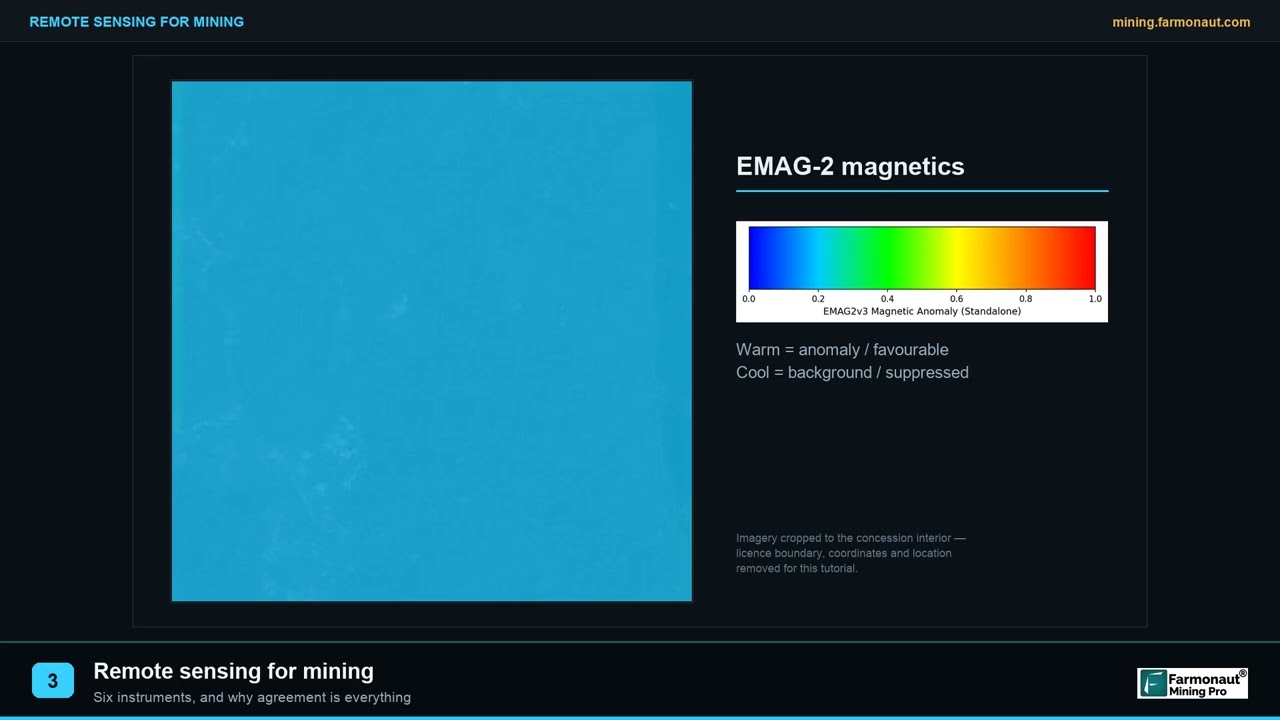
▶ Explains remote sensing for mining in plain words: the instrument types and why agreement between them matters. · 2:01
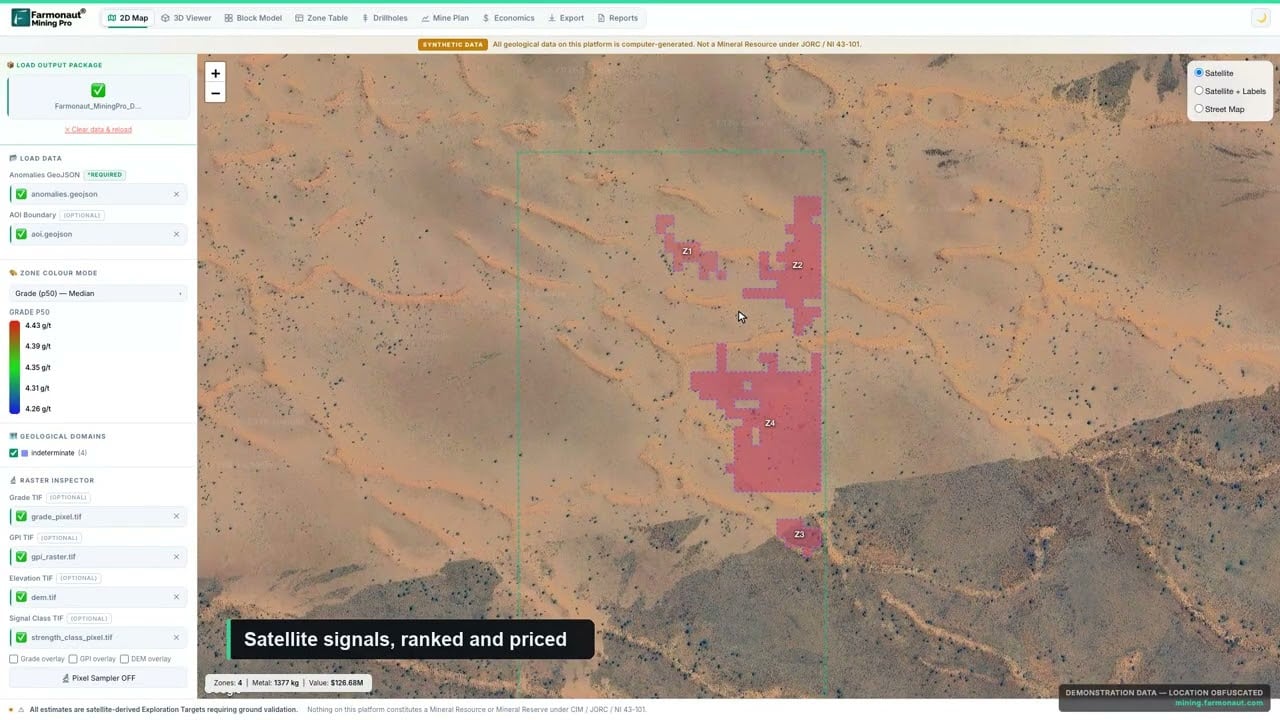
▶ A quick look at Farmonaut Mining Pro, which turns a licence boundary into a geological and economic picture (demo data). · 4:56
Frequently asked questions
Is thoriated tungsten radioactive?
Yes, mildly. Electrodes contain thorium oxide, a naturally radioactive material. The DOE bulletin says the concern is internal exposure from dust and fume made by grinding and welding, not from holding a rod.
What color is a thoriated tungsten electrode?
Red for about 2% thorium oxide (WT20 or EWTh-2) and yellow for about 1% (WT10 or EWTh-1). ISO also lists violet for about 3% and orange for about 4%. Always confirm with the markings and the safety data sheet.
How much thorium is in thoriated tungsten?
The DOE bulletin says rods typically hold one or two percent thorium oxide by weight. ISO 6848 also lists grades with about 3 and 4 percent.
Is grinding thoriated tungsten electrodes dangerous?
Grinding makes dust, and airborne activity can be higher while grinding than while welding. Use a grinder with local exhaust ventilation, wear a mask, and clean the area afterward.
What is the best substitute for thoriated tungsten?
Ceriated and lanthanated electrodes are the usual non-radioactive choices. Cerium gives good arc stability and starting but is less effective than thorium, and lanthanum has a similar effect. Test them on your own material and current.
Can I use thoriated tungsten for aluminum?
Not with alternating current. Pure or zirconiated electrodes are preferred because thoriated tips are more likely to spit particles into the weld. Direct-current, electrode-negative welding of aluminum can use thoriated rods.
What is copper tungsten used for?
Electrical contacts in vacuum interrupters and circuit breakers, heat sinks and EDM electrodes. It combines tungsten’s wear and arc-erosion resistance with copper’s conductivity.
How much tungsten is copper tungsten?
A supplier states that W-Cu composites typically hold 70 to 90 weight percent tungsten. A journal review lists W-10 to W-60 wt.% Cu for contact uses, with 10-30% copper in low-voltage vacuum interrupters and 15-40% in higher-voltage switches.
What are the main tungsten ores?
Wolframite, an iron-manganese tungstate, and scheelite, calcium tungstate. Mined ore rarely holds more than 1.5% tungsten oxide before concentration.
Which country produces the most tungsten?
China, with an estimated 67,000 of the world’s 85,000 tonnes of contained tungsten mined in 2025 (USGS, 2026).
Is the United States a tungsten producer?
No mine output has been reported since 2015, according to the USGS. The country imports concentrates and other forms and converts them in seven companies’ plants.
This page is for information only. It is not investment advice, and it is not health, safety or legal advice. Confirm handling, storage and disposal rules for thoriated electrodes with your radiation safety officer or regulator.
Farmonaut mining
Map your licence area from space
Request a quote for a satellite screening report of your licence area, as an exploration target ahead of any resource estimate.

Mining Pro sample view, synthetic data
Keep reading
Sources
- USGS, Mineral Commodity Summaries 2026: Tungsten: pubs.usgs.gov
- US DOE, Safety Bulletin 2007-04: Use of Tungsten Welding Rods Containing Thorium: ehss.energy.gov
- Wikipedia, Gas tungsten arc welding (ISO 6848 / AWS A5.12 electrode table): en.wikipedia.org
- Wikipedia, Tungsten: en.wikipedia.org
- Oriental Journal of Chemistry, Tungsten copper composite powders for electrical contact materials (review): orientjchem.org
- Goodfellow, Tungsten/Copper Bar material information: goodfellow.com
- SMM, Tungsten prices rally on long contract prices and tight spot supply (5 June 2026): news.metal.com
- Wikipedia, Cemented carbide: en.wikipedia.org
- Wikipedia, Scheelite: en.wikipedia.org
- Wikipedia, Wolframite: en.wikipedia.org
- USGS, Mineral Commodity Summaries 2026 (full volume): pubs.usgs.gov
Discussion
Questions, corrections or field experience? Share them below. First-time comments are reviewed before they appear, and your email is never published.
No comments yet. Be the first to add a question or your experience.

 Mineral Gulf Transhipment DMCC
 G.I.T.T.
 Jaunita Erss Ltd
 Almosi SARL
 SRK Consulting
 Berks Gold Limited
 Mwerezi Minerals Company Limited
 Mining SARL
 SenGold Invest SAS
 Sean Mining Limited
 NTS Group (Pty) Ltd
 Mine4Africa
 Lithspo Minerals Limited
 Tintina Mining Group
 Dalgety Minerals Pty Ltd
 Vortex Minerals Pty Ltd

 Licence holder · Nigeria · Gold + lithium










