

West Africa gold · Country comparison
West Africa Gold Reserves and Output by Country
Ghana leads West Africa with an estimated 150 tonnes mined in 2025 and 1,000 tonnes of USGS reserves. Burkina Faso, Côte d’Ivoire and Mali follow, and this guide shows what each national figure counts.
Key takeaways
- USGS estimates Ghana mined 150 tonnes in 2025 and holds 1,000 tonnes of reserves, 1.5% of the world’s 66,000 tonnes (USGS, 2026).
- Burkina Faso’s mines minister reported more than 94 tonnes for 2025, mostly industrial and artisanal gold; artisanal gold rose from 8.1 to 42 tonnes (Ecofin Agency, February 2026).
- Mali’s provisional 2025 output was 48.2 tonnes, with industrial output down 22.9% after the Loulo-Gounkoto dispute (Reuters, January 2026).
- Côte d’Ivoire’s output grew from 23.54 tonnes in 2015 to 59.124 tonnes in 2024, with 13 mines operating (mines ministry).
- USGS lists reserves only for Ghana in this region; other countries are pooled in ‘Other countries’ (11,000 tonnes).
In this article
- How we ranked the countries
- West African gold producers ranked by latest output
- Ghana: the region's largest producer
- Burkina Faso gold reserves and output
- Mali: output fell after the Barrick dispute
- Côte d'Ivoire: ten years of steady growth
- Guinea, Senegal and the smaller producers
- Gold reserves versus production
- What gold output is worth to a government
- Who operates the main mines
- How to read a West African gold statistic
- Licences, state buyers and who can mine
- How satellite data helps screen a licence in West Africa
- Frequently asked questions
Ghana is the largest gold producer in West Africa: USGS estimates its 2025 mine output at 150 tonnes, about 4.5% of the world’s 3,300 tonnes (USGS, Mineral Commodity Summaries 2026). Burkina Faso reported more than 94 tonnes for 2025, Côte d’Ivoire about 59 tonnes in 2024 and Mali 48.2 tonnes in 2025 (provisional). Only Ghana has a published USGS reserve figure, 1,000 tonnes. For the other countries, reserves are known only mine by mine, in company filings.
This guide ranks the region’s gold producers by the latest output figure that a government, regulator or company published, explains what each number measures, and shows how reserves differ from production. A tonne here is a metric tonne (1,000 kg), which equals about 32,150 troy ounces. “Moz” means million ounces.
How we ranked the countries
The ranking uses one metric: gold mined in the latest year with a published national figure. We used USGS for Ghana, ministry statements reported by Reuters and Ecofin Agency for Burkina Faso and Mali, and the Ivorian mines ministry for Côte d’Ivoire. The figures are not on the same basis, so each row of the table says what it counts and when.
Guinea is not ranked because no national output figure is given here, only one mine (Siguiri), not for the whole country; it appears in its own section. We also left out reserve rankings, because no single agency publishes comparable reserves for all of these countries.
West African gold producers ranked by latest output
| Rank | Country | Latest output (tonnes) | What the figure counts |
|---|---|---|---|
| 1 | Ghana | 150 | Mine production, 2025 estimate (USGS) |
| 2 | Burkina Faso | more than 94 | 2025, national total as reported (mines minister, 2 February 2026) |
| 3 | Côte d’Ivoire | 59.1 | 2024, mines ministry; the ministry’s forecast for 2025 is 61 |
| 4 | Mali | 48.2 | 2025, provisional: 42.2 industrial and 6 artisanal (mines ministry via Reuters) |
Chart
Latest published gold output, tonnes
Tonnes; bases differ: Ghana 2025 estimate, Burkina Faso 2025 national total, Côte d’Ivoire 2024, Mali 2025 provisional
Ghana’s figure is well documented: the Extractive Industries Transparency Initiative calls it Africa’s top gold producer and puts its output at about 4.8 Moz in 2024, which matches USGS’s 149 tonnes. Burkina Faso’s total is a government statement that mixes industrial mines and artisanal gold bought by the state (APA reports that it also counts a small amount of seized gold), so it is not directly comparable with a mine-output figure. Mali’s number is the lowest because of a dispute with its largest producer, described below.
Ghana: the region’s largest producer
Ghana mined 149 tonnes in 2024 and an estimated 150 tonnes in 2025, and USGS gives it reserves of 1,000 tonnes, 1.5% of the world’s 66,000 tonnes (USGS, 2026). Reserves are the part of a deposit that can be mined at a profit today; resources are the larger amount that is geologically known. The EITI reports that extractive industries made up 12.8% of Ghana’s GDP and 10% of government revenue in 2023.
Small-scale and artisanal miners matter here. Ecofin Agency reports that they produced about 1.9 Moz, around 59 tonnes, in 2024, which is 39% of national output, with industrial mines producing the other 61% (Ecofin Agency, 5 February 2026). Since 1 May 2025 the Ghana Gold Board (GoldBod) has been the sole regulator and accredited buyer of small-scale gold. The same report says it set a target of buying at least 3 tonnes a week and exporting about 100 tonnes in the year.
The law behind this is the Ghana Gold Board Act (Act 1140), passed on 29 March 2025 and signed on 2 April 2025; from 1 May 2025 foreigners and individuals may not trade in the local gold market unless they apply to GoldBod (Graphic Online, 14 April 2025). AngloGold Ashanti, which reports on Siguiri in Guinea, also operates in Ghana.
Burkina Faso gold reserves and output
Burkina Faso has no reserve figure in the USGS 2026 tables; it sits inside “Other countries”, which share 11,000 tonnes of reserves. What is published is output. The mines minister reported on 2 February 2026 that Burkina Faso produced more than 94 tonnes in 2025, over 30 tonnes more than the volume declared for 2024, with 42 tonnes from artisanal mining, up from 8.1 tonnes in 2024 (Ecofin Agency, 5 February 2026).
The jump came mostly from gold that used to go unrecorded. A state company, SONASP, now buys artisanal and semi-mechanised gold at counters across the country. Industrial output was nearly flat: 40.87 tonnes by the end of September 2025 against 39.24 tonnes a year earlier (Ecofin Agency, 18 December 2025). The same report says Orezone completed an US$80 million investment in mid-December 2025 that lifted output at its Bomboré mine by 45%.
Ownership is changing as well. In June 2025 Burkina Faso transferred five gold assets, two operating mines and three exploration licences held by subsidiaries of Endeavour Mining and Lilium, to its state miner SOPAMIB, according to a decree reported by Reuters through Kitco. Reuters called Burkina Faso Africa’s fourth-largest producer in 2023, at more than 57 tonnes.
Mali: output fell after the Barrick dispute
Mali’s industrial output fell 22.9% in 2025 to 42.2 tonnes from 54.8 tonnes in 2024, and artisanal output stayed at 6 tonnes, making a provisional national total of 48.2 tonnes, 22.7% below the government forecast of 54 tonnes (Reuters through Kitco, 16 January 2026). B2Gold became the largest producer with 17.5 tonnes, ahead of Allied Gold with 9.58 tonnes and Barrick with 5.5 tonnes.
Chart
Two disrupted gold sectors, 2024 versus 2025
Tonnes; Burkina Faso 2024 total is about 61 t as reported
Barrick’s Loulo-Gounkoto complex produced 22.5 tonnes in 2024 and 5.5 tonnes in 2025 after it was placed under provisional administration on 16 June 2025. Barrick reports a settlement payment to the Government of Mali in November 2025 and says it regained control of the complex on 16 December 2025 (Barrick results, 2025). The 2025 figures are therefore a snapshot of a disrupted year, not of the mines’ capacity.
Côte d’Ivoire: ten years of steady growth
Côte d’Ivoire’s output rose from 23.54 tonnes in 2015 to 59.124 tonnes in 2024, a rise of 151%, according to the mines ministry’s portal (Ministry of Mines, Petroleum and Energy). The portal lists 13 gold mines in operation in 2024 against four in 2015, and 19 valid industrial exploitation permits. Exports were 57.265 tonnes in 2024.
Chart
Côte d’Ivoire gold production, 2015-2024
Tonnes per year
The ministry forecasts 61 tonnes for 2025, 63 tonnes for 2026 and 65 tonnes for 2027, helped by the Lafigué mine, which entered production in 2024, and the Koné project planned for 2027. It describes the country’s gold potential as about 600 tonnes and says Resolute Mining’s Doropo discovery holds estimated reserves of 100 tonnes. These are government estimates of potential, not audited reserves.
Guinea, Senegal and the smaller producers
Guinea’s best-documented mine is Siguiri. AngloGold Ashanti reported 289,000 ounces in 2025, about 9 tonnes and 6% more than in 2024, with revenue of US$990 million against US$653 million (Ecofin Agency, 22 February 2026). That is one mine, not the country total.
Endeavour Mining, which runs mines in Côte d’Ivoire, Burkina Faso and Senegal, produced 1,209,000 ounces in 2025 at an all-in sustaining cost of US$1,433 per ounce. Its proven and probable reserves ended the year at 16.6 Moz, down 10% on depletion and model changes, and its measured and indicated resources at 25.0 Moz (Endeavour Mining, 5 March 2026). The all-in sustaining cost is what it costs the miner to produce one ounce including upkeep spending. Sabodala-Massawa, in Senegal, is one of its mines. For a neighbouring market with its own licensing rules, see our guide to gold exploration in Nigeria.
Gold reserves versus production
People searching for “gold reserves” in a country often mean three different things. Production is the gold mined in a year. Reserves are the ore that a company or agency considers economic to mine with current prices and methods. Resources include material that may never be mined. Central bank gold holdings are a fourth thing and have nothing to do with the ground.
Because a country’s reserves depend on the gold price and on each company’s studies, USGS publishes them only for the largest holders. In the 2026 summary the West African entry is Ghana with 1,000 tonnes, against 5,000 tonnes for South Africa. Everything else is pooled in “Other countries”. A hobby list that shows 700 or 900 tonnes for a Sahel country cannot be traced to a published source, so use mine-level numbers instead, such as Endeavour’s 16.6 Moz of reserves, which is roughly 516 tonnes across all its mines.
Reserves also shrink as mines deplete. The World Gold Council expects global mined production to plateau rather than peak, and names declining reserves, disruptions and capital costs as limits on growth (World Gold Council, January 2026). Endeavour’s reserves fell 10% in 2025 for the same reason.
When you compare countries, compare the same measure. Ghana’s USGS figure is mined gold. Burkina Faso’s mixes industrial and artisanal gold. Côte d’Ivoire’s is from the previous year. A difference of 10 tonnes between two countries can come from the definition alone.
What gold output is worth to a government
Gold’s weight in a national economy follows the price as much as the tonnage. Ecofin Agency estimates Ghana’s gold export revenue at US$20.9 billion in 2025, nearly half of it from artisanal gold, and says gold revenues almost doubled year on year (Ecofin Agency, 5 February 2026). Burkina Faso’s mines minister said the same reforms raised mining’s share of GDP, without giving figures.
The calculator below turns a tonnage into troy ounces and gross value, and shows the government’s take at a royalty rate you choose. A royalty is a payment to the state, usually a percentage of the value of the gold sold. Rates differ by country and often rise with the gold price, so check the current mining code before relying on any rate. The default numbers are examples, not any country’s rate or price.
Calculator
What is a country’s gold output worth?
Enter a tonnage, a price and a royalty rate of your own.
- Gross value at your price: $4,822,605,000
- Royalty at your rate: $241,130,250
Example values only, not any country’s output, price or royalty rate. One tonne is 32,150.7 troy ounces (1,000,000 g divided by 31.1035). The gold price is an input: example, use today’s price. Result is gross value before costs.
▶ Explains what mining contributes to an economy: exports, jobs and revenue. · 5:03
Who operates the main mines
The table lists the operators named in the sources above. It is a list of facts from those sources, not a complete directory, and ownership has changed fast in Burkina Faso and Mali.
| Country | Operator or owner named | What the source says |
|---|---|---|
| Mali | B2Gold | Largest producer in 2025 at 17.5 tonnes (Reuters via Kitco) |
| Mali | Allied Gold | 9.58 tonnes in 2025, helped by the new Korali-Sud mine (Reuters via Kitco) |
| Mali | Barrick | Loulo-Gounkoto produced 5.5 tonnes in 2025; control regained on 16 December 2025 (Barrick) |
| Burkina Faso | SOPAMIB (state) | Received five Endeavour and Lilium assets in June 2025 (Reuters via Kitco) |
| Burkina Faso | Orezone | Bomboré mine output up 45% after an US$80 million investment (Ecofin Agency) |
| Côte d’Ivoire, Burkina Faso, Senegal | Endeavour Mining | Group output across its mines in all three countries: 1,209,000 oz in 2025 (Endeavour Mining) |
| Côte d’Ivoire | Barrick | Sold its interest in the Tongon mine, completed on 1 December 2025 (Barrick) |
| Guinea | AngloGold Ashanti | Siguiri produced 289,000 oz in 2025 (Ecofin Agency) |
How to read a West African gold statistic
Four checks stop most mistakes. First, find the year: Ghana’s USGS number is an estimate for 2025, while the Ivorian series ends in 2024. Second, find what is counted. Industrial output, artisanal gold bought by the state and exports are different totals, and a country can report any of them as “production”. Third, find who says so. A minister’s statement and a company filing are both primary, but one speaks for a government and the other for a mine. Fourth, check for revisions: Mali’s 2024 industrial figure was updated to 54.8 tonnes in the 2026 report.
Artisanal numbers deserve extra care. Burkina Faso’s artisanal total went from 8.1 tonnes to 42 tonnes in one year largely because the state began recording gold that was already being mined. A rise in recorded output is not the same as a rise in mined gold, so look at industrial output and at the number of operating mines as a second signal.
Licences, state buyers and who can mine
Three trends decide access in the region. Ghana routes small-scale gold through GoldBod. Burkina Faso moves assets to SOPAMIB and buys artisanal gold through SONASP. Reuters notes that Mali and Niger, like Burkina Faso, are seeking a larger share of their mineral resources. For a foreign company or individual, a local partner, a licence from the national mining authority and the buyer rules above are the first checks. Rules change quickly, so confirm them with the regulator.

▶ Whether a foreigner can get a small-scale mining licence in Africa. · 5:16
How satellite data helps screen a licence in West Africa
A satellite cannot see gold. It maps the rock around it: iron stains, clay minerals and fault lines that hot fluids leave behind. For a consultant weighing licence blocks, that screening step comes before field sampling and drilling. Farmonaut’s satellite mineral detection takes a licence boundary as a KML, KMZ or polygon file and returns exploration targets in 5 to 20 business days; these are targets, not a resource estimate. See satellite-based mineral detection, send a site query or contact the team.

▶ What satellites can and cannot show about gold: the rock around it, not the metal. · 4:25
We cover a connected topic in Phosphorus Mining by Country: Output and Reserves.
For a closer look at a related question, see our guide: Platinum Mines in South Africa: Operators and Output.
Frequently asked questions
Which West African country produces the most gold?
Ghana, with 149 tonnes in 2024 and an estimated 150 tonnes in 2025 (USGS). Burkina Faso reported more than 94 tonnes for 2025, a national total that mixes industrial and artisanal gold.
Which West African country has the largest gold reserves?
Among the countries USGS lists separately, Ghana, with 1,000 tonnes in 2026. The agency does not publish reserves for Mali, Burkina Faso, Côte d’Ivoire or Guinea.
What are Burkina Faso’s gold reserves?
USGS publishes no reserve total for Burkina Faso, and neither does the government. It sits in USGS’s “Other countries” group. Reserves are reported by mine in company filings, so check the operator of the mine you care about.
How much gold did Mali produce?
The mines ministry’s provisional figure is 48.2 tonnes: 42.2 industrial and 6 artisanal. Industrial output fell 22.9% from 54.8 tonnes in 2024.
Why did Mali’s output fall?
The Loulo-Gounkoto complex, the biggest producer, was placed under provisional administration in June 2025 and its output fell from 22.5 to 5.5 tonnes. Barrick reports it regained control on 16 December 2025.
Why did Burkina Faso’s gold figure jump?
Most of the rise came from artisanal gold, up from 8.1 to 42 tonnes after the state began buying it through SONASP. Industrial output was nearly flat.
How many gold mines does Côte d’Ivoire have?
The mines ministry lists 13 gold mines in operation in 2024, up from four in 2015.
What is GoldBod?
The Ghana Gold Board, created by Act 1140 of 2025. Since 1 May 2025 it has been the sole buyer, seller, assayer and exporter of gold from licensed small-scale miners.
Can foreigners trade gold in Ghana?
Not in the local market. Since 1 May 2025 foreigners and individuals must apply to GoldBod to buy gold directly from it.
What is the difference between gold reserves and resources?
Reserves are the part of a deposit that is economic to mine now. Resources include everything geologically known, even if it may never be mined.
Can satellites find gold deposits in West Africa?
They cannot see gold itself, but they map alteration minerals and structures that guide where to sample. The result is an exploration target that needs field work to confirm.
This page is for information only. It is not investment advice and it is not legal advice. Confirm licence and trading rules with the national regulator. Figures from ministries are provisional until the ministry publishes final statistics.
Farmonaut mining
Map your mining site from space
Consultants can screen a licence boundary for exploration targets before sampling, ahead of any resource estimate.
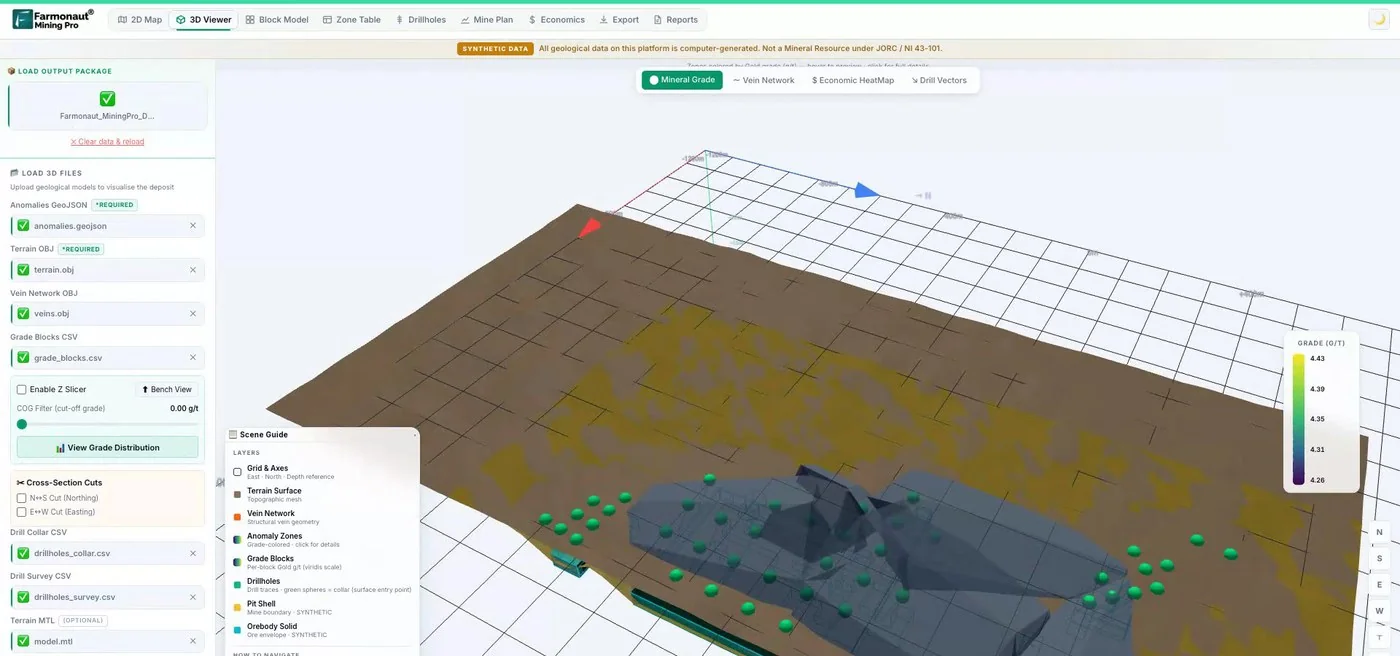
Mining Pro sample view, synthetic data
Keep reading
Sources
- USGS, Mineral Commodity Summaries 2026: Gold: pubs.usgs.gov
- EITI, Ghana: eiti.org
- Ecofin Agency, Reforms lift artisanal gold’s share in Ghana, Burkina Faso (5 Feb 2026): ecofinagency.com
- Ecofin Agency, Burkina Faso gold production up 58% in nine months (18 Dec 2025): ecofinagency.com
- Graphic Online, Ghana bans foreigners, individuals from local gold trading (14 Apr 2025): graphic.com.gh
- Reuters via Kitco, Burkina Faso completes nationalization of five gold mining assets (12 Jun 2025): kitco.com
- Reuters via Kitco, Mali gold output plunges 23% (16 Jan 2026): kitco.com
- Barrick, Full year and fourth quarter 2025 results: finviz.com
- Côte d’Ivoire Ministry of Mines, Petroleum and Energy: gold production: economie-ivoirienne.ci
- Ecofin Agency, Guinea’s largest gold mine records 6% output rise (22 Feb 2026): ecofinagency.com
- Endeavour Mining, FY-2025 results (5 Mar 2026): endeavourmining.com
- World Gold Council, Is mined gold production peaking? (Jan 2026): gold.org
Discussion
Questions, corrections or field experience? Share them below. First-time comments are reviewed before they appear, and your email is never published.
No comments yet. Be the first to add a question or your experience.

 SMA Investments Ltd
 NTS Group (Pty) Ltd
 Mine4Africa
 Lithspo Minerals Limited
 Tintina Mining Group
 Dalgety Minerals Pty Ltd
 Vortex Minerals Pty Ltd
 Faith At Work (Pty) Ltd
 Geotech Mining Solutions plc
 Vulcan International Limited
 Kidepo Associates
 GKY Mining
 Alkimy SARL
 Double A Trading
 GemSprout Metals Limited
 Qader Group
 Ileys General Trading
 SG Gold Mining LLC
 VRV Global Pte Ltd
 Omsri International FZE
 G.I.T.T.
 Jaunita Erss Ltd
 Almosi SARL
 SRK Consulting
 Berks Gold Limited










