

South Africa PGM and gold · Operator guide
Platinum Mines in South Africa: Operators and Output
South Africa mined about 70% of the world’s platinum in 2025 (USGS estimate). This guide names the operators and mines, their 2026 reported output with the metal basket stated, and the main South African gold mines.
Key takeaways
- South Africa mined 120 tonnes of platinum in 2025, about 70% of the 170-tonne world total, and holds 63 of more than 76 million kg of PGM reserves (USGS, 2026).
- Reported 2026 output: Implats 3.50 million oz (6E, year to June), Northam 938,754 oz (4E), Sibanye-Stillwater 789,647 oz (4E, half year, includes Mimosa in Zimbabwe), Valterra guided 3.0 to 3.4 million oz.
- Harmony’s Mponeng produced 9,561 kg of gold in the year to 30 June 2026, the most of any mine in its filing.
- Kitco showed platinum at US$1,616 and gold at US$4,157.70 per troy ounce on 15 October 2026.
- Reserves are more concentrated than output: about four-fifths of world PGM reserves, against a production share of about 70% (USGS, 2026).
In this article
- Platinum mines in South Africa: who runs them and what they produce
- How we chose these operators
- How much platinum South Africa mines and holds
- Operator by operator
- Platinum and gold prices
- What does a PGM mine earn? A quick margin check
- South African gold mines: who produces what
- African gold beyond South Africa
- Who can get a mining or prospecting right in South Africa
- Costs, safety and environmental pressure
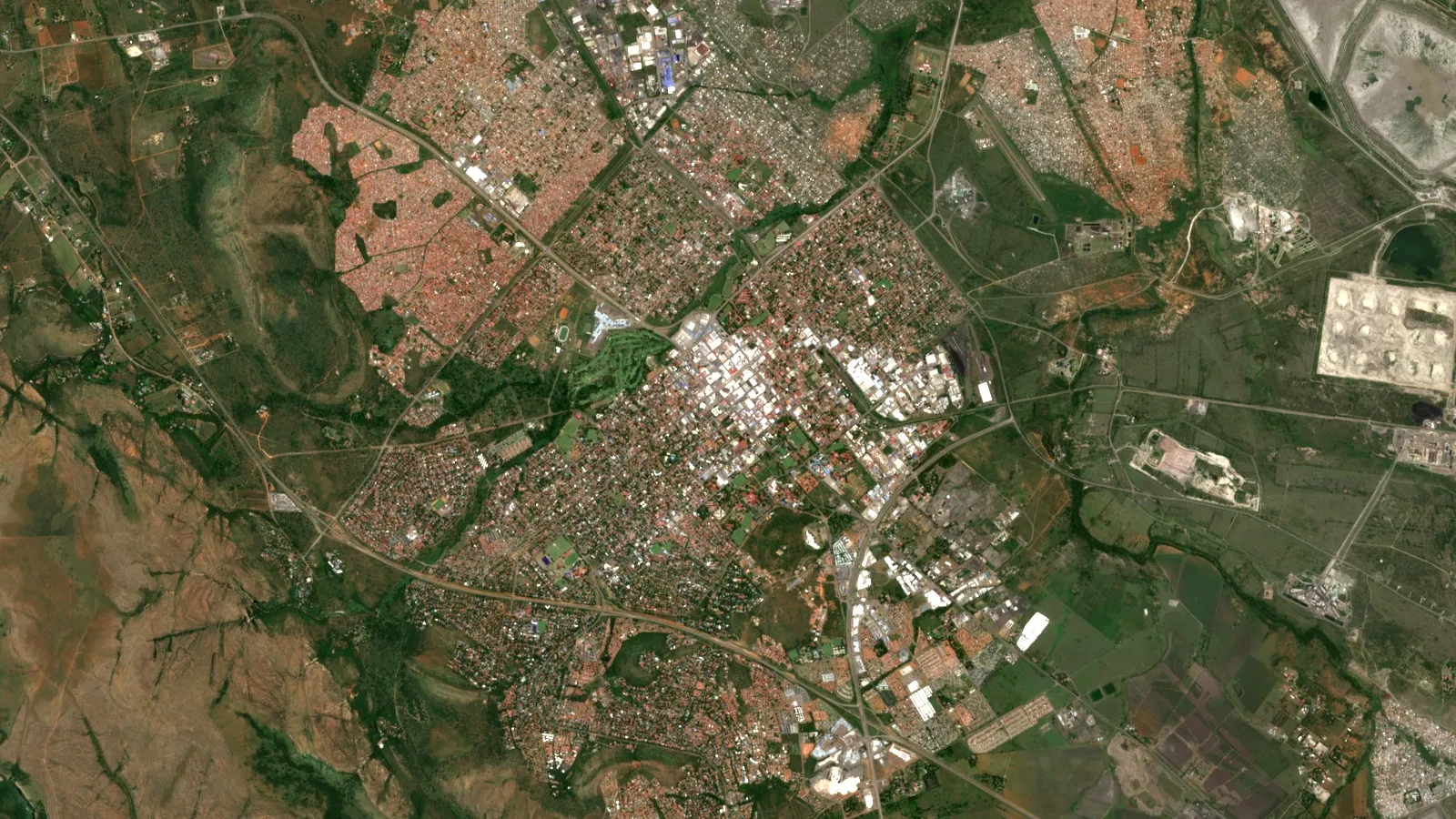
- Checking a South African site from space
- How to read a mine's production report
- What to watch next in South African PGM and gold
- Frequently asked questions
South Africa is the world’s largest platinum producer: USGS estimates it mined 120 tonnes of platinum in 2025, about 70% of the 170 tonnes mined worldwide, and its Bushveld Complex holds most of the world’s platinum-group metal (PGM) reserves (USGS Mineral Commodity Summaries, 2026). This page lists the main platinum operations by company, shows what each one reported in 2026, and then covers South African gold mines and the licence rules that apply to anyone who wants to explore there.
PGMs are a family of six metals found together: platinum, palladium, rhodium, ruthenium, iridium and osmium. Mines report them as a “basket” in ounces, written 3E, 4E, 5E or 6E depending on how many metals are counted, so ounce figures from different companies are not directly comparable. We state the basis next to every number.
Platinum mines in South Africa: who runs them and what they produce
Four producers (Valterra, Implats, Sibanye-Stillwater and Northam) report most of the country’s PGM output, and Ivanhoe is ramping up a fifth mine. The table gives each company’s South African operations as named in its own 2026 reports, and the latest output figure it published, with the basis and period. Outputs cover different periods and metal baskets, so read down the “basis” column before comparing rows.
| Company | Named operations | Latest reported output | Basis and period |
|---|---|---|---|
| Valterra Platinum | Mogalakwena, Amandelbult, Mototolo (plus Unki in Zimbabwe, which is in the group total) | 775,400 oz in the quarter; 3.0 to 3.4 million oz guided for the year | 5E plus gold, metal in concentrate, Q2 2026 and 2026 guidance |
| Impala Platinum (Implats) | Impala Rustenburg and other group operations | 3.50 million oz | 6E, group, year to 30 June 2026 |
| Sibanye-Stillwater | Rustenburg (including Kroondal), Marikana, Platinum Mile, plus Mimosa (Zimbabwe, joint venture) | 789,647 oz, of which 55,002 oz is Mimosa in Zimbabwe (831,307 oz with purchased concentrate) | 4E, managed and attributable, six months to 30 June 2026 |
| Northam Platinum | Zondereinde, Booysendal, Eland | 938,754 oz | 4E refined-metal equivalent, own operations, year to 30 June 2026 |
| Ivanhoe Mines | Platreef (Mokopane, Limpopo) | Ramping up; first concentrate November 2025 | Company release, 12 January 2026 |
Sources: Valterra Platinum production report, 17 July 2026; Implats FY2026 news release, 3 September 2026; Sibanye-Stillwater interim results filing (Form 6-K), 2026; Northam production update, 13 July 2026; Ivanhoe Mines release, 12 January 2026.
How we chose these operators
The list is not a ranking. We included each company that publishes a 2026 production report we could open and that names South African PGM operations. Smaller producers are not in the table. Treat the table as a map of the big operators, not a complete census of every shaft.
For a step-by-step view of how a PGM mine moves from drilling to refined metal, see our guide to the key steps in platinum mining.
How much platinum South Africa mines and holds
USGS puts South African platinum output at 126 tonnes in 2024 and 120 tonnes in 2025 (estimate), against a world total of 179 and 170 tonnes. Russia is second at 20 tonnes, then Zimbabwe at 18 tonnes, Canada at 5 tonnes and the United States at 1.8 tonnes (USGS, 2026). For palladium, the other major PGM, South Africa mined 70 tonnes of a world total of 190 tonnes in 2025 (estimate), so it is the second-largest source after Russia (84 tonnes).
Chart
World platinum mine production, 2025 estimate
Tonnes of platinum
Reserves are even more concentrated. USGS lists South African PGM reserves at 63 million kilograms out of more than 76 million kilograms worldwide, which is roughly four-fifths, and states that the largest resources and reserves are in the Bushveld Complex. The 70% figure often quoted for South Africa is its share of production, not of reserves.
Inside South Africa, PGMs are the largest employer in mining. The Department of Mineral and Petroleum Resources reports that mining contributed 6.1% of nominal GDP in 2024, that total direct and contractor employment was 474,736, and that PGMs and gold provided 37% and 21% of mining jobs, against 20% and 17% of mining revenue (DMPR, South Africa’s Mining Sector Performance 2024, report R141/2025). Total mineral sales were R865.8 billion in 2024.
Operator by operator
Valterra Platinum
Valterra (formerly Anglo American Platinum) became an independent company when Anglo American completed the demerger on 31 May 2025 (Anglo American). In the second quarter of 2026 it produced 775,400 ounces (5E plus gold, metal in concentrate), of which 525,700 ounces came from its own mines, up 13%, helped by a recovery at Amandelbult after flooding in 2025. Purchased concentrate from third parties fell 18% to 249,700 ounces. Its 2026 guidance is 3.0 to 3.4 million ounces, with a targeted all-in sustaining cost (AISC, the full yearly cost of keeping a mine running per ounce) of about US$1,050 per 3E ounce.
Chart
Northam output by mine, year to June 2026
Thousand ounces, 4E
Impala Platinum (Implats)
Implats reported group 6E production of 3.50 million ounces for the year to 30 June 2026, with refined and saleable output up 5% to 3.56 million ounces. Revenue rose 58% to R135.1 billion as metal prices recovered. The company finished consolidating Impala Rustenburg and approved life-of-mine extension projects.
Sibanye-Stillwater
Sibanye’s South African PGM operations are Rustenburg (including Kroondal), Marikana and Platinum Mile. Its Mimosa joint venture is in Zimbabwe (55,002 attributable 4E ounces in the half). Excluding purchased concentrate, managed and attributable 4E production was 789,647 ounces in the six months to 30 June 2026. That total includes Mimosa; the South African operations alone (Rustenburg, Marikana and Platinum Mile) produced 734,645 ounces.
Northam Platinum
Northam’s three mines produced 938,754 ounces (4E) in the year to 30 June 2026, and it also sold a record 1,690,495 tonnes of chrome concentrate, from the UG2 reef. Booysendal made the most metal, as the chart shows. Northam said Eland was ramping up on schedule and that Zondereinde was benefiting from Merensky stoping in its western extension (Northam, July 2026).
Ivanhoe Mines: Platreef
Platreef, near Mokopane in Limpopo Province, held its official opening and produced its first concentrate on 18 November 2025. Ivanhoe says Phase 2 should lift output to about 450,000 ounces of platinum, palladium, rhodium and gold a year in under 24 months from January 2026, and that the Flatreef discovery holds 59 million ounces in the Indicated category and 93 million ounces in Inferred at a 1 gram per tonne cut-off. Ivanhoe’s executive co-chair says the orebody averages 26 metres of continuous mineralisation, much thicker than the narrow reefs mined elsewhere in the Bushveld. These are company statements from a release dated 12 January 2026.
Platinum and gold prices
On 15 October 2026 Kitco showed a platinum bid of US$1,616 per troy ounce at 2:50 p.m. New York time (Kitco) and a gold bid of US$4,157.70 per troy ounce at 2:51 p.m. New York time (Kitco). Northam’s website listed rhodium at US$9,150 and palladium at US$1,113 on the same date. Prices move daily, so check the live quote before using them. For comparison, USGS puts the 2025 average platinum price at about US$1,200 per troy ounce (estimate).
What does a PGM mine earn? A quick margin check
Mining companies quote revenue per ounce of the whole basket, not the platinum price alone. The calculator below multiplies a yearly ounce figure by a basket price you choose and subtracts an all-in cost per ounce. It gives a rough gross margin before tax, royalties and capital spending, so it is a screening tool, not a valuation.
Calculator
What is the gross margin on a PGM mine’s ounces?
Enter your own ounces, basket price and cost per ounce. The values shown are examples.
- Revenue (US$): $900,000,000
- Margin per ounce (US$): $750
- Gross margin (rand): 6,375,000,000 R
Example values only, not a benchmark. The default cost per ounce echoes Valterra’s targeted AISC of about US$1,050 per 3E ounce (Valterra, July 2026). Basket price and exchange rate are inputs: use today’s price. Result is before tax, royalties and growth capital.
South African gold mines: who produces what
South Africa mined 90 tonnes of gold in 2024, about 2.7% of the 3,280 tonnes mined worldwide, and USGS lists its reserves at 5,000 tonnes (USGS, 2026). The country was once the largest gold producer in the world; our guide to the largest gold producers shows where the leaders are now.
Chart
Gold mine production, 2024
Tonnes, selected countries
Harmony Gold publishes the most detailed mine-by-mine figures of the South African gold producers. In the year to 30 June 2026 it produced 44,464 kg (1,429,551 oz) of gold in total, of which 38,560 kg came from South African underground and surface operations (Harmony, FY2026 results filing). Its mines in that report, with kilograms of gold produced:
| Harmony mine | Gold produced (kg) | Note from the filing |
|---|---|---|
| Mponeng | 9,561 | High-grade underground; 307,392 oz; ore milled 896 thousand tonnes |
| Moab Khotsong | 5,182 | High-grade underground; 166,605 oz |
| Tshepong North | 3,977 | Life-of-mine extension project approved |
| Kusasalethu | 3,198 | Optimised underground |
| Doornkop | 2,851 | Optimised underground |
| Tshepong South | 2,541 | Optimised underground |
| Masimong | 1,562 | Optimised underground |
| Target 1 | 1,409 | Optimised underground |
| Joel | 1,399 | Optimised underground |
Sibanye-Stillwater’s South African gold operations produced 9,134 kg (293,665 oz) in the first half of 2026. Its filing states that Kloof underground production was 19% lower, Driefontein was broadly stable, Beatrix was hit by seismic damage to infrastructure, and Kloof’s life of mine was one year at 31 December 2025 (Sibanye-Stillwater, 2026). Harmony’s figures are for a fiscal year and USGS’s are for a calendar year, so do not subtract one from the other.
If you want a district-level look at where South African gold sits and how it is explored, read our guide to gold exploration in South Africa.
▶ How gold is mined and refined, from rock to ring · 5:27
African gold beyond South Africa
In USGS’s 2024 table, Ghana mined 149 tonnes of gold, well above South Africa’s 90 tonnes, and holds 1,000 tonnes of reserves. USGS does not list Mali or Tanzania as separate lines; they fall in “other countries”. Neighbouring Zimbabwe also hosts platinum and gold; see our page on gold exploration in Zimbabwe.
Artisanal and small-scale mining (ASM) supplies part of Africa’s gold; the USGS table does not split it out, so we give no ASM share.
Who can get a mining or prospecting right in South Africa
Rights are granted under the Mineral and Petroleum Resources Development Act (MPRDA) by the Department of Mineral and Petroleum Resources (DMPR). The department says the principles are first-come, first-served processing and no duplicate applications for the same right on the same land. Applications have been filed on the SAMRAD database, which the department calls outdated; a new digital cadastre has been piloted in the Western Cape, with online registration, application lodgement, payments and a map viewer, and the DMPR says it will replace SAMRAD, with no firm national date given (Business Report, 16 June 2026). Before you pay for any claim or licence, confirm ownership with the regulator and a South African attorney.
Overseas readers often ask whether a foreigner can hold a small-scale licence in Africa. Our short video explains the three routes that exist.

▶ Can foreigners get a small-scale mining licence in Africa? · 5:16
Costs, safety and environmental pressure
Deep, narrow reefs raise cost per ounce, and the sector carries a heavy safety burden. Valterra reported two work-related fatalities in the second quarter of 2026 and Implats says the loss of colleagues at its operations remains unacceptable. Companies respond with more mechanisation, better ventilation and water recycling: Implats reported 58% water recycling and re-use and 30% renewable or non-carbon electricity in the year to June 2026. Production figures for 2025 also show the strain: USGS estimates South African platinum output at 120 tonnes (down from 126) and palladium at 70 tonnes (down from 82.6), after significant revisions to the 2024 data.
Chart
PGM mine output, 2024 against 2025
Tonnes
Mining also changes the land around it. Our short clay-animation video lists the seven main environmental impacts of mining in plain words.

▶ The seven environmental impacts of mining, explained in clay · 2:31
Checking a South African site from space
A prospecting right gives you access to ground, not a result. Farmonaut’s satellite mineral detection reports map alteration clues on a licence boundary from imagery, in days rather than months, so a consultant can rank targets before booking drills. Reports are exploration targets, not a resource estimate. See the developer documentation for API access.
How to read a mine’s production report
Production reports look alike but hide differences that change the story. Check five things before you compare two mines or two companies.
- The metal basket. 3E, 4E, 5E and 6E ounces count different metals. Valterra reports 5E plus gold, Sibanye and Northam report 4E, and Implats reports 6E.
- Metal in concentrate versus refined metal. Metal in concentrate is what the mine’s concentrator produces. Refined metal is what comes out of the smelter and refinery weeks later. Northam reports both and Valterra notes that refined output exceeded concentrate output in its quarter because of work-in-progress inventory.
- Own mines versus purchased concentrate. Sibanye’s 789,647 ounces exclude third-party concentrate; with it the figure is 831,307 ounces. Valterra’s own-mined 525,700 ounces are about two-thirds of its 775,400-ounce total.
- The reporting period. Implats and Northam report fiscal years to 30 June, Valterra reports quarters, and USGS reports calendar years.
- Cost basis. AISC includes sustaining capital; cash operating cost does not. Valterra’s cash operating unit cost guidance is R19,000 to R20,000 per PGM ounce, a rand figure, while its AISC target is in dollars.
The same habits apply to gold. Harmony reports kilograms and ounces; USGS reports tonnes; Sibanye reports both. One tonne is 32,150.7 troy ounces, and one kilogram is 32.1507 troy ounces, so 9,561 kg of gold equals about 307,400 ounces, which matches Harmony’s figure for Mponeng.
What to watch next in South African PGM and gold
Four dated items are worth tracking in company reports rather than in news summaries. First, Valterra’s second-half 2026 output against its 3.0 to 3.4 million ounce guidance. Second, Northam’s ramp-up at Eland and the commissioning of 3 shaft at Zondereinde, both named in its July 2026 update. Third, Platreef’s Phase 2 timetable in Ivanhoe’s next quarterly report. Fourth, the national rollout of the DMPR cadastre, which the department has not dated. Each is a fact you can check against a filing, which is more useful than a forecast.
For a closer look at a related question, see our guide: Acid Mine Drainage in South Africa: Basins, Costs, Fixes.
If this topic matters to you, read Largest Iron Ore Mining Companies in Africa next.
Frequently asked questions
Which country has the most platinum mines?
South Africa. USGS estimates it mined 120 tonnes of platinum in 2025, ahead of Russia at 20 tonnes and Zimbabwe at 18 tonnes.
Where are the platinum mines in South Africa?
Most are in the Bushveld Complex, which USGS names as the location of the largest PGM resources and reserves. Companies name operations such as Mogalakwena, Amandelbult, Mototolo, Zondereinde, Booysendal, Eland, Marikana and Platreef.
Who owns the biggest platinum mines in South Africa?
By reported output, the main owners are Valterra Platinum, Impala Platinum, Sibanye-Stillwater and Northam Platinum, with Ivanhoe Mines building Platreef.
How much platinum does South Africa produce?
About 120 tonnes in 2025 (USGS estimate), roughly 70% of world mine output.
Does South Africa hold 70% of the world’s platinum reserves?
No. The 70% figure matches its share of production. USGS lists 63 million kilograms of PGM reserves in South Africa out of more than 76 million kilograms worldwide.
What is the difference between 3E, 4E, 5E and 6E ounces?
They count different groups of PGMs. 4E means platinum, palladium, rhodium and gold, and 6E adds ruthenium and iridium. Always compare companies on the same basis.
Which South African gold mine produces the most?
In Harmony’s results for the year to 30 June 2026, Mponeng produced the most, at 9,561 kg of gold.
How much gold does South Africa produce?
USGS estimates 90 tonnes in 2024 and 90 tonnes in 2025 (estimate), about 2.7% of world output in 2024.
Is South Africa still the biggest gold producer in Africa?
No. In USGS’s table Ghana mined 149 tonnes in 2024 against South Africa’s 90 tonnes.
How do I check who holds a mining right on a property?
Ask the DMPR and use its cadastre systems, then have a South African attorney confirm. The department says duplicate applications for the same right on the same land are not allowed while one is under consideration.
This page is for information only. It is not investment advice and gives no price targets. It is not legal advice; confirm licence and mining-right rules with the regulator. Company figures come from 2026 filings and change often.
Farmonaut mining
Map your mining site from space
For consultants screening a licence area: Farmonaut satellite mineral detection reports map alteration clues on your boundary and rank targets ahead of drilling.

Mining Pro sample view, synthetic data
Keep reading
Sources
- USGS, Mineral Commodity Summaries 2026: platinum-group metals: pubs.usgs.gov
- USGS, Mineral Commodity Summaries 2026: gold: pubs.usgs.gov
- Valterra Platinum, production report for Q2 2026 (17 July 2026): valterraplatinum.com
- Implats, FY2026 news release (3 September 2026): implats.co.za
- Sibanye-Stillwater, interim results, Form 6-K (2026): sec.gov
- Northam Platinum, voluntary production update (13 July 2026): sharedata.co.za
- Northam Platinum, website market prices (15 October 2026): northam.co.za
- Ivanhoe Mines, Platreef update (12 January 2026): newsfilecorp.com
- Harmony Gold, FY2026 results, Form 6-K: sec.gov
- Kitco, platinum price (15 October 2026): kitco.com
- Kitco, gold price (15 October 2026): kitco.com
- Business Report, new mining cadastre (16 June 2026): businessreport.co.za
- DMPR, South Africa’s Mining Sector Performance 2024 (report R141/2025): dmpr.gov.za
- Anglo American, demerger of Valterra Platinum (31 May 2025): angloamerican.com
Discussion
Questions, corrections or field experience? Share them below. First-time comments are reviewed before they appear, and your email is never published.
No comments yet. Be the first to add a question or your experience.

 VRV Global Pte Ltd
 Omsri International FZE
 G.I.T.T.
 Jaunita Erss Ltd
 Almosi SARL
 SRK Consulting
 Berks Gold Limited
 Mwerezi Minerals Company Limited
 Mining SARL
 SenGold Invest SAS
 Sean Mining Limited
 NTS Group (Pty) Ltd
 Mine4Africa
 Lithspo Minerals Limited
 Tintina Mining Group

 Licence holder · Nigeria · Gold + lithium










