

Copper and aluminum geology · Producer guide
Copper and Aluminum in Nature: Where They Are Found
Aluminum is about 8.2% of the upper crust (USGS) but is mined only as bauxite, led by Guinea, Australia and China. Copper averages 27 mg/kg and is led by Chile, the DRC and Peru (USGS, 2026).
Key takeaways
- Aluminum averages about 8.2% of the upper crust but never occurs as a pure metal; it is mined as bauxite formed by tropical weathering (USGS).
- Guinea, Australia and China mined about three quarters of the world’s 440 Mt of bauxite in 2025e (USGS, 2026).
- Copper averages 27 mg/kg in the upper crust; porphyry deposits supply about 60% of world copper at an average 0.44% Cu (USGS).
- Chile, the DRC and Peru mined 11.2 Mt of the world’s 23 Mt of copper in 2025e (USGS, 2026).
- USGS estimates at least 3,500 Mt of undiscovered copper in porphyry and sediment-hosted types, against 2,100 Mt identified (2015 assessment).
In this article
- Where is aluminum found in nature?
- Top bauxite-producing countries
- How bauxite forms: laterite and karst types
- Where is copper found in nature?
- Porphyry copper deposits: the biggest source
- Top copper-producing countries
- Copper and aluminum side by side
- How much copper is left to find?
- Calculator: how far above the crust is your ore grade?
- How to screen a licence area for copper or aluminum
- How we chose these numbers
- Frequently asked questions
Aluminum is the most abundant metal in the Earth’s crust, at about 8.2% by weight in the upper crust, yet it is mined from one rock type only: bauxite, a tropical weathering product. Copper is about 3,000 times scarcer in ordinary rock, at 27 mg/kg, so it is mined where hot fluids or sedimentary basins have concentrated it. In 2025, Guinea, Australia and China dug about three quarters of the world’s 440 million tonnes of bauxite, while Chile, the Democratic Republic of the Congo (DRC) and Peru mined just under half of the world’s copper (USGS Mineral Commodity Summaries, 2026).
This guide is written for consultants who have to say what a licence area could hold. It explains how each metal sits in rock, which deposit types carry it, which countries produce it, and what to check on a map before you spend money on field work. It also has a short calculator that shows how far an ore grade sits above the crustal average.
Where is aluminum found in nature?
Aluminum never occurs as a pure metal in nature. The U.S. Geological Survey (USGS) describes it as the most abundant metal and the third most abundant element in the crust, locked inside common aluminosilicate minerals such as feldspars and clays. Kaolinite, a clay with the formula Al2Si2O5(OH)4, is especially rich in aluminum. Average abundance in the upper crust is about 8.2 weight percent, and igneous rocks and shale sit close to that figure. Sandstone holds about half as much, and carbonate rocks such as limestone hold less than 1 weight percent.
Because aluminum is bound so tightly in silicate minerals, it costs too much to pull out of granite or clay. The ore that makes economic sense is bauxite, a rock in which long, hot, wet weathering has washed away most other elements and left aluminum hydroxide minerals behind. The main ones are gibbsite, boehmite and diaspore, mixed with iron oxides such as hematite and goethite, which give bauxite its red-brown colour. Those iron minerals and any quartz are called gangue, the worthless part of an ore.
So the honest answer to “where is aluminum found in nature” has two layers. It is in almost every rock and soil on land. It is only worth mining in bauxite belts. About 63% of the bauxite used in the United States in 2025 was refined by the Bayer process, which dissolves aluminum hydroxide out of the rock to make alumina (aluminum oxide), and alumina is then smelted to metal (USGS, 2026).
Top bauxite-producing countries
The table below lists eight leading bauxite producers (a selection of producers, not a complete ranking; some countries not shown also mine bauxite) by 2025 estimated mine output, using USGS Mineral Commodity Summaries 2026. Reserves are the part of a resource that can be mined profitably under today’s conditions, so they change when prices, costs or rules change.
Chart
Bauxite mine output, selected producers
Million tonnes of bauxite, 2025 estimate, selection of eight producers (not a complete ranking)
| Country | Bauxite mined, 2025e (Mt) | Share of world | Reserves (Gt) |
|---|---|---|---|
| Guinea | 150 | 34% | 7.4 |
| Australia | 97 | 22% | 3.7 |
| China | 87 | 20% | 0.71 |
| Brazil | 33 | 7.5% | 1.7 |
| Indonesia | 10 | 2.3% | 2.9 |
| Jamaica | 6.2 | 1.4% | 2.0 |
| Russia | 5.7 | 1.3% | 0.65 |
| Saudi Arabia | 5.7 | 1.3% | 0.18 |
World output was 440 million tonnes (Mt) in 2025e, and world reserves are 29 billion tonnes (Gt). Shares are our own division of the USGS figures. Guinea holds about a quarter of world reserves and mined about a third of the world’s bauxite. Vietnam is not in the output list, but it is third in reserves at 3.1 Gt. At the 2025e rate, 29 Gt of reserves equals roughly 66 years of mining. USGS puts total bauxite resources, including ground that is not yet economic, at 55 to 75 Gt.
China is the odd case. It mines 87 Mt of bauxite but made 93 Mt of the world’s 150 Mt of alumina in 2025e, so it imports ore to feed its refineries. Where the ore is dug and where the metal is made are different maps. Primary aluminum smelters made 74 Mt worldwide in 2025e, with China at 45 Mt (USGS, aluminum summary, 2026).
How bauxite forms: laterite and karst types
USGS recognises two main bauxite models. Both need intense weathering in a warm, wet climate, and both need a landscape that stays stable for a very long time so that the weathered layer is not stripped away by erosion.
- Laterite bauxite forms in the subsoil of well-drained plateaus on almost any aluminum-bearing rock. It sits under a thin soil and above saprolite, which is rock that is only partly weathered. The best ore is often at the eroded edges of old plateau remnants. USGS lists Australia, Brazil and Guinea among its examples of this model.
- Karst bauxite accumulates on carbonate rock, mostly in pockets and depressions on an old limestone surface. It can include material washed in from elsewhere, such as volcanic ash. USGS describes it as tied to wet tropical weathering, with Jamaican deposits among those reviewed in the literature.
Age shows in the mineral. Young deposits in the tropics are mostly gibbsite. Older ones hold boehmite, and Paleozoic and Mesozoic karst deposits are boehmite-dominated (USGS Bulletin 1693). Both models list aluminum and gallium as their geochemical signature.
For field work, this means bauxite targets follow climate history, not plate boundaries. Look for flat, high, old surfaces in the present or past tropics. Our guide to iron ore, bauxite and other bulk deposits covers how these bodies are tested once you have a target.
Where is copper found in nature?
Copper is one of the few metals that can occur as a pure metal. USGS notes that it is found as native copper, and that it bonds strongly with sulfur to make sulfide minerals: chalcopyrite (CuFeS2), chalcocite (Cu2S), bornite (Cu5FeS4), covellite (CuS) and digenite (Cu9S5). Its average abundance in the upper crust is only 27 mg/kg (0.0027%). Dark mafic rocks such as basalt and gabbro carry 30 to 160 mg/kg, shale about 45 mg/kg, granite about 12 mg/kg, limestone about 6 mg/kg and sandstone about 2 mg/kg.
That spread explains the pattern on a map. Copper ore needs a process that moves copper out of a large volume of rock and drops it in a small one. Several geological processes do this work, and the three below are the ones most often named:
- Hot magmatic-hydrothermal fluids rising above cooling intrusions build porphyry deposits, according to the USGS porphyry copper model.
- Basin brines moving through red-bed sandstones and shales that sit beside reduced rock leave sediment-hosted stratabound copper.
- Hydrothermal systems in basalt and on the seafloor can form native copper and massive sulfide bodies (general geology). Wisconsin’s geological survey describes native copper as veins and cavity fillings in hydrothermally altered basalt, and as a product of near-surface supergene alteration of sulfides such as chalcopyrite.
Supergene means formed near the surface by weathering; the USGS porphyry model has a section on supergene ore and weathering processes. In general geology terms, weathering can change copper sulfides near the surface into oxide and carbonate minerals. The Wisconsin survey notes that native copper often carries green or black weathering rinds of malachite, azurite, cuprite and other minerals. Green copper stains in outcrop are therefore a field clue, but a stain is not an ore grade.
Porphyry copper deposits: the biggest source
A porphyry copper deposit is a very large body of rock, with copper sulfides spread through veinlets and small grains around a buried intrusion. USGS calls these deposits the world’s largest source of copper, at about 60% of production and 65% of resources. They also supply molybdenum, gold and silver. Grades are low, an average of 0.44% copper in 2008, but size makes up for it: commonly hundreds of millions to billions of tonnes of rock and mine lives of decades.
Grade is the share of metal in the rock. At 0.44% copper, a tonne of ore holds 4.4 kg of copper. That is still about 160 times the crustal average of 27 mg/kg, which is the kind of jump the calculator below lets you test. Our deeper pages on porphyry copper alteration, grades and discovery and on copper deposit types and where to explore cover this ground in more detail.
Massive sulfide deposits are the other base-metal family that often carries copper. Our page on massive sulfide deposits explains how they differ from porphyry systems.
Top copper-producing countries
Copper mining is concentrated along two geological belts: the Andes, where porphyry deposits formed above a subduction zone, and the Central African Copperbelt, where sediment-hosted deposits dominate. The ranking below uses mine output (copper content of ore) for 2025e and reserves from USGS Mineral Commodity Summaries 2026.
Chart
Copper mine output by country
Thousand tonnes of contained copper, 2025 estimate, eight leading producers
| Rank | Country | Copper mined, 2025e (kt) | Share of world | Reserves (Mt) |
|---|---|---|---|---|
| 1 | Chile | 5,300 | 23% | 180 |
| 2 | Congo (Kinshasa) | 3,200 | 14% | 80 |
| 3 | Peru | 2,700 | 12% | 85 |
| 4 | China | 1,800 | 7.8% | 41 |
| 5 | Russia | 1,300 | 5.7% | 80 |
| 6 | United States | 1,000 | 4.3% | 47 |
| 7 | Zambia | 940 | 4.1% | 21 |
| 8 | Australia | 730 | 3.2% | 100 |
The figures are thousand tonnes (kt) of contained copper. World mine output was about 23,000 kt (23 Mt) and world reserves were 980 Mt. Shares are our own division of the USGS values, and the world total is rounded by USGS, so treat them as close, not exact. Chile alone mined about 23% of the world’s copper in 2024 according to Natural Resources Canada, which matches the USGS 2025e share.
Australia is eighth in output but second in reserves, at 100 Mt. Reserves of 980 Mt equal about 43 years at the 2025e mining rate, but reserves change with prices, costs and new discoveries.
The Central African Copperbelt is a good example of sediment-hosted copper. Our page on the top global sources of copper adds supply-side detail. Our channel video on the DRC’s copper deposits walks through the basin and its mining regions.

▶ Farmonaut video on the DRC’s copper deposits in the Central African Copperbelt · 13:34
Copper and aluminum side by side
| Question | Copper | Aluminum |
|---|---|---|
| Average in upper crust | 27 mg/kg (0.0027%) | about 8.2% by weight |
| Native metal in nature? | Yes, rarely, as native copper | No, never in pure form |
| Main ore minerals | Chalcopyrite, bornite, chalcocite; oxide minerals near surface | Gibbsite, boehmite, diaspore in bauxite |
| Main deposit types | Porphyry, sediment-hosted, massive sulfide, native copper | Laterite and karst bauxite |
| How it forms | Hot fluids or basin brines concentrate copper | Tropical weathering removes everything else |
| Top miners, 2025e | Chile, Congo (Kinshasa), Peru | Guinea, Australia, China |
| World mine output, 2025e | about 23 Mt of copper | 440 Mt of bauxite ore |
| World reserves | 980 Mt of copper | 29 Gt of bauxite ore |
| Typical ore grade | 0.44% Cu average for porphyry (2008) | Quoted as Al2O3 content, varies by deposit |
Read the output and reserve rows with care: the copper numbers are tonnes of metal contained in the ore, and the bauxite numbers are tonnes of ore. They are not the same unit, and only the producer rankings can be compared across the two columns.
How much copper is left to find?
The last USGS global assessment (2015, revised version published later) looked at porphyry and sediment-hosted copper in 236 permissive areas, which are zones where the geology allows such deposits. It estimated that at least 3,500 Mt of copper remains undiscovered in those two deposit types, against 2,100 Mt of identified resources (a total that includes about 600 Mt already mined, per USGS MCS 2026). Porphyry deposits hold 1,800 Mt identified and at least 3,100 Mt undiscovered, and South America is the leading source of both. Sediment-hosted deposits hold 310 Mt identified and at least 420 Mt undiscovered, in basins such as the Katanga Basin of central Africa, the Southern Permian Basin of Poland and Germany, the Chu-Sarysu Basin of Kazakhstan and the Kodar-Udokan area of Russia.
Chart
Copper resources by deposit type
Million tonnes of copper, USGS 2015 global assessment
Undiscovered does not mean economic. The USGS report says the share that may be worth mining depends on how deep a deposit lies and how good the local infrastructure is. For comparison, total world copper production from 1879 to 2012 was about 600 Mt. Aluminum has no similar scarcity story: USGS says bauxite resources are enough to meet world demand for aluminum metal well into the future. The tighter limits for bauxite are local, such as ore quality, distance to a port and permits.
Calculator: how far above the crust is your ore grade?
The calculator that follows turns a grade into a “times the crustal average” figure, and shows how much ore a tonne of metal needs. It is a quick screening aid for comparing a project grade with the Earth’s background level. Enter your own numbers.
Calculator
How far above the crustal average is your ore grade?
Enter a grade, the crustal average for that metal and an ore tonnage.
- Tonnes of ore per tonne of metal: 227
- Contained metal (thousand tonnes): 440
Example values only, not a benchmark. Defaults: 0.44% Cu is the USGS porphyry average (2008) and 27 mg/kg is the USGS upper-crust copper average (SIR 2017-5118). For aluminum use the crustal average of 82,000 mg/kg (8.2%).
How to screen a licence area for copper or aluminum
For a consultant, the first question is whether the setting fits the deposit type. The map checks below follow from the geology above:
- Match the setting. Copper porphyry: a volcanic arc or old arc with intrusions. Sediment-hosted copper: a red-bed basin beside reduced rock. Bauxite: a flat old plateau in a warm, wet climate, now or in the past.
- Look for the alteration halo. Porphyry systems leave iron-oxide stains and clay-rich altered rock over large areas, which multispectral satellite images can separate from fresh rock.
- Check the surface. Green stains point to oxidised copper but say nothing about grade. A thick lateritic cap over saprolite is the bauxite sign, and only drilling or pitting proves the ore thickness.
- Compare with known districts. A grade near the porphyry average of 0.44% copper is normal for a large open-pit target. Small, high-grade veins call for underground mining and a different cost model.
- Plan sampling. Satellite and geological maps are a way to rank where to sample, not a resource estimate. Any tonnage needs drilling and a qualified person’s report.
Farmonaut’s satellite-based mineral detection works from a licence polygon and can screen for copper among 20+ mineral types. It does not replace sampling. To discuss an area, use the mining quote form or contact the team.
Remote sensing means measuring the ground from a distance. The short video on how satellites help find gold uses the same logic that applies to copper: the satellite cannot see the metal, it maps the rock around it.

▶ Farmonaut video: how satellites map the rock around a metal · 4:25
How we chose these numbers
All production and reserve figures come from the USGS Mineral Commodity Summaries 2026 pages for copper, aluminum and bauxite-alumina, and the crustal averages come from the USGS soil geochemistry atlas (SIR 2017-5118), which quotes published values for the upper crust. Deposit-type facts come from USGS descriptive models and assessments, and the native copper note comes from the Wisconsin Geological and Natural History Survey. We did not use company marketing pages. Where we divided one USGS figure by another, the text says so. USGS marks 2025 values as estimates (2025e), and these can be revised in the next edition.
Related reading on this site: Maine Tourmaline Mines: Where to Dig, What It Sells For.
We cover a connected topic in Where Is Benitoite Found? Origin, Mines and Facts.
Frequently asked questions
Where is aluminum found in nature?
Aluminum is in nearly every rock and soil as part of minerals such as feldspar and clay, at about 8.2% of the upper crust (USGS). It is never found as a pure metal. It is mined from bauxite, which forms by deep tropical weathering.
Which country has the most bauxite?
Guinea. It holds 7.4 Gt of the world’s 29 Gt of reserves and mined 150 Mt in 2025e (USGS, 2026). Australia is second in both reserves (3.7 Gt) and output (97 Mt).
Where can copper be found in nature?
Copper is found in sulfide minerals such as chalcopyrite, in oxide and carbonate minerals near the surface, and in rare native form. The largest deposits are porphyry copper systems above old and young subduction zones, such as the Andes, and sediment-hosted deposits such as the Central African Copperbelt.
Which countries produce the most copper?
Chile mined about 5.3 Mt of copper in 2025e, then the DRC at 3.2 Mt and Peru at 2.7 Mt (USGS, 2026). Together they made just under half of the world’s 23 Mt.
Is copper rarer than aluminum in the Earth’s crust?
Yes. The upper crust averages about 27 mg/kg of copper and about 82,000 mg/kg (8.2%) of aluminum, which is roughly 3,000 times more (USGS). Ore forms where geology concentrates a metal far above its average.
What is the difference between bauxite and aluminum?
Bauxite is the ore rock. Alumina is aluminum oxide refined from bauxite, mostly by the Bayer process, and aluminum metal is smelted from alumina. World output in 2025e was 440 Mt of bauxite, 150 Mt of alumina and 74 Mt of primary aluminum (USGS).
What is a porphyry copper deposit?
It is a very large, low-grade body of rock with copper sulfides in veinlets around a buried intrusion. USGS says these deposits supply about 60% of the world’s copper, with an average grade of 0.44% in 2008.
Can you find native copper on the surface?
Sometimes. Native copper occurs in altered basalt and in weathered zones, often with green or black coatings of malachite, azurite and cuprite. Most surface copper stains are copper carbonates or oxides, not metal, and a stain does not tell you the grade.
How much copper is still undiscovered?
USGS estimated at least 3,500 Mt of undiscovered copper in porphyry and sediment-hosted deposits in its 2015 global assessment, compared with 2,100 Mt identified in the same types. It is an estimate of what could exist, not what is economic to mine.
Can satellites find copper or bauxite?
Satellites cannot see the metal underground. They map surface clues, such as iron staining, clay alteration and faults for copper systems, and lateritic surfaces for bauxite. Those clues rank where to sample first. Sampling and drilling decide whether a target is ore.
This page is for information only. It is not investment advice. Satellite and map screening ranks places to sample; it is not a resource estimate. Check local mining law and licence rules before you stake or sample, and follow site safety rules in the field.
Farmonaut mining
Map your mining site from space
Send your licence polygon and get a satellite screen of the ground before you plan sampling.
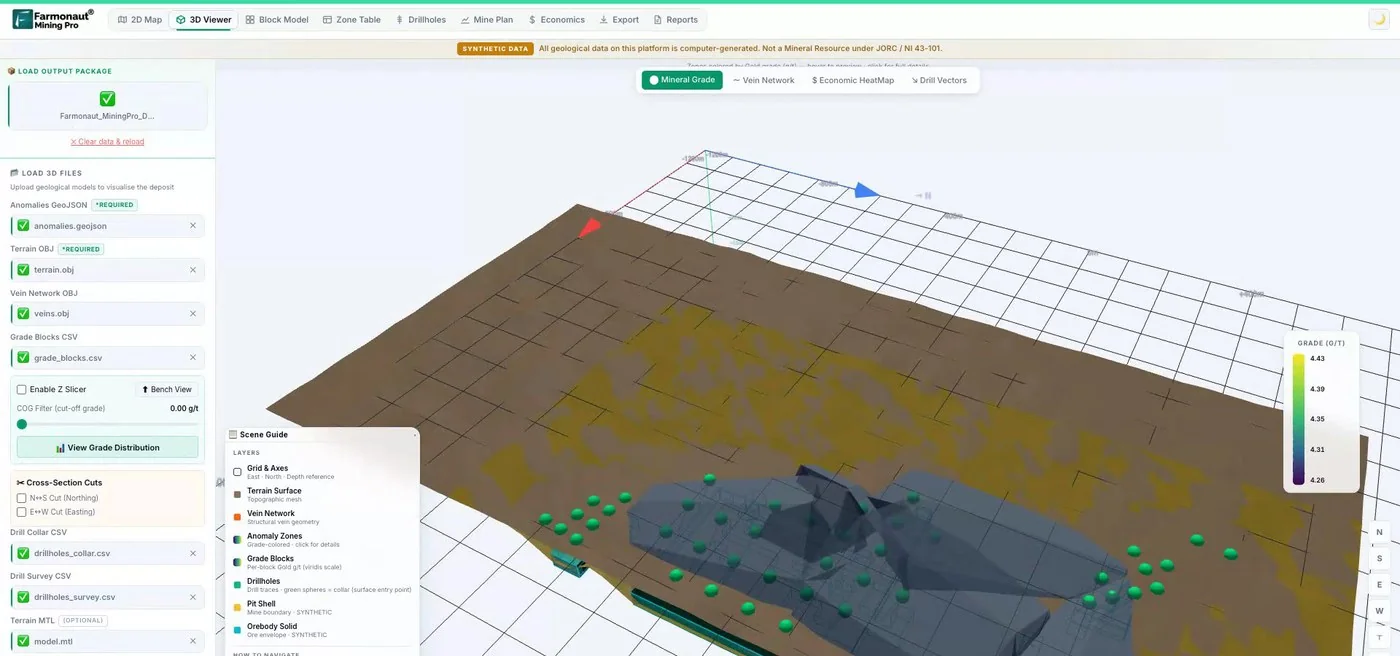
Mining Pro sample view, synthetic data
Keep reading
Sources
- USGS, Mineral Commodity Summaries 2026: Copper: pubs.usgs.gov
- USGS, Mineral Commodity Summaries 2026: Aluminum: pubs.usgs.gov
- USGS, Mineral Commodity Summaries 2026: Bauxite and Alumina: pubs.usgs.gov
- USGS SIR 2017-5118, Geochemical and mineralogical maps for soils: Aluminum: pubs.usgs.gov
- USGS SIR 2017-5118, Geochemical and mineralogical maps for soils: Copper: pubs.usgs.gov
- USGS SIR 2010-5070-B, Porphyry copper deposit model: pubs.usgs.gov
- USGS SIR 2018-5160, Assessment of undiscovered copper resources of the world, 2015: pubs.usgs.gov
- USGS Bulletin 1693, Descriptive model of laterite type bauxite (Model 38b): pubs.usgs.gov
- USGS Bulletin 1693, Descriptive model of karst type bauxite (Model 38c): pubs.usgs.gov
- Wisconsin Geological and Natural History Survey, Copper: home.wgnhs.wisc.edu
- Natural Resources Canada, Copper facts: natural-resources.canada.ca
Discussion
Questions, corrections or field experience? Share them below. First-time comments are reviewed before they appear, and your email is never published.
No comments yet. Be the first to add a question or your experience.

 Sania Corporation
 Sean Mining Limited
 NTS Group (Pty) Ltd
 Mine4Africa
 Lithspo Minerals Limited
 Tintina Mining Group
 Dalgety Minerals Pty Ltd
 Vortex Minerals Pty Ltd
 Faith At Work (Pty) Ltd
 Geotech Mining Solutions plc
 Vulcan International Limited
 Kidepo Associates
 GKY Mining
 Alkimy SARL
 Double A Trading
 GemSprout Metals Limited
 Qader Group
 Ileys General Trading
 SG Gold Mining LLC
 VRV Global Pte Ltd
 Omsri International FZE
 G.I.T.T.
 Jaunita Erss Ltd
 SRK Consulting
