

Oilseeds · Flax growing guide
Flax Yield per Acre: How to Grow Flax for More Bushels
US flax averaged 22.2 bushels per acre in 2025 and Saskatchewan 27.8 (official statistics). This guide covers variety, sowing, nitrogen, pests, harvest and prices, with a calculator for your own return per acre.
Key takeaways
- US flax yield averaged 22.2 bu/acre in 2025 on 234,000 harvested acres (USDA NASS, October 2026).
- Saskatchewan averaged 27.8 bu/acre in 2025, against 18.7 in 2024 and a five-year average of 19.0 (Saskatchewan Crops Profile 2025).
- NDSU recommends 25 to 45 lb of seed per acre, 0.75 to 1.5 inches deep, sown early in spring.
- Total nitrogen should not exceed 80 lb N/acre in tilled fields or 50 lb in long-term no-till; phosphorus gave no yield response (NDSU).
- The US season-average flax price was US$13.00/bu for 2025, preliminary (USDA NASS, February 2026).
In this article
- Flax yield per acre at a glance
- What sets flax yield per acre
- Choosing a flax variety
- Soil and field preparation
- When and how to sow flax
- Flax growth stages and crop calendar
- Fertilizer for flax
- Water management and irrigation
- Weeds, insects and diseases in flax
- Harvest, drying and storage
- Flax prices and returns per acre
- Using satellite maps on flax fields
- Regenerative and sustainable flax practices
- Seed flax vs fiber flax
US flax growers harvested an average of 22.2 bushels per acre in 2025, according to the USDA NASS Crop Production report of October 2026. That is about 1,240 lb, or roughly 1.4 tonnes per hectare. In Saskatchewan, the biggest flax area in North America, the 2025 average was 27.8 bushels per acre against a five-year average of 19.0. So a typical flax yield per acre sits between about 18 and 28 bushels. Weather drives much of the swing from year to year, and management decides how close your field gets to what the season allows.
This guide shows what drives that number, step by step: variety, soil, sowing date, seed rate, nitrogen, weeds, disease and harvest. It also gives current prices with their dates, four charts built from official statistics, and a calculator that turns your own yield, price and costs into a return per acre.
Flax yield per acre at a glance
The numbers below come from government crop statistics. A bushel of flax weighs 56 lb (25.4 kg), so 20 bushels per acre is 1,120 lb per acre, or about 1.26 t/ha.
Chart
Average flax yield by area
Bushels per acre; 2025 crop unless stated
| Area and year | Average yield | Source |
|---|---|---|
| United States, 2025 | 22.2 bu/acre | USDA NASS, October 2026 |
| North Dakota, 2025 | about 24 bu/acre | Derived from USDA NASS value and price data |
| Montana, 2025 | about 18 bu/acre | Derived from USDA NASS value and price data |
| Saskatchewan, 2025 | 27.8 bu/acre | Saskatchewan Crops Profile 2025 |
| Saskatchewan, 5-yr avg | 19.0 bu/acre | Saskatchewan Crops Profile 2025 |
| Canada, 2025-26 | 1.82 t/ha (about 29 bu/acre) | Agriculture and Agri-Food Canada, August 2026 |
| Canada, 2026-27 forecast | 1.35 t/ha (about 21.5 bu/acre) | Agriculture and Agri-Food Canada, August 2026 |
The state figures for North Dakota and Montana are worked out from the USDA NASS Crop Values 2025 Summary: value of production divided by the price per bushel, then by harvested acres. North Dakota produced about 3.96 million bushels on 165,000 harvested acres. Montana produced about 1.24 million bushels on 69,000 acres.
The Saskatchewan Crops Profile 2025 says the province seeded 536,900 acres of flax in 2025 and produced 375,600 tonnes, 92% more than in 2024. Yields jumped from 18.7 bushels per acre in 2024 to 27.8 in 2025. The swing between those two years shows how much weather moves flax yields. The same field can give 19 bushels one year and 28 the next.
What sets flax yield per acre
Flax is a cool-season crop with a short, shallow-looking canopy and a deep taproot. North Dakota State University (NDSU) notes in its guide Flax Production for Oil and Seed in North Dakota that the taproot may reach 40 inches in good conditions. The plant needs about 50 days of leafy growth, 20 to 25 days of flowering and another 25 to 30 days to mature.
Yield is the product of plants per square foot, bolls per plant, seeds per boll and seed weight. NDSU says a full boll can hold 10 seeds, but most bolls average about six. Heat during flowering can lower pollen viability, which leaves fewer seeds per boll or fewer bolls per plant. That is why early seeding matters so much.
The main levers you control are:
- Sowing date. Early-seeded flax usually gives the highest yields, according to NDSU.
- Stand. Treated, certified seed at the right rate and depth gives an even stand.
- Nitrogen. Enough to fill bolls, but not so much that the crop lodges.
- Weed control. Flax competes poorly with weeds, so clean fields pay.
- Disease. Resistant varieties and rotation limit wilt, rust and pasmo.
- Harvest timing. Cutting at the right boll colour and drying seed properly protects both yield and grade.
Weather sets the ceiling. Your management decides how close you get to it.
Choosing a flax variety
Producers grow two types of flax. Seed flax (also called linseed or oilseed flax) is grown for its oil-rich seed. Fiber flax is grown for the long fibers in its stem, which are spun into linen. NDSU says almost no fiber flax is grown commercially in the US today, and the upper Midwest and the Canadian Prairies grow mainly seed flax.
When you choose a seed flax variety, check four things:
- Local trial yields. NDSU publishes flax variety trial results each year. Prairie provinces publish their own seed guides.
- Disease resistance. Look for resistance to flax wilt and rust.
- Seed colour. Brown and yellow (golden) varieties are both grown. NDSU warns that off-colour seed in a food-grade lot can lead to steep discounts, so keep brown and yellow flax apart.
- Maturity. Earlier varieties lower the risk of a wet or frosty harvest.
The Saskatchewan Crops Profile names CDC Rowland as the most widely grown variety in the province in 2025, followed by CDC Glas. NDSU recommends certified seed because it is tested for weed content, genetic purity and germination, and it consistently yields more than bin-run seed.
Soil and field preparation
NDSU says flax can be grown on most soils, but advises avoiding poorly drained soils, soils prone to drought and erosion, and soils high in soluble salts. A firm, moist seedbed matters more than deep tillage. NDSU says flax does well in no-till systems and in high-residue fields, as long as you keep the seeding depth right.
Field preparation in practice:
- Soil test first. Sample to 2 feet for nitrate, and ask for zinc. NDSU advises zinc when the DTPA test is below 1 ppm.
- Pick a clean field. Flax is a poor competitor. A field with heavy wild oat, kochia or wild buckwheat pressure is a poor choice.
- Keep a firm seedbed. Loose soil leads to seed placed too deep and uneven emergence.
- Keep residue on the surface. NDSU notes that early planting and surface residue help reduce heat canker, an injury to young stems on hot, dark soils.
Reduced tillage protects soil structure and moisture. Our guide to conservation tillage and soil care explains the trade-offs for different soils.
When and how to sow flax
Flax is sown in spring on the northern Plains and the Prairies, as soon as the field can be worked. The Flax Council of Canada grower manual covers seeding, rotation and plant stages in detail. NDSU gives these sowing guidelines:
- Depth: 0.75 to 1.5 inches into firm, moist soil. Deep seeding delays emergence and weakens seedlings.
- Seeding rate: 25 to 45 lb per acre is common. Use lower rates (25 to 35 lb) in drier western areas and higher rates (35 to 45 lb) in wetter eastern areas.
- Seed size and colour: Yellow-seeded varieties may need higher rates because of lower seedling vigor.
- Seed treatment: NDSU recommends a fungicide seed treatment to cut seed decay and seedling blight. Use higher rates if seed is untreated.
Frost risk is lower than many growers expect. NDSU says just-emerging seedlings can stand 28°F for a few hours, and after the second leaf they can stand temperatures in the low 20s °F. Late sowing may help with weed control, but it almost always lowers yield and leaves the crop ripening unevenly.
Flax growth stages and crop calendar
A spring-sown flax crop on the northern Plains follows a calendar like the one below. Dates shift with latitude and weather.
| Stage | What happens | Typical timing (northern Plains) | What to do |
|---|---|---|---|
| Seeding | Seed placed in moist soil | Late April to mid-May | Check depth and seed rate |
| Emergence | Seedlings break the surface | 1 to 2 weeks after seeding | Scout for cutworms and crusting |
| Vegetative | Leafy growth, about 50 days | May to late June | Weed control while weeds are small |
| Flowering | Blue or white flowers, 20 to 25 days | Late June to July | Scout aphids, grasshoppers, pasmo |
| Boll fill | Seeds develop, 25 to 30 days | July to August | Watch for heat and drought stress |
| Maturity | Bolls turn brown | Mid-August to September | Harvest at 90% brown bolls |
The stage lengths come from NDSU. The Flax Council of Canada adds that potato aphids move into flax in late June to early July, so scouting during bloom is important.
Fertilizer for flax
Flax needs less nitrogen than wheat or canola. Too much nitrogen gives a tall, leafy crop that lodges and ripens late. NDSU sets a ceiling on total available nitrogen (soil plus fertilizer):
- 80 lb N per acre in a conventionally tilled field.
- 50 lb N per acre in a long-term no-till field.
The NDSU formula is: nitrogen to apply = 80 lb N per acre minus soil test nitrate (to 2 feet) minus the previous crop credit. The credit is 40 lb N per acre after an annual legume such as field pea or soybean.
Phosphorus is different. NDSU reports that flax showed no yield response to added phosphorus, even on low-testing soils. You may still apply phosphorus to keep soil levels up for the next crop, but do not expect more flax from it. Potassium follows the soil test, and zinc is advised when the DTPA test reads below 1 ppm.
Fertilizer rules differ by state and province. Check your product labels, follow local rules and talk to a certified crop adviser before you set rates.
Water management and irrigation
Most flax in the US and Canada is grown on dryland. The crop’s deep taproot helps it use stored soil water, and early seeding lets it flower before the hottest days of July. The swing in Saskatchewan yields between 2024 and 2025 was mostly about rain: the province’s crops profile says 2025 began with better early moisture, while dry spells in central and southern areas held yields back in some places.
Chart
Canadian flax yield by crop year
Tonnes per hectare; 2026-27 is a forecast
Where irrigation is available, the aim is to keep the soil moist from flowering through boll fill and to avoid late water that delays ripening. Too much water late in the season can also bring disease and lodging. Our guide to water efficiency in sustainable agriculture covers scheduling, soil moisture checks and drip or pivot choices.
Watching soil moisture and weather through the season helps you time sowing and spot dry patches early. Developers who want to build weather data into their own farm tools can use the satellite and weather API documentation.
Weeds, insects and diseases in flax
Weeds
NDSU says flax is less competitive with weeds than small grains and should be grown on fairly clean fields. Its advice:
- Control weeds after the harvest of the crop before flax, and in no-till systems use a late fall treatment against winter annuals.
- Use spring soil-applied herbicides to cut early weed competition.
- Spray post-emergence products while weeds and flax are small. NDSU lists bromoxynil, MCPA, clopyralid products and Stinger HL for broadleaf weeds, and several grass herbicides labelled for flax.
Always read and follow the label, and check which products are registered in your state or province. For a wider plan that mixes rotation, tillage and herbicides, see our guides to integrated weed management and weed control strategies.
Insects
The insects NDSU flags in flax are grasshoppers, cutworms, armyworms, aster leafhoppers, aphids and wireworms. Grasshoppers can chew through stems below the bolls near harvest, so the bolls drop.
The Flax Council of Canada gives a clear threshold for potato aphids. Control is usually cost-effective when aphids exceed three per plant at full bloom, or eight per plant at the green boll stage. It estimates a loss of about 0.33 bushels per acre for each aphid per plant at full bloom. Scout with a sweep net, then count aphids on cut stems.
Diseases
NDSU says disease losses in flax have become smaller than in most other annual crops because resistant varieties are now widely grown. The main diseases and controls are:
| Disease | Main control |
|---|---|
| Flax wilt | Resistant variety |
| Flax rust | Resistant variety |
| Pasmo | Crop rotation, fungicide |
| Aster yellows | Early seeding |
| Root rots, seedling blight | Clean seed, seed treatment, rotation |
Do not plant flax after flax. A break of several years between flax crops lowers disease pressure.
Harvest, drying and storage
NDSU advises harvest when 90% of the bolls have turned brown. The stems may still be green at that point, and green flax stems are among the hardest of all crops to cut, so sharp, well-set cutter bars are essential.
- Straight combining works if the crop has ripened evenly and there are few green weeds.
- Swathing helps with uneven crops. Leave 4 to 6 inches of stubble to hold the swath off the ground.
- Desiccants are labelled for flax in some areas. NDSU warns not to use glyphosate or Sharpen on flax grown for seed, because germination may fall.
Custom harvesting is an option if you do not own a combine. The 2024 North Dakota Custom Rates survey put the average rate for straight combining small grains and flaxseed at US$36.49 per acre, and combining from swaths at US$36.06 per acre.
For storage, NDSU says flax is safe at 10% moisture short term when seed is cool, and at 8% for long-term storage through warm summer weather. Flax resists airflow more than wheat, so drying needs a centrifugal fan and shallow bins. NDSU also warns that flax seed flows easily and has caused deaths by engulfment, so enter flax bins with great care.
Mapping yield across the field at harvest shows which zones gave the most and least seed. See our guide to yield mapping in precision agriculture for how to use that data in the next season.
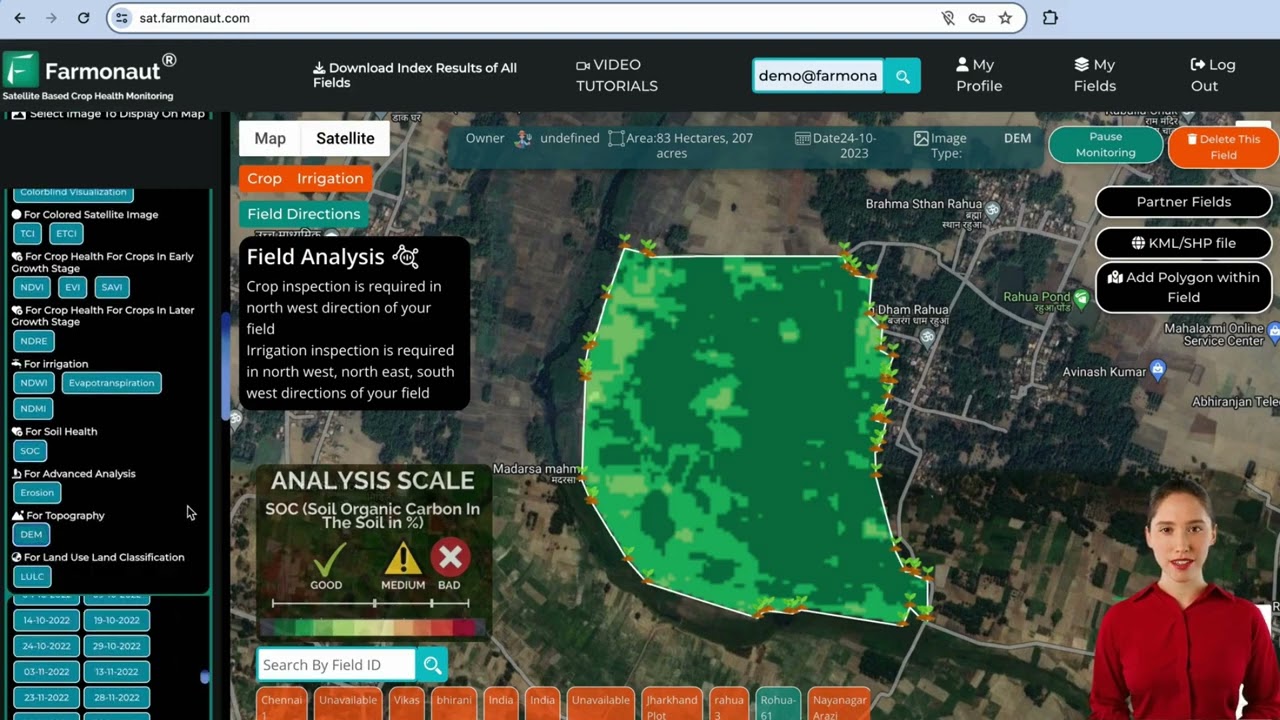
▶ A tutorial of the Farmonaut web app for satellite monitoring of your fields. · 8:02
Flax prices and returns per acre
Price turns yield into income. The USDA NASS Crop Values 2025 Summary gives the US average marketing-year price for flaxseed as US$12.10 per bushel in 2023, US$12.50 in 2024 and US$13.00 in 2025 (preliminary). These are season-average prices received by farmers, not daily cash bids.
Chart
US flaxseed price received by farmers
US$ per bushel, marketing-year average; 2025 preliminary
In Canada, the Agriculture and Agri-Food Canada outlook of 20 August 2026 estimates the 2025-26 average price for No. 1 flax in-store Saskatoon at C$625 per tonne and forecasts C$630 per tonne for 2026-27, 14% below the five-year average. C$630 per tonne is about C$16 per bushel.
At 22 bushels per acre and US$13.00 per bushel, gross revenue is about US$286 per acre. Whether that is a profit depends on your costs for seed, fertilizer, crop protection, machinery, land and insurance. Use the calculator below with your own numbers. The example values sit close to break-even on purpose; they are not a forecast.
Try the numbers for your own farm below.
Calculator
Flax return per acre calculator
Enter your own yield, price, seed and other costs.
- Gross revenue per acre (US$): $286
- Seed cost per acre (US$): $32
- Break-even yield: 21.7 bu/acre
- Your yield in metric units: 1,381 kg/ha
Example values only, set near break-even; they are not a forecast or a benchmark. Price is an example, use today’s price from your buyer. ‘Other costs’ should include fertilizer, crop protection, machinery or custom work, land, insurance and interest. 1 bushel of flax = 56 lb = 25.4 kg.
Using satellite maps on flax fields
Flax fields often vary. Low spots stay wet, hilltops dry out first, and weed patches thin the stand. Satellite vegetation maps, taken every few days, show those differences across the whole field without walking every acre.
Practical uses on a flax field:
- Check emergence. Thin or patchy areas show up as low vegetation index values a few weeks after seeding.
- Direct scouting. Walk the weak zones first to look for weeds, insects or crusting.
- Watch for stress at flowering. A drop in plant vigor during bloom can point to drought, heat or disease.
- Plan harvest. Fields and zones that brown first can be cut first.
The Farmonaut Satellite + AI Farm Monitoring System shows vegetation and moisture maps for each field you draw, on web, Android and iOS. It does not replace scouting, but it tells you where to look.
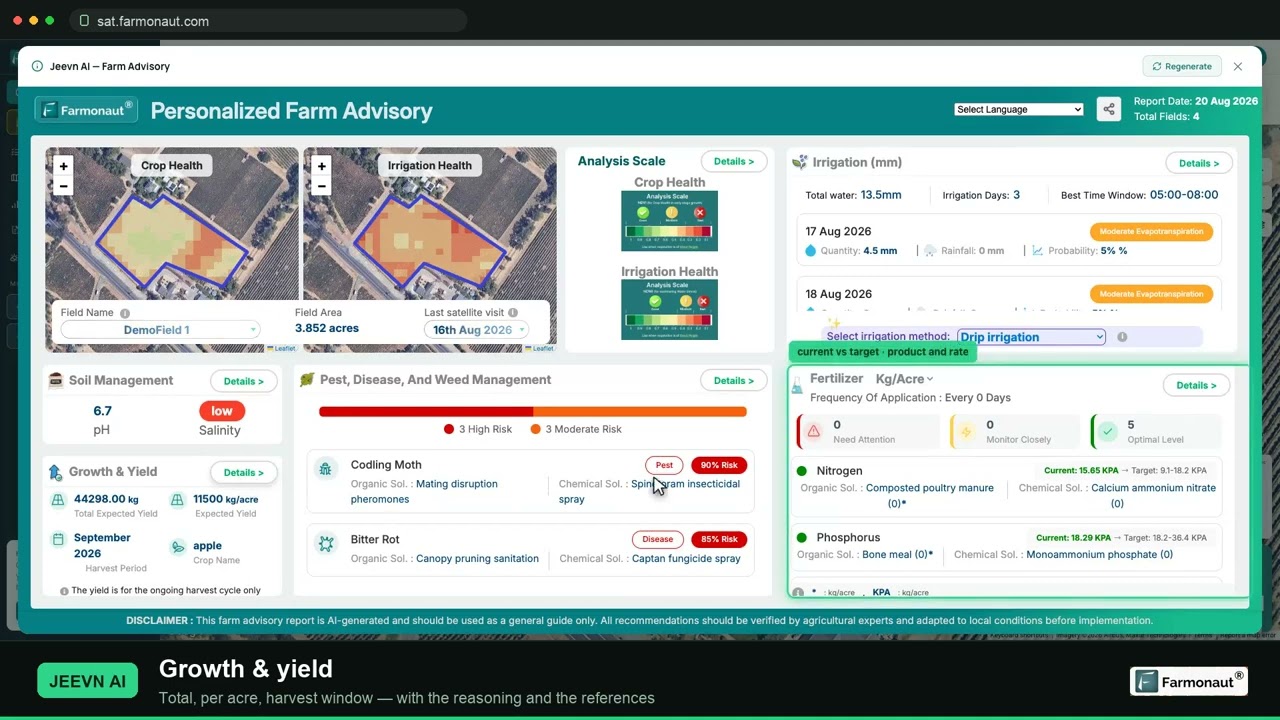
▶ How satellite crop maps reveal crop stress about two weeks before it shows in the field. · 19:36
Regenerative and sustainable flax practices
Flax fits well into diverse rotations. NDSU describes it as a low-input crop with good returns on investment and a useful rotation crop. Practices that support soil health on flax farms include:
- Diverse rotation. Grow flax after a cereal or a pulse, never after flax. Rotation breaks pasmo and seedling disease cycles.
- No-till or reduced tillage. Flax establishes well in standing residue if seed depth is right.
- Right-sized nitrogen. Credit legumes and soil nitrate, as in the NDSU formula, to avoid excess fertilizer.
- Threshold-based spraying. Spray insects only when counts pass the economic threshold.
- Straw management. NDSU no longer recommends burning flax residue. Chop and spread straw evenly at harvest instead.
NDSU adds one caution for mixed farms: green flax straw can carry a prussic acid risk if fed to livestock, especially right after a frost.

▶ Seven easy sustainable farming wins, from rotation to soil cover. · 4:34
Seed flax vs fiber flax
The two crops are managed very differently. Seed flax is combined for its seed, which is crushed for linseed oil and meal or sold whole and milled for food and feed. NDSU notes that flax seed is valued for dietary fiber, omega-3 oils and lignans.
Fiber flax is pulled, not cut, so the full stem length is kept. The plants are then left in the field to ret before the fiber is separated. Western Europe dominates this crop: France grew about 75% of the world’s raw or retted flax in 2022, according to FAOSTAT data summarised in Wikipedia’s flax article. In the UK, the linseed area is now so small that the Agriculture in the United Kingdom 2025 crops chapter no longer reports it separately.
Where flax is grown in North America
The USDA NASS Acreage report of June 2026 put US flax plantings at 305,000 acres for 2026, 23% more than in 2025. North Dakota, the largest flaxseed-producing state, planned 185,000 acres, up 9%. Montana planned 120,000 acres, up 54%.
Chart
US flax planted area by state
Thousand acres planted, 2025 and 2026
In Canada, Agriculture and Agri-Food Canada puts 2026-27 seeded area at 263,000 hectares, with Saskatchewan at 82% of the crop, Alberta 13% and Manitoba 4%. The Saskatchewan Crops Profile adds that Canada’s flax exports in 2024 were worth US$154 million, and the United States bought about 70% of them.
NDSU’s flax crop page links to the latest variety trial results and production guides for growers in the region.
FAQ
What is a good flax yield per acre?
The US average was 22.2 bushels per acre in 2025 (USDA NASS). Saskatchewan averaged 27.8 bushels per acre in 2025, against a five-year average of 19.0.
How much flax seed do I need per acre?
NDSU says 25 to 45 lb per acre is common: 25 to 35 lb in drier areas and 35 to 45 lb in wetter areas. Use the upper end for yellow-seeded varieties or untreated seed.
When should flax be planted?
As early in spring as the field can be worked. NDSU says early-seeded flax generally gives the highest yields, and emerging seedlings can stand 28°F for a few hours.
How many kilograms per hectare is a bushel per acre of flax?
One bushel of flax is 56 lb, or 25.4 kg. One bushel per acre equals about 62.8 kg per hectare, so 22 bushels per acre is about 1,380 kg/ha.
How long does flax take from sowing to harvest?
About 95 to 105 days in most years: roughly 50 days of leafy growth, 20 to 25 days of flowering and 25 to 30 days to mature (NDSU). Wet autumns can stretch this until frost.
Does flax need much fertilizer?
No. NDSU caps total nitrogen at 80 lb N per acre in tilled fields and 50 lb in long-term no-till, and found no yield response to phosphorus. Check local rules and get professional advice for your field.
Related pages on our site: soil conservation tips, yield mapping.
Farmonaut crop monitoring
See your flax fields from space
Draw your fields once and Farmonaut shows satellite vegetation and moisture maps for them through the season, on web, Android or iOS.




Sources
- USDA NASS, Crop Production (October 2026): release.nass.usda.gov
- USDA NASS, Crop Values 2025 Summary (February 2026): release.nass.usda.gov
- USDA NASS, Acreage (June 2026): release.nass.usda.gov
- Government of Saskatchewan, Saskatchewan Crops Profile 2025: publications.saskatchewan.ca
- Agriculture and Agri-Food Canada, Canada: Outlook for Principal Field Crops (20 August 2026): agriculture.canada.ca
- NDSU Extension, A1038 Flax Production for Oil and Seed in North Dakota: ndsu.edu
- NDSU Agriculture, Flax crop production page: ndsu.edu
- NDSU, 2024 North Dakota Custom Rates, Part II Late Season Operations (December 2024): ndsu.edu
- Flax Council of Canada, Growing Flax grower manual: flaxcouncil.ca
- GOV.UK, Agriculture in the United Kingdom 2025, Chapter 7: Crops: gov.uk
- Wikipedia, Flax (production data from FAOSTAT): en.wikipedia.org
Discussion
Questions, corrections or field experience? Share them below. First-time comments are reviewed before they appear, and your email is never published.
No comments yet. Be the first to add a question or your experience.

 Tucor
 Saraswati Agro
 Geno
 Hayleys Agriculture
 Linx Agritech
 Adinet
 Save Your Soils
 Grandstream Algérie
 XOS Realty
 Geospatial Lab Africa
 Agro La Gándara
 HIPSAC
 ZOL Zimbabwe
 Juligerm
 MISE Maroc
 NWNS

 Licence holder · Niger · Gold
 Client · Somalia · Gold
 Client & affiliate partner · Ghana · Gold










