

Tillage · Equipment cost guide
Tandem Disc Harrow: Cost per Acre, Setup and Offset Guide
Tandem disking averaged $17.40 an acre in the 2024 Iowa custom rate survey and $24.22 in Texas in 2026. Owning and running a 33 ft disc came to $18.30 an acre in University of Illinois estimates. Sizes, settings, residue left and how it compares with an offset disc.
Key takeaways
- Custom tandem disking averaged $17.40 an acre in Iowa (2024 survey), $18.00 in Mississippi (2024) and $24.22 in Texas (2026 survey).
- The University of Illinois put the cost to own and run a 33 ft 7 in tandem disk at $18.30 an acre, with about 0.5 gallon of diesel an acre (August 2025).
- Cost per acre barely changes with width: from $18.30 to $20.40 across six sizes from 23 to 45 ft; wider units save time, not money.
- A primary tandem pass leaves 30 to 60% of corn residue and 20 to 40% of soybean residue (University of Missouri Extension).
- An offset disc bites deeper in heavy residue; Iowa custom rates were $20.35 for heavy or offset disking against $17.40 for tandem.
In this article
- Tandem disc harrow at a glance
- What a tandem disc harrow does
- Tandem vs offset disc vs pull-type
- Cost per acre: custom rates and owning
- Sizes, horsepower and list prices
- Blade design, gang angle and spacing
- How much residue a tandem disc leaves
- Precision farming and the tandem disc
- Calculator: own a tandem disc or hire one?
- When to disc and when to skip it
- Buying checklist
- FAQ
A tandem disc harrow is a tillage tool with four gangs of concave discs set in an X: the front gangs throw soil out and the rear gangs throw it back, so one pass cuts residue, breaks clods and levels the seedbed. Hiring one costs about $17 to $24 an acre in recent US custom rate surveys: the 2024 Iowa Farm Custom Rate Survey put tandem disking at an average of $17.40 an acre, and the 2026 Texas survey at $24.22. Owning a 33-foot unit costs about $18.30 an acre in the University of Illinois machinery cost estimates of August 2025.
This guide compares the tandem with offset and pull-type discs, shows what each size costs and how much residue a pass leaves, and gives you a calculator to test whether owning or hiring is cheaper on your acres.
Tandem disc harrow at a glance
The table sums up the main facts. Each point has its own section below with the source behind it.
| Question | Short answer | Source |
|---|---|---|
| What it does | Cuts and mixes residue, breaks clods, firms and levels a seedbed | NC State Extension |
| Custom rate per acre | $17.40 (Iowa, 2024 survey), $18.00 (Mississippi, 2024), $24.22 (Texas, 2026) | State extension surveys |
| Cost to own and run | $18.30 an acre for a 33 ft 7 in disc behind a 240 hp tractor | University of Illinois, August 2025 |
| Fuel | About 0.5 gallon of diesel an acre | University of Illinois, August 2025 |
| Typical field speed | 6 mph (range 4 to 7 mph), 80% field efficiency | Mississippi State University, from ASABE data |
| Corn residue left | 30 to 60% after a primary pass with blades spaced over 9 inches | University of Missouri Extension |
What a tandem disc harrow does
A tandem disc has two pairs of gangs. The front pair is angled so the discs throw soil outward. The rear pair is angled the other way and throws it back toward the centre. Because the two rows pull against each other, the frame runs straight behind the tractor and the field is left fairly level.
Farmers use it for three main jobs. The first is cutting and mixing crop residue after harvest, for example corn stalks or wheat stubble. The second is primary tillage on light soils or after a chisel plow, where the disc breaks large clods. The third is a finishing pass before planting, when a shallow disc firms the top layer and kills small weeds. NC State Extension’s guide to disk tillage covers the soil side of these jobs in more detail.
A disc is not the best tool for every field. Repeated disking at the same depth can form a dense layer just below the blades, often called a disk pan. Disking also buries residue, which leaves the soil surface more exposed to wind and rain. Both points are reasons to set depth with care and to skip passes the crop does not need.
Tandem vs offset disc vs pull-type
Buyers who search for a “tandem harrow” often compare it with an offset disc. The difference is in the layout of the gangs, not in how a single blade works.
| Type | Gang layout | Best fit | Hitch | Trade-off |
|---|---|---|---|---|
| Tandem disc harrow | Four gangs in an X, front and rear opposed | Open fields, residue mixing, seedbed finishing | Three-point hitch (small units) or drawbar | Lighter cutting than an offset of the same size |
| Offset disc | Two gangs in a V, set to one side of the tractor | Heavy residue, primary tillage, orchards and terraces | Mostly drawbar | More weight per blade, so more draft and fuel |
| Pull-type disc | Tandem or offset gangs on a wheeled frame | Wide fields and large tractors | Drawbar, transport wheels | Longer to turn and transport |
An offset disc puts more weight on each blade, so it bites deeper into hard ground and heavy residue. That is why custom rate surveys often list it as a separate job. In the Iowa survey, heavy or offset disking averaged $20.35 an acre against $17.40 for tandem disking. In the Texas 2026 survey the statewide averages were close: $24.62 for an offset disc and $24.22 for a tandem disc.
The offset layout also lets the tractor run beside the worked strip. That is useful under tree rows and along terraces, where a centred tandem would hit branches or banks.
Cost per acre: custom rates and owning
There are two ways to put a price on a tandem disc pass. A custom rate is what a contractor charges, with tractor, fuel and operator included. An ownership estimate adds up depreciation, interest, insurance, housing, repairs, fuel and labour for your own machine.
The 2024 Iowa Farm Custom Rate Survey reported an average of $17.40 an acre for tandem disking, with responses from $10.00 to $27.50. Mississippi State University’s survey of producers in spring and summer 2024 gave an average of $18.00 an acre for tandem disking, from $15 to $20. The 2026 Texas Agricultural Custom Rates survey reported a statewide average of $24.22 an acre from 78 responses, with a most common rate of $25.00.
The University of Illinois machinery cost estimates of August 2025 work out what it costs to own and run a disc instead. For a 33 ft 7 in tandem disk pulled by a 240 hp tractor, the total is $18.30 an acre. That splits into $6.60 for tractor overhead and $8.80 for disc overhead (depreciation, interest, insurance, housing and repairs), $1.70 for fuel and lube and $1.20 for labour. The estimate assumes diesel at $3.00 a gallon and labour at $22.00 an hour.
These are survey averages and cost models, not quotes. Rates move with fuel prices, field size and how busy contractors are, so ask two or three local operators before you decide.
Chart
Tandem disking: cost per acre
US$ per acre; custom rates include tractor, fuel and operator; Illinois figure is an ownership cost model
Sizes, horsepower and list prices
Tandem discs range from small mounted units for compact tractors up to folding frames over 40 ft wide. The Illinois estimates list six sizes, each matched with a tractor. List prices here are manufacturer list prices used in the model, not dealer transaction prices.
Chart
Tandem disk list price by width
Manufacturer list price used in the cost model, US$ thousand
| Disc width | Tractor hp | List price (US$) | Acres per hour | Total cost per acre (US$) |
|---|---|---|---|---|
| 23 ft 7 in | 175 | 88,889 | 14.2 | 19.80 |
| 26 ft 5 in | 205 | 98,323 | 15.9 | 20.40 |
| 29 ft 3 in | 225 | 105,570 | 17.7 | 19.40 |
| 33 ft 7 in | 240 | 120,128 | 20.3 | 18.30 |
| 40 ft 8 in | 285 | 158,481 | 24.5 | 19.50 |
| 44 ft 11 in | 310 | 194,534 | 27.2 | 20.00 |
The cost per acre barely changes with size. A wider disc covers more ground each hour, but it needs a bigger tractor and costs more to buy, so the two effects cancel out. What a wider unit buys you is time: the 44 ft disc covers almost twice as many acres an hour as the 23 ft one, which matters when the planting window is short.
Field speed sets how much a disc covers. Mississippi State University’s machinery cost guide, based on ASABE standards, gives a typical speed of 6 mph for a tandem disk harrow, with a range of 4 to 7 mph, and a typical field efficiency of 80%. A heavy-duty disk runs slower, at a typical 4.5 mph. Field capacity in acres per hour is speed times width times efficiency, divided by 8.25.
For used units, see our separate guide to disc harrows for sale, which lists current models.
Chart
Typical field speed by tillage tool
Miles per hour, typical values
Blade design, gang angle and spacing
Notched and smooth blades
Notched blades, also called cutout blades, have scallops around the edge. They grip and slice heavy residue and push into hard ground more easily. Smooth blades last longer in sandy or stony soil because there is less edge to wear. Many tandem discs use notched blades on the front gangs to cut residue and smooth blades on the rear to level and finish.
Gang angle
Gang angle is the main setting an operator can change. A steeper angle moves more soil, cuts deeper and buries more residue, but it needs more pull from the tractor. A flatter angle leaves more residue on top and burns less fuel. Change the angle to suit soil moisture and the residue load rather than leaving it at one setting all season.
Blade spacing and depth
Wider spacing between blades, about 9 inches or more, lets larger blades work deeper and is used for primary tillage. Spacing of 7 to 9 inches suits shallow finishing work. Depth is set with the frame wheels on pull-type units and with the hitch on mounted units. Run the front and rear gangs at the same depth, or the frame will pull to one side.
Scraper kits and furrow fillers
Scrapers sit against each blade and strip off sticky soil, so the blades keep their full size in wet clay. Furrow fillers trail the rear gang and fill the small ridge left in the centre, giving a level finish in one pass. Rolling baskets or harrow sections behind the disc do the same job on many newer frames.
How much residue a tandem disc leaves
Residue cover protects the soil from erosion. The University of Missouri Extension guide G1650 lists how much residue different tools leave behind, for corn (non-fragile) and soybean (fragile) residue. A tandem disc used for primary tillage with blades over 9 inches apart leaves 30 to 60% of corn residue. A finishing tandem with 7 to 9 inch spacing leaves 40 to 70%. A light tandem pass right after harvest, before other tillage, leaves 70 to 80%. For comparison, a moldboard plow leaves 0 to 10%.
Chart
Corn residue left after one pass
Percent of non-fragile (corn) residue remaining, range by tool
Soybean residue is more fragile, so less of it is left after each pass: 20 to 40% after a primary tandem pass and 40 to 50% after a light pass after harvest. If you farm under a conservation plan that needs 30% cover at planting, two disc passes in soybean stubble can take you below that line.
USDA’s Economic Research Service reports that the share of wheat, corn, soybean and cotton acres in some form of conservation tillage, meaning no-till and reduced till combined, has increased over the past two decades. A tandem disc still has a place in those systems as a light, shallow pass, but each pass has a residue cost to weigh against the benefit.

▶ Why soil carbon matters, and how tillage and residue choices affect it. · 12:15
Precision farming and the tandem disc
A disc is a mechanical tool, but the tractor pulling it often is not. USDA’s Economic Research Service reports that auto-steer guidance systems were used on only 5.3 percent of planted corn acres in 2001 and on 58 percent in 2016. The same report notes that guidance is now used on well over 50 percent of the acreage planted to the main row crops. Guidance cuts overlap between passes, so the disc covers each strip once.
Satellite data now reaches tillage too. A farmdoc daily article from October 2026 describes a method to detect tillage practices from space across the US Midwest. For no-till, its estimates explained 84% of the variation in county-level percentages for corn and soybean when checked against reference data. Reduced tillage was harder to tell apart from the other classes.
For a single farm, satellite maps help most before a pass. Wet patches, bare soil and crop cover show up on the map, so you can leave the disc parked on fields that are too wet and avoid smearing clay. The Farmonaut Satellite + AI Farm Monitoring System shows these field maps on web and phone, and developers can pull the same data through the satellite API and its API developer docs.
For the wider picture, our pages on precision farming technology and modern farming machines explain where tillage tools fit among other equipment. Our page on self-driving tractors looks at where hitching and field passes may be headed.
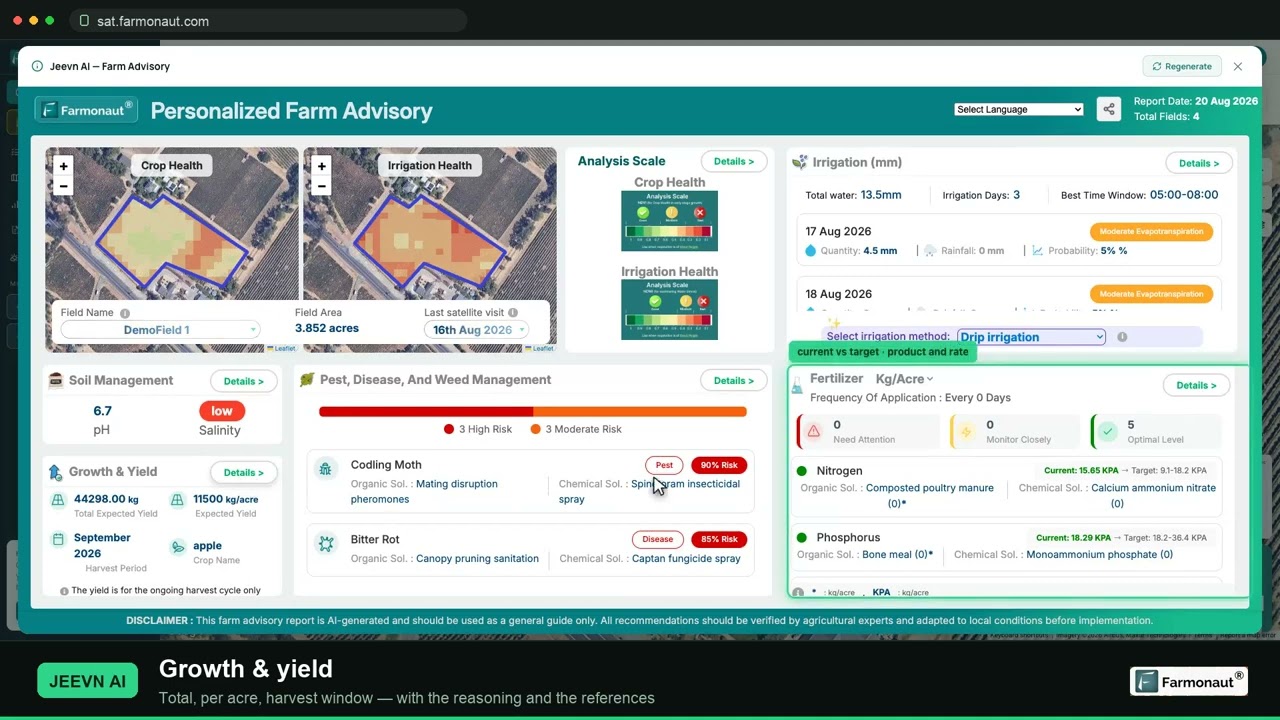
▶ A full walkthrough of satellite crop monitoring: reading NDVI maps and field reports. · 19:36
Calculator: own a tandem disc or hire one?
This calculator compares the cost per acre of owning a tandem disc with a custom rate. It spreads depreciation and interest over the acres you disc each year, then adds tractor, labour, repair and fuel costs per acre. The example values sit close to break-even on purpose. Replace them with your own numbers and today’s prices.
Try the numbers for your own farm below.
Calculator
Owning vs hiring a tandem disc
Enter your own acres, prices and rates.
- Ownership cost per year: $13,080 US$
- Your cost per acre to own and run: $17.74 US$/acre
- Fuel cost per acre: $1.70 US$/acre
- Break-even acres per year: 1,924 acres
Example values only, set close to break-even; they are not a benchmark or a quote. Ownership cost per year = depreciation (price minus salvage, spread over the years kept) plus interest on the average investment. Fuel use is fixed at 0.5 gallon an acre, the University of Illinois estimate for a 33 ft 7 in tandem disk (August 2025). The tractor, labour and repairs field should include your tractor’s share of costs; Illinois put tractor costs at $6.60 and labour at $1.20 an acre for that size. Insurance and housing are left out. Get advice from your lender or farm adviser before buying.
When to disc and when to skip it
Timing matters as much as settings. Disc soil that is too wet and the blades smear it, which leaves a compacted layer and cloddy seedbed. Disc soil that is too dry and the pass turns it to dust that blows or crusts after rain. A simple check is to squeeze a handful from the working depth: if it forms a ribbon, wait.
Skip passes the crop does not need. Each pass costs money, burns fuel and lowers residue cover. On many farms one pass in fall to size residue, plus one finishing pass in spring, is enough. Fields with a weed problem may need more, but the disc should not be the only tool for weed control.
Keep records. Note the date, depth, gang angle and fuel used for each field, and compare yields across fields where you disc and fields where you do not. Your own data will tell you more than any national average, because the answer depends on your soil, rotation and rainfall. For more on new methods, see our page on new farming techniques, and for soil health, our page on farming techniques for crop yield and soil health.
▶ How satellite maps show crop stress across a large farm before you can see it. · 4:09
Buying checklist
- Match the tractor. The Illinois estimates pair a 23 ft disc with a 175 hp tractor and a 44 ft disc with a 310 hp tractor. A disc too big for the tractor slows field speed and raises fuel use.
- Check the bearings. Sealed or greaseless bearings cut daily upkeep. On used units, spin each gang and listen for rough bearings.
- Measure the blades. Worn blades lose diameter and cut shallower. Compare the blade size with the maker’s new size.
- Look at the frame. Check for cracks around the hitch, wing hinges and gang mounts.
- Ask about parts. Blades, scrapers and bearings wear out. Make sure a local dealer stocks them.
- Read the manual. Follow the maker’s settings for depth, angle and transport, and check local road rules for moving wide folding frames.
The Census of Agriculture from USDA NASS reports tillage practices by state every five years, which helps you see how farms near you prepare their fields.
To see your own fields from space, the Farmonaut web and mobile apps show vegetation and soil moisture maps for each field you draw.
FAQ
What is a tandem disc harrow used for?
It cuts and mixes crop residue, breaks clods after primary tillage and firms and levels the seedbed before planting. Light passes after harvest size residue so it breaks down faster.
What is the difference between a tandem disc and an offset disc?
A tandem has four gangs in an X, centred behind the tractor. An offset has two gangs in a V, set to one side. The offset puts more weight on each blade, so it cuts deeper in heavy residue and hard ground, and it can work under tree rows.
How much does tandem disking cost per acre?
Recent custom rate surveys put it at an average of $17.40 an acre in Iowa (2024 survey), $18.00 in Mississippi (2024) and $24.22 in Texas (2026). The University of Illinois estimated $18.30 an acre to own and run a 33 ft disc in August 2025.
How much horsepower does a tandem disc need?
The University of Illinois cost estimates pair a 23 ft 7 in disc with a 175 hp tractor and a 33 ft 7 in disc with 240 hp. Soil type, depth and gang angle change the pull needed, so check the maker’s guide.
How fast should you pull a tandem disc?
Mississippi State University, using ASABE data, gives a typical speed of 6 mph, with a range of 4 to 7 mph. Too fast and the disc can ridge the field. Too slow and it may not mix residue well.
Does a tandem disc bury all crop residue?
No. University of Missouri Extension figures show a primary tandem pass leaves 30 to 60% of corn residue and 20 to 40% of soybean residue on the surface. A light pass after harvest leaves more.
Farmonaut field monitoring
Check field conditions before you disc
Draw your fields once and Farmonaut shows satellite vegetation and soil moisture maps for them through the season, on web, Android or iOS.




Sources
- Iowa State University Extension, 2024 Iowa Farm Custom Rate Survey (Ag Decision Maker A3-10): crops.extension.iastate.edu
- Texas A&M AgriLife Extension, 2026 Texas Agricultural Custom Rates survey: agecoext.tamu.edu
- Mississippi State University Extension, Custom Rates for Mississippi Agricultural Practices (2024 survey): extension.msstate.edu
- University of Illinois, Machinery Cost Estimates: Field Operations (August 2025): farmdoc.illinois.edu
- University of Illinois, Machinery Cost Estimates: Summary (2025): farmdoc.illinois.edu
- Mississippi State University Extension, Farm Machinery Cost Calculations, Publication 3543 (2020): extension.msstate.edu
- University of Missouri Extension, G1650 Conservation Tillage and Residue Management to Reduce Soil Erosion: mssoy.org
- USDA Economic Research Service, Soil Tillage and Crop Rotation: ers.usda.gov
- USDA Economic Research Service, Precision Agriculture in the Digital Era: Recent Adoption on U.S. Farms (EIB-248, 2023): ers.usda.gov
- farmdoc daily, Detecting Tillage Practices from Space (October 2026): farmdocdaily.illinois.edu
- NC State Extension, Disk Tillage: soilmanagement.ces.ncsu.edu
- USDA NASS, Census of Agriculture: nass.usda.gov
Discussion
Questions, corrections or field experience? Share them below. First-time comments are reviewed before they appear, and your email is never published.
No comments yet. Be the first to add a question or your experience.

 Inclusive Growth Chain
 AdBio
 MISE Maroc
 Drift-Sense
 NWNS
 Red August Group
 Farm Inc
 WeMe Global
 Agrotoken
 Blue BearX
 Insignito
 Croptimum
 DnCubed
 Field Capacity
 Indosistim Teknologi
 Liquify Digital
 CU Foods
 BeyondTech Global

 Licence holder · Niger · Gold
 Licence holder · Nigeria · Gold + lithium
 Client · Somalia · Gold










