

UK Vertical Farming AI: 7 Tech Breakthroughs 2025
“By 2025, UK vertical farms using AI are projected to increase crop yields by up to 30% compared to traditional methods.”
Summary: Vertical Farming and AI — Revolutionizing Agriculture for the Future
Vertical farming ai is rapidly reshaping how we grow food in 2025 — especially across UK regions facing land availability and climate challenges. By leveraging AI, controlled environments, and precision technologies, vertical farming tech enables us to maximize yields, minimize environmental impact, and generate sustainable solutions for future food security. This is a new era for UK agriculture, empowered by data-driven systems and continuous advancements in AI-powered farming.



The Rise of Vertical Farming Technology in the UK
UK vertical farming is rooted in the innovations of controlled environment agriculture (CEA). In major urban centers like London, Manchester, and Birmingham, the emergence of highly automated, indoor farms is drastically changing how fresh produce is grown and distributed.
What Is Vertical Farming?
Vertical farming is an innovative approach to growing crops in vertically stacked layers or controlled environments using advanced agricultural technologies. Instead of relying on arable land and traditional field farming, it employs hydroponics, aeroponics, and aquaponics systems, allowing plants to grow without soil and independent of weather fluctuations.
- Hydroponics: Crops are grown with roots submerged in a water-based, nutrient-rich solution.
- Aeroponics: Plant roots are suspended in air and misted with nutrients.
- Aquaponics: Combines fish farming and hydroponics, using fish waste to feed plants.
These systems are optimized to provide light, temperature, humidity, and CO₂ conditions that maximize plant growth and yields year-round. The benefits include:
- Drastically reduced land footprint (vital for space-constrained urban and UK environments)
- Up to 95% less water consumption compared to conventional farming
- Major reductions in transport emissions, as crops are grown closer to consumers
Why Is Vertical Farming Tech Important for the UK?
The UK is characterized by:
- Limited arable land due to population density and urbanization
- Unpredictable weather and climate uncertainties that threaten crop reliability
- Increasing demand for fresh, pesticide-free produce
- Concerns over food imports and a push for food security
These challenges make UK vertical farming — especially when enhanced by AI — a cornerstone of the region’s sustainable agriculture future.
The Role of AI in Vertical Farming
The integration of artificial intelligence has been the decisive factor in propelling vertical farming tech to new heights in 2025. AI makes vertical farming systems far more intelligent, responsive, and productive — enabling hyper-efficient resource usage and real-time adaptation to the needs of each individual plant.
How Does AI Transform Vertical Farming?
- Continuous Data Monitoring: Sensors collect vast data on light intensity, temperature, CO₂ levels, humidity, nutrient composition, and plant health, all fed into AI algorithms.
- Real-Time Environmental Adjustments: AI-driven systems can instantly adjust lighting, temperature, water cycles, and nutrient delivery, optimizing for maximum growth and yield.
- Predictive Analytics: AI interprets data trends for early detection of pests, plant disease, or nutrient deficiencies, allowing for preventions before escalation.
- Automated Crop Management: Robotics and AI handle planting, pruning, and harvesting, massively reducing labour costs and human error.
- Supply Chain Optimization: AI forecasts market trends and demands, helping plan harvesting and reduce waste.

The outcome is clear: vertical farming with AI promises higher yields, lower input costs, drastically reduced water and energy consumption, and vastly improved sustainability across all urban and local UK farms.
“Seven new AI-driven technologies are set to automate over 60% of vertical farming operations in the UK by 2025.”
UK Vertical Farming AI: 7 Tech Breakthroughs in 2025
Let’s explore the seven most significant artificial intelligence breakthroughs shaping vertical farming ai in the UK for 2025 and beyond.
-
AI-Powered Environmental Control Systems
At the heart of vertical farming with AI is the ability to monitor and adjust every parameter in real time — including light, temperature, humidity, and CO₂ levels. UK farms leverage sensors and AI algorithms to maintain conditions perfectly optimized for every type of crop, regardless of external weather uncertainties.
- Benefit: Unlocks consistent, high-quality production regardless of climate
- Sustainability: Enables precision use of resources, reducing waste and resource consumption
-
AI-Driven LED Lighting Optimization
Advanced LED lighting — automatically calibrated by AI — tailors spectra and intensity to match each plant’s photosynthetic stage. This means plants receive only the exact light they need for rapid, healthy growth, drastically reducing electricity usage.
- Benefit: Promotes sustainable energy consumption
- Yield: Enhances photosynthesis and speeds up harvesting cycles
-
Automated Plant Health Monitoring & Disease Prediction
Machine vision AI continuously assesses plant health, identifying subtle signs of stress, nutrient deficiencies, or pathogens far earlier than the human eye. This lets vertical farms act early and sustain year-round yields.
- Benefit: Drastically reduces crop losses through real-time intervention
- Advancement: Enables data-driven decisions, optimizing nutrient delivery
-
AI-Optimized Nutrient Delivery Systems
Vertical farming AI brings hyper-precise nutrient delivery, automatically producing and supplying the ideal mix for each crop’s unique needs. Adjustments are made instantly based on plant stage and environmental feedback.
- Benefit: Reduces fertilizer use and runoff — making food production cleaner and more sustainable
- Impact: Promotes efficient growth and maximum yield per layer
-
AI & Robotics for Automated Planting, Pruning, and Harvesting
Tasks like planting, pruning, and harvesting crops are increasingly performed by intelligent robots guided by machine learning and real-time environmental feedback. For UK vertical farms, this marks a leap in scaling production while reducing labor dependency and human error.
- Benefit: Automates over 60% of farming operations (by 2025 projection), increasing consistency and profitability.
- Innovation: Frees human resources for higher-level system oversight and strategy.
-
Predictive AI Market & Supply Chain Analytics
The use of predictive analytics, leveraging historic and real-time data, helps vertical farms align production with local demands, minimize waste, and optimize logistics. AI forecasts market prices, buyer preferences, and even climate impacts on demand.
- Benefit: Significantly reduces over-production and waste
- Sustainability: Strengthens food security and supports hyper-local, sustainable agriculture
-
AI-Enhanced Vertical Rice Farming
Vertical rice farming in the UK is an emerging frontier, allowing water-intensive crops like rice to be grown using AI-driven water recirculation and environmental controls. AI manages flood/dry cycles and nutrient dosing, drastically lowering water consumption and emissions.
- Benefit: Significant environmental impact, particularly in reducing methane emissions and water waste
- Status: Still in trial stages, but innovation is ramping up through 2025

Comparison Table: UK Vertical Farming AI Breakthroughs 2025
| Breakthrough Overview | Key AI Feature | Estimated Yield Improvement (%) | Sustainability Impact (Estimated CO₂ Reduction %) | Implementation Status (2025 Estimate) |
|---|---|---|---|---|
| AI Environmental Control | Real-time sensor monitoring & parameter adjustment | +22% | Up to 35% | Widespread |
| AI-Driven LED Lighting | Plant-specific spectrum/intensity optimization | +18% | Up to 28% | Widespread |
| Plant Health AI | Machine vision disease/stress detection | +12% | Up to 20% | Growing/Standard across top UK farms |
| Automated Nutrient Delivery | Dynamic, tailored dosing using AI | +20% | Up to 30% | Widespread |
| Robotics Automation | AI-guided planting, pruning, harvesting | +10%-17% | 12-20% | Scaling rapidly in 2025 |
| Predictive Analytics for Market & Supply Chain | Demand/supply forecasting, waste reduction | +8%-12% | Up to 18% | Common in advanced facilities |
| AI-Enhanced Vertical Rice Farming | AI-driven water, CO₂ & nutrient management | Up to +25% | Over 40% (greenhouse gas & water use reduction) | Emerging/Experimental in UK |
Vertical Farming in the UK Context: Local Innovations & Impact
UK vertical farming is advancing rapidly, with local and urban farms pushing the boundaries of what’s possible through the integration of artificial intelligence and smart farming solutions. The unique circumstances in the UK—urbanization, constrained land supply, and demand for fresh, local produce—have catalyzed the adoption of vertical farming ai as a mainstream solution.
- London: Large-scale vertical farms supply high-end retailers and restaurants with fresh herbs, leafy greens, and specialty crops—significantly reducing carbon footprint tied to imported produce.
- Manchester: Urban vertical farms utilize AI-based crop management systems to maximize harvests within city limits, fostering sustainability and food resilience.
- Nationwide: Government support and private investment are boosting R&D in next-generation controlled environments, plant science, and robotics—enabling a new era in UK agriculture focused on both yields and sustainability.
Check out this video for cutting-edge Manchester AI Gardening tips in 2025:

The integration of AI-driven systems into urban farms offers the UK agricultural sector a solution for:
- Consistent food production despite climate uncertainties
- Strengthened food security in times of supply chain disruption
- Energy and water savings crucial for sustainability targets
- Enhanced profitability for both new and established growers
Vertical Rice Farming: The Next UK Frontier
Vertical rice farming represents an extraordinary new chapter in the evolution of controlled-environment crop production. Traditionally, rice requires massive fields and high water usage, but vertical farming tech can upend this paradigm, even in regions like the UK.
- Controlled Environments: Rice grown vertically in stacked layers within greenhouses or retrofitted urban spaces, using hydroponics.
- AI Optimization: Artificial intelligence dynamically manages nutrient delivery, flood/dry cycles, and environmental controls, tailoring everything to the rice plant’s exact growth stage.
- Environmental Savings: Water usage drops by over 70% and methane emissions are minimized—addressing both resource scarcity and climate concerns associated with traditional rice production.
- Food Security: Year-round production allows for local rice cultivation even in unfavorable climates, potentially supporting food sovereignty for high-value local and specialty rice.
While vertical rice farming is still new in the UK, its feasibility is buoyed by powerful AI tools and improved controlled environment infrastructure, paving the way for further innovation and sustainability.

Farmonaut: Advancing AI-Driven Precision Agriculture
As we consider the UK’s vertical farming ai landscape, Farmonaut is committed to advancing the digital transformation of agriculture with affordable, accessible, and scalable solutions—from traditional open fields to the most sophisticated urban vertical farms.
- Satellite-Based Crop Health Monitoring: We provide real-time data on crop health, soil moisture, and environmental parameters, allowing growers to monitor diverse farms—even multiple vertical sites—from a single dashboard.
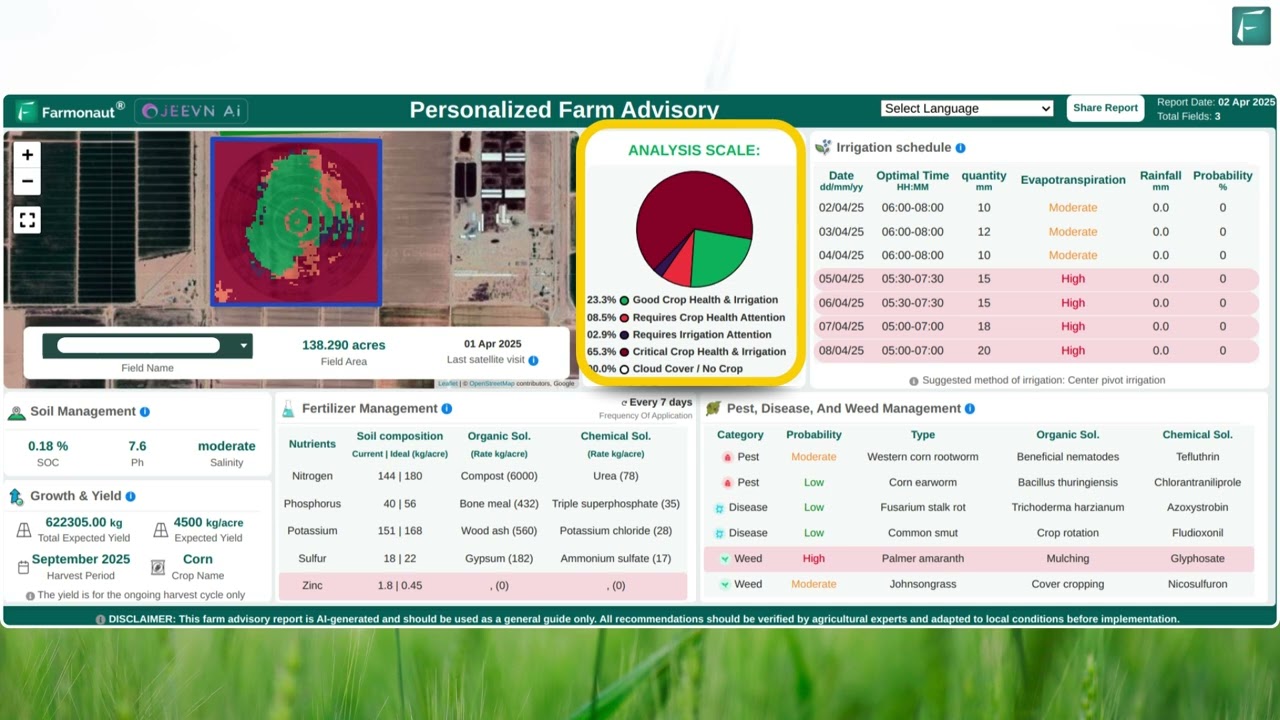
- AI-Driven Advisory Systems (Jeevn AI): Our intelligent farm advisory combines satellite and on-farm data to give smart, field-specific recommendations—improving crop yields while reducing resource wastage.
- Resource Management & Sustainability: Farmonaut’s platform empowers farms with carbon footprint tracking (see our detailed carbon footprinting), supporting compliance with UK environmental standards and helping users form strategies for sustainable farming.
- Blockchain-Based Traceability: Our traceability feature (see details) ensures full transparency from farm to fork—vital for building consumer trust in local and urban food supply chains.
- Fleet & Large-Scale Farm Management: Users can leverage advanced fleet management and automation tools to optimize logistics and crop care across dispersed vertical and traditional sites.
Access our API for plug-and-play integration of vertical farming ai insights into your own platforms or apps — see API. For developer resources, consult our API Developer Docs.
Frequently Asked Questions (FAQ)
What is vertical farming AI, and how does it work?
Vertical farming ai refers to the use of artificial intelligence to monitor and control all environmental, lighting, and nutrient parameters in vertical farms. It processes sensor data to optimize conditions for each crop, automate operations (planting, pruning, harvesting), and predict crop needs or market demand.
Why is vertical farming tech critical for the UK’s agriculture future?
The UK faces limited arable land, climate uncertainties, and urbanization. Vertical farming tech enables efficient crop production in smaller spaces, while AI maximizes productivity, sustainability, and local food security—addressing challenges unique to UK regions.
How does AI enhance sustainability in vertical farming?
AI-controlled systems optimize water and nutrient use, reduce electricity consumption through intelligent lighting, and decrease waste by matching production to real demand. AI-driven operations lower the carbon footprint and environmental degradation associated with conventional agriculture.
What crops are best suited to vertical farming with AI in the UK?
Leafy greens, herbs, microgreens, tomatoes, strawberries, and now even rice (experimental) thrive in UK vertical farms, thanks to the precision environment control and disease prevention made possible by AI.
Can small and independent UK farmers benefit from vertical farming AI?
Yes! Modern vertical farming tech solutions and Farmonaut’s affordable, scalable platform make AI-powered agriculture accessible to farms of any size—democratizing technology previously available only to industrial-scale growers.
Conclusion: The Future of Sustainable Farming in the UK — Powered by AI
By 2025, the confluence of vertical farming and artificial intelligence will have fundamentally altered the UK agricultural landscape. The adoption of vertical farming ai is addressing urgent challenges—reducing water usage, maximizing yields, and fostering sustainability for future generations. As the UK continues to innovate and refine these solutions, the potential for vertical rice farming and other AI-enhanced approaches will expand, ensuring a sustainable, productive, and resilient food system.
Embracing this revolution is not just about reimagining how we grow food, but about securing food security, combating climate impacts, and unlocking the next era of productivity for urban and rural communities alike.
For those seeking to optimize their own farming operations with AI-driven tools and insights, Farmonaut’s digital platform and advisory services offer actionable, affordable, and globally accessible solutions—helping everyone, from individual growers to large-scale agribusinesses, take part in the future of agriculture.
For more information or to get started with precision agriculture and vertical farming ai, explore our full suite of services and join the movement to revolutionize agriculture for the future.

 Nivia
Nivia Doodlakine
 Exurbia Geospatial
 FieldZero
 Indico Company
 Kubota
 FFBS
FFBS Jontra
 Kalustyan
 Tucor
Tucor Geno
Geno Hayleys Agriculture
 Linx Agritech
 Adinet
