

Citrus · Root guide
Lemon Tree Root System: Depth, Spread and Care
Citrus roots are generally in the upper 2 feet (60 cm) of soil and reach past the drip line (UC extension). Root zones run from 12 to 18 inches in bedded Florida groves to 36 inches or more on deep ridge sand, and roots have been found at 3.3 m on rough lemon rootstock. Charts, planting steps and a watering calculator.
Key takeaways
- UC extension: citrus roots are generally concentrated in the upper 2 feet (about 60 cm) of soil and extend well past the drip line.
- In Florida, bedded flatwoods groves root in the upper 12 to 18 inches, while ridge sands give root zones of 36 inches or more (UF/IFAS FAWN guide).
- In deep, well-drained Florida sand the main root system reached 0.6 to 0.9 m, and roots on rough lemon rootstock have been found at 3.3 m (reported in Engenharia Agricola, 2012).
- Plant in a hole twice as wide as the root ball and no deeper, and at least 12 feet (UC) to 15 feet (UF/IFAS) from the next tree.
- Lemons use about 20% more water than oranges, and trees in turf about 20% more again (University of Arizona, 2021).
In this article
- Lemon tree root system at a glance
- How deep do lemon tree roots go?
- Do lemon tree roots grow down or out?
- What changes how deep the roots grow
- Root health: rot, drainage and greening
- Planting a lemon tree: hole, spacing and timing
- Watering the root zone
- Water calculator for one lemon tree
- Feeding and mulching around the roots
- Corn seed depth in brief
- Where satellites help, and where they do not
- FAQ
- How we checked the numbers
The lemon tree root system is shallow and wide. University of California extension says citrus roots are generally concentrated in the upper 2 feet (about 60 cm) of soil and extend well past the drip line (UC Sacramento extension guide). In deep, well-drained Florida sand the main root system reached 0.6 to 0.9 m, and roots on rough lemon rootstock have been found at 3.3 m (reported in the background section of a 2012 Florida study in Engenharia Agricola, which cites earlier Florida work). This guide shows how depth changes with soil, rootstock and water, and gives a watering calculator.
Lemon tree root system at a glance
A lemon tree has two kinds of roots. Structural roots are the thick, woody roots that anchor the tree and carry water and nutrients. Fibrous roots, also called feeder roots, are the fine roots that take up water and nutrients from the soil (UF/IFAS Florida Citrus Production Guide, 2026-2029). The table sums up what each root type does and where gardeners and growers usually look for it.
| Root part | What it does | Where it sits | Source |
|---|---|---|---|
| Structural roots | Anchor the tree, move water and food | Spread out to the edge of the wetted zone or canopy, then down and out | UF/IFAS, 2026 |
| Fibrous roots | Take up water and nutrients | Grow in dense clusters where water and nutrients are most abundant; with microsprinkler irrigation, 80% sit in the top 10 inches of the wetted zone | UF/IFAS, 2026 |
| Taproot | Main downward root of a seedling | Not distinct in UF/IFAS excavations of nursery and 2-year-old field trees, even from seed | Citrus Industry, 2022 |
| Root system in deep, well-drained soil | Reaches 1.2 to 1.5 m, main roots 0.6 to 0.9 m | Deep, well-drained soil | Engenharia Agricola, 2012 |
| Whole root zone | Water and nutrient supply | Generally the upper 2 feet, past the drip line | UC Cooperative Extension |
How deep do lemon tree roots go?
A note on the data: these depth figures are for citrus in general (oranges, rootstocks and rough lemon), not lemon on its own roots. Lemon-only measurements are scarce.
Chart
Citrus root depth in four published settings
centimetres; each bar measures something different, see the labels
Depth is not one number. It depends on the soil, the water table, the rootstock and the age of the tree. The chart puts four published figures side by side. They measure different things, so read the labels.
In Florida flatwoods groves the shallow root system sits in the upper 12 to 18 inches of the bed. On deep, well-drained ridge sands, citrus root zones are typically 36 inches or more (UF/IFAS FAWN irrigation scheduler guide). The background section of a 2012 Florida paper, citing earlier work, says root systems in deep, well-drained soils are 1.2 to 1.5 m deep, with the main root system reaching only 0.6 to 0.9 m, and that most water extraction came from the top 0.6 m (Engenharia Agricola, 2012).
The deepest roots found were on rough lemon rootstock at 3.3 m and on sour orange at 2.7 m, in sandy Florida ridge soil. These are the deepest roots reported, found in well-drained sandy Florida ridge soil (Engenharia Agricola, 2012). A tree in a pot has only the pot to root in, and UF/IFAS notes that a high water table can keep roots to the top few inches.
Do lemon tree roots grow down or out?
Mostly out. A UF/IFAS researcher writes that most trees have a lateral root system, which usually lacks a deep taproot, extends much beyond the canopy dripline and stays in the upper soil. UF/IFAS excavations of young citrus trees found shallow, lateral roots (Citrus Industry, 2022, on UF/IFAS excavations). In those excavations, no tree had a distinct taproot, even when the rootstock came from seed. After two years in the field, the new roots a tree grew from its root stump made up most of the root system of the mature tree.
The spread past the canopy has a practical use. The University of Arizona advises a watering basin that reaches about one foot beyond the canopy, because the roots extend past it (University of Arizona Cooperative Extension, 2021). UC extension says to water mainly near the drip line once the tree is established. The one measured distance is for orange: in an 11-year-old Valencia orchard on Swingle rootstock in Florida, the largest share of roots lay in the top 0.3 m, out to 2 m from the trunk. No lemon-only distance is published in the sources used here, so treat “past the drip line” as the working rule.
What changes how deep the roots grow
Four factors show up in the research: soil and drainage, rootstock, water, and how the tree was handled at planting. The Florida paper also lists tree age. No source ranks them.
| Factor | Effect on roots | Source |
|---|---|---|
| Soil and drainage | Deep, well-drained sand let rough lemon roots reach 3.3 m; a high water table can keep roots to the top few inches | UF/IFAS FAWN; Engenharia Agricola, 2012 |
| Rootstock | Rough lemon and sour orange form vigorous, spreading systems; sweet orange and Orlando tangelo form compact, feeder-dominated ones | Florida State Hort. Society, 1977 |
| Water | Trees under repeated drought stress may root deeper where soil allows; drip-irrigated trees build the most fibrous roots in the wetted soil | Engenharia Agricola, 2012 |
| Container and planting | Pot-bound or circling roots can girdle the trunk or roots | Citrus Industry, 2022 |
The rootstock row comes from a 1977 excavation of young nursery trees (budded in 1976, dug in 1977) on 12 rootstocks in Florida. The pits were only 24 inches deep, so it says little about the depth of mature trees (Proceedings of the Florida State Horticultural Society, 1977). Nursery trees bought as lemons are grafted, so the rootstock is the name on the tag only if the nursery states it. UF/IFAS notes that retail nurseries usually sell trees on the industry-standard rootstock and the buyer rarely chooses it (UF/IFAS, Citrus Culture in the Home Landscape).
Root health: rot, drainage and greening
Citrus roots need air. UC extension says more citrus trees die from excess water than from drought. Phytophthora root rot is one reason. The disease destroys the feeder roots of susceptible rootstocks, and the UC IPM guidelines list good drainage and avoiding over-irrigation as the first steps (UC IPM Pest Management Guidelines). If a tree looks stressed, dig a little soil at the drip line and look at the feeder roots. Follow the product label and local rules for any fungicide.
Citrus greening (huanglongbing, HLB) also attacks the roots. UF/IFAS reports 30% to 50% root loss early in the disease and more than 70% once the canopy declines. Fibrous roots live 1.5 to 4 months on infected trees against 9 to 12 months on healthy ones (UF/IFAS, 2026-2029).
Chart
How long fibrous roots live, healthy and with greening
months of life per fibrous root, range given by UF/IFAS

▶ Citrus greening disease: symptoms, the psyllid that spreads it and control options. · 13:17
Planting a lemon tree: hole, spacing and timing
Get the planting right and the roots do the rest. UC extension says to dig the hole at least twice as wide as the root ball but no deeper, and to loosen matted or circling roots at the edges. It also says not to plant citrus in a lawn (UC Cooperative Extension, Sacramento). UF/IFAS adds that some of the potting mix should be removed from the root mass so the outer roots can grow into the soil, because a sharp soil change at the edge of the root ball makes watering and root growth hard.
Spacing is set by tree size and light. UC says to space standard trees at least 12 feet apart and dwarf trees 8 to 10 feet apart. UF/IFAS gives a minimum of 15 feet between trees in home plantings, and says to think about buildings because citrus grows into large trees, and to avoid septic tanks and drain fields. Neither guide gives a safe distance to a foundation or a pipe. Ask a local arborist or your city for that.
When to plant depends on climate. UC says early spring, after the danger of frost has passed, so the tree settles in before hot weather. UF/IFAS says container-grown trees can go in at any time of year in Florida. Cold decides the choice: the chart shows the temperatures below which UC says citrus can be damaged.
Pot-grown lemons follow the same root rules in a smaller space. Roots circle at the wall of the pot, so loosen circling roots when you re-pot or plant out, as UC advises for matted or circling roots.
Chart
Cold temperatures where citrus leaves and branches can be damaged
degrees Fahrenheit; UC says these are not hard and fast figures
Watering the root zone
Because roots sit in the top 2 feet and reach past the canopy, water for an established tree goes under and just beyond the canopy, not at the trunk. UC says a newly planted tree needs water near the trunk until its roots grow out. UC suggests a drip system with 2 or 4 emitters per tree or micro-sprinklers, directed away from the trunk. Young trees may need water twice a week in the first two years in hot weather. Mature trees can go to every 7 to 10 days, with water wetting the soil 2 to 3 feet deep. Avoid wetting the soil at the base of the trunk.
The University of Arizona says mature citrus uses about 60 inches of water a year, and that lemons use about 20% more than oranges. Trees grown in turf need about 20% more than trees with bare ground. Its table gives daily use for an orange tree by canopy width and month. The chart plots two canopy sizes. Use is far higher in July than in January, and the table is for Arizona’s desert climate, so other regions will differ.
Chart
Daily water use of an orange tree by month
US gallons per tree per day, Arizona; lemons use about 20% more
Water calculator for one lemon tree
The calculator below uses the University of Arizona table, scaled to your canopy width.
Try the numbers for your own farm below.
Calculator
How much water does my lemon tree need?
Enter your own canopy width and season. Results are for US gallons.
- Per watering (all days since the last one): 127 gal
- Same amount in litres per watering: 480 L
- Basin diameter, one foot past the canopy: 12.0 ft
- Basin floor area: 113 sq ft
Example values only, not a forecast or a watering schedule. Method: the University of Arizona table for orange trees (2021) scales with canopy width squared; its July value is about 0.15 gallons per day per square foot of canopy width (a fixed constant we derived from the table). Lemon use is set 20% above orange and turf adds 20%, both stated in the same publication. Arizona is a hot desert; set the month share lower in cool or wet seasons and follow local irrigation advice.
Feeding and mulching around the roots
Fertilizer works where the feeder roots are, so apply it under the canopy and out past the drip line, not against the trunk (UF/IFAS HS132). UC notes that citrus trees are heavy feeders that may need nitrogen, iron or zinc, and that an annual application of compost helps. Follow the label and local rules on fertilizer rates; soil tests give the actual need.
Advice on mulch differs between states. UC suggests 4 to 6 inches of organic mulch kept 4 to 6 inches from the trunk. UF/IFAS does not recommend mulch around citrus and says that, where a bed is mulched, it should stay at least a foot from the trunk. The University of Arizona cites UC research that heavy mulch can promote soil disease. UC and UF/IFAS agree on one point: keep mulch off the trunk. Also remove weeds and grass next to the trunk; UF/IFAS links them to foot rot.
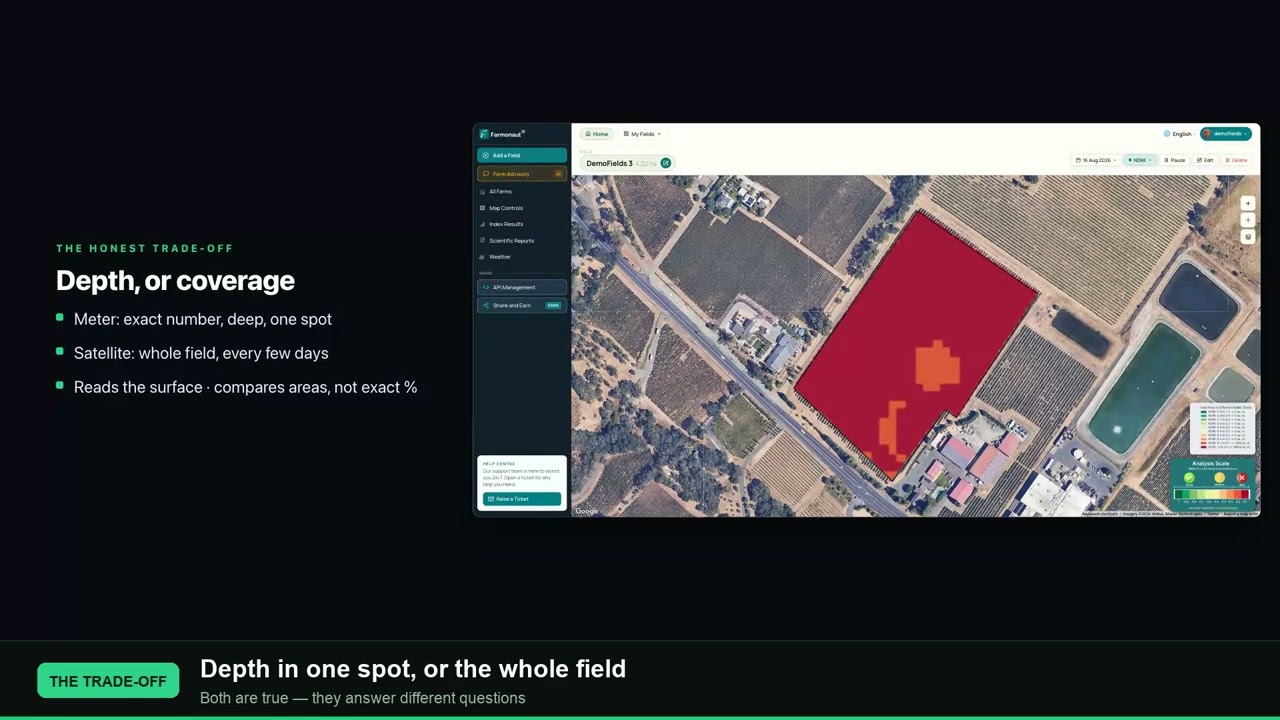
A soil moisture reading at root depth tells you more than the surface. UC and the University of Arizona both say to wet the soil about 2 feet deep, so probe readings down to 2 feet show whether water reaches the roots, and a satellite map shows how the whole block compares.
▶ What a satellite measures across a field and where a soil moisture probe at root depth still wins. · 2:11
Corn seed depth in brief
This page also covered corn planting depth in an earlier version, so here is a short answer. Clarke McGrath, an Iowa State University extension specialist, wrote in 2016 that some agronomists say 2 to 3 inches and others 1.5 to 2 inches, and that he targets 2 inches (about 5 cm), and 2.5 inches if the soil gets very dry. He saw more season-long problems with shallow corn than with deep corn, including rootless corn and poor root development (Iowa State Integrated Crop Management, 2016). That is one agronomist’s field experience. Check your seed company and local extension for your soil.

▶ Why organic matter matters for soil and what it does for plants. · 7:33
Where satellites help, and where they do not
Satellites cannot see roots. They can show how green and vigorous the canopy is across a block, which helps you find a weak patch to dig into. Farmonaut Satellite + AI Farm Monitoring System maps vegetation indices such as NDVI for fields and orchards. A low patch can come from many causes, including roots, so check it on the ground.
Related pages on our site: lemon tree fungus, carbon footprinting tools, large-farm management, satellite data API, weather API documentation, product traceability, crop loans and insurance, fleet management, farm monitoring home.
FAQ
How deep are lemon tree roots?
Generally in the upper 2 feet (60 cm) of soil, according to UC extension. In deep, well-drained Florida sand the main root system reached 0.6 to 0.9 m and the deepest roots on rough lemon rootstock were found at 3.3 m.
How far do lemon tree roots spread?
Past the drip line. UC and UF/IFAS both say citrus roots extend beyond the canopy. The one measured distance is 2 m from the trunk for 11-year-old orange trees in Florida; for lemons, water and feed to just beyond the canopy edge.
Do lemon trees have a taproot?
Not a distinct one in the UF/IFAS excavations: roots were lateral and shallow in nursery and young field trees, even from seed. A 1977 Florida excavation of young nursery trees on rough lemon rootstock did find a taproot with many lateral roots, and the 2022 article notes that seed-grown nursery rootstocks typically form one.
Can I plant a lemon tree near my house?
The extension guides here set spacing for light and tree size: at least 12 feet between standard trees in the UC guide and 15 feet in UF/IFAS, and away from septic systems. Ask a local arborist about foundations and pipes.
Do lemon trees do well in pots?
The root rules are the same in a pot but the space is limited. Roots circle at the wall of a container, so loosen circling roots at planting, and keep drainage good because root rot follows wet soil.
How we checked the numbers
We read each page cited above in October 2026. Depth figures come from Florida and California extension and research sources. They describe those soils and citrus in general, not lemons alone. Arizona supplies the water-use table. Water use is for orange trees in Arizona, with the lemon uplift from the same publication. Check your local extension service before you change irrigation or fertilizer.
Farmonaut crop monitoring
See your orchard from space
Draw your orchard once and see satellite vegetation maps for it through the season, on web, Android or iOS.




Keep reading

Sources
- UC Cooperative Extension Sacramento County, Growing Citrus in Sacramento (GN 127): ucanr.edu
- University of Arizona Cooperative Extension, Irrigating Citrus Trees (az1151, 2021): extension.arizona.edu
- UF/IFAS, 2026-2029 Florida Citrus Production Guide: Root Health Management: ask.ifas.ufl.edu
- UF/IFAS FAWN, Citrus irrigation scheduler help: root distribution: fawn.ifas.ufl.edu
- Engenharia Agricola (2012), Citrus root distribution under water stress in sandy soil of central Florida: scielo.br
- Proceedings of the Florida State Horticultural Society (1977), Root system characteristics of citrus rootstocks: journals.flvc.org
- Citrus Industry magazine (2022), Citrus Root Structures: Lessons From Below: citrusindustry.net
- UC IPM, Phytophthora Root Rot in citrus: ipm.ucanr.edu
- UF/IFAS EDIS, Citrus Culture in the Home Landscape (HS132): edis.ifas.ufl.edu
- Iowa State University Extension, Corn planting depth (McGrath, 2016): crops.extension.iastate.edu
Discussion
Questions, corrections or field experience? Share them below. First-time comments are reviewed before they appear, and your email is never published.
No comments yet. Be the first to add a question or your experience.

 Native Seeds
 Fresh Platter
 Andex
 FCF India
 Unifrutti Gulf
 Deluxe Conseil
 TVS Electronics
 BW Pipelines
 WICO
 Gen Chayat
 Chimera Innovation
 SkyHarvest
 Polaris Digitech
 Teledarbas
 Wild Oak Farm

 Licence holder · Niger · Gold










