

Rare earth prices · Price data
Lanthanum Price per Gram: Rare Earth Price Chart
Lanthanum oxide averaged about US$1.00 per kilogram in 2025, roughly US$0.001 per gram (USGS, 2026), the cheapest rare earth by weight. Terbium oxide cost about a thousand times more.
Key takeaways
- Lanthanum oxide (99.5%) averaged US$1.00/kg in 2025, about US$0.001 per gram, FOB China (USGS, 2026).
- Terbium oxide averaged US$1,010/kg and dysprosium oxide US$239/kg in 2025 (USGS, 2026).
- Lanthanum oxide was US$50–52/kg at year-end 2011, about fifty times today’s level (USGS, 2015).
- Outside China, dysprosium oxide was US$2,500–5,500/kg in October 2026 against US$196–201 in China (REEx, 2026).
- China mined about 270,000 of the world’s 390,000 tonnes of rare earth oxide in 2025 (USGS, 2026).
In this article
- Lanthanum price per gram today
- Rare earth metal prices per gram compared
- Why lanthanum is so cheap per gram
- Oxide, metal or lab pack: what your quantity costs
- Rare earth prices historical: lanthanum since the 2011 spike
- China and outside-China rare earth prices
- Key factors behind rare earth metal prices today
- What prices mean for rare earth projects and investors
- How to check a rare earth price quote
- Frequently asked questions
Lanthanum oxide sold for an average of about US$1.00 per kilogram in 2025, which is roughly US$0.001 (one tenth of a cent) per gram, according to the USGS Mineral Commodity Summaries 2026, which uses FOB (loaded at a Chinese port) quotes from Argus Media. That makes lanthanum the cheapest rare earth on the market by weight. Terbium oxide, at the other end, averaged about US$1,010 per kilogram, a thousand times more. This page puts every major rare earth on one per-gram table, shows how lanthanum fell from its 2011 spike, explains why China and outside-China prices now differ by more than 100 times for some oxides, and gives you a calculator for your own quantity and quote.
A note on units before the numbers. Rare earths are not traded on an exchange like gold or copper. They are sold in private contracts, almost always as an oxide (the element bonded to oxygen) at a stated purity, and priced in US dollars per kilogram or Chinese yuan per tonne. A per-gram figure is simply the per-kilogram price divided by 1,000. Purity is written as a percentage: “99.5% minimum” means at least 99.5% of the product is the named oxide.
Lanthanum price per gram today
The most recent full-year benchmark is the USGS average for lanthanum oxide of 99.5% minimum purity: US$0.97 per kilogram in 2024 and an estimated US$1.00 per kilogram in 2025. Per gram, that is about US$0.001. A one-tonne bag of the oxide would cost roughly US$1,000 at that average, before freight, insurance and import duty.
Lanthanum oxide (La2O3) is not pure lanthanum. Using IUPAC standard atomic weights (lanthanum 138.905, oxygen 15.999), the oxide is about 85.3% lanthanum by weight. So the price per gram of contained lanthanum at the 2025 average is about US$0.00117, still close to one tenth of a cent.
Three things move the number you will actually pay:
- Form. Oxide is the cheapest form. Lanthanum metal and alloys need an extra reduction step and sell for more per kilogram. The USGS lists mischmetal, a cerium-lanthanum metal alloy, at an average of US$5.62 per kilogram in 2025, more than five times the oxide.
- Purity. Each extra “nine” of purity (99.9%, 99.99%) adds separation work and cost.
- Pack size. Bulk industrial prices apply to tonnes. Laboratory chemical suppliers sell grams in small bottles, and the price per gram in a catalogue is far above the bulk market because it covers packing, testing and handling.
If you were quoted a price per gram for lanthanum that is many times higher than one tenth of a cent, check which of those three things explains it before comparing it with the bulk benchmark.
Rare earth metal prices per gram compared
The table converts the USGS 2025 average prices (oxide basis, FOB China) to a price per gram, and adds the October 2026 China price ranges assessed by Rare Earth Exchanges (REEx) where it covers the same oxide. Grades are not identical between the two sources, so treat the columns as two reference points rather than a single series.
Chart
Average rare earth oxide prices
US$ per kilogram, 2025 average, FOB China
| Oxide | USGS average, 2025 (US$/kg) | Approx. US$ per gram, 2025 | REEx China range, Oct 2026 (US$/kg) | Main use |
|---|---|---|---|---|
| Lanthanum oxide, 99.5% | 1.00 | 0.001 | not covered | Refinery catalysts, optical glass, NiMH batteries |
| Cerium oxide, 99.5% | 1.71 | 0.0017 | not covered | Glass polishing, catalysts |
| Samarium oxide, 99.5% | 2.82 | 0.003 | 22.96–25.77 | Samarium-cobalt magnets |
| Europium oxide, 99.99% | 27 | 0.027 | not covered | Phosphors |
| Gadolinium oxide, 99.99% | 30 | 0.030 | 25.32–28.14 | Magnets, medical imaging |
| Holmium oxide, 99.5% | 70 | 0.070 | 89.77–92.59 | Magnets, lasers |
| NdPr oxide, 99% | 69 | 0.069 | 103–106 | NdFeB permanent magnets |
| Neodymium oxide, 99.5% | 73 | 0.073 | not covered separately | NdFeB permanent magnets |
| Praseodymium oxide, 99.99% | 74 | 0.074 | not covered separately | Magnets, alloys |
| Dysprosium oxide, 99.5% | 239 | 0.24 | 196–201 | Heat-resistant magnets |
| Terbium oxide, 99.99% | 1,010 | 1.01 | 896–904 | Heat-resistant magnets, phosphors |
Sources: USGS Mineral Commodity Summaries 2026 (rare earths and heavy rare earths chapters); REEx monthly assessment, October 2026, China prices ex-works and excluding VAT.
The spread is the main point. A gram of terbium oxide cost about a thousand times more than a gram of lanthanum oxide in 2025. The magnet metals (neodymium, praseodymium, dysprosium, terbium) carry the value of a typical rare earth deposit, while lanthanum and cerium make up much of the tonnage but little of the revenue.
Why lanthanum is so cheap per gram
Lanthanum and cerium are the most plentiful rare earths. The USGS rare earth fact sheet notes that cerium, the most abundant of the group, is more common in the Earth’s crust than copper or lead. In the two main rare earth ore minerals, bastnaesite and monazite, lanthanum and cerium together usually make up the largest share of the rare earth content. Every mine that digs for neodymium and praseodymium also produces lanthanum and cerium whether it wants them or not.
Chart
Lanthanum, cerium and mischmetal prices
US$ per kilogram, 2025 average
That creates a steady oversupply. Demand for lanthanum comes from fluid catalytic cracking catalysts in oil refineries, optical glass for camera lenses, nickel-metal hydride batteries and hydrogen storage alloys, as the Royal Society of Chemistry element page describes. These are real markets, but they do not grow as fast as the output of co-produced lanthanum. The result is a price that sits near the cost of separation, and rare earth producers often treat lanthanum and cerium as low-value by-products.
For the United States, the USGS reports that the leading domestic end use of rare earths in 2025 was catalysts, while the leading global use was magnets. That difference helps explain why a cheap element like lanthanum still matters in US import data even though it earns little per gram.
Oxide, metal or lab pack: what your quantity costs
Most people who search for a price per gram want to know what a specific amount would cost. The calculator below takes the quantity of oxide, the price per kilogram you have been quoted and the share of the element in the oxide. It then gives the total cost, the price per gram of oxide and the price per gram of the contained element.
For lanthanum oxide the element share is about 85.3%. Other rare earth oxides have different formulas (cerium is usually sold as CeO2, terbium as Tb4O7), so work out the share from the formula on the quote. Use the price you have in hand: the defaults are examples only.
Calculator
What does your quantity of rare earth oxide cost?
Enter the oxide quantity, your quoted price and the element share of the oxide.
- US cents per gram of oxide: 0.10
- Contained element (kg): 85.3
- US cents per gram of contained element: 0.12
Example values only, not a benchmark. Price is an input: example, use today’s price. The 85.3% default is lanthanum’s share of La2O3 from IUPAC atomic weights (La 138.905, O 15.999).
Rare earth prices historical: lanthanum since the 2011 spike
Lanthanum was not always cheap. In 2010 and 2011 China cut export quotas, and buyers outside China scrambled for supply. The USGS Mineral Commodity Summaries 2015 lists year-end lanthanum oxide at US$59–61 per kilogram in 2010 and US$50–52 in 2011, which is about US$0.05–0.06 per gram, or fifty to sixty times the 2025 level.
Chart
Lanthanum oxide price since 2010
US$ per kilogram; year-end midpoints to 2016, annual averages from 2019
The spike did not last. New supply came on outside China, buyers cut use where they could, and prices fell fast. Year-end lanthanum oxide was US$9–11 per kilogram in 2012, US$5 in 2014 and about US$2 in 2015 and 2016, according to the USGS 2015 and 2018 summaries.
Since then the price has drifted between about US$1 and US$2 per kilogram. The USGS 2023 summary gives an average of about US$2 for 2018 to 2020, and the 2026 summary gives US$1.51 for 2021, US$1.39 for 2022, US$0.96 for 2023, US$0.97 for 2024 and an estimated US$1.00 for 2025. Note that the older figures are year-end ranges and the newer ones are annual averages, so the line is a guide to the trend, not a single consistent series.
The magnet oxides followed a different path. Neodymium oxide averaged US$134 per kilogram in 2022, then US$78 in 2023, US$56 in 2024 and an estimated US$73 in 2025 (USGS, 2026). Terbium oxide averaged US$2,050 per kilogram in 2022 and US$1,010 in 2025. These metals respond to electric vehicle and wind turbine demand, so they swing far more than lanthanum does.
China and outside-China rare earth prices
Since 2025 there are two rare earth markets. In April 2025 China tightened export controls on alloys, compounds, metals and oxides of samarium, gadolinium, terbium, dysprosium, lutetium, scandium and yttrium. In October it added further elements, then in November suspended the October controls for one year; the April controls stayed in place, with general export licences issued to selected exporters, according to the USGS 2026 summary.
Chart
China vs outside-China oxide prices
US$ per kilogram, range midpoints, October 2026
The effect shows up in the prices. In its October 2026 assessment, REEx put dysprosium oxide at US$196–201 per kilogram in China but US$2,500–5,500 outside China, and terbium oxide at US$896–904 in China against US$10,000–13,000 outside China. NdPr oxide, which is not under the April controls, showed a much smaller gap: US$103–106 in China against US$125–140 outside. REEx notes that the two markets use different delivery terms (ex-works China versus CIF Rotterdam), so the gap is a cross-market comparison rather than an exact premium.
REEx also reports price floors set for dysprosium and terbium oxide from the Serra Verde project in Brazil, under an agreement between USA Rare Earth and the US government: US$575 per kilogram for dysprosium oxide and US$2,050 per kilogram for terbium oxide. Floors like these, and long-term offtake agreements, matter more to a new project’s revenue than the China spot quote does.
Lanthanum is not on the April 2025 control list, and REEx does not track it. Its price has stayed near the China level because supply from outside China is plentiful as a by-product.
Key factors behind rare earth metal prices today
Five drivers explain most price moves. Check each before you rely on a quote.
- China’s share of supply. China mined an estimated 270,000 tonnes of rare earth oxide in 2025 out of a world total of about 390,000 tonnes, and holds 44 million tonnes of the world’s reserves of more than 75 million tonnes (USGS, 2026). Its policy on quotas and exports sets the base price.
- Export controls. Controlled elements trade at large premiums outside China; uncontrolled ones like lanthanum and cerium do not.
- Magnet demand. Electric vehicles, wind turbines, defence systems and industrial motors use neodymium-iron-boron magnets. This drives neodymium, praseodymium, dysprosium and terbium, and through co-production it adds lanthanum and cerium supply.
- Separation capacity. Mining a concentrate is only the first step. Separating individual oxides is the expensive part, and capacity outside China is still being built. The USGS notes that at least five companies were developing commercial-scale heavy rare earth processing in 2025.
- Processing waste and permits. Many rare earth ores contain thorium or uranium. Handling radioactive tailings adds cost and time to permits, which slows new supply.
Recycling of magnets and substitution (for example, motors designed to use less dysprosium) are growing but are still small next to mine supply.
▶ Walks through the main environmental impacts of mining, which shape permits and costs. · 2:31
What prices mean for rare earth projects and investors
For a licence owner or investor, the useful question is not the price of one oxide but the value of the full basket of oxides in an ore. This is called the basket price: each oxide’s share of the total rare earth oxide (TREO) in the deposit multiplied by its price, then summed. A deposit rich in neodymium, praseodymium, dysprosium and terbium has a high basket price. A deposit dominated by lanthanum and cerium has a low one, even at the same grade.
Grade means the concentration of rare earth oxide in the rock, usually written as percent TREO. Two deposits at 2% TREO can have basket values that differ several times over, simply because one carries more magnet elements. When you read a project announcement, look for the distribution of individual oxides, not just the headline grade.
US readers can see where domestic deposits sit on our US rare earth minerals map and in our guide to Wyoming rare earth deposits. For listed developers, our comparison of rare earth exploration companies covers who holds which projects. Projects that plan to sell outside China often rely on an offtake agreement with a fixed or floor price rather than the spot market.
Before any drilling, satellite imagery can help screen a licence area for the alteration and rock types linked to rare earth deposits, so that field work targets the most promising ground. Farmonaut offers this kind of screening as an early exploration step; it sits ahead of sampling and a resource estimate, not in place of them.
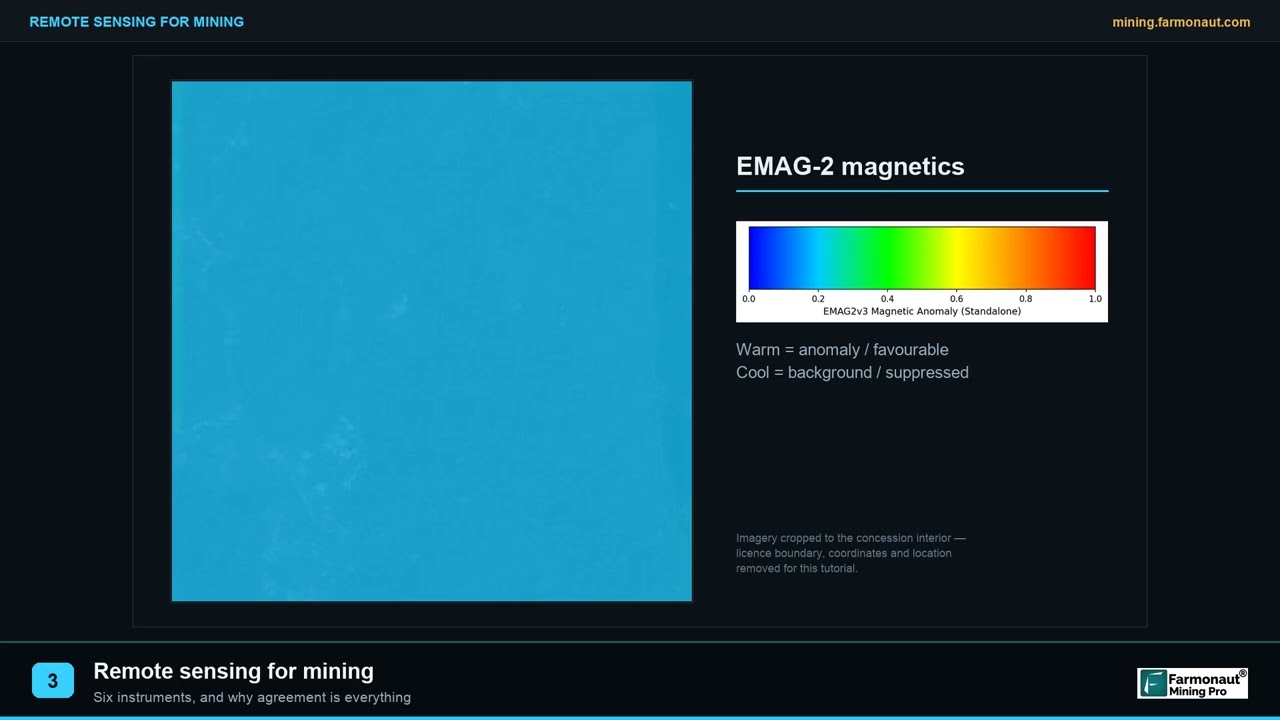
▶ Explains in plain terms how remote sensing is used to screen ground for mining. · 2:01
How to check a rare earth price quote
- Confirm the form. Oxide, carbonate, metal, alloy or concentrate. Concentrate prices are on a contained-oxide basis and much lower than separated oxide.
- Confirm the purity. 99%, 99.5%, 99.9% and 99.99% are priced differently.
- Confirm the delivery terms. FOB China, ex-works China (excluding VAT) and CIF Rotterdam are not the same price.
- Convert the currency. China quotes are often in yuan per tonne. Divide by the exchange rate and by 1,000 to get US$ per kilogram.
- Convert to the element if needed. Multiply the oxide quantity by the element share (about 85.3% for lanthanum oxide) to get contained metal.
- Compare with a dated benchmark. Use the USGS annual average and a recent monthly assessment, and write down the date of each.
Frequently asked questions
What is the price of lanthanum per gram?
Lanthanum oxide averaged about US$1.00 per kilogram in 2025 (USGS, 2026), which is about US$0.001 per gram. Contained lanthanum metal in that oxide works out to about US$0.0012 per gram. Laboratory packs cost much more per gram.
What is the price of dysprosium per gram?
Dysprosium oxide averaged about US$239 per kilogram in 2025 (USGS, 2026), or about US$0.24 per gram. In October 2026 REEx assessed it at US$196–201 per kilogram in China and US$2,500–5,500 per kilogram outside China, about US$2.50 to US$5.50 per gram.
What is the most expensive rare earth?
Among the oxides in the USGS price tables, terbium oxide is the highest, at an average of about US$1,010 per kilogram in 2025, roughly US$1 per gram. Outside China, REEx assessed it at US$10,000–13,000 per kilogram in October 2026.
What is the cheapest rare earth?
Lanthanum oxide, at about US$1.00 per kilogram in 2025, followed by cerium oxide at about US$1.71 per kilogram (USGS, 2026).
Why are rare earth prices given as ranges?
Rare earths are sold in private contracts, not on an exchange. Price depends on purity, quantity, origin, delivery and payment terms, so price reporters publish a range that reflects trades and offers during the period.
Where can I see a rare earth price graph?
The charts on this page plot USGS annual prices and REEx monthly ranges. For older history, the USGS Mineral Commodity Summaries give a five-year price table for each year back to the 1990s.
How much was lanthanum worth in 2011?
Year-end lanthanum oxide was US$50–52 per kilogram in 2011, after US$59–61 in 2010 (USGS, 2015). That was about fifty times the 2025 average.
Are rare earth metals actually rare?
Not in the crust. Cerium is more common than copper or lead (USGS, 2014). What is rare is a deposit rich enough, and simple enough to process, to mine at a profit.
Which country produces the most rare earths?
China, with an estimated 270,000 tonnes of rare earth oxide in 2025, about 69% of the world total of 390,000 tonnes. The United States was second at about 51,000 tonnes, mostly from Mountain Pass, California (USGS, 2026).
Does lanthanum come under China’s export controls?
Lanthanum was not on the April 2025 list, which covered samarium, gadolinium, terbium, dysprosium, lutetium, scandium and yttrium (USGS, 2026). Check the latest Chinese commerce ministry notices before any trade, because the lists have changed more than once.
More from Farmonaut: agro admin app, carbon footprinting, farmonaut satellite weather api developer docs, fleet management, product traceability.
This page is for information only. It is not investment advice. Prices are dated reference values, not quotes.
Farmonaut mining
Screen a rare earth licence from space
Investors can see how satellite data ranks exploration targets on a licence area before money goes into drilling.

Mining Pro sample view, synthetic data
Keep reading
Sources
- USGS, Mineral Commodity Summaries 2026: Rare earths (2026): pubs.usgs.gov
- USGS, Mineral Commodity Summaries 2026: Rare earths (heavy) (2026): pubs.usgs.gov
- USGS, Mineral Commodity Summaries 2026, full volume (2026): pubs.usgs.gov
- USGS, Mineral Commodity Summaries 2023: Rare earths (2023): pubs.usgs.gov
- USGS, Mineral Commodity Summaries 2018: Rare earths (2018): d9-wret.s3.us-west-2.amazonaws.com
- USGS, Mineral Commodity Summaries 2015: Rare earths (2015): d9-wret.s3.us-west-2.amazonaws.com
- USGS, Mineral Commodity Summaries 2013: Rare earths (2013): d9-wret.s3.us-west-2.amazonaws.com
- USGS Fact Sheet 2014-3078, The rare-earth elements: vital to modern technologies (2014): pubs.usgs.gov
- Rare Earth Exchanges, Rare earth prices, October 2026 assessment (2026): rareearthexchanges.com
- Royal Society of Chemistry, Periodic table: Lanthanum: periodic-table.rsc.org
- Royal Society of Chemistry, Periodic table: Dysprosium: periodic-table.rsc.org
- IUPAC, Periodic table of elements (standard atomic weights): iupac.org
Discussion
Questions, corrections or field experience? Share them below. First-time comments are reviewed before they appear, and your email is never published.
No comments yet. Be the first to add a question or your experience.

 Critica Metals Limited
 Congo Mining Solutions
 Mining SARL
 SenGold Invest SAS
 Sania Corporation
 Sean Mining Limited
 NTS Group (Pty) Ltd
 Mine4Africa
 Lithspo Minerals Limited
 Tintina Mining Group
 Dalgety Minerals Pty Ltd
 Vortex Minerals Pty Ltd
 Faith At Work (Pty) Ltd
 Geotech Mining Solutions plc
 Vulcan International Limited
 Kidepo Associates
 GKY Mining
 Alkimy SARL
 Double A Trading
 GemSprout Metals Limited
 Qader Group
 Ileys General Trading

 Client & affiliate partner · Ghana · Gold










