

Reviewed August 2026 against USDA Agricultural Research Service field data and Mordor Intelligence / DataMint Intelligence market research.
Try it: Run your own numbers →
“Vertical farms can use up to 38% more energy per kilogram of produce compared to traditional farming.”
Is Vertical Farming Eco Friendly? The Short Answer
Vertical farming is eco friendly on water and land, and not eco friendly on energy and materials — the honest answer is “it depends on which resource you’re measuring.” Closed-loop hydroponic systems cut water use by up to 95% compared with conventional field agriculture, according to the USDA Agricultural Research Service and the Bureau of Reclamation. But that same controlled environment runs on artificial lighting and HVAC systems that can push energy use per kilogram of produce well above open-field farming, unless the electricity comes from renewables. So vertical farming is not eco friendly or not a binary — it’s a resource trade-off, and which side wins depends on your crop, your climate, and your power grid.
This is the actual shape of why vertical farming is not eco friendly for some operations and genuinely sustainable for others: it swaps a land-and-water problem for an energy-and-materials problem. Whether that’s a good trade depends on what’s scarce where you farm. A drought-stressed region in the western United States gains more from the water side of the ledger; a region with cheap, clean grid power gains more from the energy side. Neither side of that trade is marketing — both are measurable, and this article measures them.
Drawing from both scholarly and technical literature — including analysis published in the Journal of Eco Friendly Agriculture — and adopting a holistic scope that includes agriculture, forestry, mining supply chains, and infrastructure, the rest of this piece breaks the question into its component parts: energy, water, materials, land, nutrients, and economics. By the end, you’ll have a framework for answering “is vertical farming eco friendly” for your specific crop and region, not just a slogan either way.



The Vertical Farming Premise: Ecofriendly Farming Solution?
The concept of vertical farming conjures the image of plants thriving year-round inside controlled environments — stacked high in urban warehouses or shipping-container farms, hydroponically or aeroponically nourished without soil, and illuminated by artificial lighting. The promise: local, pesticide-reduced, water-efficient, high-tech food production that relieves pressure on arable land, cuts transportation emissions, and secures the urban food supply, particularly in US metro areas far from major growing regions like California’s Central Valley or Arizona’s Yuma County.
However, if we scrutinize claims of environmental benefit line by line, a more complicated picture emerges. Vertical farms, especially at large scale, depend on significant energy inputs, cutting-edge equipment, and climate-control systems that run 24/7 regardless of the weather outside — challenges that are seldom obvious to the casual shopper but have real consequences when evaluated with a full life-cycle accounting instead of a single marketing metric.
- ✔ Key benefit: Water use down by as much as 95% versus conventional field agriculture (USDA ARS / Bureau of Reclamation, 2023).
- ⚠ Risk: Energy use up to 38% higher per kilogram of produce than traditional farming.
- 📊 Data insight: LED lighting can constitute more than 50% of facility energy consumption in some vertical farms.
- 🔄 Sustainability trade-off: High water efficiency in closed-loop hydroponics — but a real risk of nutrient or plastic contamination if systems leak.
- 🌱 Missed opportunity: No contribution to soil health, biodiversity, or landscape-scale ecosystem services.

Key Trivia: Vertical Farming Energy Use
“LED lighting in vertical farming can account for over 50% of total energy consumption in some facilities.”
Resource Intensity: The Core Concern of Vertical Systems
The allure of vertical farming is tied to its perceived resource efficiency — more production per square foot, less land disturbed. But the core concern behind why vertical farming is not eco friendly in many operator cost breakdowns is the resource intensity of the systems that make that land savings possible: artificial lighting, climate control, and precision irrigation, all running continuously.
- 🌍 Artificial Lighting: Most vertical farms rely on energy-intensive LED arrays to provide plants with photosynthetically active radiation (PAR). This need is constant and year-round, regardless of outdoor conditions — a warehouse in Ohio in January draws the same lighting load as one in Arizona in July.
- 🌡 Climate Control: Controlled environments require HVAC systems for heating, cooling, humidity management, and CO₂ supplementation — systems that draw significant electrical, and sometimes fossil-fuel, energy input.
- 💧 Precision Irrigation: Hydroponic and aeroponic setups use pumps, filtration units, sensors, and sometimes UV sterilization, adding to the overall resource load even as they cut water volume.

1. Energy Demand: Why Vertical Farming Is Not Eco Friendly For Many Crops
- 💡 Energy requirements remain high per unit of produce — up to 38% higher than traditional farming — especially for leafy greens, herbs, and crops with high light needs.
- 🔌 Unless the electricity grid is powered by renewables, these operations contribute indirect greenhouse gas emissions, undermining sustainability claims even while water use drops.
- 🚜 Even with clean energy, the sheer volume of energy needed for lighting and climate stabilization outpaces traditional outdoor farming for several crops, particularly fruiting vegetables and grains.
2. Climate Stability vs. Climate Impact
Vertical farms maintain precise control over temperature, humidity, and light. This control ensures consistent growth conditions, reduces pest and disease pressure, and enables year-round production regardless of season. But that stable artificial climate consumes substantial energy, with costs most pronounced in regions with cold winters or hot summers — think Minnesota in February or Texas in August, where the HVAC load to hold a warehouse at optimal growing temperature fights the outdoor extreme in both directions.
- ⚡️ Climate stabilization is both a major benefit (crop consistency, no weather-related crop loss) and a major cost (energy intensity that scales with how extreme the local climate is).
- 📈 Energy intensity remains up to 38% higher per kilogram produced compared to open-field operations for most commonly grown crops.
Energy Consumption and Greenhouse Gas Footprint
The elephant in the vertical room: energy is the single biggest line item in both running costs and environmental footprint. Here are the core factors driving the energy side of the eco-friendly question:
- 🔋 Lighting Arrays: Even advanced LEDs draw a total energy input for photosynthesis that often exceeds the energy needed for traditional sun-powered outdoor fields — sunlight is free; grow lights are not.
- ❄ Cooling Loads: All that lighting and electronics generate heat, which raises climate control demand on top of the lighting draw itself — a compounding, not additive, cost.
- 🏭 Grid Dependency: Most vertical farms rely on grid electricity, and the generation mix behind that grid — coal, gas, nuclear, wind, solar — is what actually determines the greenhouse gas outcome, not the farm itself.
Even for operations powered entirely by renewables, the energy input per kilogram of yield can remain higher than conventional agriculture, especially for crops that aren’t well suited to vertical stacking or high-density hydroponics, such as row crops and grains.
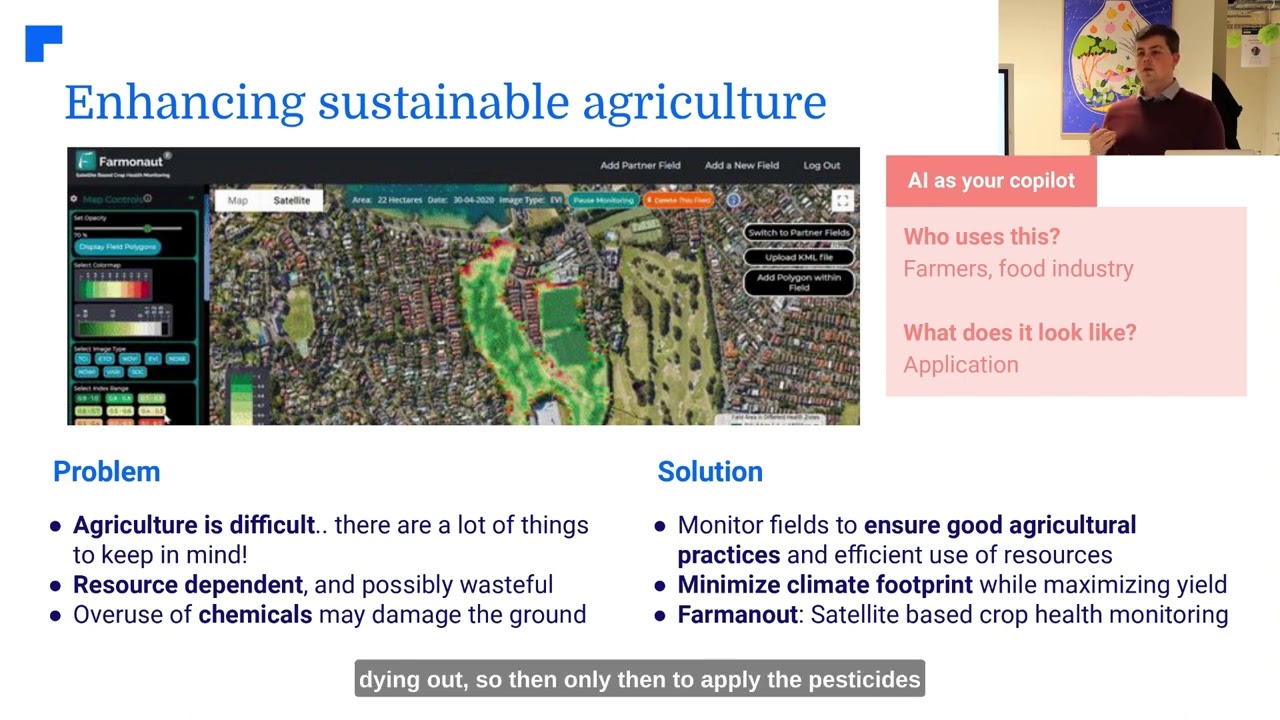
Farmonaut’s Carbon Footprinting tools enable businesses to monitor and reduce the carbon emissions associated with all forms of agriculture, including high-input systems like vertical farms. Real-time data can help operators quantify energy use per kilogram and guide grid-to-renewable transitions whenever a business case exists.
Water Use, Recirculation, and Hydroponics: The 95% Number, Checked
Water savings is the strongest, most verifiable case for vertical farming being eco friendly. According to the USDA Agricultural Research Service and the Bureau of Reclamation (2023), closed-loop vertical farms can cut water use by up to 95% compared with conventional field agriculture. That figure comes from comparing recirculating hydroponic systems — where water lost to evaporation and deep leaching is essentially eliminated — against open-field irrigation, where a large share of applied water never reaches the plant.
- 💧 Precision irrigation: Controlled, automated, and frequently recirculated, allowing water use to be measured and adjusted in real time rather than estimated from a soil-moisture guess.
- 🔄 Filtration and nutrient management: Required to keep recirculated water usable and to avoid system-wide contamination or crop loss.
- ⚠ Challenges: If hydroponic systems leak, or nutrient management is poor, concentrated solutions can escape into local waterways, with the same kind of ecological harm as agricultural runoff.
Does that 95% figure mean vertical always wins on water? Not universally:
- 🌦 Regions with ample rainfall or highly efficient drip irrigation: Traditional field farming can close much of that water-efficiency gap for certain crops, especially once you add back the water embedded in producing the electricity a vertical farm consumes.
- 🌀 Periodic replenishment and inputs: Hydroponics still requires high-quality source water, regular filtration, and waste management — externalities that don’t show up in the headline 95% figure.

Summary Insight: The 95% water savings figure is real and citable, published by a US federal agency, but it answers only one part of “is vertical farming eco friendly or not.” Pair it with the energy figure above before drawing a conclusion — a farm can be a clear water winner and a clear energy loser at the same time.
For those interested in combining the best of precision irrigation with natural ecosystem management, Farmonaut’s Crop Plantation & Forest Advisory offers satellite-based insights for water use, soil health, and integrated agroforestry practices on conventional acreage.
Material Use, Waste, and Lifecycle Considerations
Vertical farms often require significant investment in capital equipment: structural racking, lighting arrays, climate-control units, sensors, pumps, and supporting electronics — none of which a field farmer needs to grow the same crop outdoors.
- 🥽 Advanced materials: Many systems depend on plastics, rare earth elements, and composites that are not easily recyclable at end-of-life.
- 🔌 Electronics and sensors: Improve precision and control but contribute embedded emissions and e-waste at both the manufacturing and disposal stages.
- 🦾 Structural steel and building materials: Carry substantial upfront carbon footprints from mining, processing, and construction before a single seed is planted.
- ♻ Substrate waste: Soil-free growing media — rockwool, coconut coir, synthetic polymers — need periodic replacement and pose recycling or disposal problems most conventional farms never face.
Lifecycle analysis suggests that when these overheads are counted — from the mining and manufacturing of raw materials through transport and eventual disposal — the total environmental footprint can rival, or in some cases exceed, traditional agriculture on a per-unit basis, even after crediting the water savings.

- 📦 Common Mistake: Underestimating the long-term waste stream from substrate and lighting disposal when calculating a facility’s true footprint.
Farmonaut’s Blockchain-Based Traceability can help agriculture and mining supply chains account for origin, processing, and end-of-life impacts, enhancing transparency around vertical farm components as well as field-grown produce.
Land Use Efficiency vs. Ecological Benefits: A Balanced Examination
Land-use efficiency is the signature boast of the vertical farming industry: maximizing yield per square foot, stacking production ever higher, and shrinking the agricultural footprint. That can enable local, year-round supply in dense US metro areas far from traditional growing regions. But land-use efficiency is not synonymous with ecological sustainability or a lower total environmental footprint — it’s a trade of one resource for another.
- 🌳 Agroforestry and traditional agriculture in open fields, meadows, or working forests provide ecosystem services vertical systems cannot: carbon sequestration, soil health, pollinator habitat, and biodiversity support.
- 🏞 Vertically stacked systems contribute nothing to soil ecosystem processes, don’t support natural pest-predator cycles, and do little to buffer landscapes from climate variability.
- ⚡️ Energy-for-land trade-off: The compressed land footprint of vertical farms is achieved at the cost of substantially higher energy and material inputs per kilogram of produce — this is the crux of the “eco friendly or not” question, restated as a trade rather than a verdict.
Forestry and agroforestry practices often demonstrate resilience, low-input sustainability, and landscape-scale adaptability that indoor production, however space-efficient, cannot replicate.

- 🌱 Investor Note: Yield per square foot is only one metric — a full sustainability case has to factor in biodiversity, carbon, and ecosystem resilience, not just floor-space output.
For operators seeking landscape-level approaches, Farmonaut Large Scale Farm Management delivers real-time satellite data for entire farm portfolios, enabling integrated practices across agriculture, forestry, and natural resource projects.
Nutrient Management and Chemical Dependencies
Vertical farms rely on precise, automated delivery of nutrients — dissolved fertilizers and pH-regulated solutions — for optimal plant growth in a soil-free medium.
- ⚗ Specialized nutrient formulations: Needed for different crops and recirculating water chemistry, which increases input costs and operational complexity relative to soil-based fertility management.
- 🌊 Risk of contamination: Poor management, leaks, or accidents can introduce concentrated chemicals into local water bodies — a consequence structurally similar to fertilizer runoff from conventional agriculture, just with a different failure mode.
- 🦠 Microbial management: Additives such as biocides, beneficial fungi, and microbes are sometimes used; mismanagement risks pathogen outbreaks or full system collapse.
While automated dosing and closed loops can reduce overall fertilizer use and off-site runoff compared with field applications, they don’t eliminate the need for synthetic inputs, nor the risk of environmental harm if systems fail or go unmaintained.
- ❌ Common Mistake: Assuming nutrient recycling is “risk-free” simply because it happens indoors.
“Vertical farms can use up to 38% more energy per kilogram of produce compared to traditional farming.”
Supply Chains, Mining, and Advanced Material Impacts
The backbone of vertical farming technology is rooted in advanced materials: semiconductors, rare earth elements, precision-engineered plastics, and smart sensors, plus structural steel and glass. Each component carries its own environmental lifecycle, upstream of the farm itself.
- ⛏ Mining and extraction: Sourcing minerals for electronics, lighting, and growing substrates generates emissions, land disturbance, water use, and waste well before a single LED is installed.
- 🚛 Global supply chains: Transport, storage, and end-of-life disposal cascade impacts across regions, especially when manufacturing happens in jurisdictions with weaker environmental standards.
- 📱 High-tech dependency: Accelerates demand for rare resources, contributing to ecological and social challenges in the mining regions those materials come from.
Key Insight: New farming methods don’t exist in a vacuum — eco friendly technologies in agriculture must reckon with system-wide impacts, not just endpoint benefits at the point of sale.
Operators tasked with managing large, distributed, or resource-intensive agriculture and mining assets can leverage Farmonaut’s Fleet and Resource Management platform for efficient tracking, operational oversight, and resource optimization, ensuring sustainability claims are backed by data rather than assumption.
Economic and Social Dimensions: Equity and Accessibility
Beyond natural resources, answering “is vertical farming eco friendly” honestly also means addressing economic justice and social inclusion — sustainability that only large operators can afford isn’t sustainable at scale.
- 💸 Capital costs: Building a modern vertical farm demands significant upfront investment, often favoring large corporations and urban entrepreneurs over smallholders and rural growers.
- ⚡️ Operational costs: Continuous energy demand and technical maintenance make these operations more exposed to electricity price spikes or grid disruption than a field farm with no HVAC load.
- 💼 Resource diversion: Investment in high-tech indoor farming can draw funding away from lower-cost, climate-resilient, community-based agricultural development.
While the technology enables new forms of urban agriculture, it can also widen inequities if not matched with inclusive policy and accessible tools for smaller, decentralized growers.
- 🌏 Investor Note: Balance technology investment with commitment to local capacity, affordable tools, and equitable access for diverse growers, not just capital-rich urban operators.
To empower both large and small agricultural stakeholders, Farmonaut Crop Loan and Insurance Verification offers satellite-based, data-driven lending and risk assessment — making financing accessible and reducing fraud in both traditional and vertical farming contexts.
Market Growth: Why the Eco-Friendly Question Matters More Now
The eco-friendly debate isn’t academic — it’s playing out against a fast-growing industry. The global vertical farming market was valued at $9.61 billion in 2025, according to DataMint Intelligence market research. Europe’s slice of that market was valued separately at $1.99 billion in 2025, per Mordor Intelligence, and Mordor projects the European market will grow at a compound annual growth rate of 26.7% from 2026 through 2035. That’s a lot of new capacity being built on an environmental case that, as the sections above show, is genuinely mixed rather than settled.
Growth at that rate means the energy-versus-water trade-off scales with it: every new facility either compounds the energy problem or, if built with on-site renewables and efficient LEDs from day one, narrows it. Which outcome dominates in your region depends on local electricity generation mix and available capital — details a national market-size figure can’t tell you, but your utility’s rate schedule and generation disclosure can.
For a deeper technical look at the equipment driving this growth — LED efficiency gains, sensor networks, and automation — see 7 shocking innovations in vertical farming technology. To check whether these figures have moved since this review, both DataMint Intelligence and Mordor Intelligence update their market reports on a regular publication cycle; search their current release for the latest CAGR and market-size revision.
Eco Friendly Technology in Agriculture: How New Technologies Tip the Balance
Despite the trade-offs above, innovation is not static. Eco friendly technologies in agriculture, applied deliberately, can tilt the balance in vertical systems toward the “eco friendly” side of the ledger:
- 🌞 Energy-efficient lighting (high-lumen-per-watt LEDs): Reduces total energy input for plant growth, especially for crops with lower photosynthetic demand such as leafy greens and herbs.
- ⚡ On-site renewable energy (solar panels, wind turbines): Decouples production from fossil-heavy grid electricity, directly attacking the energy side of the eco-friendly question.
- 🌀 Passive climate designs: Thermal mass, smart ventilation, or heat exchange systems that reduce HVAC load without sacrificing climate stability.
- 🌱 Adaptive crop selection: Growing crops especially well-suited to controlled environments — high commercial or nutritional value per unit of energy input, rather than every crop a field farm can grow.
- 🛠 Modular and recyclable components: Choosing substrates, plastics, and electronics with circular lifecycles and real end-of-life recycling paths.
- 🔁 Robust nutrient cycling: Precision management that reuses or upcycles waste streams rather than routing them to disposal.
- 📊 Integrated monitoring and action platforms (such as Farmonaut): Real-time data to continually optimize resource use, verify emissions claims, and improve system resilience.
The future of sustainable agriculture goes beyond any single solution. It requires systems-level thinking, adaptive management, and a willingness to combine technologies — while keeping the underlying resource accounting honest.
Comparative Environmental Impact Table: Vertical vs. Traditional Farming
| Environmental Factor | Vertical Farming | Traditional Field Farming | Key Insight |
|---|---|---|---|
| Water use per kg produce | Up to 95% lower | Baseline | USDA ARS / Bureau of Reclamation, 2023 — the strongest verified eco-friendly case for vertical systems. |
| Energy use per kg produce | Up to 38% higher | Baseline | Driven by 24/7 LED lighting and HVAC; the strongest case against. |
| Land footprint | Substantially smaller per kg (stacked growing) | Baseline | Space efficiency is real, but doesn’t offset the energy cost — it’s a different resource, not a wash. |
| Pesticide use | Reduced, enclosed system limits pest pressure | Variable by crop and region | One of the more defensible enclosed-system benefits, independent of energy source. |
| Soil health & biodiversity contribution | None — soil-free hydroponic/aeroponic systems | Present in well-managed systems | A structural limit of vertical farming that no efficiency gain in lighting or water can fix. |
Where a figure above isn’t in the published record — such as an exact wholesale price premium for vertically farmed lettuce versus field lettuce in US markets — the honest move is to say so rather than estimate one. The USDA National Agricultural Statistics Service publishes annual crop water requirement and pricing studies; pairing that with your regional utility’s per-kWh rate lets you build a farm-specific version of this table rather than relying on a national average that may not fit your operation.
Calculator: Is Vertical Farming Eco Friendly For Your Crop?
Use your own facility’s numbers to see which resource trade-off dominates for your specific operation — water savings or energy penalty — instead of relying on national averages.
Run your own numbers
Assumptions: uses the figures you cited above as defaults, but every value is yours to change. It excludes materials, construction, and end-of-life impacts covered elsewhere in this article, and it does not model carbon intensity of your specific electricity grid — pair the energy output with your utility’s published emissions factor for a full picture.
Highlight Boxes & Callouts
Farmonaut: Empowering Data-Driven Sustainability
At Farmonaut, our mission is to democratize advanced satellite and AI-powered solutions for practitioners across agriculture, mining, and infrastructure. Our tools enable real-time monitoring, advisory, traceability, and resource management — helping clients make informed, sustainable choices regardless of whether their operation is vertical, traditional, or hybrid.
- 📡 Satellite-Based Monitoring: Analyze crop and soil health (NDVI), detect stress, and monitor water use and land transformation to quantify sustainability rather than assume it.
- 🤖 AI Advisory Systems: Our Jeevn AI gives tailored, actionable recommendations based on weather, resource status, and ecological indicators.
- ⛓ Blockchain Traceability: Ensures transparency and security from production source to consumer, critical for mining-linked and advanced material supply chains that feed vertical farm equipment.
- 🚚 Fleet & Resource Management: Improve logistics, reduce operational costs, and support compliance with sustainability benchmarks.
- 🌍 Environmental Impact Monitoring: Track carbon, water, and energy footprints, empowering users to reduce emissions, optimize input management, and align with sustainability goals with data instead of a slogan.
For developers and enterprise integration, our API and developer documentation enable the seamless connection of Farmonaut satellite and weather insights into third-party platforms and applications.
Interested in making satellite-powered, eco-friendly farm and supply chain management affordable and accessible?
Top 5 Vertical Farming Limitations for Sustainability
- ⚡ Energy Overhead: Up to 38% higher energy use per kilogram of produce, expensive to offset without on-site renewables.
- 🔋 Material Intensity: Dependence on electronics, plastics, and rare minerals with high embodied emissions.
- 💧 Water System Risks: Recirculation saves water, but leaks and contamination are dangerous for local ecosystems.
- 🌿 Ecological Disconnect: No direct soil, carbon, or biodiversity benefits — landscape services are reduced, not replaced.
- 💰 Equity Gaps: Favors large, capital-rich enterprises and urban areas, potentially marginalizing rural communities and smallholders.
Key Environmental Opportunities via Technology
- 🔄 Data-Driven Decisions: Real-time tracking and AI-powered insights (see: Farmonaut) enable responsive resource management instead of guesswork.
- 🔗 Transparent Supply Chains: Blockchain traceability ensures sustainability is verified, not just marketed.
- ♻ Circular Materials: Recycling and sustainable design are crucial for long-term ecological value in equipment-heavy systems.
- 🌞 On-Site Renewables: Direct solar and wind energy use reduces dependence on fossil-heavy grids and directly narrows the energy penalty.
- 🌱 Integrated Systems: Combining vertical, outdoor, and agroforestry creates a more robust agricultural portfolio than betting on one method alone.
Frequently Asked Questions: Is Vertical Farming Eco Friendly or Not?
1. Is vertical farming eco friendly or not — what’s the real answer?
Both, depending on the resource. It is eco friendly on water (up to 95% less than conventional field agriculture, per USDA ARS and the Bureau of Reclamation, 2023) and frequently not eco friendly on energy (up to 38% higher per kilogram of produce than traditional farming). There is no single yes-or-no answer; there’s a resource trade-off you can measure for your own crop and grid.
2. Why is vertical farming not eco friendly, specifically?
The main driver is continuous energy demand: 24/7 artificial lighting (LEDs can be over 50% of a facility’s total energy use), HVAC climate control, water pumps, and sensor networks. Without clean, renewable electricity behind that demand, the carbon footprint per kilogram of produce can exceed field farming’s, even though the farm uses far less land and water.
3. Is vertical farming eco friendly for water use specifically?
Yes, and this is the best-supported part of the case: closed-loop hydroponic and aeroponic systems can cut water use by up to 95% compared with conventional field agriculture, according to USDA ARS and the Bureau of Reclamation (2023). System leaks or poor nutrient management can offset some of that benefit locally, but the baseline efficiency gain is real and government-documented.
4. Does the growth of the vertical farming market change the eco-friendly calculus?
Not the underlying physics, but it raises the stakes. The global market was valued at $9.61 billion in 2025 (DataMint Intelligence), with Europe’s market at $1.99 billion in 2025 and projected to grow at a 26.7% CAGR from 2026 to 2035 (Mordor Intelligence). More facilities built without renewable power lock in more of the energy penalty; more facilities built with it narrow the gap.
5. How can vertical farming become more eco friendly?
By investing in on-site renewable energy, high-efficiency LED lighting, modular and recyclable equipment, robust waste and nutrient management, choosing crops suited to controlled environments (leafy greens and herbs over fruiting crops or grains), and using monitoring platforms to track and reduce energy and water use with real numbers instead of estimates.
Operators can also combine vertical methods with field agriculture or agroforestry for a more balanced overall footprint.
Further reading:
Conclusion: A Nuanced View on Eco Friendly Technologies in Agriculture
Vertical farming holds real promise for addressing land scarcity, urban food security, and water-constrained agriculture in specific US and European contexts. But a balanced accounting — across energy, water, materials, and ecosystem impacts — shows that whether vertical farming is eco friendly or not is not one answer for every crop, region, or production goal. It trades water and land savings for energy and materials costs, and which side of that trade wins depends on your local electricity mix, your crop choice, and how the equipment is sourced and disposed of.
Key Takeaway: Eco friendly technology in agriculture isn’t about flashy infrastructure or a single headline metric like “95% less water.” It’s about continuous lifecycle management, context-appropriate system design, and integration with the broader energy grid and materials economy. True sustainability comes from honest accounting against sources like USDA ARS and current market data, not from picking whichever number flatters the pitch.
For stakeholders in agriculture, mining supply chains, infrastructure, and land management, platforms like Farmonaut offer the data-driven transparency and optimization tools needed to navigate this complex landscape — minimizing emissions, maximizing efficiency, and supporting a genuinely sustainable mix of vertical and traditional production.
Start your evidence-based sustainability journey today with Farmonaut — where satellite insights meet actionable, ecofriendly farming solutions.

 Gen Chayat
 Chimera Innovation
 Hiteshi Infotech
 Clubhouse OS
 SkyHarvest
 Polaris Digitech
 Teledarbas
 Wild Oak Farm
 SFX
SFX BACF Africa
 Doodlakine
 Exurbia Geospatial
 FieldZero
 Indico Company
