

Washington State · Licensing guide
Washington Dredge Mining Rules: Permits and Work Windows
Washington dredge mining is legal only outside salmon waters: since 11 June 2020 motorized dredging is banned in salmonid habitat, and the rest needs a WDFW written HPA plus an Ecology individual NPDES permit applied for 180 days ahead.
Key takeaways
- Since 11 June 2020 motorized and gravity-siphon mining is banned in ESA critical habitat for salmon, steelhead and bull trout and in fresh waters designated for salmon spawning, rearing and migration (Ecology, RCW 90.48.615).
- Allowed waters need a written WDFW HPA plus an Ecology individual NPDES permit, applied for at least 180 days before mining starts (Ecology, 2026 page).
- The suction nozzle may be 5 inches or less (never above 5.25 in) and the hose no more than 1 inch larger (WAC 220-660-305).
- Pamphlet work windows are short: Okanogan 1 July to 15 August, Chelan and Whatcom 16 July to 15 August, Kittitas 1 July to 30 September (WDFW Gold and Fish pamphlet, May 2021).
- Working without a required HPA is a gross misdemeanor: the pamphlet gives up to one year in jail and a $5,000 fine, and says breaking its rules can add civil penalties of up to $10,000 per day (WDFW pamphlet, RCW 77.15.300 and 77.55).
In this article
- Is suction dredging legal in Washington?
- Which permit does each method need?
- Where can motorized dredging be allowed?
- How to apply: the two permits in order
- Equipment and in-stream limits
- Work windows by county and by stream
- Claims, landowners and other agencies
- What dredging without approval can cost
- How Washington compares with Oregon, Idaho and California
- Washington gold in context: small placers, not a producing state
- The final phase: closing out a site
- Check the ground before you apply
- Frequently asked questions
Suction dredging is legal in Washington only in a few places and only with two permits. Since 11 June 2020, RCW 90.48.615 bans motorized and gravity-siphon mining in waters that are critical habitat for salmon, steelhead or bull trout, and in all fresh waters designated for salmon spawning, rearing and migration. Elsewhere you need a written Hydraulic Project Approval (HPA) from the Washington Department of Fish and Wildlife (WDFW) and an individual discharge permit from the Department of Ecology, applied for at least 180 days before you start. Panning and small non-motorized sluices run under a simpler pamphlet. This page is written for license and claim owners, and it is not legal advice: confirm every point with WDFW and Ecology before you apply.
Terms used below. A dredge here means a suction dredge: a pump that draws gravel and water through a hose into a floating sluice. An HPA is the state permit for work that changes a stream bed. NPDES stands for National Pollutant Discharge Elimination System, the federal water-quality permit system that Ecology runs in Washington. The wetted perimeter is the part of the channel that is under water. The frequent scour zone is the strip between the water and the toe of the bank that floods often and is made of gravel, boulders or bedrock.
Is suction dredging legal in Washington?
Yes, but the rules tightened in three steps, and the answer now depends on the exact water body. Each step is listed below with its source.
- 1 November 2019: suction dredging stopped being covered by the Gold and Fish pamphlet and needed its own written HPA, according to a WDFW news release of 3 June 2019.
- 11 June 2020: state law closed critical salmon, steelhead and bull trout habitat, and all fresh waters designated for salmon spawning, rearing and migration, to motorized and gravity-siphon aquatic mining. Ecology also became the gatekeeper for a second permit.
- May 2021: WDFW’s rule changes, filed as WSR 21-09-066 on 19 April 2021, removed motorized and siphon methods from the pamphlet for good, added aquatic invasive species rules and dropped the annual suction-dredge report, as its rulemaking page explains.
When we checked on 15 October 2026, WDFW’s prospecting page still described the 2021 edition of the pamphlet as the current edition, and we found no later rule change at WDFW or Ecology. Rules can change between our check and your reading, so treat the dates above as a starting point and read the agency pages on the day you apply.
Which permit does each method need?
The permit depends on the equipment, not on whether you call it hobby or commercial. The table follows the WDFW Gold and Fish pamphlet (May 2021) and WAC 220-660-305.
| Method | Permit route | Main limits |
|---|---|---|
| Pan and hand tools only | Pamphlet, no separate application | Year-round in fresh waters except lakes; no digging inside the wetted perimeter |
| Non-motorized sluice or mini high-banker, riffle area 3 sq ft or less | Pamphlet | Year-round in fresh waters except lakes; process only classified gravel |
| Non-motorized sluice, rocker box or high-banker, up to 10 sq ft | Pamphlet, with a printed copy on site | Only inside the county or stream work window; 200 ft between larger rigs |
| Suction dredge, power sluice, motorized high-banker, dryland dredge, spiral wheel, gravity siphon | Written HPA from WDFW plus an individual NPDES permit from Ecology (or an Ecology letter saying none is needed) | Banned in salmon habitat; dates and sites are set in your HPA |
| Lakes, tribal reservations, and other waters marked “Submit Application” | Written HPA, and the land manager’s consent | Not covered by the pamphlet. State parks (streams), wilderness and tribal waters are closed unless the manager agrees; see the land section below |
One detail catches people out: a high-banker fed by a siphon hose counts as gravity-siphon equipment. The pamphlet only allows high-bankers that take water from natural stream flow or from hand-held buckets.
Where can motorized dredging be allowed?
Ecology publishes an interactive map of “mining potential use areas”: waters outside salmonid habitat where it may issue an individual NPDES permit after reviewing an application. Its page lists possible locations in ten counties: Adams, Benton, Clallam, Grant, Grays Harbor, Lincoln, Pacific, Spokane, Whitman and Yakima. Kittitas, Chelan, Okanogan and Whatcom counties are not on that list, and that includes the counties of Swauk, Peshastin and Similkameen placer creeks named by Washington DNR, so a dredge plan there needs a map check before anything else.
A map position is only the first test. Ecology says it may issue the permit to applicants who work outside salmonid habitat and return the effluent to the water body or to the ground. Ecology’s question-and-answer sheet adds that a WDFW application needs the NPDES permit, or a letter saying none is required, for each location. Inside prohibited waters only non-motorized work is allowed, such as panning, and that still falls under the pamphlet or an HPA.
The ocean beaches are a special case. Under WAC 220-660-305, motorized equipment may run year-round on ocean beaches only in Grays Harbor and Pacific counties, in waters that are not designated critical habitat for salmon, steelhead or bull trout.
How to apply: the two permits in order
The order matters because the Ecology clock is the long one. Use these steps.
Infographic
From idea to approved dredge site in 5 steps
- 1Check the waterConfirm on Ecology’s map that the reach is outside salmonid habitat.
- 2Confirm accessCheck the claim, landowner and land-manager rules.
- 3Apply to EcologyFile the individual NPDES permit at least 180 days before the start.
- 4Apply to WDFWFile the written HPA with the NPDES permit or Ecology letter.
- 5Work and close outFollow the HPA dates, then fill and level every site.
- Check the water. Open Ecology’s potential-use map and confirm that your stream reach is outside salmonid habitat. If it is not, motorized work is closed and you stay with pans and small sluices.
- Confirm who owns the ground. A claim gives you the minerals, not the stream bed or the right to ignore other agencies (see the land section below).
- Apply to Ecology for an individual NPDES permit at least 180 days before your planned start. Ecology says it cannot issue the permit for motorized or siphon mining in critical salmon areas.
- Apply to WDFW for a written HPA. Include the NPDES permit or Ecology’s letter. WDFW’s page allows up to five sites in the same watershed on one application, where a site is the length of a registered claim or 1,300 linear feet of stream if you are not on a claim.
- Arrange the invasive species check. Motorized equipment used outside Washington must be inspected by WDFW before use, and all such gear must be decontaminated between waters.
- Work to the HPA. Its dates, sites and conditions replace the pamphlet’s table.
We found no general permit for suction dredging on Ecology’s page: it offers an individual permit only. The 2020 law told Ecology to evaluate whether a general permit was warranted, so ask Ecology whether that has changed. The calculator below shows how the 180-day notice and your gravel volume fit a season.
Equipment and in-stream limits
These limits come from the rule text for motorized and siphon prospecting, WAC 220-660-305, last amended in 2021. Your individual HPA may add more. Dredge size is the part buyers ask about first: the nozzle should be 5 inches or less and may never exceed 5.25 inches, and the hose may be no more than 1 inch larger than the nozzle. A 6-inch dredge, which is legal in some other states, does not meet that limit. For a deeper look at how dredge size, pump and sluice interact, see our guides on gold dredge design, on portable dredges and on sustainable dredge technology.
| Item | Limit in the rule |
|---|---|
| Suction nozzle (inside diameter) | 5 in or less; never above 5.25 in |
| Dredge hose | No more than 1 in larger than the nozzle |
| Power sluice or high-banker | Riffle area 10 sq ft or less; pump hose 4 in or less |
| Spacing between motorized rigs | At least 200 ft apart, unless only one rig works within that radius |
| Water intake screen | Openings 5/64 in (square) or 3/32 in (round); 1 sq in of screen per gallon per minute pumped |
| Working hours in the water | Half an hour before sunrise to half an hour after sunset |
| Distance from a fishway, dam or hatchery intake | At least 400 ft |
| Excavation sites | One at a time; fill and level before moving on |
| Diversion of the stream | No more than 50% of the wetted width, built by hand |
The screen rule is easy to turn into numbers: a pump rated at 100 gallons per minute needs at least 100 square inches of functional screen, which is the example the rule itself gives. Fuel and lubricants must be stored outside the frequent scour zone, and a sheen or spill means you stop, pull the equipment out and call the state emergency management division. If you see a fish kill or fish in distress, stop work and notify WDFW and the Washington Military Department Emergency Management Division on 1-800-258-5990; the pamphlet says you may not resume until WDFW approves.
Work windows by county and by stream
The pamphlet’s table of authorized work times gives a general window for every county and then exceptions for named streams. Those windows govern the pamphlet methods, meaning non-motorized sluices, rocker boxes and high-bankers up to 10 square feet. For motorized work, WAC 220-660-305 says WDFW sets the dates in the written HPA, so the table is only a guide to when fish are least at risk in that county.
Chart
Why the stream matters more than the county
Days open per year under the pamphlet; selected streams, not a complete list
Chart
Days each county’s general window stays open, against Ecology’s 180-day notice
Selected counties, calendar days counted from the pamphlet’s county dates; the last bar is a notice period, not a window
The windows are short in most of the counties compared here. Okanogan County’s general window is 1 July to 15 August, and Chelan and Whatcom are 16 July to 15 August. Kittitas County is 1 July to 30 September, and Whitman County runs 16 July to 15 December. The chart compares them with Ecology’s 180-day notice. A project that needs a permit six months ahead and then has about a month in the water has to be planned around the calendar.
The county window is not the last word. Named streams override it, and their tributaries follow the same window unless the table says otherwise. Swauk Creek in Kittitas County is open 16 July to 30 September, while Peshastin Creek above Etienne Creek in Chelan County runs from 1 August to 28 February. Waters marked “Submit Application”, such as the Nooksack River forks in Whatcom County, are not covered by the pamphlet at all and need a written HPA. Benton County’s general window reads 1 June to 30 September and Skagit County’s 1 August to 15 September; the 2021 PDF drops the dash in both cells, so confirm those two lines with WDFW.
Calculator
Can you finish inside the work window?
Enter your gravel volume, dredge rate and the days your permit allows.
- Share of the window used: 69 %
- Days short of the 180-day Ecology notice: 60 days
Example values only, not a forecast or a benchmark. The default rate of 3 cubic yards per dredging hour is rounded from a 5-inch dredge test report on Keene Engineering’s site, which gives 2.41 cu yd per running hour and 3.01 if only 4 hours a day were real dredging time (undated); your ground and crew will differ. Window days come from your HPA or the pamphlet table. The 180-day notice is the Ecology minimum for the NPDES application.
Claims, landowners and other agencies
Neither permit gives you the right to enter land. The pamphlet states that its rules do not remove the duty to get landowner permission and any other permits, and it lists the other agencies. The points below come from it.
- Mining claims (BLM). Under the Mining Law of 1872, claims on federal land are recorded with the Bureau of Land Management State Office within 90 days of location. A claim does not replace the state HPA, and BLM asks for a Notice of Intent or a Plan of Operations when a state HPA is required or when you highbank above the high-water line.
- National forests. A suction dredge or high-banker needs at least a Notice of Intent to the District Ranger. Wilderness, about 29 percent of national forest land in Washington, is closed to prospecting.
- State trust lands. Placer mining is not allowed. State-owned aquatic lands, which include the beds of navigable rivers and lakes, need a Joint Aquatic Resources Permit Application to the Department of Natural Resources.
- Parks and tribal waters. Panning, sluicing or dredging in streams is not allowed in any state park, and waters on treaty tribal lands or reservations are closed unless the tribe agrees.
- Water rights. Highbanking takes water from a stream, so you may need a water right from Ecology.
Our short video explains why holding a claim is not the same as owning the ground, using a Washington example.
▶ Explains why a gold claim is a right to the minerals and not ownership of the land, with a Washington example. · 3:19
What dredging without approval can cost
The penalties are in the pamphlet, which cites the statutes. Under RCW 77.15.300, working on a hydraulic project without the required approval, or breaking the conditions of an approval, is a gross misdemeanor. The pamphlet gives the maximum as one year in jail and a fine of $5,000 (a gross misdemeanor is capped at 364 days under RCW 9A.20.021). It adds that breaking the pamphlet’s rules can bring a civil penalty of up to $10,000 per day under RCW 77.55. Ecology also takes complaints about mining in prohibited waters through its reporting system. A permit, a map check and a printed copy of the pamphlet cost far less than any of these.
How Washington compares with Oregon, Idaho and California
Neighbouring states regulate the same activity in different ways, which matters if you move a dredge between them.
| State | Route | Size limit |
|---|---|---|
| Washington | Written HPA plus individual NPDES permit; banned in salmon habitat | Nozzle 5 in or less |
| Oregon | General permit 700-PM registration from DEQ; no motorized in-stream mining in essential salmon habitat | Hose 4 in or less on a motorized dredge, 30 hp or less |
| Idaho | Idaho DEQ general permit for small suction dredge mining, issued 24 May 2024 | See the permit |
| California | Suction dredging is unlawful and CDFW cannot issue permits | Not applicable |
The Oregon figures come from a renewal fact sheet for a permit that was set to expire on 30 April 2025, so confirm the current permit and hose limit with DEQ: DEQ’s 700-PM fact sheet, the Idaho date from Idaho DEQ’s news release and the California status from CDFW. Of the three states that issue permits, Washington is the only one where we found no general permit. For rules in neighbouring states, see our guides to gold mining in Oregon and gold mining in California.
Washington gold in context: small placers, not a producing state
The dredge rules exist to protect salmon habitat (Ecology and WDFW say so); they are not tied to how much gold the state produces. For scale, Washington’s placers are small. The state’s geological survey, part of the Department of Natural Resources, reports that placer mining took off after finds in the 1860s on Peshastin Creek and Swauk Creek, and that records from 1900 to 1967 show a placer-gold production of $938,525. The same 1979 report says the total produced before 1900 cannot be worked out, and that small-scale mining continued on creeks such as Swauk, Williams and Boulder in Kittitas County.
Chart
National context: US gold mine production, 2021 to 2025
Metric tons; 2025 is a USGS estimate
At national level, USGS reports US gold mine production of an estimated 160 tonnes in 2025, with Nevada at about 64 percent and Alaska at about 22 percent. Washington is not among the leaders, and the USGS notes that smaller placer mines sit mostly in Alaska and the western states. For a state-by-state view, see our guide to gold deposits in the United States. A plan for the Washington creeks should rest on the permit clock, not on large production numbers.
The final phase: closing out a site
The last stage of a dredge season is what keeps the HPA in good standing. The rules ask for the following before you leave a site or move to the next one.
- Fill every excavation site and level the tailings. The only exception is a site used as a settling pond while you work.
- Remove any artificial material used to build a diversion and restore the site to about its original condition.
- Return boulders to roughly where you found them, and keep any large wood within the frequent scour zone. Do not cut large wood or live rooted plants.
- Relocate if you meet fish redds, spawning fish or live freshwater mussels.
- Decontaminate the equipment before it enters a different water body.
- Keep your own record of dates, sites and photos, since WDFW can inspect against the HPA conditions.
Keep mercury out of the work. It is not needed for gravity recovery, and Ecology’s study plan for six Washington streams records that miners and clubs have helped recover over 195 pounds of elemental mercury (as of 2009) left by early sluices. If you find liquid mercury in a stream, do not handle it; contact Ecology.
Our video below summarizes common environmental effects of mining in plain language.

▶ A short claymation on the main environmental impacts of mining, which is why stream rules exist. · 2:31
Check the ground before you apply
A 180-day permit wait is a long time to hold a stream reach you have not studied. Farmonaut can map a license or claim polygon from satellite data before field work, in 5 to 20 business days, as an exploration target and not a resource estimate, through our satellite mineral detection service. If you want a price for your area, send a quote request or contact the team. For stream-level rules, the agencies above remain the authority.
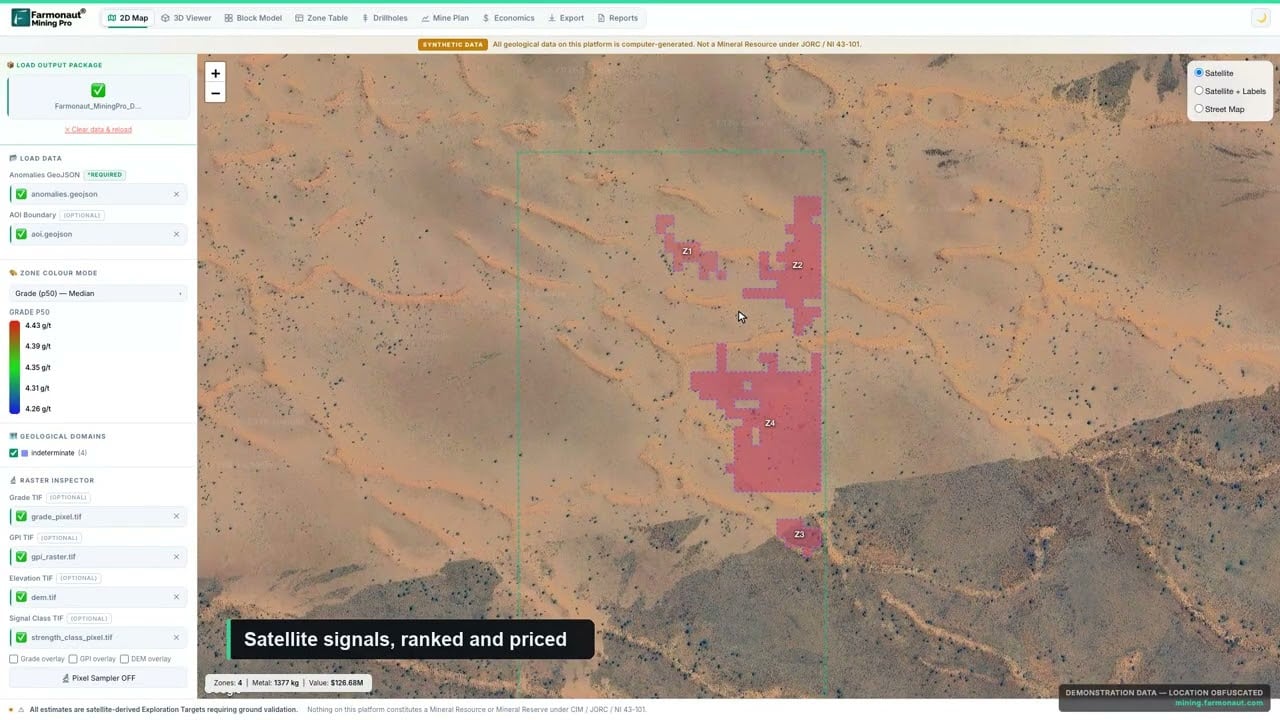
▶ A walk through Farmonaut Mining Pro, which turns a license boundary into a satellite-based exploration picture. · 4:56
Frequently asked questions
Is suction dredging legal in Washington?
Yes, in limited places. Motorized and gravity-siphon mining is banned in salmon, steelhead and bull trout critical habitat and in fresh waters designated for salmon spawning, rearing and migration. Outside those waters you need a written WDFW HPA and an Ecology individual NPDES permit.
Do I need a permit to pan for gold in Washington?
Panning is covered by the Gold and Fish pamphlet, so it needs no separate application. You still need landowner permission, and you must follow the pamphlet’s rules, such as no digging inside the wetted perimeter. Check each agency’s rules where the land is federal, state, tribal or a park.
What size suction dredge is legal in Washington?
The nozzle may be 5 inches or less and never above 5.25 inches, and the hose may be no more than 1 inch larger than the nozzle (WAC 220-660-305). A 6-inch dredge is over the limit.
How long does a Washington dredging permit take?
Ecology says to apply for the NPDES permit at least 180 days before the start of mining. WDFW’s HPA is a second application that needs the NPDES permit or an Ecology letter attached, so plan for the full 180 days. A 2019 WDFW release said it has up to 45 days to approve or deny a complete HPA application, so ask WDFW for its current timeline.
Is there a general permit for suction dredging in Washington?
We found none. Ecology offers an individual NPDES permit for this activity, unlike Oregon and Idaho, which have general permits. Ask Ecology for the current position before you apply.
When is the gold dredging season in Washington?
For pamphlet methods it is the county or stream window in the authorized work times table, for example 1 July to 15 August in Okanogan County. For motorized dredging the dates are written into your individual HPA.
Which Washington counties allow motorized mining?
Ecology lists possible locations in Adams, Benton, Clallam, Grant, Grays Harbor, Lincoln, Pacific, Spokane, Whitman and Yakima counties. A location there is only possible, and each application is reviewed on its own merits.
Can I use a sluice box or high-banker in Washington?
Yes, if it is non-motorized and fits the pamphlet: a sluice or mini high-banker with a riffle area of 3 square feet or less year-round, or up to 10 square feet inside the work window. A motorized high-banker or one fed by a siphon needs a written HPA.
What is the penalty for dredging without a permit in Washington?
Working without a required HPA is a gross misdemeanor under RCW 77.15.300. The pamphlet gives the maximum as one year in jail (364 days under RCW 9A.20.021) and a $5,000 fine. Breaking the pamphlet’s rules can also bring a civil penalty of up to $10,000 per day.
Does a mining claim let me dredge a creek?
No. A claim gives mineral rights on federal land, but the state HPA, Ecology’s rules and the agencies’ land rules still apply. The state generally owns the stream channel below the high-water mark, and BLM asks for a Notice of Intent or Plan of Operations when a state HPA is required.
Is gold mining allowed on Washington state trust land or in state parks?
No for placer mining on state trust lands, and not in streams inside any state park. State-owned aquatic lands need a JARPA application to the Department of Natural Resources.
Can I use mercury to recover gold in Washington?
You should not. Gravity methods do not need it, and Ecology has worked with miners to recover old mercury from Washington streams. Report any liquid mercury you find to Ecology.
This page is for information only. It is not legal advice; confirm with WDFW/Ecology before you apply or work. Get landowner permission, hold the required permits and never use mercury.
Farmonaut mining
Get a quote to map your claim from space
License and claim owners can request a quote for a satellite exploration screen of their area, as an exploration target ahead of any resource estimate.

Mining Pro sample view, synthetic data
Keep reading
Sources
- WDFW, Gold and Fish: Rules for Mineral Prospecting and Placer Mining (May 2021): wdfw.wa.gov
- WDFW, Rules for mineral prospecting and placer mining: wdfw.wa.gov
- WDFW, Hydraulic code and motorized aquatic mining rulemaking: wdfw.wa.gov
- WDFW, news release on suction dredging HPAs (3 June 2019, archived): wdfw.wa.gov
- Ecology, Mineral prospecting and placer mining: ecology.wa.gov
- Ecology, Motorized and gravity siphon aquatic mining FAQ (ESHB 1261): ecology.wa.gov
- Washington Legislature, WAC 220-660-305: app.leg.wa.gov
- Washington Legislature, RCW 77.15.300: app.leg.wa.gov
- Washington Legislature, RCW 90.48.615: app.leg.wa.gov
- Washington DNR, Placer Gold Mining in Washington (Moen, 1979): dnr.wa.gov
- USGS, Mineral Commodity Summaries 2026: Gold: pubs.usgs.gov
- Ecology, Quality assurance project plan: mercury from historic gold mining on six rivers (2009): apps.ecology.wa.gov
- Oregon DEQ, 700-PM general permit fact sheet: oregon.gov
- Idaho DEQ, IPDES general permit for small suction dredge mining (24 May 2024): deq.idaho.gov
- California Department of Fish and Wildlife, Suction dredge permits: wildlife.ca.gov
- Keene Engineering, 5-inch dredge field test report (undated): keeneeng.com
Discussion
Questions, corrections or field experience? Share them below. First-time comments are reviewed before they appear, and your email is never published.
No comments yet. Be the first to add a question or your experience.

 Lithspo Minerals Limited
 Tintina Mining Group
 Dalgety Minerals Pty Ltd
 Vortex Minerals Pty Ltd
 Faith At Work (Pty) Ltd
 Geotech Mining Solutions plc
 Vulcan International Limited
 Kidepo Associates
 GKY Mining
 Alkimy SARL
 Double A Trading
 GemSprout Metals Limited
 Qader Group
 Ileys General Trading
 SG Gold Mining LLC
 VRV Global Pte Ltd
 Omsri International FZE
 G.I.T.T.
 Jaunita Erss Ltd
 Almosi SARL
 SRK Consulting
 Berks Gold Limited
 Mwerezi Minerals Company Limited

 Exploration consultancy · South Africa · Gold










