

Nevada gold · Mine profile
Round Mountain Gold Mine Nevada: Output and Phase X Plan
Round Mountain, in Nye County, Nevada, is a Kinross gold mine that produced 143,402 gold-equivalent ounces in 2025 and has 1.9 million ounces of reserves. See the geology, quarterly output, costs and the Phase X underground plan.
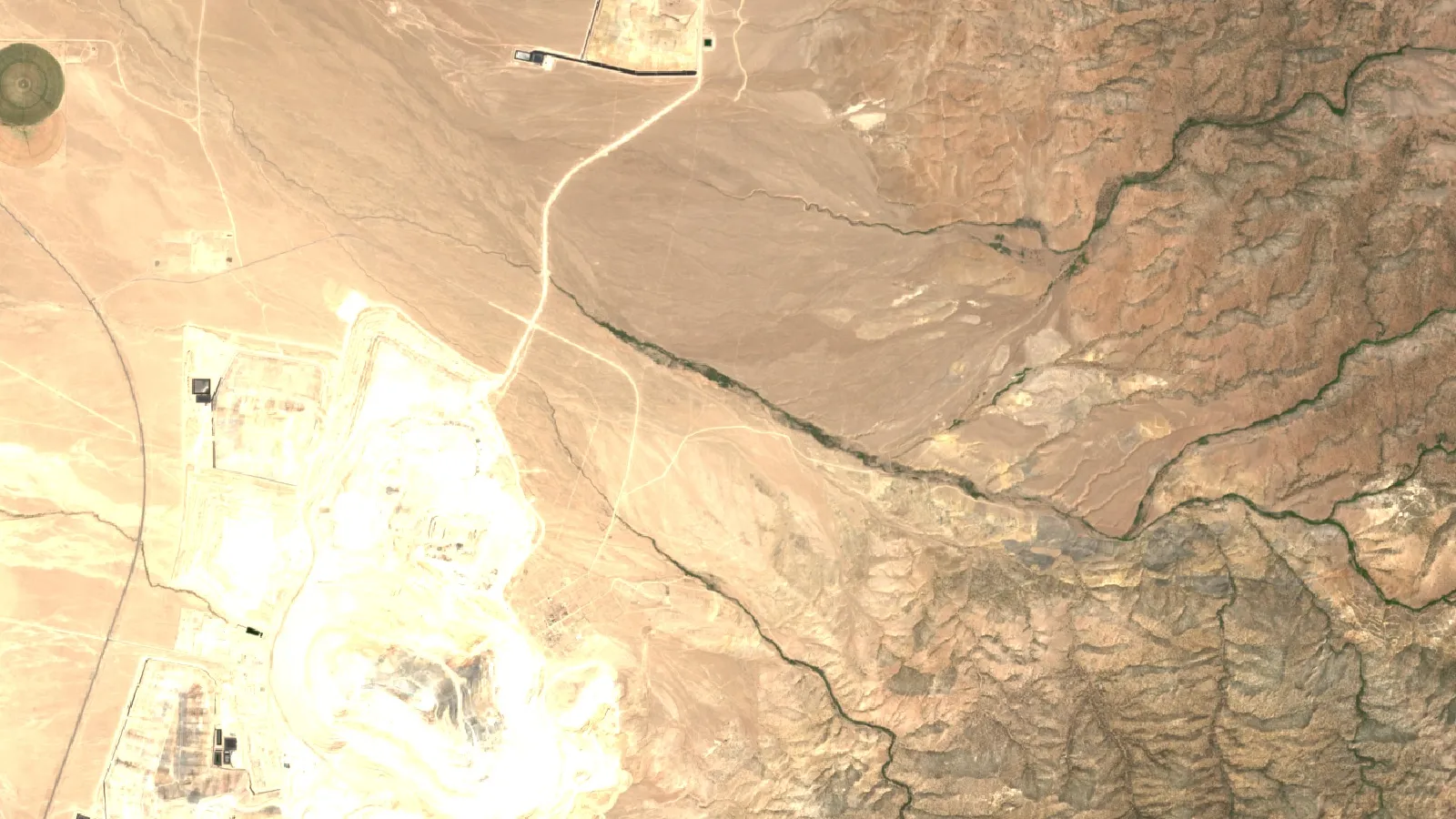
Key takeaways
- Kinross owns 100% of Round Mountain, in the Big Smoky Valley, Nye County, about 50 miles north of Tonopah (Kinross, 2025; NBMG).
- Output fell from 215,387 gold-equivalent ounces in 2024 to 143,402 in 2025, and the first half of 2026 produced 45,989, against 74,351 in the first half of 2025 (Kinross).
- Reserves were 1,888,000 ounces of gold at 1.3 g/t on 31 December 2025 (Kinross, February 2026).
- Phase X underground is planned to average about 140,000 gold-equivalent ounces a year from 2029 to 2037 and extend the mine life to 2038 (Kinross, January 2026).
- The deposit formed in a collapsed volcanic crater about 26 million years ago and, counting gold already mined plus reserves, had at least 16 million ounces of gold as of 1996 (Henry and others, 1997).
In this article
- Round Mountain gold mine at a glance
- Where Round Mountain is and who owns it
- How the gold deposit formed
- How ore is mined and processed
- Gold production and costs, quarter by quarter
- Reserves and resources: how much gold is left
- Phase X underground: what changes below the pit
- Water, mercury and reclamation
- Jobs, taxes and the local economy
- Where satellite data fits in Nevada gold exploration
- Frequently asked questions
Round Mountain gold mine at a glance
Round Mountain is a large gold mine in Nye County, Nevada, owned and operated by Kinross Gold. It produced 143,402 gold-equivalent ounces in 2025, down from 215,387 in 2024, and Kinross reported proven and probable gold reserves of 1,888,000 ounces at the end of 2025 (Kinross, 2025 fourth-quarter and full-year results). A gold-equivalent ounce adds the small amount of by-product silver to the gold, converted at a set ratio. In January 2026 Kinross approved an underground mine called Phase X below the old pit, which extends the mine life to 2038.
This page collects the numbers people search for when they look up the mine: where it is, who owns it, what the rock is, how the ore is processed, what it produced quarter by quarter, how much gold is left and what the new underground plan changes. Every figure carries its source and date.
| Item | What the sources show | Source and date |
|---|---|---|
| Location | Western slope of the Toquima Range, Big Smoky Valley, Nye County, about 50 miles north of Tonopah | Nevada Bureau of Mines and Geology |
| Owner | Kinross Gold, 100% | Kinross reserve statement, 31 December 2025 |
| Mining | Open pit today (Phase S); underground Phase X under development | Kinross, January 2026 and Q2 2026 |
| Processing | Mill plus heap leach pads | Kinross site report, 2021; Kinross, 2025 |
| 2025 output | 143,402 gold-equivalent ounces | Kinross, February 2026 |
| Reserves | 45.1 million tonnes at 1.3 g/t, 1,888,000 ounces of gold | Kinross, 31 December 2025 |
| Total endowment | At least 16 million ounces of gold (production plus reserves, as of 1996) | Henry and others, Economic Geology, 1997 |
Grade is the amount of gold in a tonne of rock, written in grams per tonne (g/t). One ounce is 31.1035 grams. At 1 g/t, a tonne of ore holds a little under 0.03 ounces of gold, which is why a mine like this must move a very large amount of rock.
Where Round Mountain is and who owns it
The mining district sits on the western slope of the Toquima Range in Nye County, about 50 miles north of Tonopah (Nevada Bureau of Mines and Geology, Bulletin 100). The town of Round Mountain and the mine are in the Big Smoky Valley, a remote part of central Nevada. The answer to “what county is Round Mountain, NV in” is Nye County.
Kinross already owned half of the mine when, in January 2016, it completed the purchase of Barrick’s 50% share of Round Mountain, together with the Bald Mountain mine, for US$610 million, which made Kinross the sole owner of Round Mountain (Associated Press via KNPR, January 2016). Kinross’ 2025 reserve statement lists its interest at 100%. The statement treats the Round Mountain deposit and the nearby Gold Hill deposit as one project; the silver comes only from Gold Hill.
Nevada as a whole is the center of United States gold mining. The USGS estimates that Nevada produced about 64% of domestic gold in 2025, from a national total of about 160 tonnes (USGS, Mineral Commodity Summaries 2026, Gold). On our arithmetic, 143,402 ounces is about 4.5 tonnes, or roughly 4% of Nevada’s estimated output. That is an approximation, because Kinross reports gold-equivalent ounces and the USGS reports gold. For other Nevada districts and how claims are dated, see our guide to gold deposits in Nevada.
How the gold deposit formed
Round Mountain is an epithermal deposit. Epithermal means the gold was laid down by hot water close to the surface, at shallow depth and relatively low temperature. It is hosted in volcanic rock rather than in a granite or a sedimentary basin.
Geologists from the Nevada Bureau of Mines and Geology, New Mexico Tech and the mine itself described it as one of the largest volcanic-hosted precious metal deposits in the world, with reserves plus production of at least 16 million ounces of gold. The gold sits in a thick ash-flow tuff (a rock made of welded volcanic ash) that filled a collapsed volcanic crater, called a caldera, along its ring fracture (Henry and others, Economic Geology, 1997).
The same paper dated the event with argon isotopes. The caldera collapsed about 26.5 million years ago. Nine samples of the mineral adularia, which formed with the gold, average 26.03 million years, and the authors conclude the hot-water system lasted a very short time, most likely about 100,000 years. Earlier USGS work set the geologic history of the Round Mountain and Manhattan districts in the same frame, with granite intrusions about 95 million years old to the southeast (Shawe and others, USGS, Economic Geology, 1986).
Why it matters for the mine: the gold is spread through a very large volume of rock at a low grade, and the faults and the ring fracture control where the richer zones lie. That is the reason the open pit moves large tonnages at low grade, and the reason the new underground plan targets a narrower, higher-grade zone below the pit.
How ore is mined and processed
Kinross describes Round Mountain as a conventional open-pit operation that treats ore by mill and by heap leach (Kinross, 2021 site report). The two routes suit different grades.
- Mill. Higher-grade ore is crushed and ground, and the gold is dissolved in a cyanide solution and recovered. A mill gives a higher share of the gold but costs more per tonne. In the fourth quarter of 2025 the mill treated about 966,000 tonnes at 0.49 g/t.
- Heap leach. Lower-grade ore is stacked on a lined pad and sprinkled with leach solution, which slowly dissolves the gold. It is cheap per tonne, and slower. In the same quarter about 1.1 million tonnes went to the heap at 0.29 g/t (Kinross, February 2026).
Kinross has said it expects to place the last tonne of ore on the Round Mountain leach pads in 2028 (Kinross, third-quarter 2025 report). Gold keeps draining from pads for some time after stacking ends. After 2028 the ore is expected to go to the mill only, which is why the higher-grade underground ore matters.
The pit has moved through numbered stages called phases. Phase W finished in the third quarter of 2025, and Phase S ore began in the same quarter (Kinross, February 2026). Stripping means removing waste rock to uncover ore. For a general walk-through of how gold is recovered from rock, see our guide to gold extraction methods.
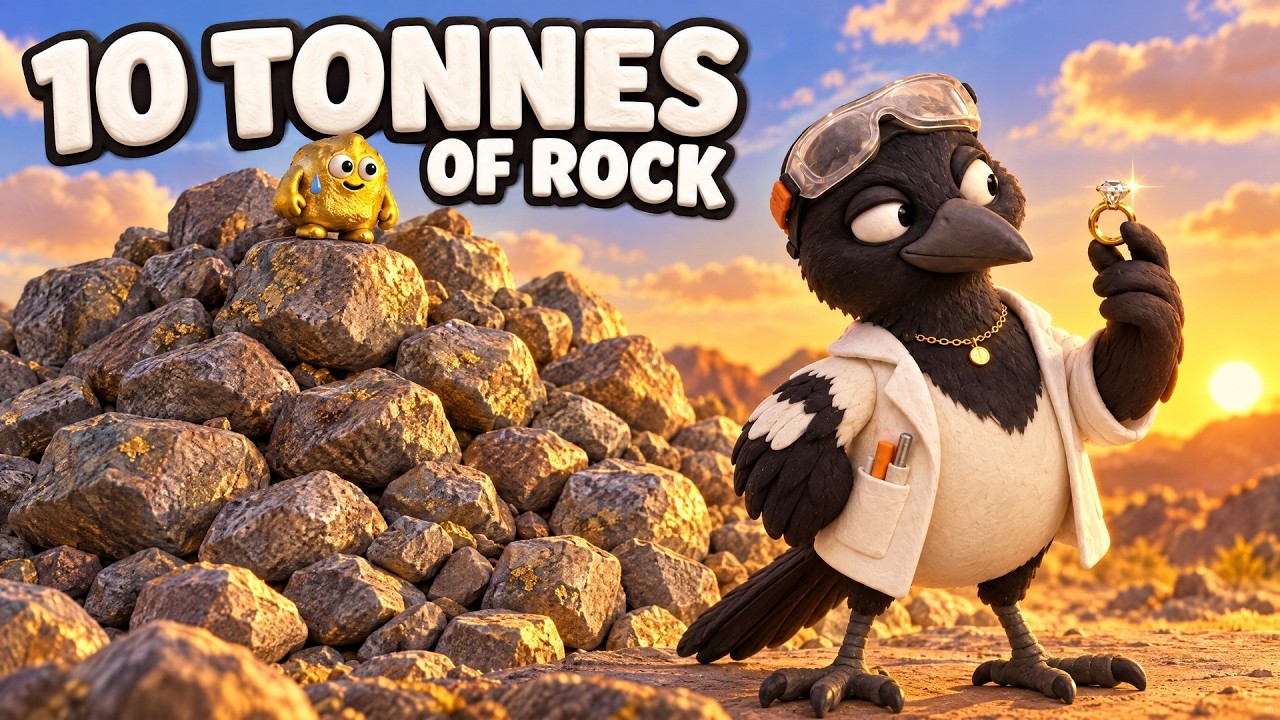
▶ A clay nugget follows gold from rock to ring: found, drilled, crushed, dissolved and refined. · 5:27
Gold production and costs, quarter by quarter
Production at Round Mountain has fallen since 2024, and the cost of each ounce has risen. Kinross reported 42,969 gold-equivalent ounces in the fourth quarter of 2024 and 19,789 in the second quarter of 2026. Over the first half of 2026 the mine produced 45,989 ounces, against 74,351 in the first half of 2025 (Kinross, second-quarter 2026 results).
Chart
Production cost of sales per ounce sold
US$ per gold-equivalent ounce sold, by quarter
Chart
Round Mountain quarterly production
Thousand gold-equivalent ounces produced, 100% basis
The company’s own explanation is mine sequencing. Phase W was mined out in the third quarter of 2025, and the site moved to the start of Phase S ore, with lower mill grades and fewer ounces stacked on the heap leach pads. In the 2026 results Kinross says Round Mountain is in a phase of higher waste mining and lower-grade, lower-volume ore supply while it strips Phase S, and that higher-grade, higher-recovery ore is expected from Phase S in the second half of the year. That is a forecast, not a result.
Mill recovery, the share of gold recovered from mill feed, fell with the grade: 80% in the second quarter of 2025, 72% in the third, 67% in the fourth, 52% in the first quarter of 2026 and 44% in the second quarter of 2026 (Kinross quarterly results; heap leach recovery is not measured quarterly).
Production cost of sales per ounce sold is the cost of mining and processing divided by the ounces sold. It rises when ounces fall, because a large part of the cost is fixed. For the full year it was US$1,918 per ounce in 2025 against US$1,527 in 2024 (Kinross, February 2026). It is not the same as all-in sustaining cost, which also adds overhead and the capital needed to keep the mine running.
If this topic matters to you, read El Dorado Mine Nevada: Techatticup History and Output next.
Reserves and resources: how much gold is left
Reserves and resources are different things. A reserve is the part of a deposit that a company has shown can be mined at a profit with current plans and prices. A resource is mineralized rock that has reasonable prospects of being mined, with less certainty. Measured and indicated resources are better known than inferred resources, which are too uncertain to count as reserves.
Chart
Gold at Round Mountain, 31 December 2025
Thousand ounces of gold, Kinross 100% share
At 31 December 2025 Kinross reported for Round Mountain, on a 100% basis (Kinross, February 2026):
- Proven and probable reserves: 45,055 thousand tonnes at 1.3 g/t, containing 1,888 thousand ounces of gold.
- Indicated resources, in addition to the reserves: 81,275 thousand tonnes at 0.6 g/t, containing 1,446 thousand ounces.
- Inferred resources: 61,269 thousand tonnes at 1.0 g/t, containing 1,960 thousand ounces.
The 2025 update reflects the switch to underground mining. Kinross says higher-margin underground reserves at 3.2 g/t replaced lower-margin open-pit reserves at 0.8 g/t, and that the remaining low-grade, high-strip-ratio open-pit resource was removed. That means a smaller total resource, but a better one. Kinross also reports that Phase X underground drilling in 2025 (about 28,000 metres) included intercepts such as 140 metres at 4.4 g/t gold equivalent and 23 metres at 37.5 g/t gold equivalent, and that step-out drilling continues down-dip to look for more (Kinross, exploration release, February 2026). Drill intercepts are measured along the hole, not across the true width of the zone.
Phase X underground: what changes below the pit
Phase X is a bulk-tonnage underground mine below the Phase W pit. Kinross announced the construction decision on 15 January 2026. It reported the following plan figures, which it calls preliminary and which are partly based on inferred resources (Kinross, 15 January 2026):
Chart
Grade today and under the Phase X plan
Grams of gold per tonne
- About 1.4 million incremental gold-equivalent ounces, averaging about 140,000 ounces a year from 2029 to 2037, with first production in 2028 and the mine life extended to 2038.
- Initial capital of about US$400 million over four years: US$240 million for development and equipment, US$90 million for infrastructure and US$70 million for indirect costs and contingency.
- All-in sustaining cost (AISC, which adds overhead and sustaining capital to operating cost) of US$1,680 per gold-equivalent ounce at US$4,300 gold and US$1,590 at US$3,200 gold.
- Peak mining rate of 4,800 tonnes a day, with ore treated in the existing 10,000-tonne-a-day mill, at an average processed grade of 3.0 g/t and an average recovery of 88%.
- Long-hole open stoping with paste backfill, in a zone averaging 120 metres wide. In this method, large blocks are drilled and blasted from below, and the empty space is filled with a paste of tailings and binder so the rock stays stable.
- At US$4,300 an ounce, an after-tax net present value of US$1,881 million at a 5% discount rate, an internal rate of return of 67% and a payback of 1.9 years. At US$3,200 an ounce the figures are US$1,044 million, 40% and 3.0 years.
The net present value is today’s value of future cash flows after discounting; the internal rate of return is the discount rate at which that value falls to zero. Both depend heavily on the gold price Kinross assumes. For 2026 Kinross budgets about US$100 million of non-sustaining capital on Phase X. As of the second quarter of 2026, underground development was advancing slightly ahead of schedule, with more than 8,400 metres developed (Kinross, second-quarter 2026 results). Kinross also lists the project among three U.S. growth projects expected to start contributing in 2028.
The calculator below shows how tonnes, grade and recovery turn into ounces. The defaults are rounded from the Phase X plan figures above, and they are examples, not a forecast.
Calculator
How many ounces does a daily ore rate produce?
Enter your own ore rate, grade, recovery and price to see recovered ounces and revenue.
- Gold recovered per day (oz): 407
- Revenue per year (US$): $594,824,377
Example values rounded from the Kinross Phase X plan (4,800 tonnes a day, 3.0 g/t, 88% recovery; Kinross, 15 January 2026). They are examples, not a forecast or a mine plan. Prices are inputs: use today’s price.
Water, mercury and reclamation
Kinross’ most detailed site-level environmental figures are in its 2021 site report. It says the mine recycled 93% of the water it consumed, discharged 10 million cubic metres of water from pit dewatering back into groundwater through a rapid infiltration system, and installed carbon scrubbers to meet state mercury emission standards (Kinross, 2021 site report). Gold ore can carry mercury, which is released when it is heated, so scrubbers on process off-gas matter at this type of mine. Those figures are three or more years old and should not be read as current performance.
Mine closure costs are a normal part of any plan. Reclamation means regrading the land, covering waste and heap leach material, and restoring vegetation, and the operator must post financial assurance with the regulators. For a plain description of the main impacts of mining on land and water, the video below explains seven of them.

▶ The seven main environmental impacts of mining, explained in plain words. · 2:31
Jobs, taxes and the local economy
The same 2021 site report gives the last detailed local figures. It lists 864 employees and 128 contractors, US$127.8 million in wages and benefits, US$287.3 million in local procurement and US$23.7 million in payments to governments. It states that property taxes of US$9.6 million were about 40% of Nye County property tax revenue, which made Round Mountain the county’s largest private tax contributor (Kinross, 2021 site report). These are 2021 numbers and may differ today.
The Phase X plan keeps the site employing people past the end of heap leach stacking. Kinross says most of the capital development in 2026 to 2028 will be done by a mining contractor.
Where satellite data fits in Nevada gold exploration
A satellite cannot see gold in the ground. It can see the rock and soil changes around a gold system: iron-oxide staining, clay and silica alteration, and the faults that channel fluids. Those are the same kinds of clues that the studies of Round Mountain describe, an altered volcanic system controlled by a ring fracture. Farmonaut combines multi-sensor satellite data and elevation models to map those signs inside a licence area and rank targets before drilling. The results are exploration targets, not a resource estimate.
If you are screening ground in Nevada or the wider United States, our overview of satellite gold exploration in the United States covers the method and its limits, and the satellite-based mineral detection page describes the service. You can send a mining query with your area, or contact us for a quote.

▶ Satellites cannot see gold, but they map the rock changes around it. This video explains how. · 4:25
Frequently asked questions
Where is the Round Mountain gold mine in Nevada?
It is in the Big Smoky Valley on the western slope of the Toquima Range in Nye County, about 50 miles north of Tonopah, according to the Nevada Bureau of Mines and Geology.
What county is Round Mountain, NV in?
Round Mountain is in Nye County, central Nevada.
Who owns the Round Mountain mine?
Kinross Gold owns 100% of Round Mountain. It bought Barrick’s 50% share in January 2016 and now holds the whole mine.
How much gold does Round Mountain produce?
Kinross reported 143,402 gold-equivalent ounces for 2025 and 215,387 for 2024. In the first half of 2026 it reported 45,989 ounces. The fall reflects the move from Phase W to Phase S.
How much gold is left at Round Mountain?
At 31 December 2025 Kinross reported 1,888,000 ounces of gold in proven and probable reserves, 1,446,000 ounces of indicated resources in addition to reserves and 1,960,000 ounces of inferred resources. Reserves can change with plans, grades and gold prices.
Is Round Mountain an open-pit or underground mine?
It is an open-pit mine today. Kinross is building an underground mine, Phase X, below the Phase W pit, with first production planned for 2028.
What is Phase X at Round Mountain?
Phase X is a bulk-tonnage underground project that Kinross approved in January 2026. It targets about 1.4 million gold-equivalent ounces at an average grade of 3.0 g/t and extends the mine life to 2038, on the company’s preliminary economics.
How is gold recovered at Round Mountain?
Higher-grade ore goes through a mill and lower-grade ore is stacked on lined heap leach pads. Both use a leach solution to dissolve the gold, which is then recovered from the solution.
Why did the cost per ounce rise at Round Mountain?
Kinross attributes lower production to mine sequencing and stripping of Phase S, with lower grades and less ore stacked. Because many costs are fixed, fewer ounces sold raises the cost of each ounce. Cost of sales was US$3,360 per ounce sold in the second quarter of 2026.
What type of gold deposit is Round Mountain?
It is a volcanic-hosted epithermal gold-silver deposit in ash-flow tuff inside a collapsed caldera, with gold dated to about 26 million years ago.
How important is Nevada to U.S. gold production?
The USGS estimates Nevada produced about 64% of U.S. mined gold in 2025, ahead of Alaska at about 22%.
Can satellite data find a deposit like Round Mountain?
Satellite data can map alteration minerals and structures that point to areas worth sampling. It cannot measure gold content, so drilling and assay work still decide whether a target holds a resource.
This page is for information only. It is not investment advice. It names no security to buy or sell. Company figures are as reported by Kinross on the dates shown and may change.
Farmonaut mining
Map your own project area from space
Farmonaut maps alteration and structure inside a licence area so consultants can rank exploration targets before drilling.

Mining Pro sample view, synthetic data
Keep reading
Sources
- Kinross Gold, 2025 fourth-quarter and full-year results (February 2026): kinross.com
- Kinross Gold, 2026 second-quarter results: s204.q4cdn.com
- Kinross Gold, Phase X, Curlew and Redbird 2 construction release (15 January 2026): kinross.com
- Kinross Gold, third-quarter 2025 report: s204.q4cdn.com
- Kinross Gold, 2025 year-end exploration release: s204.q4cdn.com
- Kinross Gold, 2021 site report: Round Mountain: s204.q4cdn.com
- Henry and others, Brief duration of hydrothermal activity at Round Mountain, Economic Geology (1997): pyrite.utah.edu
- Shawe and others, USGS, Ages of igneous and hydrothermal events in the Round Mountain and Manhattan districts (1986): pubs.usgs.gov
- Nevada Bureau of Mines and Geology, Bulletin 100: Lode gold deposits of Round Mountain: pubs.nbmg.unr.edu
- Associated Press via KNPR, Barrick sells two Nevada mines to Kinross (January 2016): knpr.org
- USGS, Mineral Commodity Summaries 2026: Gold (February 2026): pubs.usgs.gov
Discussion
Questions, corrections or field experience? Share them below. First-time comments are reviewed before they appear, and your email is never published.
No comments yet. Be the first to add a question or your experience.

 Enterprise Takreem
 Sean Mining Limited
 NTS Group (Pty) Ltd
 Mine4Africa
 Lithspo Minerals Limited
 Tintina Mining Group
 Dalgety Minerals Pty Ltd
 Vortex Minerals Pty Ltd
 Faith At Work (Pty) Ltd
 Geotech Mining Solutions plc
 Vulcan International Limited
 Kidepo Associates
 GKY Mining
 Alkimy SARL
 Double A Trading
 GemSprout Metals Limited
 Qader Group
 Ileys General Trading
 SG Gold Mining LLC
 VRV Global Pte Ltd
 Omsri International FZE
 G.I.T.T.
 Jaunita Erss Ltd
 SRK Consulting
 Berks Gold Limited











