

Gold geology · Fool's gold field tests
Does Pyrite Contain Gold? 5 Tests to Tell Real Gold
Sometimes. Pyrite in gold deposits can hold microscopic or ‘invisible’ gold, in rare cases 0.25% by weight, but most pyrite carries little; only an assay tells you, and five quick tests separate it from real gold.
Key takeaways
- Pyrite (FeS2) can host gold as tiny inclusions or as atoms in its crystal, mostly in arsenic-rich pyrite.
- Reich et al. (2005) found a solid-solution limit near one gold atom per 50 arsenic atoms in arsenian pyrite.
- Gold streaks yellow, dents under a needle and has a specific gravity of 19.3; pyrite streaks greenish-black, is brittle and near 5.
- Gold locked in pyrite is refractory: a 2025 study recovered 98.4% only after acidic pressure oxidation.
- Pyrite grade and rock grade differ: 3% pyrite at 50 g/t gives about 1.5 g/t rock.
In this article
- Does pyrite contain gold? The short answer
- Can pyrite and gold be found together?
- Is gold found near pyrite? What the signs mean
- How to identify pyrite
- 5 expert ways to tell real gold from pyrite
- Gold vs pyrite vs other fool's gold: comparison table
- How gold is recovered from pyrite
- How much gold can pyrite hold? Grades and value
- What to check before you treat pyrite as gold ore
- Frequently asked questions
Yes, pyrite can contain gold, but usually only in tiny amounts you cannot see. In many gold deposits the gold sits inside pyrite crystals as microscopic grains or as atoms locked into the crystal structure, which geologists call “invisible gold”. Geology.com notes that some pyrite holds 0.25% gold by weight or more, enough to be mined, while most pyrite in ordinary rocks holds little or none. A shiny cube of “fool’s gold” on its own tells you nothing about grade; only a laboratory assay does.
This guide explains when pyrite carries gold and when it does not, gives five field tests that separate real gold from pyrite in a few minutes, and shows how mines recover gold that is locked inside sulfide minerals. It ends with a calculator that turns an assay result into ounces and a gross value.
Does pyrite contain gold? The short answer
Pyrite is iron sulfide, FeS2. Pure pyrite has no gold in its formula. Gold enters it in two ways when both minerals grow from the same hot, metal-rich fluids:
- Inclusions: small specks of native gold trapped inside or along cracks in the pyrite crystal, often a few microns across.
- Solid solution: single gold atoms built into the crystal lattice, usually in pyrite that also carries arsenic (arsenian pyrite). This gold cannot be seen even under an ordinary microscope; it is found only by chemical analysis.
Arsenic matters because it opens space in the crystal for gold. A widely cited study of arsenian pyrite by Reich and co-authors (Geochimica et Cosmochimica Acta, 2005) found an upper limit for gold held in solid solution of about one gold atom for every 50 arsenic atoms (Au/As of about 0.02). Pyrite with more gold than that limit contains native gold nanoparticles instead. In practice, arsenic-rich pyrite is the type most likely to carry gold, and arsenic is one of the first elements a laboratory reports alongside gold.
So the honest answer for a prospector or a consultant is: pyrite is a common companion of gold and sometimes its main host, but its presence is a reason to sample, not proof of value.
Can pyrite and gold be found together?
Yes, very often. Gold and pyrite form under similar conditions and occur in the same rocks. The US Geological Survey lists pyrite as the mineral most often mistaken for gold, precisely because prospectors meet it in the same places. The settings where the two are found together include:
- Orogenic quartz veins: gold-bearing quartz veins in old metamorphic belts commonly carry a few per cent pyrite and arsenopyrite. Visible gold may sit next to the pyrite, and more gold may be hidden inside it.
- Carlin-type deposits: sediment-hosted deposits in Nevada where nearly all the gold is invisible and held in arsenic-rich pyrite rims. Most of the gold mines in the Great Basin belong to this type.
- Porphyry copper-gold and epithermal systems: pyrite is the most abundant sulfide in the altered rock around these systems; only some zones carry gold worth mining.
- Volcanic-hosted massive sulfide (VMS) deposits: large bodies of pyrite with copper, zinc and lead, where gold is usually a by-product.
- Black shales and coal: pyrite is abundant but normally barren. This is the main case where a lot of pyrite means very little gold.
The deposit type explains the grade more than the amount of pyrite does. Our guide to types of ore deposits compares their grades and sizes. For mining consultants, the useful field question is not “is there pyrite?” but “what kind of pyrite, in what host rock, next to what alteration?”
Is gold found near pyrite? What the signs mean
Where pyrite reaches the surface, it rusts. Oxygen and water break it down into iron oxides and sulfuric acid, which stains the rock orange, red and brown. Geologists call a rusty, iron-rich cap over sulfides a gossan. In an oxidised zone the pyrite has gone, but the gold it held is released, often as fine particles that are easier to recover than the gold still locked in fresh pyrite below.
That has three practical points for anyone checking ground:
- Rusty, leached outcrops above a vein are worth sampling, because they may sit over a sulfide zone.
- Cube-shaped holes in rock (boxwork) show where pyrite crystals weathered away; gold sometimes remains in or near them.
- Fresh, unweathered pyrite deeper down may hold gold that standard processing cannot reach (see the processing section below).
The same oxidation is behind acid mine drainage, so pyrite-rich waste rock needs careful handling on any mine site.
▶ How satellites map iron staining and clay alteration around gold systems. · 4:25
How to identify pyrite
Pyrite is pale brass-yellow, with a bright metallic lustre that tarnishes darker over time. It usually forms sharp cubes, eight-sided crystals (octahedrons) or twelve-sided “pyritohedrons”, and the faces of the cubes often carry fine parallel lines called striations. It is hard (about 6 to 6.5 on the Mohs scale of 1 to 10), brittle, and breaks with an uneven surface. It is fairly heavy for a mineral, at a specific gravity of about 5, meaning it weighs about five times as much as the same volume of water.
Two other minerals are also called fool’s gold. Chalcopyrite, a copper-iron sulfide, is a deeper, more golden yellow, often tarnishes to purple or blue, and is softer than pyrite. Weathered mica (biotite or muscovite flakes) can shine gold in a stream but is very light and splits into thin sheets.
Is pyrite magnetic? Not in any useful way. Pyrite is only very weakly magnetic, so a hand magnet does not pick it up. A magnet does pick up magnetite in black sand, which is why panners use one to clean concentrates; it does not separate pyrite from gold.
▶ Arkansas’s 1880s gold boom, and the pyrite that fooled it. · 6:31
5 expert ways to tell real gold from pyrite
These five tests need nothing more than a pocket knife, a needle, a piece of unglazed porcelain and a gold pan. Used together they separate gold from pyrite with near certainty.
Chart
Mohs hardness of gold and three kinds of fool’s gold
Mohs scale, 1 (talc) to 10 (diamond)
1. The streak test
Rub the mineral across the back of an unglazed porcelain tile. Gold leaves a golden-yellow streak. Pyrite and chalcopyrite leave a greenish-black to black streak, and mica leaves a white streak, according to the USGS. The streak of pyrite is the single quickest test.
2. The poke or scratch test (malleability)
Press a needle or knife point into the grain. Gold is soft and malleable: it dents or gouges like lead and does not break. Pyrite is brittle: it powders, flakes or crumbles. This also answers a common search: gold’s texture is malleable and ductile, not brittle. Pyrite is brittle.
3. Hardness
Gold is 2.5 to 3 on the Mohs scale, softer than a steel knife. Pyrite is 6 to 6.5, hard enough to scratch glass. If your “gold” scratches glass, it is not gold.
4. Weight and the pan test (specific gravity)
Pure gold has a specific gravity of 19.3, almost four times that of pyrite, according to Geology.com’s gold data. In a pan, gold flakes stay put at the bottom while pyrite and mica wash forward with the lighter sand. Natural gold alloyed with silver is lighter, but still much heavier than any fool’s gold.
5. Shape and how it looks in shade
Gold grains are rounded, flattened or irregular, with no sharp crystal faces. Pyrite forms cubes and other sharp-edged crystals. Gold also looks the same colour in sun and shade, while pyrite and mica glitter in direct light and look dull or grey when shaded. A further laboratory test: pyrite dissolves in concentrated nitric acid and gold does not, as noted in a Washington State placer gold guide. Leave acid tests to a lab.
Gold vs pyrite vs other fool’s gold: comparison table
| Property | Gold | Pyrite | Chalcopyrite | Weathered mica |
|---|---|---|---|---|
| Composition | Au (native metal) | FeS2 | CuFeS2 | Silicate sheets |
| Colour | Butter-yellow, same in shade | Pale brass-yellow | Brass-yellow, tarnishes purple or blue | Gold to silvery, glittery |
| Streak | Golden yellow | Greenish-black to brownish-black | Greenish-black | White |
| Mohs hardness | 2.5 to 3 | 6 to 6.5 | 3.5 to 4 | 2.5 to 3 |
| Specific gravity | 19.3 (pure) | about 4.95 to 5.10 | 4.1 to 4.3 | 2.8 to 2.9 |
| Tenacity | Malleable, bends | Brittle, powders | Brittle | Flexible thin flakes |
| Typical shape | Rounded grains, flakes, nuggets | Cubes, striated faces | Masses, rarely crystals | Flat flakes |
Chart
How heavy is gold compared with fool’s gold?
Specific gravity (times the weight of water); mid-point of published ranges
Sources: USGS; Wikipedia pyrite mineral data; Geology.com mineral pages for gold, chalcopyrite and muscovite.
How gold is recovered from pyrite
Gold locked inside pyrite is called refractory gold: the standard cyanide leach cannot reach it because the sulfide crystal shields it. Exposed gold, by contrast, dissolves directly. To recover refractory gold, mines first destroy the pyrite with one of three pre-treatments, as summarised in a 2025 study in REM International Engineering Journal:
Chart
Gold recovered from a sulfide concentrate by pre-treatment
Per cent of gold recovered by cyanide after pressure oxidation, laboratory tests
- Roasting (calcination): burning the sulfide concentrate in a furnace. Widely used but energy-hungry, and it releases sulfur and arsenic gases that must be captured.
- Pressure oxidation (POX): heating the concentrate with oxygen in an autoclave (a pressure vessel). It fixes arsenic as stable compounds.
- Bacterial oxidation: using bacteria that feed on sulfide to break the pyrite down slowly.
The same study tested a Brazilian sulfide concentrate holding 12% sulfur. Acidic pressure oxidation at 220°C followed by cyanide leaching recovered 98.4% of the gold, about 19 percentage points more than an alkaline version of the process. Carlin-type ores in Nevada are a classic case of refractory gold of this kind. For a small claim owner the message is simpler: gold in pyrite is real gold, but it costs more to get out than gold in an oxidised zone. Our guide to oxidized gold ore covers the cheaper case.
How much gold can pyrite hold? Grades and value
Gold grade is reported in grams per tonne (g/t), which is the same as parts per million (ppm). The range in pyrite is wide:
- Pyrite in barren shale or coal: typically well below 0.1 g/t.
- Pyrite from gold-bearing veins and Carlin-type ore: commonly tens to hundreds of g/t within the pyrite grains themselves, although the whole rock grade is far lower because pyrite is only a few per cent of the rock.
- Exceptional gold-rich pyrite: 0.25% gold, or 2,500 g/t, according to Geology.com.
The point to remember is the difference between the grade of the pyrite and the grade of the rock. A rock with 3% pyrite carrying 50 g/t gold in the pyrite has a whole-rock grade of about 1.5 g/t. That is why a laboratory crushes the whole sample before assaying it. Our guide to assay services for mining explains fire assay and its costs, and the gold element facts page covers why gold is so dense and so rare.
Gold traded at US$4,111 per troy ounce on 9 November 2026, according to Trading Economics. Use the calculator below with your own assay and today’s price.
Calculator
How much gold is in this pyrite-bearing rock?
Enter rock tonnes, pyrite share, gold grade in the pyrite, recovery and price.
- Contained gold (oz): 482
- Gross value of recoverable gold (US$): $1,680,679
Example values only, not a benchmark. Uses 31.1035 grams per troy ounce. Gross value is before mining, processing, royalty and tax. Use your own assay and today’s price.
What to check before you treat pyrite as gold ore
- Send a sample for fire assay, with arsenic in the analysis. Arsenic-rich pyrite is the type most likely to carry gold.
- Log the deposit setting: quartz vein, altered sediment, volcanic sulfide or shale. The setting predicts the grade better than the pyrite does.
- Separate oxide from fresh sulfide ore, because their recovery and cost differ sharply.
- Run a simple leach test before any plant decision: if cyanide recovers little gold from a sample with good assays, the gold is probably locked in the pyrite.
- Drill before you value the ground: fresh pyrite usually lies below the oxidised zone, so core or reverse-circulation holes are needed to see it; our review of drilling technologies in mineral exploration compares the methods.
- Plan waste-rock handling for acid drainage from the first day of any work.
▶ How gold is mined and refined, from rock to ring. · 5:27
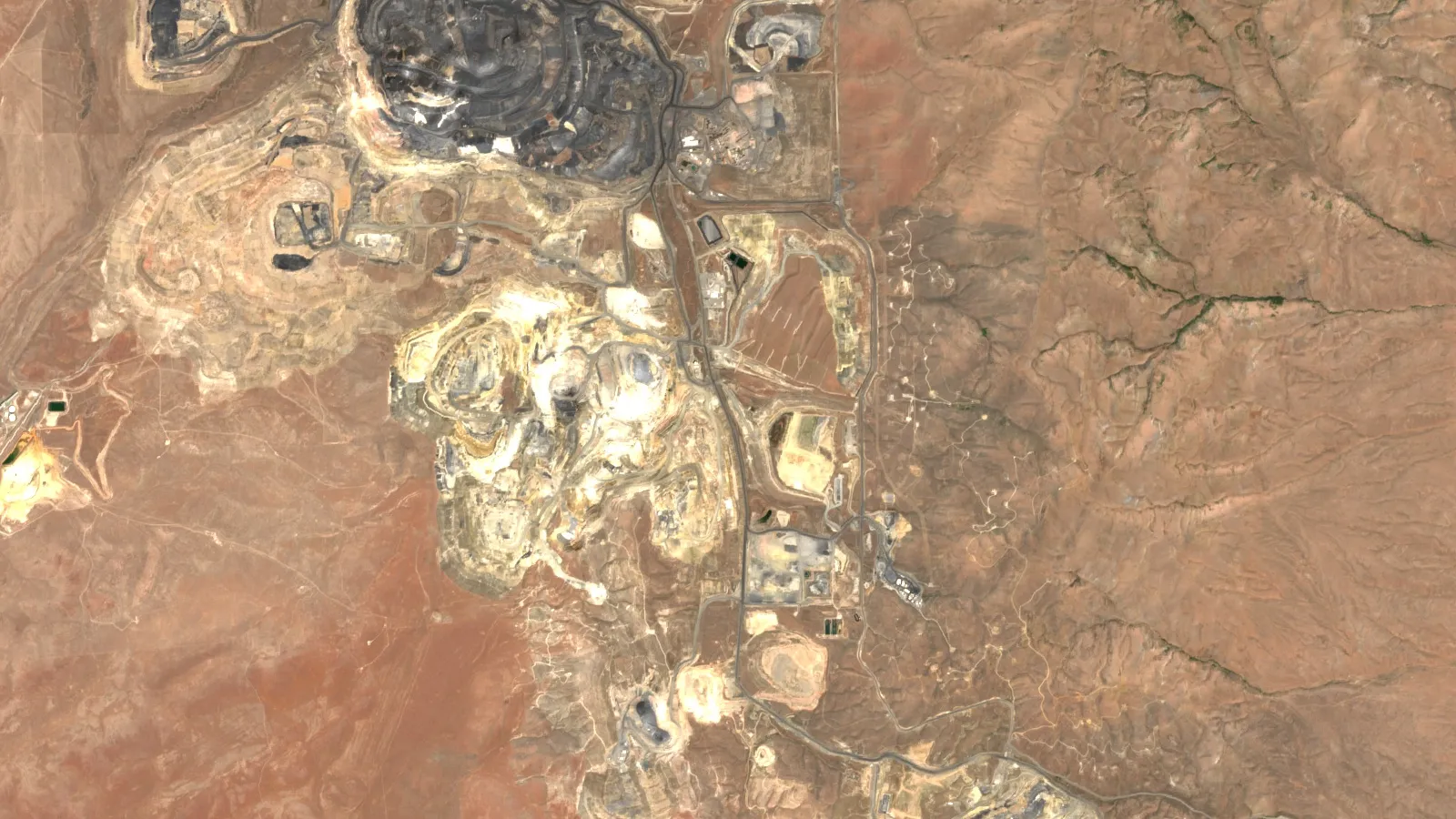
Satellite images help at the screening stage: they map iron-oxide staining and clay alteration over sulfide zones across a whole licence, which shows where to take the first samples. Read how satellite-based mineral detection works, or send us a question about your site (or use our contact page).
Frequently asked questions
Does pyrite contain gold?
Sometimes. Pyrite in gold deposits often holds microscopic gold, either as tiny inclusions or as atoms in the crystal. Pyrite in shale or coal usually holds almost none. Only an assay tells you how much.
Can pyrite contain enough gold to mine?
Yes. Many large mines, including Nevada’s Carlin-type mines, recover most of their gold from pyrite and arsenopyrite after roasting or pressure oxidation.
Where there is pyrite, is there gold?
Not necessarily. Pyrite is one of the most common sulfide minerals on Earth and forms in many rocks with no gold. It is a useful sign only in a gold-bearing setting such as quartz veins or altered sediments.
What is the streak of gold and of pyrite?
Gold leaves a golden-yellow streak on unglazed porcelain. Pyrite leaves a greenish-black to brownish-black streak.
What is pyrite’s hardness on the Mohs scale?
Pyrite is 6 to 6.5 on the Mohs scale, harder than a steel knife. Gold is 2.5 to 3.
What is the specific gravity of pyrite?
About 4.95 to 5.10, compared with 19.3 for pure gold.
Is fool’s gold magnetic?
No. Pyrite is only very weakly magnetic and a hand magnet will not pick it up. Magnetite in black sand is the mineral a magnet attracts.
Is gold malleable, ductile or brittle?
Gold is malleable and ductile: it flattens and bends without breaking. Pyrite is brittle and powders when you press a point into it.
How do you tell pyrite flakes from gold flakes in a pan?
Gold flakes stay at the bottom and keep their colour in shade; pyrite and mica flakes wash forward, glitter in sunlight and look dull in shade. A needle dents gold and breaks pyrite.
What is gold-bearing pyrite called?
Geologists often call it auriferous pyrite. When the gold cannot be leached directly, the ore is called refractory.
Does pyrite contain iron?
Yes. Pyrite is iron sulfide, FeS2, roughly 47% iron and 53% sulfur by weight. It is not used as iron ore because the sulfur is costly to remove.
This page is for information only and is not investment advice. Prospect only with the landowner’s permission and the right licence, never use mercury, and leave acid tests to a laboratory.
Farmonaut mining
Map your mining site from space
Consultants can screen a whole licence for iron-oxide and clay alteration over sulfide zones before choosing where to sample.

Mining Pro sample view, synthetic data
Keep reading
Sources
- USGS, What is Fool’s Gold?: usgs.gov
- Geology.com, Pyrite: geology.com
- Geology.com, Gold: geology.com
- Geology.com, Chalcopyrite: geology.com
- Geology.com, Muscovite: geology.com
- Wikipedia, Pyrite: en.wikipedia.org
- Wikipedia, Carlin-type gold deposit: en.wikipedia.org
- Reich et al. (2005), Solubility of gold in arsenian pyrite, Geochimica et Cosmochimica Acta: repositorio.uchile.cl
- Lemos et al. (2025), Recovery of gold from refractory ore employing pressure oxidation: scielo.br
- Washington DNR, Placer gold mining in Washington: dnr.wa.gov
- Wikipedia, Acid mine drainage: en.wikipedia.org
- Trading Economics, Gold (9 November 2026): tradingeconomics.com
Discussion
Questions, corrections or field experience? Share them below. First-time comments are reviewed before they appear, and your email is never published.
No comments yet. Be the first to add a question or your experience.

 Ramani Investments Ltd
 Congo Mining Solutions
 Mining SARL
 SenGold Invest SAS
 Sania Corporation
 Sean Mining Limited
 NTS Group (Pty) Ltd
 Mine4Africa
 Lithspo Minerals Limited
 Tintina Mining Group
 Dalgety Minerals Pty Ltd
 Vortex Minerals Pty Ltd
 Faith At Work (Pty) Ltd
 Geotech Mining Solutions plc
 Vulcan International Limited
 Kidepo Associates
 GKY Mining
 Alkimy SARL
 Double A Trading
 GemSprout Metals Limited

 Client · Somalia · Gold
 Client & affiliate partner · Ghana · Gold










