

Deep mining · Ranked by stated depth
Deepest Gold Mine in the World: 7 Mines Ranked by Depth
Mponeng in South Africa is the deepest gold mine in the world: Harmony Gold mines its reef 3,160-3,740 m below surface (FY2025). Six of the seven mines in this depth ranking are in the Witwatersrand Basin.
Key takeaways
- Mponeng is mined 3,160-3,740 m below surface and produced 333,402 oz at 11.27 g/t in FY2025 (Harmony Gold).
- Kusasalethu (3,388 m), Driefontein (about 3,300 m) and Kloof (about 3,200 m) follow Mponeng (Harmony FY2025; Sibanye-Stillwater 20-F, 2024).
- LaRonde in Quebec is the deepest gold mine outside Africa in this ranking, with operations more than 3 km down (Agnico Eagle).
- Gold Fields designs cooling on rock temperature of 15°C plus 12.2°C per km of depth, close to 58°C at 3.5 km (du Plessis et al., 2006).
- South Africa holds an estimated 5,000 t of gold reserves but mined about 90 t in 2025 (USGS, 2026).
In this article
- The deepest gold mine in the world: the short answer
- How we ranked the deepest gold mines
- World's deepest gold mines ranked by depth
- Where is the deepest gold mine in the world?
- Why the deepest gold mines are in South Africa
- How deep are gold mines usually?
- Heat at depth: how hot is the rock?
- Engineering a mine more than 3 km deep
- Water, energy and land around deep mines
- Will gold mines go deeper?
- What deep mines mean for licence owners and investors
- Frequently asked questions
The deepest gold mine in the world is Mponeng, near Carletonville in South Africa. Its operator, Harmony Gold, says the reef is mined between 3,160 m and 3,740 m below surface, roughly 2.3 miles down (Harmony Gold, Mponeng key facts). The often-quoted “over 4 km” figure is a rounded press number, not the operator’s stated working depth. Six of the seven deepest working gold mines with published depths sit in the same South African basin, the Witwatersrand. This guide ranks them by the depth each operator reports, explains why they are so deep, and gives a calculator that estimates rock temperature at any depth.
The deepest gold mine in the world: the short answer
Mponeng holds the record among operating mines. Harmony calls it the deepest mine in the world on its own operations page, and its stated mining depth of up to 3,740 m is greater than any other gold mine that publishes a figure. The mine works mainly the Ventersdorp Contact Reef, a thin, gold-bearing layer of rock, and has produced since 1986.
Three facts make Mponeng stand out beyond depth alone:
- Grade: Harmony reports a grade of 11.27 g/t for its 2025 financial year. Grade means the amount of gold in each tonne of ore; g/t is grams per tonne. A deep mine needs rich rock like this to pay for the long trip to surface.
- Output: 333,402 troy ounces (10,370 kg) of gold in the 2025 financial year.
- Life: Harmony approved a life-extension project in February 2024 and gives Mponeng a 19-year life of mine.
Harmony bought Mponeng from AngloGold Ashanti in a deal announced in February 2020. The same package included the neighbouring TauTona and Savuka mines and their tailings sites (Harmony announcement, February 2020). TauTona was long described in the press as the second-deepest mine. Savuka is now run only as a surface tailings retreatment operation, after its milling section closed in October 2021 (Harmony).
How we ranked the deepest gold mines
Depth figures for deep mines are easy to mix up. A shaft can be deeper than the levels being mined, a “level” can be measured below the shaft collar or below a survey datum, and old records can describe workings that are now closed. To keep the list fair we used one rule:
- Metric: the deepest working level or mining depth below surface stated by the operator in its own report, filing or operations page.
- Scope: gold mines producing in the most recent reporting year. Closed or tailings-only sites are left out.
- Sources: Harmony Gold operations pages (FY2025 data), Sibanye-Stillwater’s 2024 Form 20-F, Gold Fields’ technical report summary filed with the US SEC, and Agnico Eagle’s LaRonde page.
Where a company gives only a shaft depth or a “more than” figure, we say so. Depths change as mines deepen, so each figure carries the date of its source.
World’s deepest gold mines ranked by depth
This is the ranked list. Every mine on it except LaRonde is in South Africa’s Witwatersrand Basin, the ancient sedimentary basin that has supplied a large share of all gold ever mined.
Chart
Deepest producing gold mines by stated depth
Deepest stated mining depth or working level, metres below surface
- Mponeng, South Africa (Harmony Gold): mining depth 3,160-3,740 m below surface. Best for: the record. Pros: highest grade on this list (11.27 g/t, FY2025). Cons: extreme heat and rockburst risk.
- Kusasalethu, South Africa (Harmony Gold): mining depth 3,388 m below surface, 116,675 oz in FY2025 at 6.67 g/t. Harmony gives it a 3-year remaining life, so it is near the end of its life (Harmony, Kusasalethu).
- Driefontein, South Africa (Sibanye-Stillwater): four operating vertical shafts, down to 50 Level at No. 5 Shaft, about 3,300 m below surface.
- Kloof, South Africa (Sibanye-Stillwater): three producing vertical shafts; 40 Level at No. 7 Shaft is the deepest working level at about 3,200 m (Sibanye-Stillwater Form 20-F for 2024).
- Moab Khotsong, South Africa (Harmony Gold): mining depth 1,791-3,052 m, 198,820 oz in FY2025 at 8.21 g/t, with a 19-year life of mine (Harmony, Moab Khotsong).
- LaRonde, Canada (Agnico Eagle): operations reach more than 3 km below surface. The 2.2 km Penna Shaft is described by Agnico Eagle as the deepest single-lift shaft in the Western Hemisphere, and an 823 m internal shaft takes mining deeper (Agnico Eagle, LaRonde complex). Best for: the deepest gold mine outside Africa.
- South Deep, South Africa (Gold Fields): the Twin Shaft main shaft is a single drop to 110A Level, 2,998 m below surface; the vent shaft reaches 2,947 m (Gold Fields technical report summary, SEC filing). Unlike its neighbours, South Deep is a mechanised mine run by an owner workforce.
The comparison table below sets the same seven mines side by side.
| Rank | Mine | Operator | Area | Stated depth below surface | Source and date |
|---|---|---|---|---|---|
| 1 | Mponeng | Harmony Gold | West Wits, near Carletonville | 3,160-3,740 m | Harmony, FY2025 |
| 2 | Kusasalethu | Harmony Gold | West Wits, near Carletonville | 3,388 m | Harmony, FY2025 |
| 3 | Driefontein | Sibanye-Stillwater | West Wits, near Carletonville | about 3,300 m (50 Level) | Form 20-F, 2024 |
| 4 | Kloof | Sibanye-Stillwater | West Wits, near Westonaria | about 3,200 m (40 Level) | Form 20-F, 2024 |
| 5 | Moab Khotsong | Harmony Gold | Klerksdorp-Orkney | 1,791-3,052 m | Harmony, FY2025 |
| 6 | LaRonde | Agnico Eagle | Abitibi, Quebec, Canada | more than 3,000 m | Agnico Eagle, 2025 |
| 7 | South Deep | Gold Fields | Far West Rand | 2,998 m (main shaft; deepest working level about 2,900 m) | Gold Fields SEC filing |
For more on how these operations compare by output rather than depth, see our guide to the largest gold mines in the world and the top gold mining companies. Earlier posts on the same theme, including our South African deep-mine guide and deep-mining technology overview, are kept for reference.
Where is the deepest gold mine in the world?
Mponeng sits on the West Rand, about 90 km south-west of Johannesburg, near the town of Carletonville in Gauteng province. Kusasalethu, Driefontein and Kloof are close neighbours in the same West Wits district, so four of the five deepest gold mines lie within a short drive of each other. Moab Khotsong is farther south-west, near Orkney on the Vaal River. Our detailed page on Mponeng’s depth and underground operations covers the mine layout.
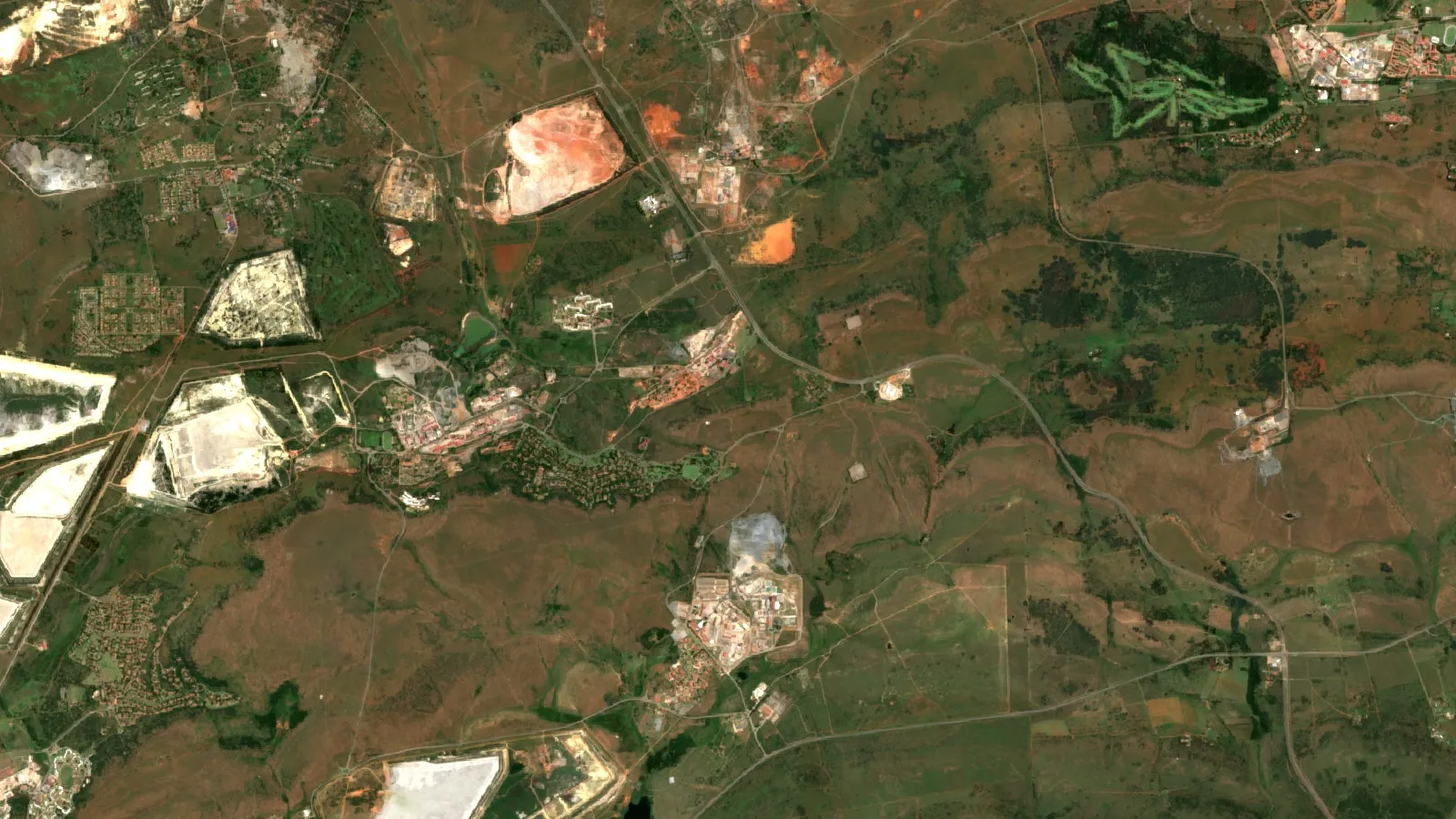
The satellite image at the top of this page shows the Carletonville area from space. The headframes, plants and pale tailings dams on the surface are the only visible sign of workings that run more than 3 km below.
Why the deepest gold mines are in South Africa
The reason is geology. The Witwatersrand gold occurs in thin conglomerate layers, called reefs, laid down in an ancient basin. The reefs dip downward away from where they first reached the surface near Johannesburg, and they stay continuous for kilometres. Miners followed them down for more than a century. Because the reefs are thin but rich and very continuous, it has paid to keep sinking shafts instead of switching to open pits.
Two more factors help:
- A manageable heat gradient: Gold Fields plans Witwatersrand cooling on rock temperature rising about 12°C per kilometre, a rate that refrigeration and ventilation can still handle at 3 km and more (see the heat section below).
- Large reserves still in the ground: the USGS estimates South Africa’s gold reserves at 5,000 tonnes, among the largest in the world, although mine output has fallen to about 90 tonnes in 2025 (USGS Mineral Commodity Summaries 2026, gold).
Most gold elsewhere comes from very different deposit styles, such as large low-grade open pits and shallow vein systems. Our guide to types of gold deposits explains how these differ, and our list of gold producing countries shows where output comes from today.
How deep are gold mines usually?
Most gold mines are far shallower than the Witwatersrand giants. Many of the world’s large gold mines are open pits, and most underground mines stop well short of the depths in this list. Only a handful of producing gold mines report working levels below 3 km, and in this ranking all of them are in South Africa except LaRonde in the Abitibi belt of Quebec.
Depth within one mine also varies. Moab Khotsong is a good example: Harmony gives its mining depth as a range from 1,791 m to 3,052 m, because different parts of the orebody sit at different depths. When you read a single “depth” for a mine, check whether it means the deepest shaft, the deepest working level, or the average mining depth.
For examples of active mines in the US, which are mostly open pits and shallower underground operations, see our page on active gold mines in the USA. You can also compare deep-mine depths with the copper and gold operations in our deepest copper and gold mines overview.
▶ How gold is mined and refined, step by step from rock to bar. · 5:27
Heat at depth: how hot is the rock?
Heat is the main limit on deep mining. Rock gets hotter with depth, and the temperature of undisturbed rock is called the virgin rock temperature. Gold Fields engineers, planning cooling at Kloof’s No. 4 Shaft (reached through shafts to some 3,287 m), used a design gradient of 15°C plus 12.2°C for every kilometre of depth (du Plessis, Scott and Moorcroft, Journal of the Mine Ventilation Society of South Africa, 2006). On that basis rock at 3.5 km is close to 58°C.
Chart
Virgin rock temperature rises with depth
°C, Gold Fields design gradient for Kloof No. 4 Shaft (15°C + 12.2°C per km)
The same paper sets the design reject wet-bulb temperature for stopes and development at 27.5°C. Wet-bulb temperature combines heat and humidity, and above this design limit the working place has to be cooled further or work stops. To stay below it, deep mines pump chilled water and air underground, use ice or refrigeration plants on surface and underground, and size ventilation shafts to move huge volumes of air. The Kloof No. 4 study estimated a total heat load of about 52.8 MW for that one shaft area.
The calculator below uses the same straight-line approach so you can estimate rock temperature for any depth and gradient. Change the gradient to suit another region: hotter crusts, such as many volcanic or younger mountain belts, have much steeper gradients.
Calculator
How hot is the rock at your mine depth?
Enter a depth and a temperature gradient to estimate virgin rock temperature.
- Same temperature in °F: 124.9
- Temperature rise from depth (°C): 36.6
Example values only, not a site measurement. Defaults use the Gold Fields design basis for Kloof No. 4 Shaft: 15°C plus 12.2°C per km (du Plessis et al., 2006). Gradients differ by region; use measured values for any design.
Engineering a mine more than 3 km deep
Getting people, rock, water and air up and down 3 km of shaft shapes every part of a deep mine.
Shafts and hoisting
Deep mines usually use more than one shaft in series. A main shaft from surface reaches a few kilometres, and a sub-shaft (a second vertical shaft started underground) carries mining deeper. Mponeng uses a main shaft supported by a sub-shaft, and LaRonde uses an 823 m internal shaft below its 2.2 km Penna Shaft. South Deep is unusual because its main shaft drops 2,998 m in a single run.
Ground control and rockbursts
At these depths the weight of the rock above creates very high stress. A rockburst is a sudden, violent failure of rock under that stress. Deep mines use mining layouts that leave pillars of rock, yielding support, and backfill to manage it. Harmony reports a lost-time injury frequency rate of 6.12 per million hours worked at Mponeng for FY2025, a reminder that safety is the daily focus of deep mining.
Mining method
Most deep Witwatersrand mines still use conventional narrow-reef stoping: drilling and blasting a thin reef that may be about a metre thick, with crews working in tight spaces. Mponeng mainly uses breast mining, a layout in which the face advances along the strike of the reef. South Deep is the exception: Gold Fields describes it as an underground mechanised mine using its own workforce, because its orebody is thicker.
Water, energy and land around deep mines
Deep mines use a lot of water and power, and both are now reported openly. For FY2025 Harmony reports these figures for Mponeng:
- Energy: 1.10 MWh per tonne treated.
- Greenhouse gas intensity: 1.15 t CO2e per tonne treated.
- Workforce: 6,087 people, of whom 4,753 are permanent employees and 1,334 are contractors.
On the surface, the main long-term issues are tailings dams and groundwater. Harmony says it has planted more than 6,000 trees at Mponeng to help manage a groundwater pollution plume. Old tailings are also a source of gold today: Harmony’s Savuka plant now only retreats tailings to recover gold left behind by earlier processing. Gold Fields reports its South Deep operation under the International Cyanide Management Code, an industry standard for cyanide safety (South Deep summary audit report, 2025).
▶ The seven main environmental impacts of mining, explained in clay animation. · 2:31
Will gold mines go deeper?
Some will. Harmony approved a life-extension project at Mponeng in February 2024, and Moab Khotsong and Mponeng both carry 19-year lives on Harmony’s figures. Kusasalethu, at 3,388 m, has only about three years left. The balance between grade, gold price and cooling cost decides how deep each mine can go.
What to check before trusting any “deepest mine” claim:
- Is the figure the shaft bottom, the deepest working level or a planned depth?
- Is the mine still producing, or is the record from closed workings?
- Is the source the operator’s own report, or a rounded press figure?
- Is depth measured below surface or below sea level? The Witwatersrand mines sit on the high Highveld plateau, so their depth below surface is much greater than their depth below sea level.
What deep mines mean for licence owners and investors
For a licence or claim owner, the main lesson from the deepest mines is that depth is affordable only with very rich, continuous ore and a large resource. Most new discoveries are found much closer to surface, from outcropping rock, soil geochemistry, geophysics and remote sensing, and then tested by drilling. Satellite imagery is useful at that early stage: it can map alteration minerals, iron oxides and structures across a licence before any drilling is planned. Farmonaut offers this kind of satellite mineral screening for licence areas, and you can request a quote for your own boundary.
Chart
Gold output of deep mines
Thousand troy ounces (koz); Harmony FY2025 (to June), LaRonde calendar 2025
For investors, depth is one input among many. The operator figures in this guide show how grade, output and remaining mine life differ even among neighbours in one basin. Read each company’s latest annual report and mineral reserve statement before drawing conclusions.

▶ How satellites help find gold by mapping alteration minerals and structures. · 4:25
Frequently asked questions
What is the deepest gold mine in the world?
Mponeng in South Africa. Harmony Gold states its mining depth as 3,160-3,740 m below surface (FY2025), deeper than any other gold mine that publishes a figure.
How deep is Mponeng in miles?
Its deepest stated mining depth of 3,740 m is about 2.3 miles below surface. Press reports often round this up to “about 4 km”.
Where is the deepest gold mine located?
Near Carletonville on the West Rand of Gauteng province, about 90 km south-west of Johannesburg, in the Witwatersrand Basin.
How deep are gold mines on average?
There is no single average. Many large gold mines are open pits, and most underground mines are far shallower than the deepest South African mines. Only a few producing gold mines, mostly in South Africa, report working levels below 3 km.
What is the deepest gold mine outside South Africa?
Among the mines in this guide it is LaRonde in Quebec, Canada, where Agnico Eagle says operations reach more than 3 km below surface.
Is TauTona still the second-deepest mine?
TauTona was long described that way in press reports. It was sold with Mponeng to Harmony Gold in 2020. Among operating gold mines with operator-published depths, Kusasalethu (3,388 m) and Driefontein (about 3,300 m) now follow Mponeng.
How hot is it at the bottom of the deepest gold mine?
Using the Gold Fields design gradient of 15°C plus 12.2°C per km, rock at about 3.7 km is close to 60°C. Cooling and ventilation keep working places below a design wet-bulb limit of 27.5°C.
Why do miners go so deep for gold?
Because the Witwatersrand reefs are rich and continue for kilometres down-dip. Mponeng’s ore grade of 11.27 g/t is many times that of typical open-pit gold ore, which pays for the cost of hoisting and cooling.
Is Mponeng the deepest mine of any kind?
Mponeng is also described by Harmony as the deepest mine in the world of any type.
Is the deepest gold mine still producing?
Yes. Mponeng produced 333,402 oz in FY2025, and Harmony guides 279,600-310,600 oz for FY2026.
More from Farmonaut: contact us, deepest gold mine locations worlds top 7 deep mines.
This page is for information only. It is not investment advice. Company figures are as published by each operator on the dates shown.
Farmonaut mining
Screen your own licence area from space
Request a quote for satellite mineral screening of your licence or claim boundary before you plan drilling.
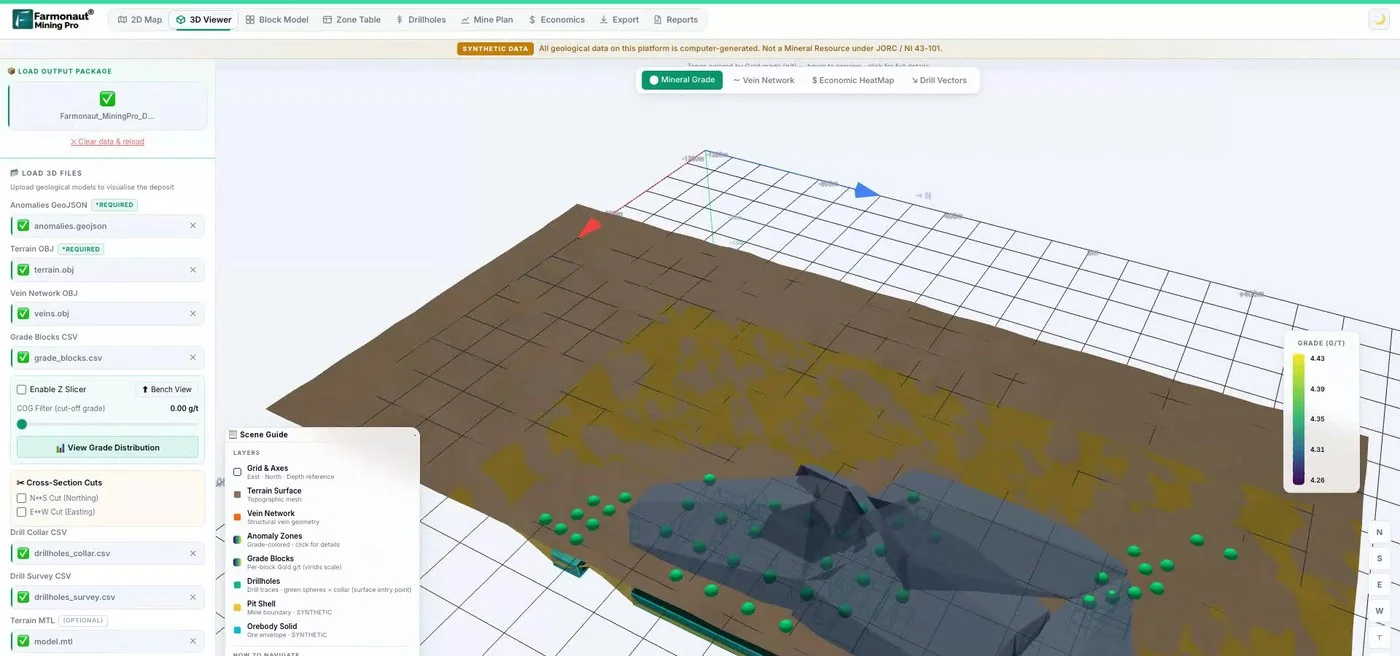
Mining Pro sample view, synthetic data
Keep reading
Sources
- Harmony Gold, Mponeng key facts and FY2025 performance: harmony.co.za
- Harmony Gold, Kusasalethu key facts (FY2025): harmony.co.za
- Harmony Gold, Moab Khotsong key facts (FY2025): harmony.co.za
- Harmony Gold, Savuka operation page: harmony.co.za
- Harmony Gold, acquisition of Mponeng and Mine Waste Solutions (February 2020): harmony.co.za
- Sibanye-Stillwater, Form 20-F for 2024 (SEC): sec.gov
- Gold Fields, South Deep technical report summary (SEC exhibit 96.1, 2025): sec.gov
- International Cyanide Management Code, Gold Fields South Deep summary audit report (2025): cyanidecode.org
- Agnico Eagle, LaRonde complex: agnicoeagle.com
- du Plessis, Scott and Moorcroft, Modern cooling strategies for ultra-deep hydropower mines (2006), University of Pretoria repository: repository.up.ac.za
- USGS, Mineral Commodity Summaries 2026: Gold: pubs.usgs.gov
Discussion
Questions, corrections or field experience? Share them below. First-time comments are reviewed before they appear, and your email is never published.
No comments yet. Be the first to add a question or your experience.

 Qader Group
 Ileys General Trading
 SG Gold Mining LLC
 VRV Global Pte Ltd
 Omsri International FZE
 G.I.T.T.
 Jaunita Erss Ltd
 Almosi SARL
 SRK Consulting
 Berks Gold Limited
 Mwerezi Minerals Company Limited
 Mining SARL
 SenGold Invest SAS
 Sean Mining Limited
 NTS Group (Pty) Ltd
 Mine4Africa
 Lithspo Minerals Limited
 Tintina Mining Group

 Licence holder · Nigeria · Gold + lithium










