

Underground mining · Methods explained
Animation for Mining Methods: 8 Underground Methods
Eight underground methods, from room and pillar to block caving, explained scene by scene as an animation should show them, with published cost per tonne (Kliche, 2017) and US coal data (EIA, 2025).
Key takeaways
- Underground methods fall into three families: supported (cut and fill), self-supported (room and pillar, stoping) and caving (sublevel caving, block caving, longwall).
- In a CostMine-based estimate in 2010 US dollars, operating cost ranged from about US$68/t for cut and fill to about US$9/t for block caving (Kliche, 2017).
- Longwall mines produced about 112.8 million short tons in 2024, 55% of US underground coal, at 4.54 short tons per employee hour against 2.79 for continuous mining (EIA, 2025).
- New US underground miners must receive at least 40 hours of training before work duties (30 CFR 48.5); animations help them picture the mine.
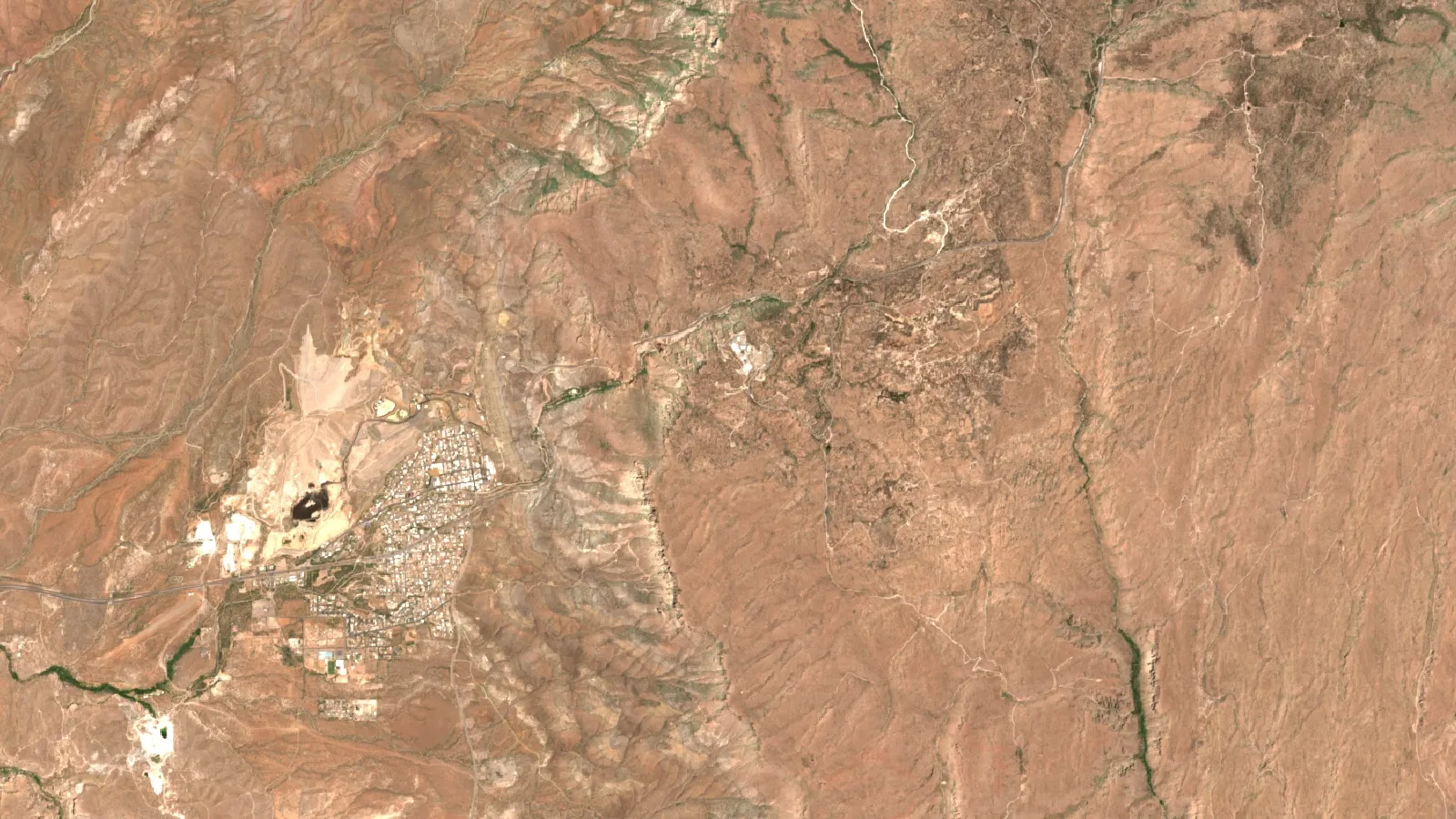
- The Resolution Copper FEIS says panel caving would create a surface crater 800 to 1,115 feet deep and about 1.8 miles across.
In this article
- Underground mining methods at a glance
- The underground methods, animated step by step
- What each method costs per tonne
- Longwall and room and pillar in US coal mines
- Top 7 uses of 3D animation of underground mining
- How a mining method animation is made
- How to brief a 3D mining animation expert
- Limits of animations in mine planning
- Frequently asked questions
An animation for mining methods shows, step by step, how ore is reached, broken, supported and hauled out of the ground. For underground mines it usually covers eight main methods: room and pillar, longwall, cut and fill, shrinkage stoping, sublevel (longhole) stoping, vertical crater retreat, sublevel caving and block or panel caving. The best 3D animations also show the reason a method was chosen: the shape, dip and strength of the ore body and the rock around it.
This guide explains what each method looks like in motion, what an animation of it should include, what each one costs per tonne in a published industry estimate, and how mine teams use 3D animation of underground mining for training, planning, permits and investor talks. It is written for mining consultants and engineers who brief animators or use animations in reports.
Underground mining methods at a glance
Every underground method answers the same question: how do you take ore out while keeping the opening stable? Methods split into three families. Supported methods (cut and fill) put waste or paste back into the void. Self-supported or open methods (room and pillar, sublevel stoping, shrinkage) leave rock pillars or rely on strong walls. Caving methods (sublevel caving, block caving, longwall in coal) let the rock above collapse on purpose.
A short note on terms used below. Ore body is the mass of rock that carries enough metal or coal to mine at a profit. Dip is how steeply it tilts from horizontal. A stope is the opening where ore is broken. Grade is the amount of metal per tonne of rock, often in grams per tonne (g/t) for gold or per cent for copper. Cut-off grade is the lowest grade that still pays to mine.
| Method | Ore body it suits | How the opening is held | What the animation must show |
|---|---|---|---|
| Room and pillar | Flat or gently dipping seams and beds (coal, salt, potash, some limestone and lead-zinc) | Pillars of unmined rock, roof bolts | The grid of rooms, pillar size, the continuous miner cycle |
| Longwall | Flat, even coal seams over large areas | Moving hydraulic shields; roof caves behind them | Shearer passes, shields advancing, the goaf caving behind |
| Cut and fill | Steep or irregular veins, weak walls, high grade | Backfill placed after each slice | Slice by slice mining, fill placement, ramp access |
| Shrinkage stoping | Steep, narrow veins with strong ore and walls | Broken ore left in the stope as a working floor | Miners working on the muck pile, ore drawn from below |
| Sublevel (longhole) stoping | Steep, thick, regular bodies with strong rock | Strong walls; stopes later filled or left open | Fan or ring drilling, blasting into the open stope, remote loading |
| Vertical crater retreat | Steep, strong ore bodies | Strong walls | Large-diameter holes, crater blasts lifting up from the bottom |
| Sublevel caving | Steep, large bodies; walls that cave | Hanging wall caves into the void | Ring blasting under the caved waste, dilution at the draw point |
| Block or panel caving | Very large, deep, lower-grade bodies (porphyry copper) | Gravity; the ore body collapses under its own weight | Undercut, draw bells, the cave growing upward, surface subsidence |
The suitability column follows the selection table in a technical memorandum on alternative mining methods prepared for the Resolution Copper review (Kliche, 2017), which rates each method by ore strength, wall strength, dip and ore body shape. For a primer on how ore body shape comes about, see our guide to types of ore deposits.
The underground methods, animated step by step
Below, each method is described the way a good animation sequence would show it, scene by scene. Use these as a storyboard checklist when you brief a studio or review a draft.
Room and pillar mining animation
The camera starts above a flat seam. Openings (“rooms”) are cut in a grid, leaving square or rectangular pillars that hold the roof. In coal, a continuous miner cuts the face, a shuttle car or conveyor carries coal away, and a roof bolter installs bolts before the next cut. The key scene is the pillar: how big it must be for the depth, and whether pillars are partly taken on retreat at the end of the panel. In the United States, continuous mining (the room and pillar machine set) produced about 92.8 million short tons of underground coal in 2024 (EIA Annual Coal Report, 2025).
Longwall mining animation
A longwall panel is a block of coal often several kilometres long, outlined first by room and pillar entries. A shearer runs back and forth along the face, cutting a strip each pass onto an armoured face conveyor. A row of hydraulic shields holds the roof over the crew and steps forward after each pass. Behind the shields the roof caves into the mined-out space, called the goaf or gob. An animation should show this cave and the surface subsidence that follows, because that is what landowners and regulators ask about. Longwall mines produced about 112.8 million short tons in 2024, 55% of US underground coal output (EIA, 2025).
Cut and fill mining animation
Miners take the ore in horizontal slices, usually working upward. After each slice is blasted and mucked out, the space is filled with waste rock, sand or cemented paste. The fill becomes the floor for the next slice and supports the walls. Mechanised versions use a ramp so loaders and drill rigs drive in. Show the cycle (drill, blast, muck, bolt, fill) and the fill curing time, because that time sets the pace of the mine.
Shrinkage stoping animation
Ore is mined upward, but only part of the broken rock is drawn out after each blast, because broken rock takes up more space than solid rock. The rest stays in the stope as a platform for miners. When the stope reaches the top, the remaining ore is drawn out. It suits narrow, steep veins with strong rock. An animation makes the odd logic clear: miners stand on the ore they are mining.
Sublevel stoping animation
Horizontal drifts (sublevels) are driven at set heights through a steep ore body. From these, long holes are drilled in fans or rings and blasted into an open void, and the broken ore falls to draw points at the bottom, where loaders, often remote-controlled, pick it up. Stopes can be filled later so the next one beside it can be mined. Key scenes: the drill pattern, the slot raise that opens the first void, and why nobody enters the open stope.
Vertical crater retreat animation
A variant of longhole stoping. Large-diameter holes are drilled from a top level to an undercut below. Charges near the bottom of the holes blast horizontal slices that “crater” downward into the void, and the face retreats upward slice by slice. Show charge placement and the order of blasts.
Sublevel caving animation
Ore is drilled and blasted in rings from sublevel drifts, working from the hanging wall toward the footwall and from top to bottom. The broken ore is drawn while waste rock from the caved roof follows it down. The animation must show dilution: as drawing continues, more waste mixes in, and the loader operator stops at a set grade.
Block caving and panel caving animation
Block caving is the largest-scale underground method. A horizontal slot (the undercut) is blasted under the ore body. With its support removed, the ore breaks and collapses under its own weight, and the broken rock funnels into draw bells and draw points on an extraction level below, where loaders carry it to crushers. Rio Tinto describes the method at Oyu Tolgoi in Mongolia, where the underground mine is planned to have about 200 kilometres of tunnels and ore reaches the surface by shaft or a 13.2 km conveyor (Rio Tinto, 2026). Panel caving opens the undercut in strips (panels) rather than all at once. Freeport-McMoRan runs the Grasberg Block Cave in Indonesia, mining the same ore body once worked from the Grasberg open pit (Freeport, 2026).
A block cave animation must show the cave front climbing over years, the draw schedule that keeps it even, and, where it reaches the surface, the subsidence zone. That last scene is the one communities ask about most.
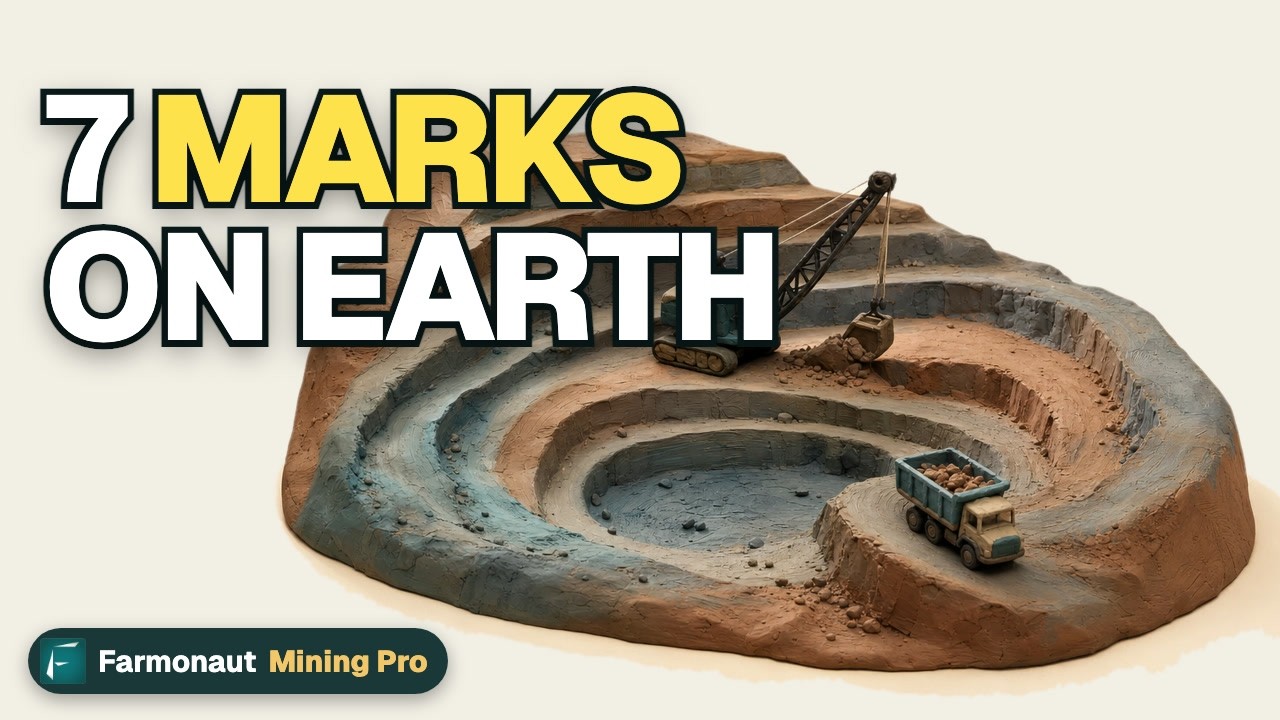
▶ The seven main environmental impacts of mining, explained in clay animation. · 2:31
What each method costs per tonne
Method choice drives cost more than almost anything else, and an animation that shows why a method was chosen should show this too. The Kliche memorandum reprints an estimate built from the CostMine Mining Cost Service for a shaft-access underground mine, in 2010 US dollars. Operating cost fell from about US$68 per tonne for cut and fill at 1,000 tonnes per day to about US$9 per tonne for block caving at 30,000 tonnes per day. The memo adds that a selective method such as cut and fill can cost 20 or more times as much per tonne as block caving, depending on the comparison used (Kliche, 2017).
Chart
Mine size against capital cost
Production rate (t/day) vs capital (US$ million, 2010)
Chart
Operating cost by underground mining method
US$ per tonne of ore, 2010 dollars, model shaft-access mines
These are old, model-mine figures, not quotes. Prices for labour, power, steel and explosives have risen since 2010, so use them to compare methods with each other, not to budget a project.
Capital cost moves the other way. In the same table, block caving at 30,000 tonnes per day needed about US$164 million of capital against about US$33 million for a 1,000 tonne per day cut and fill mine. Caving takes years of development before the first ore is drawn, which is why it suits only very large deposits.
Calculator
How much would two mining methods cost per year?
Enter your daily ore rate and the cost per tonne of two methods.
- Method A yearly operating cost (US$): $13,314,000
- Method B yearly operating cost (US$): $47,621,000
- Ore mined per year (tonnes): 700,000
Example values only, not a benchmark. Defaults are the 2010-dollar CostMine-based figures reprinted by Kliche (2017): US$19.02/t sublevel longhole and US$68.03/t cut and fill. The cost index is an input for escalating old figures; use your own current estimate.
Longwall and room and pillar in US coal mines
US coal gives the clearest public data on how two underground methods compare in practice. In 2024 the country had 177 producing underground coal mines, which produced about 206.2 million short tons, against 305.8 million short tons from 339 surface mines (EIA, 2025). EIA notes that surface mining is often used when coal lies less than 200 feet down, because it is cheaper than underground mining.
Chart
Underground coal productivity by method, 2024
Short tons per employee hour
Chart
US underground coal output by method, 2024
Million short tons
Within underground coal, longwall mines produced about 4.54 short tons per employee hour in 2024, against 2.79 for continuous (room and pillar) mines (EIA, 2025). That gap is the reason longwalls are used wherever a seam is flat, thick and continuous enough. An animation that puts the two side by side shows why: the shearer cuts the whole face while shields keep the crew covered, while a continuous miner works one room at a time.
Top 7 uses of 3D animation of underground mining
Animations are not just marketing videos. These are the seven uses that matter most to mine owners, consultants and regulators.
1. Training new underground miners
US federal rules require each new underground miner to receive at least 40 hours of training before being assigned to work (30 CFR 48.5). MSHA states that all miners must get basic and annual refresher training under an approved plan (MSHA, Training and Education). Animations of the mine’s own method, escapeways and ground support help new staff picture a place they have never seen before their first shift.
2. Showing the mining sequence
Stope order, fill timing and cave draw schedules are hard to follow on plans. A 4D animation (3D plus time) built from the mine schedule shows which stope is mined when, and where the risks of instability or dilution sit. Engineers use it to spot clashes before they happen.
3. Ventilation and escape planning
Air flow paths, doors, stoppings and escape routes are easier to check when animated. In US coal mines, ventilation plans and controls are set by 30 CFR Part 75, Subpart D. An animation can show how air reaches each working face and what changes when a door is left open.
4. Ground control and support
Showing how bolts, mesh, shotcrete, pillars or shields hold the rock helps crews understand why the support standard matters. For caving and longwall mines, showing the planned cave is the core of the safety story. Our article on mine safety solutions covers related tools.
5. Permits and community meetings
Subsidence is easier to discuss with a picture. For Resolution Copper in Arizona, the US Forest Service’s final environmental impact statement says panel caving would start a surface crater in year 6 of mining, reaching between 800 and 1,115 feet deep and about 1.8 miles across (Resolution Copper FEIS, Vol. 1). An honest animation of that kind of change, made from the engineering model, helps people see the real scale.
6. Investor and lender presentations
Investors rarely visit underground. A short animation of the ore body, access, method and plant explains the project far faster than a section drawing. Keep it tied to the reported study: show the same tonnages, the same mine plan and the same stage of study, and label what is still conceptual.
7. Comparing method options early
At the scoping stage, short animations of two or three candidate methods help teams compare access, development metres, dilution and surface effect. The Kliche memo did this in writing for Resolution, rating each method against the deposit before concluding that block caving or a variant was the only feasible option for that ore body (Kliche, 2017).
How a mining method animation is made
Good animations start from engineering data, not from artwork. The usual inputs are the geological or block model, the mine design (drifts, ramps, shafts, stopes), the schedule and the equipment list. A block model divides the deposit into small cubes, each with an estimated grade and rock type; if that term is new, the video in this section explains it. Drill core and assays sit underneath the model, as our guide to core samples explains.
Infographic
From mine data to animation in 5 steps
- 1Collect dataBlock model, mine design, schedule and equipment list.
- 2Build the sceneConvert CAD and model files into a 3D scene at true scale.
- 3Add the sequenceTime stopes, fill, cave draw or longwall passes to the schedule.
- 4Engineer reviewA mining engineer checks scale, support and safety in every scene.
- 5Label and releaseMark conceptual parts, add version and date, then publish.
The studio converts these files into a 3D scene, adds machines and people at true scale, and then times the sequence to the schedule. The review step matters most: a mining engineer should check every scene for scale, support, direction of mining and safety practice. A common fault is a machine shown far larger or smaller than the drift it drives in, or crews standing under unsupported ground.
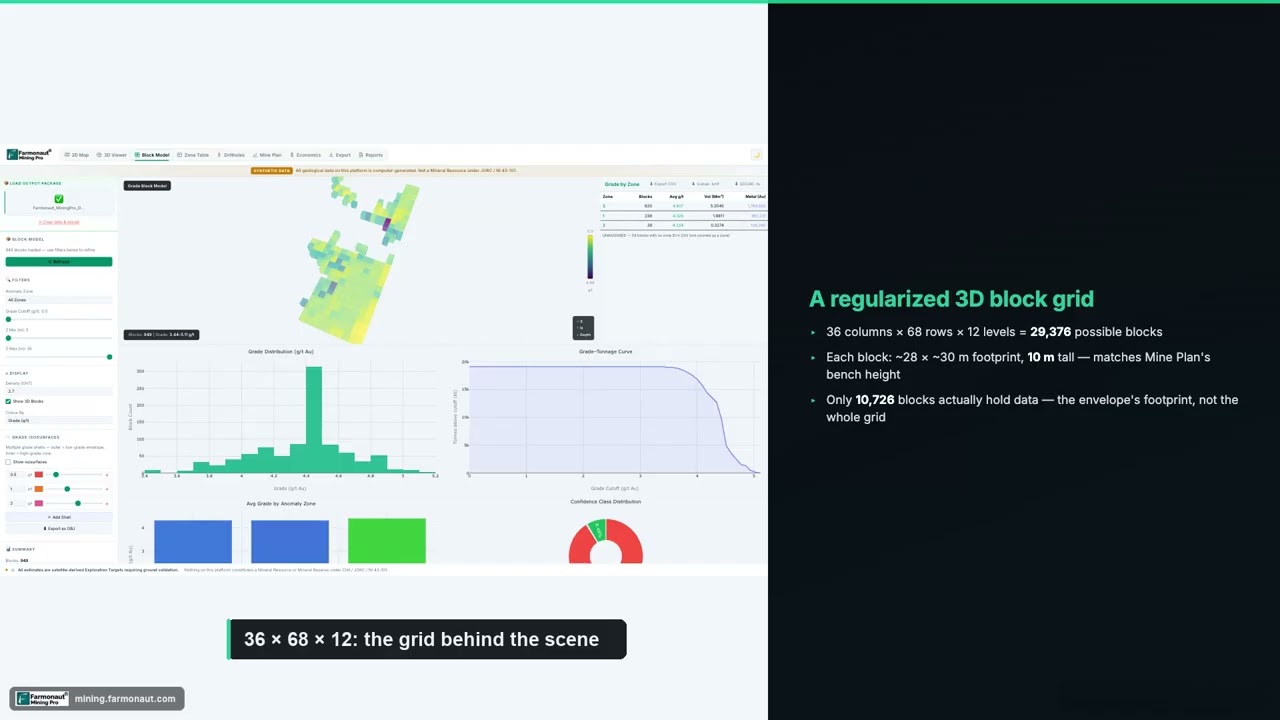
▶ What a block model is and how it feeds mine design. · 5:23
How to brief a 3D mining animation expert
Whether you hire a studio or use in-house staff, a tight brief saves rework. Include these points:
- Audience and use: induction training, a community meeting, an investor deck or an internal planning review. Each needs a different length and level of detail.
- Method and variant: for example mechanised cut and fill with paste fill, or panel caving with a specific draw point layout.
- Source data: the mine design in DXF or another CAD format, the block model, the schedule and equipment specifications.
- Scale and accuracy: state which elements must be true to scale and which can be simplified.
- Safety review: name the engineer who signs off each scene against the mine’s own standards.
- Labelling: mark conceptual or planned elements as such, so the animation is never read as a promise.
- Format: video length, resolution, narration language, and whether an interactive 3D walkthrough or VR version is needed.
Before an underground plan exists, the first question is still where the ore body sits. At that stage, satellite and terrain data can map alteration and structure across a licence; Farmonaut provides this kind of satellite screening as an input to targeting, ahead of drilling and any mine design. Project owners can describe their licence through the mining query form or contact the team.
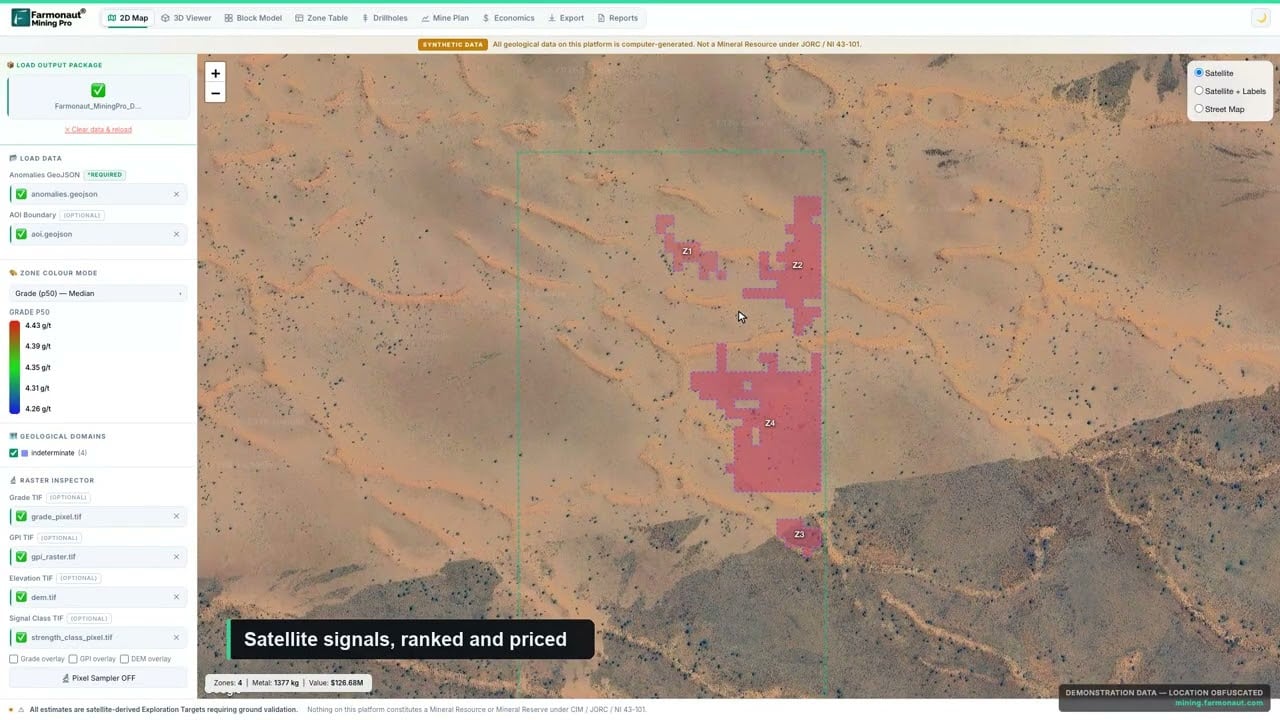
▶ What Farmonaut Mining Pro does, including its 3D views of target zones. · 4:56
Limits of animations in mine planning
An animation is a picture of a plan, not proof that the plan works. It does not replace rock mechanics calculations, ventilation modelling, geotechnical drilling or a feasibility study. It can also mislead if it is cleaner than reality: no water, no breakdowns, perfect cave draw. Treat it as a communication tool, check it against the engineering, and keep the version and date on screen so old animations are not reused after the plan changes. For how method choice feeds into margins, see our overview of mining profitability.
Frequently asked questions
What are the main underground mining methods?
The main methods are room and pillar, longwall, cut and fill, shrinkage stoping, sublevel (longhole) stoping, vertical crater retreat, sublevel caving and block or panel caving. They fall into supported, self-supported and caving groups.
Where can I watch an animation of underground mining methods?
Equipment makers, mining companies and universities publish animations on their own sites and video channels. Rio Tinto, for example, explains block caving at Oyu Tolgoi on its operation page. Check that any animation shows the method you need and true-to-scale equipment.
What does a longwall mining animation show?
It shows a shearer cutting along a long coal face, hydraulic shields advancing to protect the crew, coal carried away by conveyor, and the roof caving into the goaf behind the shields.
What is the cheapest underground mining method per tonne?
In the CostMine-based estimate reprinted by Kliche (2017), block caving had the lowest operating cost, about US$9 per tonne in 2010 dollars, but it needs a very large ore body and the highest capital.
Which underground method suits a steep, narrow gold vein?
Cut and fill and shrinkage stoping are common for steep, narrow veins; longhole stoping is used where the vein is wide and the walls are strong. The right choice depends on rock strength, grade and width.
What is the difference between block caving and panel caving?
Both rely on the ore collapsing under its own weight. Panel caving opens the undercut in strips across the deposit over time, while classic block caving undercuts a whole block.
How long should a mining method animation be?
For training and community meetings, short clips of one to three minutes per method work well; planning reviews may use longer 4D animations tied to the schedule. Match length to the audience.
What files does a 3D mining animator need?
Usually the mine design (drifts, stopes, shafts) in CAD format, the block model, the production schedule and equipment specifications. Photos of the real equipment and site help with accuracy.
Can an animation replace a mine plan or feasibility study?
No. It illustrates a plan. Engineering studies, geotechnical work and permits decide whether the plan is safe and economic.
Why do underground mines cause surface subsidence?
When rock is removed and not backfilled, the ground above can sag or collapse into the void. Caving methods and longwall mining cause it by design; filled stopes and large pillars limit it.
This page is for information only. Cost figures are historical model estimates, not quotes.
Farmonaut mining
Map your mining site from space
Before an underground plan exists, screen your licence for alteration and structure to decide where drilling should start.

Mining Pro sample view, synthetic data
Keep reading
Sources
- Kliche, Technical Memorandum for Alternative Mining Methods, Resolution Copper (2017): resolutionmineeis.us
- US Forest Service, Resolution Copper Final EIS, Volume 1: resolutionmineeis.us
- US EIA, Annual Coal Report 2024 (2025): eia.gov
- US EIA, Coal explained: mining and transportation: eia.gov
- eCFR, 30 CFR 48.5 Training of new miners: ecfr.gov
- eCFR, 30 CFR Part 75 Subpart D Ventilation: ecfr.gov
- MSHA, Training and Education: msha.gov
- MSHA, Fatality Reports: msha.gov
- Rio Tinto, Oyu Tolgoi operation page: riotinto.com
- Freeport-McMoRan, Indonesia operations (Grasberg): fcx.com
Discussion
Questions, corrections or field experience? Share them below. First-time comments are reviewed before they appear, and your email is never published.
No comments yet. Be the first to add a question or your experience.

 Geoticgy
 GemSprout Metals Limited
 Qader Group
 Ileys General Trading
 SG Gold Mining LLC
 VRV Global Pte Ltd
 Omsri International FZE
 G.I.T.T.
 Jaunita Erss Ltd
 Almosi SARL
 SRK Consulting
 Berks Gold Limited
 Mwerezi Minerals Company Limited
 Mining SARL
 SenGold Invest SAS
 Sean Mining Limited
 NTS Group (Pty) Ltd
 Mine4Africa
 Lithspo Minerals Limited

 Client · Oregon, USA · Gold










