
Mining finance · Guide
What Is a Bankable Feasibility Study? Parts and Steps
A bankable feasibility study is a feasibility study built for lenders. The SEC and the JORC Code both treat “bankable” as equivalent to a feasibility study. This guide shows the parts, the steps and real 2026 study figures.
Key takeaways
- The SEC (17 CFR 229.1300) and the JORC Code 2012 both say “bankable” and “definitive” feasibility study mean a feasibility study; the label signals it is built for lenders.
- A scoping study cannot support an Ore Reserve; JORC requires at least a pre-feasibility study (JORC Code 2012).
- Horizon Gold’s Gum Creek study (ASX, 22 July 2026) states cost accuracy of plus or minus 10% to 15% and pre-production capital of A$350.4 million, of which A$30.4 million is contingency.
- Liberty Gold’s Black Pine study (8 September 2026) shows after-tax NPV of US$1.2 billion to US$4.3 billion across US$2,500 to US$4,500 per ounce gold cases.
- Lenders normally hire an independent engineer to audit the study, as at Kwale in Kenya (SRK).
In this article
- What a bankable feasibility study means in mining
- Bankable, definitive or full: the same study under different names
- Where the bankable study sits among scoping, pre-feasibility and feasibility
- What the study must contain
- What the capital cost of a real study looks like
- How a bankable feasibility study is built, step by step
- Price sensitivity: how to read the NPV and IRR in a study
- Risk, sensitivity and the P10, P50, P90 numbers
- Market and revenue certainty
- Environmental and social due diligence
- Permitting, land access and governance
- How lenders review the study
- Initial capital versus sustaining capital
- Limits of the study
A bankable feasibility study is the final technical and economic study of a mining project, written to a standard that a bank or other financier can lend against. It is not a separate class of study: the US Securities and Exchange Commission says that terms such as full, final, comprehensive, bankable or definitive feasibility study are all equivalent to a feasibility study (17 CFR 229.1300), and the JORC Code says the same about the words “bankable” and “definitive” (JORC Code 2012, clause 40). This page explains what the study contains, how it differs from the earlier studies, what a real one looks like in numbers, and what lenders do with it.
It is written for licence and claim owners who want to know what a buyer or lender will ask for, for consultants who prepare or review studies, and for investors who read the headline figures in company announcements. It covers hard-rock mining projects only. It is general information, not advice on any project.
What a bankable feasibility study means in mining
The JORC Code defines a feasibility study as a comprehensive technical and economic study of the selected development option for a mineral project. It includes detailed assessments of the “Modifying Factors” (the mining, processing, metallurgical, infrastructure, economic, marketing, legal, environmental, social and government inputs that turn a mineral resource into something that can be mined at a profit) plus a detailed financial analysis. The result must be good enough to serve as the basis for a final decision by the project owner or a financial institution to proceed with, or finance, the project (JORC Code 2012). The US rule adds that the study must contain mining, infrastructure and process designs completed with enough rigour to support an investment decision or project financing.
In plain words, the study answers one question: if we spend this much capital and run the mine this way, will it make money at a price we can defend, and has someone independent checked the work? A “bankable” label signals that the answer is aimed at lenders. A Lexpert article on the topic (15 October 2026) notes that the phrase is a commercial label and is not separately defined in Canada’s NI 43-101 disclosure rules.
Bankable, definitive or full: the same study under different names
You will see four names for the same stage of work: feasibility study (FS), definitive feasibility study (DFS), bankable feasibility study (BFS) and, in some company reports, “final” or “full” feasibility study. Australian company reports often use DFS or BFS, and the JORC Code notes that these terms are equivalent to a feasibility study.
The difference is mostly purpose and audience. Lexpert describes a definitive study as prepared mainly for internal decisions such as board approval and capital allocation, and a bankable study as prepared for external review that must stand up to lenders, investors and their advisers, usually with a full independent audit. That is a practitioner view, not a legal one. Under the rules, what matters is that the study meets the definition of a feasibility study and that a qualified person or competent person signs it. In the United States, the registrant must obtain a dated and signed technical report summary from the qualified person (17 CFR 229.1302).
Where the bankable study sits among scoping, pre-feasibility and feasibility
Mining projects move through a ladder of studies. Each rung costs more, uses more drilling and engineering, and narrows the range of error on the cost estimate.
- Scoping study (preliminary economic assessment): an order-of-magnitude look at whether the project could be viable. The JORC Code states that a scoping study must not be used as the basis for an Ore Reserve estimate. An Ore Reserve is the part of a resource that has been shown to be economic to mine after applying the Modifying Factors.
- Pre-feasibility study (PFS): compares options and settles the preferred mining method and processing route. JORC requires at least a pre-feasibility study before an Ore Reserve is reported.
- Feasibility study (bankable, definitive): locks the chosen design and cost to a level that supports a final investment decision and financing. Its confidence level is higher than the pre-feasibility study.
Lexpert quotes cost accuracy of about plus 40% to minus 25% for a scoping study, about plus or minus 25% to 30% for a pre-feasibility study and about plus or minus 10% for a feasibility study. Published studies state their own figures. The Horizon Gold definitive study for the Gum Creek project in Western Australia (22 July 2026) says its capital and operating costs are estimated to the standard of an AusIMM Class 3 estimate, with an overall accuracy of plus or minus 10% to 15% (Horizon Gold, ASX announcement). So the range you are offered depends on the study, and the stated accuracy is the number to read first.
The same company shows how long the climb can take. Horizon completed its scoping study in March 2024 and announced the definitive study in July 2026, a little over two years later, with a final investment decision targeted for the second quarter of 2027. Chalice Mining shows the step after a pre-feasibility study: it finished the pre-feasibility study for its Gonneville palladium-nickel-copper project in December 2025 and by April 2026 had started the feasibility study, planning an 8-week continuous pilot of the full process flowsheet as the final de-risking step for the study and project financiers (Chalice Mining, ASX quarterly report, 30 April 2026). For readers who want the earlier rungs in detail, see our guide to the pre-feasibility study in mining.
What the study must contain
Every lender and regulator has its own checklist, but the content is similar everywhere. Nine parts carry most of the weight.
1. Project definition and scope
The study states where the project is, what it will produce, how many tonnes a year, which technology it will use and when. It lists the land, water, power, labour and supply arrangements the plan relies on. A lender reads this section to see that the project boundary is clear and that nothing is left to be settled later.
2. Mineral resource, Ore Reserve and mine design
The resource model and Ore Reserve are the base of every revenue forecast. The Horizon study rests on a maiden Ore Reserve of 18.2 million tonnes at 1.24 grams per tonne (g/t) gold for 728,000 ounces, a 2.4 million tonne a year process plant and an open-pit mine plan. Its announcement also shows how the base is split: the production target is underpinned by 76% Probable Ore Reserve ounces, 18% Indicated Mineral Resource ounces and 6% Inferred Mineral Resource ounces. A lender looks at that split because Inferred material has the lowest geological confidence. The JORC resource table guide and our page on NI 43-101 technical reports explain how to read these categories.
3. Metallurgy and process design
Test work on the ore sets the recovery (the share of metal that ends up in the product) and the plant flowsheet. Studies commonly add a pilot plant or large variability testing before the final design is fixed, as in the Chalice example above.
4. Capital cost (capex)
Capex is the money spent before and after first production to build and maintain the mine. Initial or pre-production capex is the bill to reach first production. Sustaining capex keeps the operation running. A good study breaks capex into work packages and shows the contingency, which is the allowance for what the estimate cannot yet see.
5. Operating cost (opex)
Opex covers labour, power, consumables, maintenance and logistics per tonne mined or milled. Studies often summarise it as all-in sustaining cost (AISC) per ounce for gold, which adds sustaining capital and site overheads to the cash cost of production.
6. Financial model
The model turns production, price and cost into cash flow. The headline outputs are net present value (NPV, the value of future cash flows discounted to today at a stated rate), internal rate of return (IRR, the discount rate at which NPV is zero) and payback (the time to recover the initial capital). A bankable study also shows debt service, tax and royalties, because lenders need to see that loan repayments are covered.
7. Market, price and revenue assumptions
Every study must say which price it assumes and why, and how the product will be sold. Gold has a deep market, while a specialty metal or battery material may need offtake agreements before a lender will commit.
8. Environmental, social and permitting work
The study summarises baseline surveys, impact assessments, water and tailings plans, the closure plan and its cost, community engagement and the permit path with dates.
9. Execution plan and risk register
The last part sets out the build schedule, procurement, owner’s team, commissioning and a ranked list of risks with actions. It is where a lender checks that the plan can be delivered, not only that the rock is good.
What the capital cost of a real study looks like
Numbers make the nine parts concrete. The Horizon Gold definitive study puts pre-production capital at A$350.4 million, including A$30.4 million of contingency. Two items, the process plant and the non-process infrastructure such as power, water, roads and camp, make up about three-quarters of the total. Contingency is about 9% of the bill. The study also carries A$62.9 million of sustaining capital after first gold. All figures come from the company’s own announcement (22 July 2026) and are in Australian dollars.
Chart
Where the pre-production capital goes in one definitive study
Gum Creek gold project pre-production capital by area, A$ million (total A$350.4 million)
The study’s economics are stated pre-tax: a net present value at a 5% discount rate of A$1,307 million and an IRR of 53.1% at a gold price of A$5,500 per ounce, an AISC of A$2,995 per ounce, and a payback of 23 months from first production. These headline numbers depend on the price assumption, which is why the next sections show how to read them.
How a bankable feasibility study is built, step by step
The order below is how most studies are run. Real projects loop back, for example when drilling changes the pit shell and the cost model has to be redone.
Infographic
The study in six stages
- 1Fix scope and standardReporting code, accuracy target and qualified persons.
- 2Close resource and reserveDrill, then convert to Ore Reserve.
- 3Test and engineerMetallurgy, mine, plant and tailings design.
- 4Cost and modelCapex, opex, price cases and sensitivities.
- 5Independent reviewA lender’s engineer audits the study.
- 6Permit and decideApprovals, financing and investment decision.
- Fix the scope and the standard. Decide the reporting code (JORC, NI 43-101 or S-K 1300), the target accuracy and who the qualified persons are.
- Close the resource and reserve. Finish the drilling needed to move material into Measured and Indicated categories, then convert it to Ore Reserve using cut-off grade, dilution and recovery. The cut-off grade is the lowest grade that still pays for mining and processing.
- Complete test work and engineering. Metallurgical testing, geotechnical work, pit or underground design, plant layout, tailings and water design.
- Estimate cost. Vendor quotes and first-principles estimates for capex and opex, with a stated accuracy and contingency.
- Build the model and test it. Cash-flow model, price cases, tax and royalty, debt terms and sensitivities.
- Get independent review. A lender’s engineer or other independent expert audits the study. See the section on lenders below.
- Permit and decide. Submit approvals, close the financing and take the final investment decision.
Price sensitivity: how to read the NPV and IRR in a study
A single NPV tells you very little until you see what price produced it. Strong studies show a base case and at least two other price cases. The Liberty Gold feasibility study for the Black Pine oxide gold project in Idaho (8 September 2026) is a clear example. Its base case uses US$3,250 per ounce and gives an after-tax NPV at 5% of US$2.4 billion and an IRR of 60%. At US$4,500 per ounce the NPV is US$4.3 billion and the IRR 104%. At US$2,500 per ounce the NPV falls to US$1.2 billion and the IRR to 33%. The study is for a 16-year, open-pit, run-of-mine heap-leach mine with initial capital of US$411.4 million (Liberty Gold news release, 8 September 2026).
Chart
Project value moves a lot with the gold price case
Black Pine after-tax NPV at 5% discount rate, US$ billion, by gold price case (US$ per ounce)
Two points are worth noticing. The mineral reserve in that study is stated at a different, lower price (US$2,250 per ounce for the cut-off grade) than the economic base case, because the reserve pit design used a gold price of US$2,250 per ounce, while the economic cases start at US$2,500. And the case that matters most to a lender is often the low-price case, because debt has to be repaid even when prices fall.
The calculator below lets you test a simple version with your own inputs. It estimates simple payback and capital intensity. It is a screening check, not a financial model, and it ignores timing, working capital and financing.
Calculator
What is the simple payback of your project case?
Enter figures from a study or your own case.
- Annual after-tax margin (US$): $225,000,000
- Capital per annual ounce (US$): $2,000
Example values only, not a benchmark and not a forecast. Price and cost are inputs: example, use today’s price. Amounts in US$. Simple payback ignores timing, working capital, tax timing and financing.
Risk, sensitivity and the P10, P50, P90 numbers
A study should list the risks that could move the result and test them one at a time. Typical sensitivities are metal price, grade, recovery, capex, opex and schedule delay. Some studies go further and run a Monte Carlo simulation, which draws thousands of random combinations of these inputs to produce a range of outcomes, often quoted as P10, P50 and P90. P50 is the middle outcome; P90 is the figure that is exceeded nine times out of ten. Be careful with the labels: in satellite grade mapping, P10 to P90 can also describe the spread of pixel grades inside one zone, which is a different thing from a financial simulation.
When you read a study, check three things. First, are the sensitivities shown for the inputs that drive the result? Second, are the ranges plausible compared with what the project has actually measured? Third, does the study say what happens to the debt at the low case?
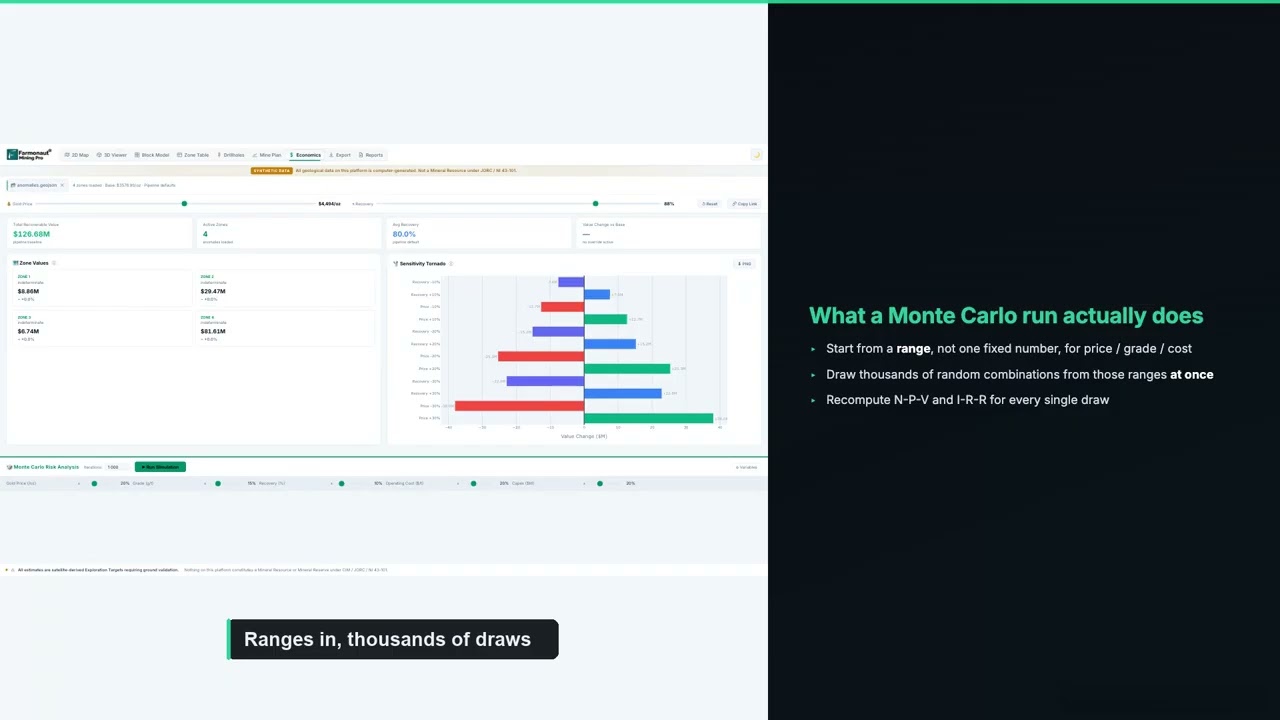
▶ Explains how a Monte Carlo P10, P50 and P90 range across price, grade and cost differs from pixel-grade spread. · 14:59
Market and revenue certainty
Revenue is price times payable metal, less the costs of selling it. The study should explain how the price assumption was set (spot, consensus forecast or a lender’s price deck), what the terms are for any smelter or refinery charges, and whether offtake contracts or streaming agreements are in place. For metals sold in a thin market, lenders often ask for signed offtake before they commit. For gold, the market is deep and the price case itself is the main assumption. Always check the date on a price: a figure from a study completed twelve months ago may not match today’s price.
Environmental and social due diligence
This part of the study covers more than a list of permits. It sets out baseline conditions, expected impacts on water, air, land and biodiversity, the mitigation plan, the closure plan with a cost and the way the company will engage with local communities and Indigenous groups. Lenders apply their own standards. In the Kwale heavy mineral sands project in Kenya, the lenders’ independent engineer reviewed the feasibility study across technical, environmental, social and economic areas and assessed the project against the Equator Principles, a risk-management framework used by financial institutions (SRK, Kwale independent engineer).
The closure cost is worth reading in any study. Black Pine carries US$160.1 million of closure cost in its life-of-mine capital of US$825.5 million, about a fifth of the total, and it appears in the study rather than being left for later.
Permitting, land access and governance
A study can be technically complete and still not be buildable if the permits, land and title are not in place. Liberty Gold notes that the Black Pine study does not replace the mine plan of operations used for the permit applications under review by regulators. Horizon targets a final investment decision in the second quarter of 2027 with the approvals process on track. So a bankable study usually comes before the last permit, but it should show the path and the timing.
Land access is the other check. A deposit can sit under a town, a protected area or someone else’s surface rights. Check the surface ownership, the mineral title, any overlapping licences and the cost of resettlement or compensation before you accept any production schedule. For licence owners this check belongs at the start of the study, not the end.
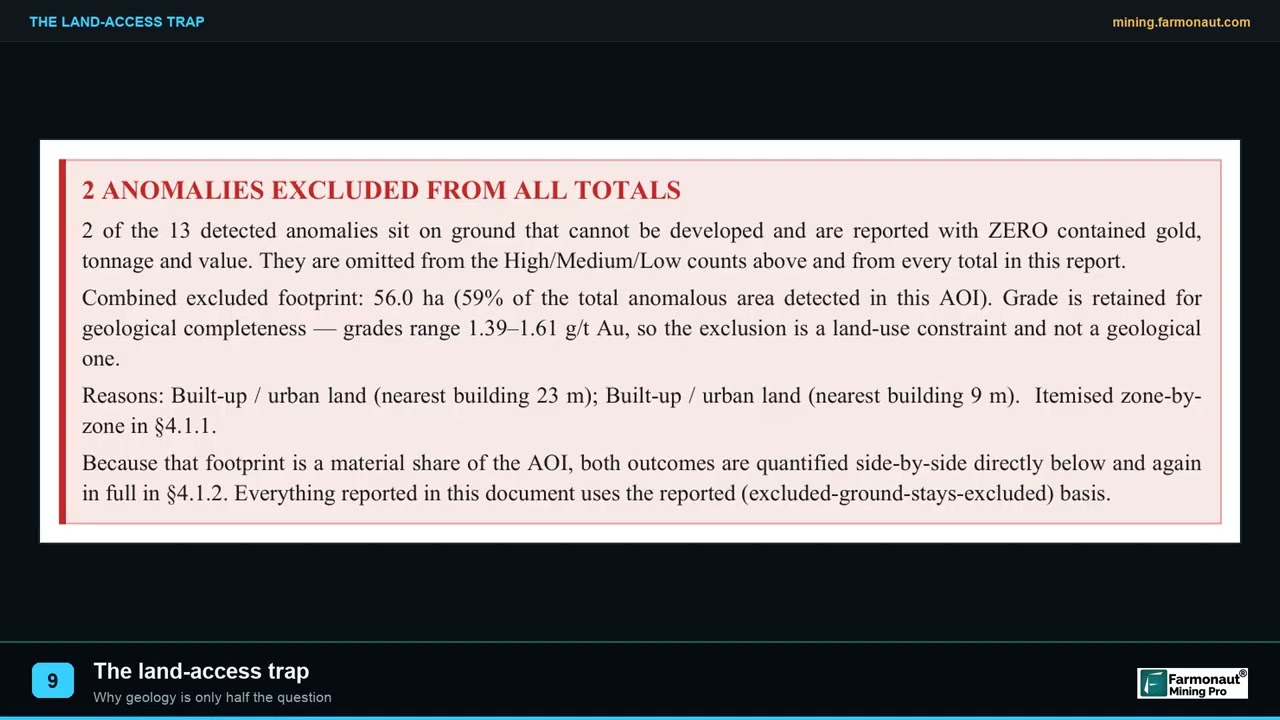
▶ Shows a survey where good rock could not be mined because the land above it was blocked. · 2:05
How lenders review the study
A bank does not take the study on trust. It hires its own independent engineer to audit it. At Kwale, SRK was engaged in early 2011 by potential lenders as independent engineer. It carried out a multi-disciplinary review of the technical, environmental, social and economic aspects of the feasibility study and issued a due diligence audit report to the lenders. Lexpert states that a bankable study is generally subject to a full independent audit and that independence of the authors and verifiable evidence for every cost, resource and market figure are what separate a study that survives lender review from one that does not.
Lenders usually look for these things:
- A resource and reserve estimate signed by an independent qualified person or competent person.
- A cost estimate at a stated accuracy, with contingency set by risk rather than as a flat figure.
- A financial model that still covers debt service at a low price case.
- A permit path, a closure plan with a cost and clear land and title rights.
- A realistic schedule and an owner’s team able to deliver it.
Requirements differ between lenders, so ask the lender’s technical adviser for its scope of work before you start the study, not after.
Initial capital versus sustaining capital
One trap in reading studies is to look only at the initial capital, which is the number in the headline. The Black Pine study separates three areas. The process plant is mostly an initial cost. The heap leach facility and the mine fleet are spent in both periods, and the heap leach facility costs more in sustaining capital (US$140.2 million) than initially (US$87.0 million). Total capital over the life of the mine is US$825.5 million, about double the initial US$411.4 million. If a lender or investor compares two projects on initial capital alone, the one with a staged build can look cheaper than it is.
Chart
Initial and sustaining capital differ by area
Black Pine capital cost by area, US$ million (closure of US$160.1 million not shown)
Limits of the study
A completed study is not a guarantee. It is an estimate made at one point in time with a stated accuracy. Costs can rise between studies. Prices move after the study is dated. An Ore Reserve can change with more drilling. The study also does not replace the permits, the financing or the build.
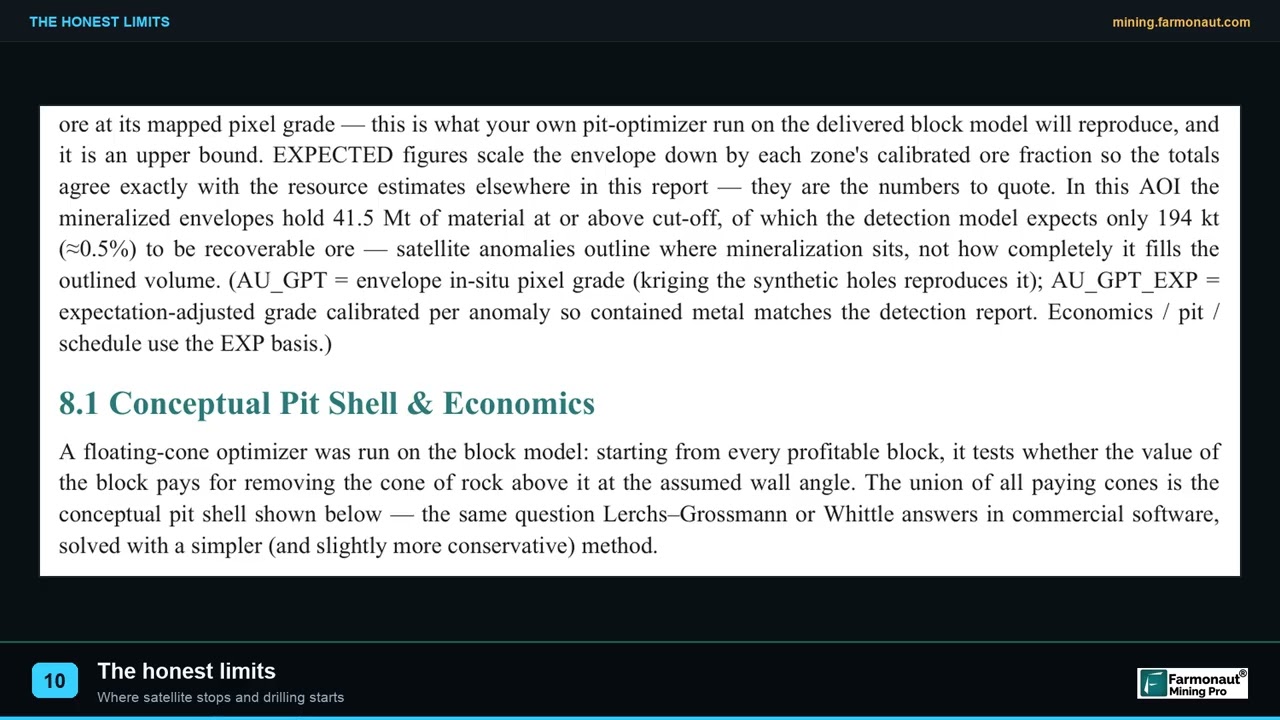
The study also depends on what came before it. If the drilling is thin, the resource model will be uncertain no matter how carefully the later steps are done. Satellite and remote-sensing work is an early-stage tool: it can screen ground and rank targets before drilling, but it does not replace drilling, resource estimation or any step of a feasibility study. Farmonaut satellite mineral detection reports give exploration targets only; they are not a resource estimate or a feasibility study under JORC or NI 43-101. Licence owners can use them to decide where to drill first, and a satellite-based mineral detection report can be requested through the mining quote form. If you are weighing who could carry a project through the studies, see our guide to mine development companies, or contact our team with questions about mapping a licence area.
Listed companies named on this page are examples of public study disclosures. Nothing here is investment advice.
▶ Covers the three limits of satellite exploration that matter in mining due diligence. · 2:08
Frequently asked questions
What is a bankable feasibility study?
It is a feasibility study prepared to a level of detail and independence that lenders can use to decide whether to finance a mine. Under the US SEC rule and the JORC Code, “bankable” is treated as equivalent to a feasibility study, so the content is the same as any full feasibility study, with an emphasis on audit and independence.
What is the difference between a bankable and a definitive feasibility study?
The rules treat them as the same stage. In practice, a definitive study is often prepared for the company’s own investment decision, while a bankable study is built for lender review and is usually independently audited, according to Lexpert.
What does a bankable feasibility study mining report include?
Project definition, resource and Ore Reserve, mine design, metallurgy and process design, capital and operating costs, the financial model, market and price assumptions, environmental and social work, permitting, and an execution plan with risks. The nine parts above cover each.
How accurate is a bankable feasibility study?
Horizon Gold’s study states plus or minus 10% to 15% for capital and operating costs, an AusIMM Class 3 estimate. Lexpert quotes about plus or minus 10% for a feasibility study. Always read the accuracy the study itself states.
How is it different from a pre-feasibility study?
A pre-feasibility study compares options and picks a preferred one. A feasibility study fixes the design and cost in detail and has a higher confidence level. Both can support an Ore Reserve under the JORC Code; a scoping study cannot.
How long does a bankable feasibility study take?
It varies by project. Horizon Gold finished its scoping study in March 2024 and announced its definitive study in July 2026. Chalice Mining began its feasibility study in the months after finishing its pre-feasibility study in December 2025 and planned an 8-week pilot plant for the second half of 2026.
How much does a bankable feasibility study cost?
Companies rarely publish the cost of the study itself, so there is no single figure to quote. What they do publish is the project capital the study estimates, such as A$350.4 million initial capital for Gum Creek and US$411.4 million for Black Pine. Ask consultants for a scope-based quote.
Who prepares and signs the study?
An engineering firm normally leads, with specialist consultants for resource, geotechnical, metallurgical, environmental and financial work. In the Black Pine study, M3 Engineering prepared the feasibility study and the qualified persons for the reserve and resource were independent of the company. A qualified person or competent person signs the technical content.
Is a bankable feasibility study required to get a loan?
Lenders need a study they can rely on and normally an independent review of it. The exact requirement is set by each lender, so ask the lender’s technical adviser.
Can I use a satellite report instead of a feasibility study?
No. Satellite reports are early exploration tools that screen ground and rank targets. They do not estimate resources, reserves, costs or economics.
What happens after the study?
The owner completes permits, arranges finance and takes a final investment decision. Horizon Gold, for example, targets that decision in the second quarter of 2027.
This page is for information only. It is not investment advice and not legal advice. Companies named are examples of public study disclosures. Confirm reporting rules with the relevant regulator.
Farmonaut mining
Screen your licence before the studies start
Request a quote to have your licence area mapped from satellite data and rank exploration targets before you commit to drilling.
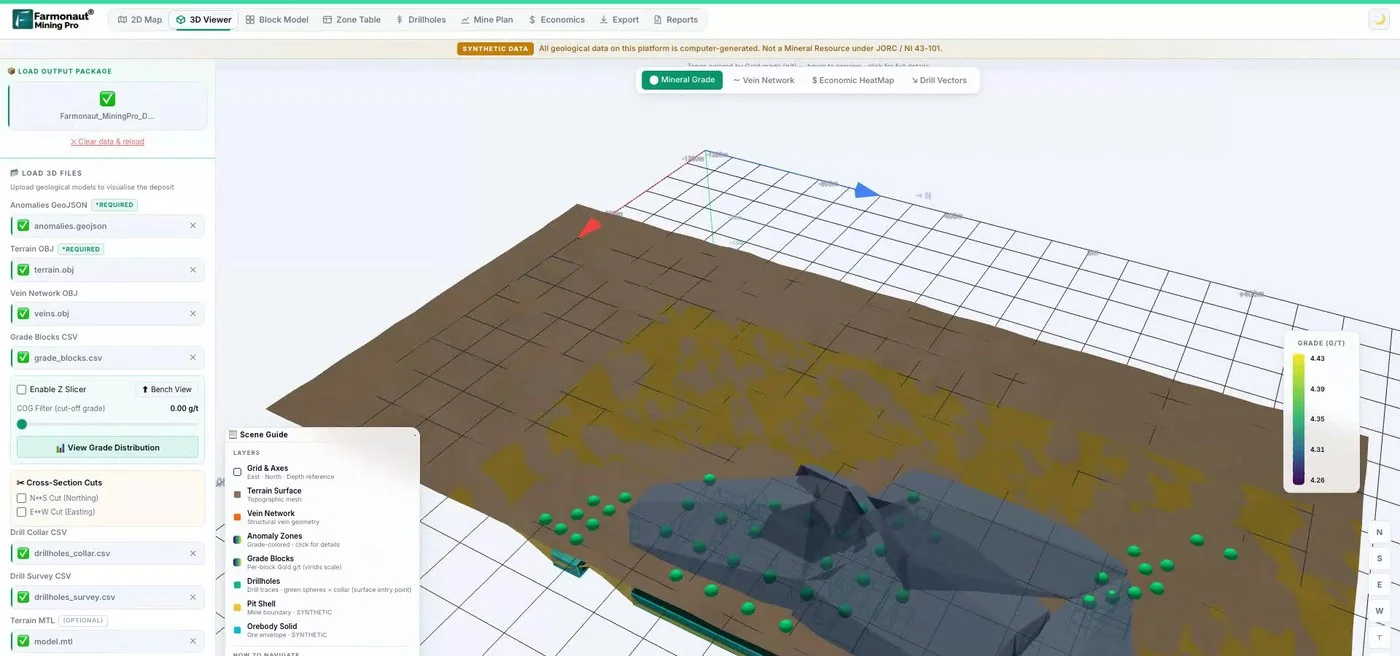
Mining Pro sample view, synthetic data
Keep reading
Sources
- US eCFR, 17 CFR 229.1300 definitions: ecfr.gov
- US LII, 17 CFR 229.1302 qualified person and technical report summary: law.cornell.edu
- JORC Code 2012, clauses 37 to 40: jorc.org
- Horizon Gold, Gum Creek Open Pit DFS (ASX, 22 July 2026): announcements.asx.com.au
- Liberty Gold, Black Pine Feasibility Study (8 September 2026): bnnbloomberg.ca
- Chalice Mining, March 2026 quarterly report (ASX): announcements.asx.com.au
- SRK, Independent engineer at Kwale Mineral Sands: srk.com
- Lexpert, Bankable feasibility study: how mines get financed (15 October 2026): lexpert.ca
- Cornell LII, 17 CFR 229.1300 (mirror): law.cornell.edu
- Farmonaut, Pre-feasibility study in mining: farmonaut.com
Discussion
Questions, corrections or field experience? Share them below. First-time comments are reviewed before they appear, and your email is never published.
No comments yet. Be the first to add a question or your experience.

 Timestream Mining
 Lithspo Minerals Limited
 Tintina Mining Group
 Dalgety Minerals Pty Ltd
 Vortex Minerals Pty Ltd
 Faith At Work (Pty) Ltd
 Geotech Mining Solutions plc
 Vulcan International Limited
 Kidepo Associates
 GKY Mining
 Alkimy SARL
 Double A Trading
 GemSprout Metals Limited
 Qader Group
 Ileys General Trading
 SG Gold Mining LLC
 VRV Global Pte Ltd
 Omsri International FZE
 G.I.T.T.
 Jaunita Erss Ltd
 Almosi SARL
 SRK Consulting
 Berks Gold Limited
 Mwerezi Minerals Company Limited

 Exploration consultancy · South Africa · Gold